Should you buy a CHEAP projector in 2026?
November 19, 2026It’s 2026, and for the last six years every November I buy every projector on Amazon priced under $100 to help you sift through the deceptive marketing and occasional flat out lies on their listings. But despite my best efforts, year after year some of the worst performing projectors, like these two pieces of junk, still become best sellers.
In this video we’ve got 19 new projectors and we’re going to actually test their brightness and contrast. Then, we’ll put them side by side in a picture quality test. Next, we’ll narrow it down and do more in-depth testing of the best ones to figure out which ones might actually be decent. As always, there are no sponsored reviews on this channel, and I bought all these projectors with my own money.
Brightness Testing
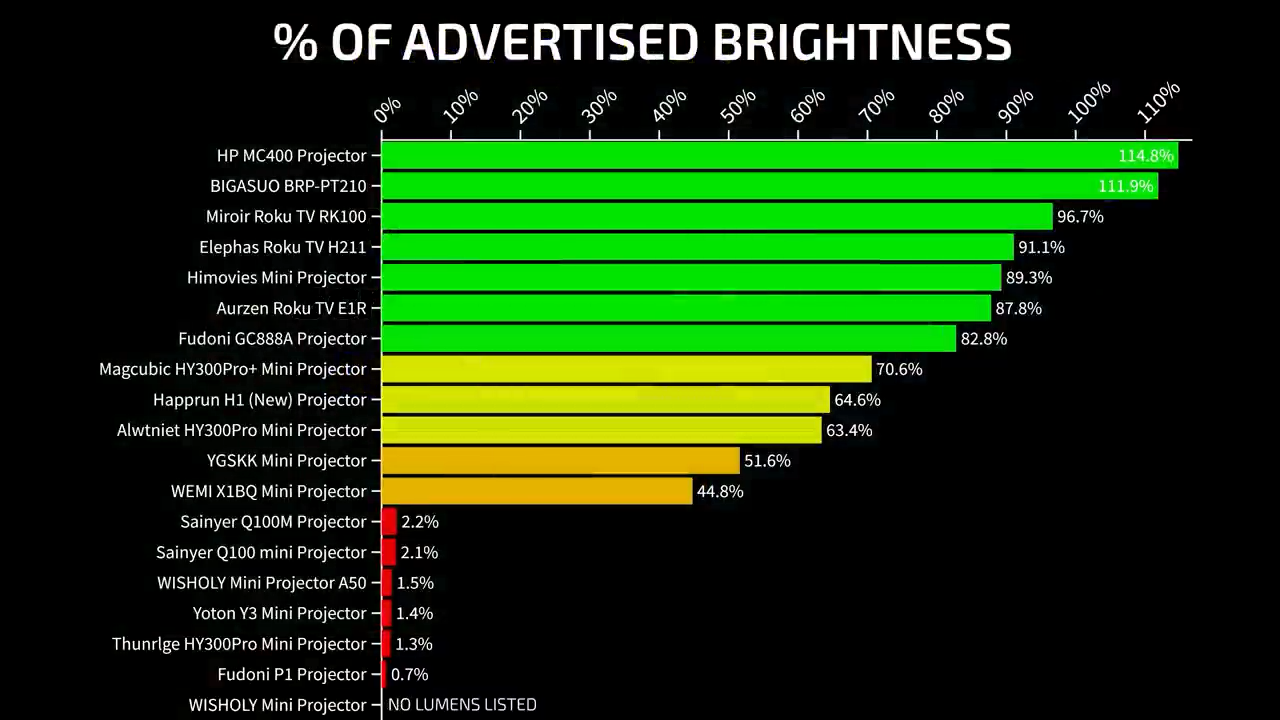
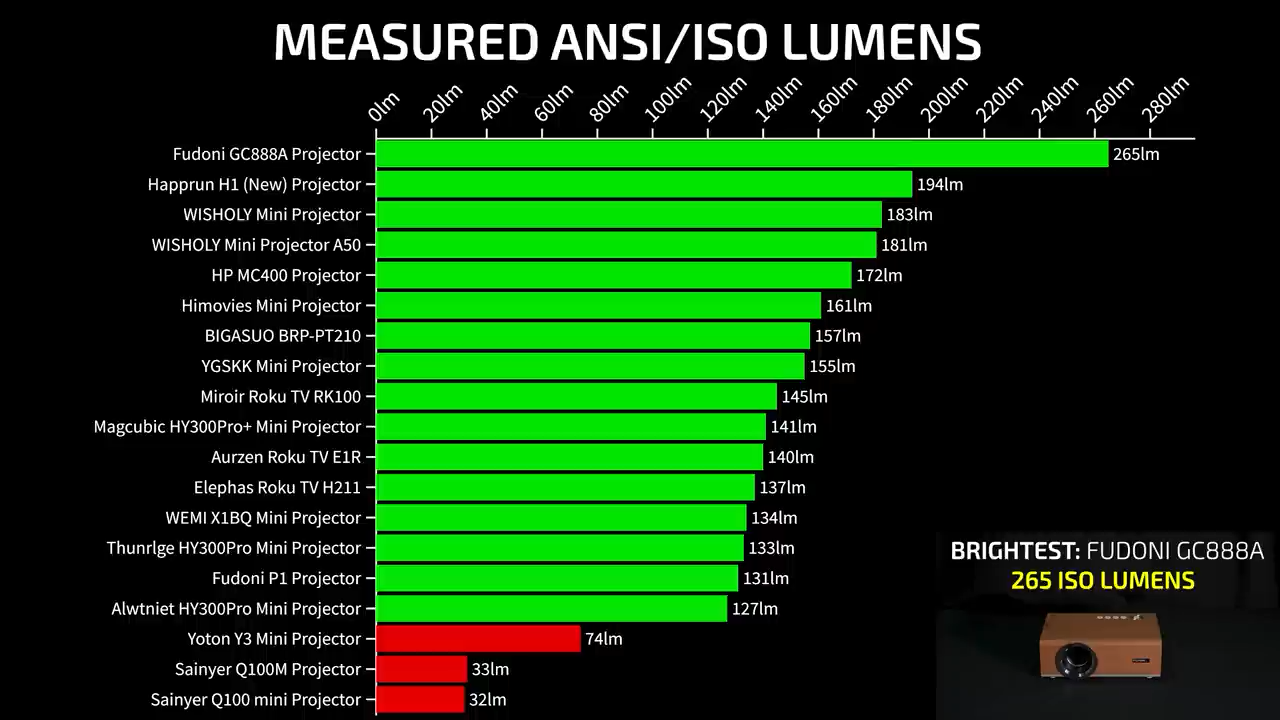
Starting with brightness, after six years of calling them out, some Amazon listings still list outrageous brightness values like 18,000 lumens for these cheap projectors. So I tested each projector using the ANSI/ISO standard where you take nine individual brightness readings and multiply the average brightness by the screen size in square meters. This year, it was encouraging to see that 7 of the 19 projectors were within 20% of their advertised brightness, which is the threshold that ISO allows, and it’s also encouraging to see that most of the projectors had over 100 lumens, which is kind of the minimum threshold for brightness to have a watchable image.
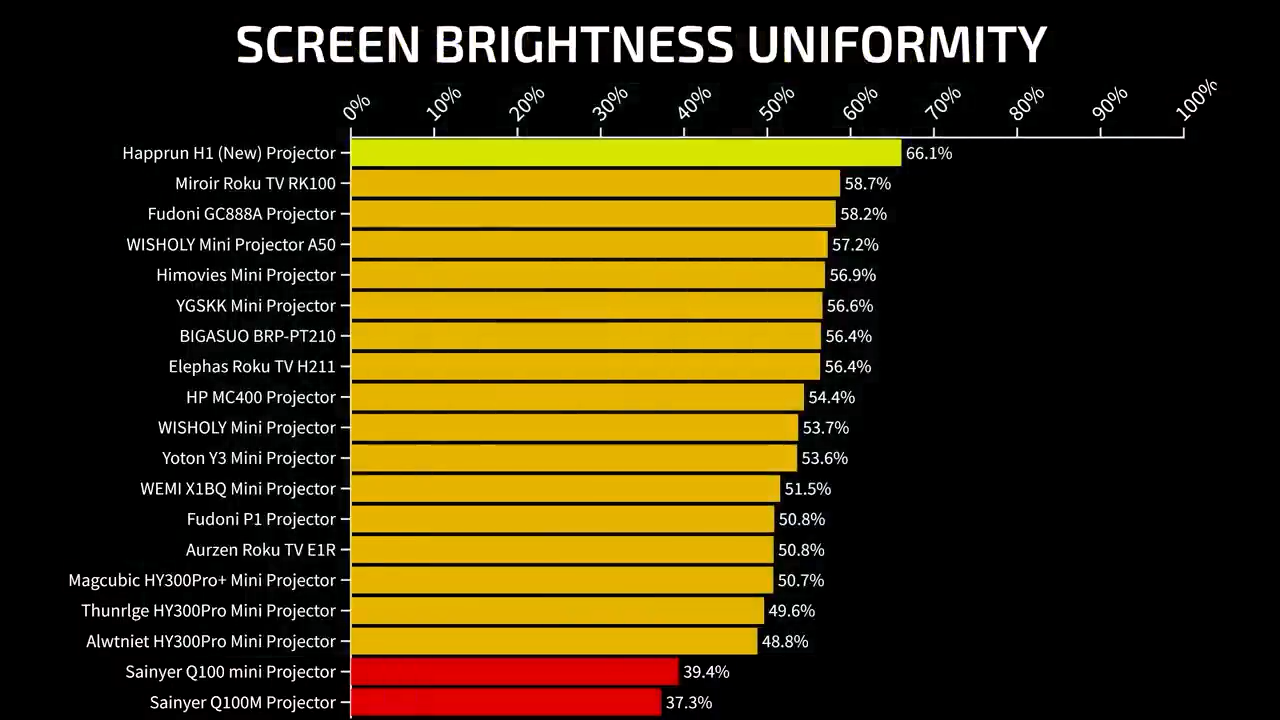
Using the ISO standard also lets us calculate brightness uniformity which is the difference between the brightest and dimmest portions of the screen when projecting a full white image. Overall, uniformity was pretty bad compared to more premium projectors but the Happrun H1 stood out as the best with 66% uniformity and the two super dim projectors from Sainyer were both under 40%.
Contrast Testing
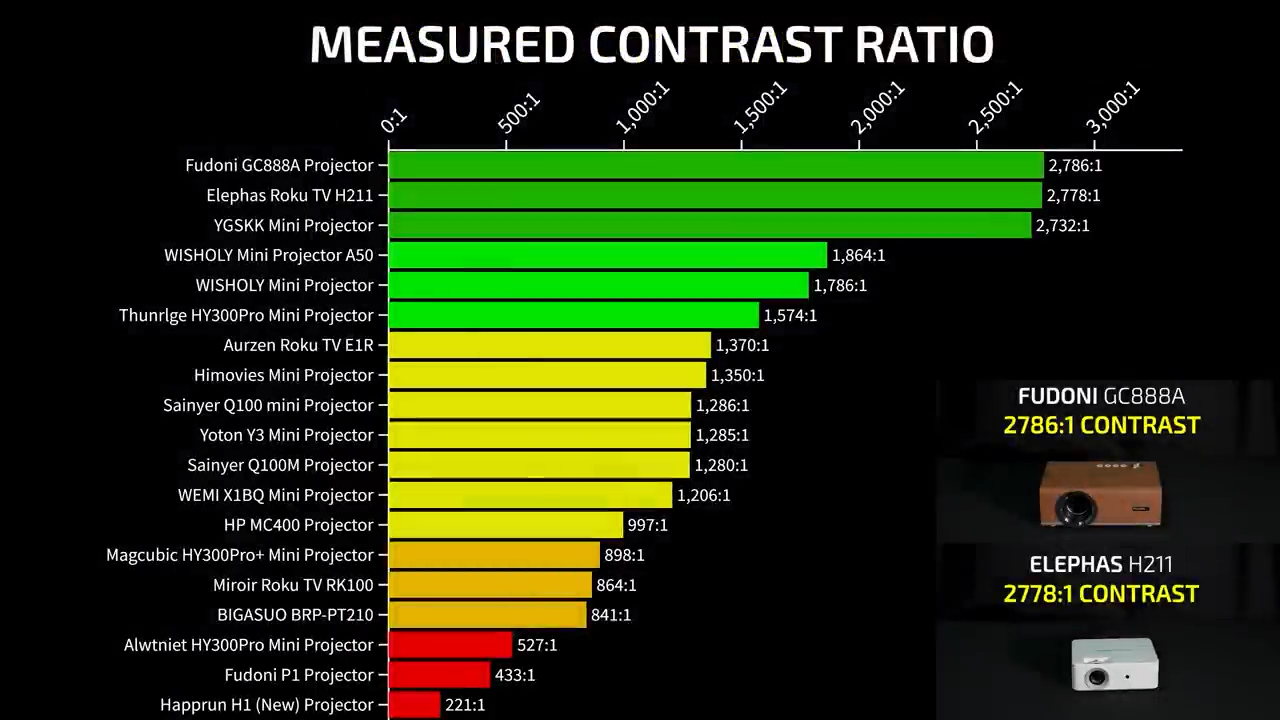
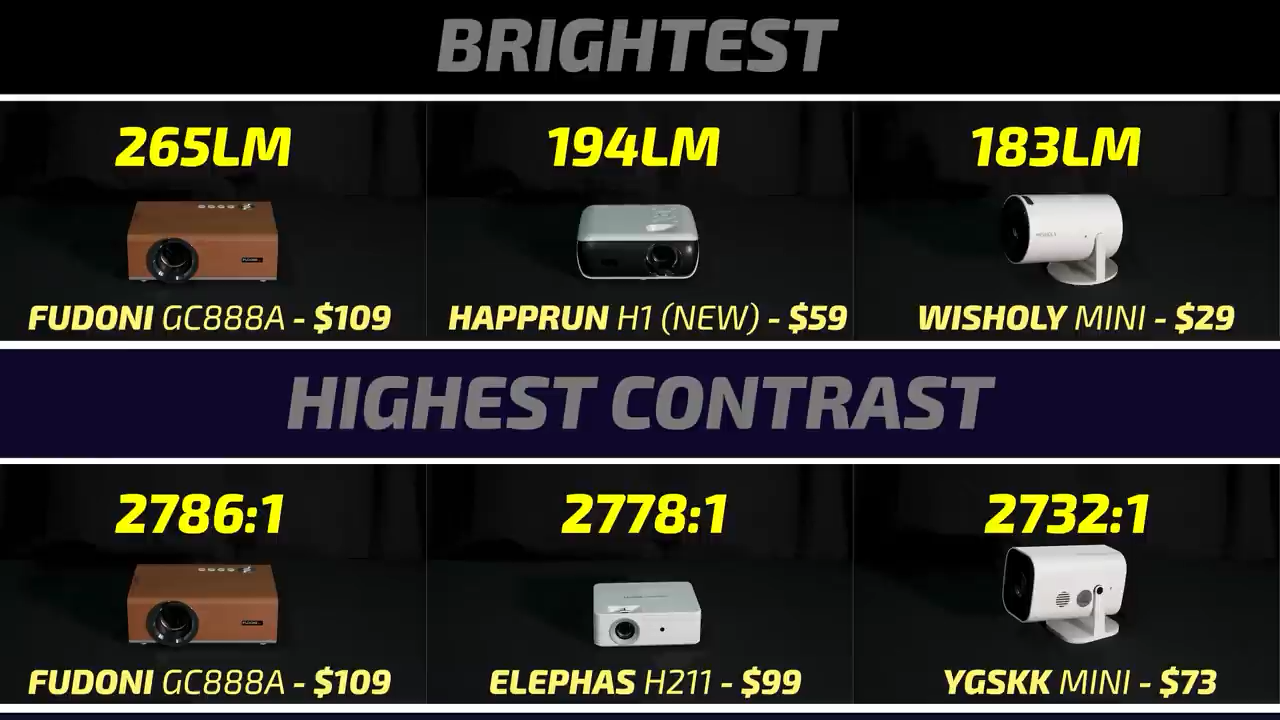
The contrast ratio is the difference between the brightness of a full white screen and a full black screen and the Fudoni GC888A and Elephas H211 came out on top with around 2800:1 contrast and the Happrun H1 was at the bottom with 10% of that at 221:1. Because this only uses a center point measurement, it doesn’t show that some projectors like the WISHOLY A50 have blue internal reflections on a full black screen which significantly reduces contrast in those areas.
While brightness and contrast do have a huge impact on image quality, the only way to really know for sure is to test the projectors head-to-head. So I set up two 100” screens and connected each projector to a Fire TV Max streaming stick.
Head-to-Head Testing
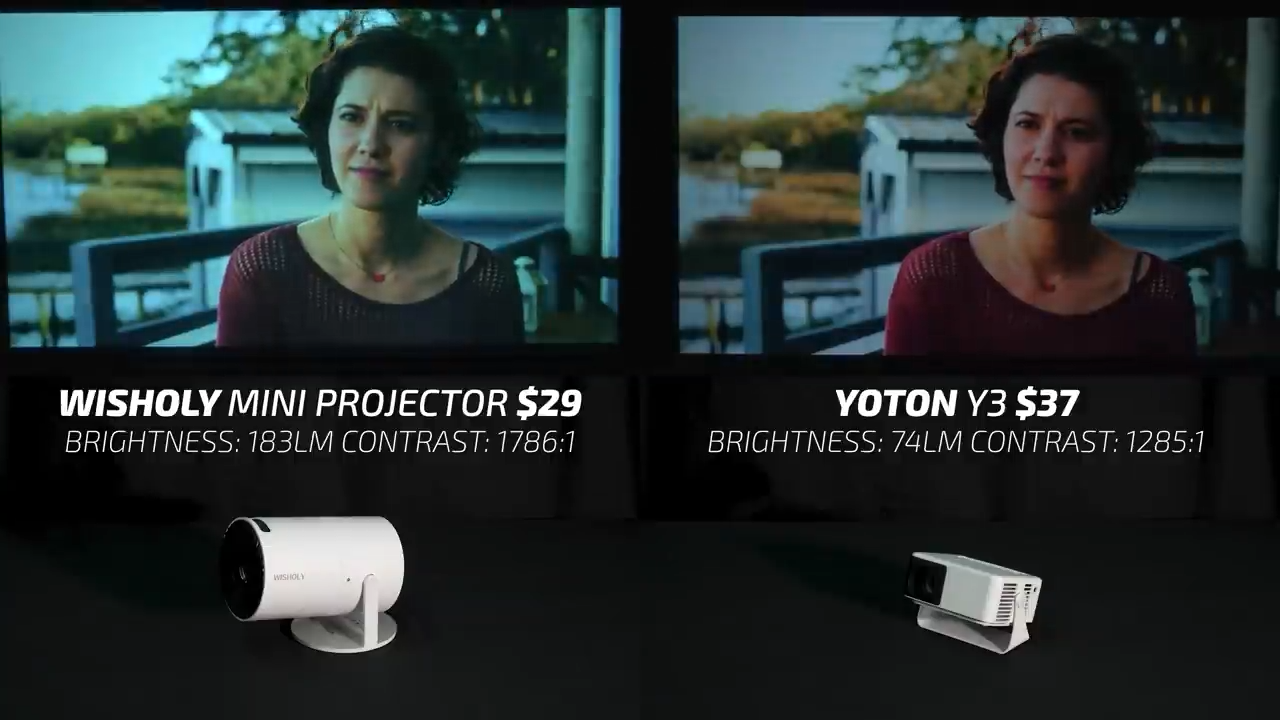
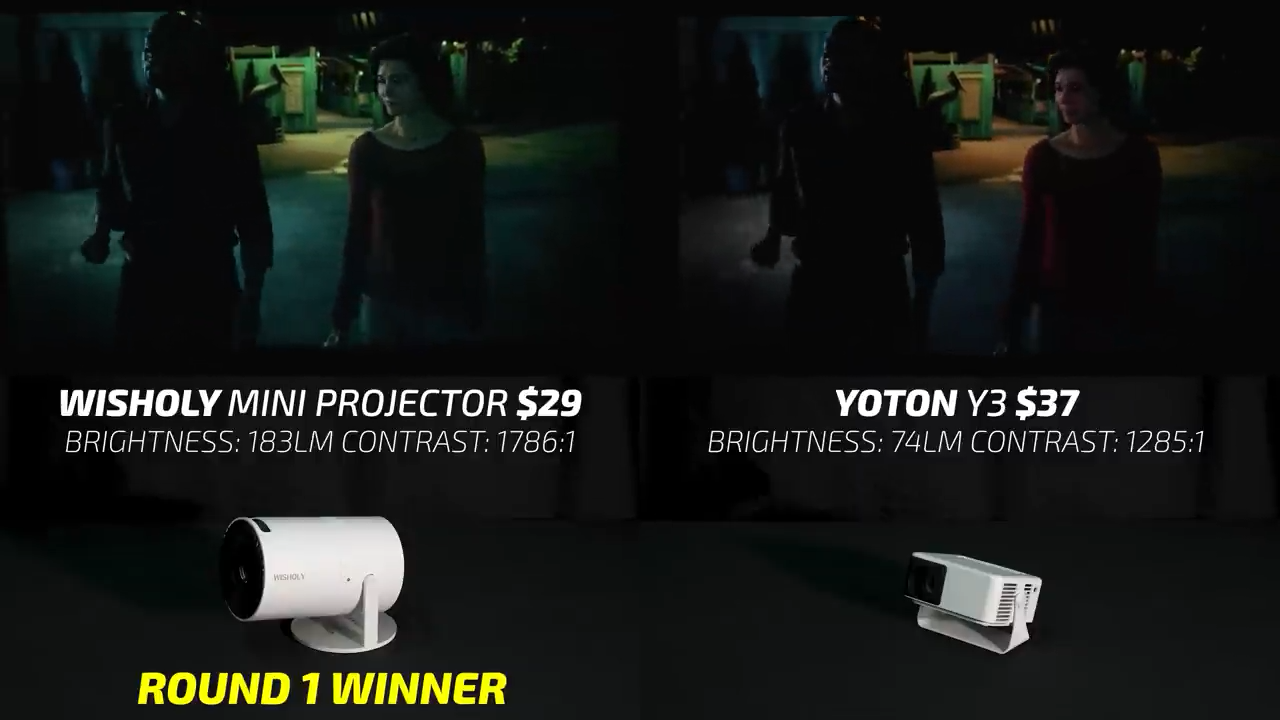
Round 1 has the least expensive projector in the video, the $29 WISHOLY Mini Projector vs the $37 YOTON Y3. Neither were great, with the WISHOLY looking pretty harsh in bright scenes and the YOTON massively crushing shadow detail. But overall, the WISHOLY was considerably more watchable, and easily took Round 1.
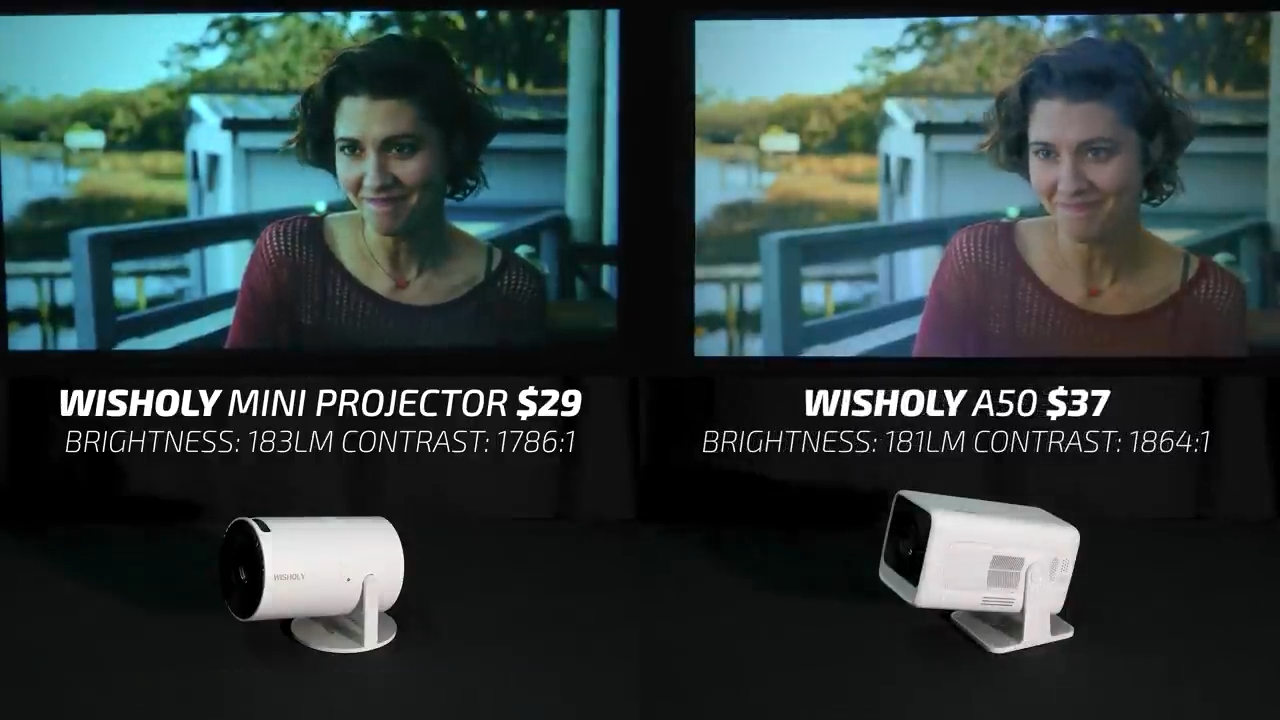
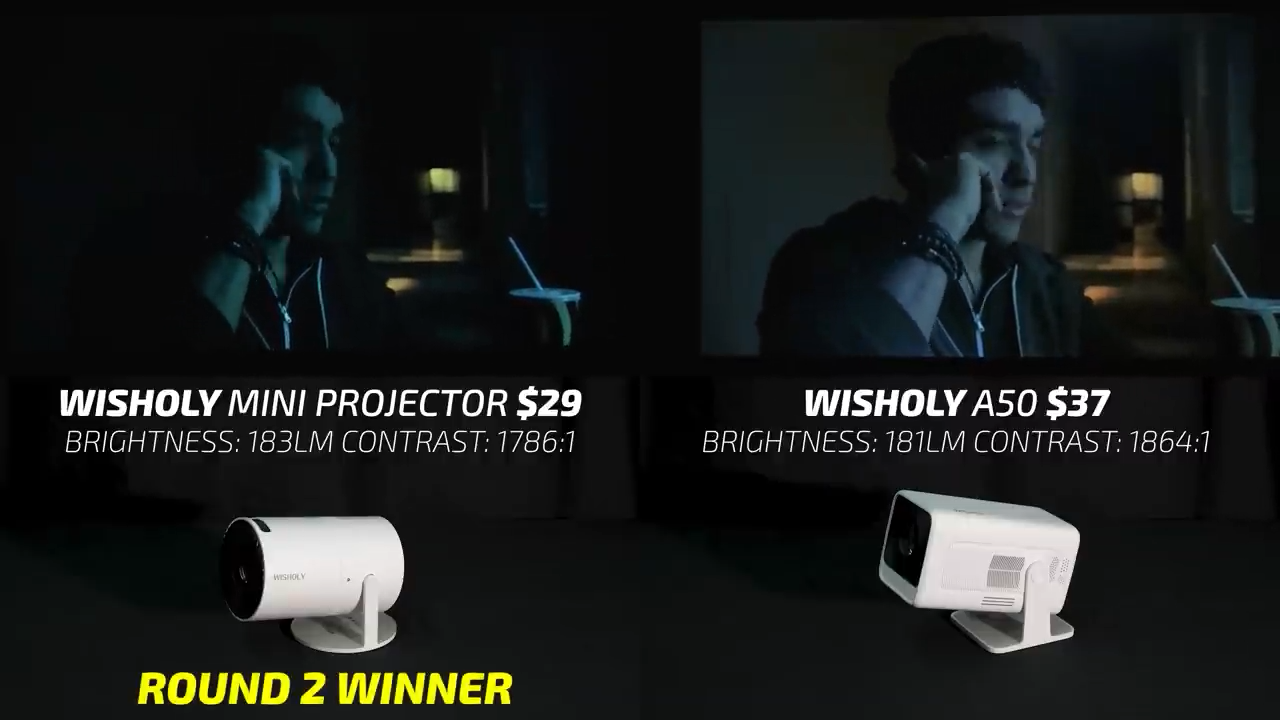
In Round 2, it goes up against another WISHOLY, the $37 A50. The A50 looked better in bright scenes in terms of midtones, but it has four large internal reflections that cast a blue light over the image, not only changing the white balance in those areas but also significantly increasing their brightness. I found those areas to be extremely distracting, so I moved the WISHOLY Mini Projector on again.
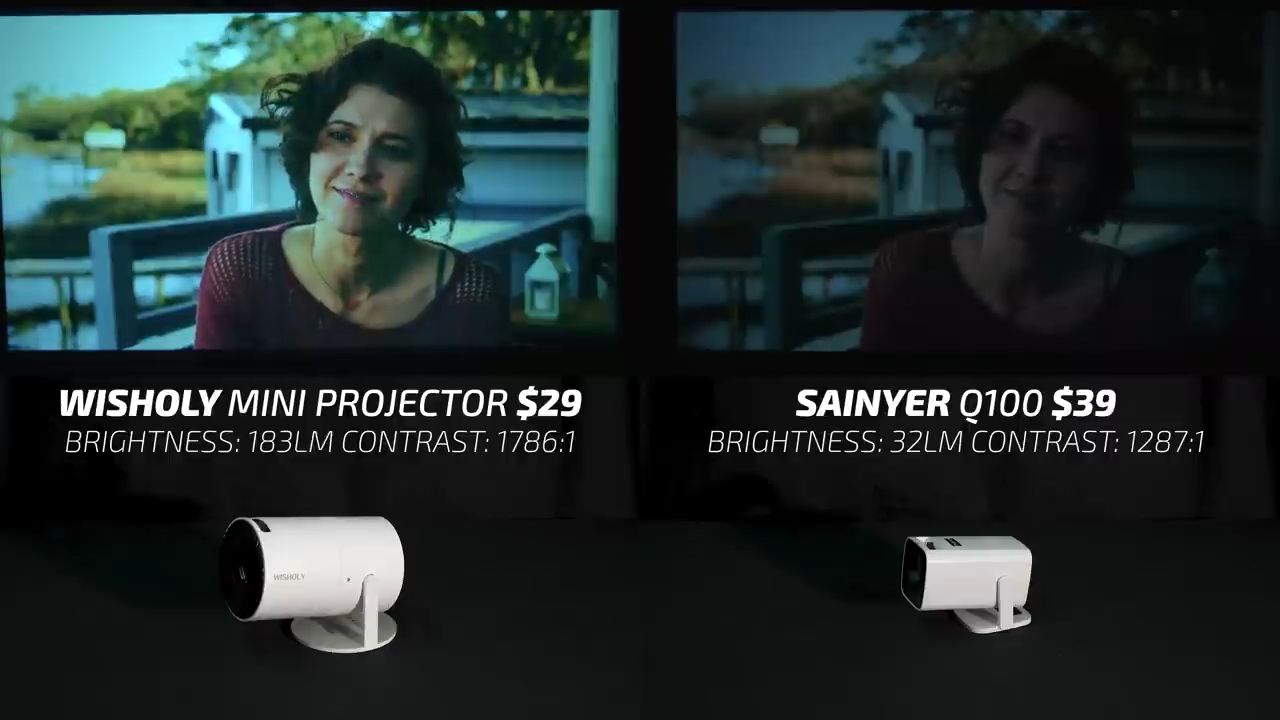
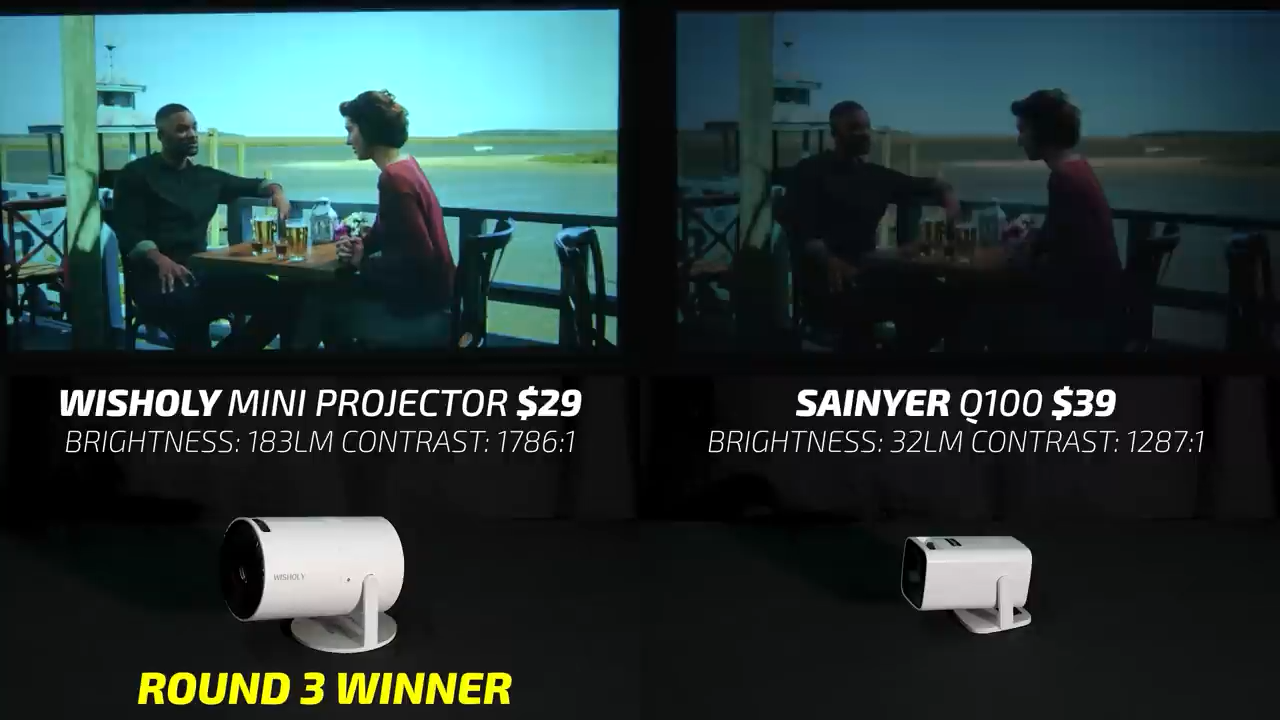
In Round 3, the WISHOLY goes up against the $39 Sainyer Q100. Despite having sold over 1000 units last month, this thing sucks, putting out just 33 lumens. It had absolutely no chance on a 100” screen.
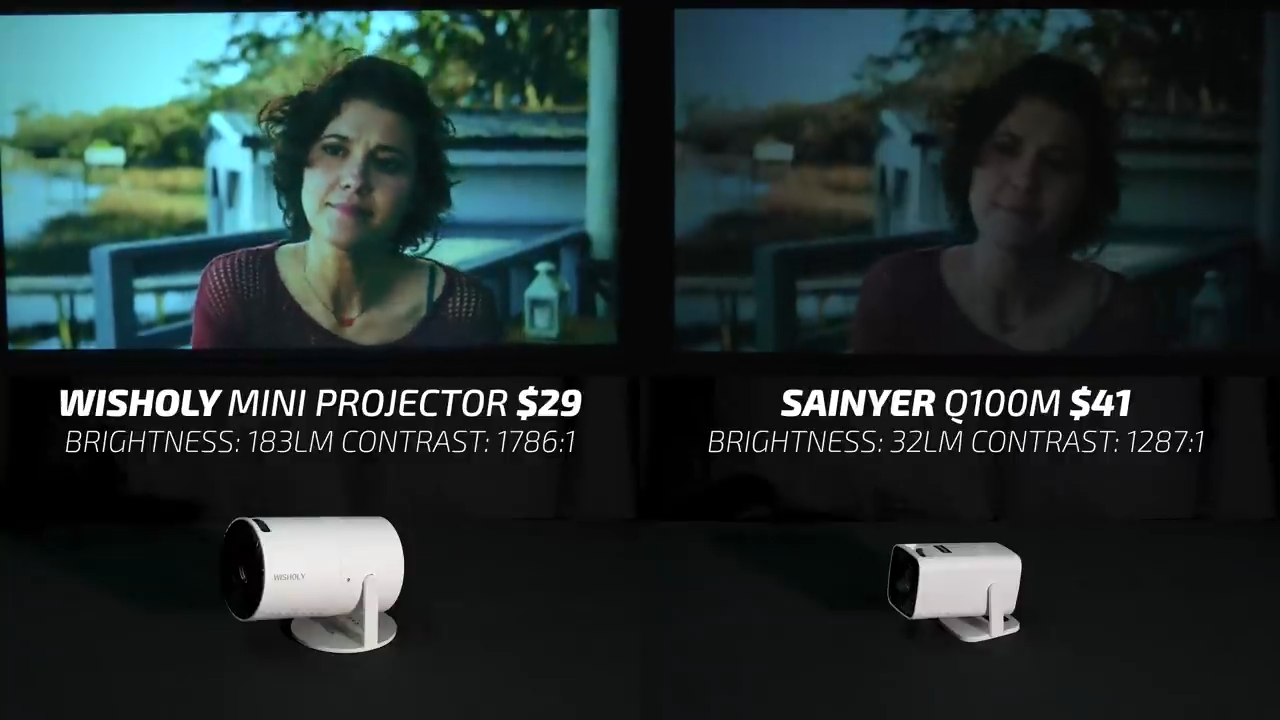
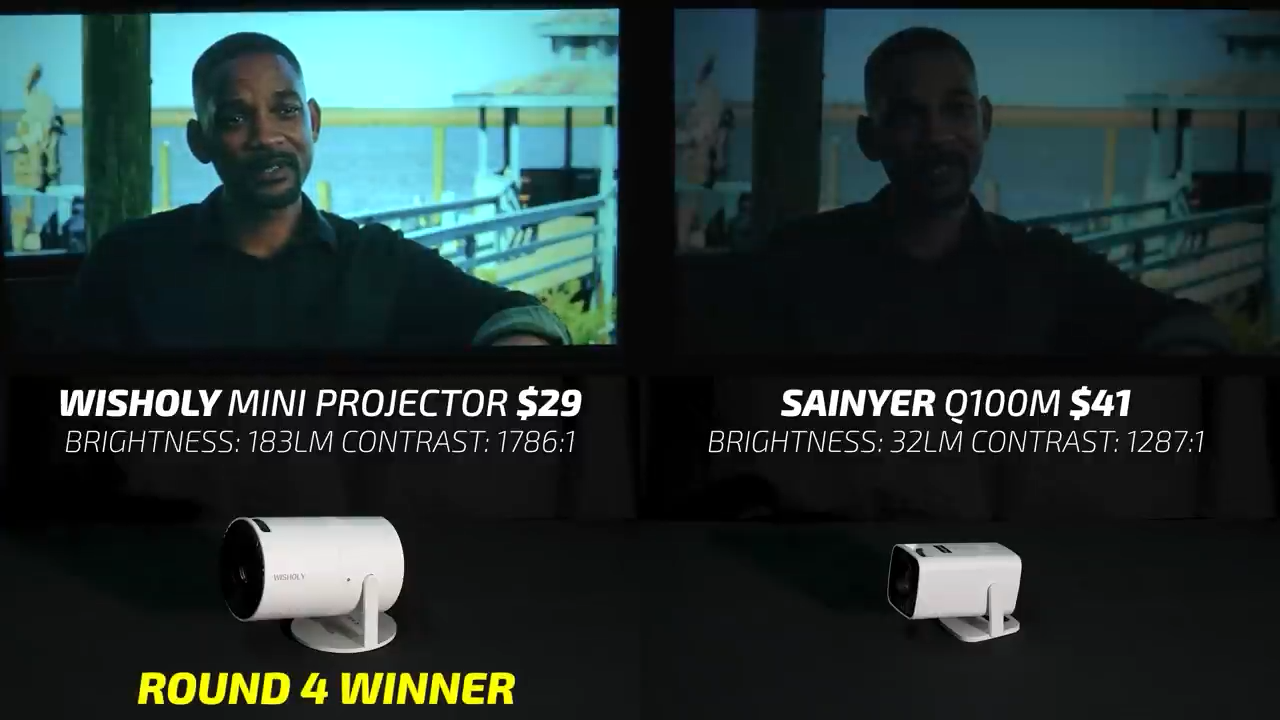
In Round 4, it goes up against a $41 Sainyer, which despite being a different listing and also selling 1000 units last month came in an identical box, had nearly identical specs, and also had absolutely no shot.
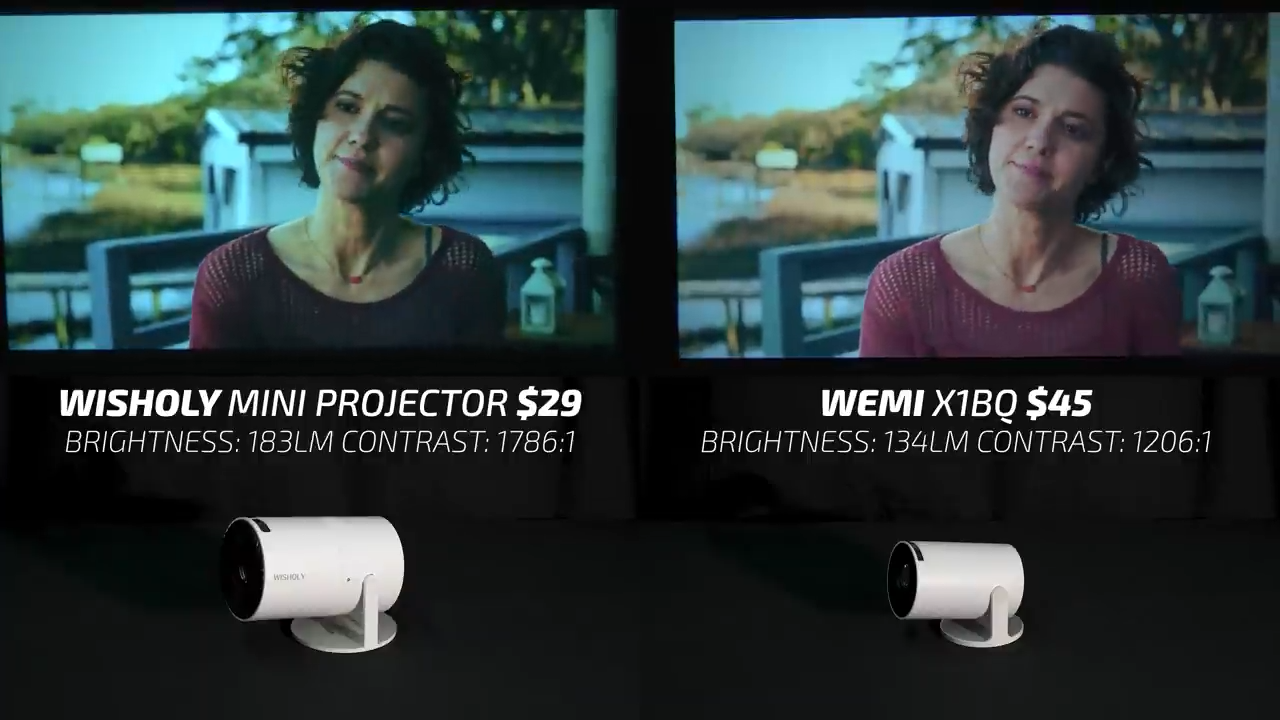
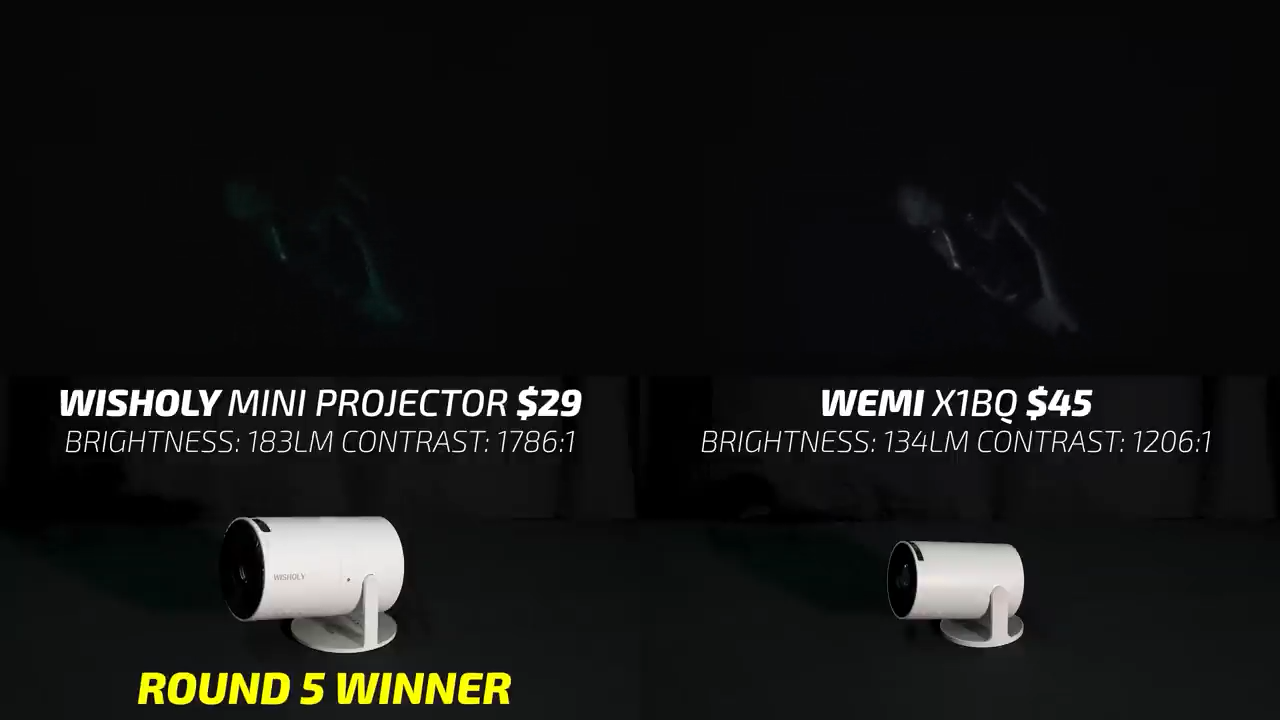
In Round 5, the WISHOLY takes on the $45 WEMI X1BQ. I should probably mention that for each projector I do attempt to make them look their best by adjusting picture settings. In the case of the WEMI, it was basically unwatchable in its Default Standard mode but was half-decent in Custom mode after raising the brightness and contrast. However, doing that also raised the black floor. This was probably the closest round yet, but I thought the WISHOLY was still slightly better, so it moves on again.
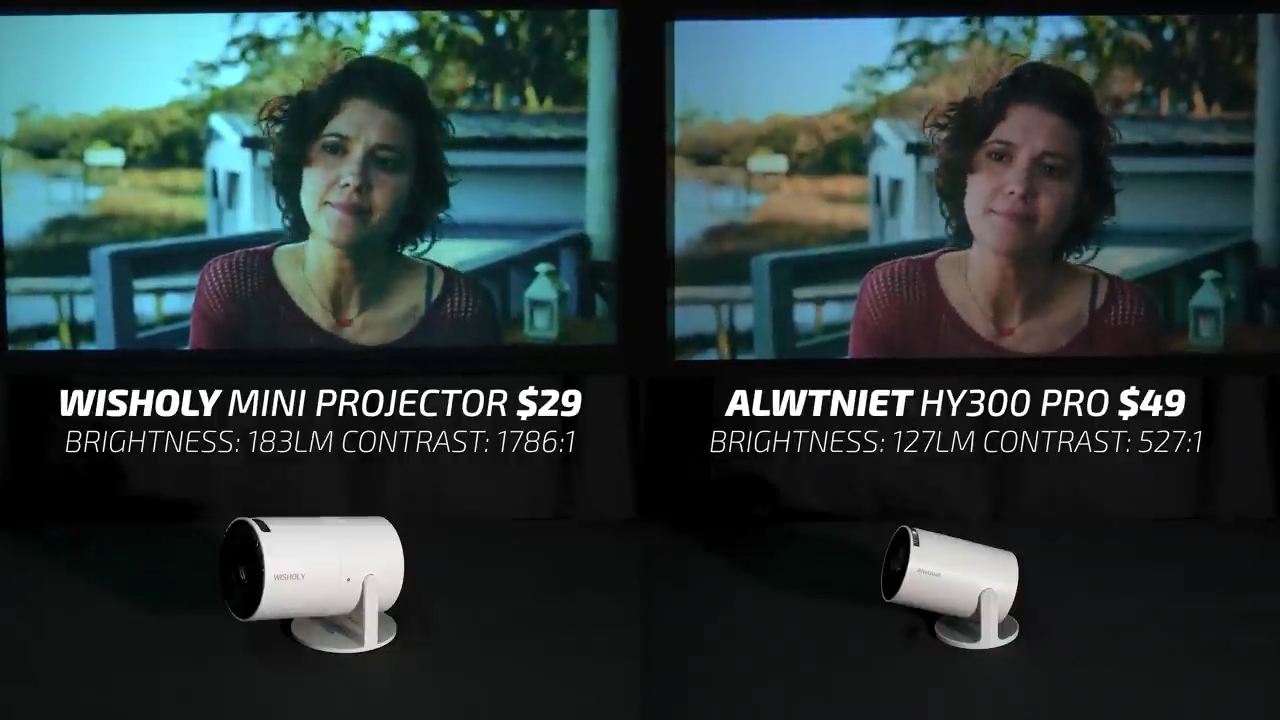
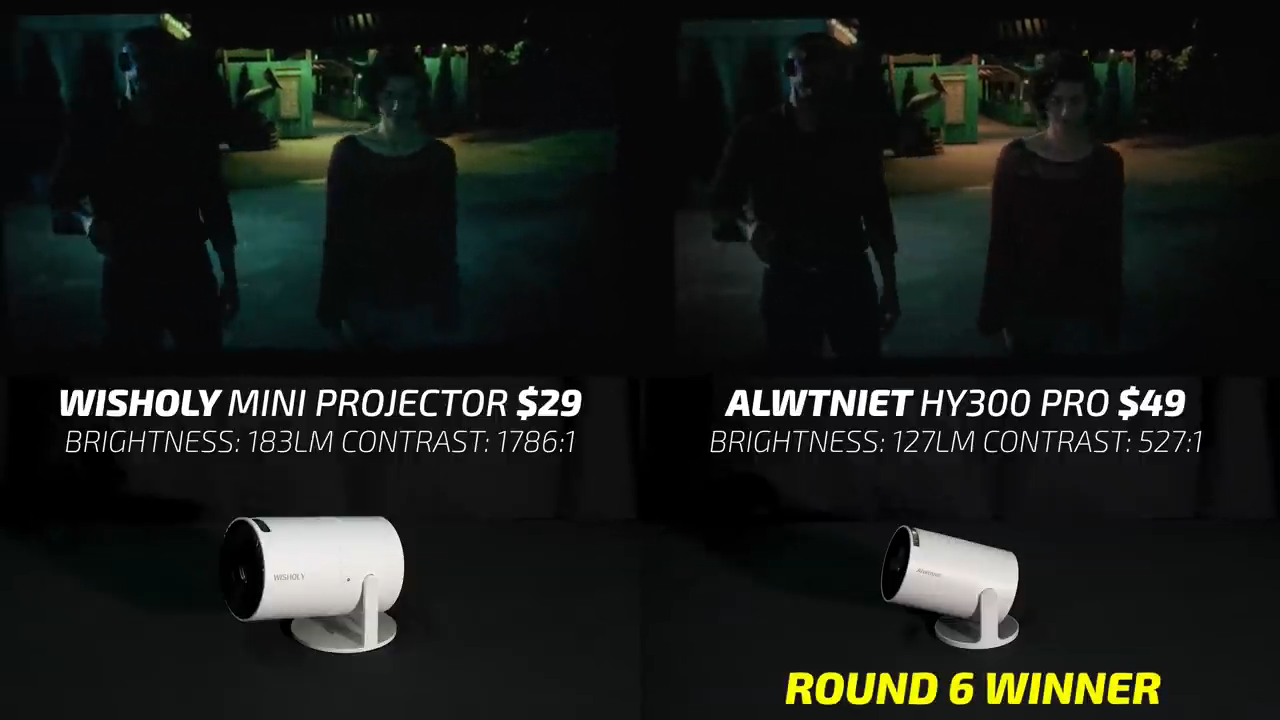
Round 6 had the $29 WISHOLY up against the $49 Alwtniet HY300 Pro. It was immediately apparent that this was the color accuracy and midtone performance that has been missing from the previous projectors and all the sudden this scene from Gemini Man that I’ve probably watched 1000 times started to look like it should. The HY300 Pro wasn’t as bright and the WISHOLY had three times the contrast, but the HY300 Pro produced a significantly more watchable image and easily knocked out the WISHOLY.
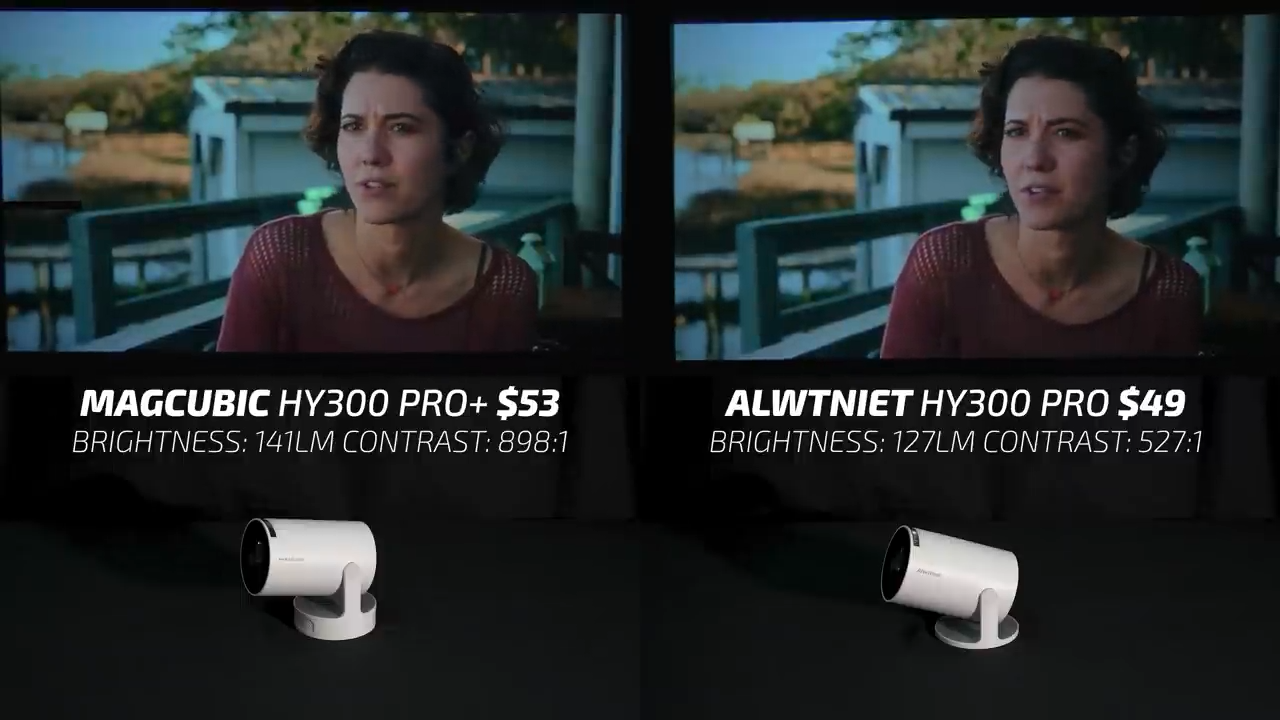
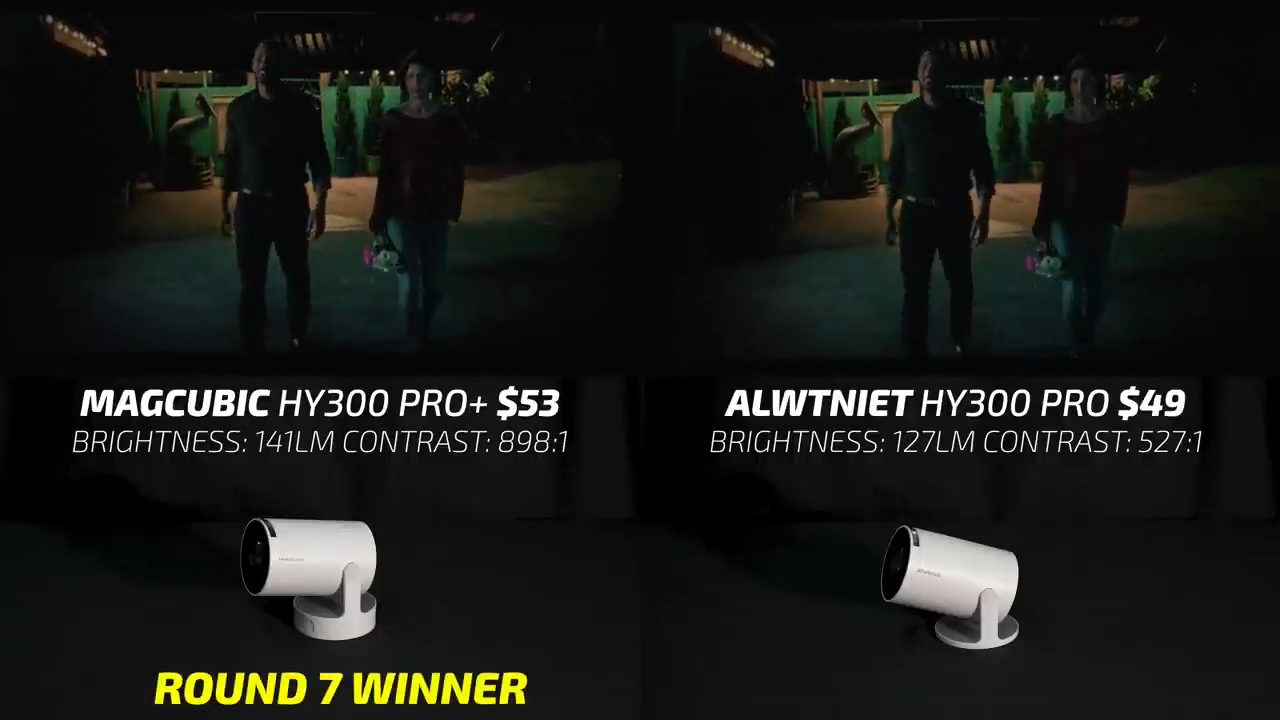
In Round 7, the Alwtniet HY300 Pro is on the right and the $53 Magcubic HY300 Pro+ is on the left. For $4 more, the Pro+ has a few more lumens and better contrast. In my opinion, the Magcubic also had a little better image tuning. While both projectors looked pretty good, I thought the Magcubic looked slightly better in every scene, knocking out the non-Plus version of the HY300.
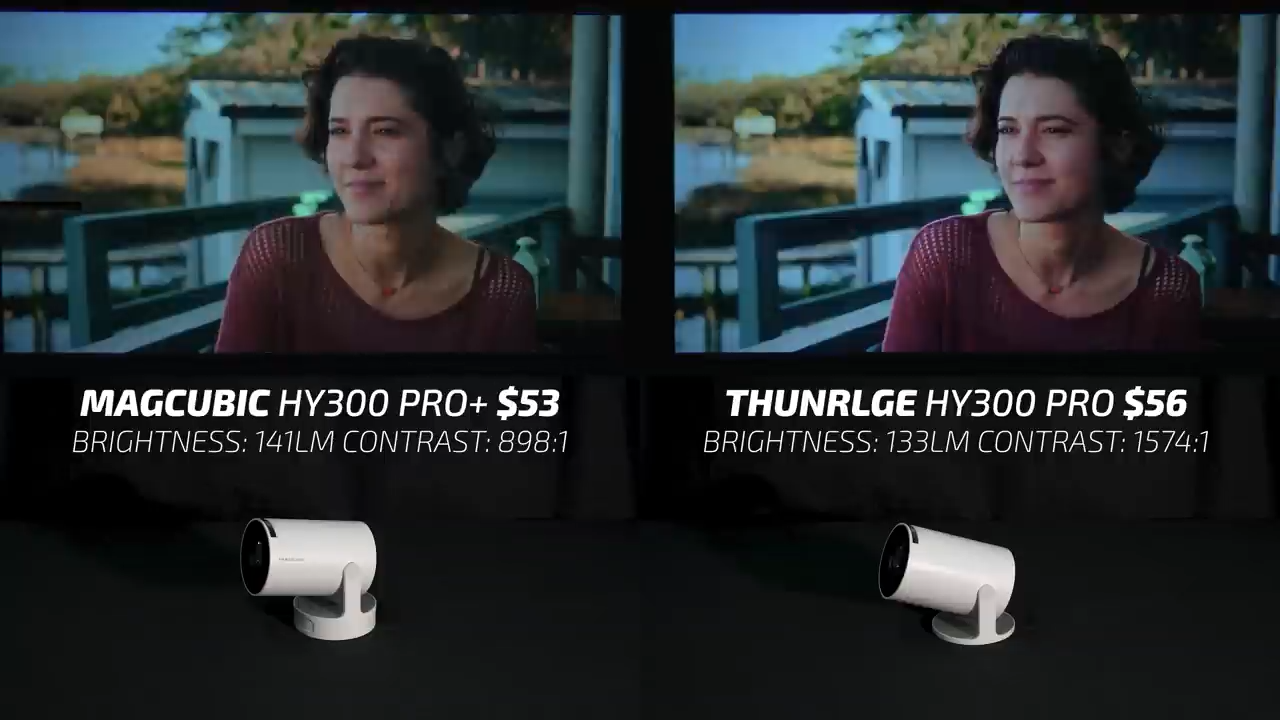
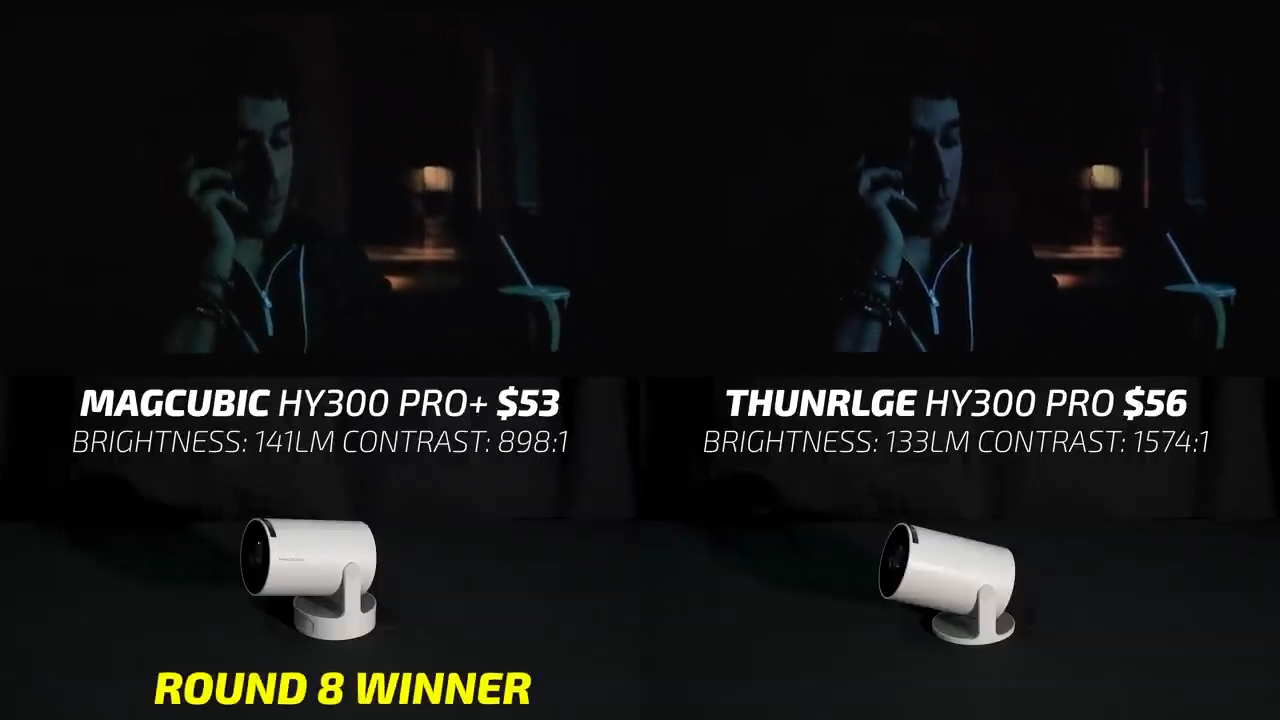
Round 8 has another HY300 Pro, and this one is $56 and made by Thunrlge. The biggest difference here is contrast, where the Thunrlge has roughly double the Magcubic. In bright scenes, I thought it looked great, but in dark scenes, the Thunrlge’s colors are all over the place and it crushes shadow detail pretty badly, giving the Magcubic another win.
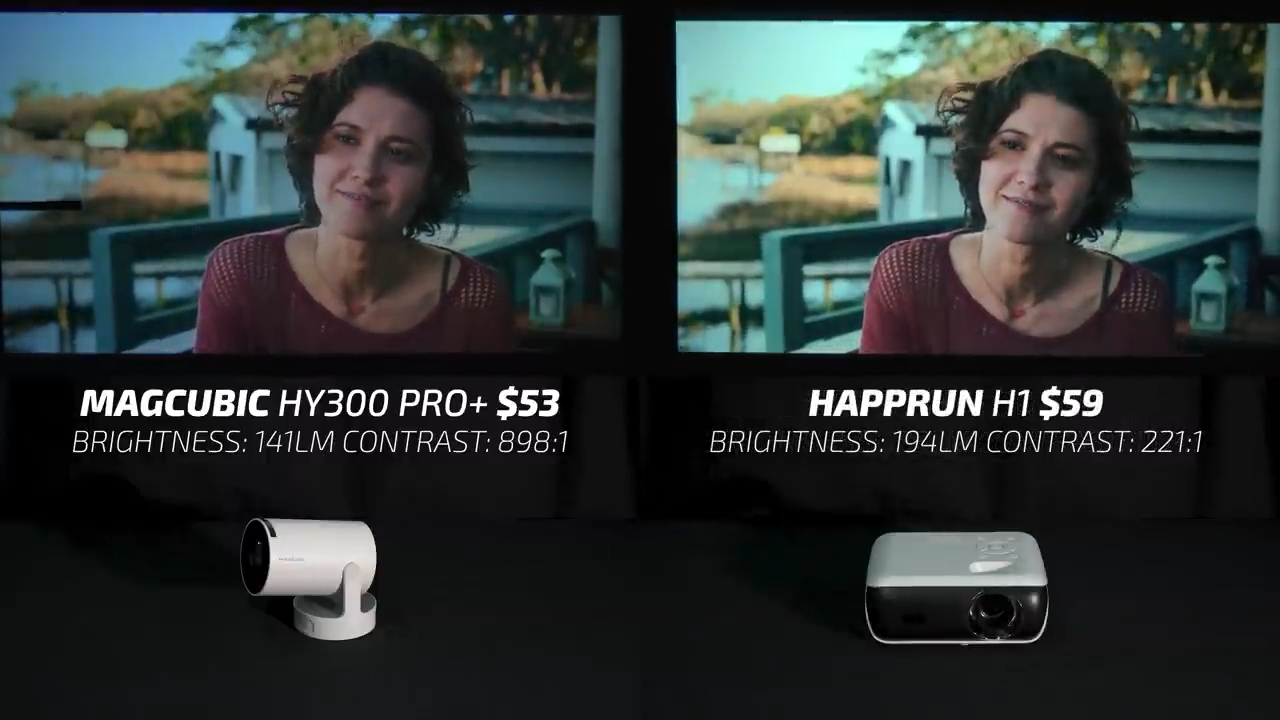
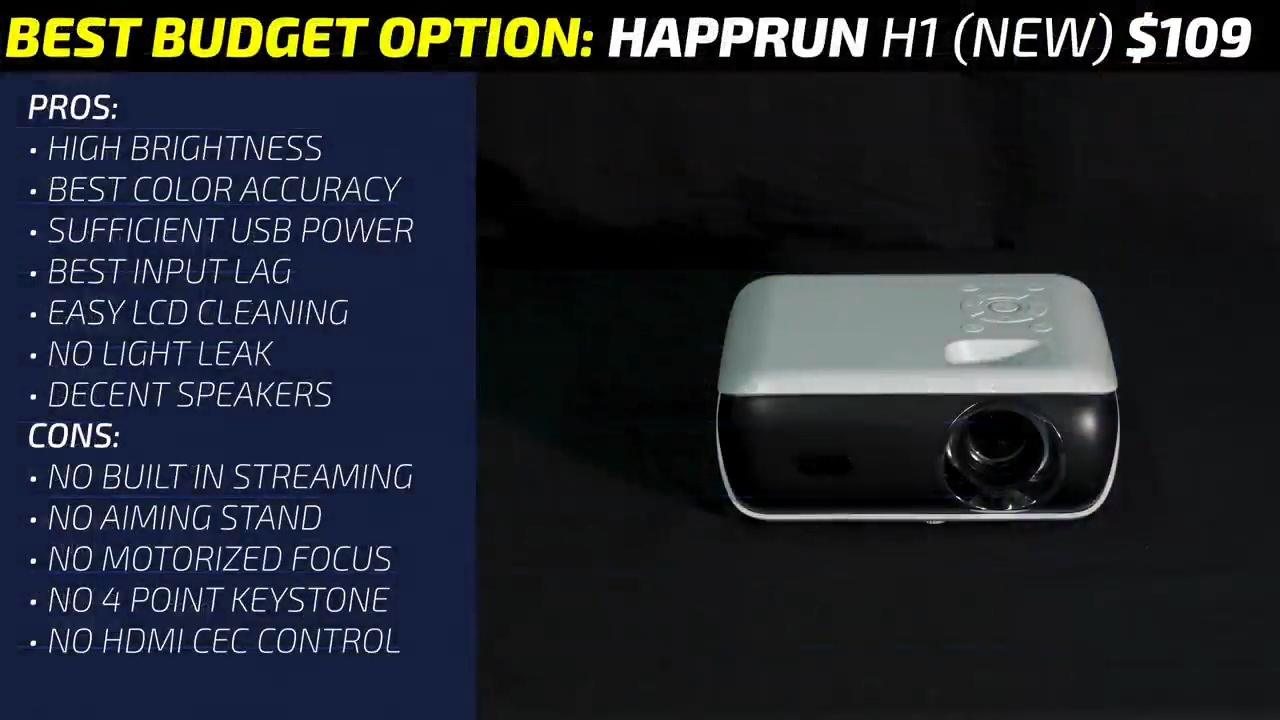
In Round 9, it will go up against the $59 Happrun H1, sort of. The Happrun H1 was the OG of decent inexpensive projectors, and it was my top pick in 2022, 2023, and 2024. But at some point in the last year, Happrun silently updated the design making it about 25% smaller while keeping the same model number. This version maintained very similar brightness at around 200 lumens, but contrast performance took a huge hit going from around 2000:1 contrast on the previous model to just 10% of that at 221:1 and it shows. While the new H1’s color accuracy was phenomenal and easily the best we’ve seen yet, the black floor was high even with the brightness lowered. Despite it looking better on video here, when I was judging in person, there was no question that the Magcubic was better in dark and moderately lit scenes. While I think the Happrun H1 is still a pretty decent deal for bright content, I’m going to move the Magcubic on again.
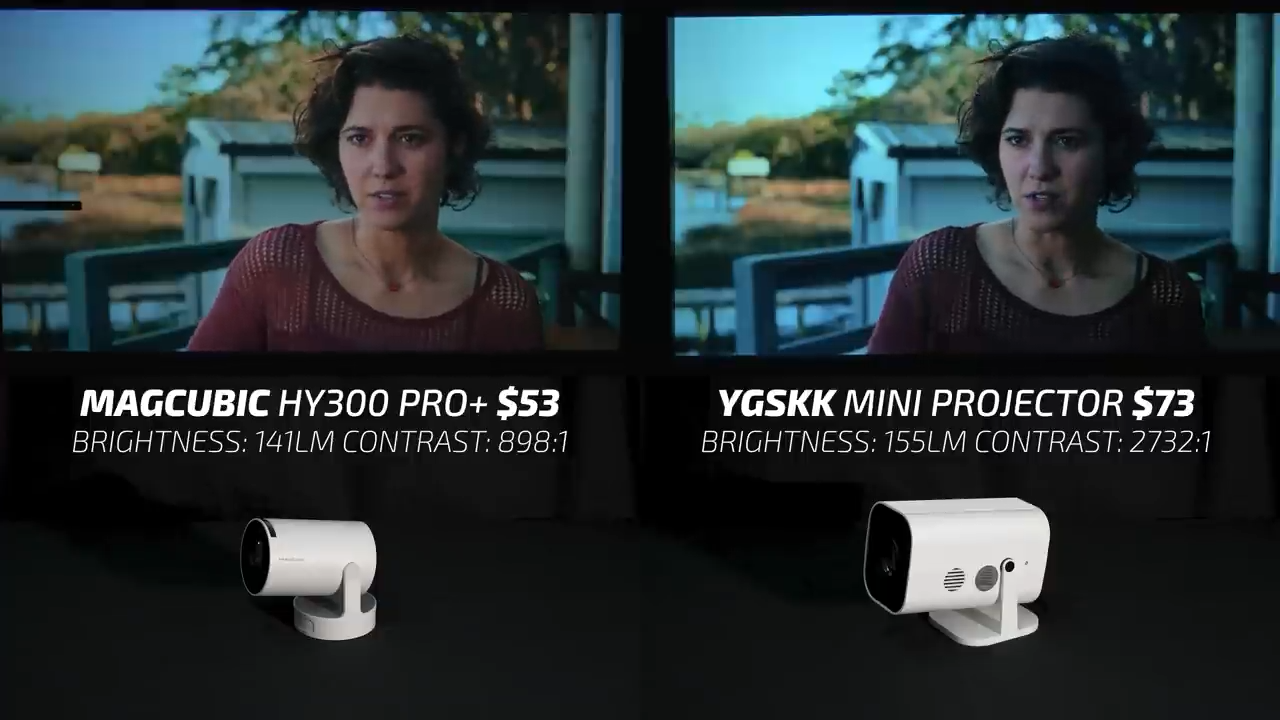
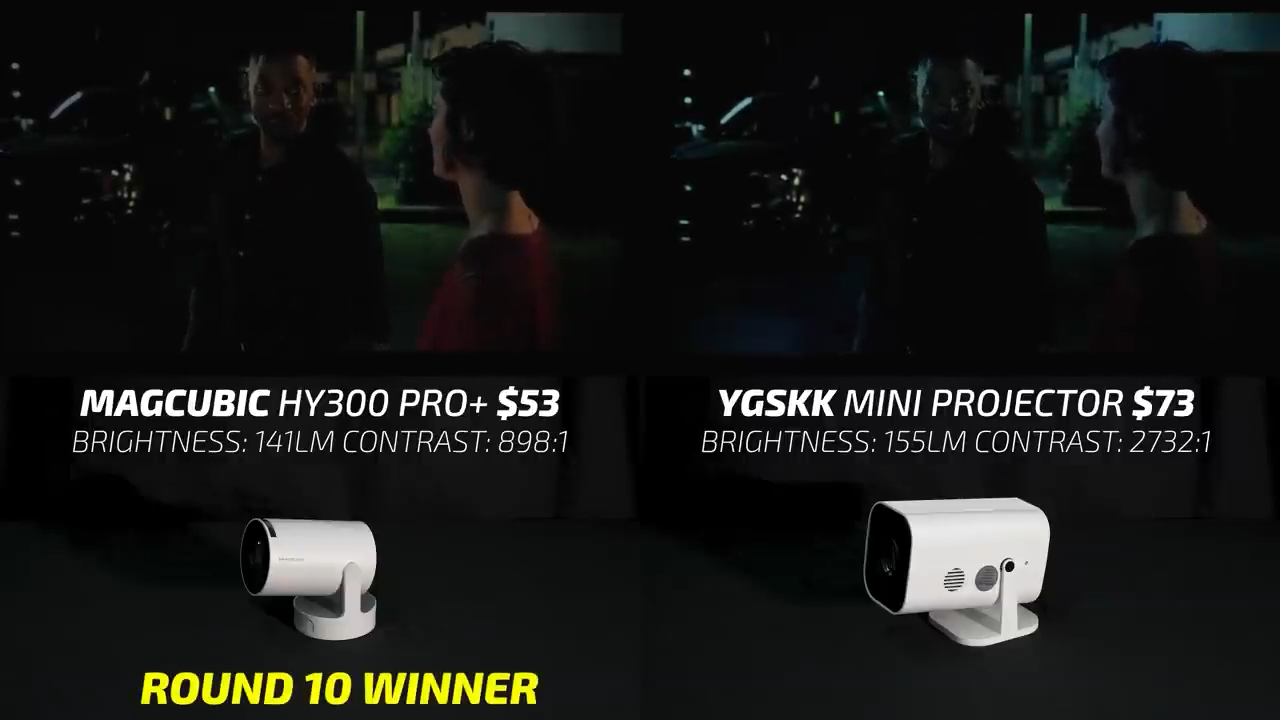
In Round 10, it goes up against the YGSKK Mini Projector, which has an impressive contrast ratio of 2732:1 as long as you measure just the center of the screen. Anywhere other than that has big blue internal reflections and overall, the white balance on the YGSKK was just way too blue. As far as I could tell, it doesn’t have any image settings to be able to adjust that, so the Magcubic moved on again.
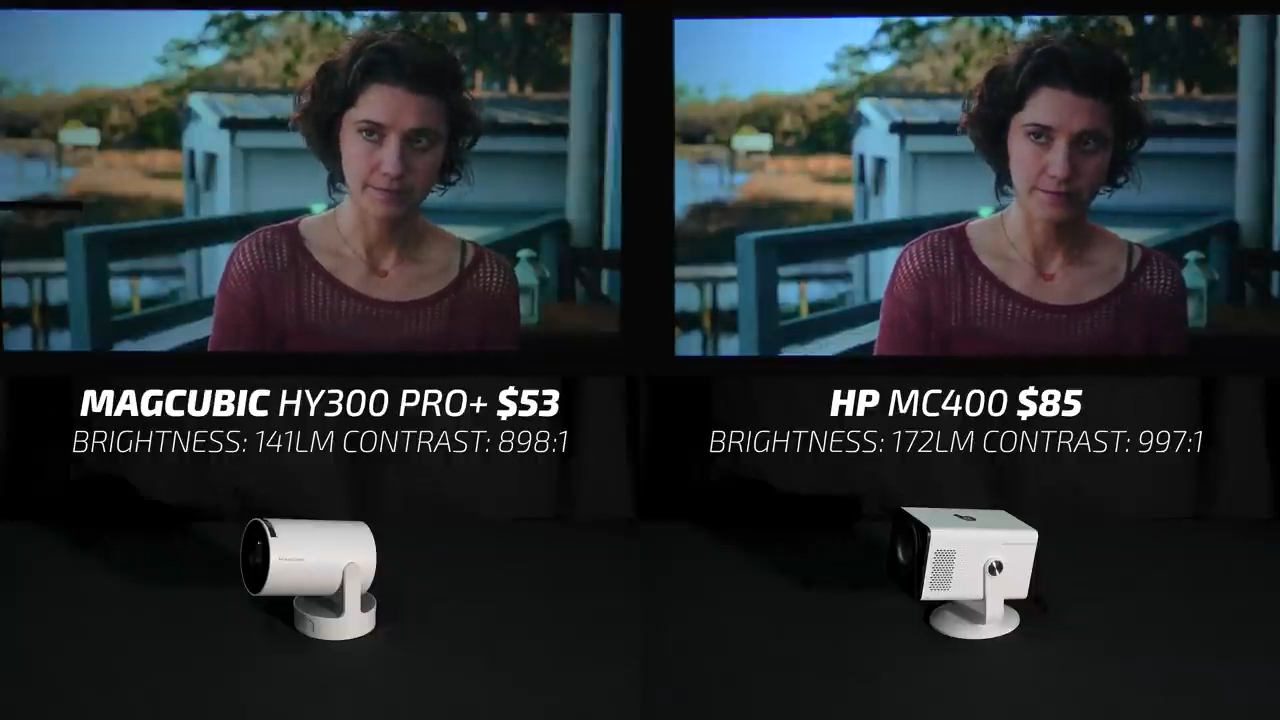
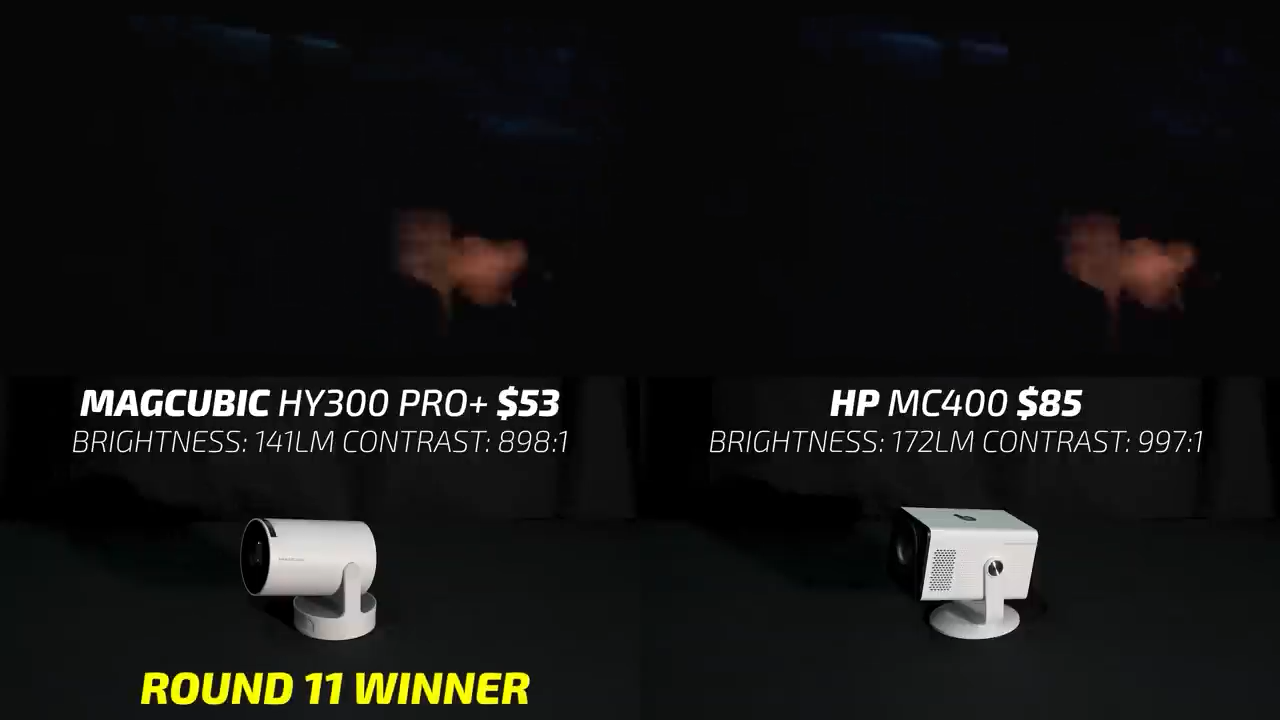
Round 11 has a projector from HP, like Hewlett Packard HP, the $85 MC400. While this is most likely just a Chinese projector licensing the HP name, I was overall pretty impressed with the MC400, and it was slightly brighter than the HY300 Pro+ but with a little cooler color temperature. I probably could have forgiven the overall cooler tone of the HP in bright scenes if it weren’t for the blue-shifted black floor in dark scenes which looked much less accurate than the Magcubic, which moved on again.
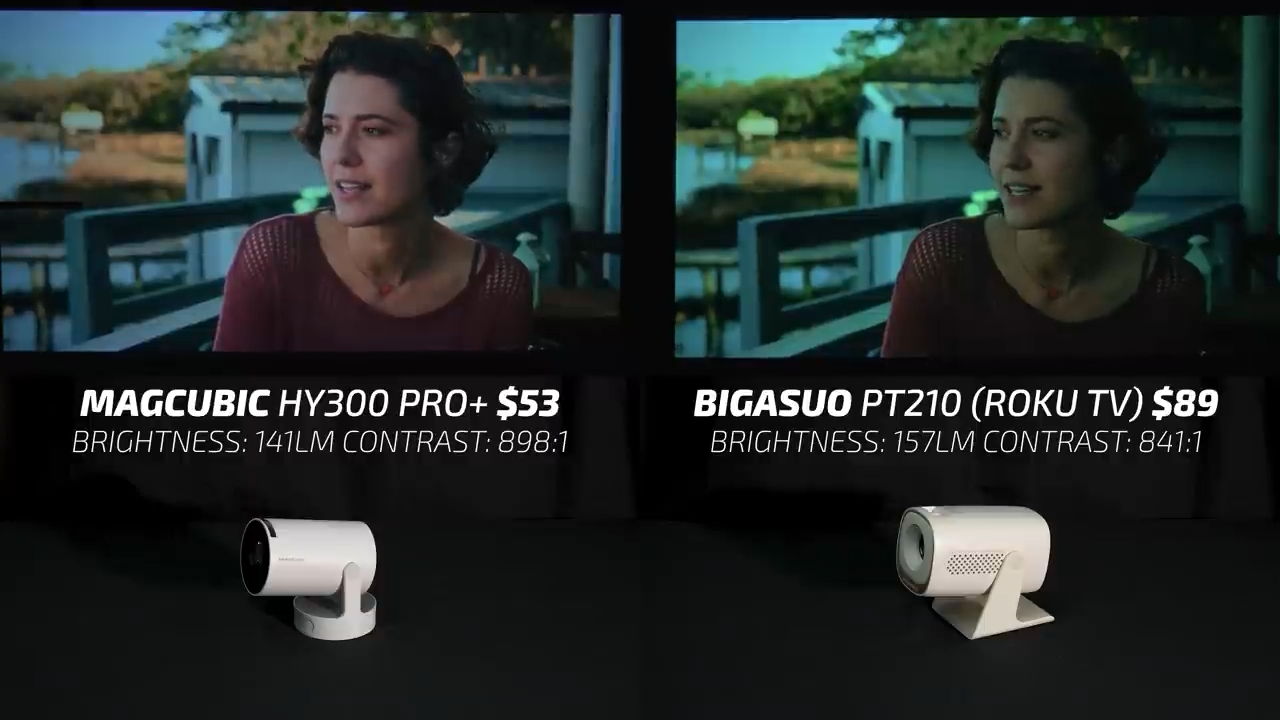
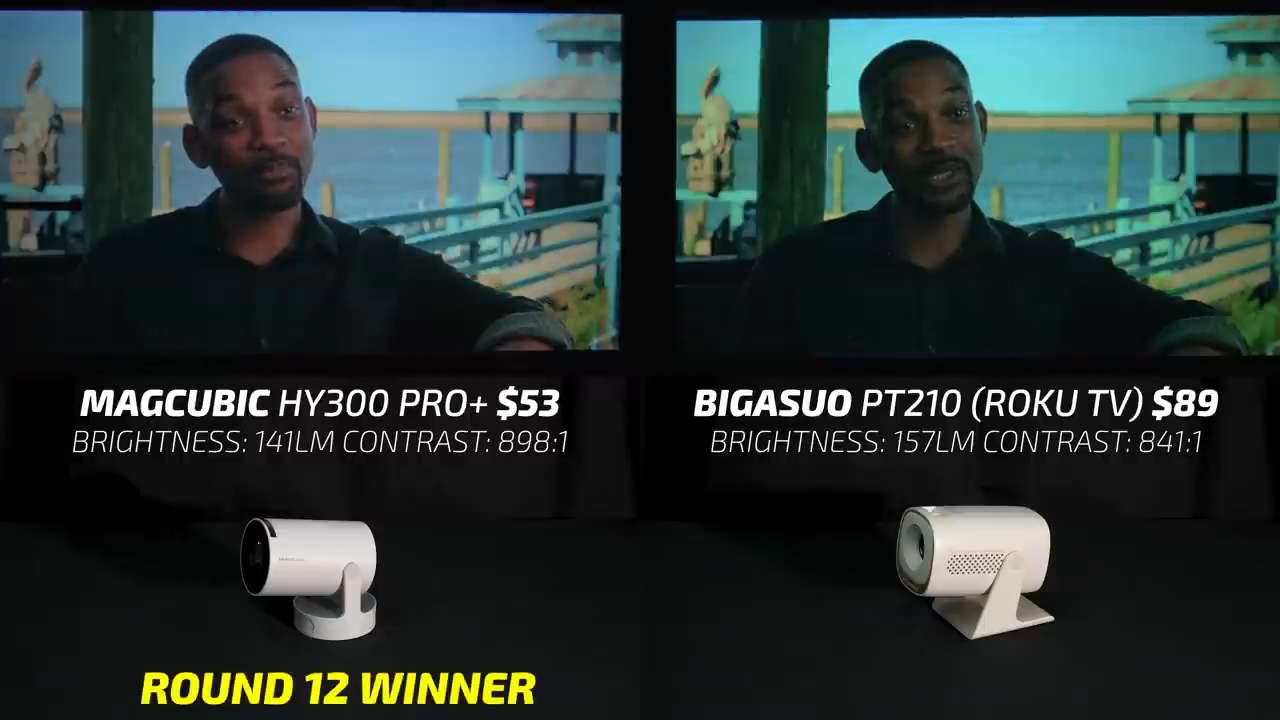
In Round 12, the Magcubic goes up against the $89 BIGASOU PT210 which is the first of the Roku TV projectors in the video. The picture quality on the BIGASOU was horrible. I did my best to try to adjust picture settings, but it remained just awful no matter what I did, so the Magcubic moved on again.
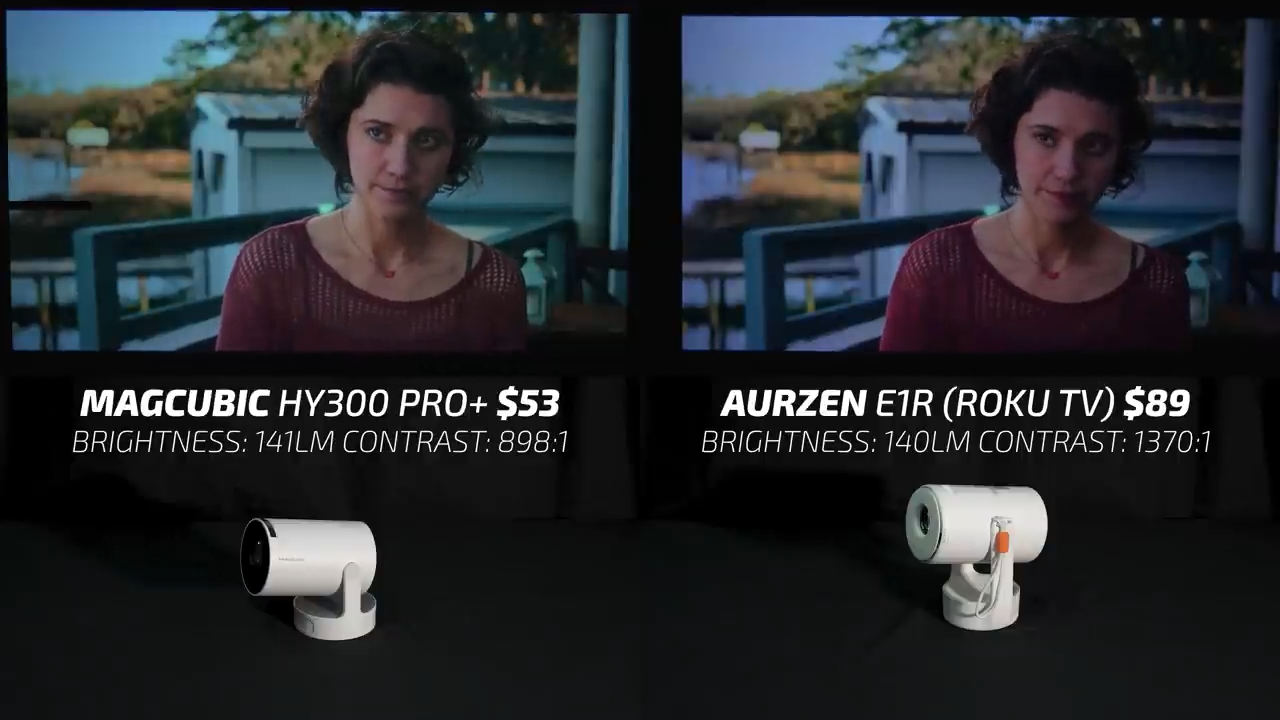
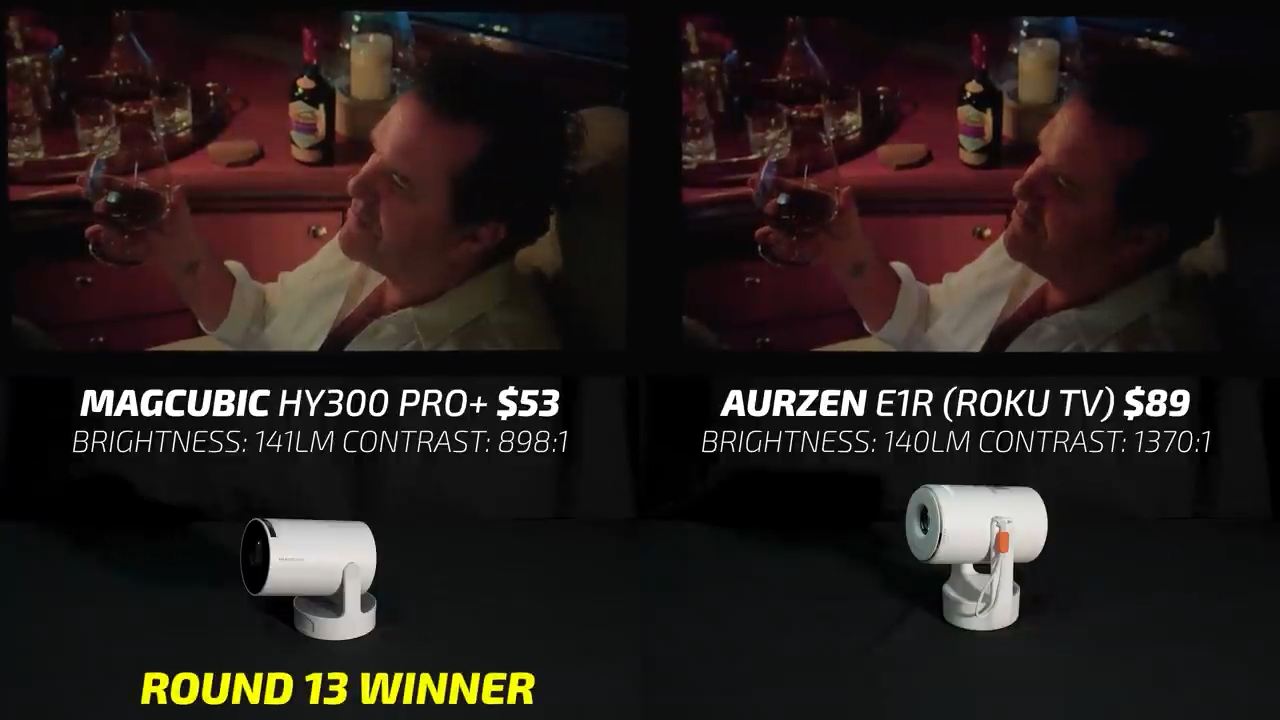
In Round 13, it went up against the $89 Aurzen E1R, another Roku TV projector. In Standard mode, where the E1R has its highest brightness, the color temperature was way too blue. Even switching over to Movie mode, it was still a much cooler image than it should have been, and color saturation and hue were all over the place in darker scenes, making this another easy win for the Magcubic.
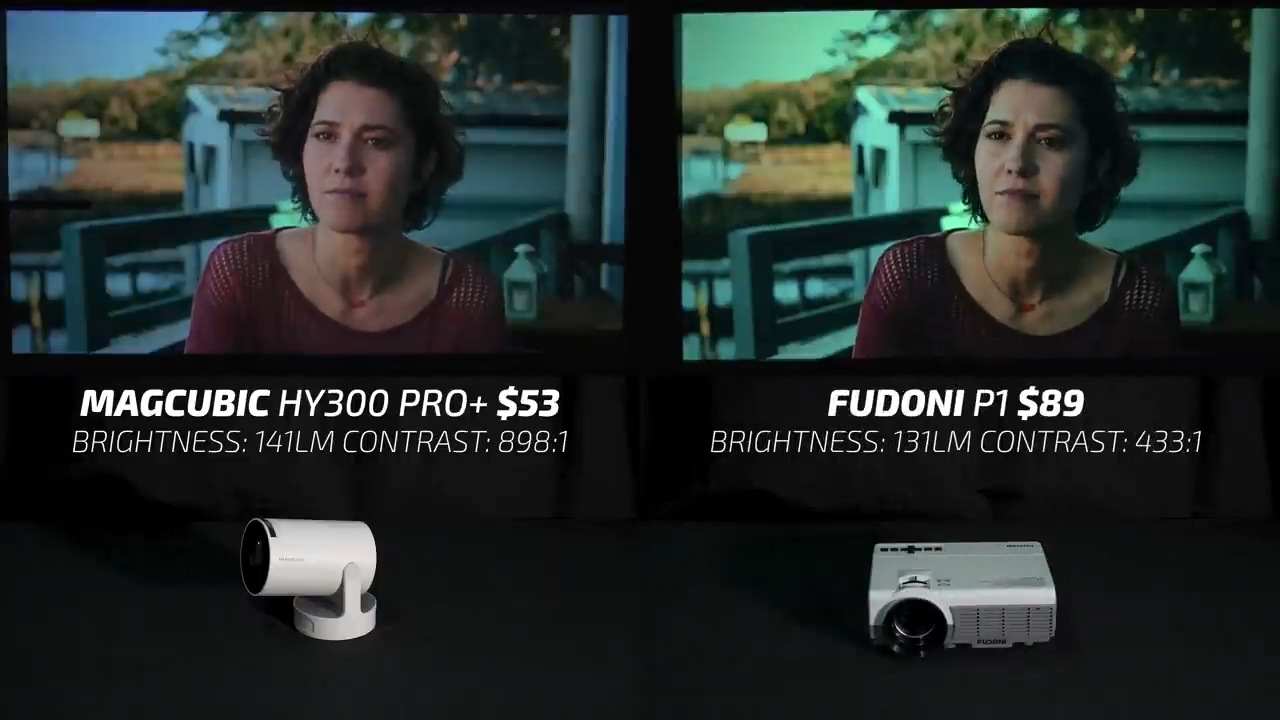
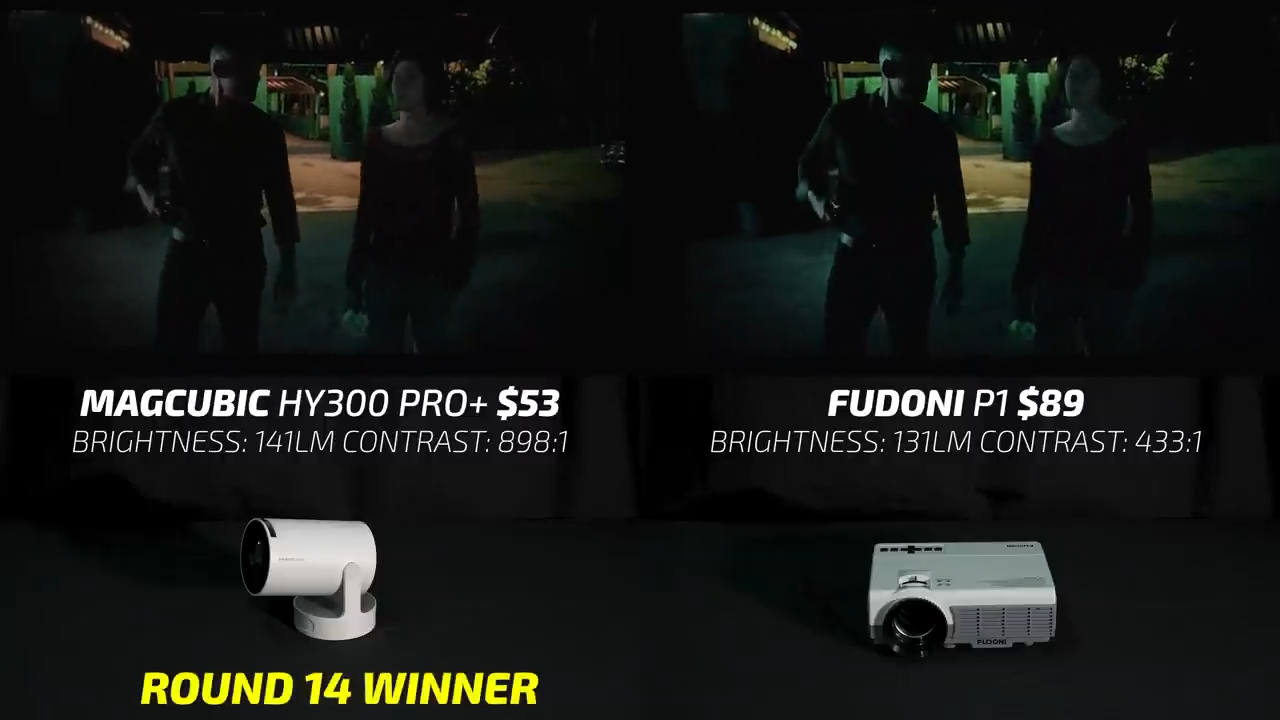
In Round 14, the challenger is the $89 Fudoni P1. Last year, another model of Fudoni’s, the GC888A, easily won my top recommendation, but the P1 was not from the same pedigree. The color was massively green shifted and Dani’s skin tone looked completely washed out, making this another easy win for the Magcubic.
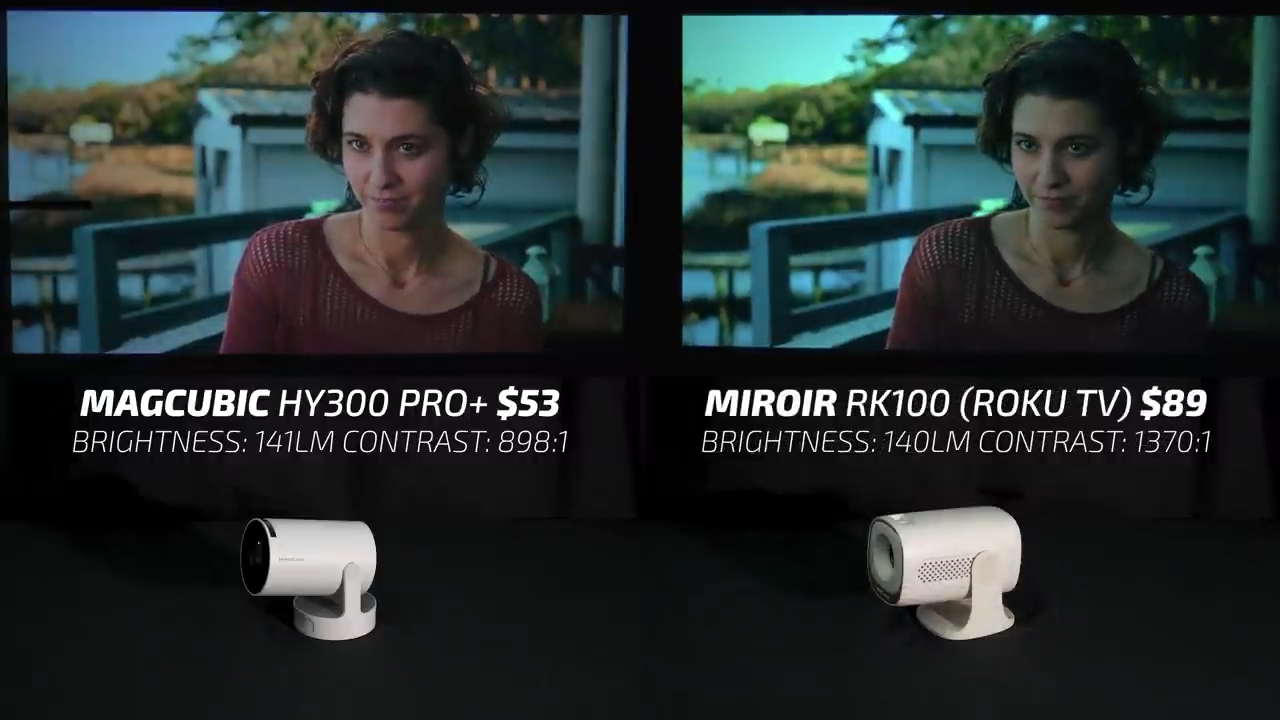
So Round 15 is the Magcubic on the left and the $94 Miroir RK100 Roku TV on the right. In addition to being a little too green in terms of white balance, the Miroir also crushed a lot of shadow detail in darker scenes. While I wouldn’t consider the overall picture quality of the RK100 bad, the Magcubic was definitely still better, so it moved on again.
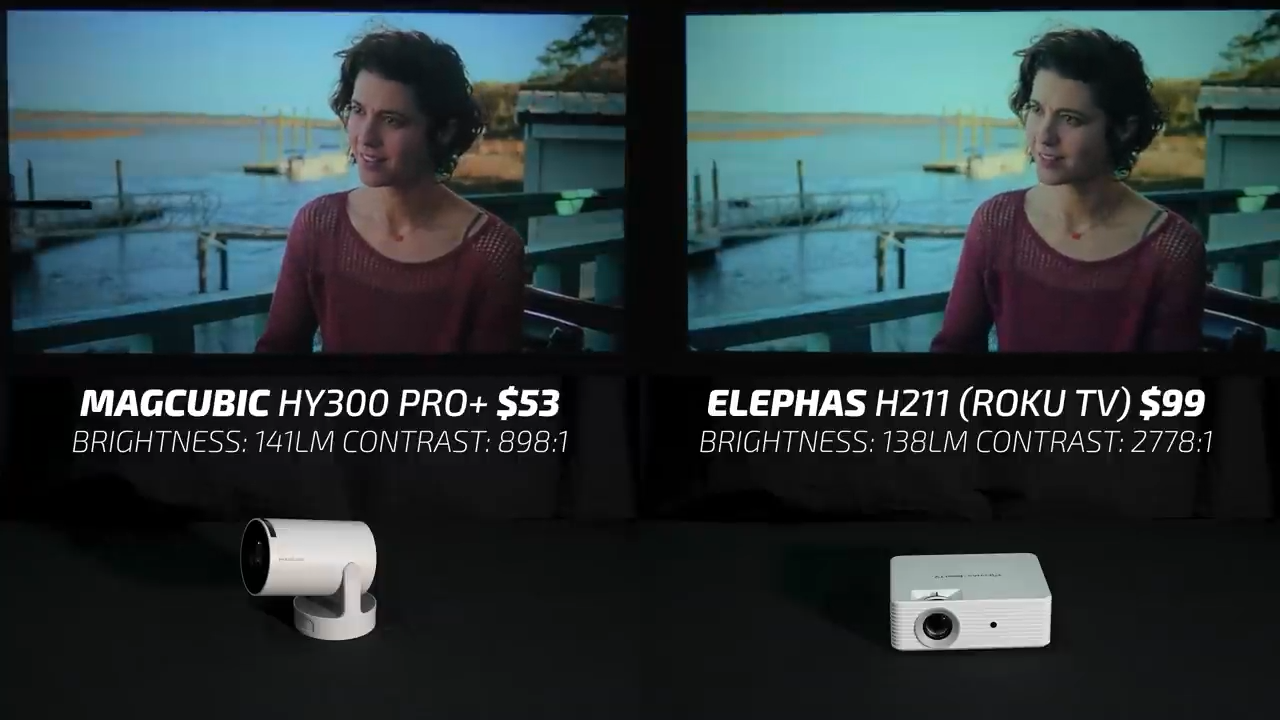
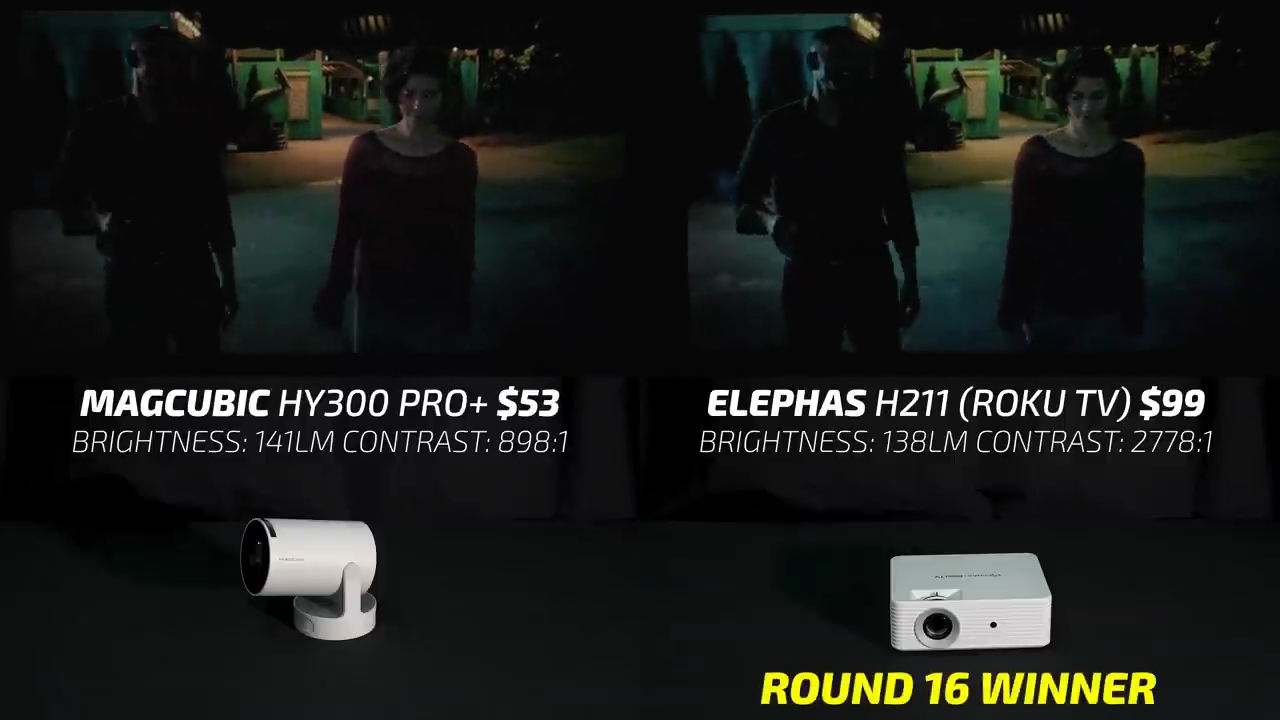
Getting closer to the end, Round 16 brought in another Roku TV, the $99 Elephas H211. In terms of pure picture quality, it was phenomenal. The Elephas had the best color accuracy since the Happrun, and the contrast and gamma curve to back it up. Despite the Magcubic winning the last nine rounds, this was the first time this video that I was slightly impressed by the picture quality of one of these projectors, and the Elephas H211 easily took this round.
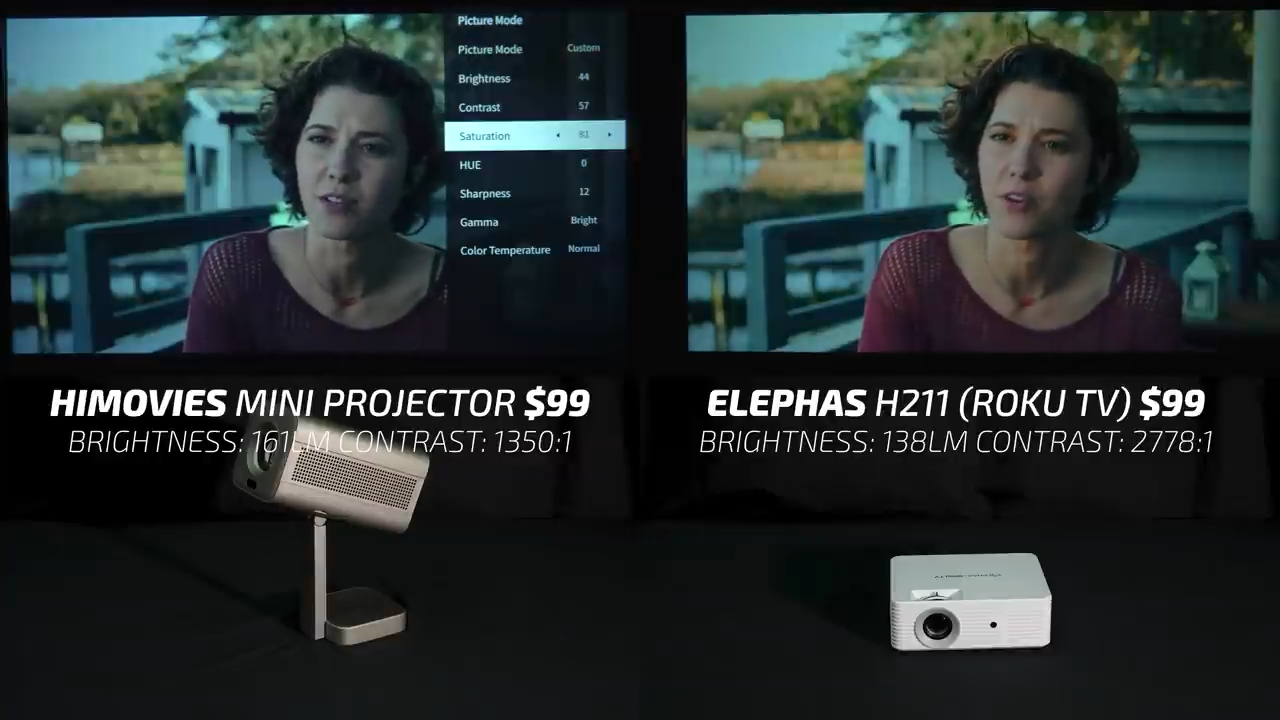
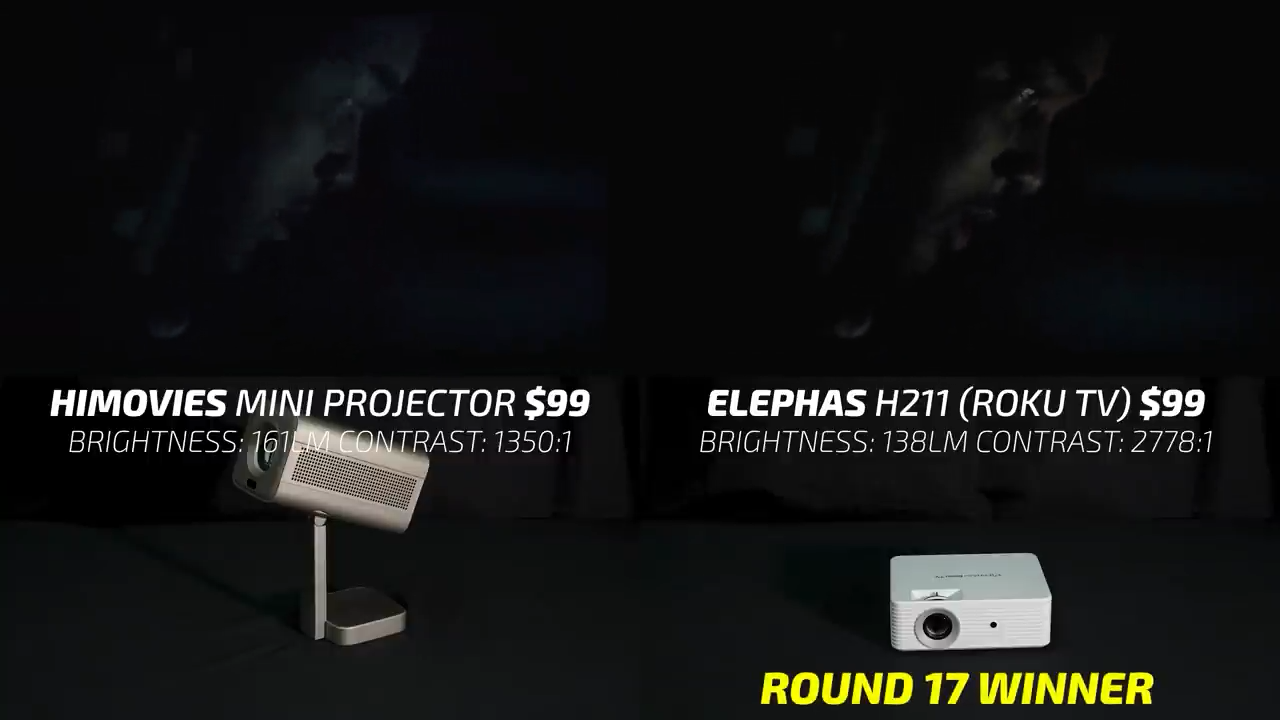
So Round 17 had the Elephas on the right and the $99 Himovies Mini Projector on the left. After initially being excited by the fact it had controls for gamma and saturation, the excitement quickly died out when I realized that those controls didn’t actually work. Overall, the picture quality of the Himovies was way too blue and washed out, and it didn’t stand a chance against the Elephas.
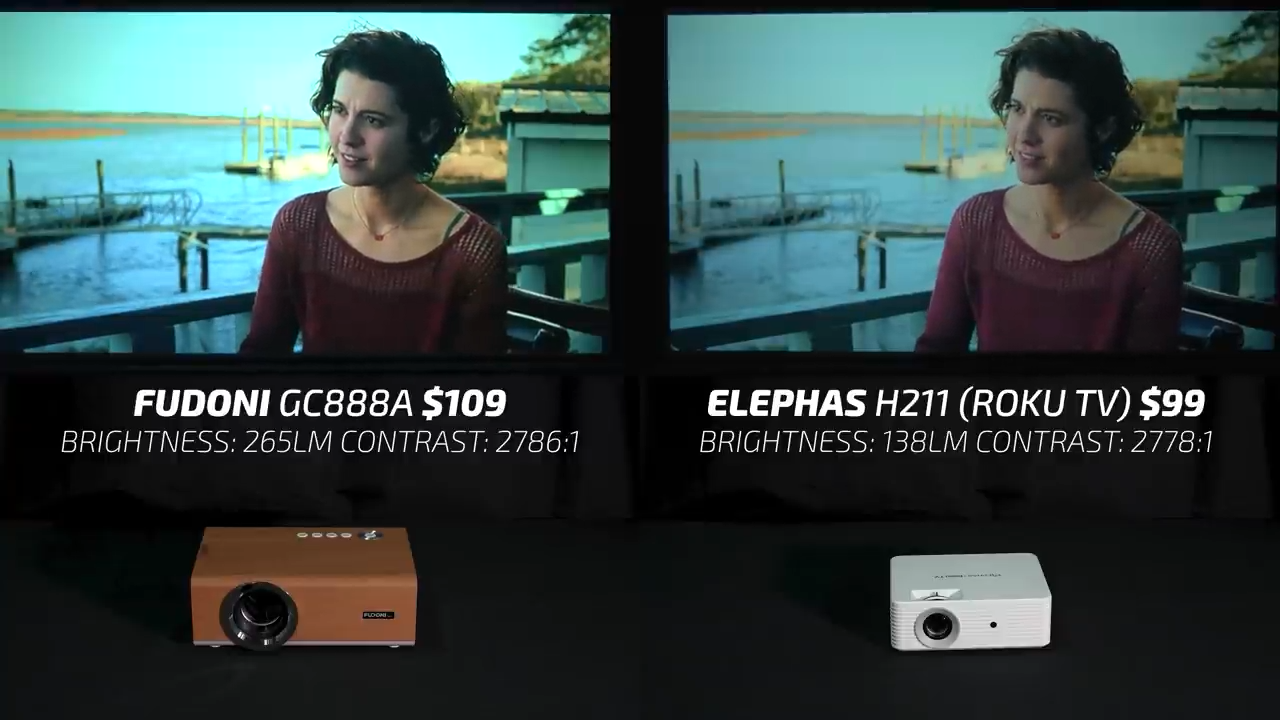
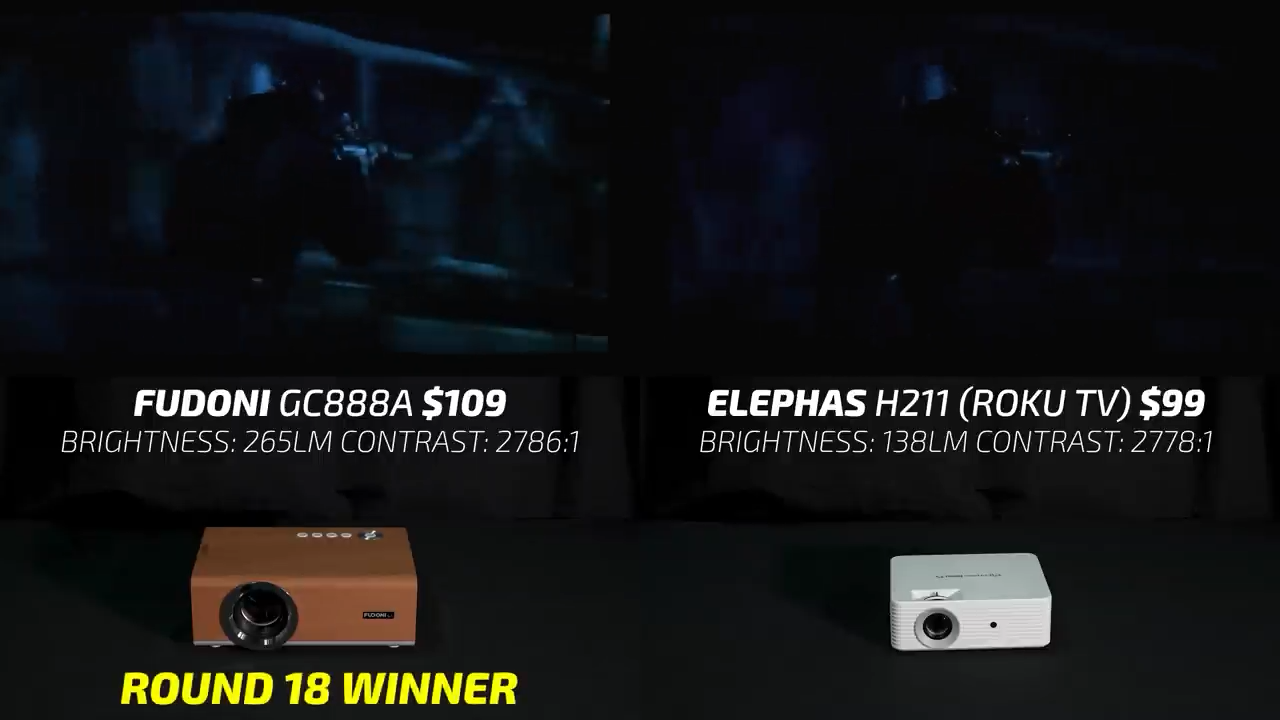
So the final round has the $99 Elephas Roku TV on the right and last year’s winner, the Fudoni GC888A on the left. Unfortunately, the Fudoni’s price hasn’t been below $100 since May 2026 and seems to have settled on a new price of $109. But in my opinion, it’s at least $10 better than the Elephas in terms of picture quality, with twice the brightness, a similar contrast ratio, and the same excellent color accuracy, making the Fudoni GC888A the clear choice in terms of strictly picture quality.
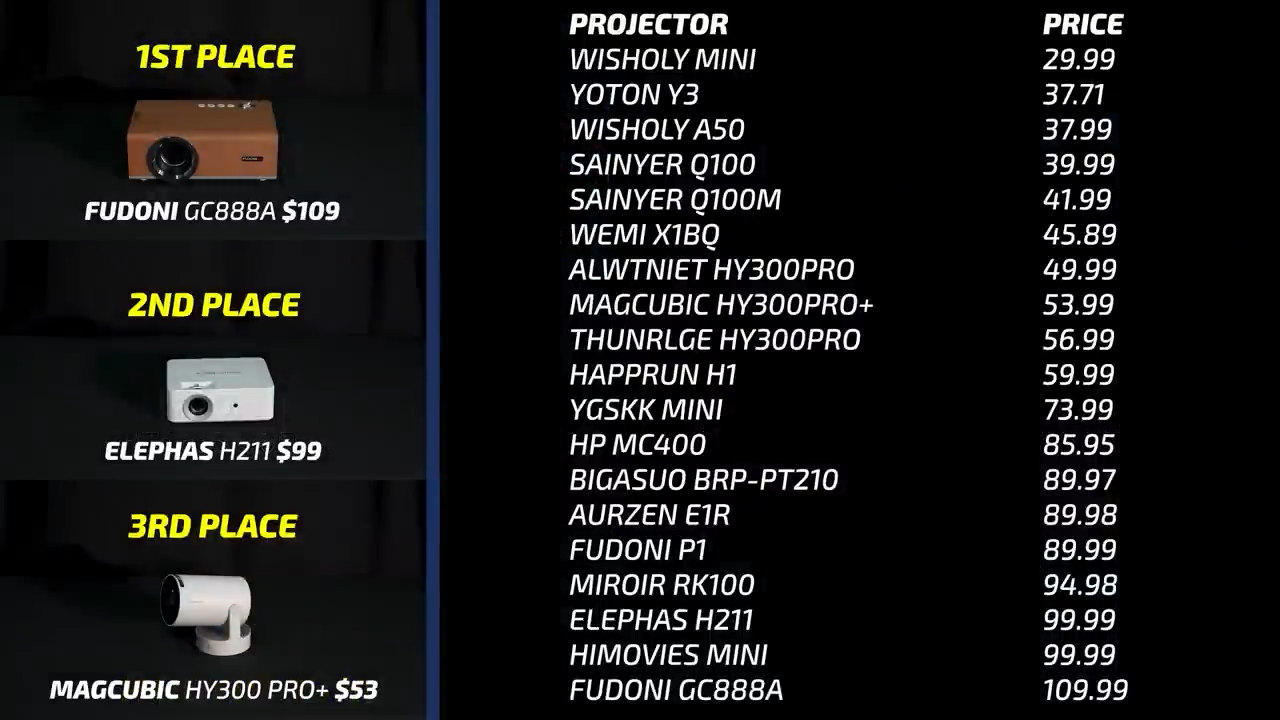
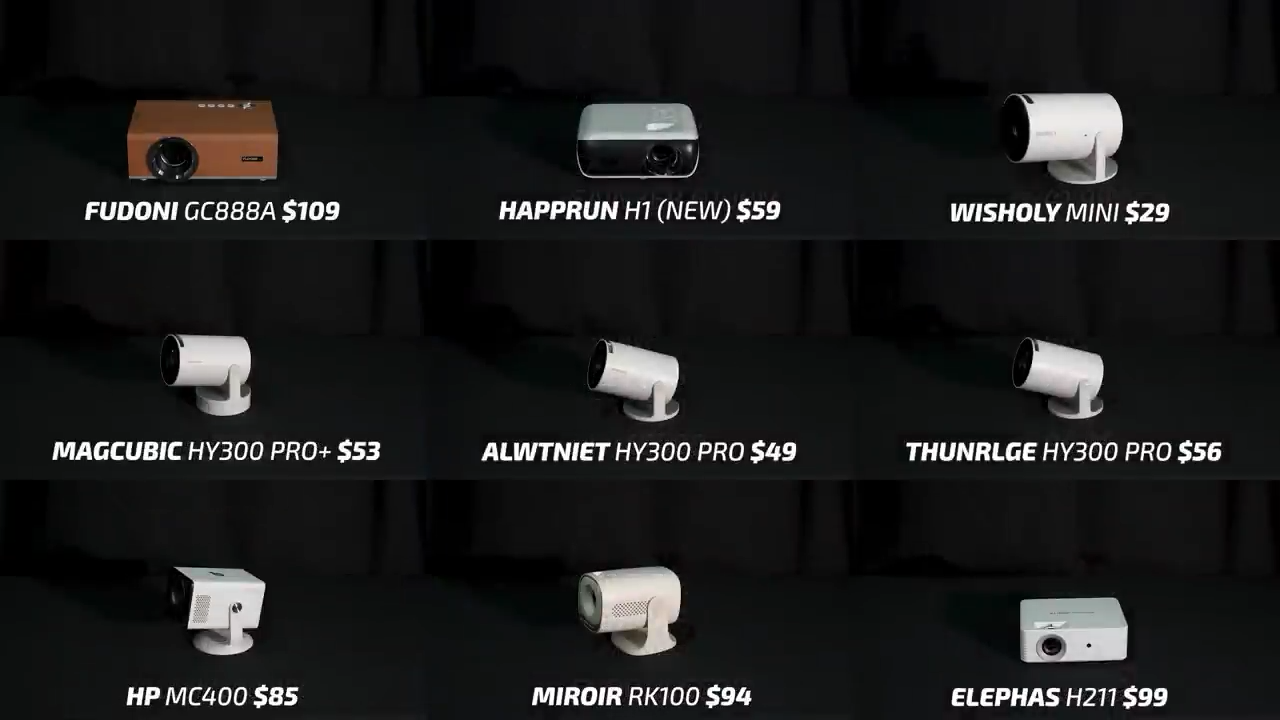
But there are plenty of other things to consider, so I went through and eliminated any projector that didn’t have good enough picture quality to be considered and that left these nine projectors for further testing. They can be divided up into three groups.
First are your mostly dumb projectors that require a streaming stick like a Fire TV as a source and those are the $109 Fudoni GC888A, $59 Updated Happrun H1, and the $29 WISHOLY Mini Projector.
Then you’ve got the Android projectors and while these projectors seem like they provide a ton of value with decent picture quality and all your favorite apps built-in including Netflix, Hulu and YouTube TV, you should be aware that malware has been found preinstalled on other inexpensive projectors running generic Android operating systems. The problem has become widespread enough that the FBI issued a warning about connecting them to your home network, so you should proceed with caution. But with that said, the finalists from this group are the Alwtniet HY300 Pro, Thunrlge HY300 Pro, Magcubic HY300 Pro+, and the HP MC400.
Last are the Roku TV projectors, which also have all of your favorite streaming apps built-in but offer a higher level of security against malware since Roku exercises more strict control over their operating system and app store than a generic Android system. While they’re not immune to malware, you probably don’t need to be as worried about your Roku TV projector becoming part of a botnet if you decide to connect it to the internet. The two finalist Roku TV projectors are the Miroir RK100 and the Elephas H211.
Fan Noise
Starting our more in-depth testing with fan noise, here they are from loudest to quietest.
Throw Ratio
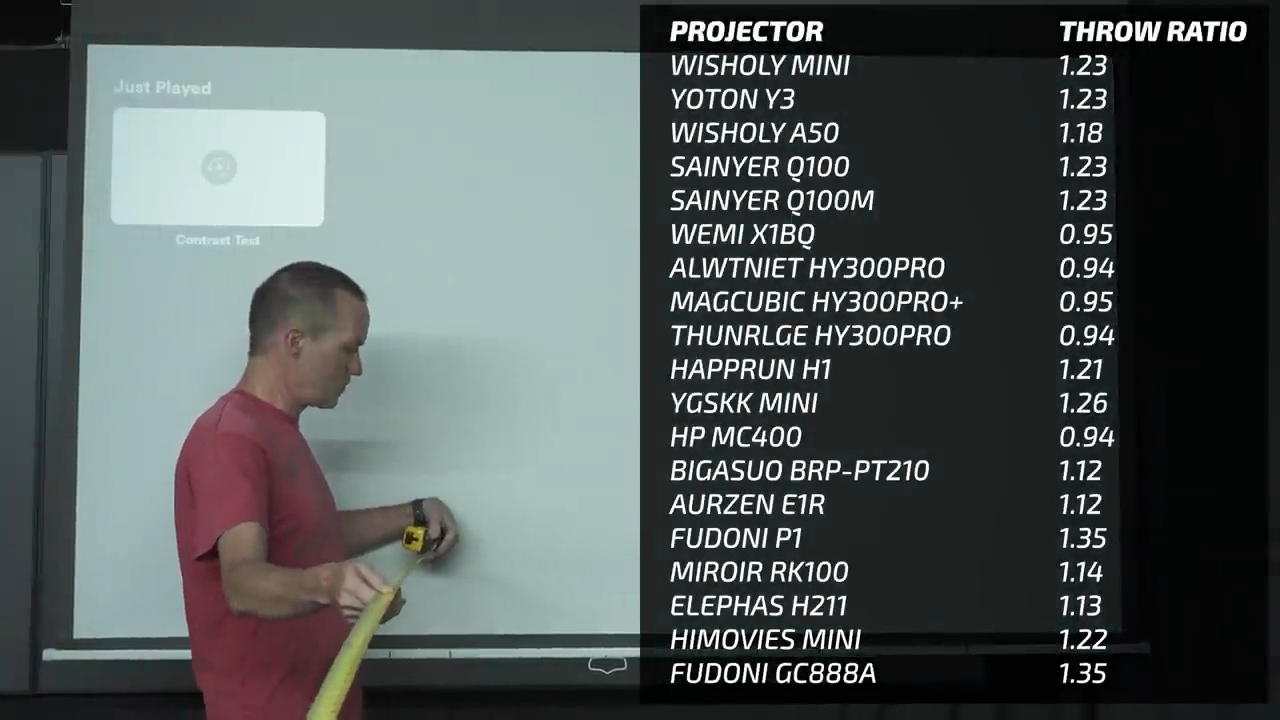
Next, throw ratio is how far away from the screen the projector needs to be to create a certain size image. If you have a wall that you want to project onto, just measure your desired screen width and multiply it by the number in this chart and that will tell you how far away the projector needs to be from the screen.
Keystone
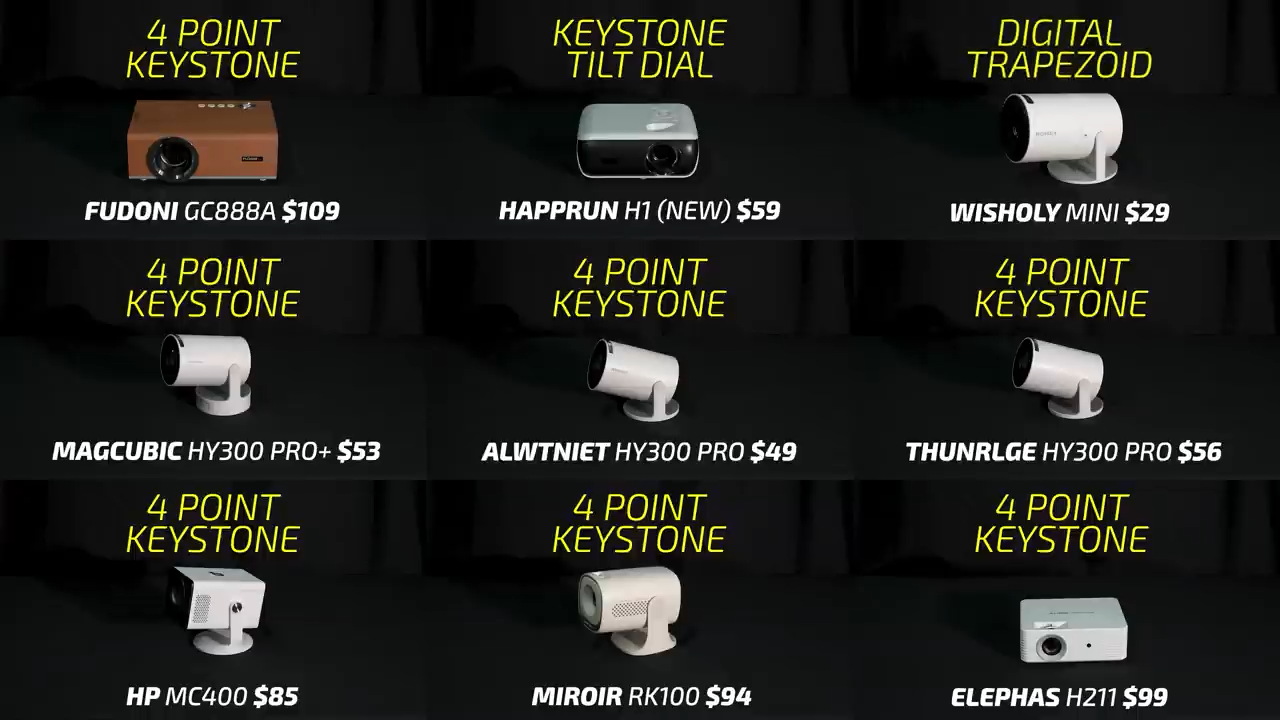
Keep in mind though that all these projectors have 0% offset meaning the projector will be lined up with the middle of the screen rather than the top or bottom like most traditional home theater projectors, so if you want to put it on a coffee table you’re going to need to use keystone. All of the projectors except the Happrun and WISHOLY have digital 4-point keystone to help you project a perfectly rectangular screen regardless of placement, while the Happrun just has a mechanical keystone tilt dial, and the WISHOLY has digital trapezoid keystoning instead of the more advanced 4-point corner pinning.
Focus and Resolution
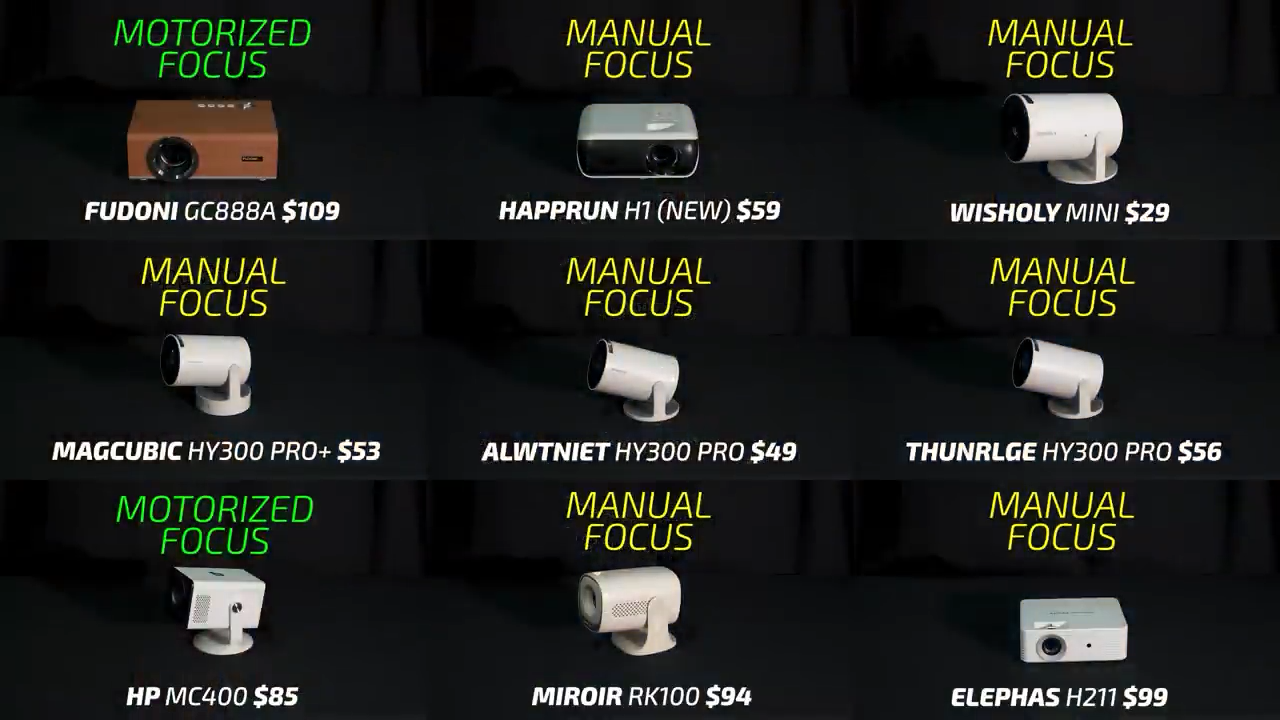
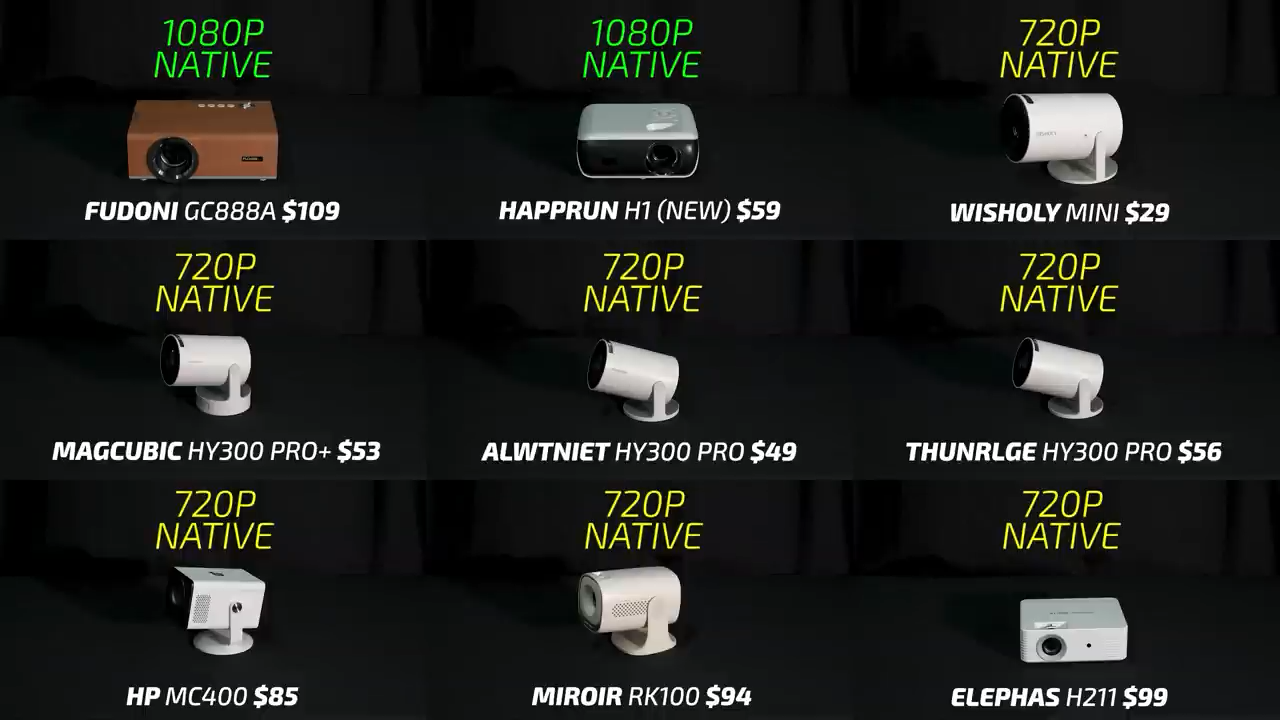
As for focus, the Fudoni GC888A and HP MC400 have motorized focus using the remote while the rest have a traditional focus wheel on the projector itself, and when it comes to screen sharpness, only the Fudoni GC888A and Happrun H1 use native 1080p LCDs and the rest are 720p native.
Input Lag
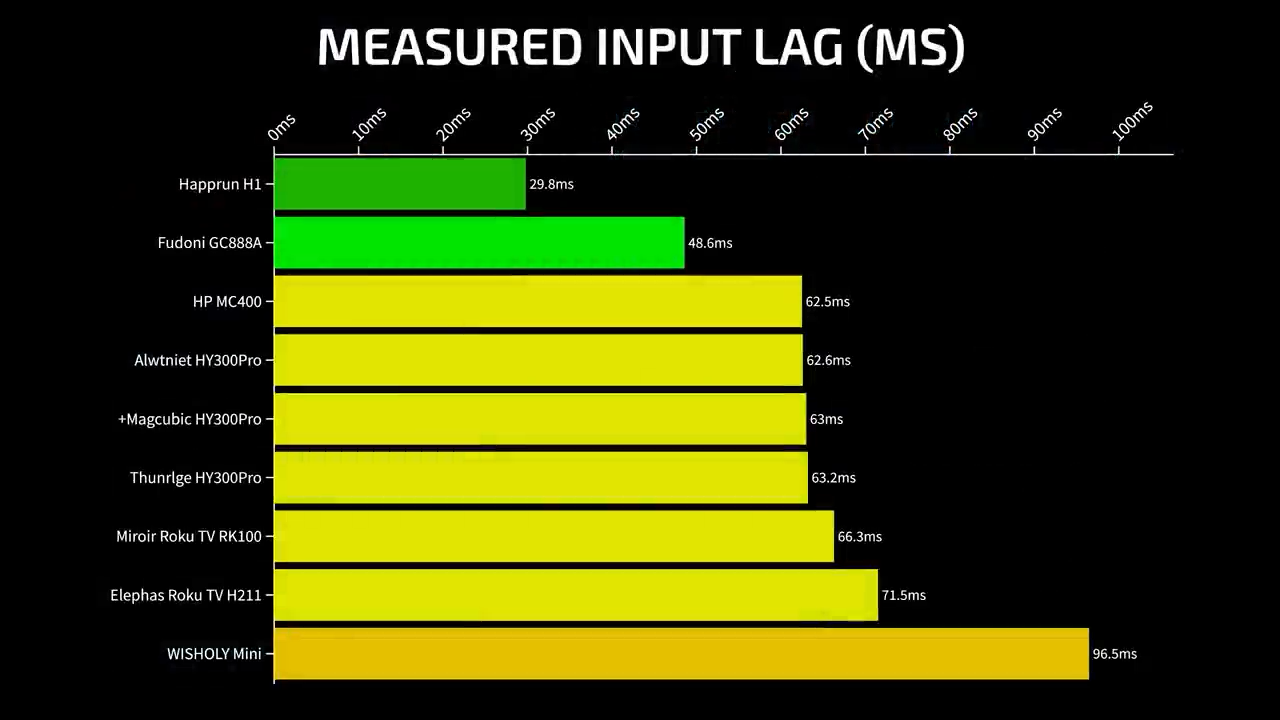
If you want to play video games on your projector, the input lag is important. None of these are great, but the Happrun H1 and Fudoni GC888A are at least under 50ms which should be fine for casual gaming.
USB Power and HDMI CEC
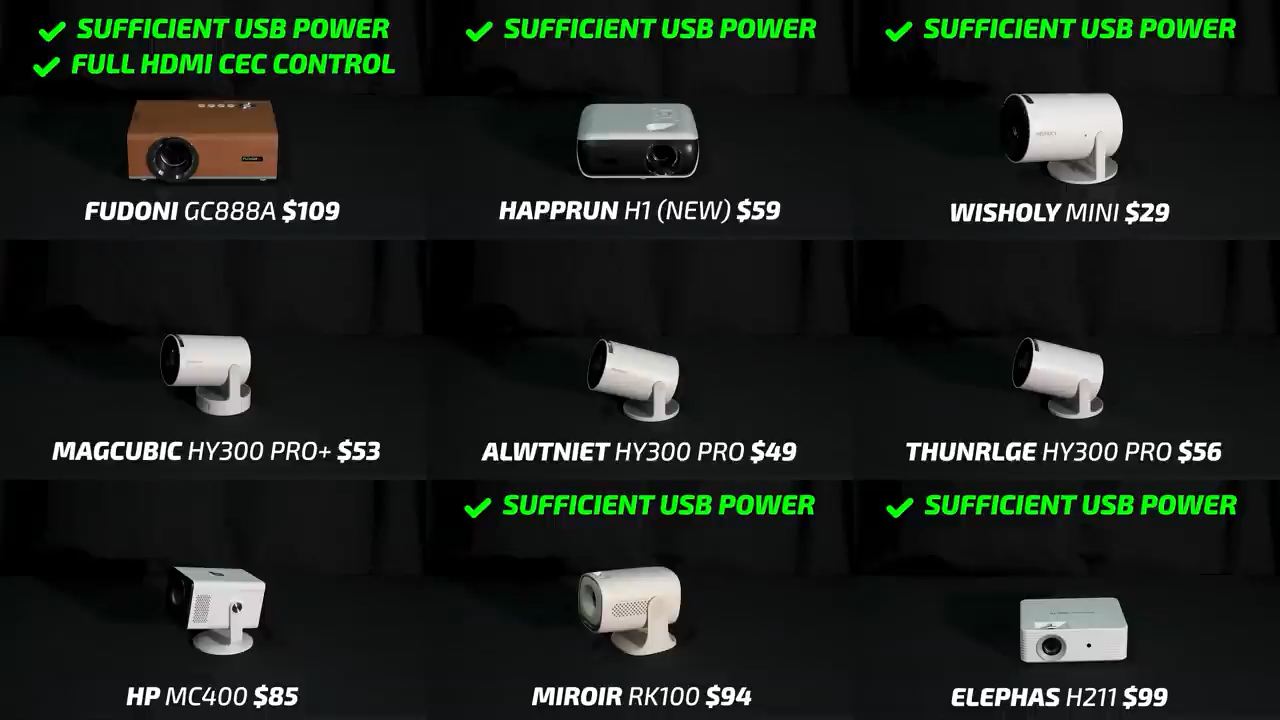
As I mentioned before, the Roku TV projectors are probably the only ones you should connect to the internet to use the built-in streaming apps. So for each projector, I looked at whether or not the USB port on the projector could power a Fire TV stick and whether the projector remote could control the streaming stick over HDMI CEC.
Speaker Quality
When it comes to their internal speakers, they’re not great. They all work with Bluetooth to connect to your headphones or a separate speaker, but if you want to use the internal speakers here’s what they sound like from quietest to loudest, with my subjective quality grade overlayed.
Dust Cleaning and Light Leakage
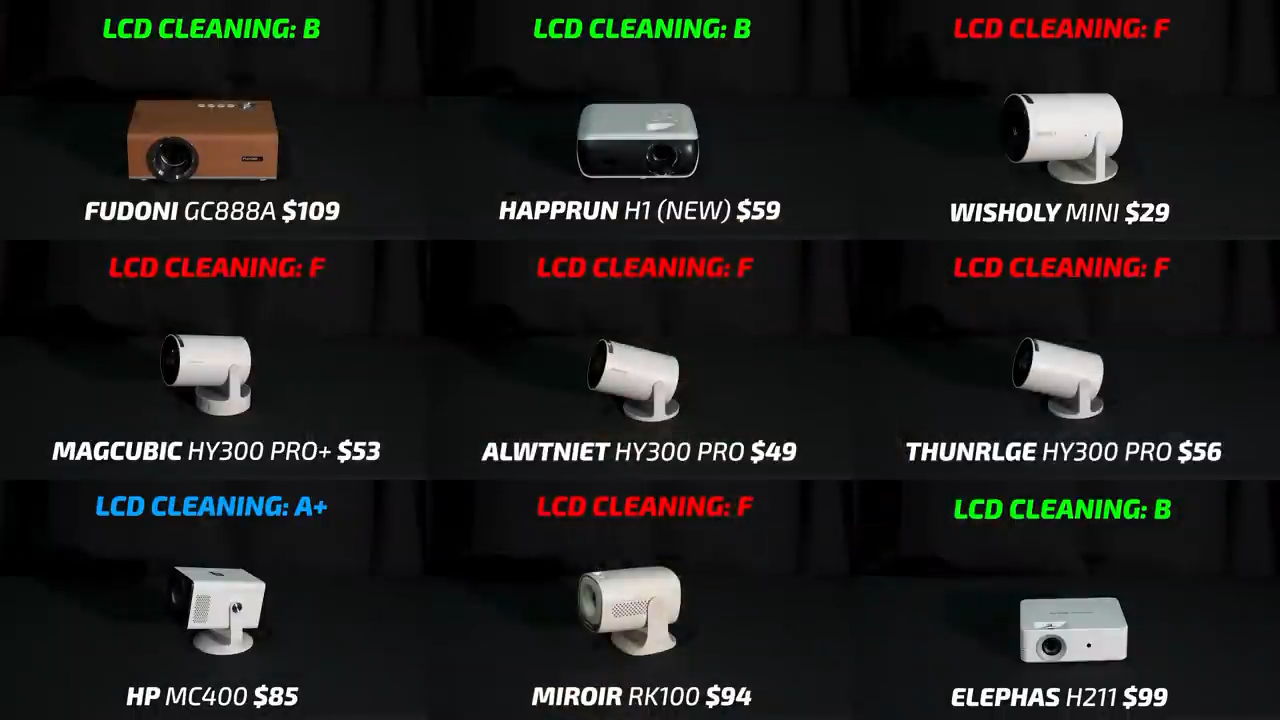
Last, none of these projectors use fully sealed light engines which causes two problems. First, there’s potential for dust to settle on the internal LCD screen, mess with the image, and cause premature failure. So, for each, I graded them on how easy it is to access the LCD for cleaning with “A” being convenient access panels and “F” requiring nearly a full teardown of the projector.
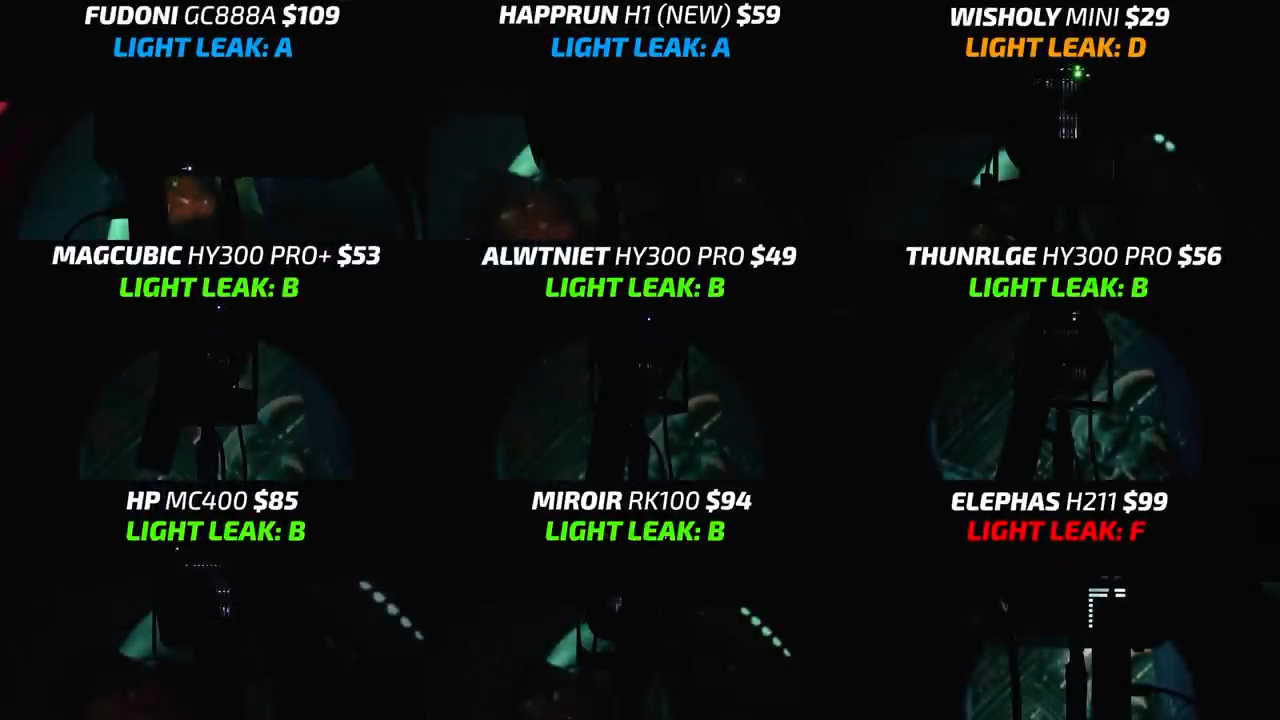
The second issue that comes from a more free air light engine is light leakage from the back of the projector. Again, I ranked these A to F with A being no light leak and F being a very distracting amount.
Final Results
Tallying up all the scores, I’ve got recommendations.
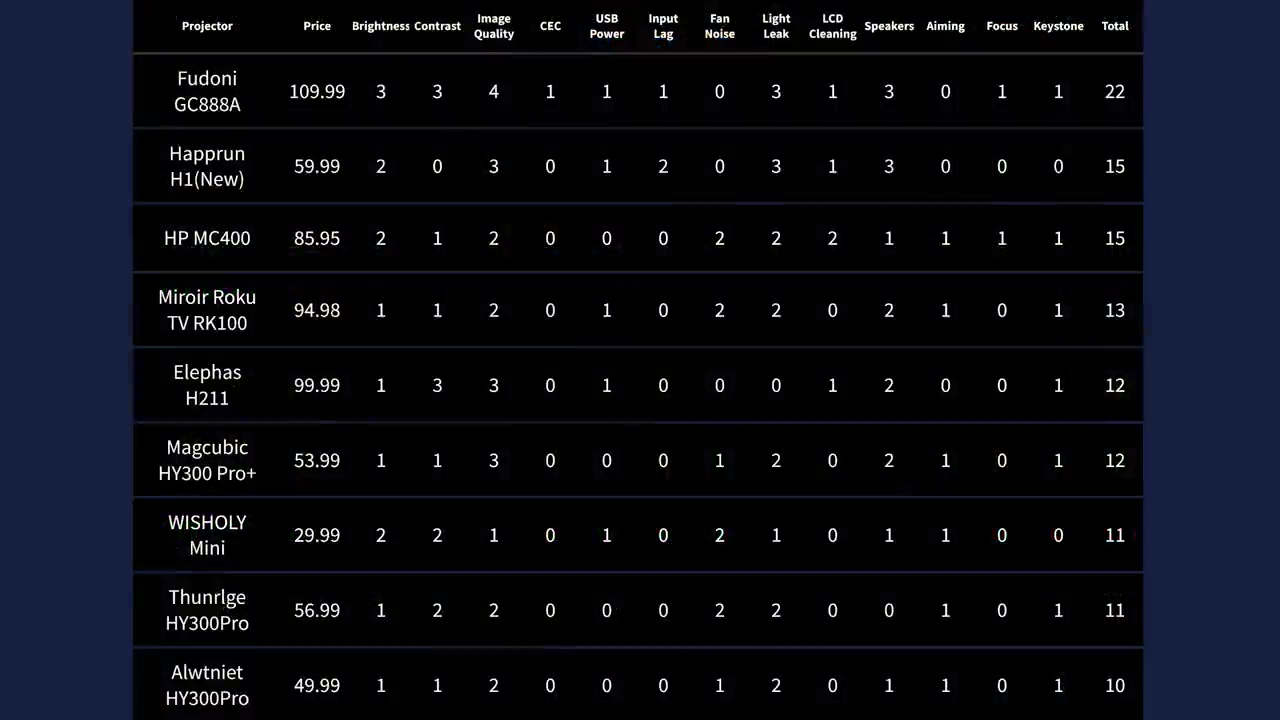
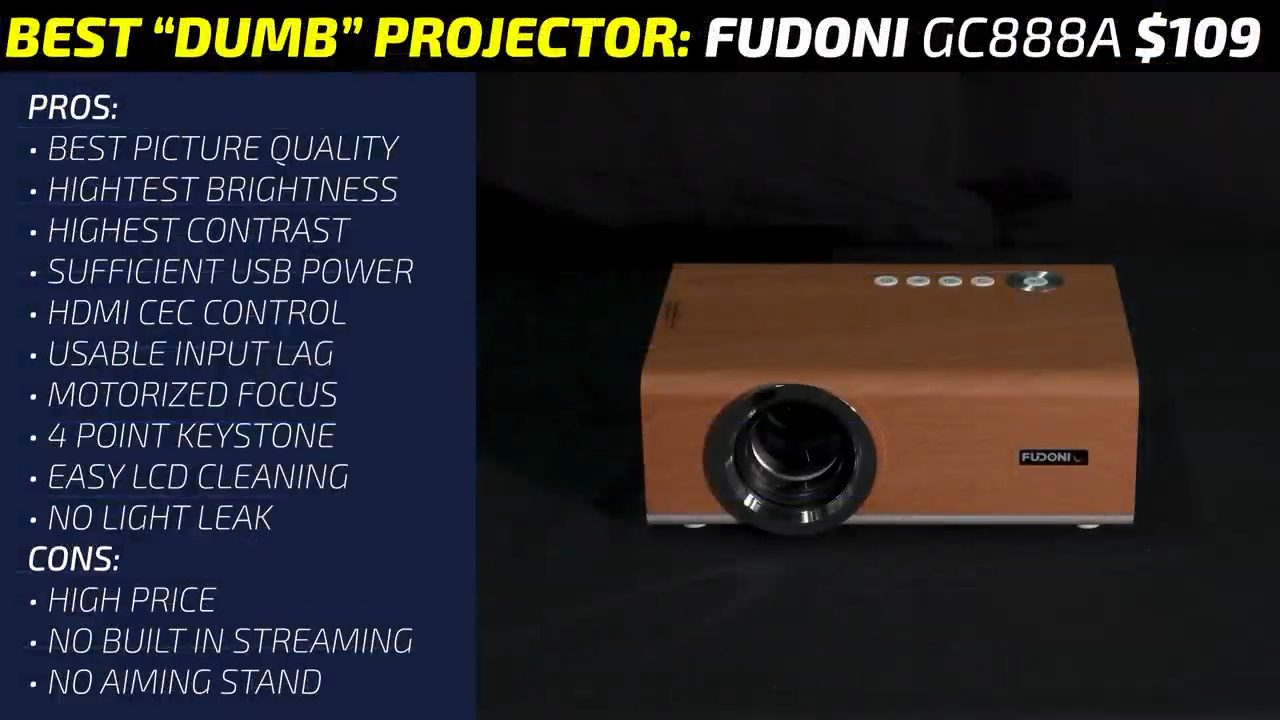
First, if you’re looking for an inexpensive projector to use with external sources like a Fire stick or a video game console, the Fudoni GC888A is the clear winner with a USB port that provides enough power for your streaming stick, HDMI CEC control, usable input lag, and the best brightness, contrast, and picture quality, plus more advanced features like motorized focus and 4-point keystone, but it is $109.
In 2nd, for $50 less, the updated Happrun H1 still has good brightness, image quality, and input lag but it lacks the more premium features for focus, keystone, and HDMI control.
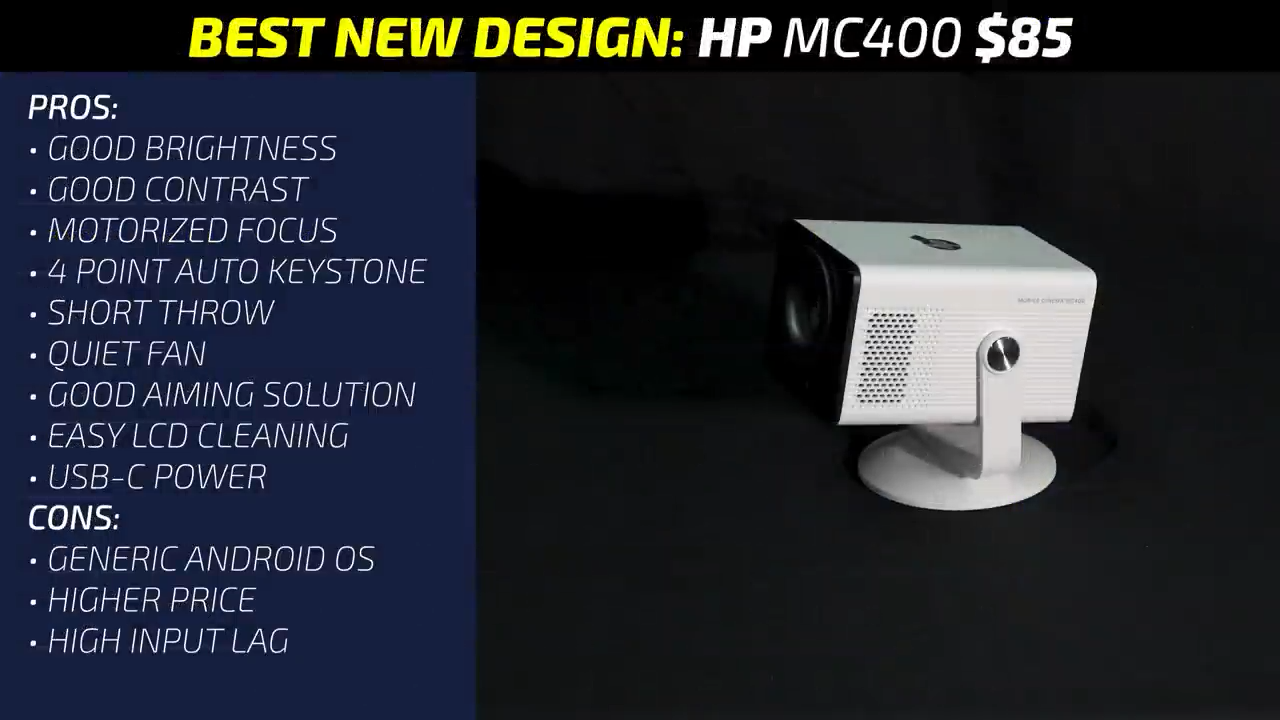
An honorable mention goes to the HP MC400 that is overall just a well-rounded and thoughtfully designed projector, with decent brightness and contrast, a quiet fan, a short throw ratio, 4-point keystone, and motorized focus in addition to a washable filter and easy LCD cleaning access port. I’m even tempted to say that it being sold by HP means it’s less likely to have malware preinstalled on its Android operating system, but I don’t have any data to back that up.
As I said, if you want a projector you can safely connect to your Wi-Fi, the Miroir RK100 provides a similar form factor and image quality to the HY300 Pro but with Roku TV instead of Android. If you want a Roku TV that maximizes picture quality, the Elephas H211 looks great but has substantial light leak from the back that will be distracting if the projector is in front of your seating position.
Digital Decoration Testing
Last, for people who want to use these projectors as digital decorations for Halloween or Christmas, I checked out USB video playback behavior and only the WISHOLY Mini Projector’s built-in player avoids showing file names and playback controls between videos. But all of the Android projectors allow you to load VLC media player using an APK and VLC lets you create playlists that can repeat and doesn’t display file names or playback controls.
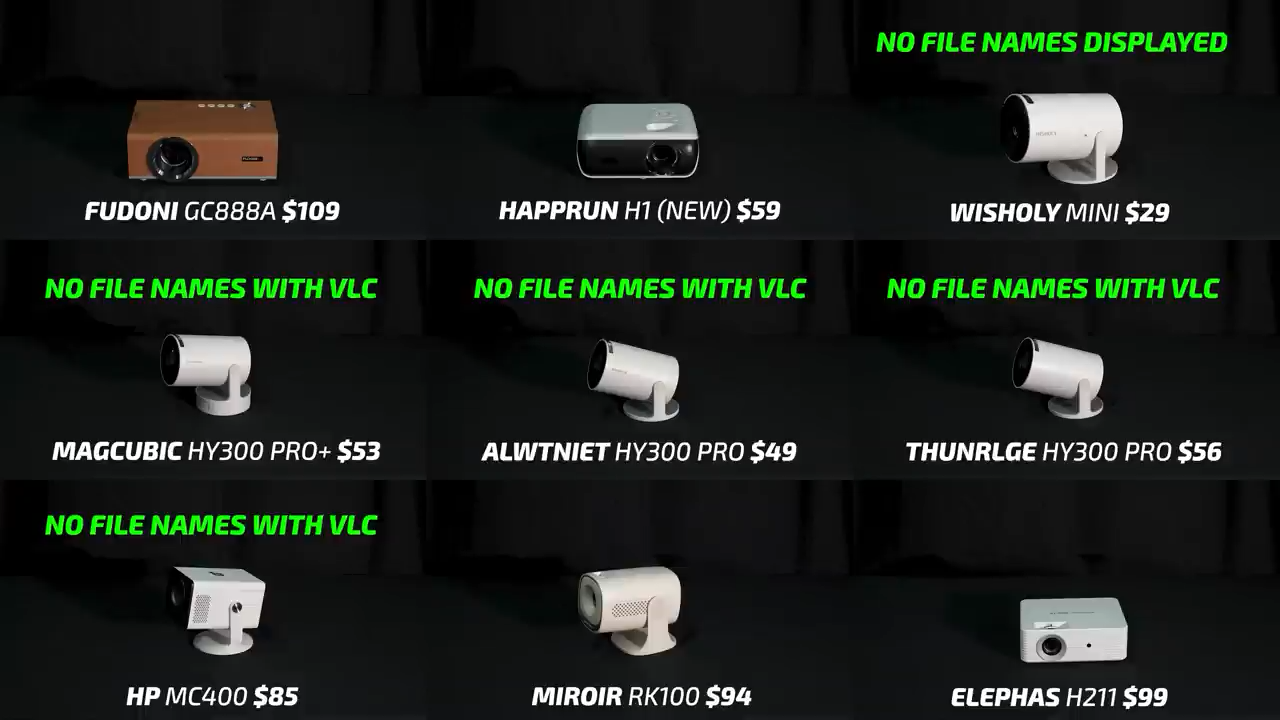
So, my two recommendations for digital decoration projectors are the WISHOLY Mini Projector, just for the shear value of getting 172 lumens for $29, and the new HP MC400, which again, is just a well-rounded and thoughtfully designed projector but has two additional digital decoration tricks up its sleeve. First, it has some internal memory so you can copy your video files right onto the projector itself and avoid having a USB drive plugged in all the time. Second, it uses USB-C PD for power, so a battery bank capable of providing 20V over USB-C makes it completely portable. With a power draw of under 40W, a 20,000mAh bank will run the MC400 for about 2 hours on high brightness mode, and 2.5 hours on eco mode.
As always, there are no sponsored reviews on this channel, but I do have links below to all of the projectors in this video, and as always, I appreciate it when you use those links since as an Amazon affiliate I do earn a small commission on the sale at no cost to you.
I’d also like to thank all my awesome patrons over at Patreon for their continued support of my channel and if you’re interested in supporting my unsponsored reviews, please check out the links below. If you enjoyed this video, please consider subscribing to my YouTube channel and as always, thanks for watching The Hook Up.