Read BEFORE You Buy a Portable Projector in 2026
October 23, 2026Today on The Hook Up, I’ve got nine new portable projectors from Samsung, XGIMI, NexiGo, Nebula, Aurzen, and TCL. I’m going to test their brightness, battery life, contrast, and color performance. Then I’ll put them head to head to test overall picture quality. Then we’ll look at speaker quality, input lag, fan noise, and their individual real life use cases to see if any of them are worth buying. As always, there are no sponsored reviews on this channel, and all the data in this video is the result of my own measurements rather than relying on manufacturer claims and spec sheets.
XGIMI Elfin Flip Plus
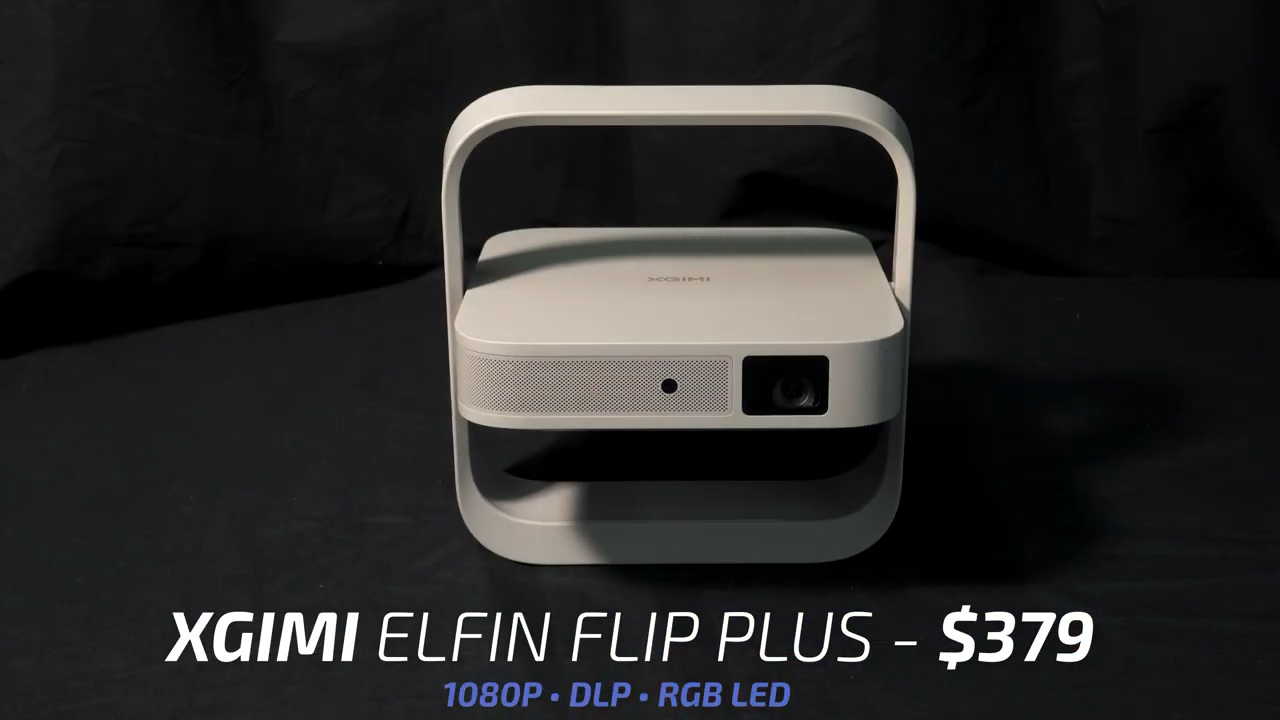
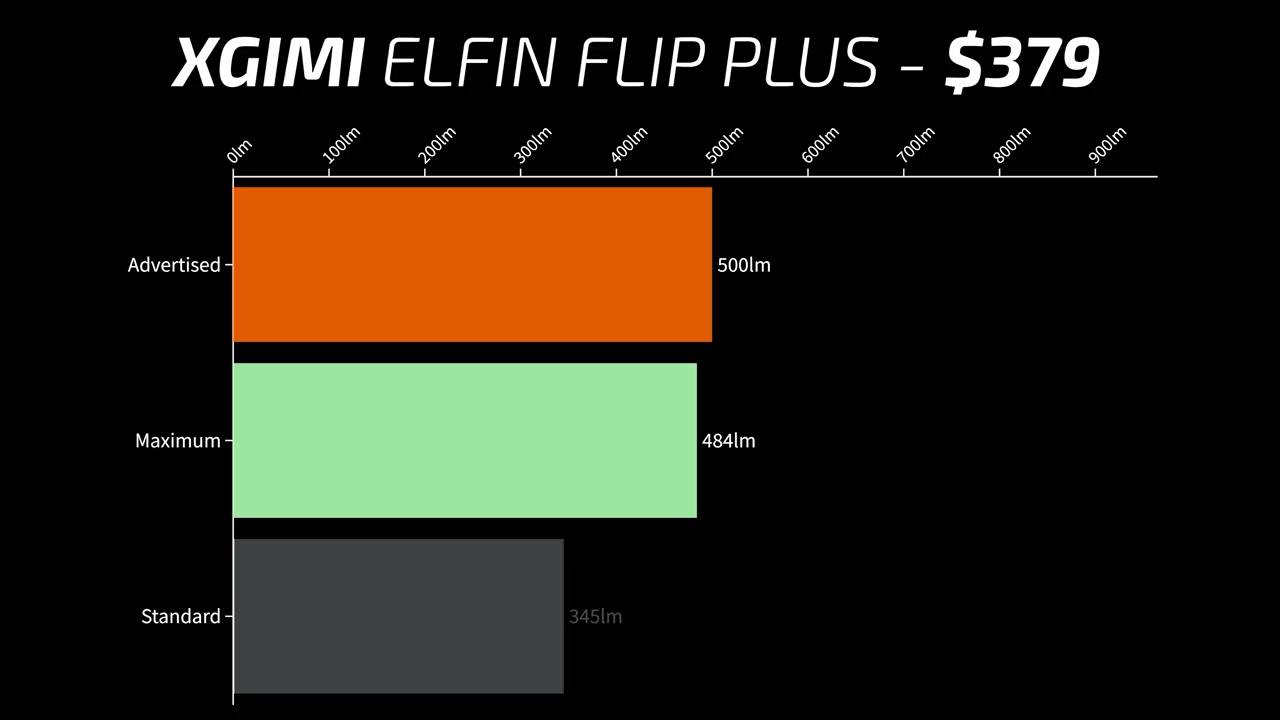
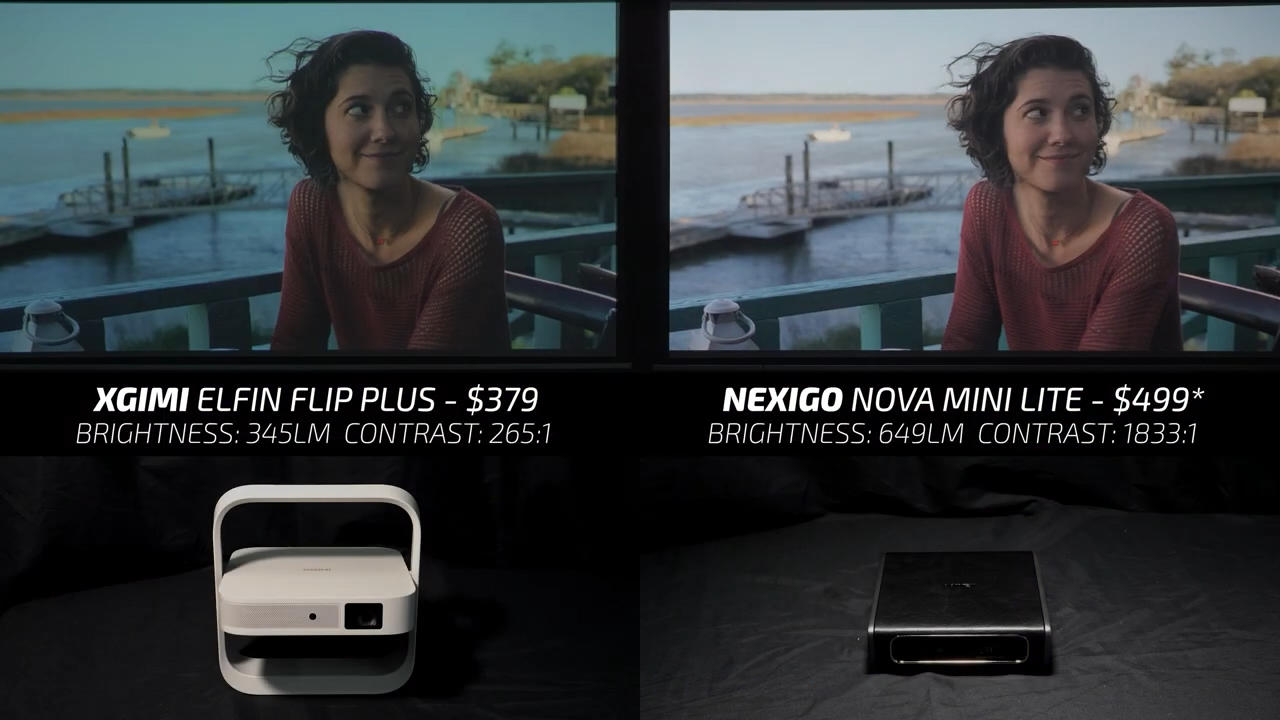
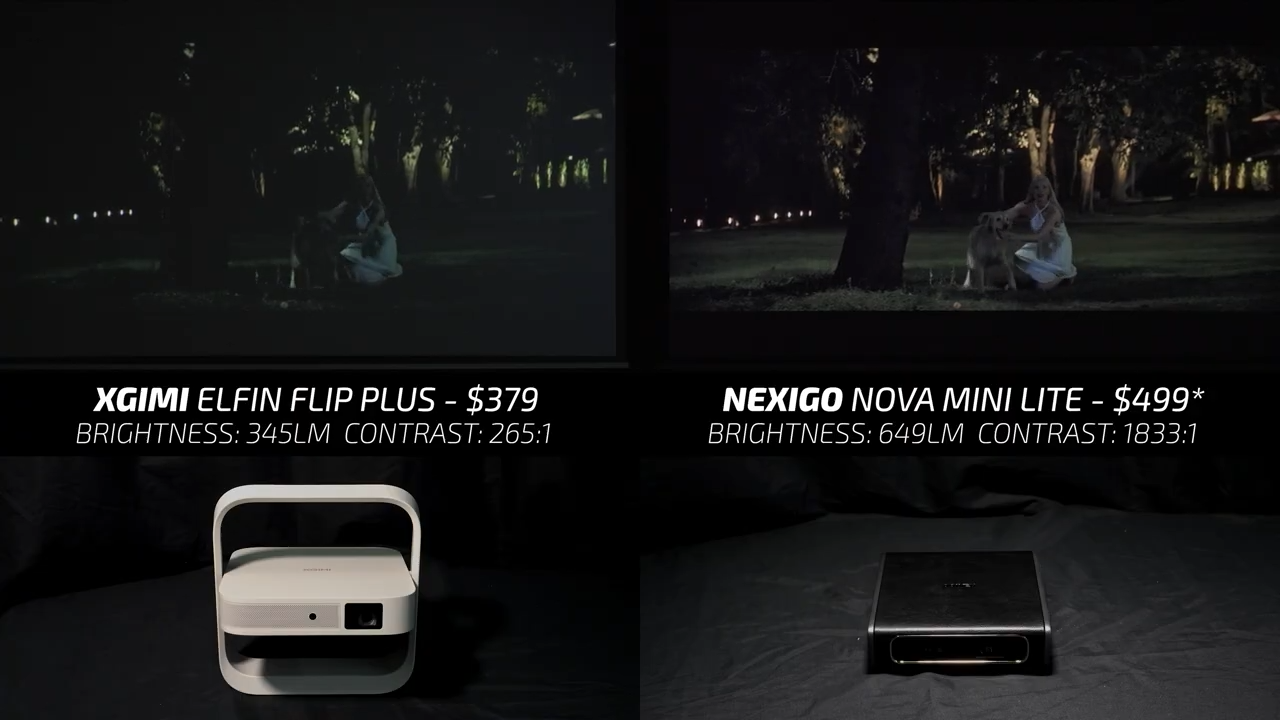
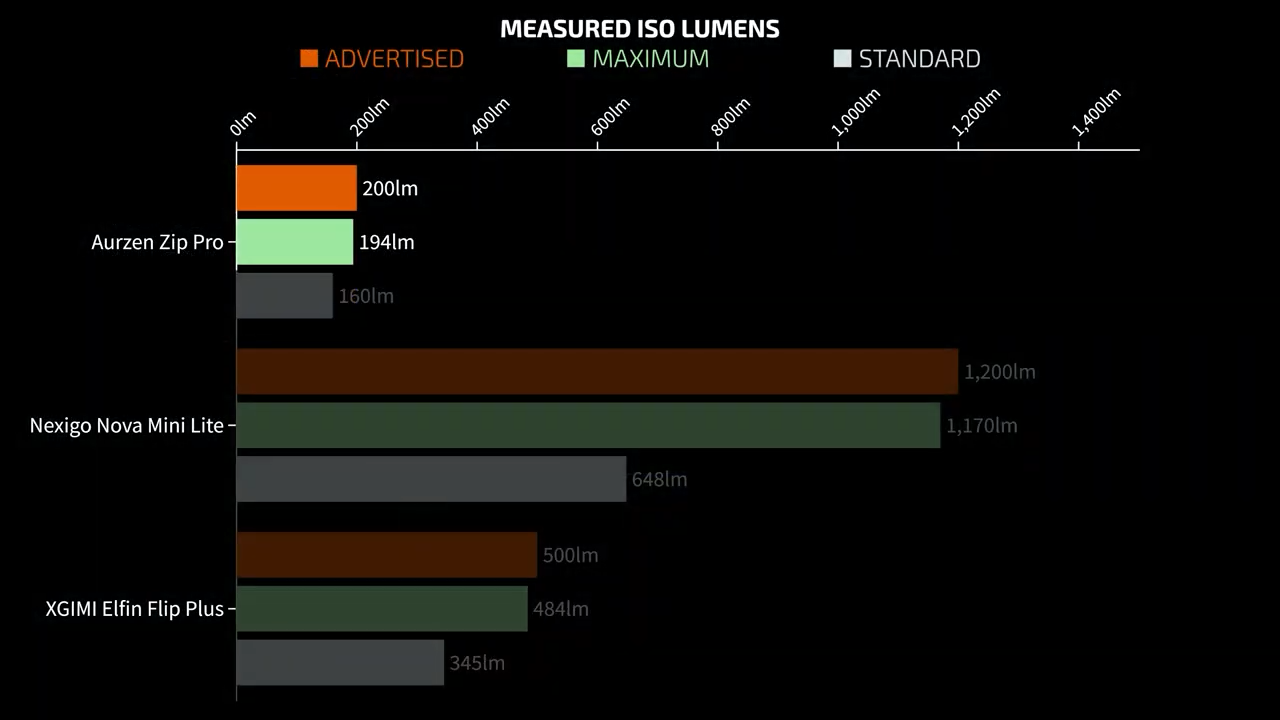
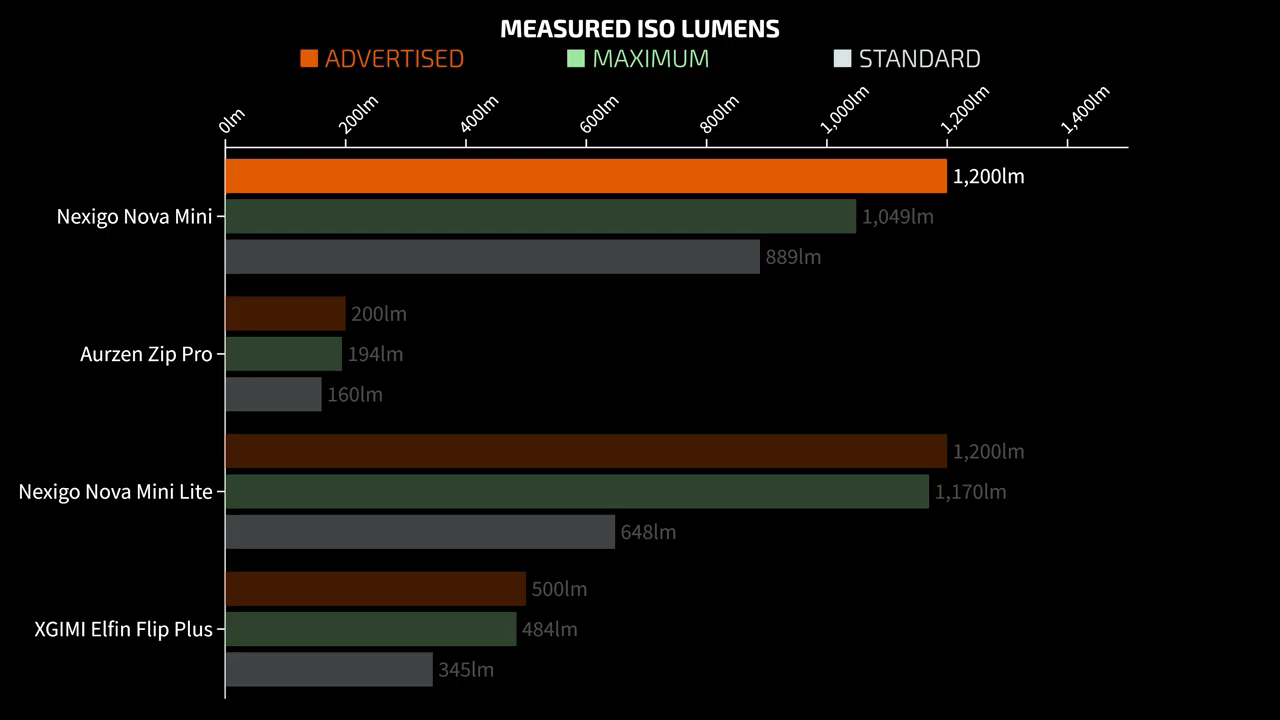
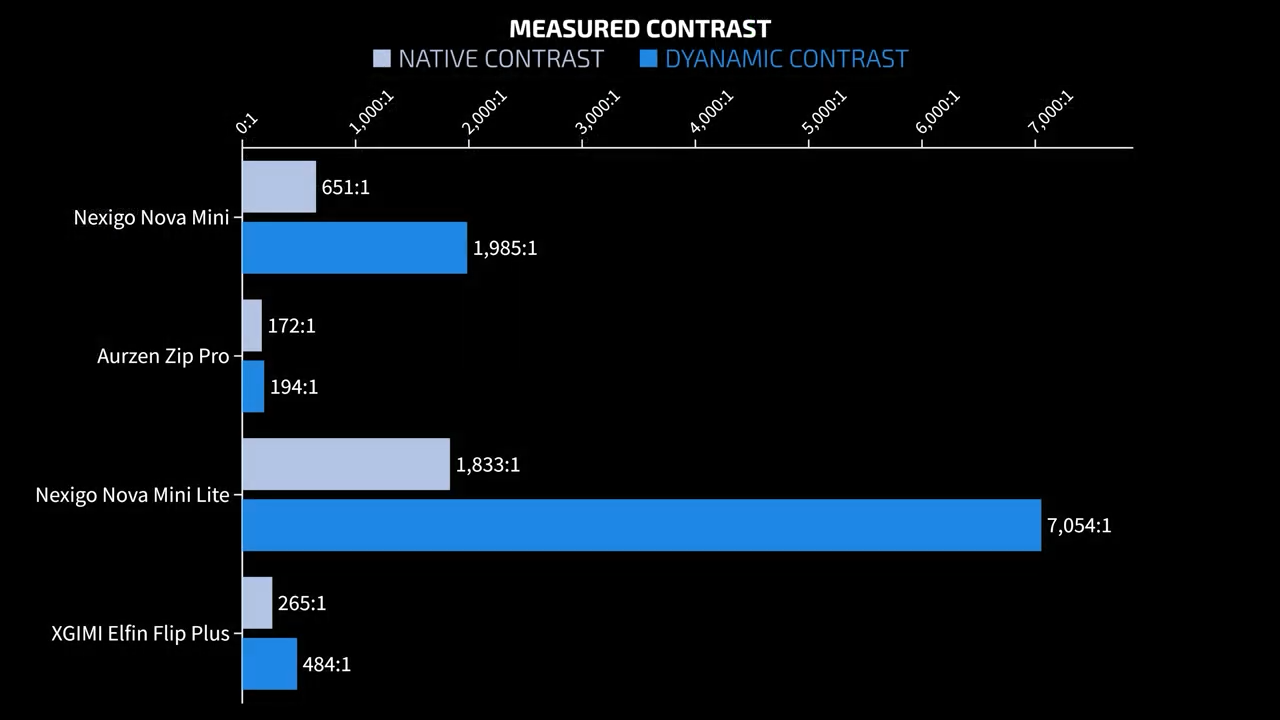
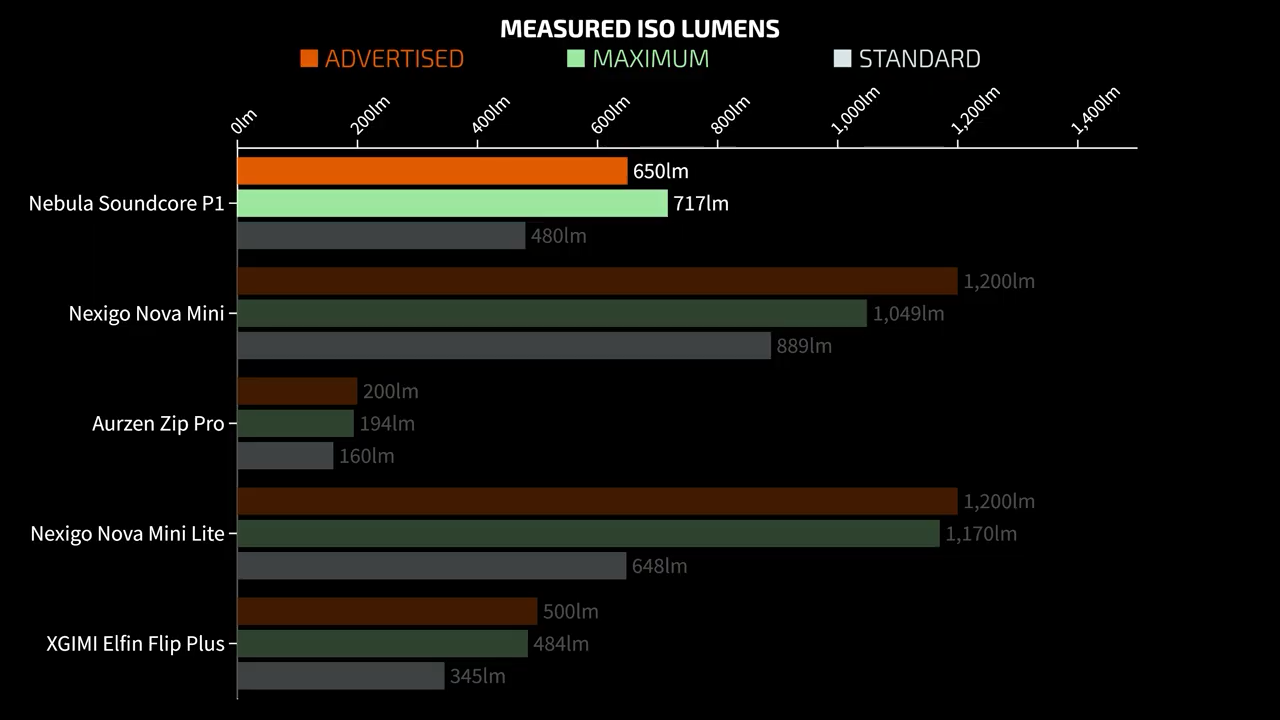
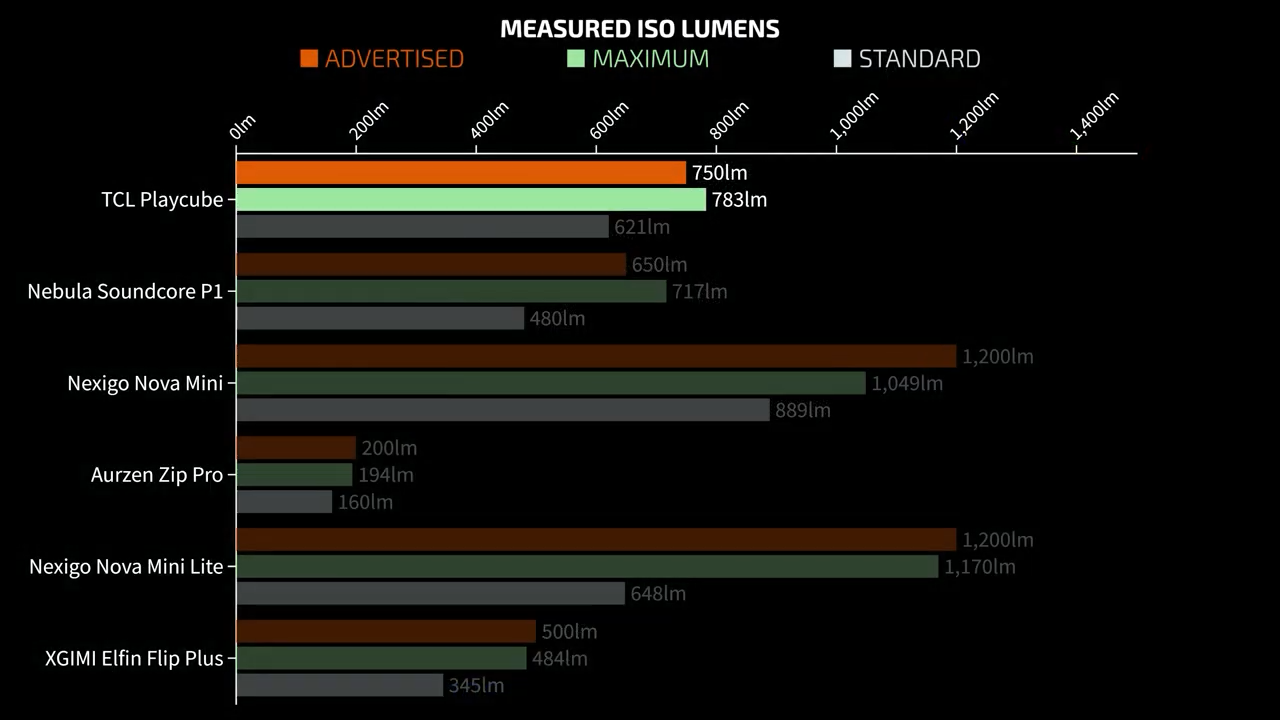
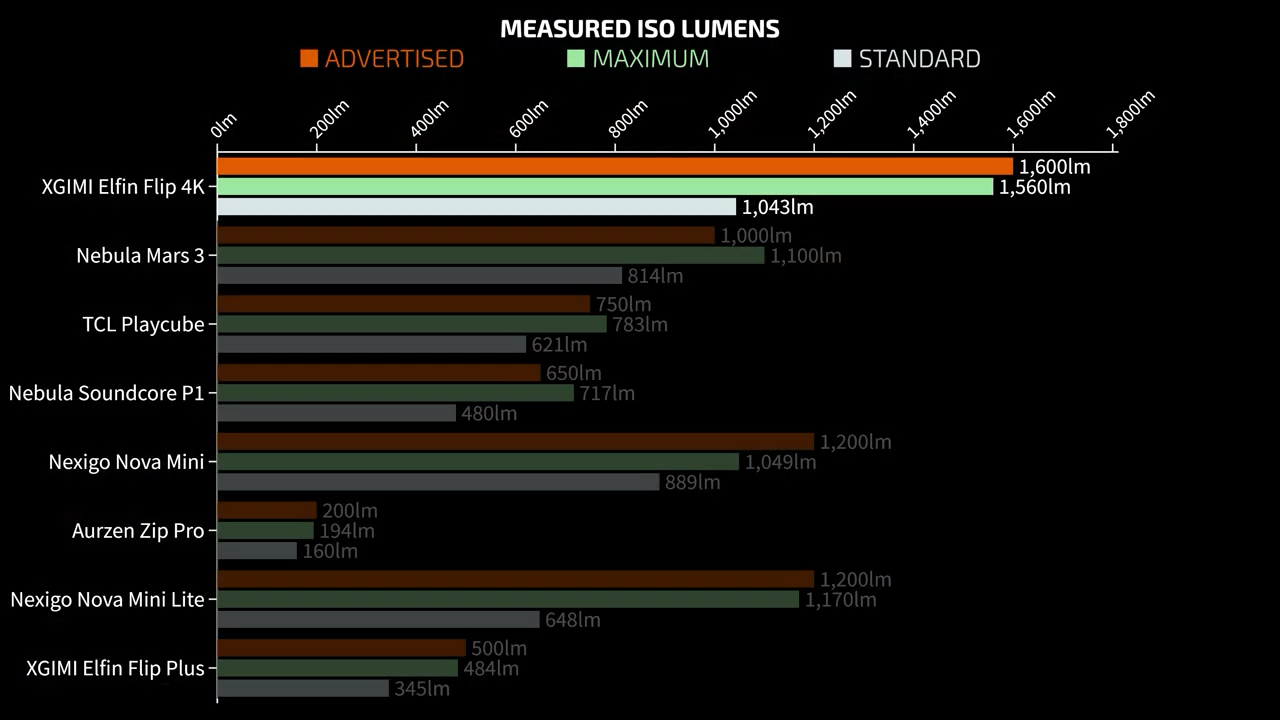
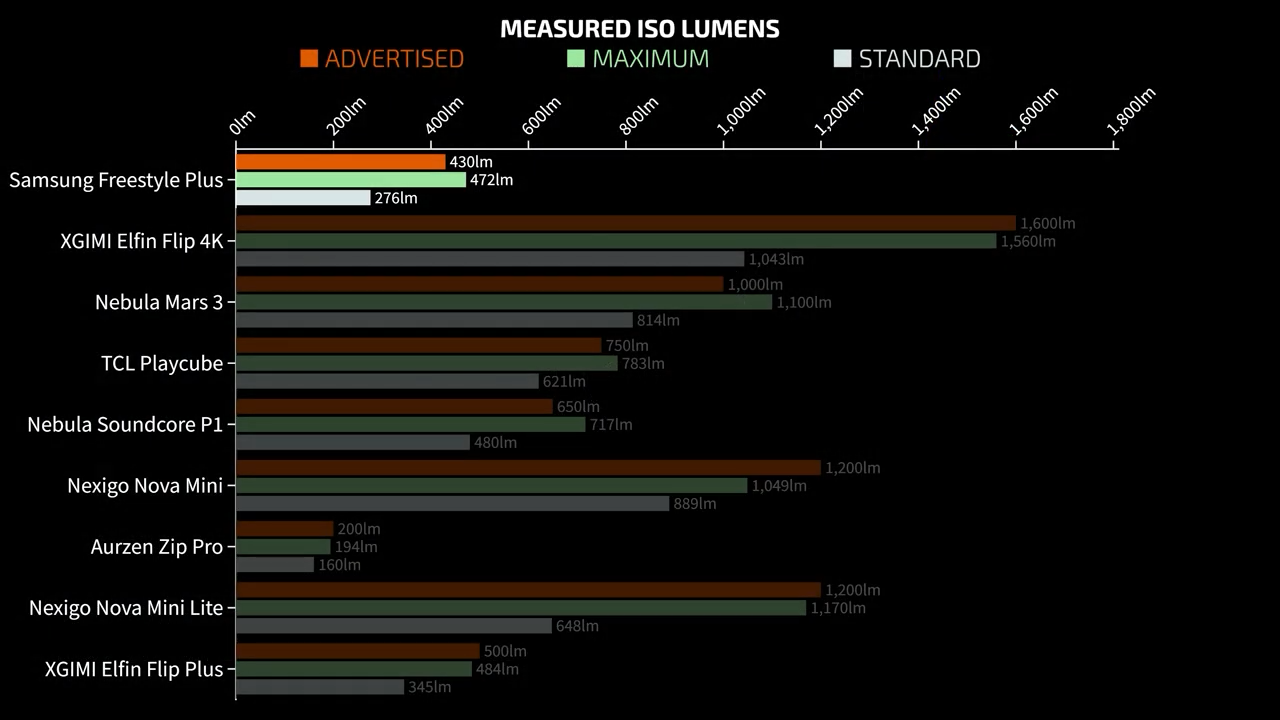
Starting with the least expensive projector in the video, the $379 XGIMI Elfin Flip Plus is a compact 1080p DLP projector with an RGB LED light source measuring approximately 8.5” by 9.5” when stored and flips out of its attached gimbal stand for easy aiming. The Elfin Plus is advertised to have 500 lumens, and I measured 484 lumens on high-performance mode where the fans ramp to 100% and the color shifts toward green, but is mostly still tolerable, while the more color accurate standard mode has 345 lumens. The XGIMI Elfin Plus has a very low contrast ratio of just 265:1 and color accuracy was about average for these portable projectors but would be considered fairly poor compared to higher priced non-portable projectors.
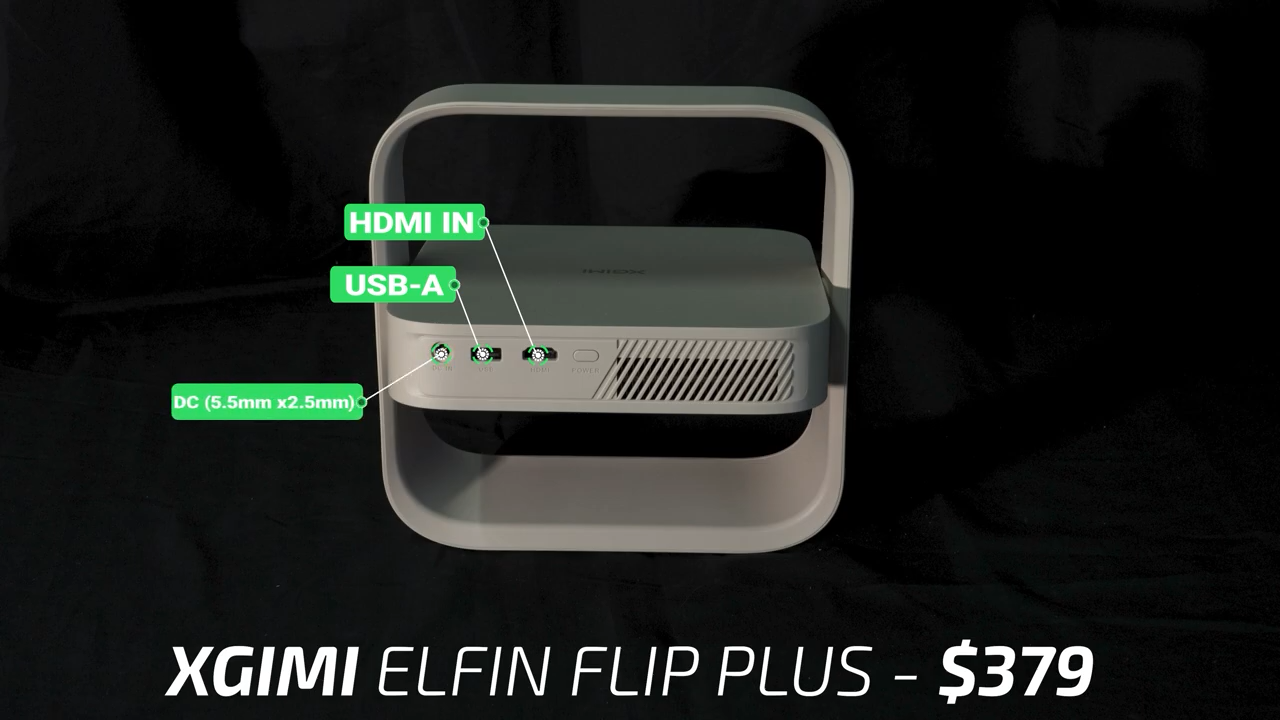
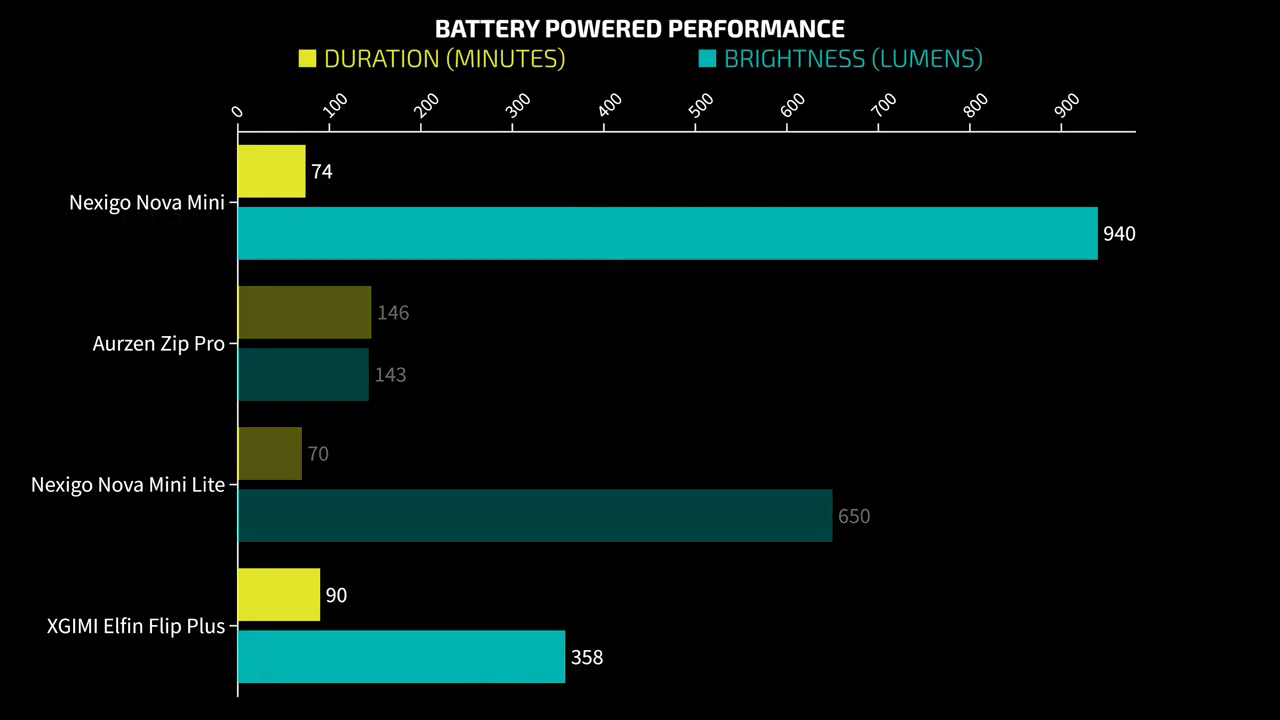
The Elfin Plus comes with Google TV OS but uses an older chipset that was slow and laggy compared to most of the other projectors in this video. For external inputs, the Elfin has one HDMI port and one USB. Also, XGIMI has chosen to use a DC barrel jack instead of USB-C to power the Elfin, but I purchased this 20V USB-C to barrel jack converter to be able to use the Elfin Plus with a PD capable battery bank and my 20,000mAh UGREEN bank powered the Elfin Plus for exactly 90 minutes before shutting off.
NexiGo Nova Mini Lite
In Round 1, the Elfin Plus is going to go up against the new NexiGo Nova Mini Lite, which is currently in pre-order for $499, but is expected to have an MSRP of $799. The Nova Mini Lite measures approximately 7” by 7” and has a built-in battery that is advertised to offer 2 hours of playback. In my testing, it lasted 1 hour and 50 minutes in Eco mode where it outputs around 300 lumens or an hour and 10 minutes at 650 lumens.
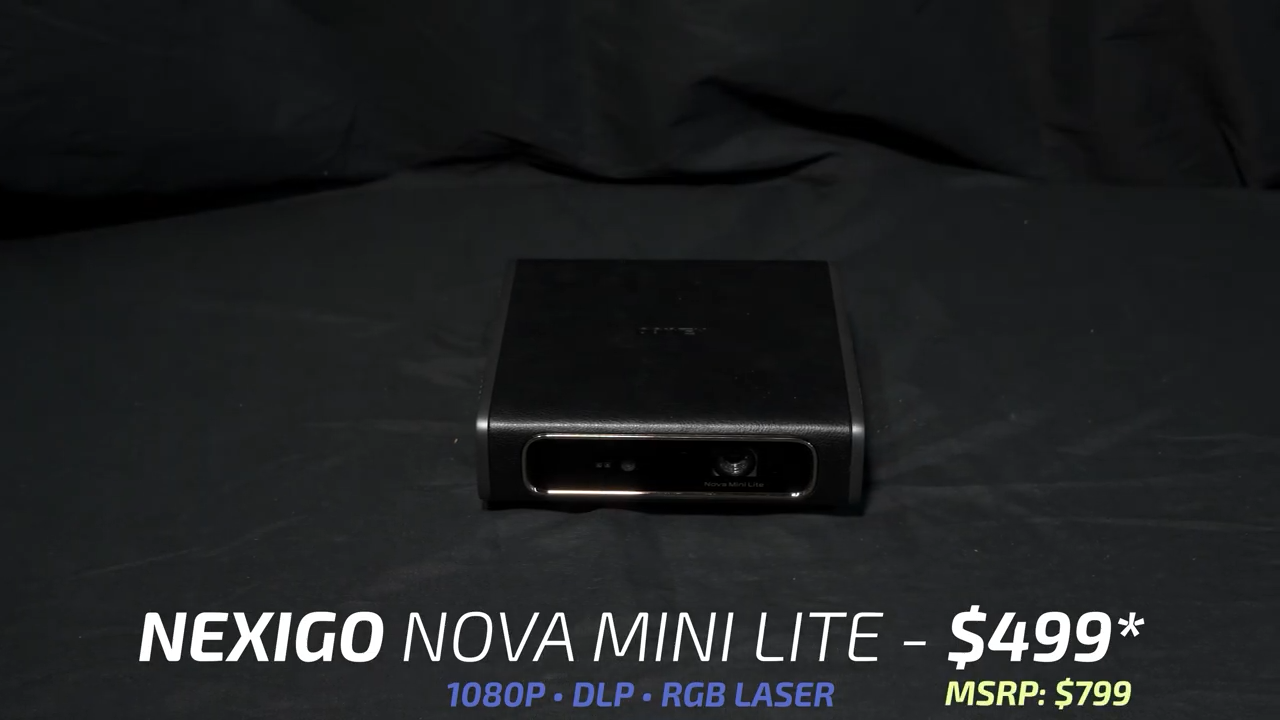
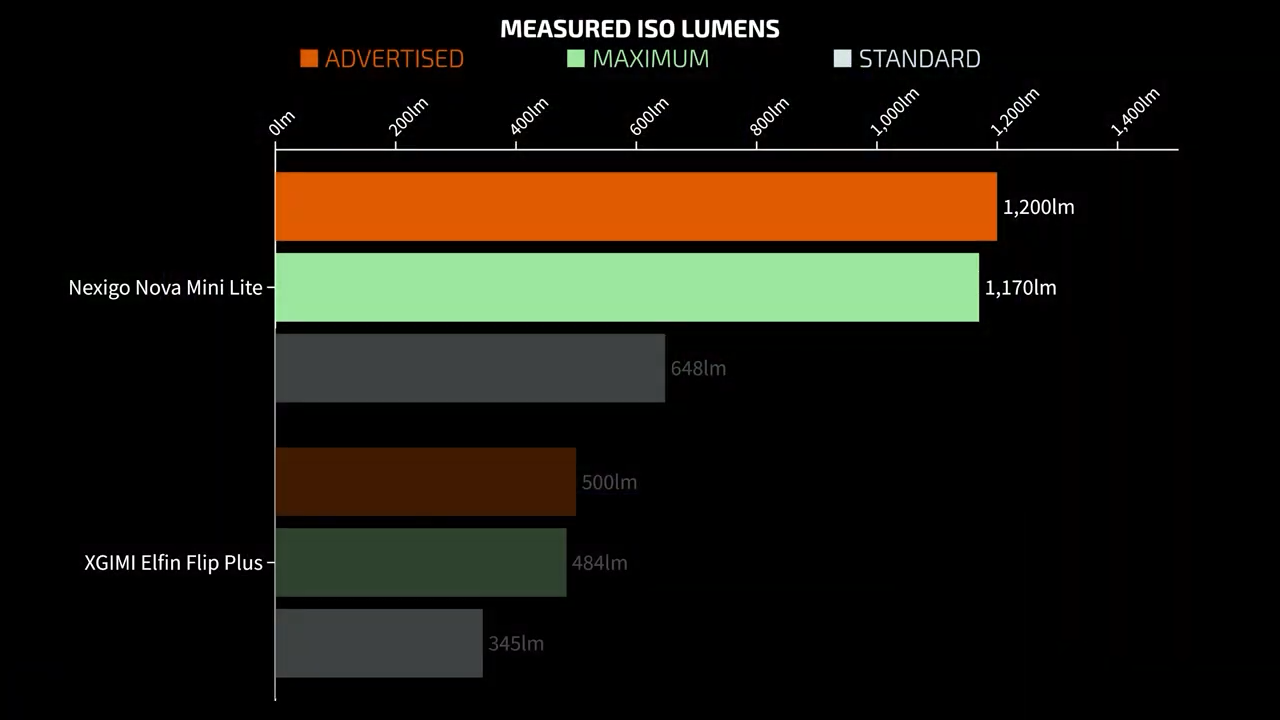
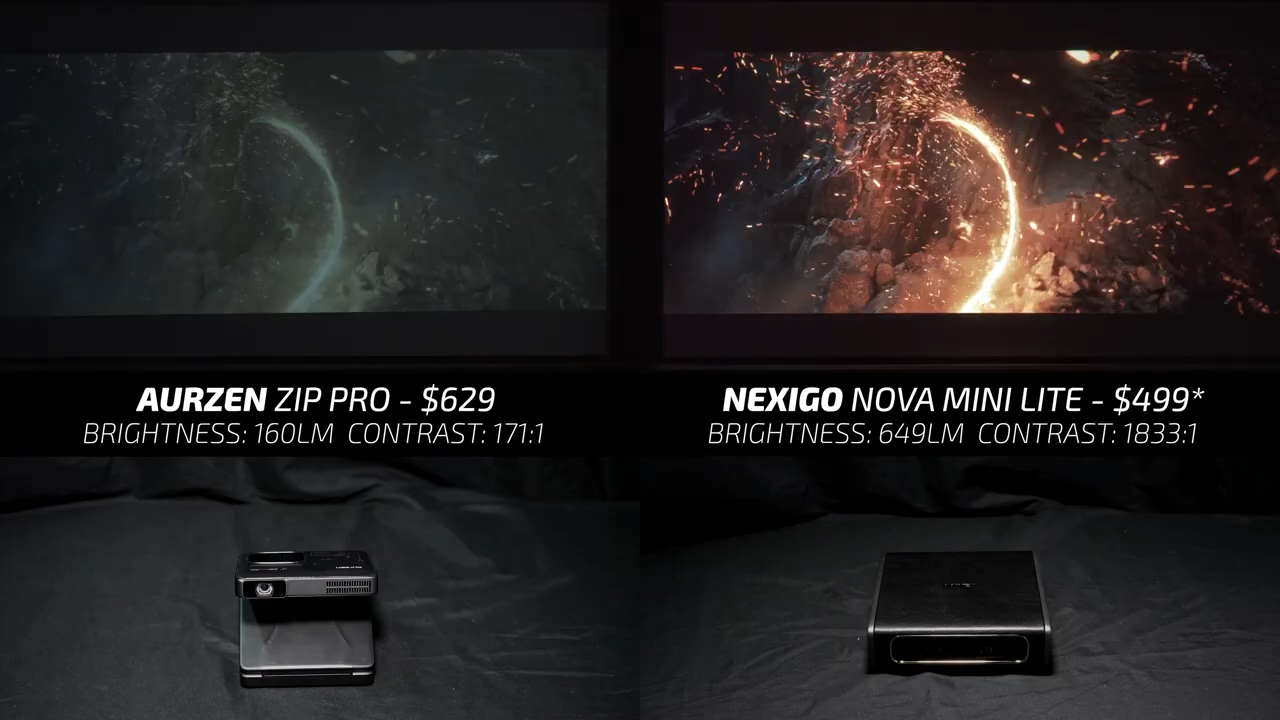
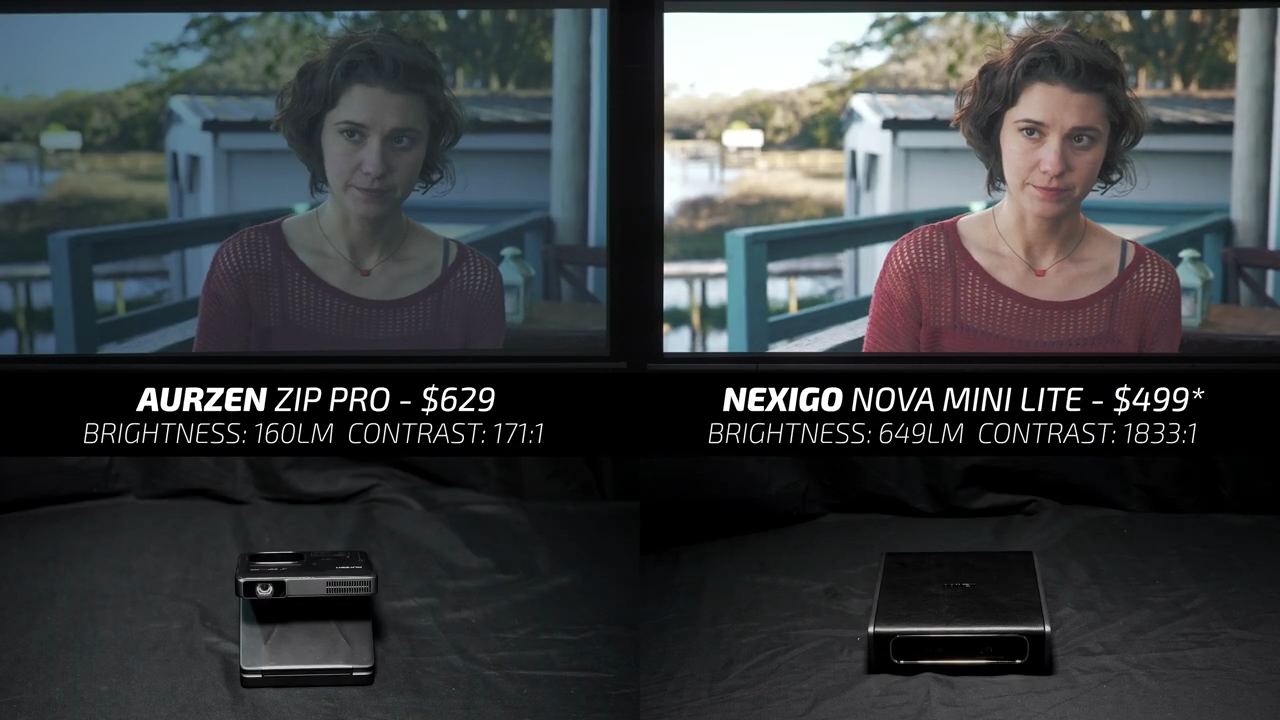
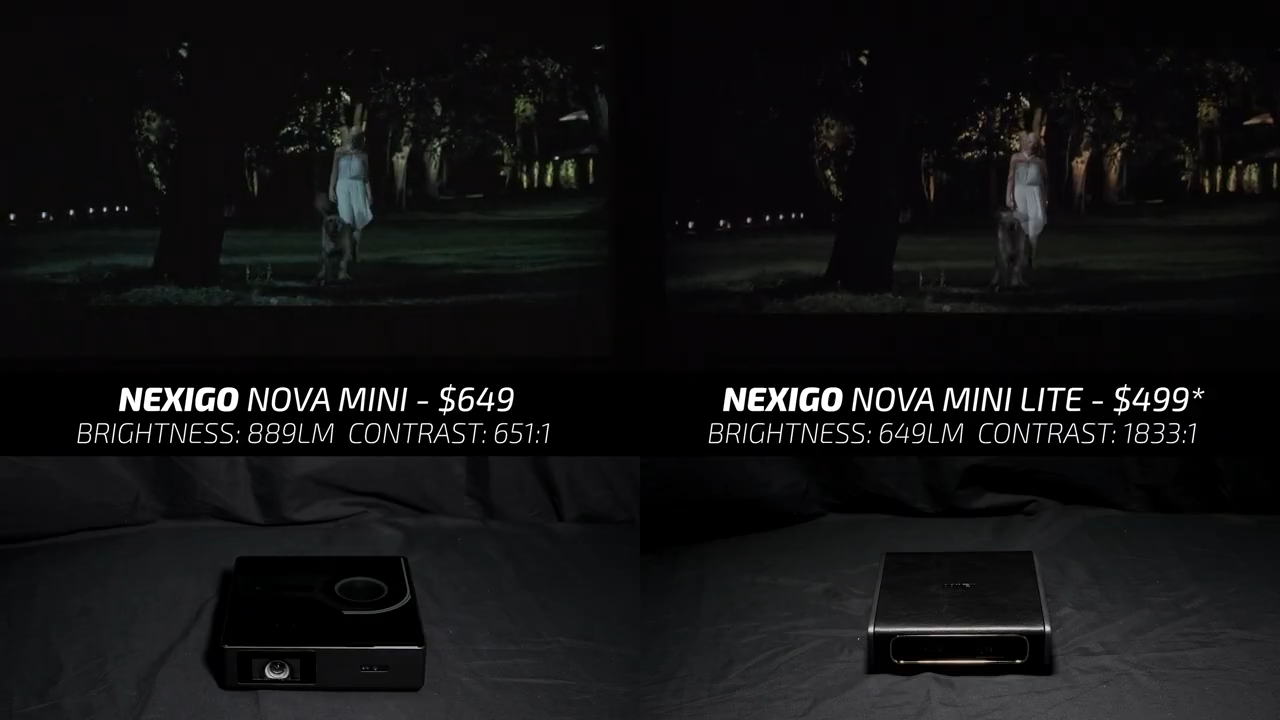
The Nova Mini Lite is a 1080p DLP projector with an RGB Laser light source and has an advertised brightness of 1200 lumens. But like the XGIMI, that brightness is only achievable in a special High Performance mode that ramps up the fans and shifts the entire image green. In that mode, I measured 1170 lumens, but in more color accurate modes, I measured the NexiGo Nova Mini Lite around 650 ISO Lumens with an impressive native contrast of 1833:1. NexiGo’s dynamic laser dimming system that they call SAE, or Scene Adapt Engine, pushed the dynamic contrast of the Nova Mini Lite to over 7000:1, and the color accuracy of the NexiGo was slightly better than the XGIMI Elfin Plus but still had a higher color error than non-portable projectors.
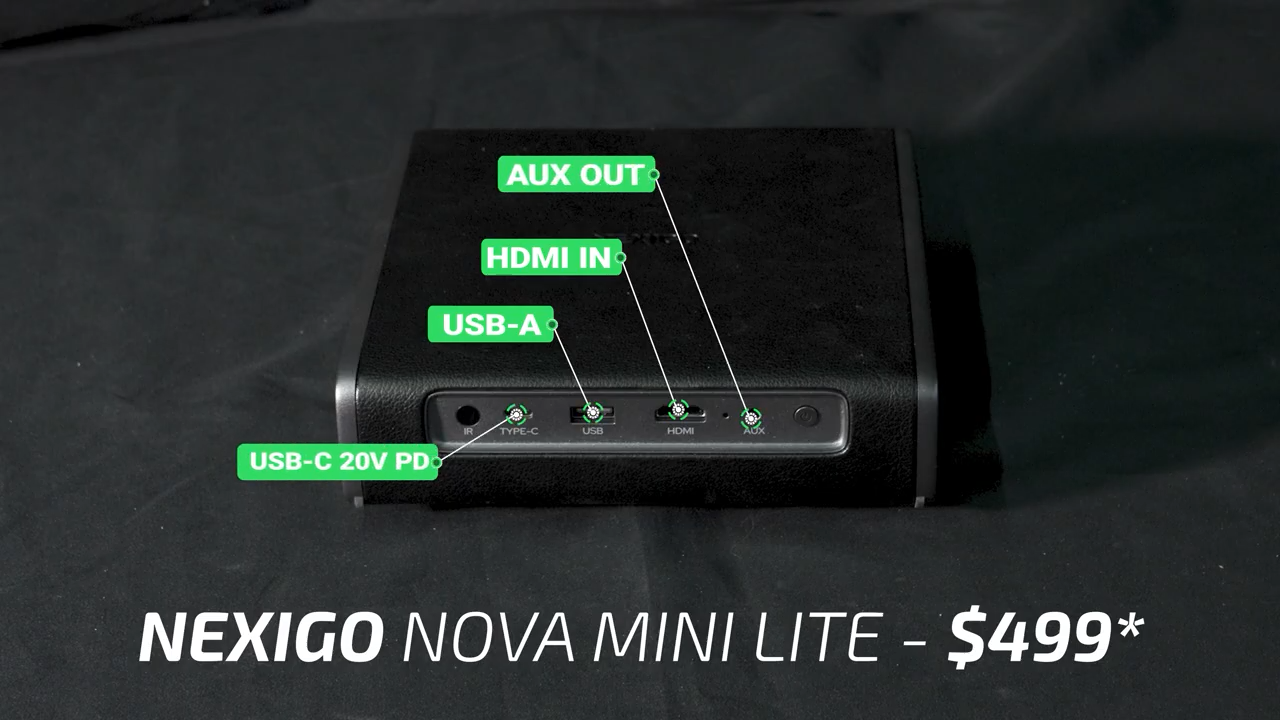
For connectivity, the NexiGo has an HDMI port, a USB port, and an Aux output, and is powered by USB-C. When plugged in, it was drawing 58 watts, but some of that may have been being used to charge the internal battery. The Nova Mini Lite uses Google TV OS and compared to the XGIMI Elfin Plus, the interface was very responsive, indicating the use of a newer higher quality chipset.
Putting the projectors side by side on 100” white screens in a light-controlled room, there was really no contest here. In bright SDR scenes, the XGIMI was tolerable, but the NexiGo was still twice as bright with better color and better contrast, but in darker scenes, or basically any scene where contrast was important, the XGIMI Elfin Plus was borderline unwatchable while the NexiGo looked excellent. This was an easy win in Round 1 for the NexiGo in terms of picture quality.
Aurzen Zip Pro
In Round 2, it’s going to go up against the most compact projector in the video, the $629 Aurzen Zip Pro. The Zip Pro is a 1080p DLP projector with an RGB LED light source that measures just 4.5” by 4” and just over 1.5” thick and includes a convenient tri fold design for aiming and a 38wH battery that Aurzen says will last 150 minutes on Eco mode where it outputs around 100 lumens. In my battery testing, the Aurzen Zip Pro lasted 13 minutes longer than that, outputting 103 lumens for 163 minutes, or 143 lumens for 146 minutes. Aurzen advertises a maximum of 200 lumens from the Zip Pro, and I measured 194 lumens on the green shifted high-performance mode, and around 160 lumens on standard mode. Contrast is definitely not the Aurzen’s strong suit with just 172:1 native contrast and no dynamic option, and the Zip Pro was also not particularly color accurate with a cooler color temp and average color error of 9.01.
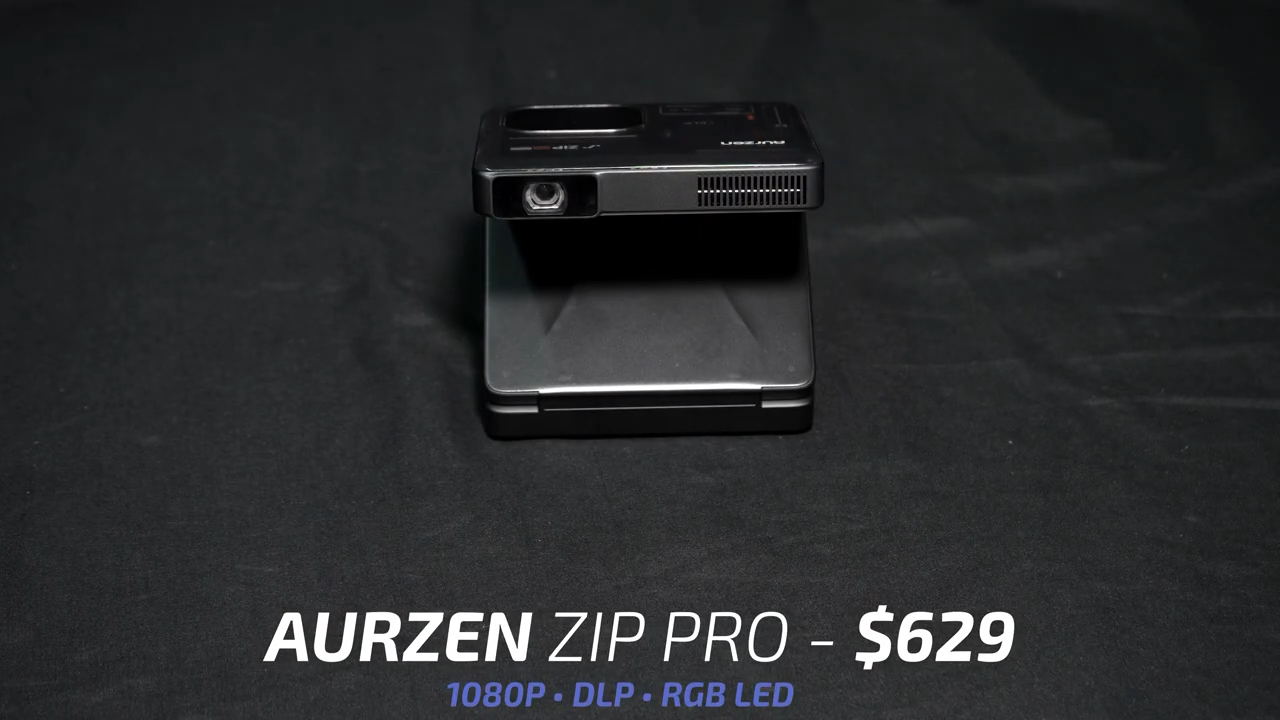
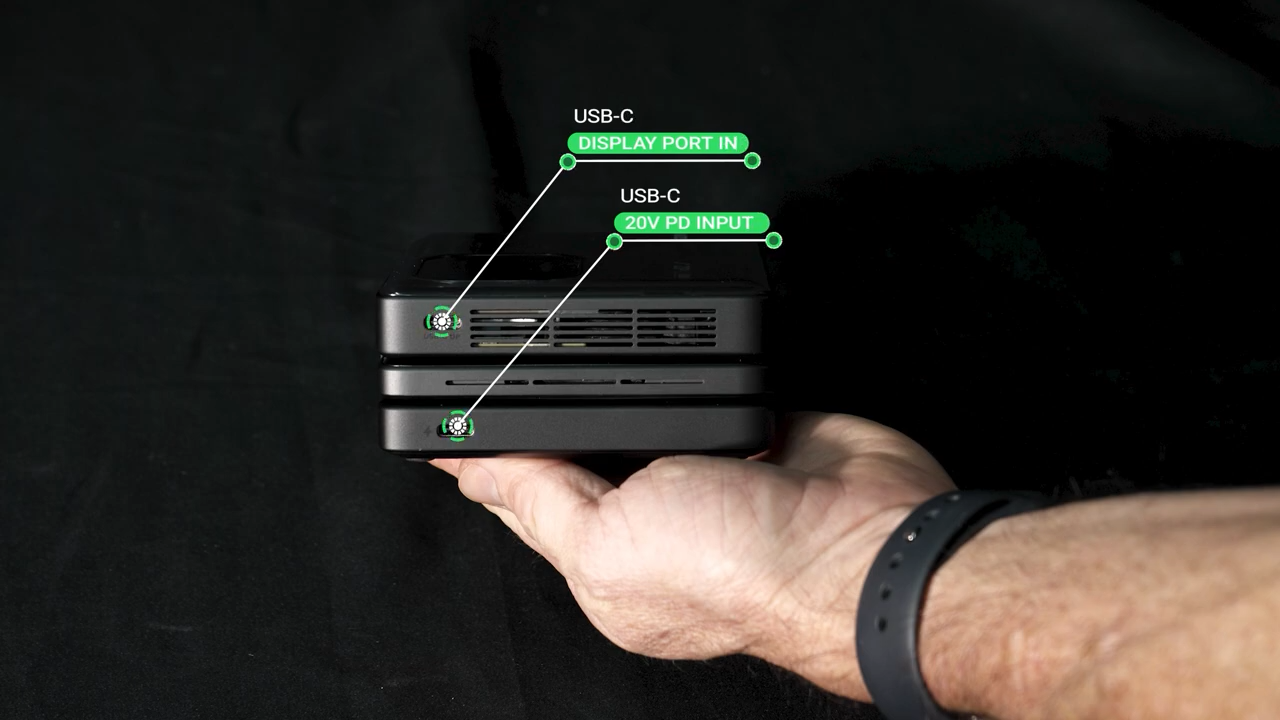
For connectivity the Aurzen Zip Pro has two USB-C ports, one for power and one that acts as display port-in over USB-C, and there’s no native smart OS because the Zip Pro is designed to be a casting target for your phone or computer rather than a standalone device.
As I’ll explain later in the video, I think a side-by-side test between a projector like the Aurzen Zip Pro and NexiGo Nova Mini Lite is of fairly limited usefulness because I think these two projectors have very different use cases, but as you can see the Aurzen didn’t stand much of a chance with a third of the brightness, a tenth of the native contrast, and much lower color accuracy and color volume, so the NexiGo Nova Mini Lite is going to move on again in terms of picture quality, but I wouldn’t cross the Aurzen Zip Pro off your list yet.
NexiGo Nova Mini
In Round 3, the NexiGo Nova Mini Lite is going to go up against last year’s picture quality winner the original $649 NexiGo Nova Mini and compared to the Mini Lite the original Mini is considerably less portable measuring approximately 8” by 8”, but with a less durable glass top and no built-in battery.
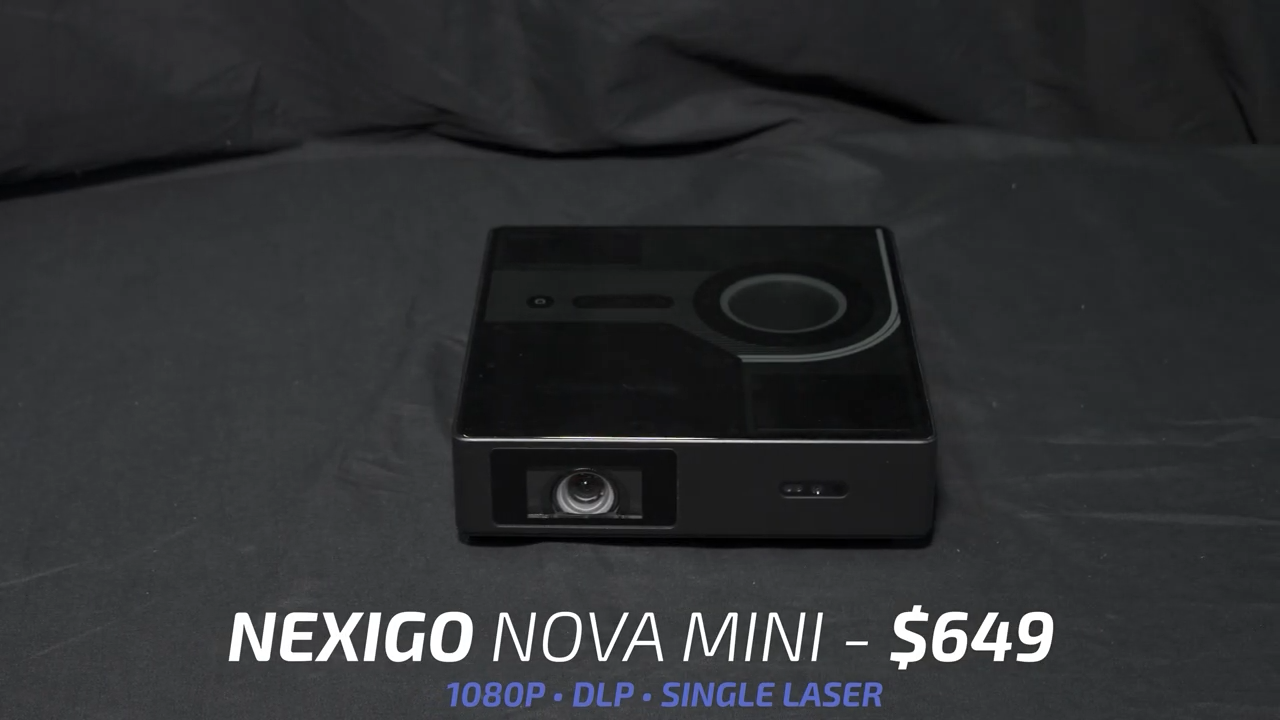
The Nova Mini is a 1080p DLP projector with a single laser light source and has an advertised brightness of 1200 lumens. I’m not sure if I’m just missing it, but I couldn’t find a high-power mode to get all the way up to 1200 lumens, but I was able to measure 1049 lumens in user mode with very acceptable color accuracy and 889 lumens in its most color accurate mode. The Nova Mini has a native contrast of 651:1 and a dynamic contrast of just under 2000:1 with SAE laser dimming turned on, which is much better than the XGIMI and Aurzen, but considerably less than the new NexiGo Nova Mini Lite, and the Nova Mini had relatively poor color accuracy with an average SDR color error of 9.29.
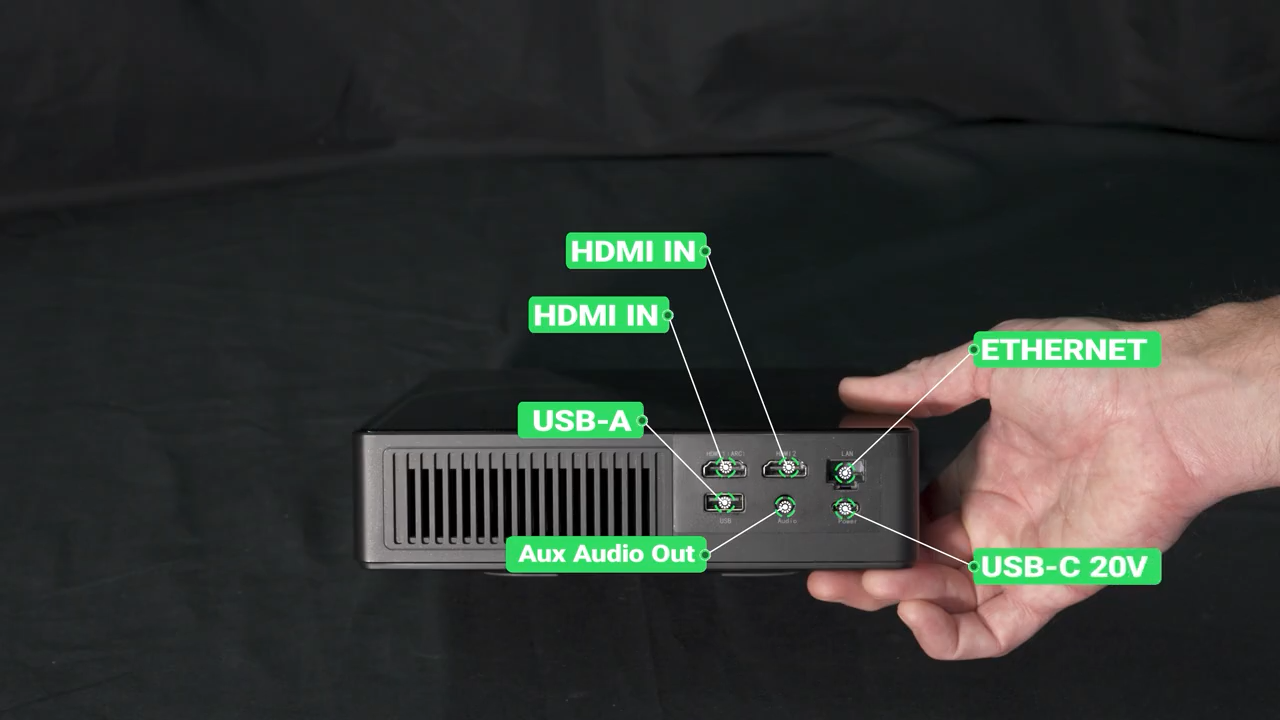
The Nova Mini runs Google TV OS and performance was slightly slower than the new Nova Mini Lite, but still very usable. For connectivity, the Nova Mini has two HDMI inputs, a USB-A port, and aux out as well as an ethernet port and a USB-C power port. The Nova Mini draws around 70 watts maximum, but if you’re using the SAE laser dimming it will drop to around 20 watts in darker scenes which significantly improves battery performance. Using my 20,000mAh UGREEN power bank, the Nova Mini ran for 74 minutes at 940 lumens, and for context, that’s 16 minutes less than the XGIMI Elfin Plus using the exact same battery bank, but the NexiGo was nearly 3x as bright.
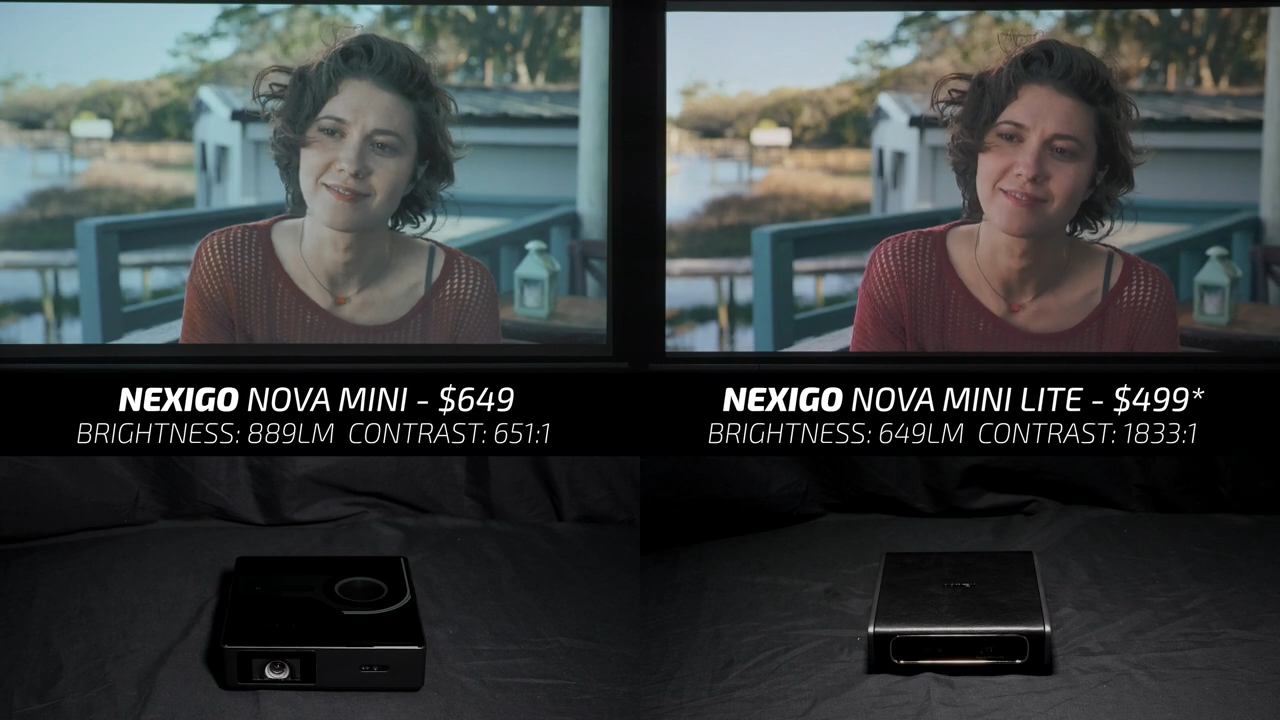
Putting the Nova Mini head to head with the newer Nova Mini Lite, I would describe the original Nova Mini’s image as both brighter and calmer, but the Nova Mini Lite was more color accurate and had significantly better contrast. But the most important difference to me was the fact that the Nova Mini’s SAE laser dimming was more likely to cause color shifting and flickering while the Nova Mini Lite’s felt more refined and free of dimming artifacts. So while both projectors have impressive picture quality for portable projectors, the newer Nova Mini Lite is slightly more refined and it’s going to move on again.
Nebula Soundcore P1
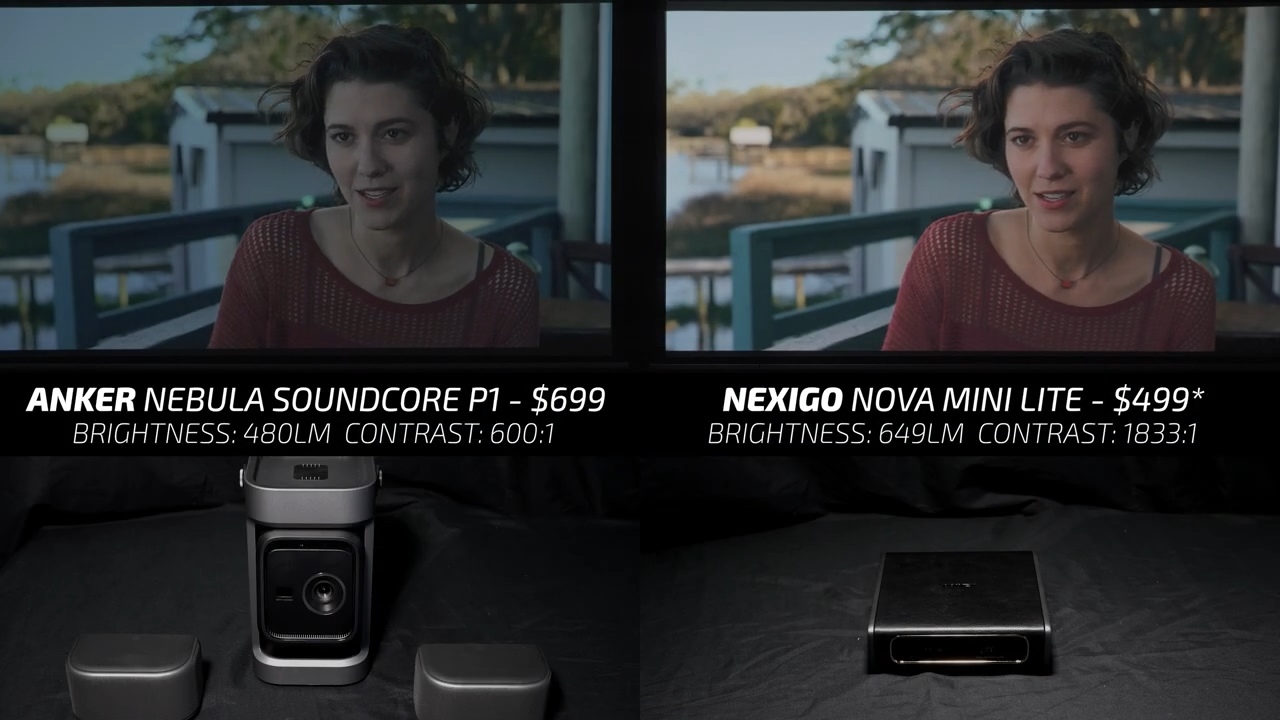
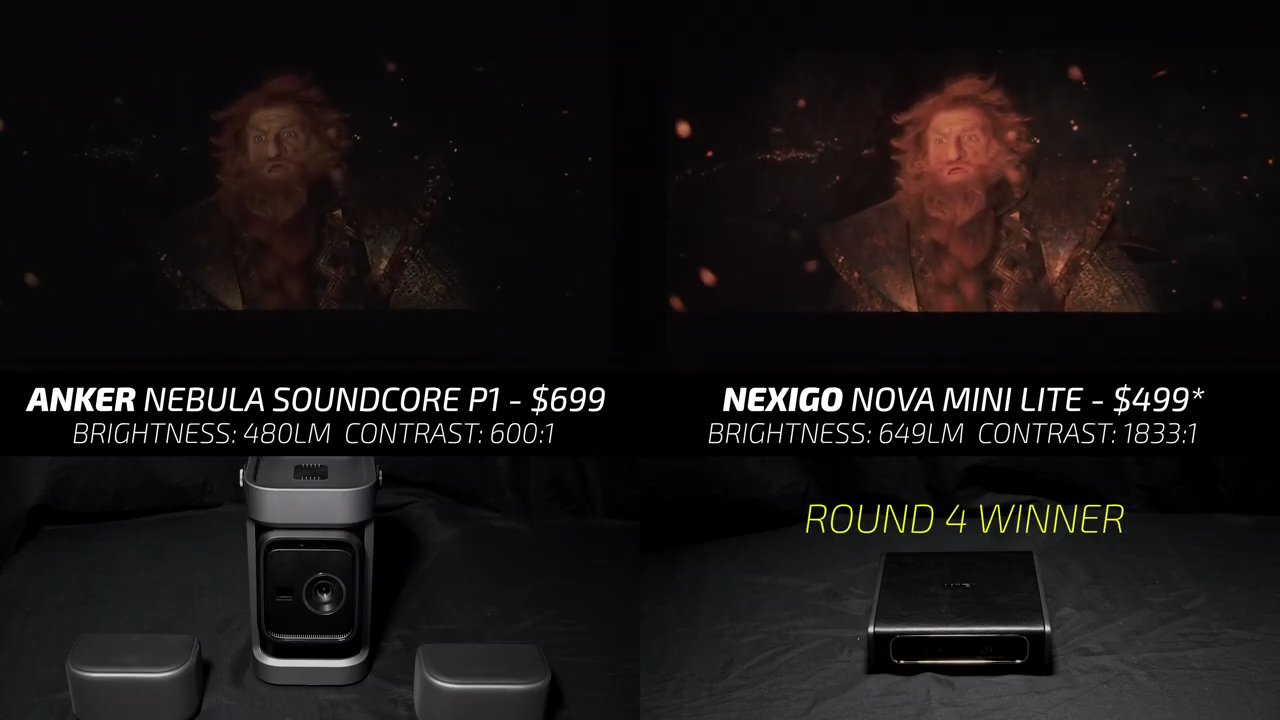
In Round 4, it will go up against the $699 Anker Soundcore Nebula P1. If you’re confused by that brand naming, Anker is the parent company, and they recently combined their Soundcore speaker brand with their Nebula projector brand. The P1’s 11” tall housing has both Soundcore speakers and a Nebula projector and is probably my favorite form factor of any portable projector that I’ve ever reviewed with a rotating gimbal for aiming the projector and two detachable wireless speakers that automatically charge when they’re stored on top of the plugged-in projector.
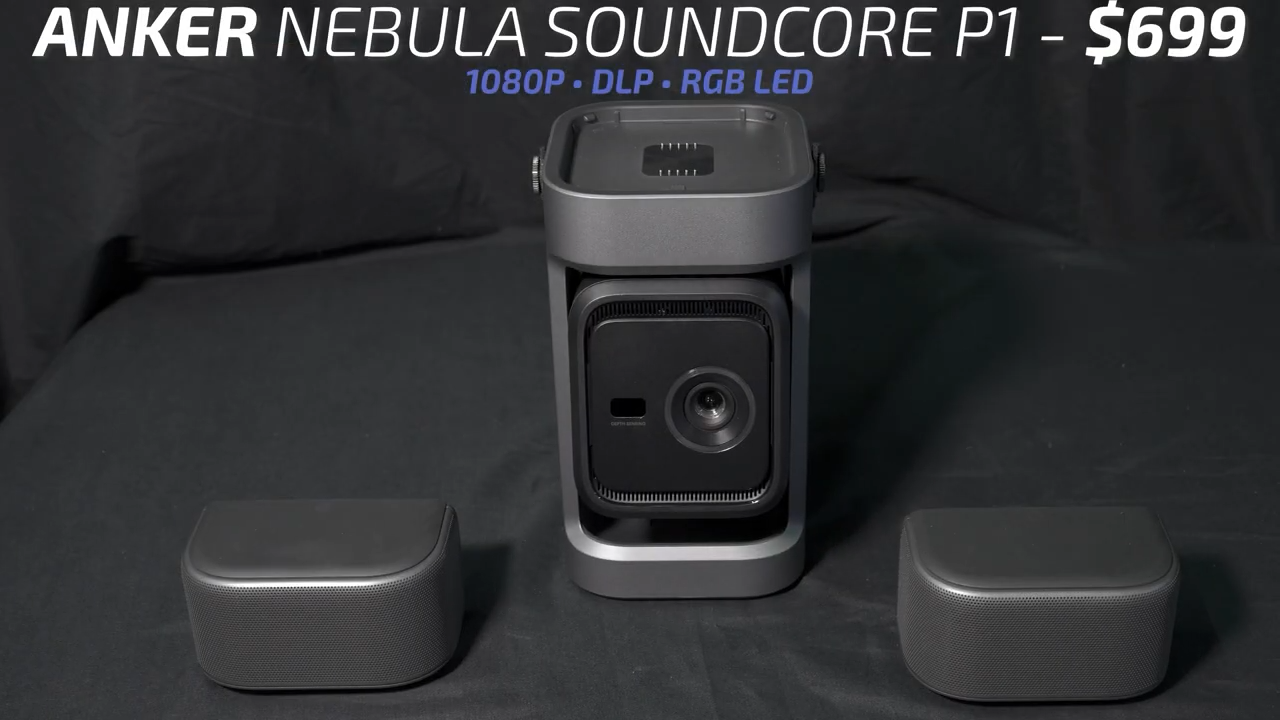
The P1 is 1080p with an RGB LED light source and it has an advertised brightness of 650 lumens, and I was able to measure around 717 lumens on conference mode brightness with that familiar green shift and higher fan noise, but I still found it reasonably usable. But standard mode with user color temperature was much more color accurate with around 480 lumens, a contrast ratio of 600:1, which is about average for these portable projectors, and color accuracy was slightly below average with an average SDR color error of 8.86.
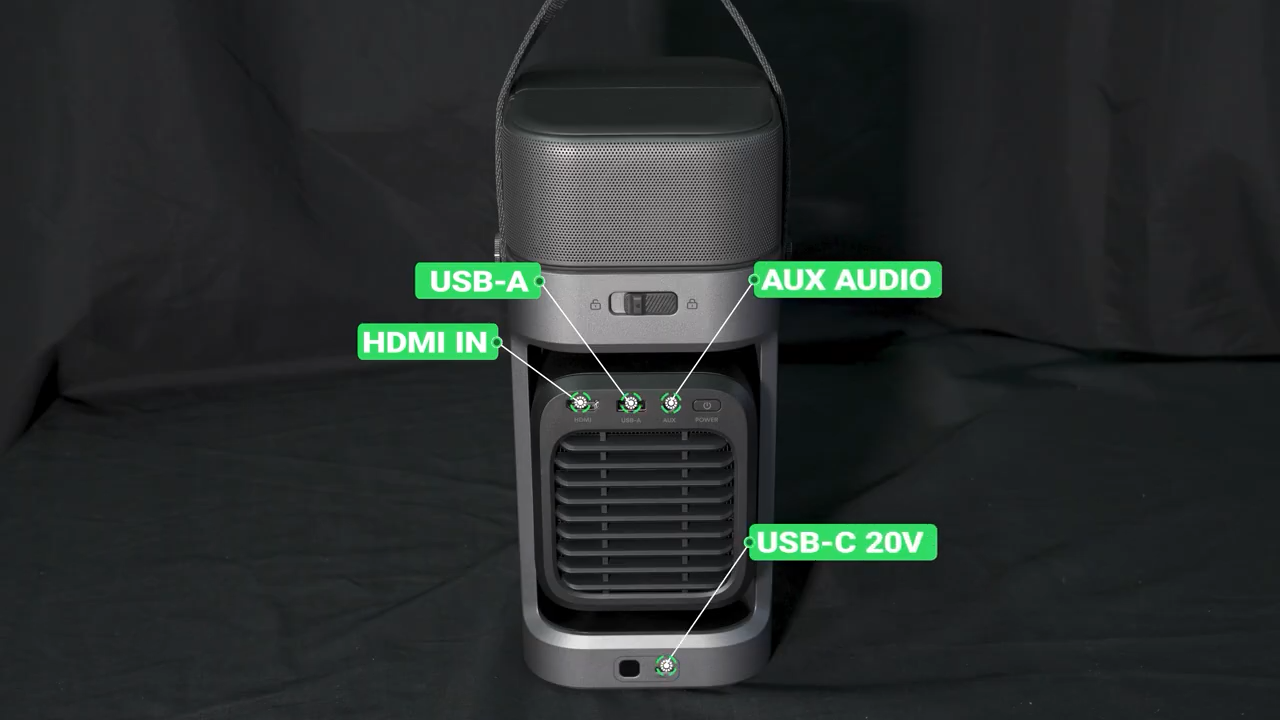
The P1 runs Google TV and was relatively responsive, somewhere in between the speed of the XGIMI Elfin Plus and NexiGo Nova Mini. For connectivity, the P1 has a single HDMI, USB-A, and an aux audio out, and it’s powered by USB-C. Despite its larger size, the P1 doesn’t have a built-in battery, but can run off a PD power bank where it draws around 75 watts, and in my testing, using a 20,000mAh bank it output around 350 lumens for just 54 minutes.
Side by side with the NexiGo Nova Mini Lite, the P1 performed okay in brighter and moderately lit scenes relying on a higher gamma setting to offset its lower contrast ratio, but in dark scenes and more colorful scenes, the P1 was considerably worse than the Nova Mini Lite with substantially worse contrast resulting in a muddy gray black floor. Again, there wasn’t much of a contest here when compared to the Nova Mini Lite, but like the Aurzen Zip Pro, I don’t really think the P1 and Nova Mini Lite are made for the same use case, so don’t count it out yet.
TCL PlayCube
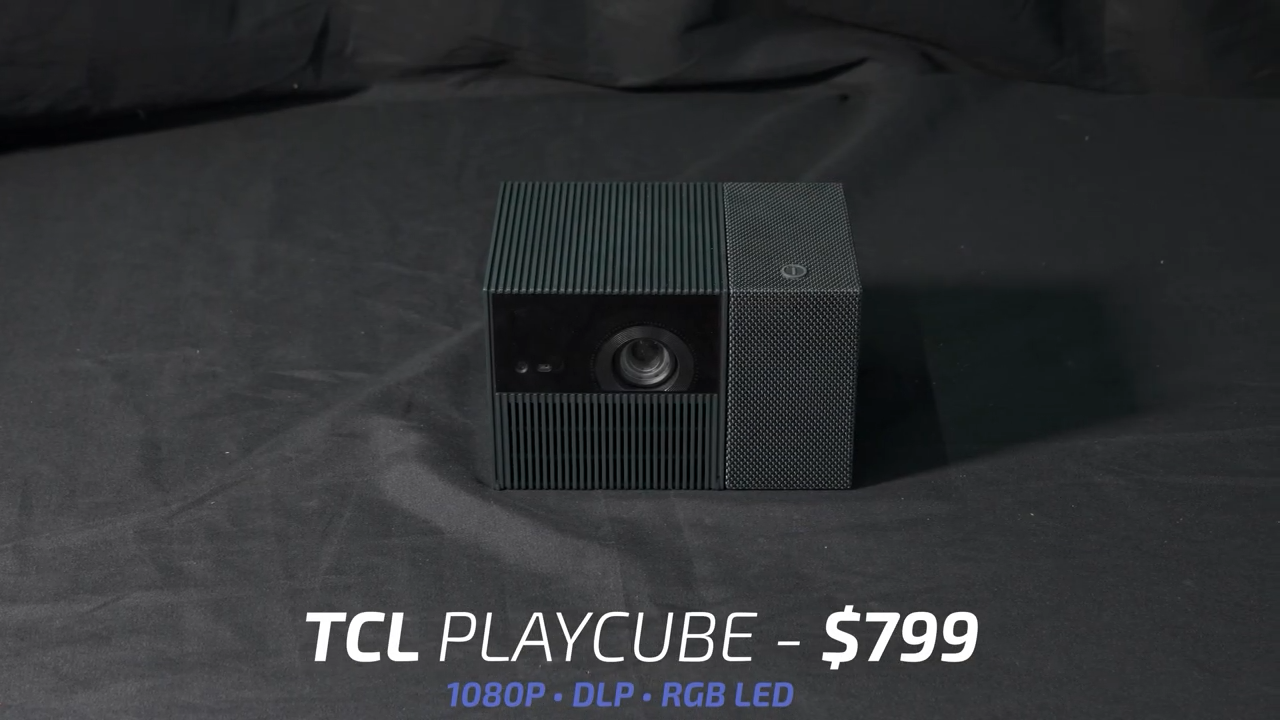
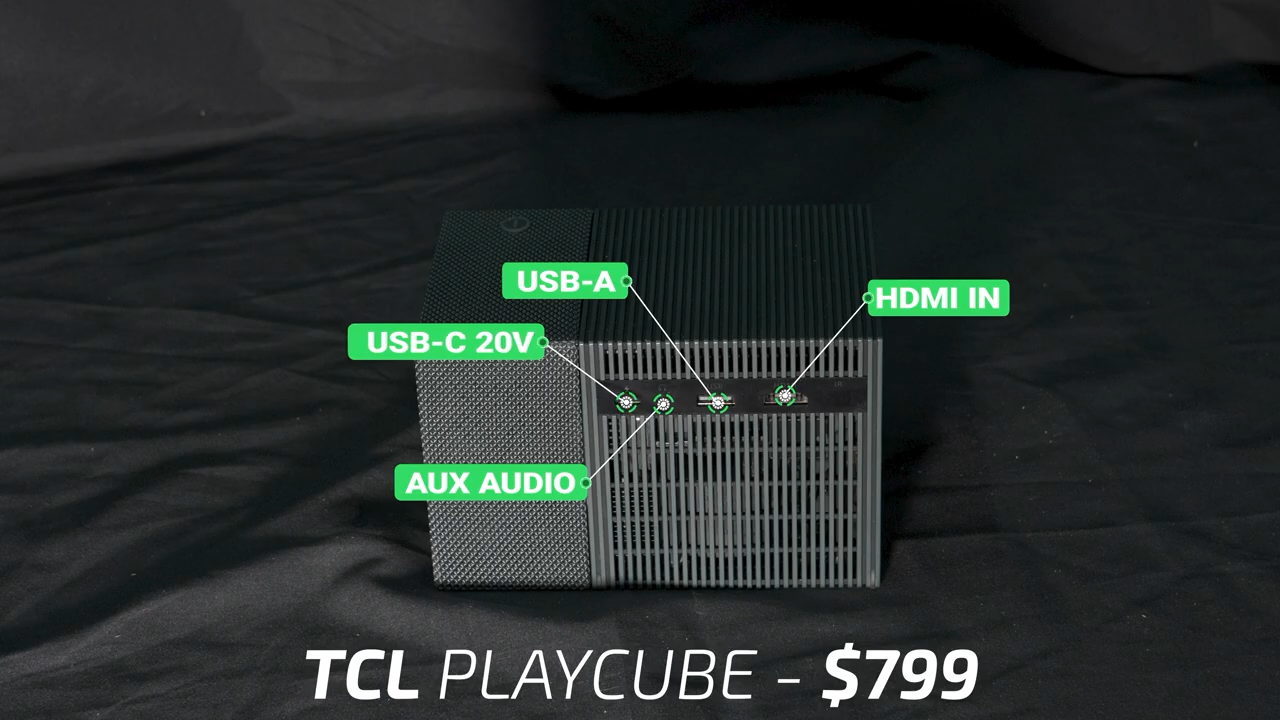
In Round 5, the NexiGo Nova Mini Lite goes up against my best all-around pick from last year, the $799 TCL PlayCube that measures in at 6”x4”x4” and has a unique 2-part rotating design for aiming. The PlayCube is a 1080p DLP projector with an RGB LED light source advertised at 750 ISO lumens and I measured 783 lumens in performance mode with high fans and a green tint but 621 lumens in its more color accurate mode with a 600:1 native contrast and the best color accuracy so far with an average SDR color error of 4.15. Using the PlayCube’s built-in 66wH battery, it output 223 lumens for 2 hours and 14 minutes, and you can increase the brightness on battery up to 490 lumens, but that will limit you to around 93 minutes of playback.
The TCL PlayCube runs Google TV OS and was slightly below average in terms of responsiveness, but still very usable. For connectivity, the PlayCube has a single HDMI, USB-A, and aux audio out, and the PlayCube gets its power from USB-C where I measured a power draw of 85.4 watts, but some of that may have been used to recharge the internal battery.
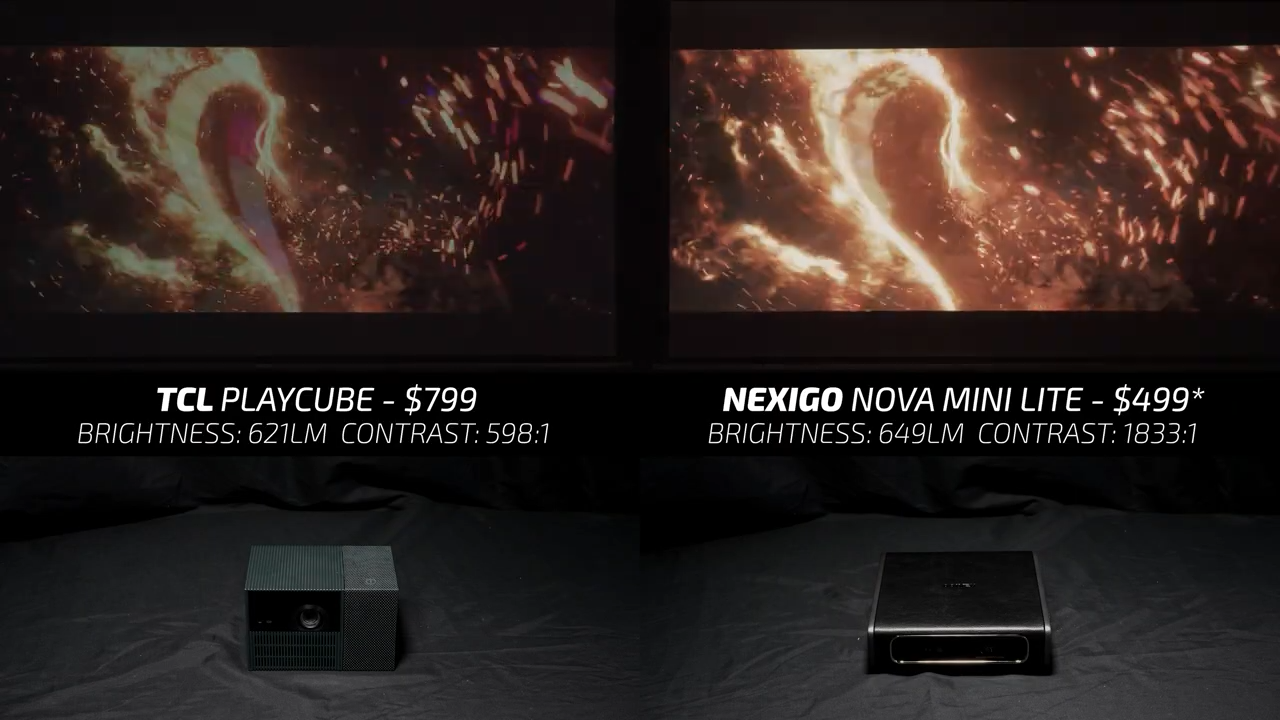
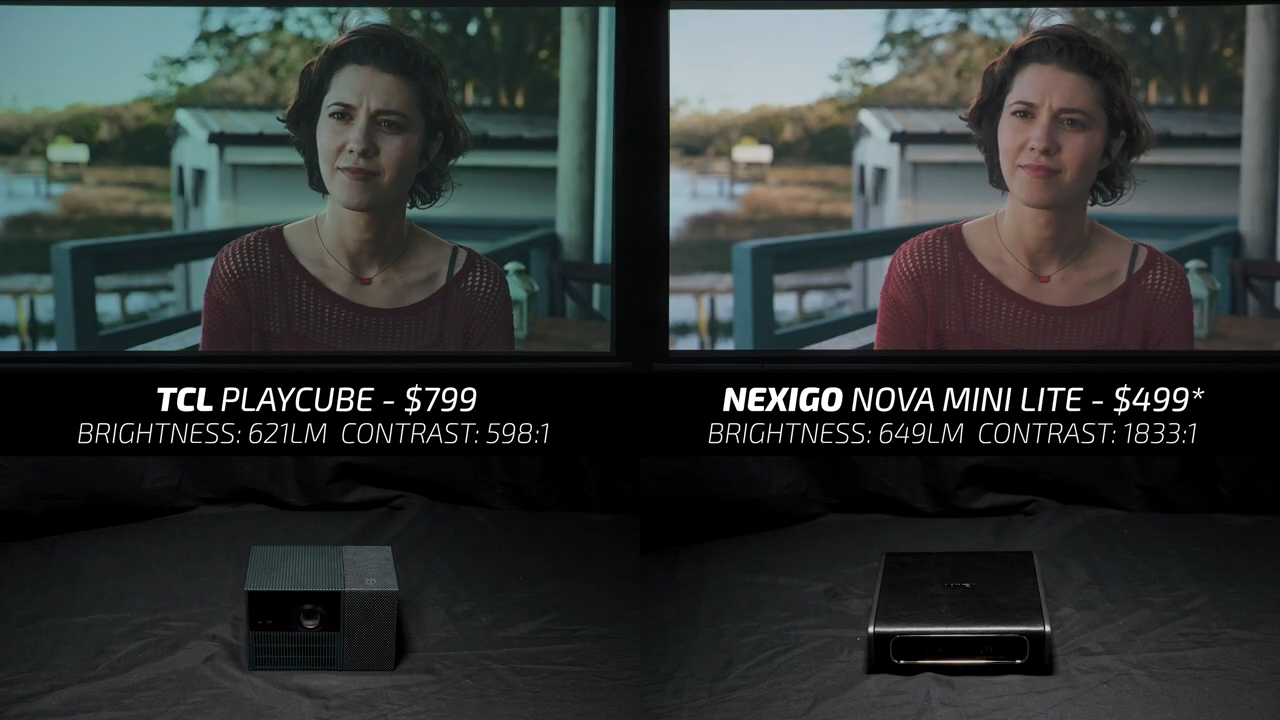
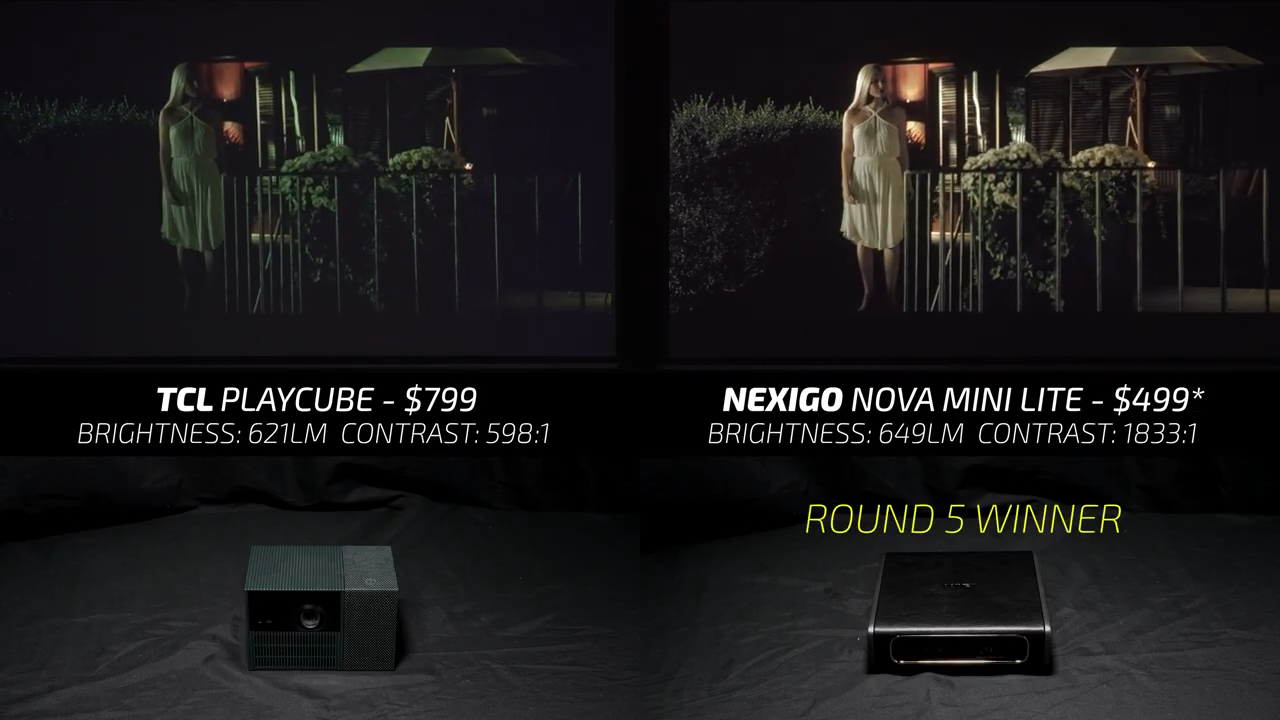
Putting it side by side against the NexiGo Nova Mini Lite, the TCL PlayCube was fine, totally watchable, reasonably color accurate, totally and completely fine. But it was just no match for the NexiGo Nova Mini’s 1800:1 native contrast, RGB Laser light source, and SAE laser dimming. Despite the fact that the PlayCube had a slightly lower overall color error when measured with Calman, the Nova Mini still looked much more accurate in bright scenes, and in dark scenes the increased brightness, reduced black floor, and wider color gamut gave the NexiGo another easy win.
Nebula Mars 3
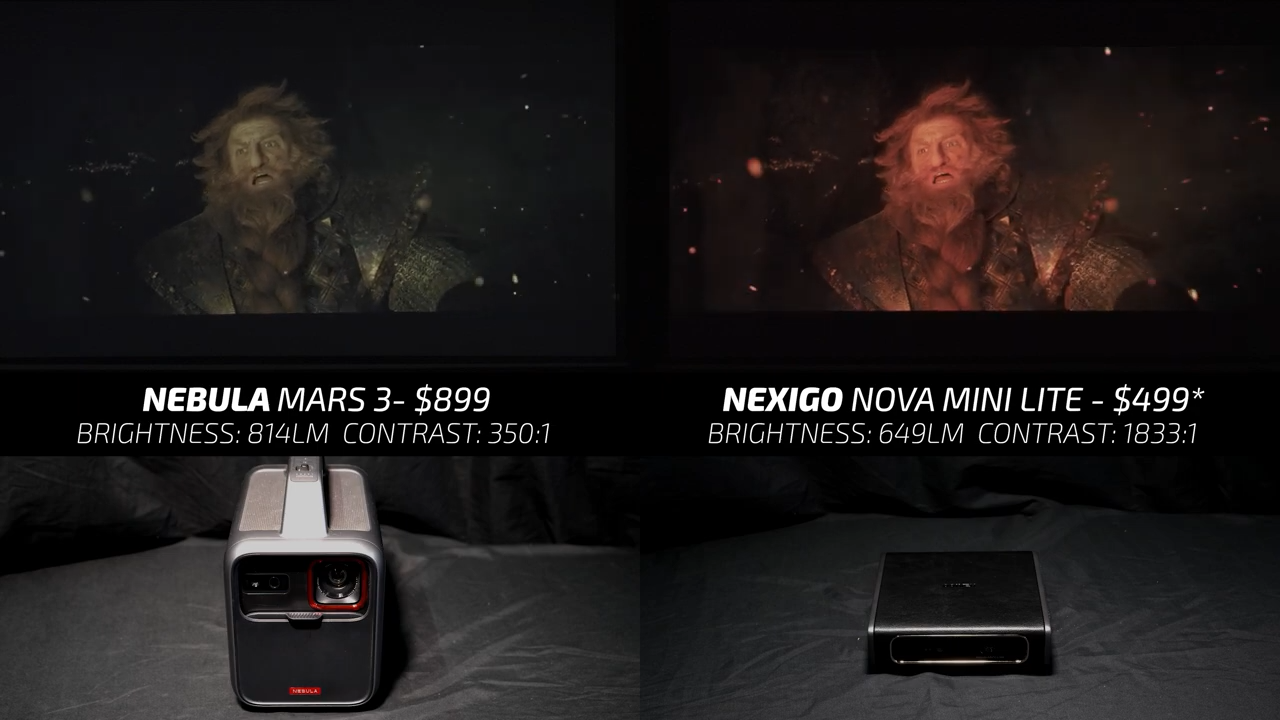
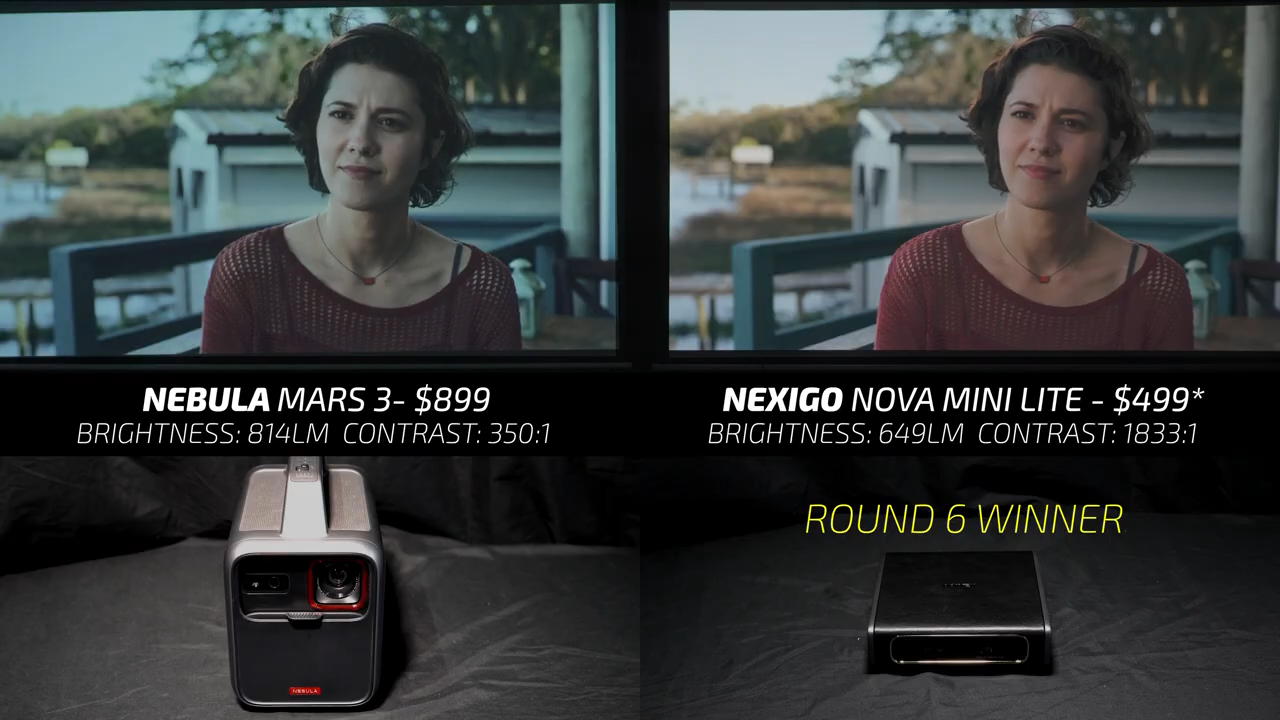
In Round 6, it will go up against the $899 Nebula Mars 3 which has been one of my top picks in my portable projector reviews for the last three years. It’s not portable in the sense that it’s compact, measuring in at 10”x6”x8” not including the handle, but it’s rugged with IP63 water resistance, and its built-in 185 watt hour battery gives 2 hours of playback at around 800 lumens and over 5 hours in eco mode with 350 lumens.
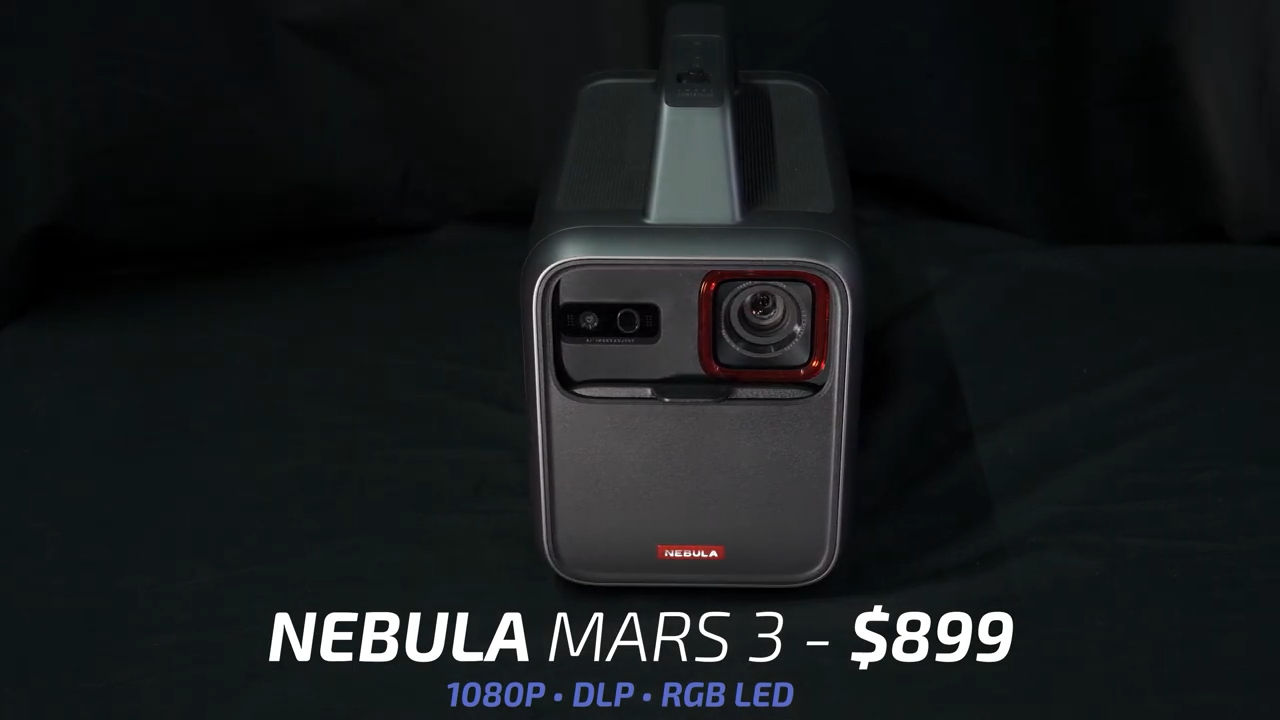
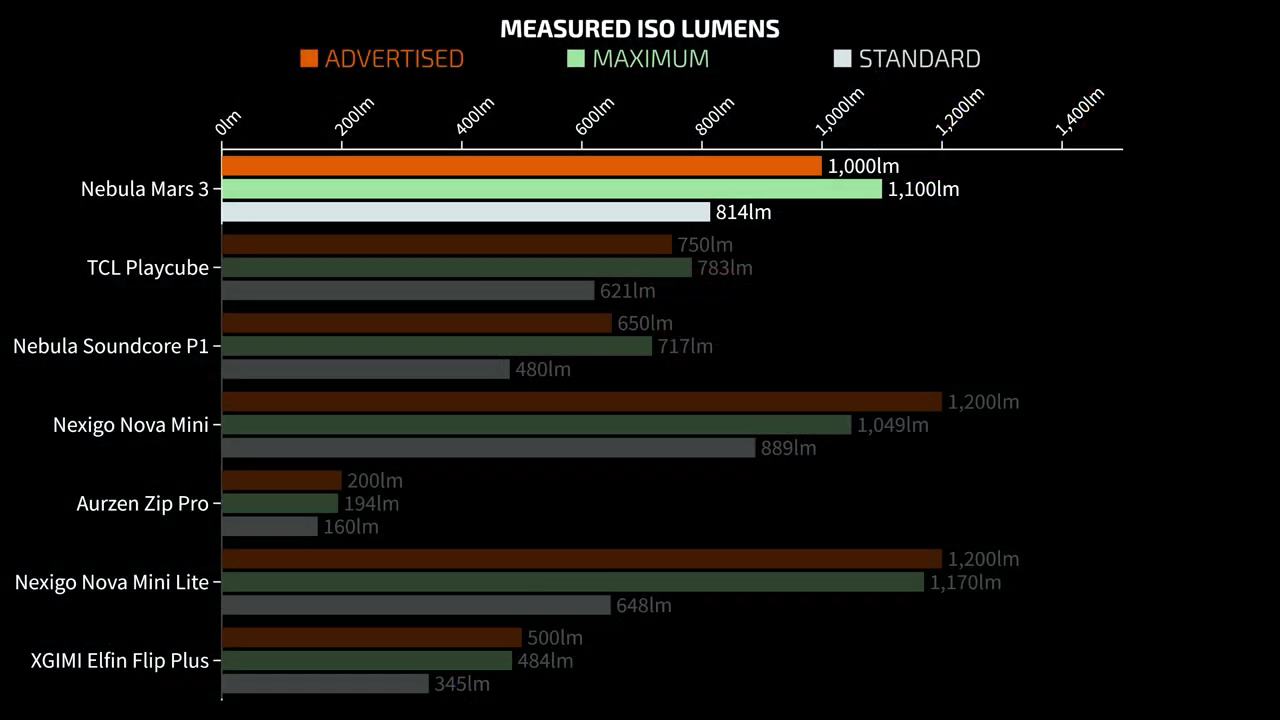
The Nebula Mars 3 is a 1080p DLP projector with an LED light source that is advertised at 1000 lumens maximum, and after three years of being my camping projector, it still hits 1100 lumens in conference mode, while its more accurate modes are just over 800 lumens with a below average native contrast of 350:1, but better than average SDR color accuracy of 4.57 average color error.
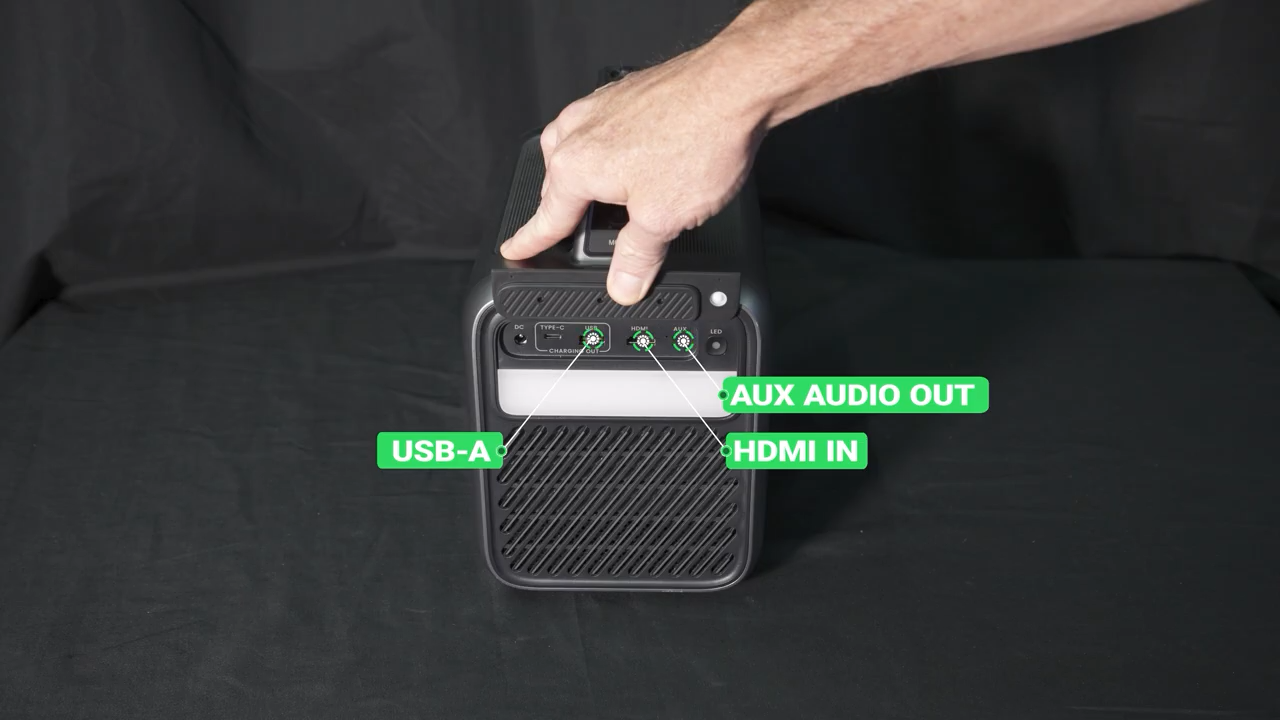
A lot of things about the Mars 3 still hold up after three years, but the native operating system could really use an update. It still runs a version of Android TV that isn’t Netflix licensed, and a lot of the built-in apps are slow and nearly unusable at this point. So it’s a good thing that there’s an HDMI in and a USB-A port for connecting an external source, and while there’s also a USB-C port, it’s a charging port for your devices rather than a power cable for the projector which uses a 10A charging brick, so its battery life can’t be extended with a USB power bank.
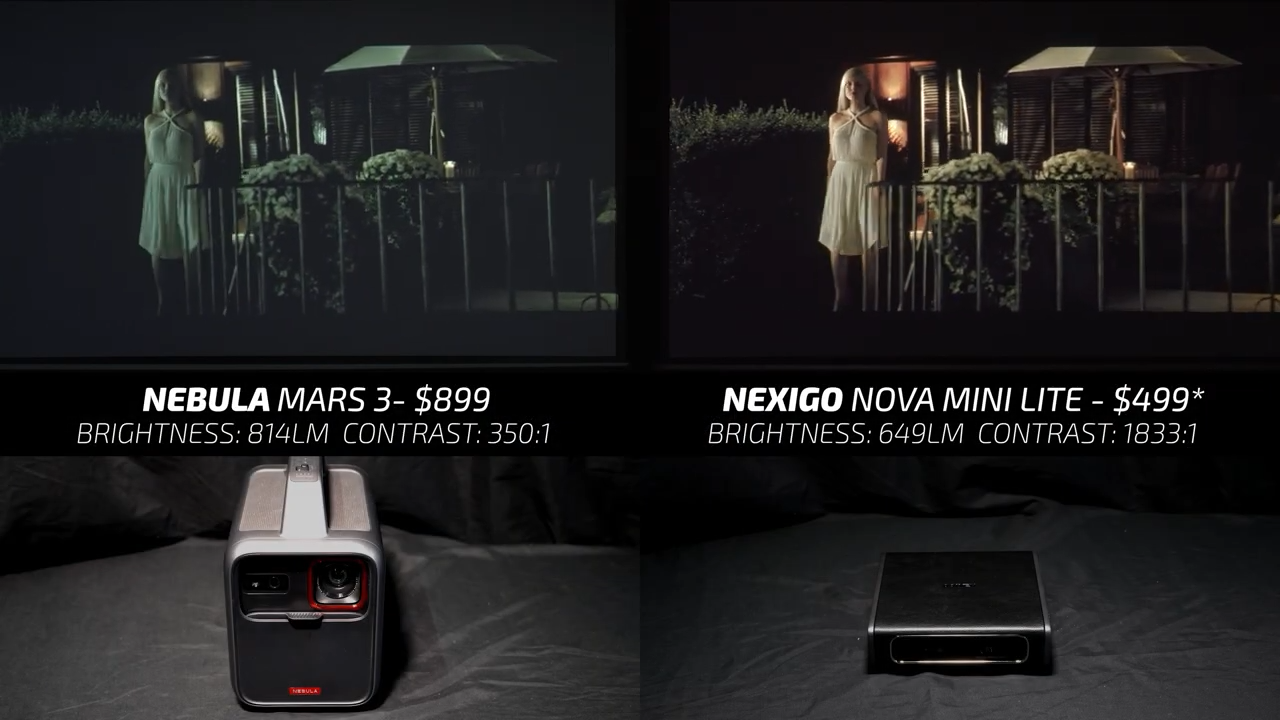
The thing about the Nebula Mars 3 that has won me over year after year is the fact that typically projectors with low contrast ratios become nearly unwatchable in dark scenes and it’s impossible to tell what’s going on but the Mars 3’s gamma curve raises the brightness of the shadows so you can still tell what’s going on. Of course that doesn’t look great when compared to a projector like the NexiGo Nova Mini Lite that has proper laser dimming and a high native contrast, but the Mars 3 is also more likely to remain watchable in poor viewing conditions like when there’s a nearby campfire. For picture quality, the Nova Mini Lite clearly wins this round, but the Mars 3’s gamma settings make more sense in poor viewing conditions.
XGIMI Eflin Flip 4K
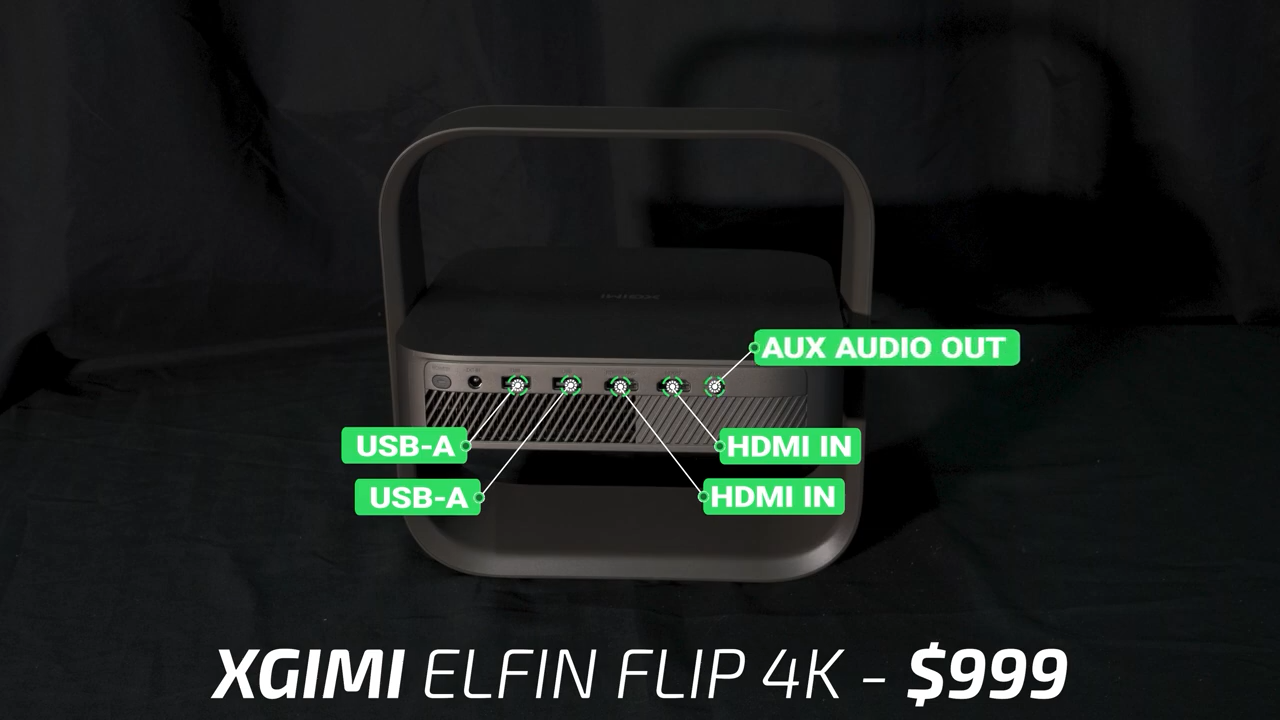
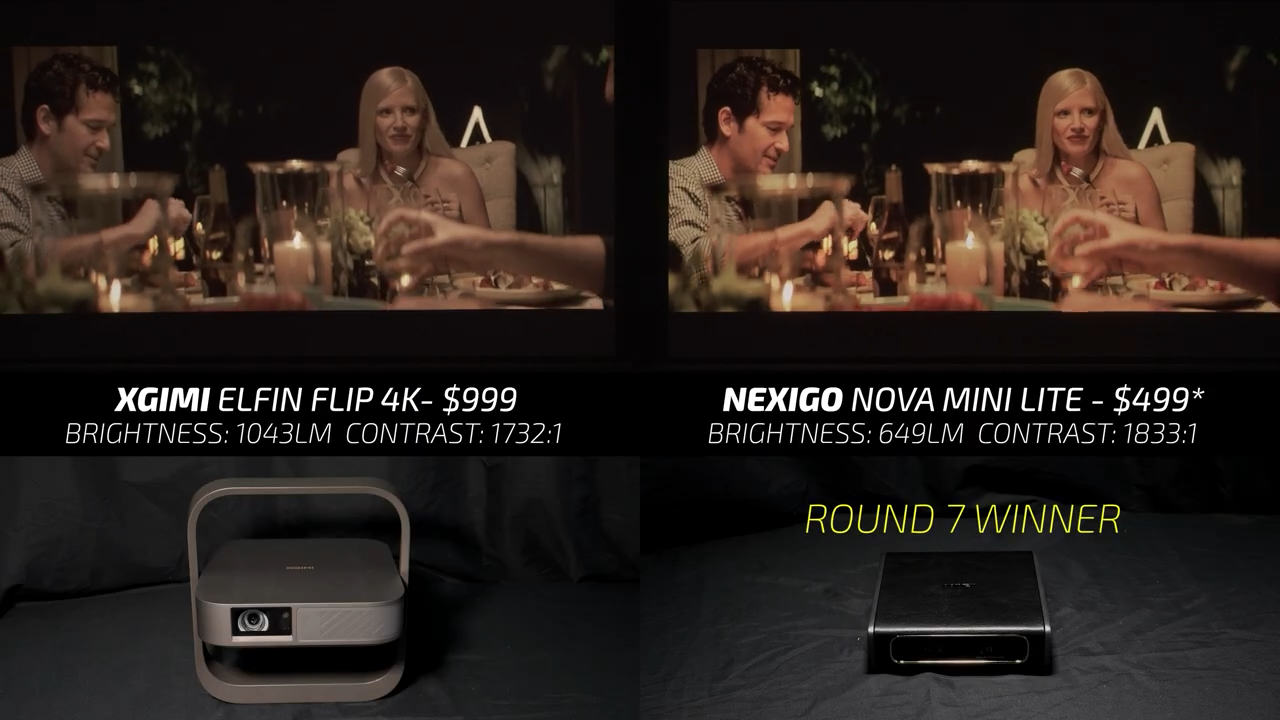
So in Round 7, the Nova Mini Light is going to go up against the $999 XGIMI Elfin Flip 4K. This is a strange projector because although the Elfin Flip Plus and Elfin Flip 4K share a similar looking form factor, I don’t think they have a single piece of hardware in common. The Elfin 4K is slightly larger at 9.5” by 10”, has a completely different DLP chip, using the new Texas Instruments 0.39” 4K pixel shifter, a completely different light source moving from RGB LED in the Elfin Plus to RGB Laser in the Elfin 4K, and the Elfin 4K even has 1.3x optical zoom.
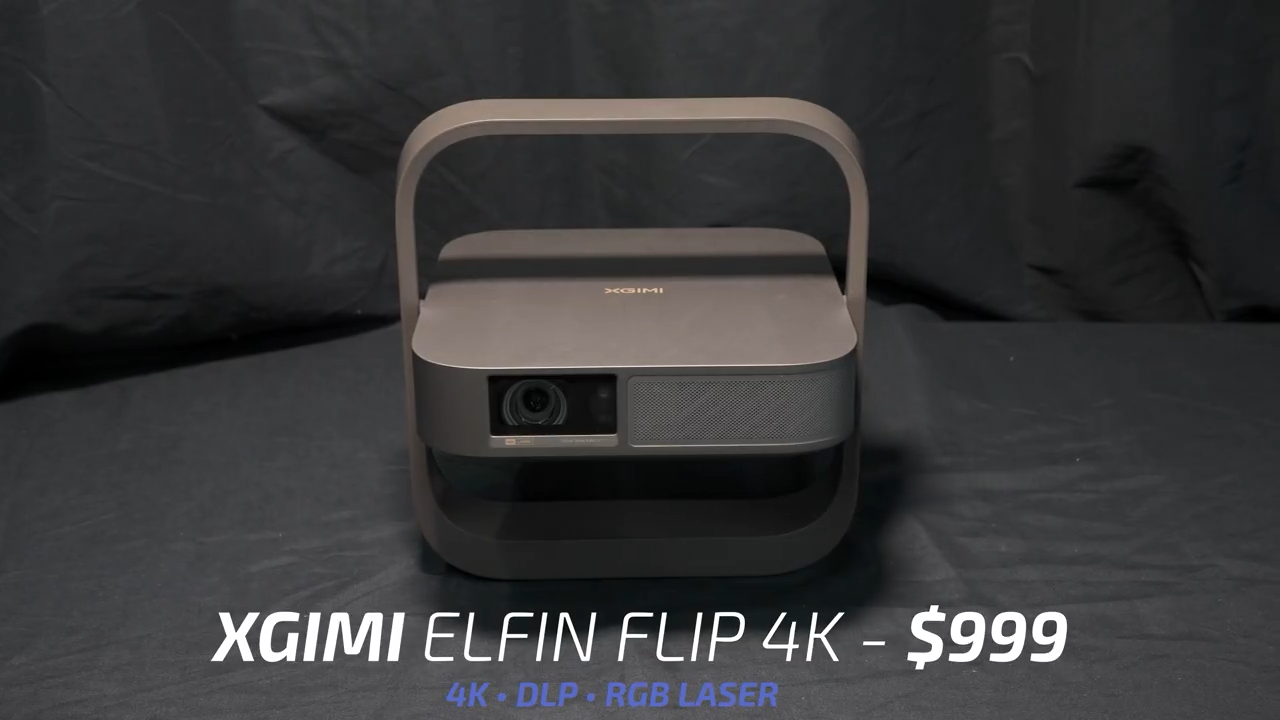
The Elfin 4K is advertised at 1600 lumens, and fell slightly short of that in my testing at 1560 lumens in performance mode with a green shifted image, but puts out 1043 lumens in standard mode with a native contrast of 1732:1. While the Elfin 4K has the option to use XGIMI’s dynamic black level enhancement laser dimming, it really only works on completely black screens and doesn’t have any significant effect on actual content, and the Elfin 4K’s color accuracy was slightly below average with an average SDR color error of 5.82.
Compared to the Elfin Plus, the Elfin 4K also got an upgraded Google TV chipset and is at least twice as responsive as the Elfin Plus. It also got twice the number of ports with two HDMI inputs, two USB-A, and an aux audio out, and the Elfin 4K is powered by a DC barrel jack, but I was able to use that same 20V USB-C to barrel adapter to power it, and using my UGREEN power bank, the Elfin 4K ran for 66 minutes outputting around 800 lumens.
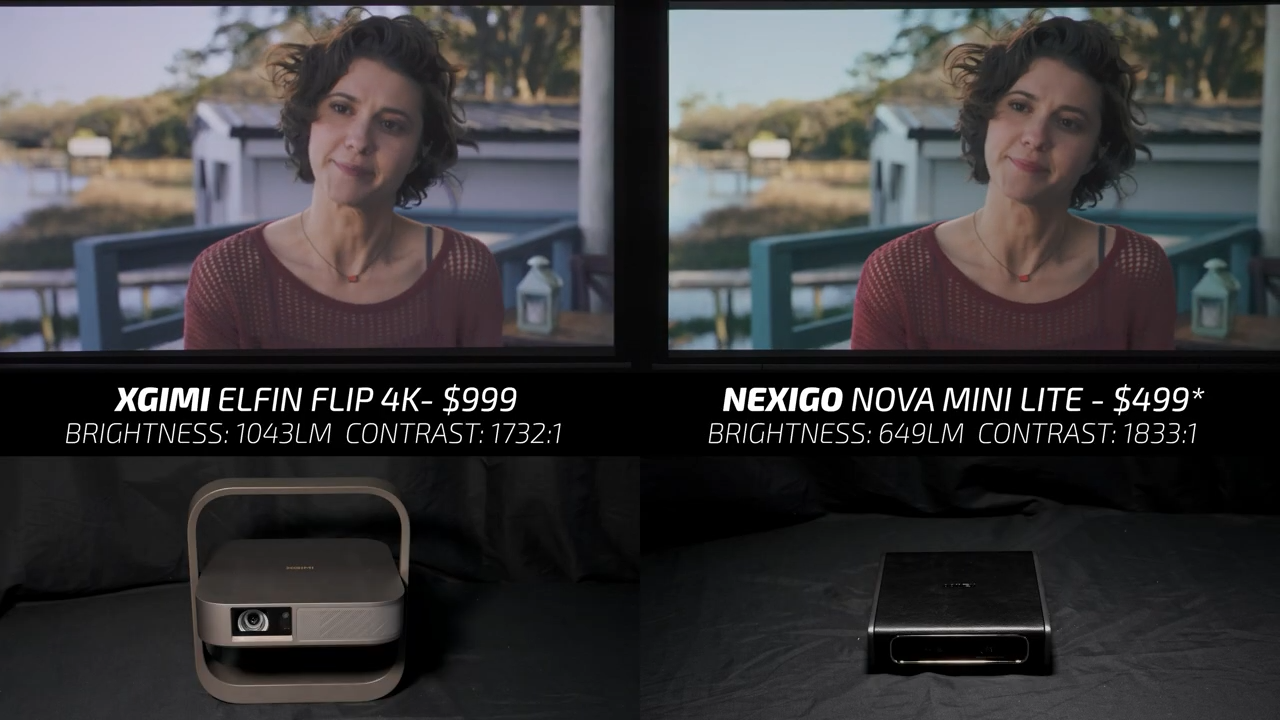
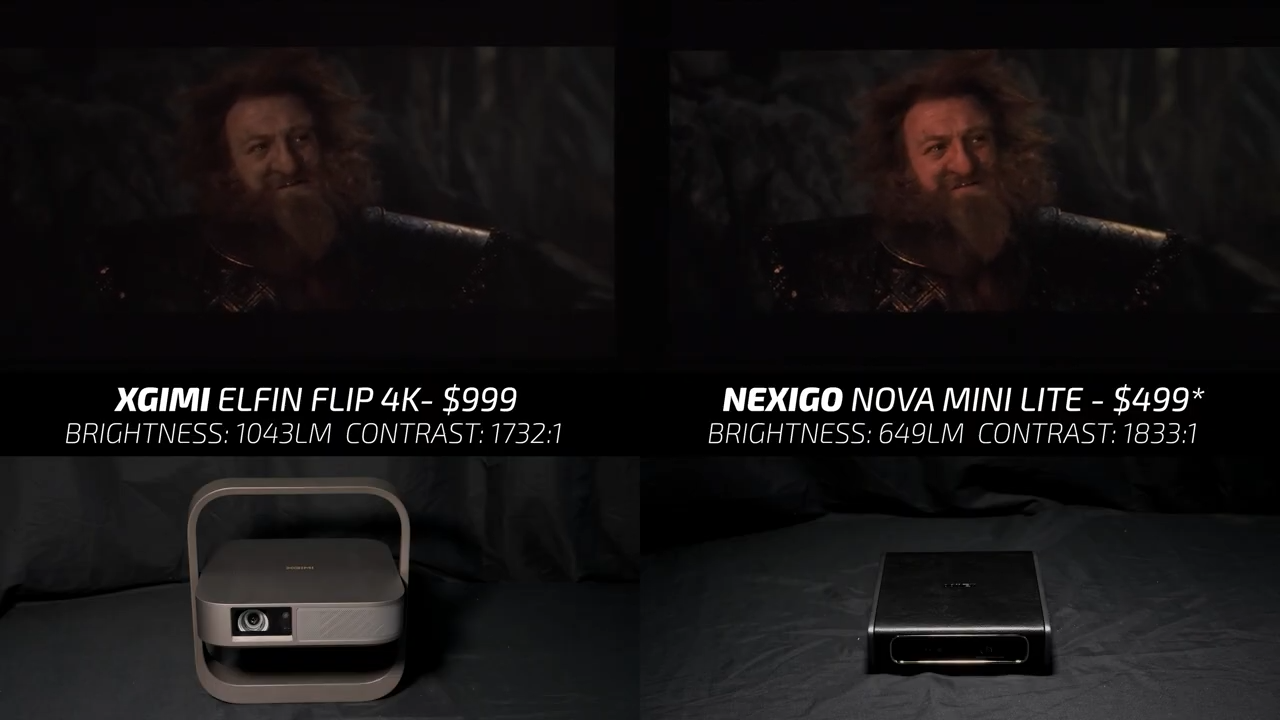
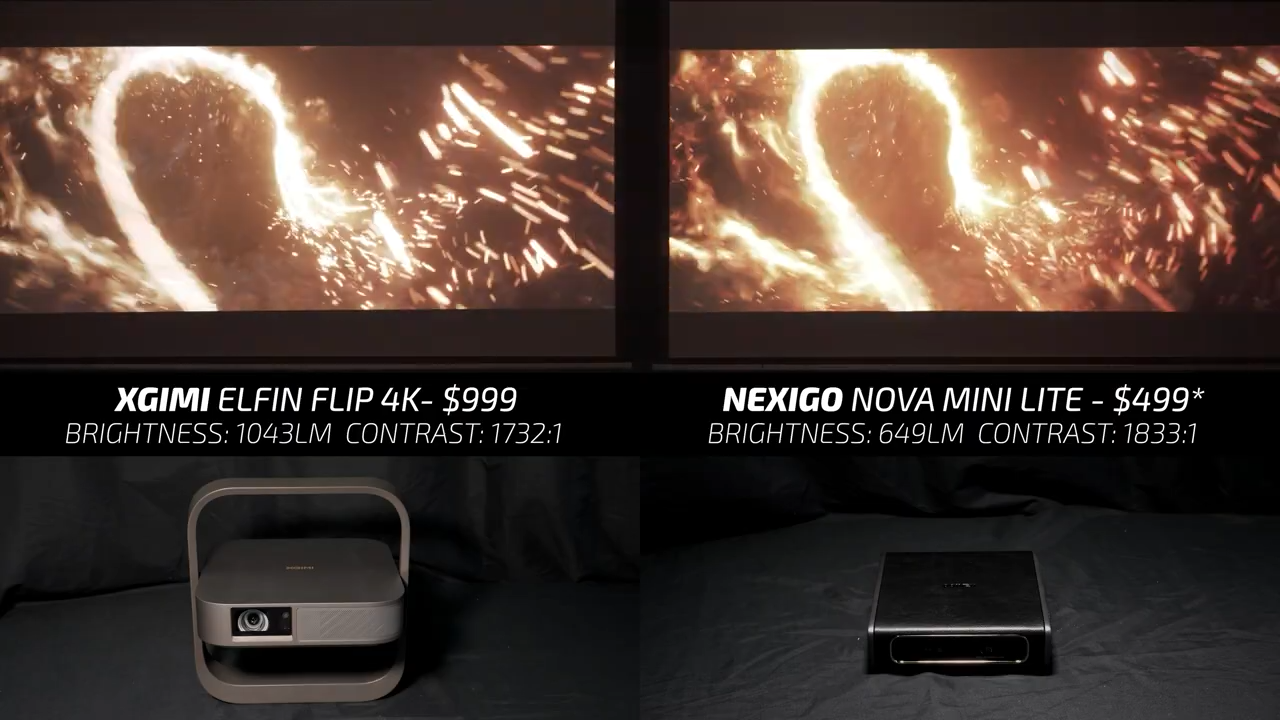
Putting the Elfin 4K up against the NexiGo Nova Mini Lite, the 4K resolution was noticeable on the Elfin, and in bright scenes, the additional brightness also came through. But perceived sharpness is actually a combination of resolution and contrast, and there were plenty of times that the 1080p NexiGo still looked sharper than the Elfin 4K due to the additional dynamic contrast provided by NexiGo’s SAE laser dimming. But if you get up close to the screen, you can definitely notice the individual pixels on the Nova Mini Lite compared to the XGIMI Elfin 4K. This was by far the closest round, and both projectors put out an impressive image for their size, but I think the increased contrast and dynamic laser dimming on the NexiGo gave it an edge over the Elfin 4K in terms of overall image quality, giving it another win.
Samsung Freestyle+ Gen3
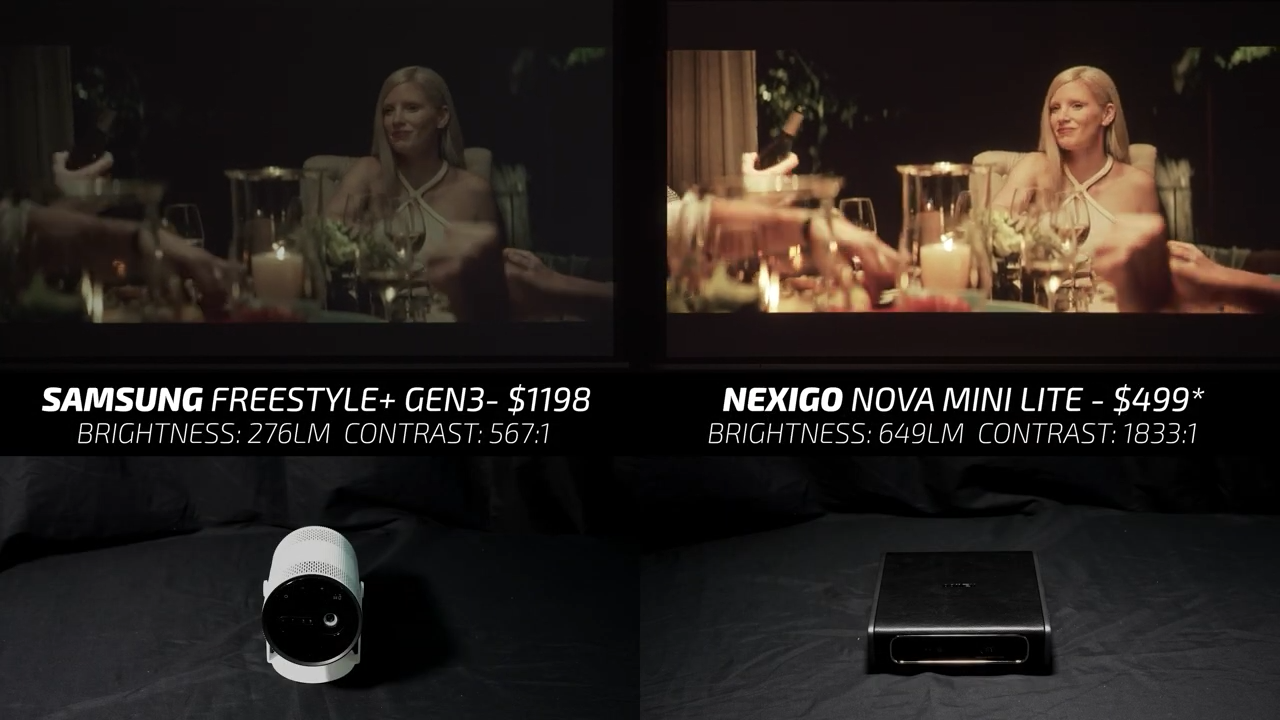
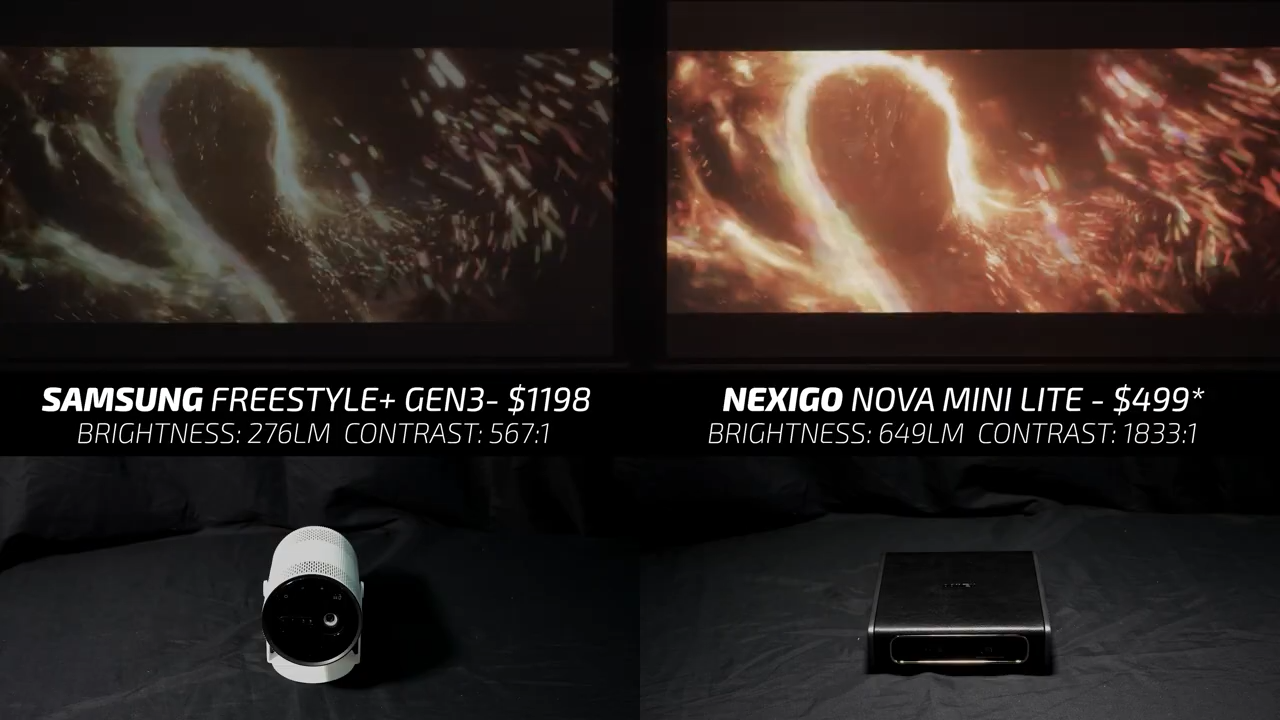
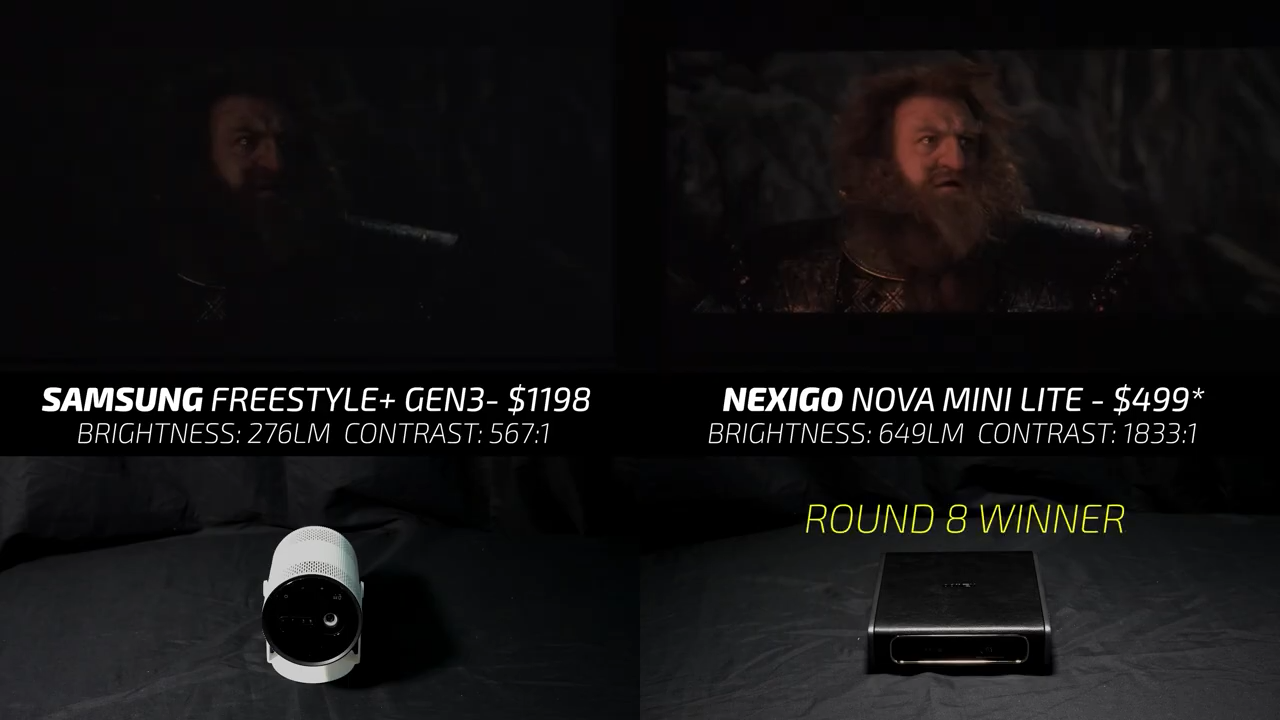
So in the final round, the NexiGo Nova Mini Lite is going to take on the $1198 Samsung Freestyle+, which is the 3rd generation of the FreeStyle, which should have given them plenty of time to fix all its issues, right? Right? The new FreeStyle+ is a 1080p DLP projector with an RGB LED light source and it’s supposed to be twice as bright as previous models, and it is because they added a green shifted high fan performance mode, but on standard mode the new Freestyle measures 276 lumens, which is just 18 lumens higher than the 258 lumens Gen2, and while the contrast did increase from around 380:1 to 570:1, the color accuracy got worse, with an average SDR color error of 6.45.
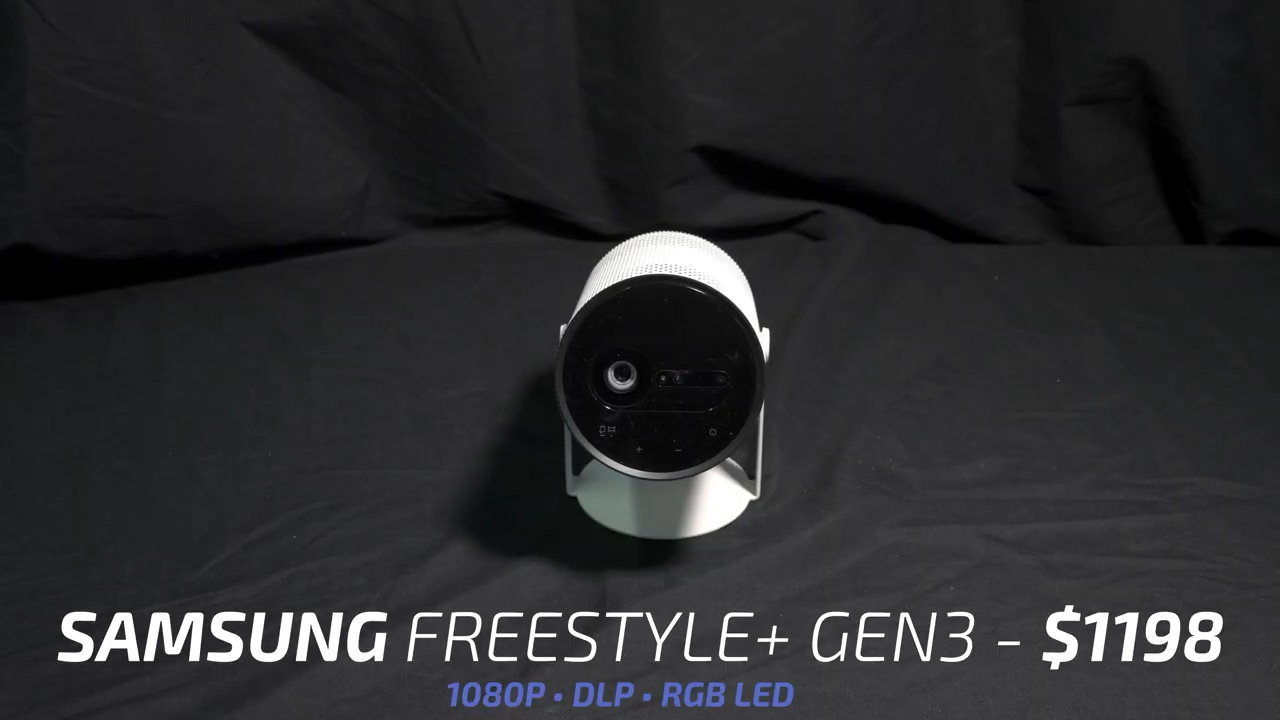
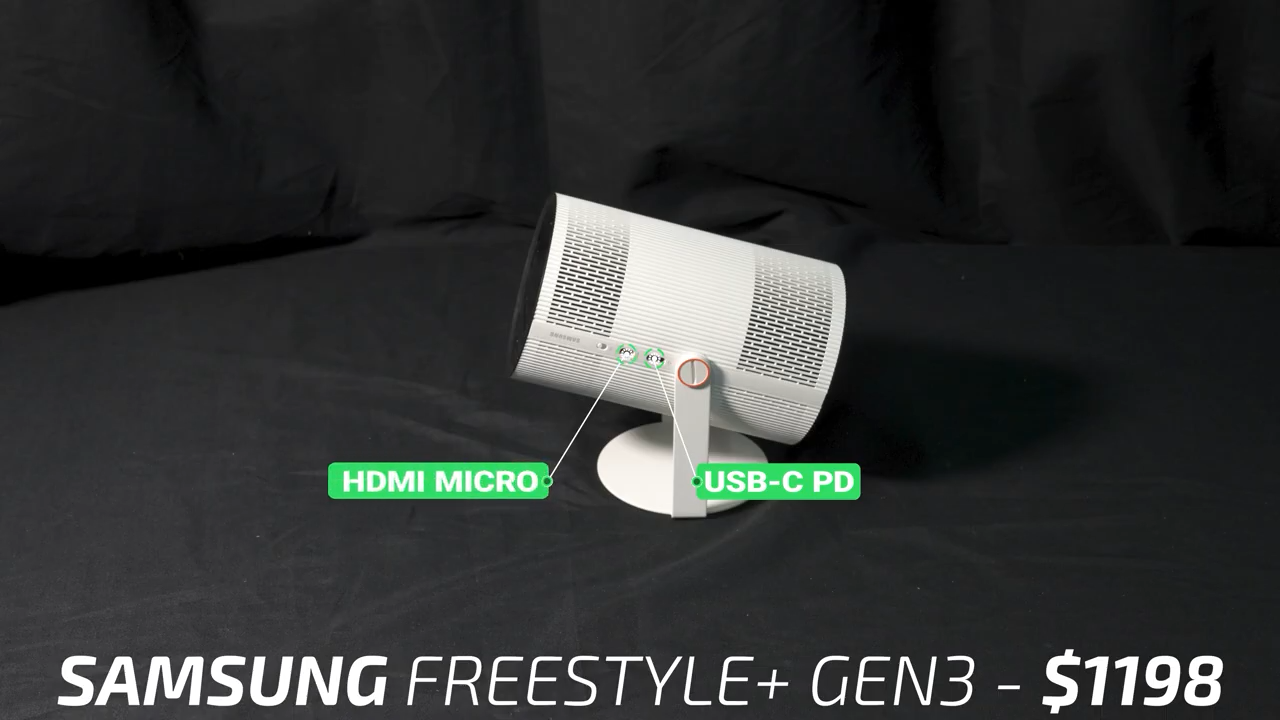
Tizen OS on the Freestyle has always been sluggish, but it went from being nearly unusable on the Gen1 to serviceable on the Gen2, and in my testing so far, it seems like the Gen3 FreeStyle+ is actually a step backwards in terms of speed and usability inside of Tizen OS. For connectivity, the FreeStyle+ hasn’t changed in three generations and has a single USB-C port that’s used for power and an HDMI micro port, and you’d think they would include a standard HDMI adapter in the box for the $1200 price tag, but you’d be wrong. The Freestyle doesn’t have a built-in battery, but battery performance is one of the Freestyle’s strengths and using my 20,000mAh power bank, the Freestyle+ ran for about 2 hours and 21 minutes outputting 276 lumens, which is a very good result.
But putting this thing up against the NexiGo Nova Mini Lite, I think the fact that the Freestyle+ exists and costs $1200 should be embarrassing for Samsung. Literally everything about its picture quality is bad, the color is bad, the brightness is bad, the motion is bad, and the contrast is so bad there were times that you literally couldn’t even see what was happening.
Final Rankings Picture Quality
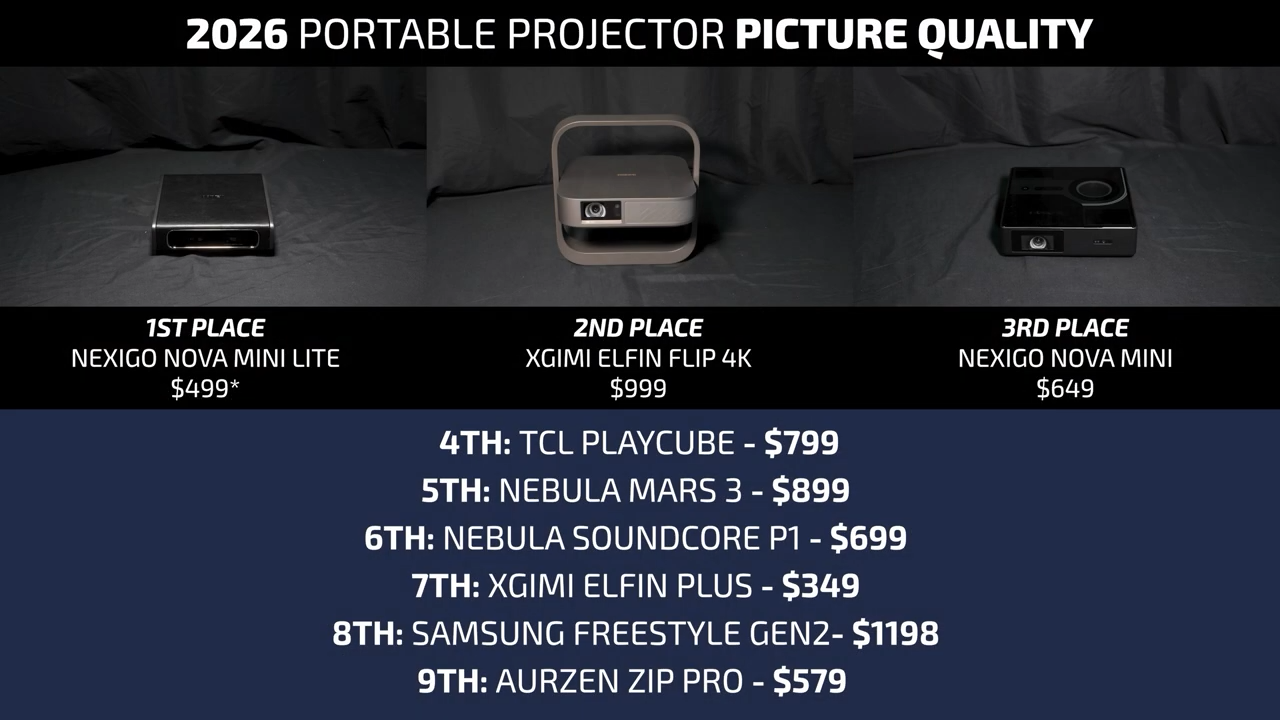
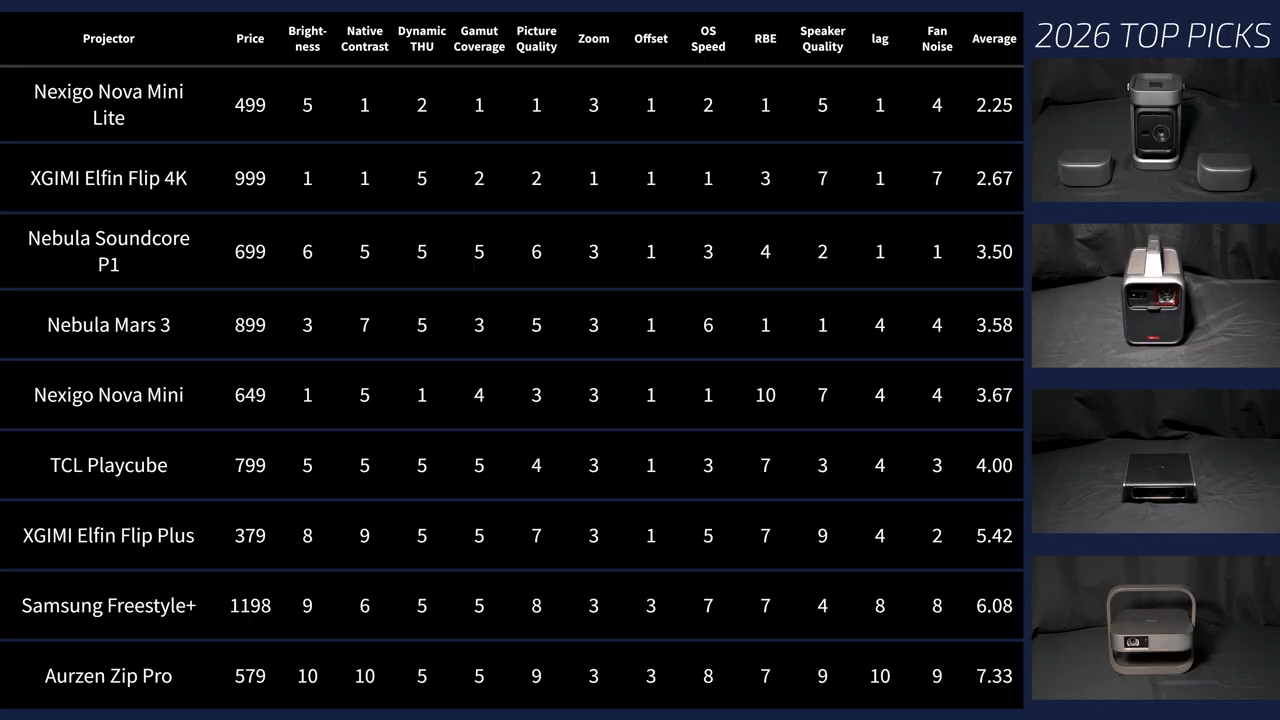
In what was maybe the most anticlimactic final round ever, the NexiGo Nova Mini Lite secured the top spot in terms of picture quality, with the Elfin 4K in second, and the original Nova Mini in 3rd.
Speaker Quality
But, especially with portable projectors, there’s a lot more to cover because unlike other projectors that will probably be paired with a screen and a surround sound system, these are meant to be more standalone devices. So next, let’s talk speakers.
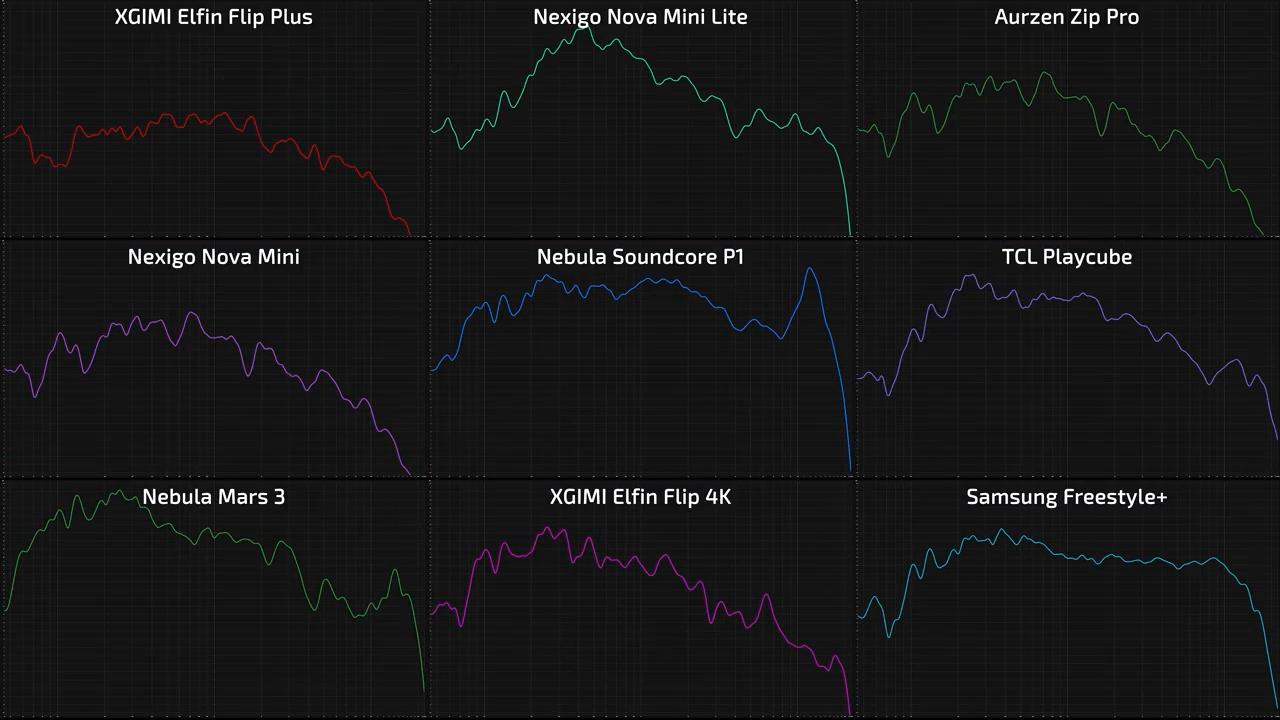
The first thing I did was run a frequency response sweep on each projector at their maximum volume which you can see all overlayed here. In these graphs, the height of the line indicates the volume at various frequencies. Everything below 200Hz is considered bass where things like explosions and thunder live. Between 200Hz and 2000Hz is called midrange, and that’s the most important for making dialog understandable. And above 2000Hz is treble, which is your higher pitched sparkly sounds. The first thing you can see is that the XGIMI Elfin Flip Plus had an extremely low overall volume compared to the rest of the projectors.
You can also see that none of the projectors generate any substantial sound below 50Hz, so bass performance isn’t great on any of them, but the Mars 3 has meaningful SPL as low as 60Hz making it by far the best performer in terms of bass.
The Soundcore P1 has a relatively excellent frequency response curve and good overall volume but has some serious resonance around 12000Hz. It’s something that I definitely noticed in my test clips and also in normal viewing, though only at max volume, and the main advantage of the P1 is that you can put the wireless speakers close enough to you that you shouldn’t need to use max volume.
Here’s an example clip of each projector’s speaker quality.
Input Lag
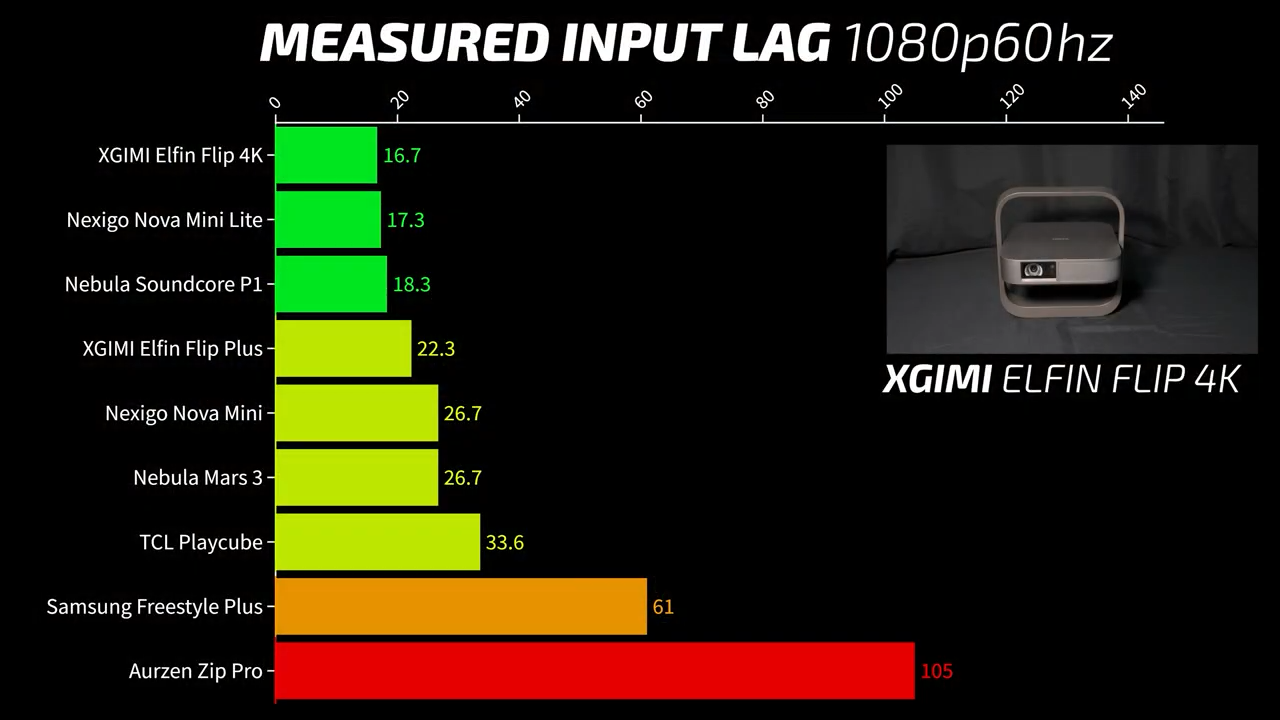
Moving on to input lag, which is important if you want to use these projectors for gaming, this measures the time in between when you press a button on the controller and when you see that action on screen. In general, input lag times under 20ms are excellent for gaming, between 20ms and 50ms are good for casual gaming, 50ms-100ms starts to become problematic, and over 100ms makes certain games unplayable.
The XGIMI Elfin 4K is a standout when it comes to gaming for three reasons. First, it has the lowest overall input lag. Second, it actually has lower than 16.7ms of lag since it refreshes from the top of the screen down, and the top bar was actually under 2ms. Third, it’s the only projector that maintained a sub-20ms input lag even with keystone enabled, so if you want to use keystone while playing competitive games, it’s basically the only option.
Throw Ratio and Offset
With the Aurzen Zip Pro and Samsung Freestyle+, you’re probably never going to be in a situation where you’ll use them without keystone because unlike most DLP projectors that have 100% offset where the bottom of the lens lines up with the bottom of the screen, both the Aurzen and Samsung have 0% offset where the middle of the lens lines up with the middle of the screen.
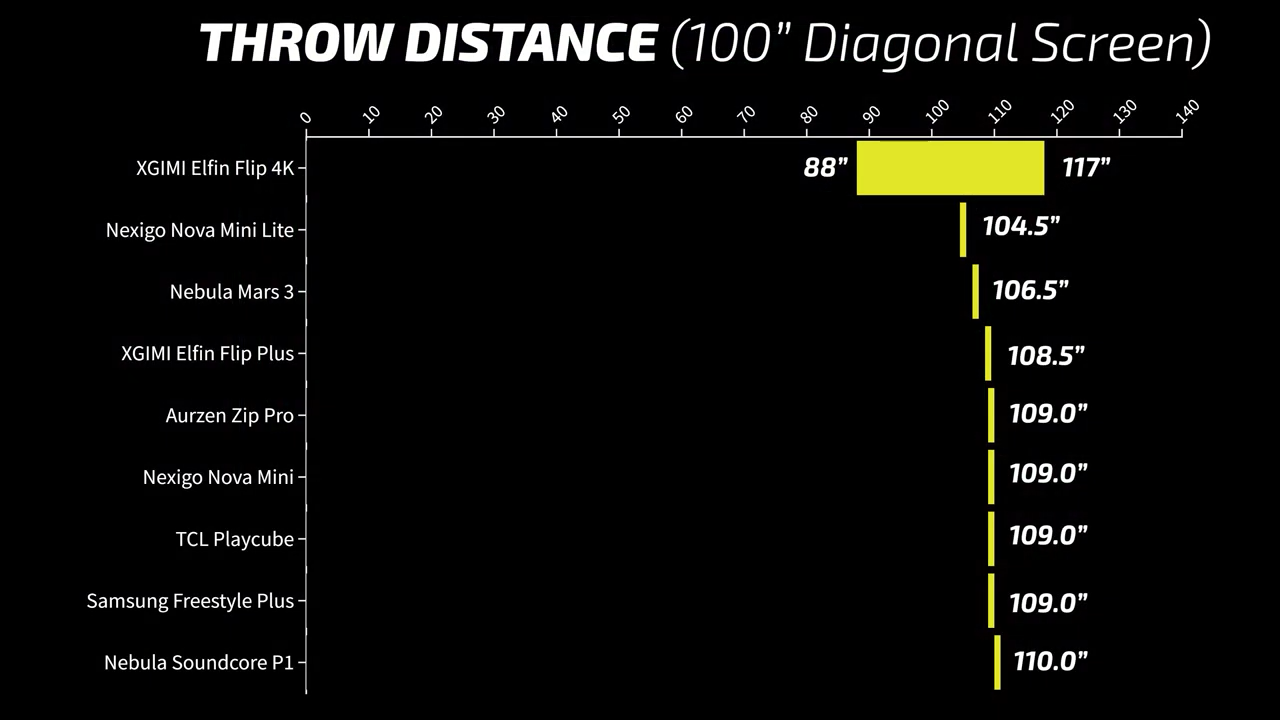
Also on the subject of projector placement, the throw ratios of all of these projectors were pretty similar needing between 105 and 110” of distance between the front of the projector and the screen to produce a 100” screen. The XGIMI Elfin 4K is the only one that has optical zoom allowing it to be placed as close as 88” and as far as 117” for a 100” screen.
Fan Noise
Based on your projector’s positioning, you may end up sitting pretty close to it, so the fan noise is also important to consider. Here they are from the quietest to the loudest. In addition to that, the NexiGo Nova Mini Lite’s SAE laser dimming works extremely well, but causes a high-pitched whining noise whenever it dims, so if that’s something you’re sensitive to it could cause a problem for you.
DLP Rainbow Effect (RBE)
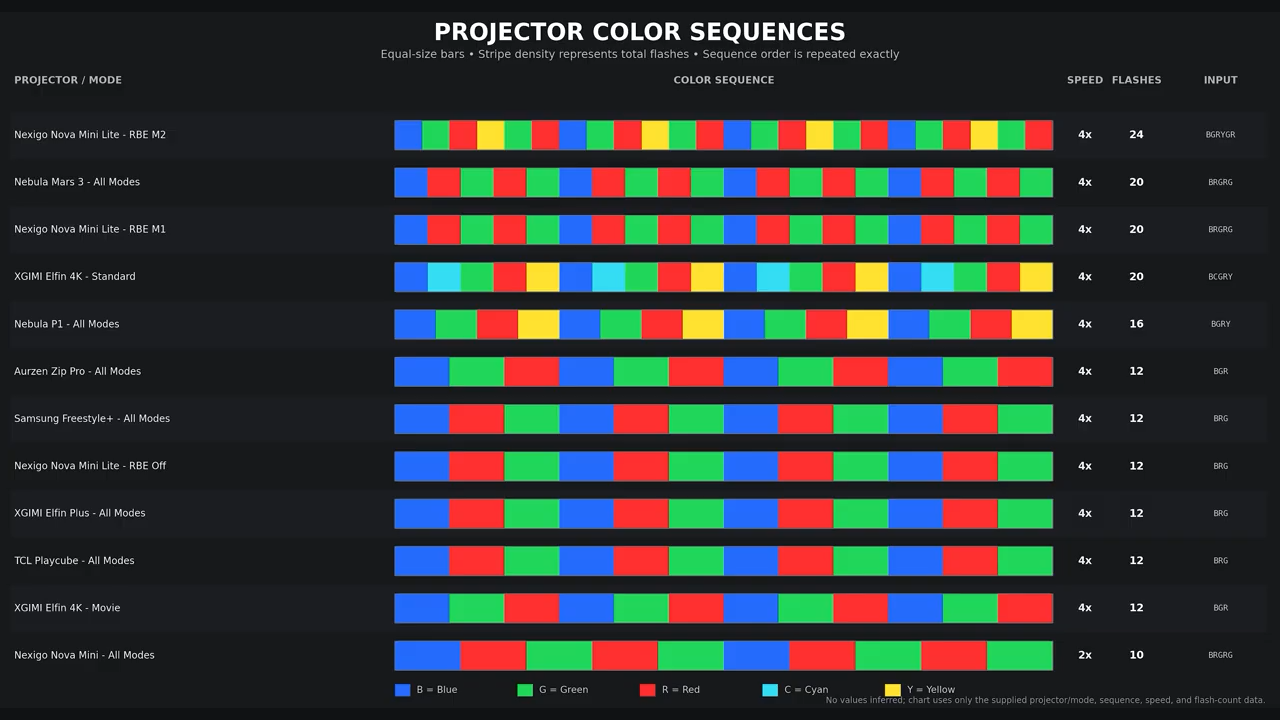
Speaking of sensitivities, all these projectors are DLP projectors which create and image by flashing colors consecutively and relying on persistence of vision to combine the red, green, and blue subframes which can sometimes lead to the DLP rainbow effect. In general, the faster the colors cycle, which can be expressed in flashes per frame, the less likely you are to see rainbows in high contrast fast moving areas. So the NexiGo Nova Mini Lite should have the least when RBE mode 2 is on, but that comes at the cost of color performance since it includes yellow in the color sequence, and the Nebula Mars 3 and Nova Mini Lite in RBE mode 1 will have the fewest rainbows without impacting color performance. The original NexiGo Nova Mini is the most likely to show the DLP rainbow effect with only 10 flashes per frame, and it’s the only one that I regularly noticed during normal viewing.
Conclusions and Recommendations
So conclusion time, do I recommend any of these projectors? Yes, but probably not the ones you think, and for me it’s less about overall performance and more about convenience and form factor.
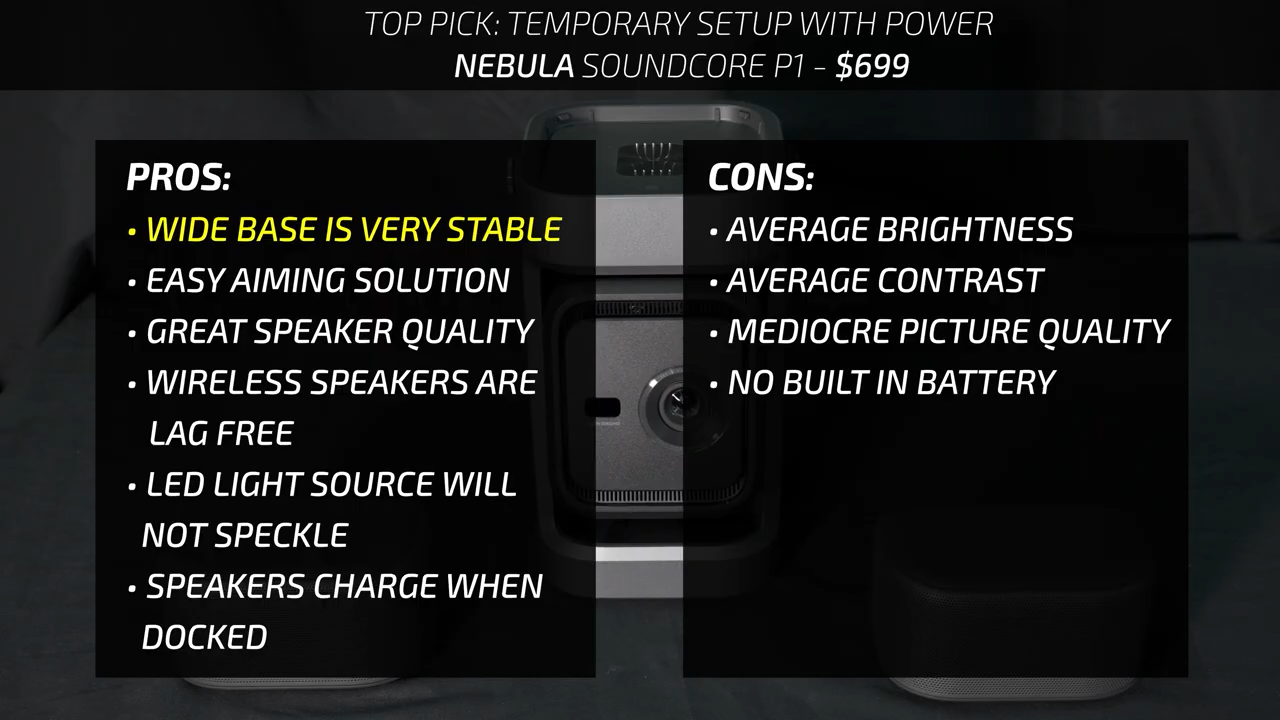
First, for a projector to be brought out on your patio at night or temporarily set up on a random wall in your house, the form factor of the Nebula Soundcore P1 is unmatched. The wider footprint of the built-in stand feels much sturdier than the Elfin Flip and the detachable wireless speakers are great because you can put them much closer to you and enjoy stereo sound without needing to blast the volume and disturb your neighbors. It’s not the brightest, the highest contrast, or the most accurate, and it doesn’t have a built-in battery, but it’s probably my favorite form factor of any portable projector I’ve ever tested, and I’ll definitely be keeping it for around the house temporary setups.
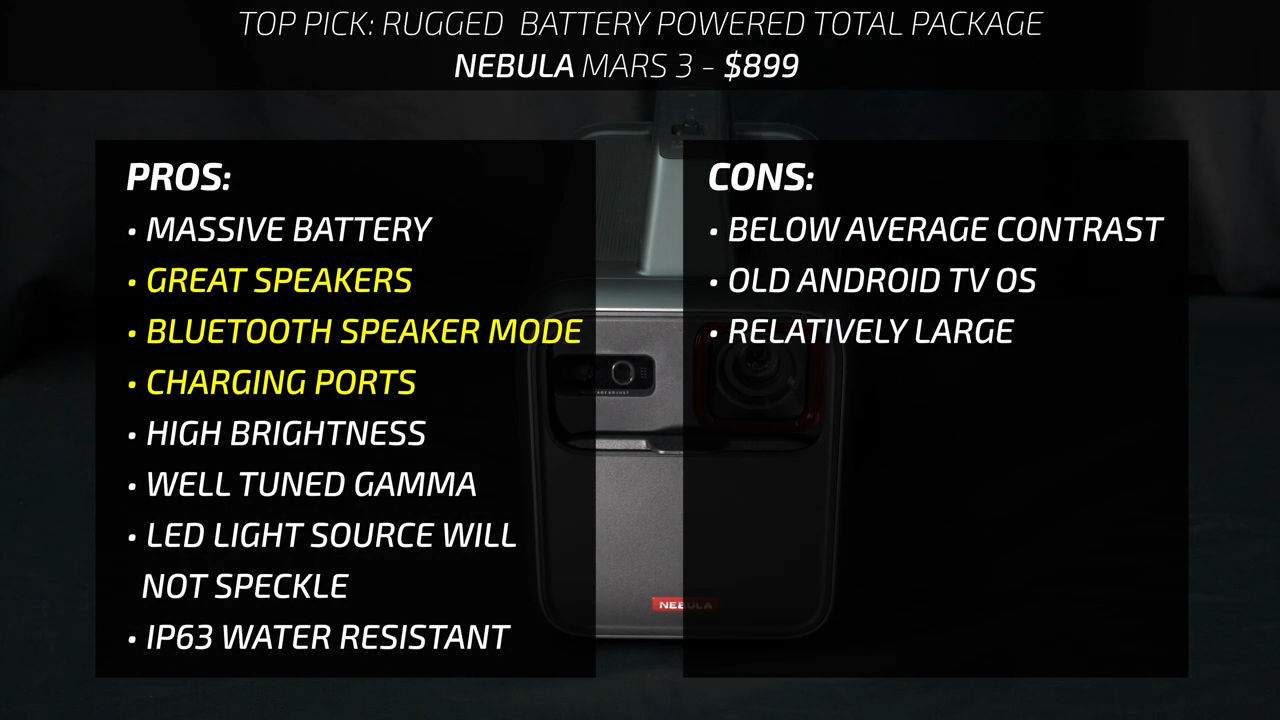
Second, the rugged camping projector, this Nebula Mars 3 has been on all my camping trips for the last three years and acts as a Bluetooth speaker and charging bank during the day and a projector at night. The downsides are the aging Android TV operating system and obviously larger size and weight, but if you need the complete package with excellent speakers, a huge battery, and more than enough brightness for a 100” screen at night, I’ve been extremely happy with the Mars 3.
The TCL PlayCube is also a complete portable projector package but in a smaller form factor. It’s got decent brightness, good picture quality, and very usable speakers along with a built-in battery that provides over 2 hours of playback. But keep in mind to get that amount of battery life, the brightness goes down to around 230 lumens, so it’s going to work best if you’re projecting a smaller screen.
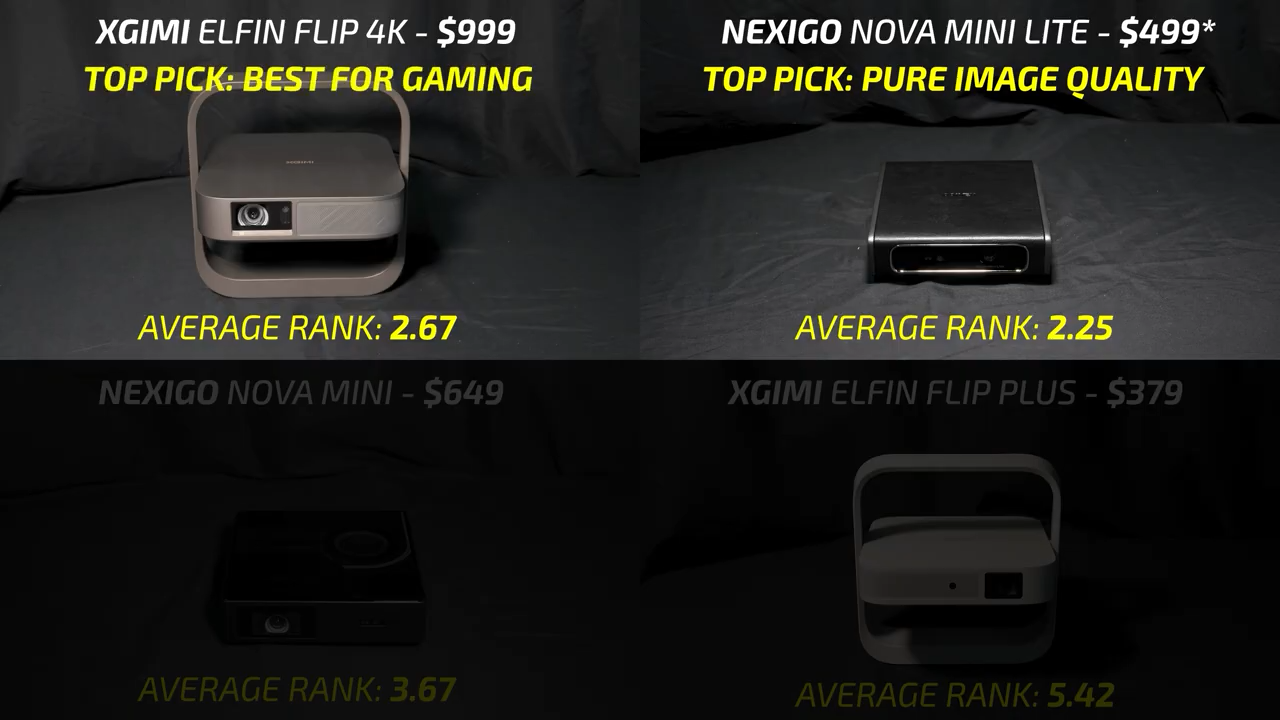
Then you’ve got the XGIMI Elfin 4K, NexiGo Nova Mini Lite, NexiGo Nova Mini, and XGIMI Elfin Plus, and I think these would be classified as travel projectors since they fold down flat and could fit in a backpack. You could use Bluetooth headphones to get around the relatively poor speaker quality, but I’m personally struggling to think of a use case where one of these projectors makes sense. However, if a small flat projector is what you need, I think the Nova Mini Lite punches way above its weight in terms of picture quality, and the XGIMI Elfin 4K is the clear pick for gaming.
Speaking of not being able to picture a use case, the Aurzen Zip is really cool. It’s crazy that a 1080p projector with a two-and-a-half-hour battery life can fold up and fit in your pocket and casting a second screen from my computer and mirroring my phone both worked perfectly. I just can’t really think of a time that I’d want to do that. If I’m missing some obvious use case please let me know in the YouTube video comments because I want to love this projector, I just don’t know what it’s for.
In a distant last place is the Samsung Freestyle+, and I can confidently say that no one should buy this thing and it probably shouldn’t even exist. It’s got terrible picture quality, a sluggish and buggy operating system, no built-in battery, a non-standard HDMI port, a loud fan, and a 0% offset throw so you’re always going to need keystone, and the kicker is it costs $1198 but I still wouldn’t recommend it even if it were the least expensive projector in the video.
As always, there are no sponsored reviews on this channel but I do have links to all the projectors below and as always, I appreciate when you use those links since as an Amazon affiliate I do earn a small commission on the sale at no cost to you.
I’d also like to thank all my patrons over at Patreon for their continued support of my channel, and if you’re interested in supporting my channel, please check out the links below. If you enjoyed this video, please consider subscribing to my YouTube channel and as always, thanks for watching The Hook Up.