Soundbars Under $100: There’s a New Budget King
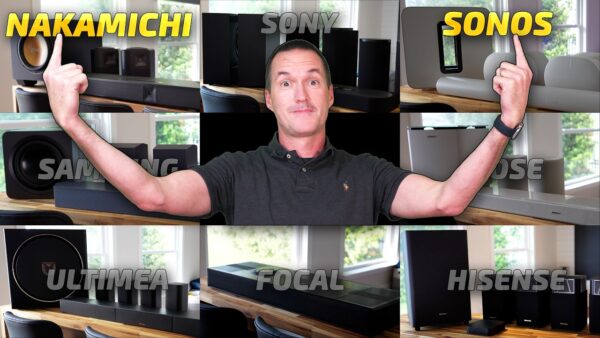
September 16, 2026Last year I bought 16 soundbars under $100 and the Ultimea Poseidon M60 came out as the clear winner. But in the last year, its price has gone up from $99 all the way to $158, so this year I bought 11 more soundbars under $100 to find its replacement. If you just want to know the winner, this bar, the INFITBO D40CS, is my new favorite, and it actually outperformed the more expensive Ultimea M60. I’ve got links below but stick around for all the testing and side-by-side comparisons. As always, there are no sponsored reviews on this channel, and I bought all these soundbars with my own money.
Ultimea M20 Pro
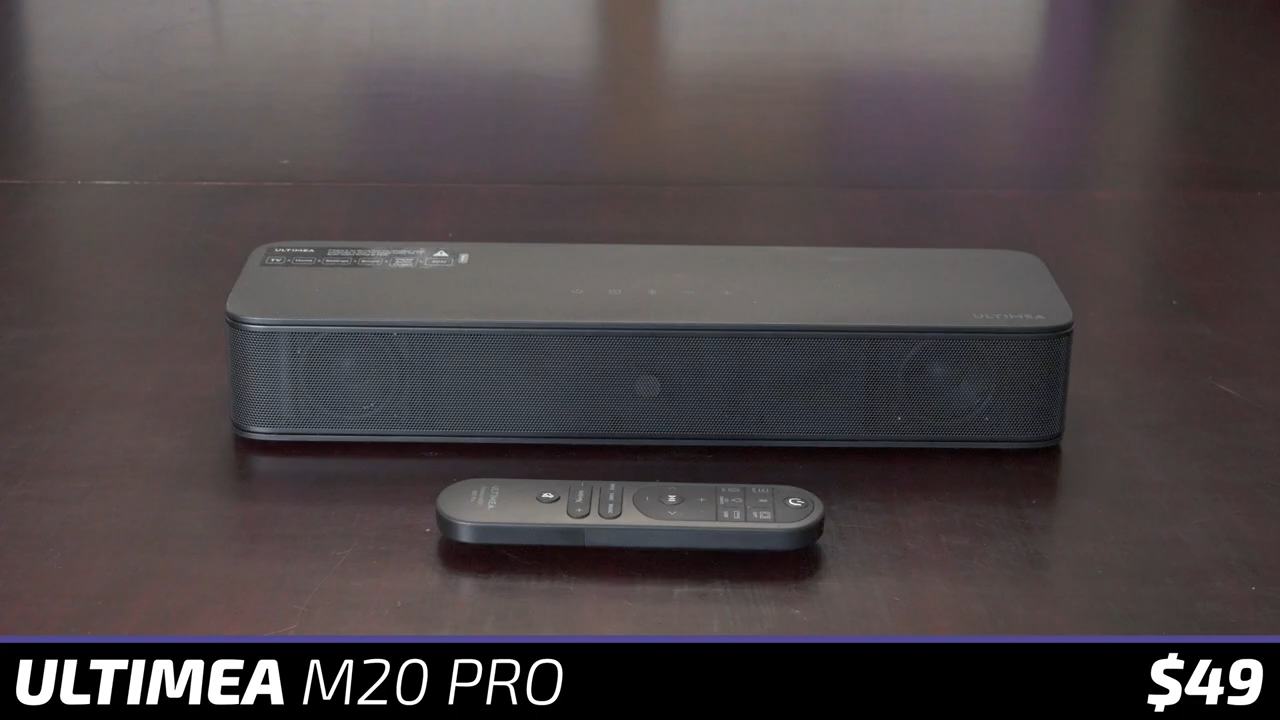
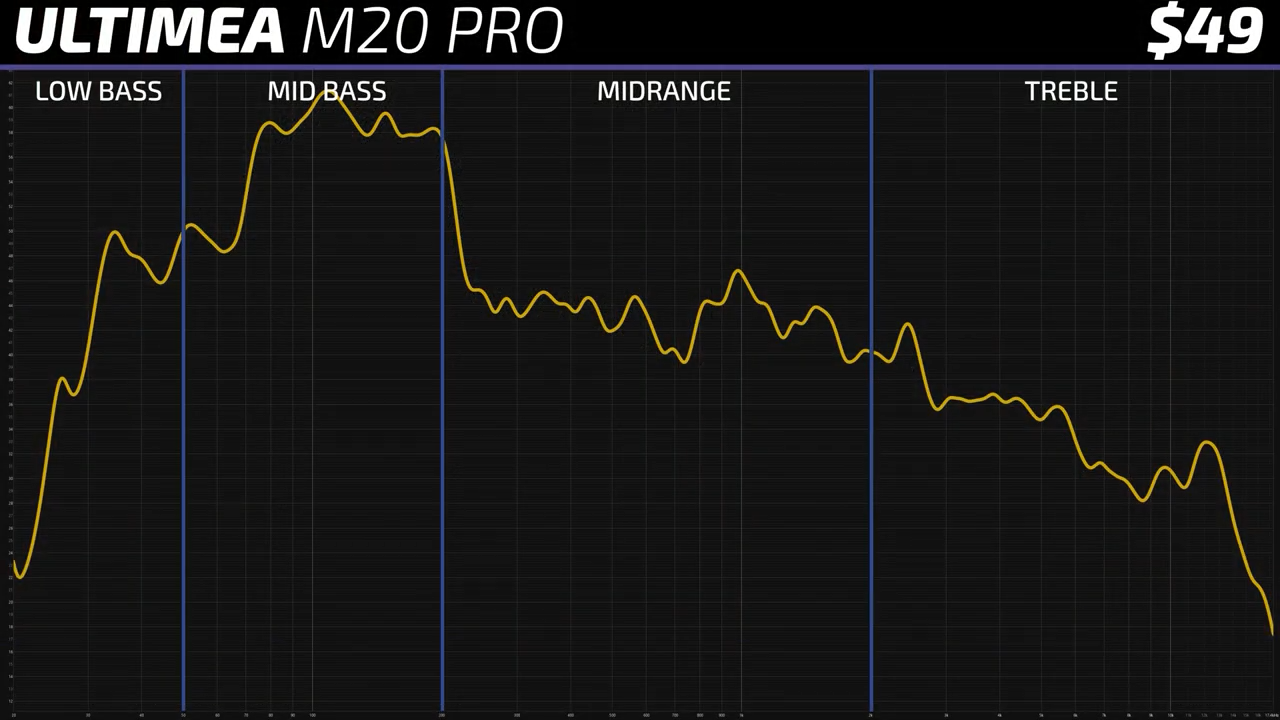
Jumping right into the head-to-head testing, the least expensive soundbar in this video is the $49 Ultimea M20 Pro, a small bar only system coming in at less than 16” total width, with 2×2” full-range drivers on the front of the bar and a 3” driver that they’re calling a subwoofer on the bottom of the bar. For inputs, the M20 has optical, AUX, and Bluetooth 5.3 but lacks HDMI ARC, so I’ll be using Bluetooth for this test.
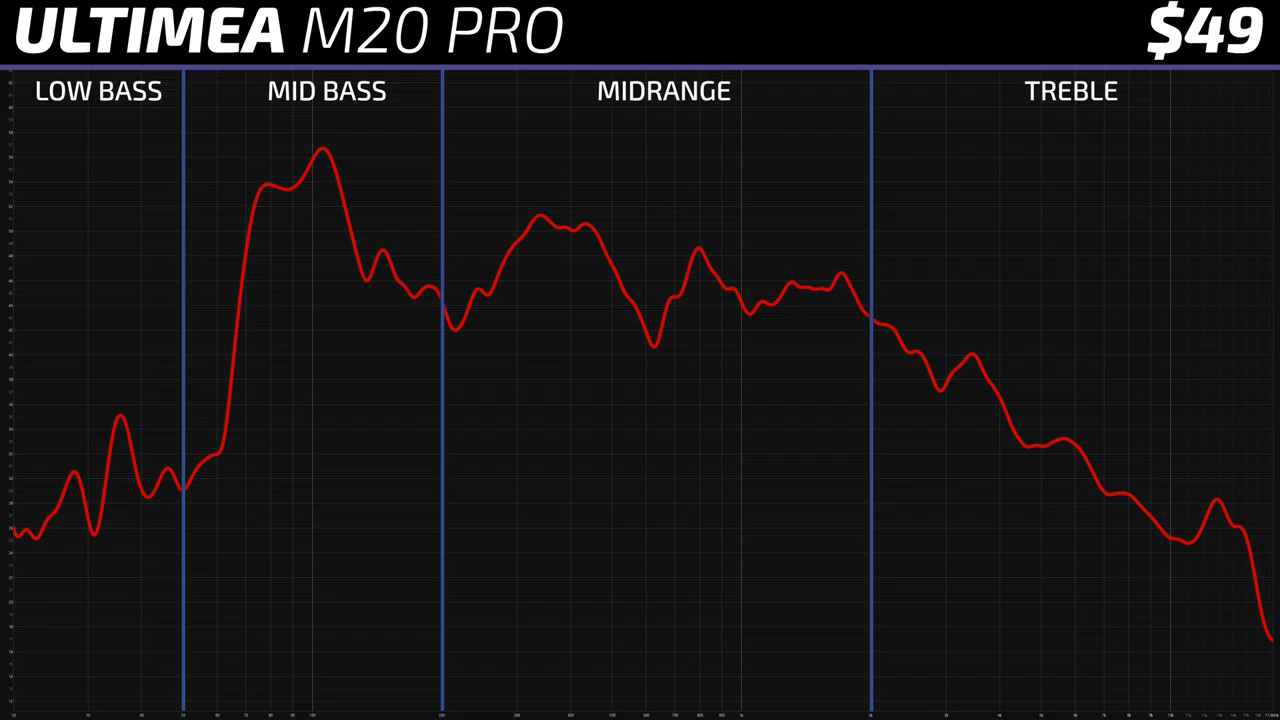
For each soundbar, I ran a frequency response sweep, which shows how well the speakers can reproduce different types of sounds. You can see that the M20’s small 3” subwoofer doesn’t start producing any meaningful sound before about 75Hz, so low-end bass like explosions and gunshots will be lacking. Instead, the M20’s frequency response heavily favors the midrange, which should make vocals extra clear, but without any dedicated tweeters, the highest frequencies trail off quickly. So we can also expect a lot of missing high-pitched sound effects.
Saiyin DS6345S
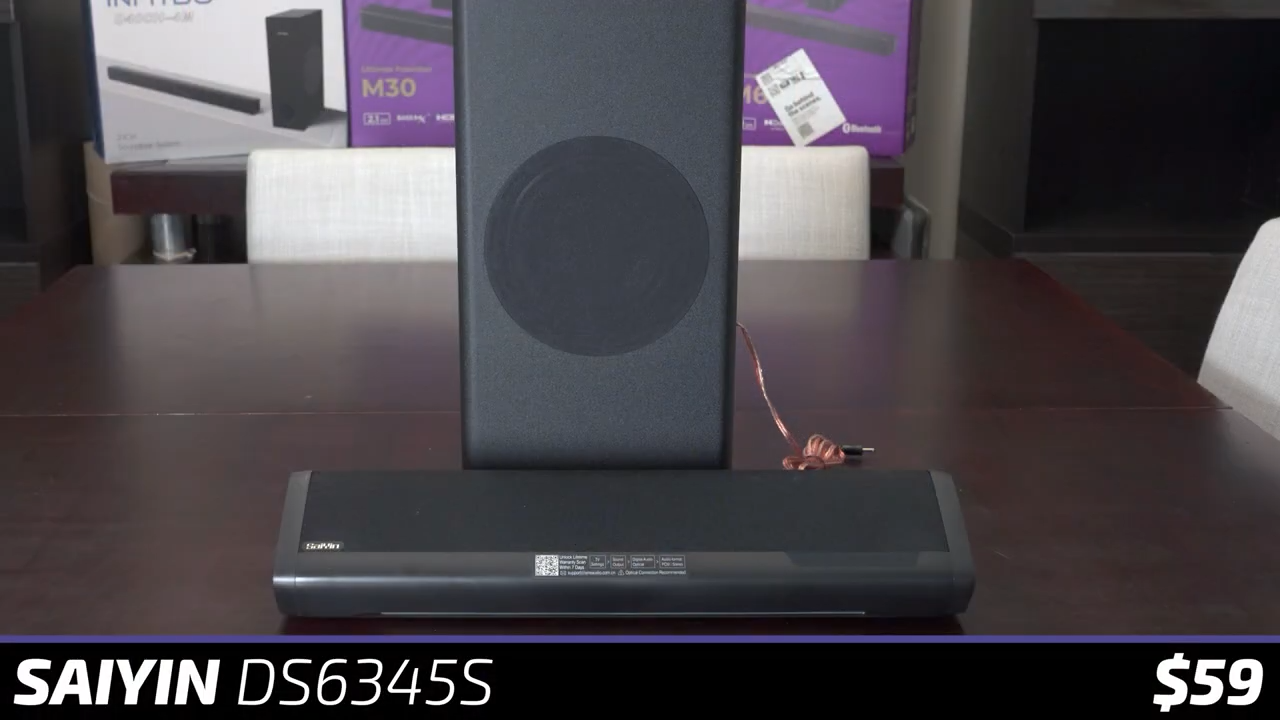
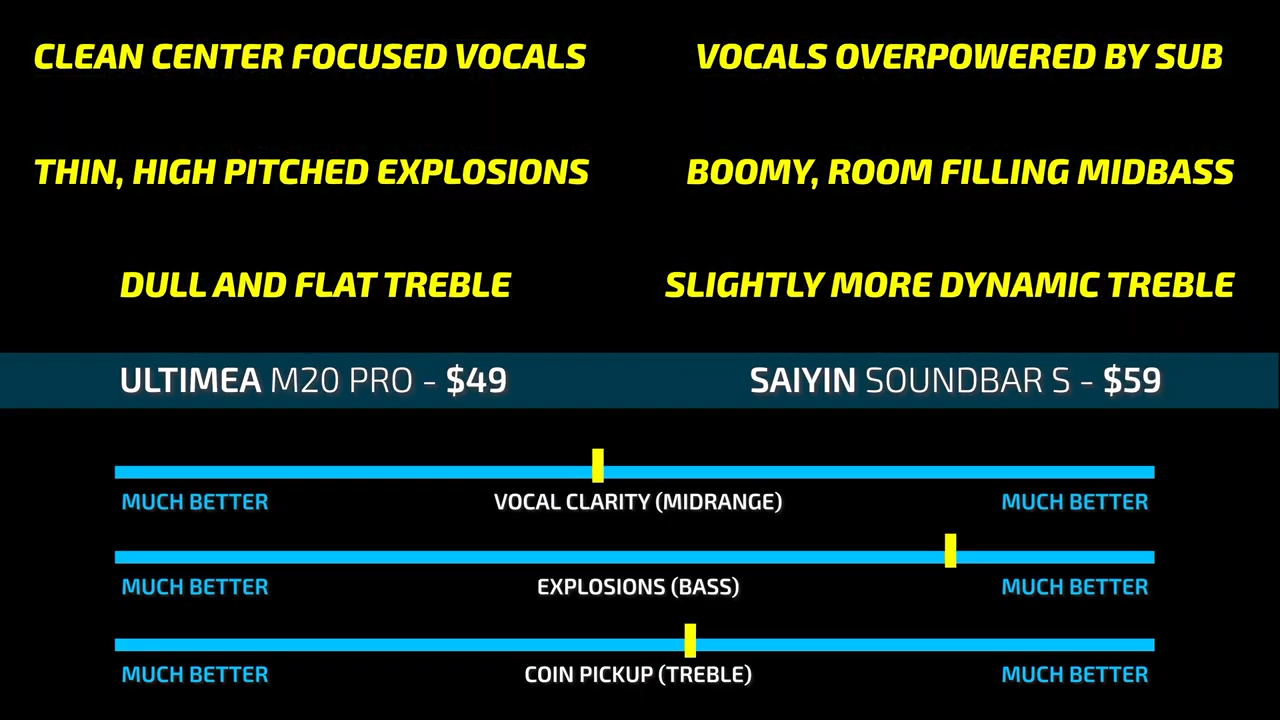
In Round 1, the Ultimea M20 Pro will go head-to-head against the $59 Saiyin DS6345S, which we’re just going to call the Saiyin S from now on. The S is also a small bar, coming in under 17”, and it has 2” x 2” full-range drivers like the Ultimea. But instead of the small 3” down-firing subwoofer, the Saiyin S has a separate wired, ported sub with a 5” driver. For connectivity, the Saiyin S has optical, AUX, and Bluetooth, but it also lacks HDMI ARC.
The Saiyin S’s frequency response curve shows that the subwoofer starts making meaningful bass around 33Hz but then has some serious boominess in the midbass between 70Hz and 200Hz. The bar itself has a relatively flat response through the midrange but trails off at higher frequencies just like the Ultimea.
For the head-to-head testing, I normalized the volume on each bar using a pink noise generator and then used my Tascam Portacapture X8 to record the opening race scene from Ready Player One. For this video, I pulled three small clips that illustrate the soundbar’s ability to recreate bass, midrange, and treble. I’m going to play each clip back to back, overlay my commentary, and choose a winner for each round.
In Round 1, the Saiyin and Ultimea’s main bars performed almost identically in terms of midrange and treble performance, with the Ultimea slightly ahead in the midrange and Saiyin slightly ahead for treble. But even though the Saiyin’s subwoofer was a little boomy and midbass-focused, the improvement over the Ultimea’s tiny 3” subwoofer was undeniable.
Miroir SL3301
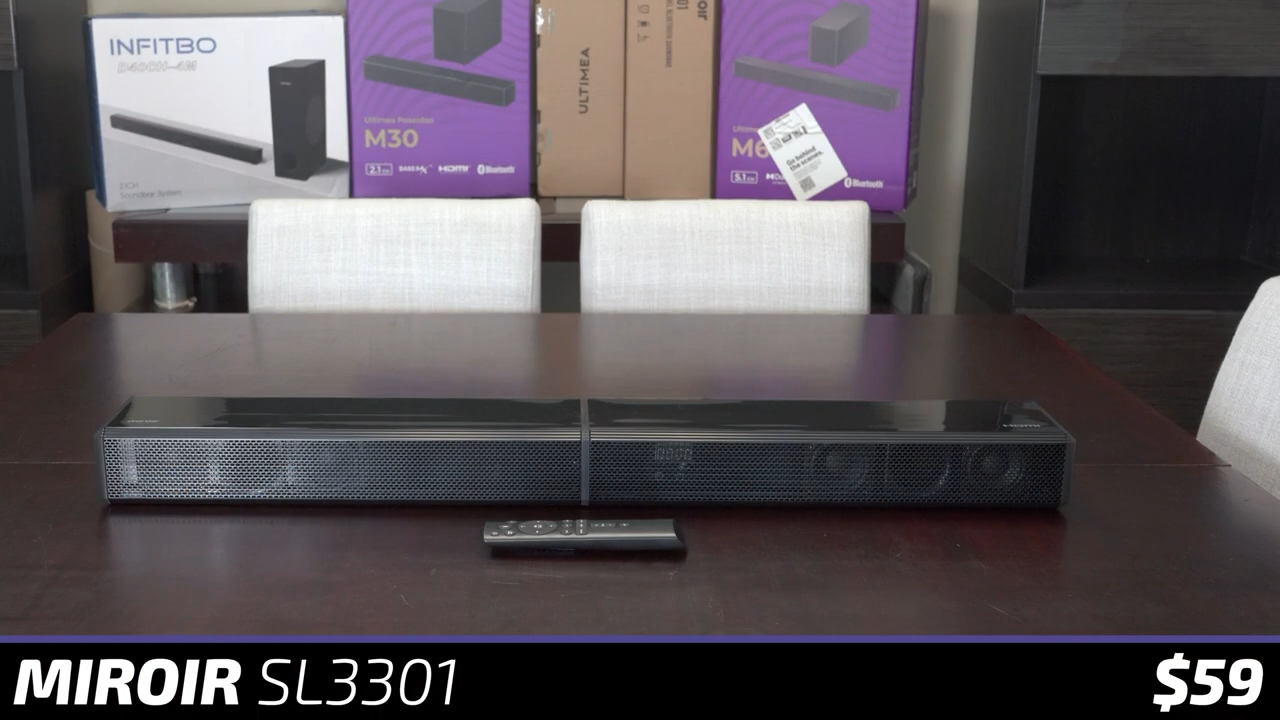
So the Saiyin will move on to Round 2, where it will go up against the $59 Miroir SL3301, a bar-only system measuring just under 32” long with four full-range 2” drivers and no subwoofer. The Miroir is the first of the bars in this video that can also be detached to use as left and right speakers instead of a single bar. For connectivity, the Miroir has AUX, optical, and HDMI ARC in addition to Bluetooth, and for these tests I’ll be using ARC.
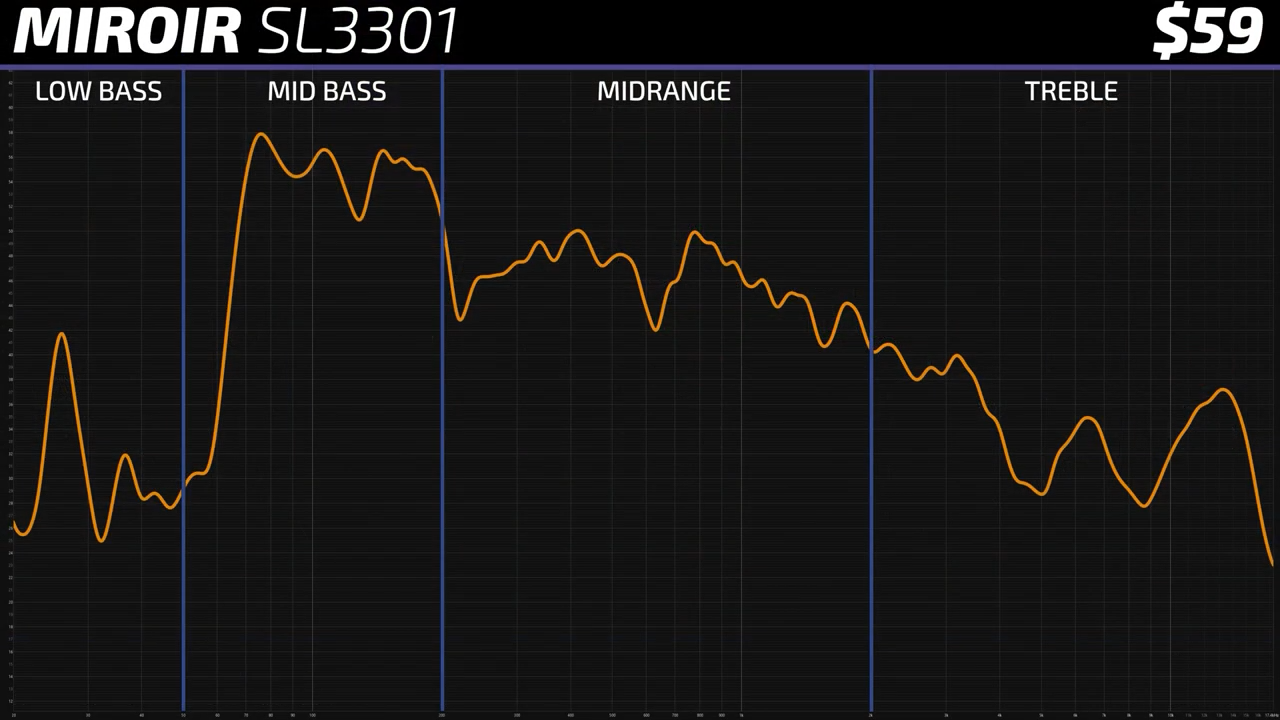
Looking at the Miroir’s frequency response, you can see that without a dedicated subwoofer, there is no meaningful bass response until around 75Hz, other than a small rattle that happened around 25Hz. But compared to the Ultimea, it does perform a little better through the mid-bass and a lot better in the treble, so we should see a significant improvement in the coin sounds.
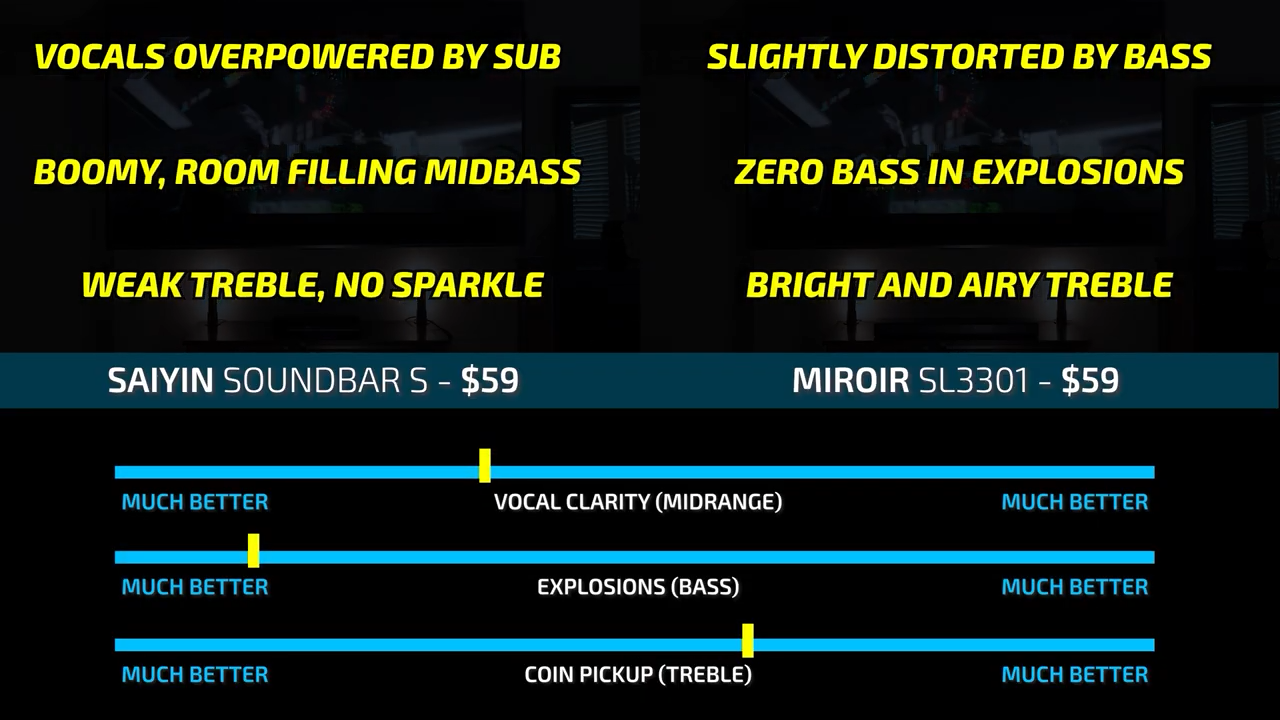
In this round, the Miroir’s vocal clarity was a bit disappointing, and to me, the vocals sounded a little muted and distorted, especially when there were competing engine noises. The bass response went about as expected given the Miroir’s lack of a subwoofer, and again, as expected given the frequency response, the sound of the coins getting collected had a lot more detail on the Miroir. But ultimately, the Saiyin S still won this round.
Vibeadio Soundbar
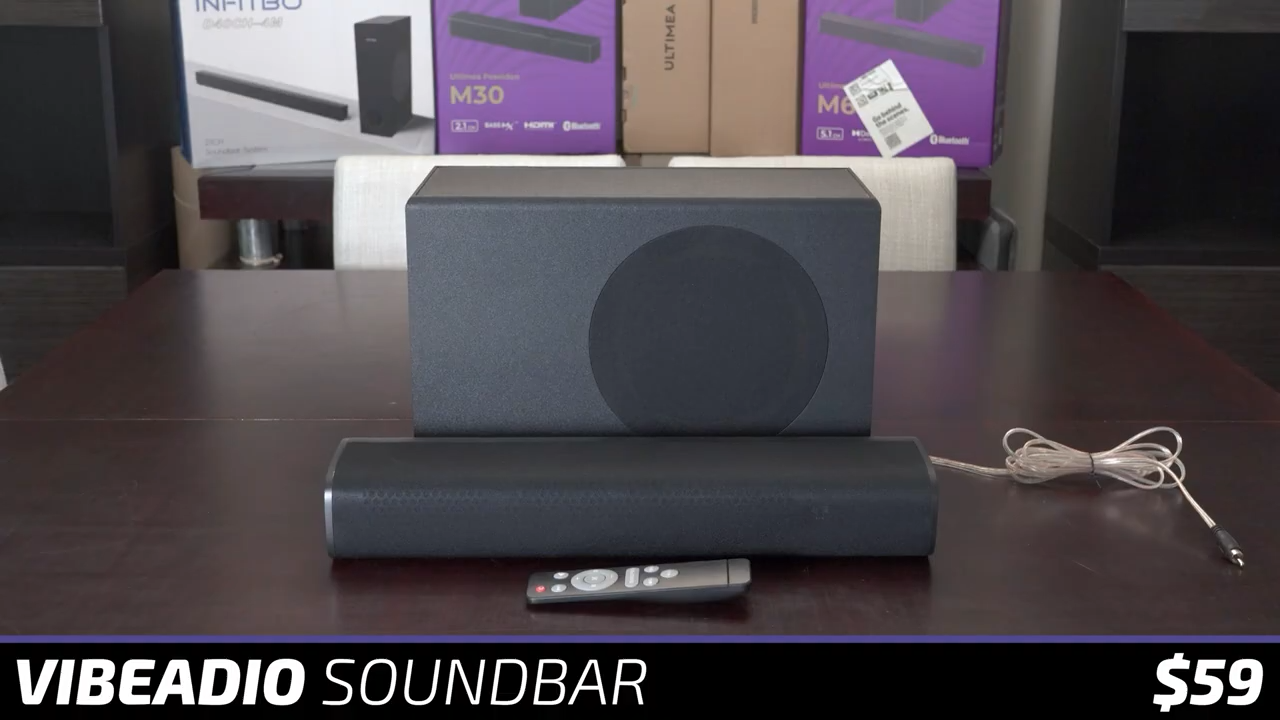
So next it will go up against the $59 Vibeadio which is another small bar with a separate subwoofer measuring just over 16” long with two full-range 3.5” x 2” racetrack drivers and a 5” subwoofer driver. For connectivity, the Vibeadio has AUX, optical, and HDMI ARC as well as Bluetooth 5.3, so I’ll test using ARC.
The Vibeadio’s frequency response is interesting, and it did make audible noise when the 20-30Hz signal was played, but it was more of a whining sound than actual bass. It didn’t actually start producing real sound until closer to 50Hz, and you can see that there are some serious peaks in the midrange and treble, which is not ideal compared to an ideal flat frequency response curve.
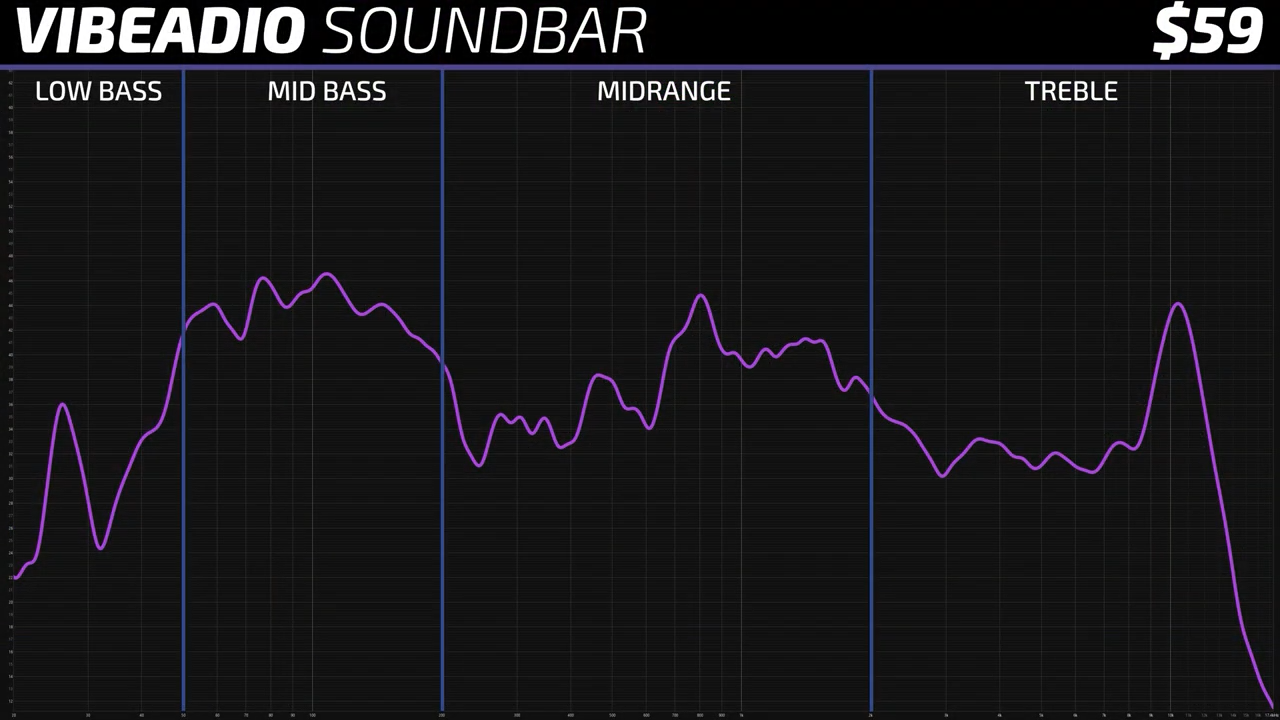
Again, that round when very predictably based on the Vibeadio’s wildly uneven frequency response curve. The random peaks and valleys caused certain sounds to be extremely overemphasized, which is unfortunate given the relatively high component quality of the Vibeadio compared to the Saiyin, but this round was still a clear win for the Saiyin.
Ultimea Poseidon M30
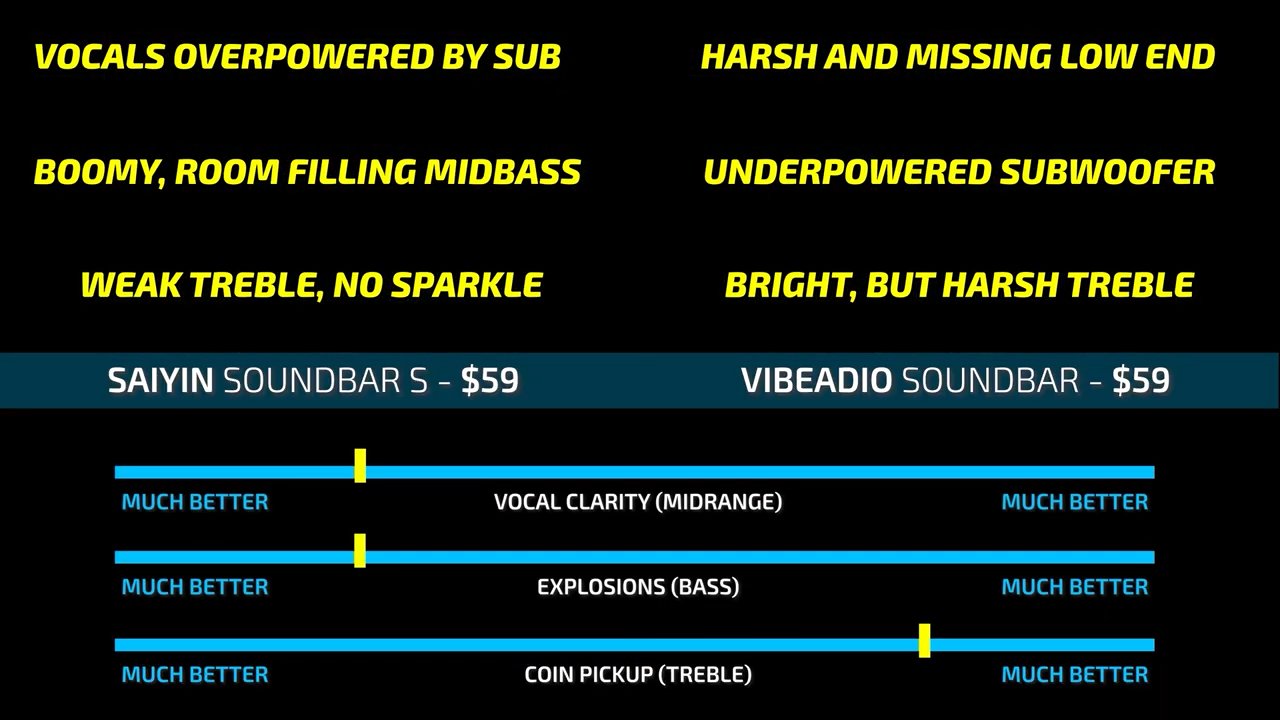
So in Round 4, the Saiyin S will go up against the $79 Ultimea M30, a midsized bar coming in just under 24”, and I couldn’t get the grill off for a better picture, but the M30 has two ported 2” full-range drivers on the main bar and a 5” down-firing ported subwoofer. Unlike most of the other bars in this video, this is a wireless sub, only needing a power connection, which makes its positioning in your room much more flexible. For connectivity, the M30 has optical and ARC as well as Bluetooth 5.3.
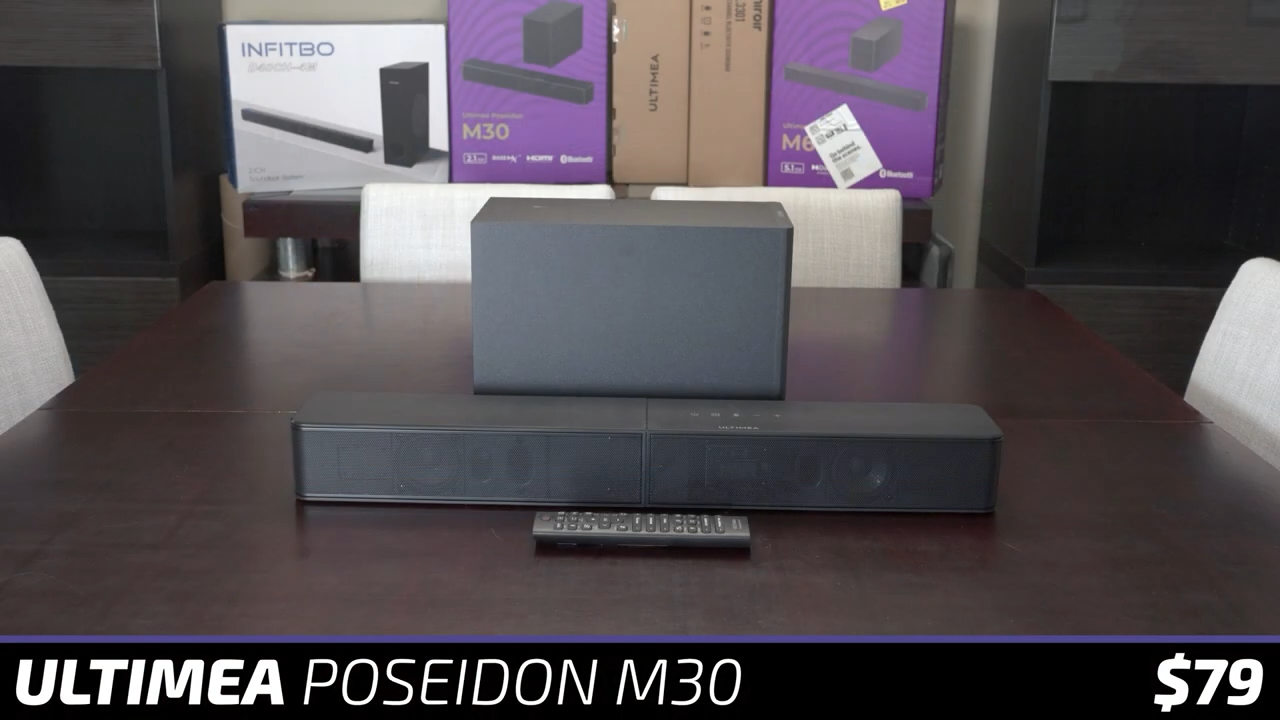
Taking a look at the frequency response, Ultimea has done a pretty good job producing a relatively flat and even curve with a few small dips in the midrange, but there’s a massive roll off between 4000 and 10,000Hz. The subwoofer performance looks great, coming in slightly before the Saiyin S and avoiding that boomy mid-bass region.
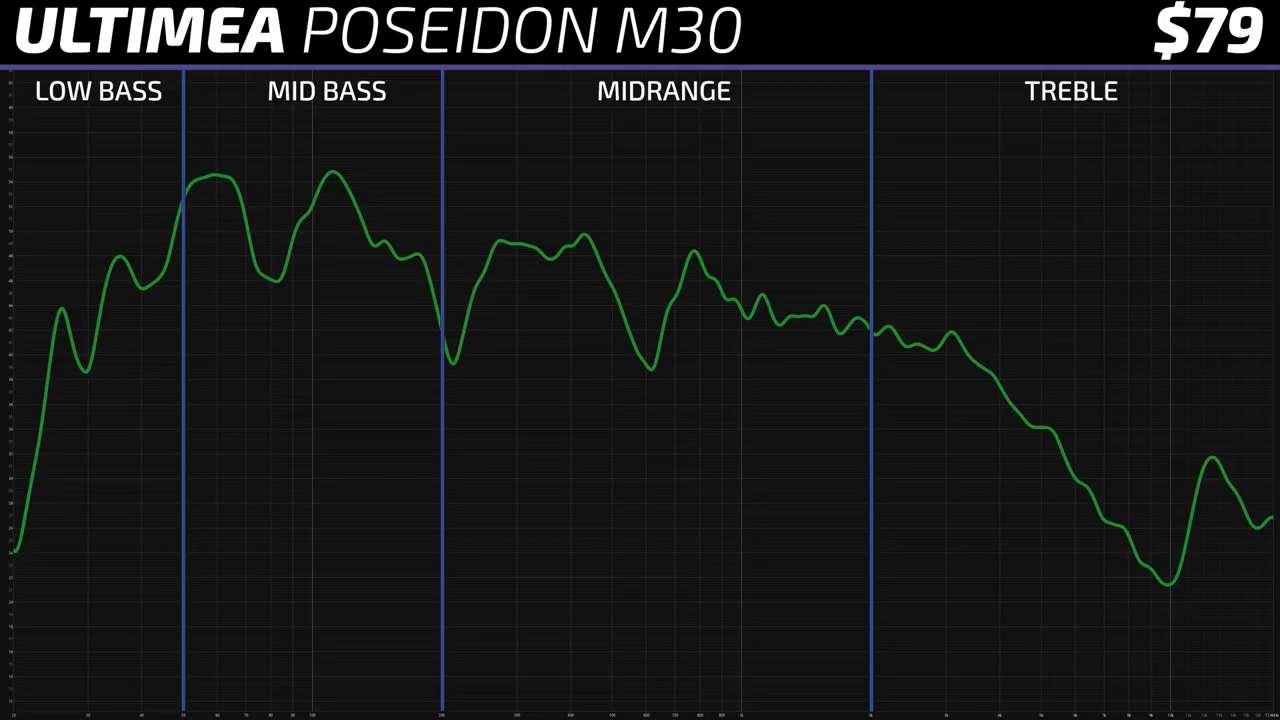
This may be a matter of preference, but I’m happy to get away from the boomy mid-bass of the Saiyin, and I thought that while the Ultimea’s bass didn’t have quite as much presence and impact, the more balanced sound was a major improvement over the Saiyin, giving the Ultimea the win this round.
Maraawa KY-2020E
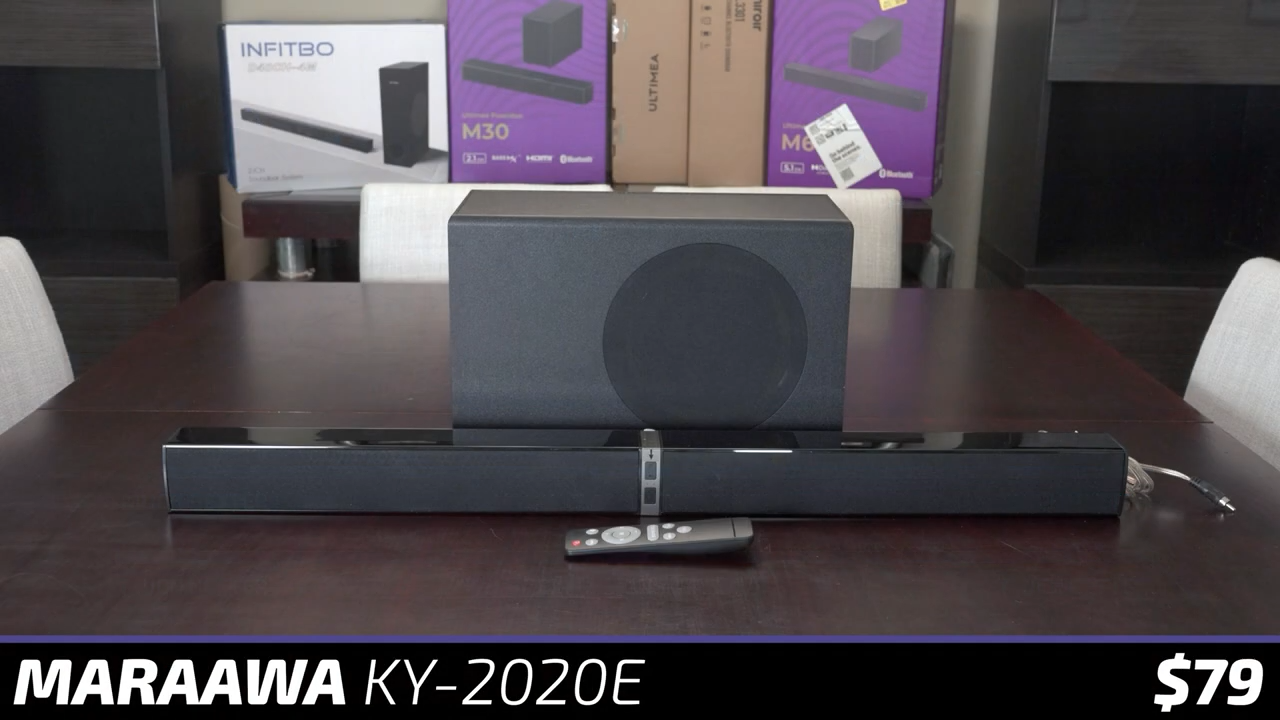
That means it will go up against the $79 Maraawa KY2020-E, which is what I ordered on Amazon, but the box says Mziebo and the bar itself says Gatagerock on one side and Mziebo on the other. But anyway, it’s a 32” bar with a separate wired subwoofer, and it can also be used as separate left and right speakers. The bar itself has two 3.5” x 2” racetrack full-range drivers and two dedicated 1” dome tweeters, and the subwoofer has a 6” driver, making this by far the best hardware so far. For connectivity, the KY2020E has AUX, optical, HDMI ARC, and Bluetooth 5.3.
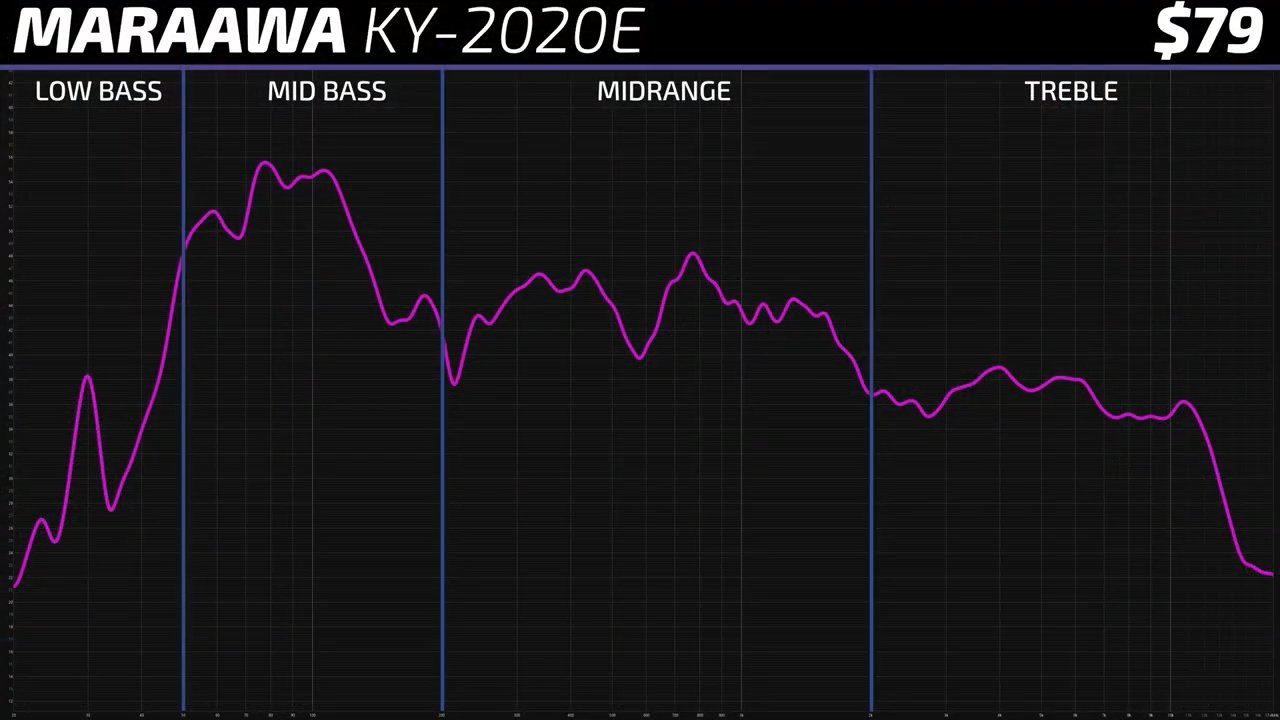
Looking at the frequency response curve, the subwoofer doesn’t look quite as competent in the lower frequencies as the Ultimea, and it has those same two dips in the midrange, but no problematic roll-off at the highest frequencies thanks to the two dedicated dome tweeters.
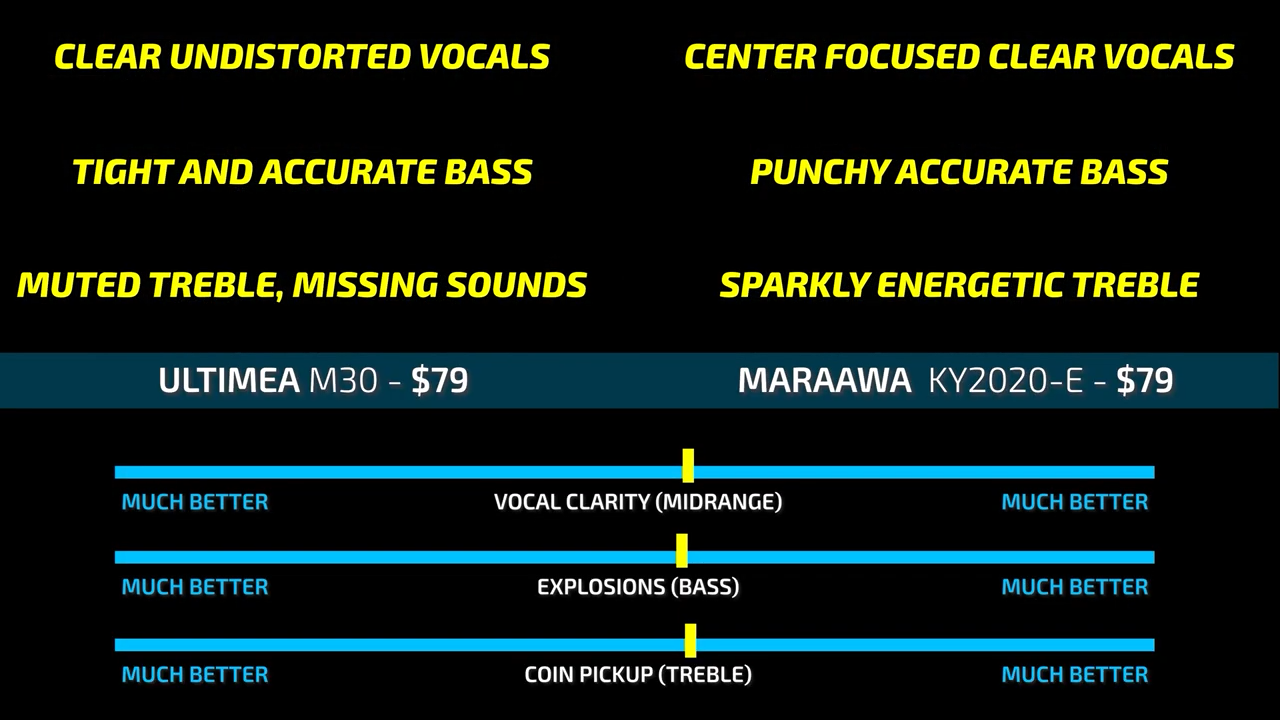
Unfortunately, this round wasn’t as one-sided as I had hoped given the excellent hardware on the Maraawa, but I did think it was slightly better than the Ultimea in every aspect.
TCL S45H
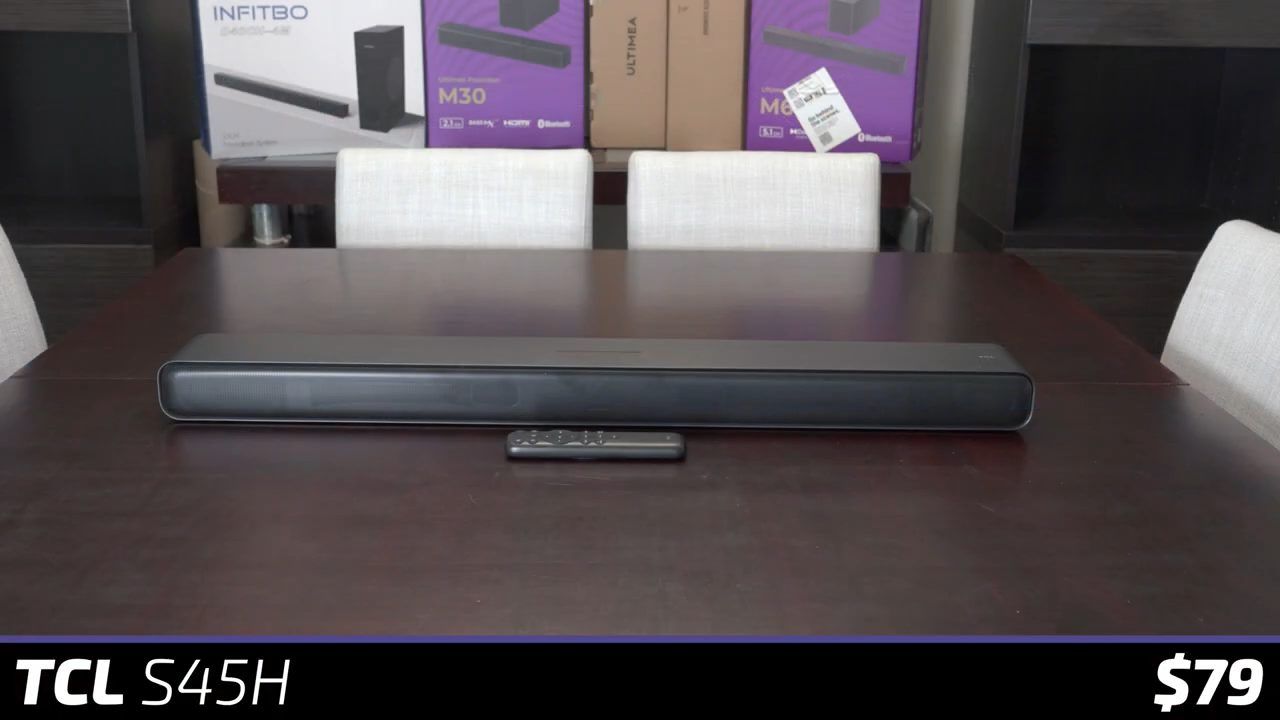
So the Maraawa or Mziebo or whatever is going to move on to the next round where it will face the $79 TCL S45H, which is a 32” bar-only design with nothing but two 3.5” x 2” racetrack full range drivers and some fancy ports. The TCL has AUX, optical, HDMI ARC, and Bluetooth and advertises that it is Dolby Atmos compatible, but there’s basically nothing you can do with Atmos with only two speaker drivers.
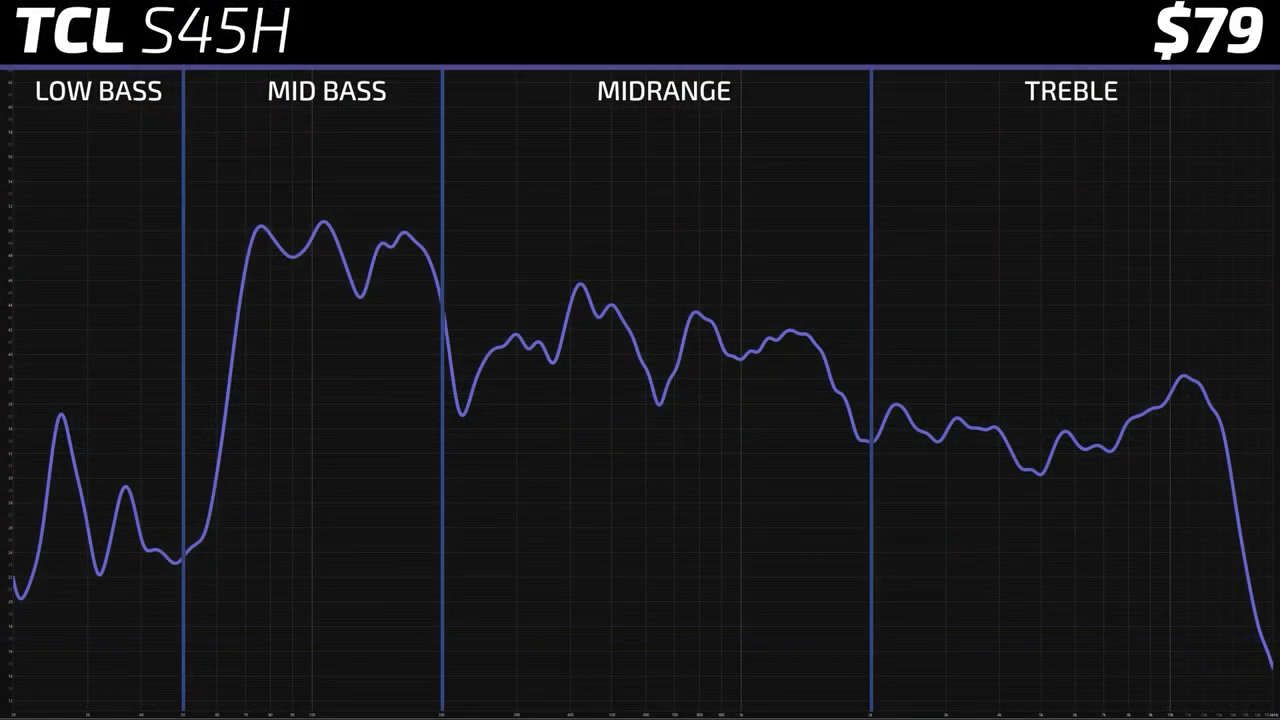
The frequency response on the TCL is pretty typical for a bar-only system with the bass coming in around 75Hz and a couple of dips in the midrange. But it appears to be tuned decently because it is relatively flat through the higher frequencies even without a dedicated tweeter. It’s also worth noting that I did run TCL’s AI Sonic Room Correction using the TCL app, but there was almost no difference in frequency response before and after, other than what appears to be a slight increase in volume.
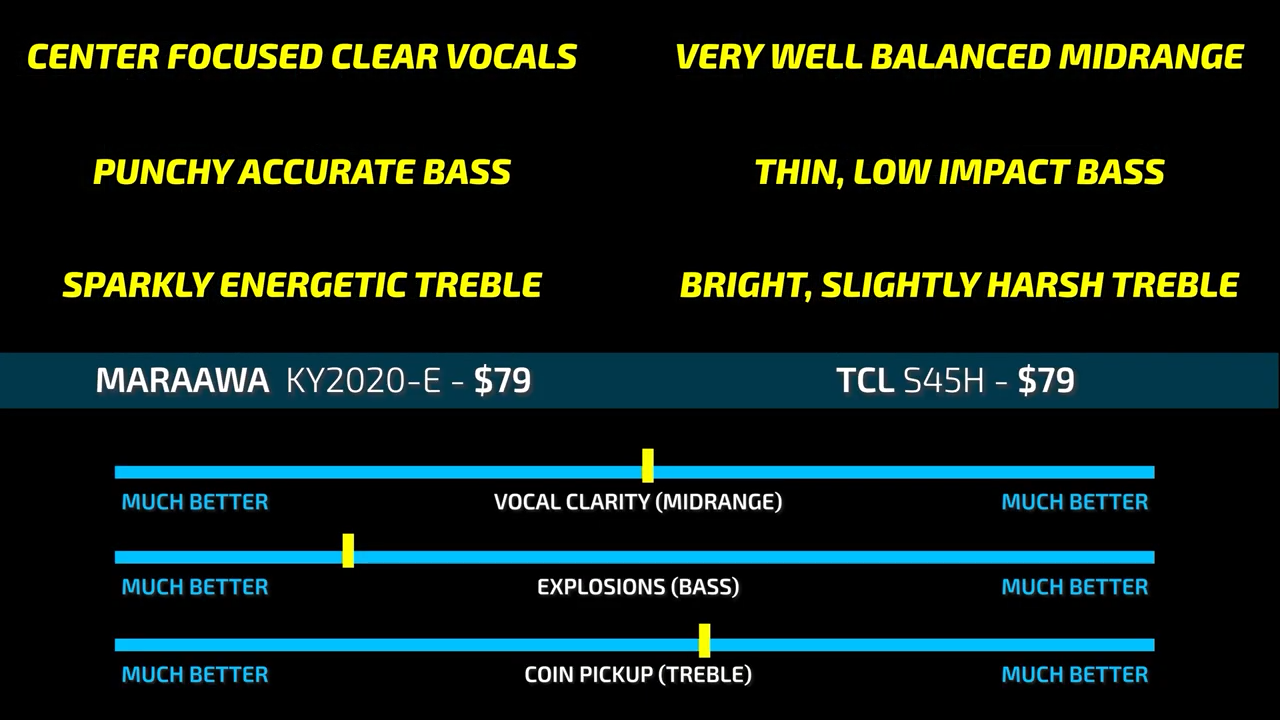
Right away, I have to say that the TCL did much better than I was expecting given its extremely lacking hardware, and I was most surprised by how much brighter and energetic the coins sounded despite the lack of dedicated tweeters. But it’s basically impossible for a bar-only system to compete with a subwoofer for bass performance, and I didn’t think the TCL’s slight advantages in treble and midrange were enough to overcome the huge discrepancy in bass performance, so the Maraawa is going to move on again.
Infitbo D40CS
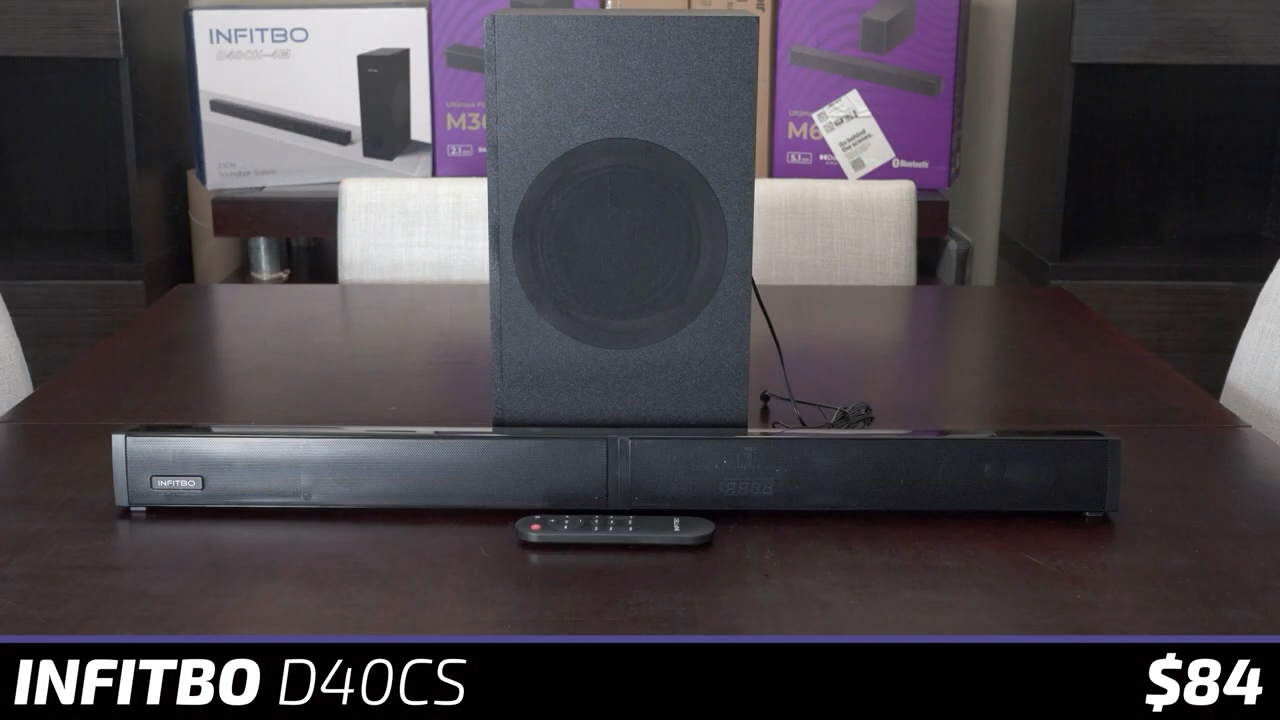
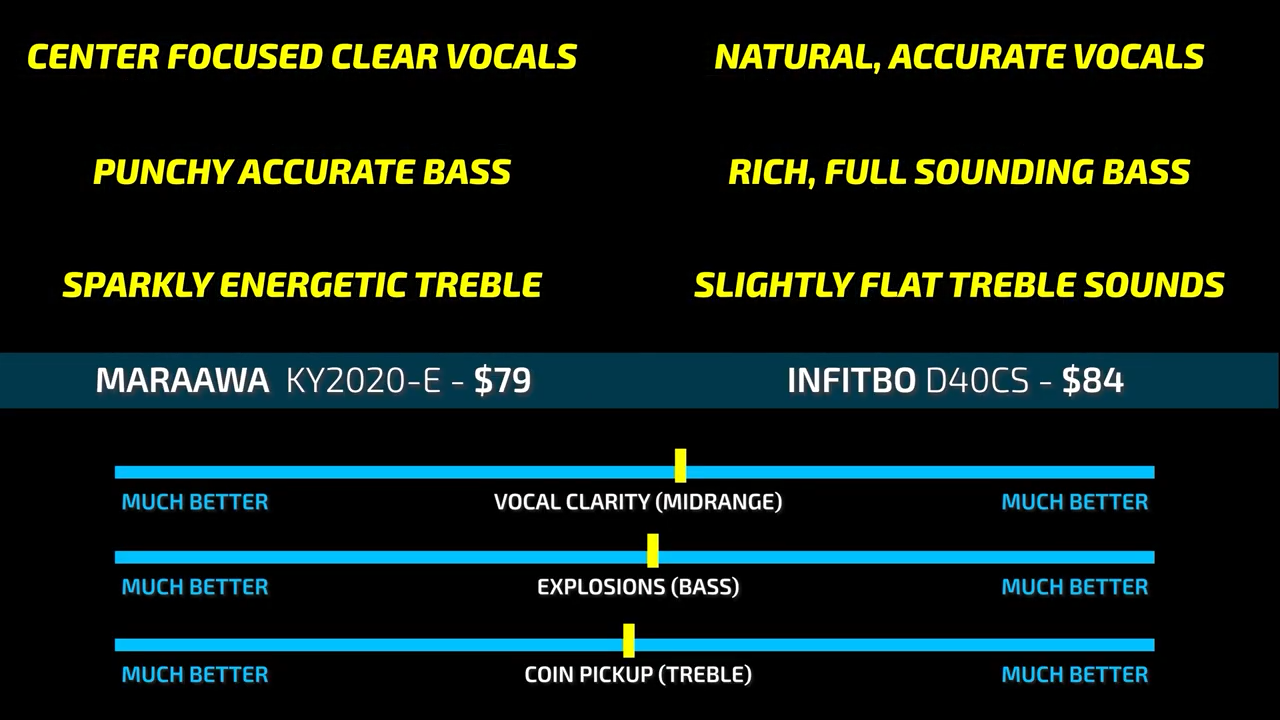
So in Round 7, it will go up against the $84 INFITBO D40CS, a roughly 32” bar that can be separated into left and right speakers with a separate wired subwoofer. Each side of the INFITBO has a single ported 4” x 2” full-range racetrack driver, and the subwoofer has a single ported 5 ¼” driver. For connectivity, the INFITBO has AUX, optical, and HDMI ARC in addition to Bluetooth 5.3.
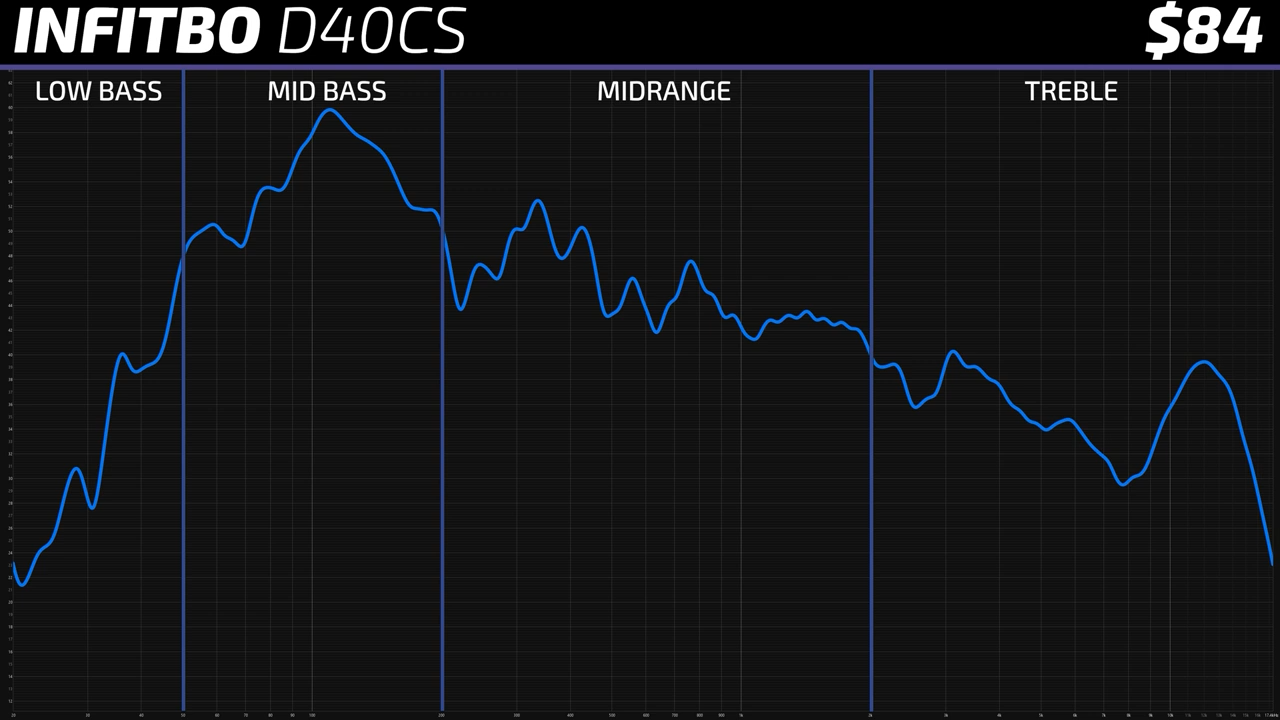
Looking at the INFITBO’s frequency response, it has a very similar bass response to the Maraawa with maybe a little bit of a boomy mid-bass around 110Hz, and it’s more stable through the midrange but has a possibly concerning dip in the treble response between 6000 and 9000Hz.
Listening to the recordings, both of these systems performed pretty well, and you can pick out a little bit of the INFITBO’s boomy subwoofer resonance, but it did help provide a more room-filling, impactful sound. In person, I was impressed by both of these systems and had this to say about the Maraawa, but this was my take on the INFITBO, which means it’s going to move on by a very narrow margin.
Assistrust KY-8000
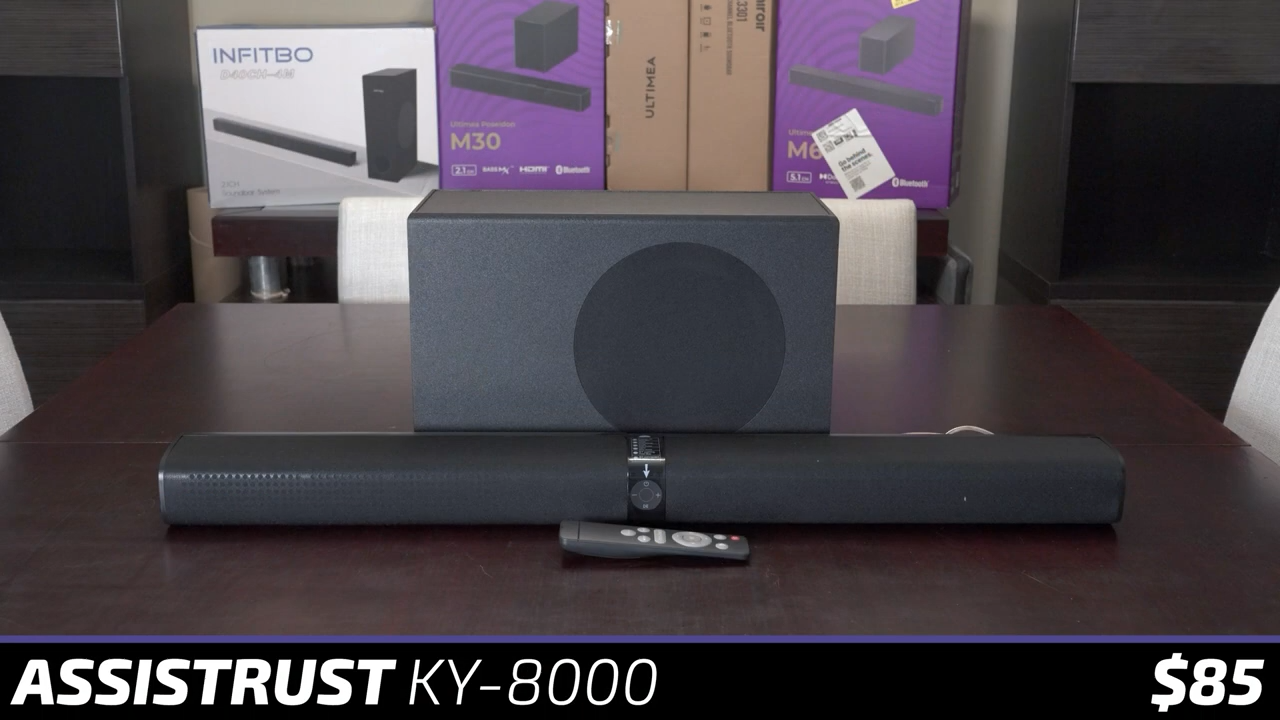
In Round 8, it’s going to face off against the $85 Assistrust KY-8000, which came in an almost identical box to the Maraawa KY-2020, and they also have identical remotes. The Assistrust is a 31” bar that can be separated into left and right speakers and a separate wired subwoofer. The main bar has four 3” x 2” racetrack drivers, and the subwoofer is a single 5 ¼” driver with a ported enclosure. For connectivity, the Assistrust has AUX, optical, and HDMI ARC as well as Bluetooth 5.3.
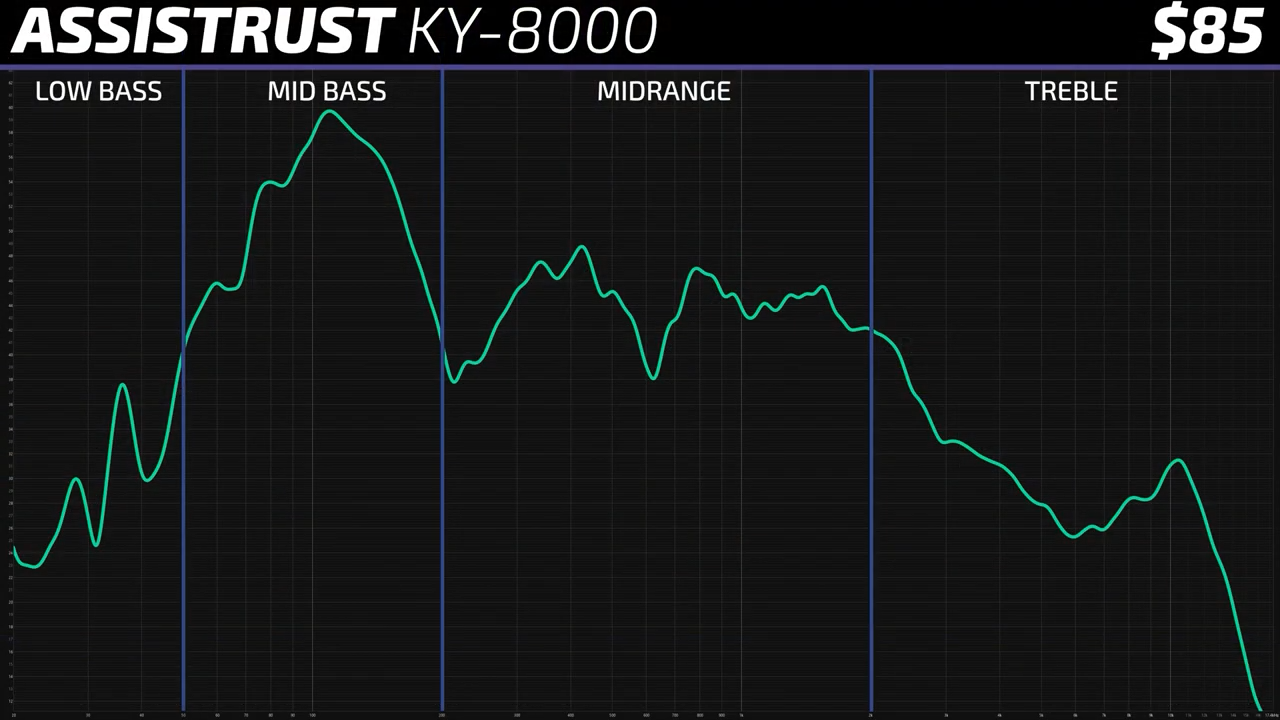
Looking at the frequency response, the Assistrust is a bit of a mess, with the subwoofer coming in slightly later than the INFITBO’s but with a nearly identical boomy peak. But then, all the places where the INFITBO had small dips, the Assistrust had even more exaggerated dropoffs, so I’d expect this sound to be all over the place.
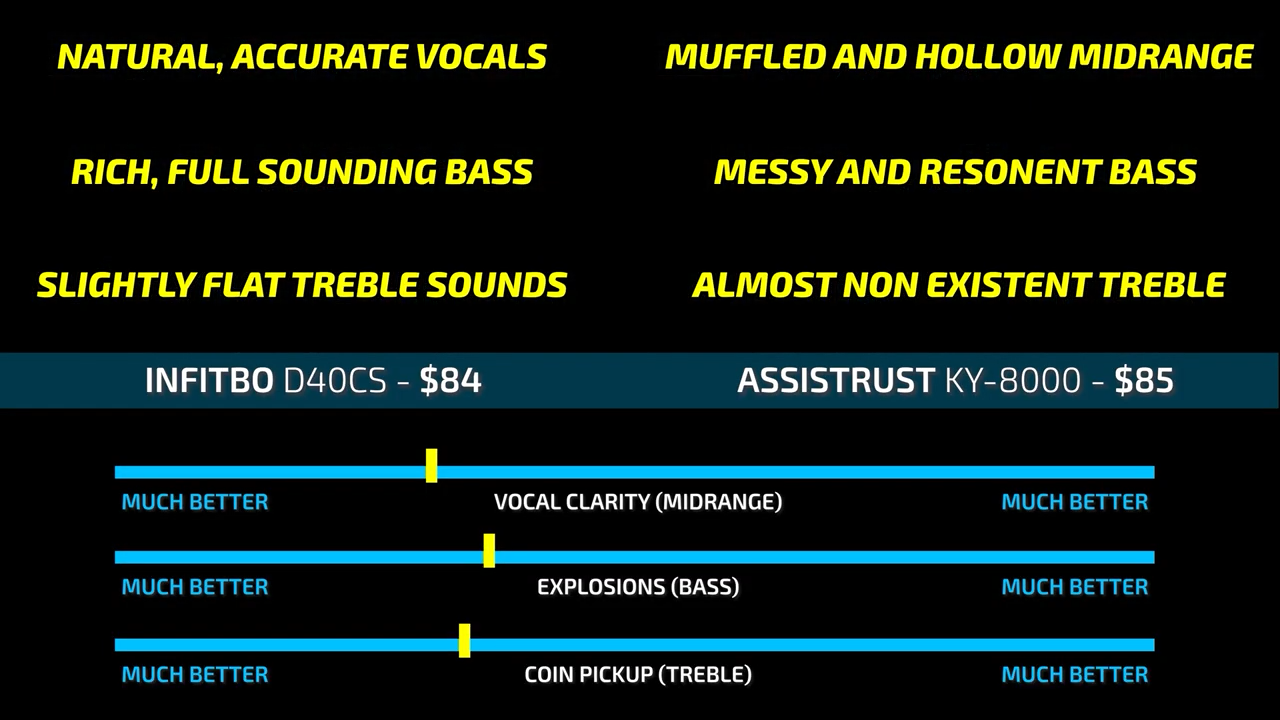
Yuck, to me it almost seemed like the Assistrust was using a crossover that was made for a completely different set of drivers, and there seemed like there were entire portions of the soundtrack that were almost missing, resulting in strange shifts in volume in what is supposed to be a consistently action-packed scene. This was a very easy win for the INFITBO.
Saiyin DS6541SPB
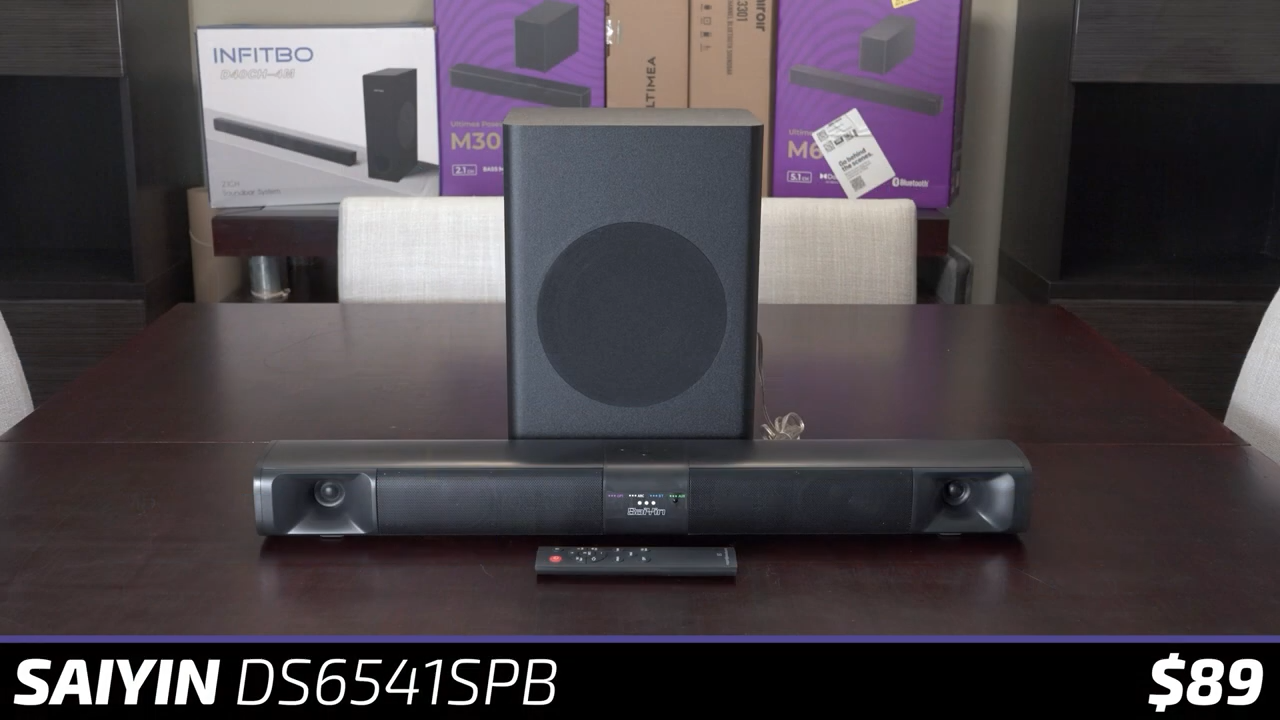
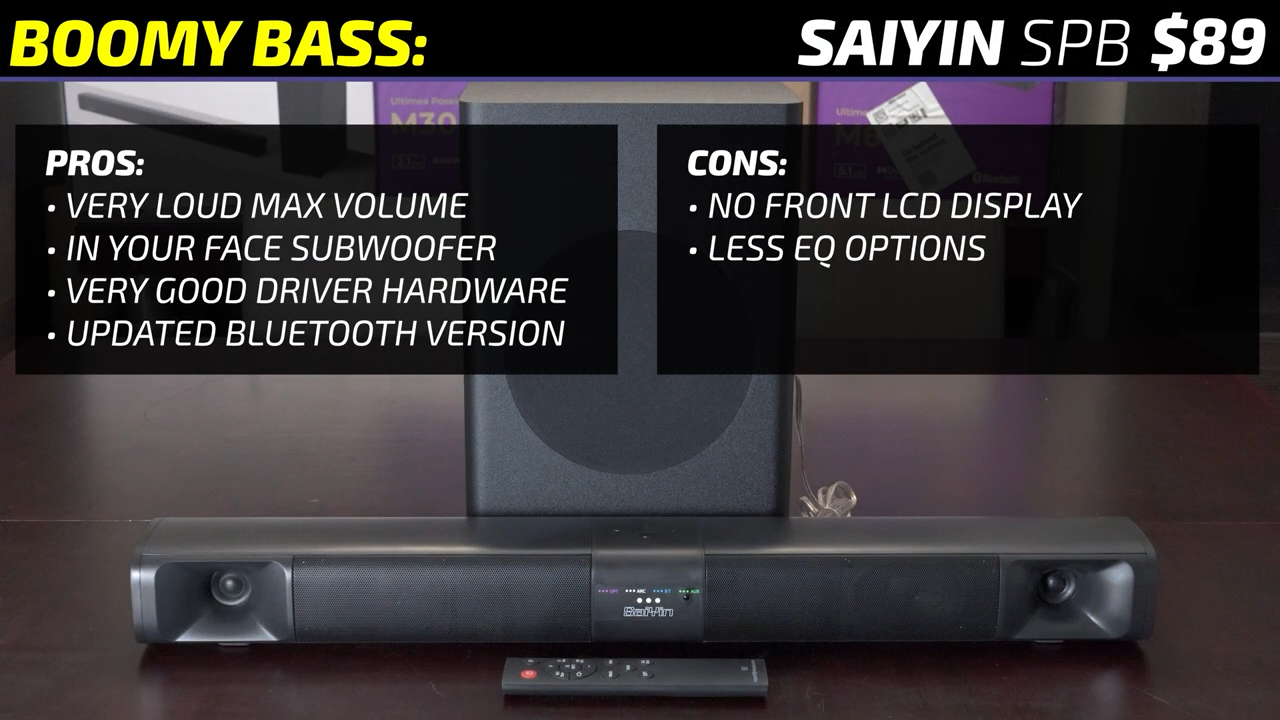
So in Round 9, the INFITBO will go up against the $89 Saiyin SPB, which was my budget pick from last year’s video. This year, when I bought it, it was $89 compared to $69 last year, but it does seem to oscillate between those two prices regularly. The SPB is a midsize bar at 24” that can be separated into left and right speakers and also has a separate wired subwoofer. The main bar has two 2” x 3” racetrack drivers and two dedicated dome tweeters with what looks like small waveguides, and the subwoofer has a slightly smaller 4 ¾” driver. For connectivity, the SPB has AUX, optical, and HDMI as well as Bluetooth 5.3.
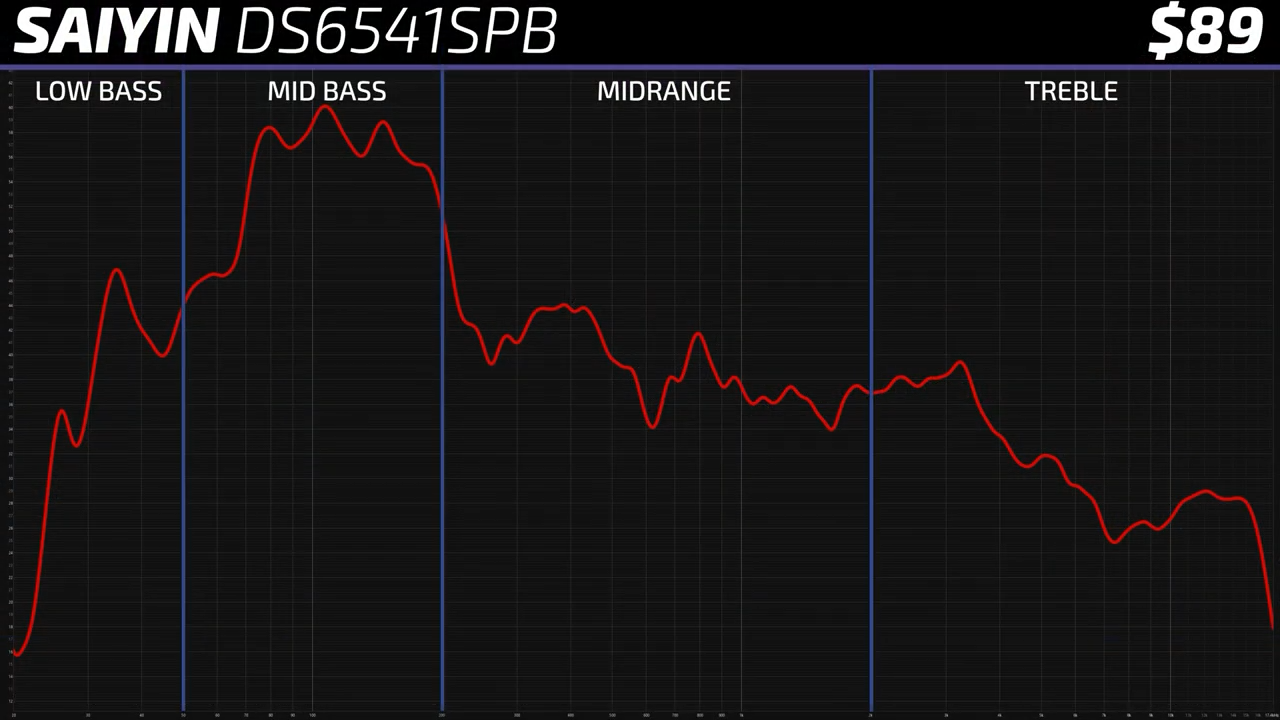
The SPB’s subwoofer looks to be doing at least something as low as 25Hz, but like the Saiyin S, it was just a strange whistling sound rather than actual bass, and the real bass didn’t kick in until around 75Hz and then stayed boomy until about 200Hz. Despite the separate tweeters, the SPB still had a pretty significant roll-off between 3000 and 7000Hz. The most interesting thing to me is how different this frequency response is from the Saiyin that I tested last year, which was still a little boomy, but was much flatter through the rest of the frequency curve. The only thing that I changed was that I normalized this year’s testing at a higher volume, so it appears that the flat EQ doesn’t hold up as well at higher volumes.
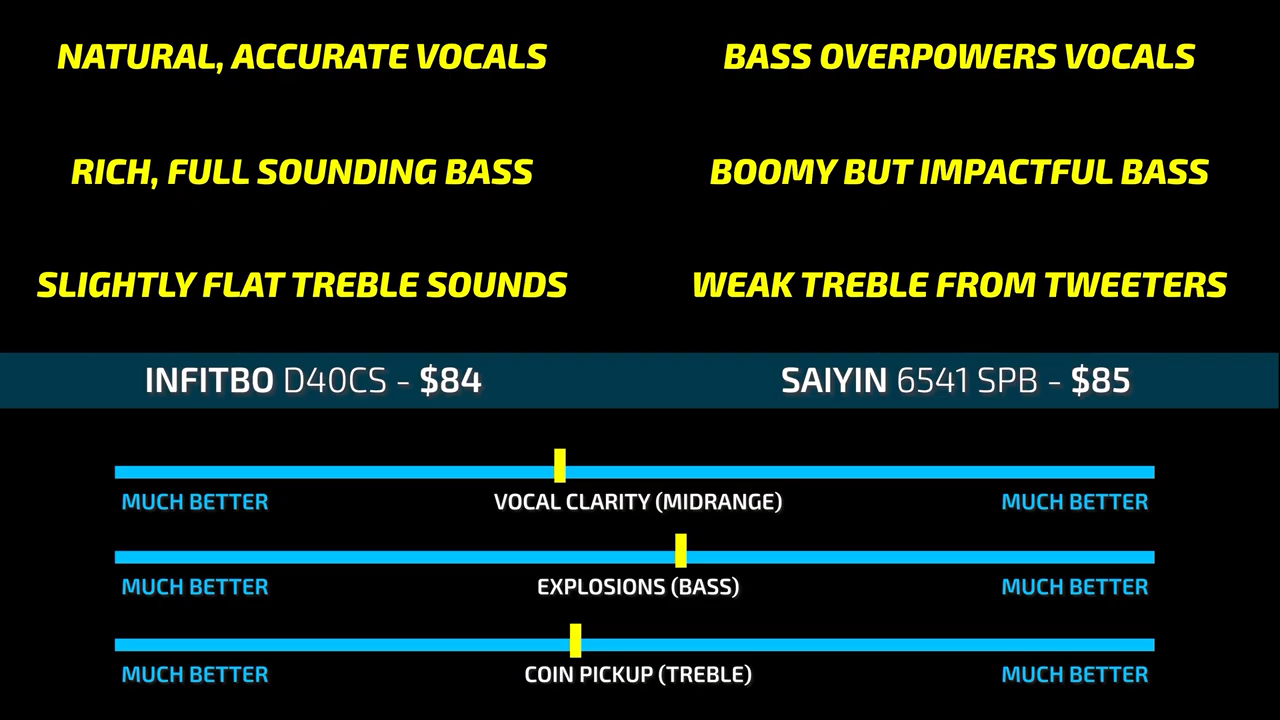
The good news is I thought that the SPB still sounded pretty good despite the differences in the frequency response, and much like last year, I think this could be a personal preference thing. If you like really boomy bass, the Saiyin could be the right pick for you, but I overall prefer the more controlled and accurate bass on the INFITBO, so it’s going to move on.
Hisense R651
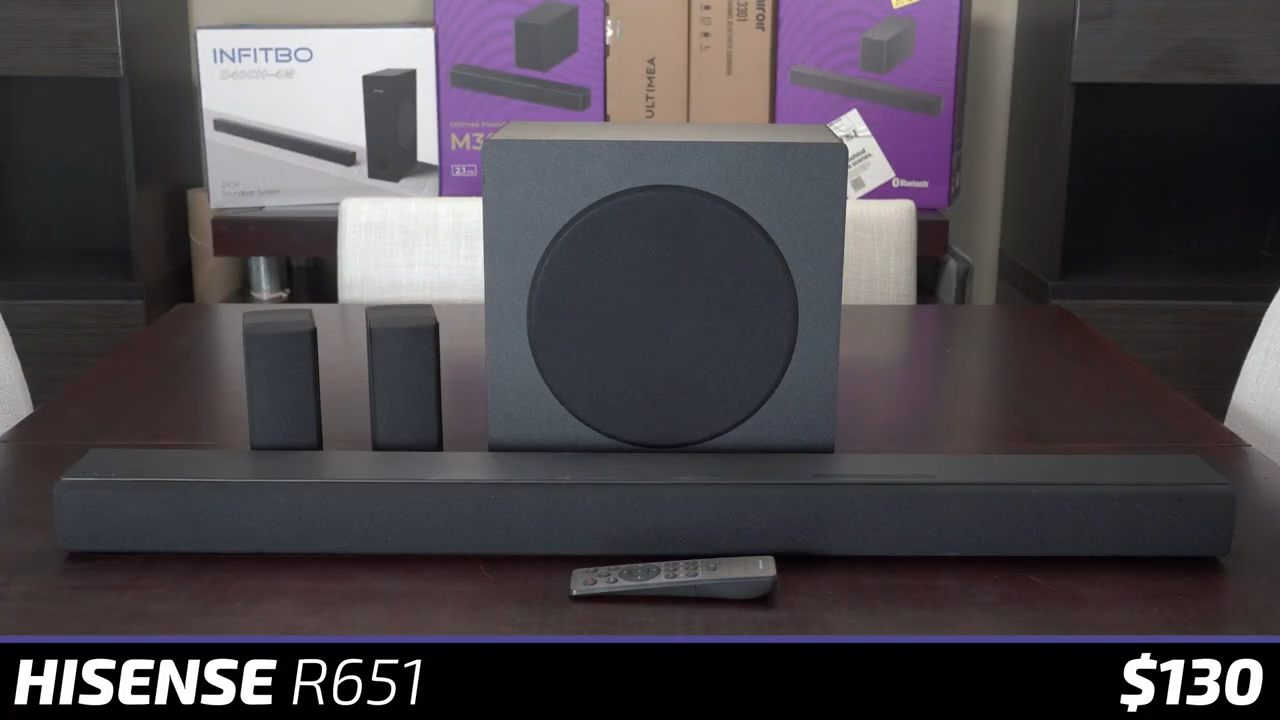
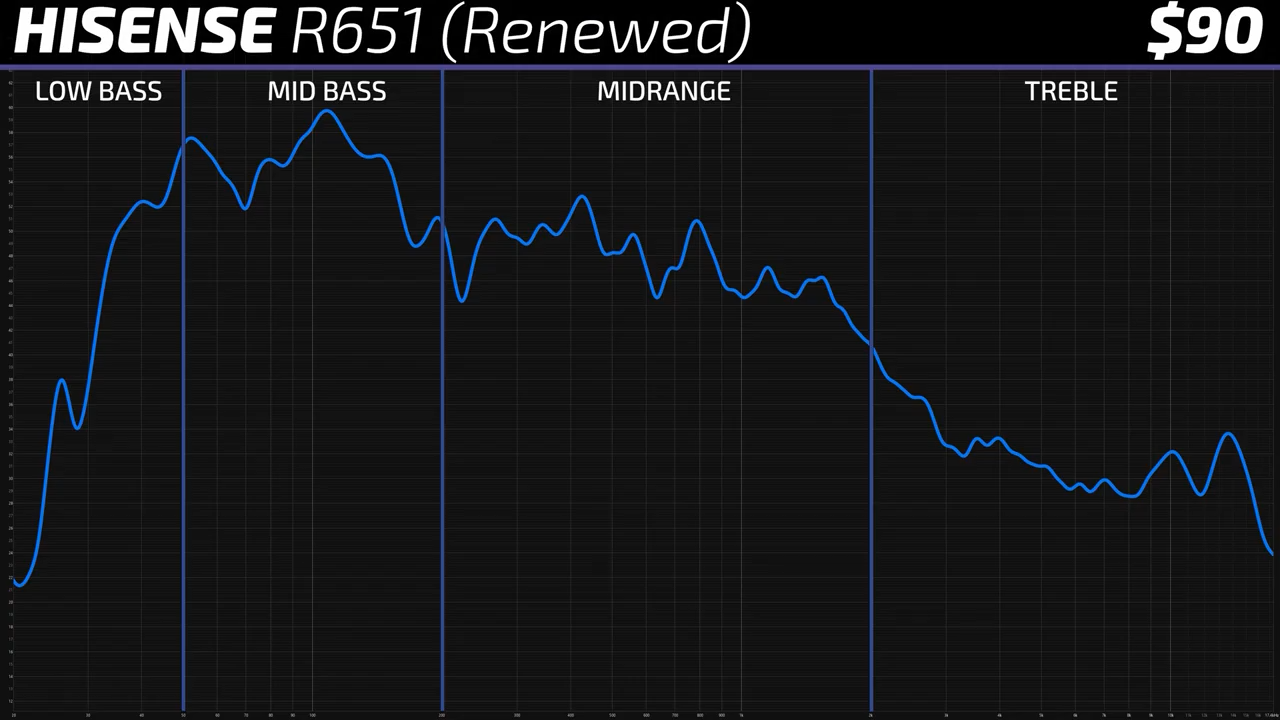
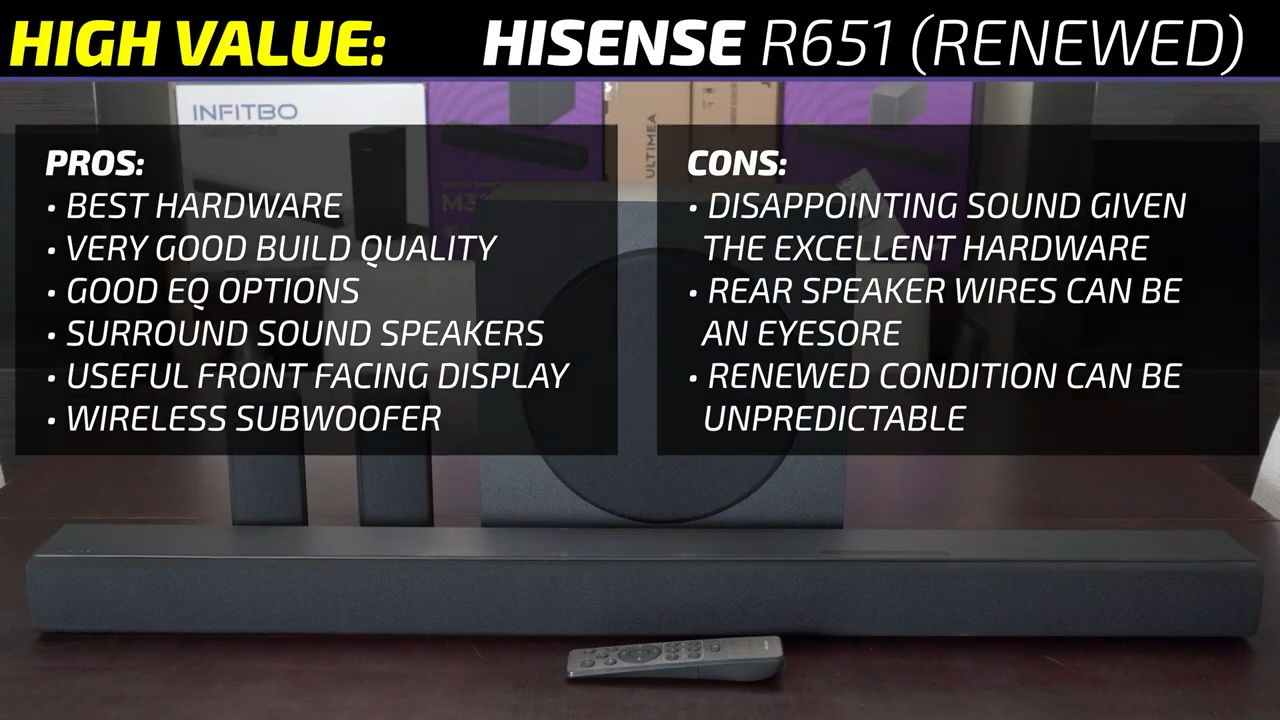
This is where the video is going to get a little squirrely because in Round 10 it’s going to go up against the Hisense R651 which I believe is normally around $130, but there’s a listing on Amazon for a refurbished version that I picked up for $90. For that price, you get a 36” one-piece main bar, a wireless subwoofer, and two surround speakers that plug into the back of the sub. The grill on the main bar was not removable, so I took the whole thing apart to reveal that the left and right channels each have a 3.5” x 2” racetrack driver and a dedicated 1” dome tweeter, and then there’s also a dedicated center channel with another 3.5” x 2” racetrack driver. The subwoofer has a 6” driver in a ported enclosure and each of the surrounds has a single 2” full-range driver. For connectivity, the Hisense has AUX, optical, and HDMI ARC in addition to Bluetooth 5.3.
Looking at the frequency response, the first thing that sticks out is that the subwoofer is providing meaningful bass all the way down to around 35Hz which is by far the best that we’ve seen yet. The midrange looks relatively stable, but again, we’re seeing a much larger roll-off in the treble than I’d expect from a bar with dedicated tweeters.
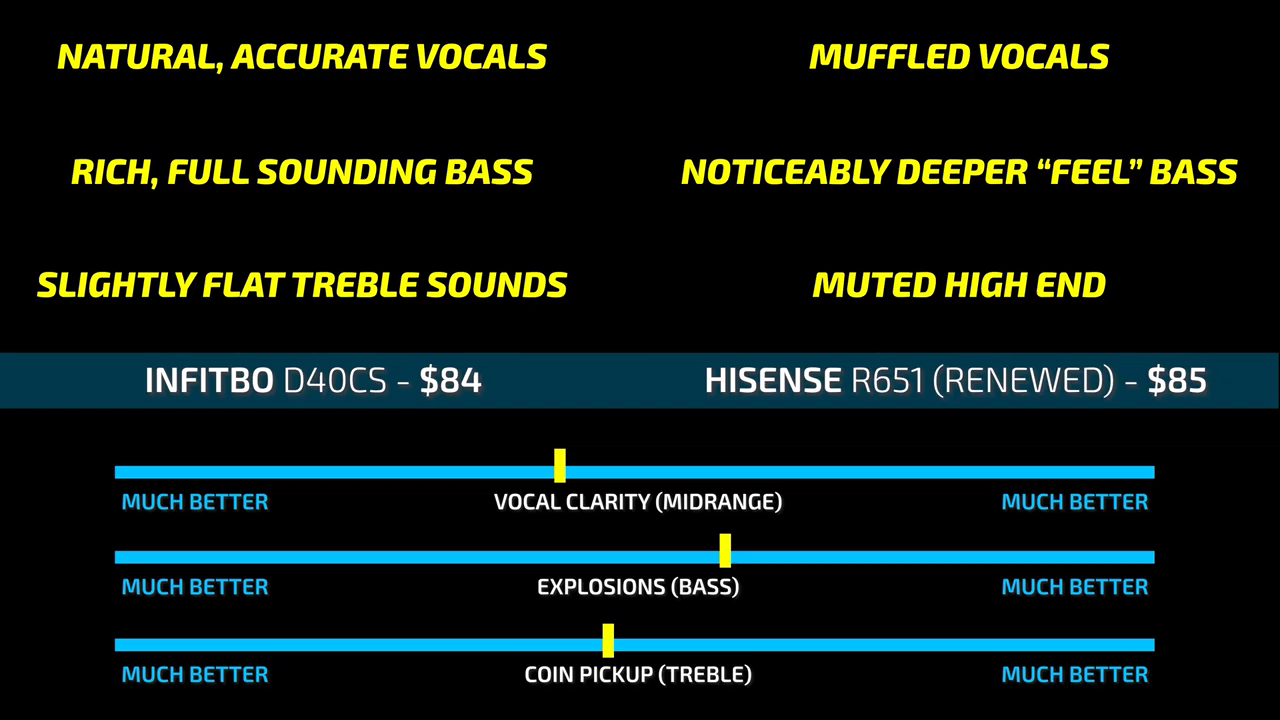
To me, this was a very unexpected outcome, and it’s hard to believe that the Hisense, with a dedicated center and separate tweeters, had worse vocal clarity than the 2-driver INFITBO, but here we are. And while the subwoofer was higher performing on the Hisense, the INFITBO was better in every other way. Though I will say that having the rear surrounds definitely adds an extra dimension to the audio if your room has a place for them where you can easily run wires from the subwoofer to each side, but I don’t think it’s worth compromising ideal sub positioning just to be able to place the surrounds.
Ultimea Poseidon M60
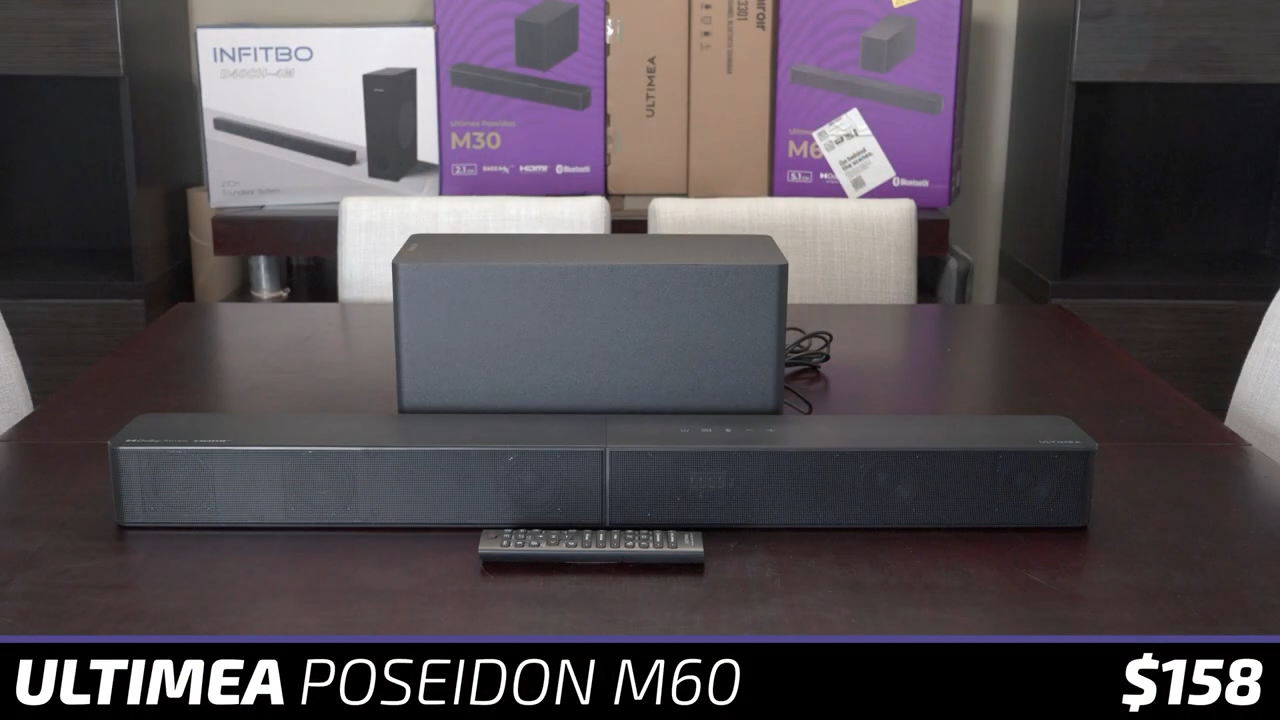
That means that in the final round, the $84 INFITBO is going to take on last year’s winner, the Ultimea Poseidon M60, which hasn’t been below $100 since the middle of July, and I paid $158 for it this year. The M60 is a 31” bar with a separate wired subwoofer, and the bar itself has 5” x 2.5” drivers, which they claim is a 5.1 system. So these would be the left and right wide, left and right front, and center channels, and the sub has a single down-firing 5” driver. For connectivity, the M60 has optical and HDMI eARC as well as Bluetooth 5.3.
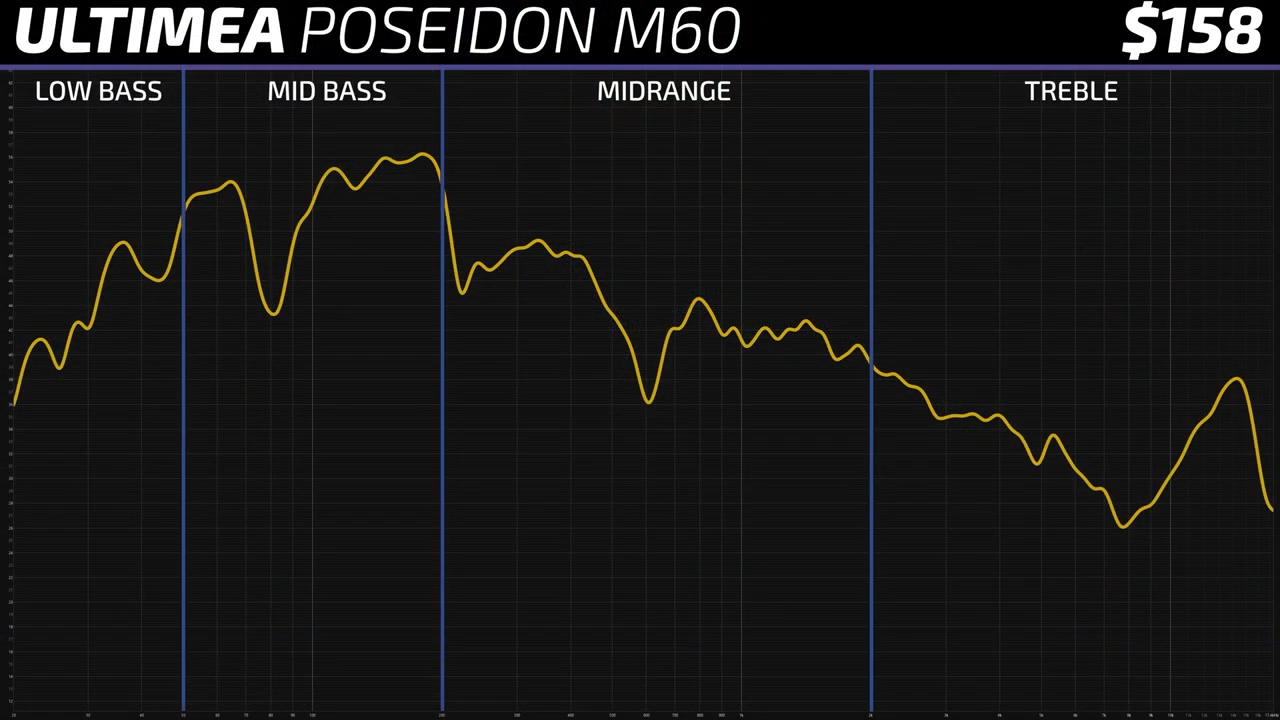
Looking at the frequency response, the M60’s sub comes in relatively quickly around 35Hz and mostly avoids getting boomy in the midbass. The midrange does have one concerning dip, and the treble seems to trail off in a similar fashion to the INFITBO, which again didn’t happen when I tested in 2025 at a lower volume. So like the Saiyin SPB, the M60 also appears to perform a little better at moderate volume levels.
There are a lot of things that I prefer about the Ultimea over the INFITBO, like the build quality, app integration, and much better remote control, but in terms of sound quality, the INFITBO was the clear pick for me, both in person and listening to the recordings. To me, the biggest difference was that the INFITBO was just so much more dynamic, with a bigger difference between quiet and loud sounds like explosions, while the Ultimea was more compressed, with a more consistent volume throughout.
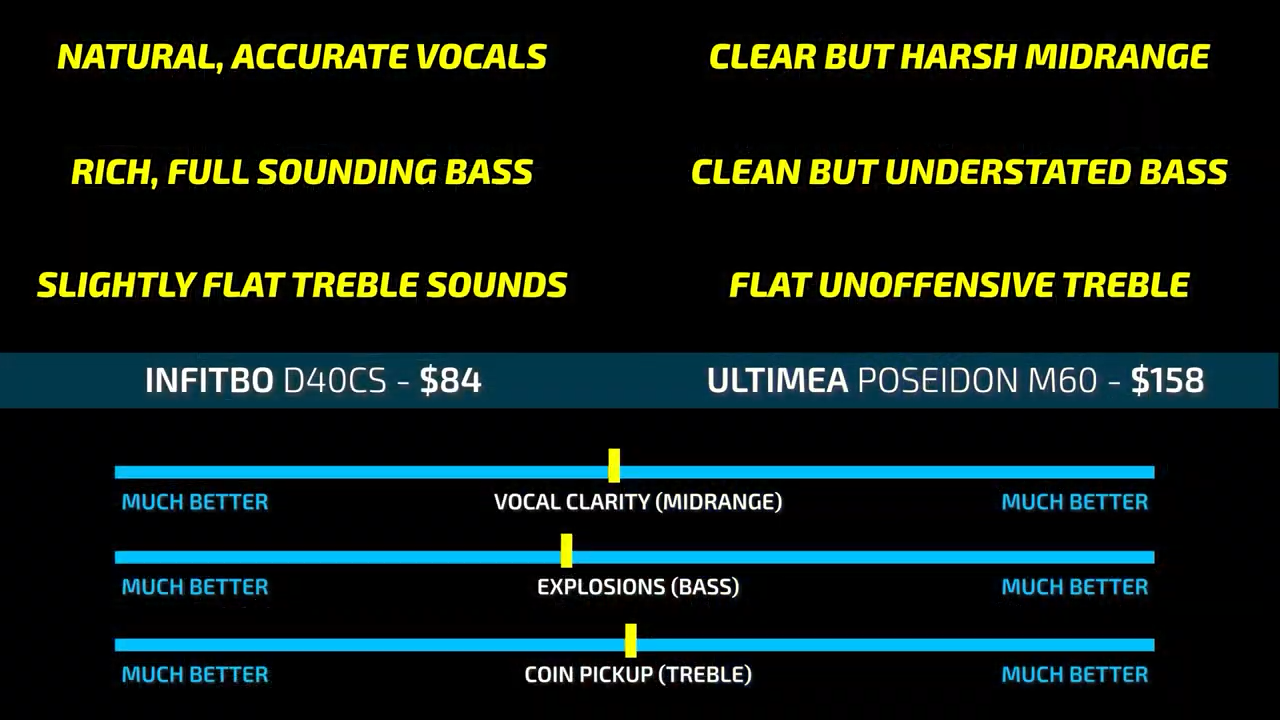
My favorite clip to show that off is in Dune 2 when Paul stands up on the sandworm, and I’m going to play the Ultimea first and then the INFITBO to illustrate the difference.
Final Rankings
After all the side-by-side testing, here are my top picks for budget soundbars in 2026 with the INFITBO in first, the Hisense and Ultimea tied for second, with an asterisk since the Hisense was refurbished, and the Ultimea is currently over $100, the boomy Saiyin SPB took 4th, and the $79 Maraawa/Mziebo bar also belongs in A-Tier in 5th place.
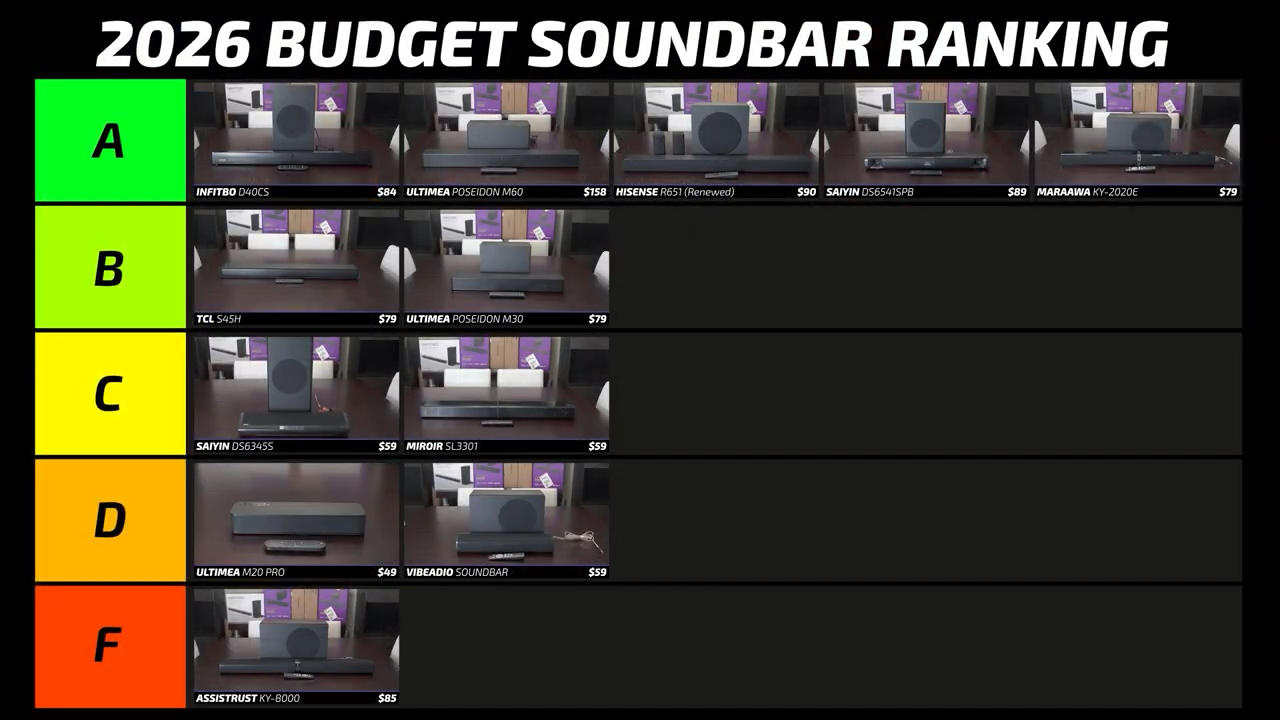
Next, now that we’ve got it narrowed down to those five, I’ve got a few additional tests to do.
Bluetooth Performance
First, we’ll look at Bluetooth connectivity, which is most important if you are planning to use these soundbars with an inexpensive projector like my current budget recommendation, the NexiGo PJ40 Pro, because it’s much more convenient to use Bluetooth rather than HDMI ARC when the projector is in the back of the room and the soundbar is in the front.
When connected to the PJ40 Pro via Bluetooth, the volume on all the soundbars is adjustable using the PJ40’s remote. But for the Saiyin and Maraawa soundbars, you’ll set a fixed volume on the soundbar, and then the projector remote will separately control the volume from 0-100. Meanwhile, the Hisense, Ultimea, and INFITBO will actually show the volume on the front display of the soundbar. The only strange behavior I noticed was that the blue lights on the front of the Saiyin SPB flash any time there wasn’t sound actively playing.
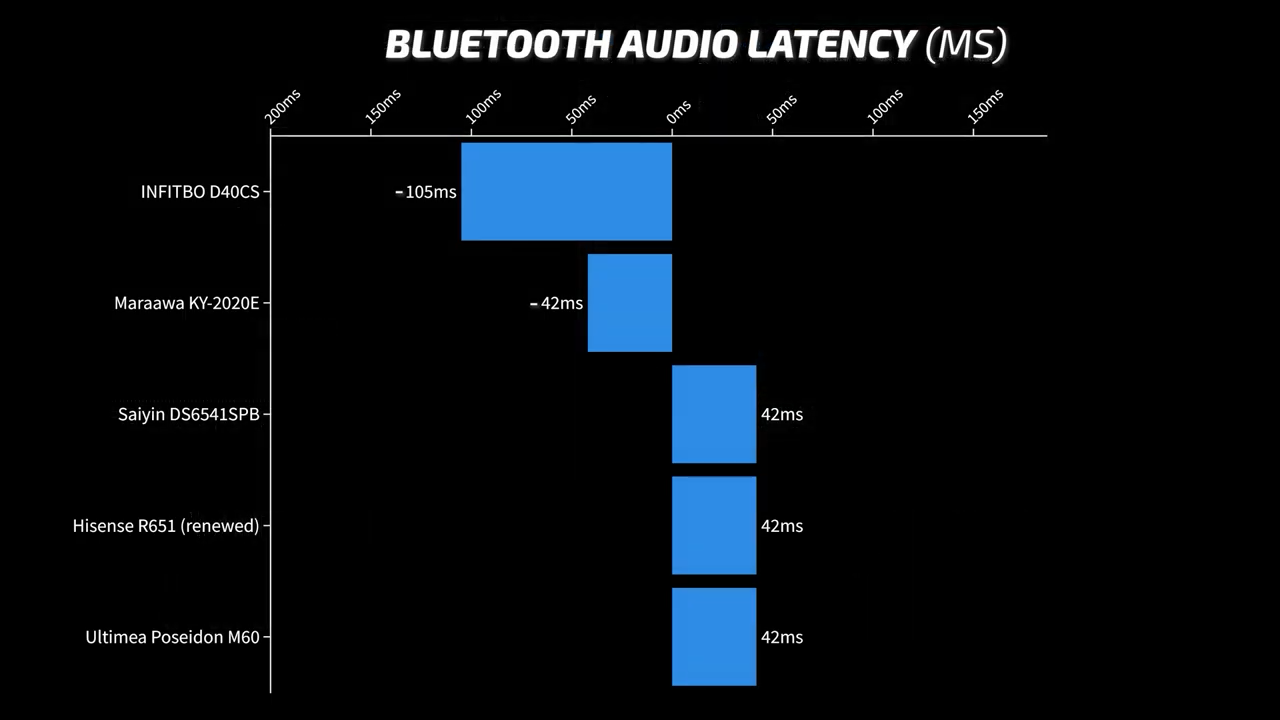
The biggest issue you’ll usually run into with Bluetooth is audio delay, so I tested each of the top performing soundbars using my audio delay test that matches sound output to a visual stimulus. The Saiyin SBP made huge improvements, going from v1.21 to v1.22 and improved its Bluetooth audio lag from 6 frames last year to just a single frame this year, so around 42ms. Most importantly it also fixed the constant resync issue that the previous version had, making the Saiyin totally acceptable for Bluetooth use now.
The Hisense and Ultimea also had exactly one frame of audio delay, which is better than the Ultimea performed last year, and that might be from an Ultimea software update. But I’m pretty sure the NexiGo and Google TV are helping with audio sync because the Maraawa actually had negative audio delay, where the sound started one frame before the visual indicator, and the INFITBO started roughly 3 frames before the visual indicator. The other strange behavior on the INFITBO was that the audio faded in and out rather than abruptly turning on and off like it’s supposed to.
That said, when watching actual content, all five soundbars performed extremely well and had no noticeable issues with audio delay, Bluetooth sync, or sound quality.
Last, a few other random things that I think are important.
On Bar Displays
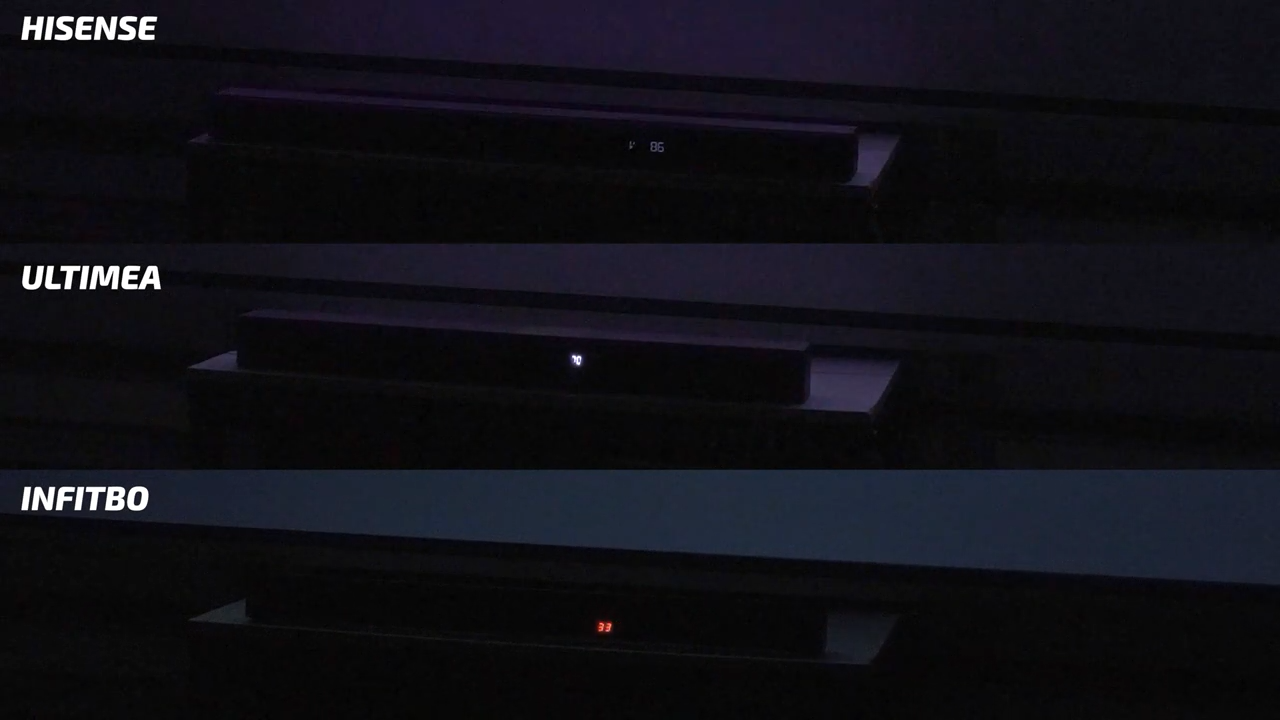
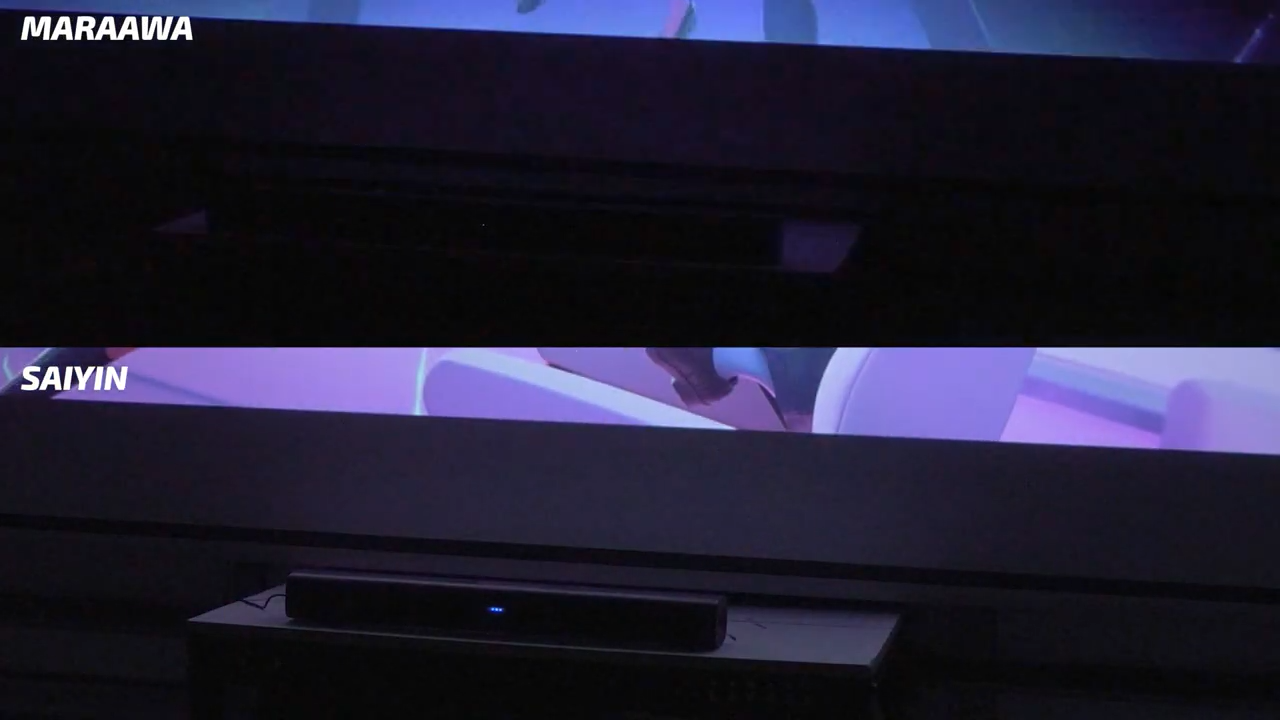
The Hisense, Ultimea and INFITBO all have front displays that indicate the current input, volume level, and EQ adjustment, and the brightness of those displays are all controllable with their remotes. In contrast, the Maraawa and Saiyin just have a colored LED indicator on the front of the bar, and you’ll need to learn what colors correspond to each input, and the brightness can’t be adjusted.
EQ Adjustments
Speaking of adjustments, the Ultimea’s EQ is the most adjustable, and you can actually connect to the soundbar in the Ultimea app to fine-tune the EQ for your room.
The Hisense and INFITBO both have preprogrammed EQ settings in addition to treble and bass adjustments on the remote, while the Saiyin is limited to just EQ presets and a subwoofer level adjustment. The only adjustments on the Maraawa remote are bass up and down, a voice button that has very little impact, and a big sound field button that adds reverb and makes the bar sound absolutely horrible.
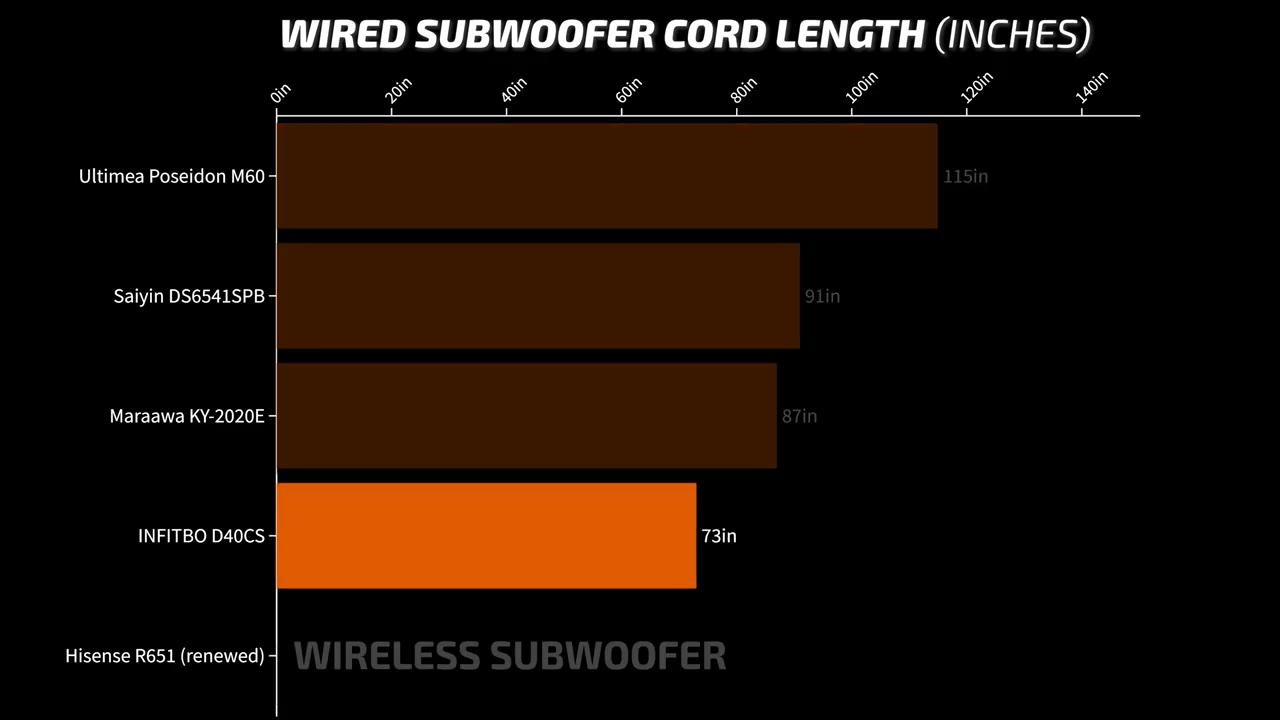
One last “gotcha” that you may run into is that the Ultimea, INFITBO, Maraawa, and Saiyin all have wired subwoofers that need to connect to the back of the soundbar, but the cords are different lengths. The Ultimea is the longest at 115” while the INFITBO is only 73”, and the Hisense subwoofer is wireless, so it has the most flexibility in room placement. (Maraawa 87”, Saiyin 91”)
So which soundbar should you buy?
Conclusions
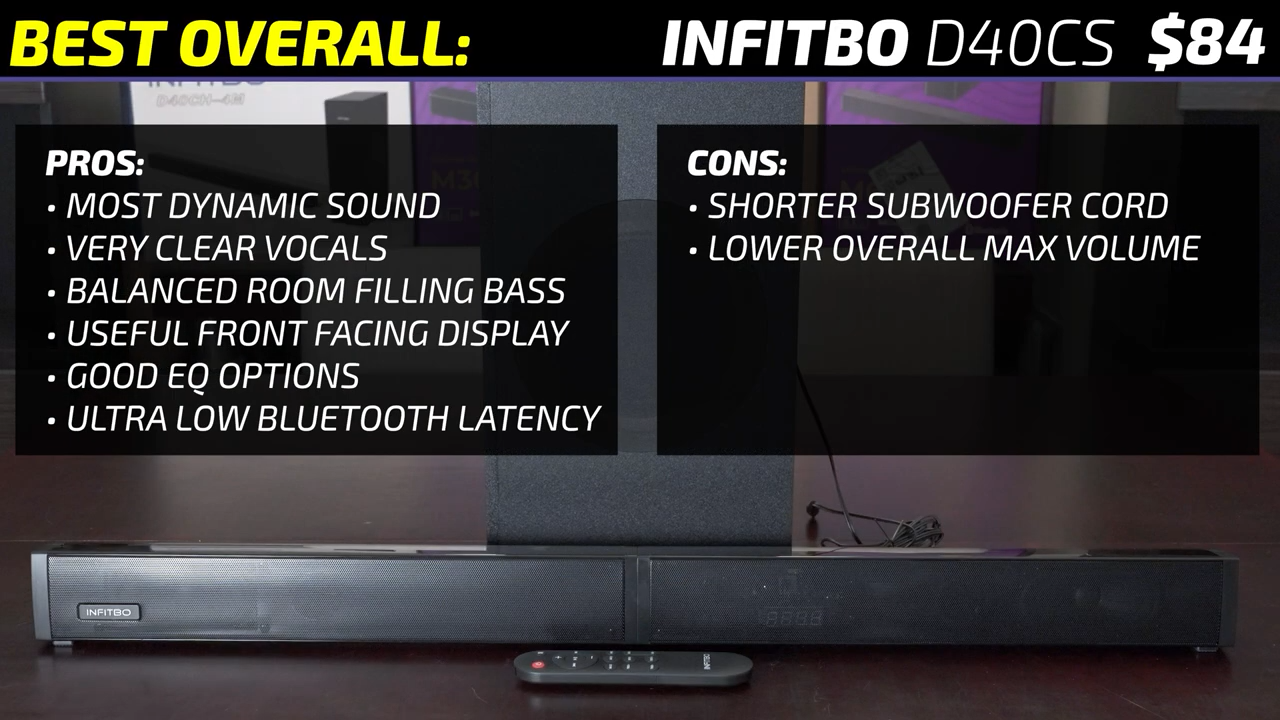
For me, the INFITBO D40CS is the one I kept coming back to. It provided the most dynamic sound with clear vocals, and the subwoofer provided meaningful bass without getting too boomy in the midbass. The only downsides about the INFITBO are its shorter subwoofer cable and a lower maximum volume than the Saiyin and Ultimea. So one of those might be a better option if you’re planning on using these outside or in a giant room and you want them to be really loud.
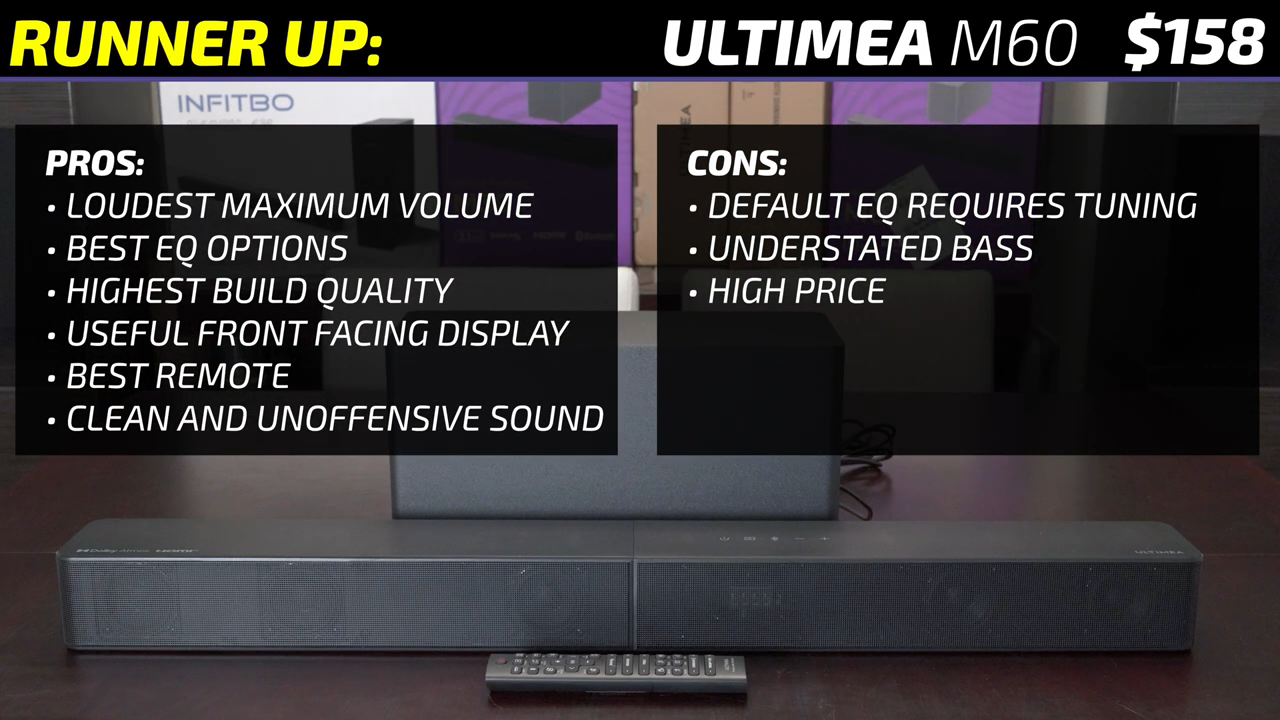
My second pick is the Ultimea Poseidon M60, which is just a really consistently good bar with no major downsides other than the higher price. I suspect we’ll still see the M60 go down to $99 for Prime Day and Black Friday, but I think the $158 normal price might be here to stay.
If you know you like to turn up the bass and you don’t mind a little bit of boominess, the Saiyin SPB will probably suit you the best, and I’m happy to see that they’ve updated their Bluetooth firmware from last year to fix the audio sync issues.
Last, the Amazon Renewed Hisense R651 offers a lot of value for $90 with five speakers in the main bar, a wireless subwoofer, and two wired surround speakers. But the overall sound quality wasn’t better than the INFITBO, and any time you get something renewed you don’t know what its condition will be. Mine was in good shape other than the fact that it smelled like a Yankee Candle store, which made me a little nervous about what smell the refurbishers were trying to cover up. Still, if you want a wireless sub and have a good spot to put the surround speakers, the Hisense R651 is a lot of system for under $100 if you’re willing to take a gamble, and the surrounds do add an extra dimension to the viewing experience.
As always there are no sponsored reviews on this channel, and I bought everything in this video with my own money, but I do have links below for my top recommendations and I appreciate when you use those links since as an Amazon Affiliate, I do earn a small commission on the sale at no cost to you.
Thank you to my awesome patrons over at Patreon for your continued support, and if you’re interested in supporting unsponsored and unbiased reviews, please check out the links below. If you enjoyed this video, please consider subscribing to my YouTube channel and as always, thanks for watching The Hook Up.