The Best $100–$500 Projectors of 2026: One Clear Winner
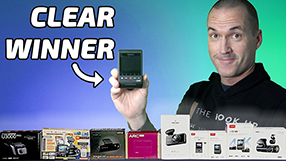
March 12, 2026Every year in November, I go on Amazon and buy every projector under $100 to find the best options for the tightest budgets. But at this tier of projectors, doubling the budget can sometimes more than double the performance. In this video, I bought 15 of the most popular projectors on Amazon between $100 and $500 and put them head to head to figure out which of these budget home theater projectors is the best in 2026. I’m not going to make you wait; most people should buy the Nexigo PJ40 Pro. But stick around to see all the testing and results to make sure it’s the right one for you. Remember, as always, there are no sponsored reviews on this channel.
Brightness Testing
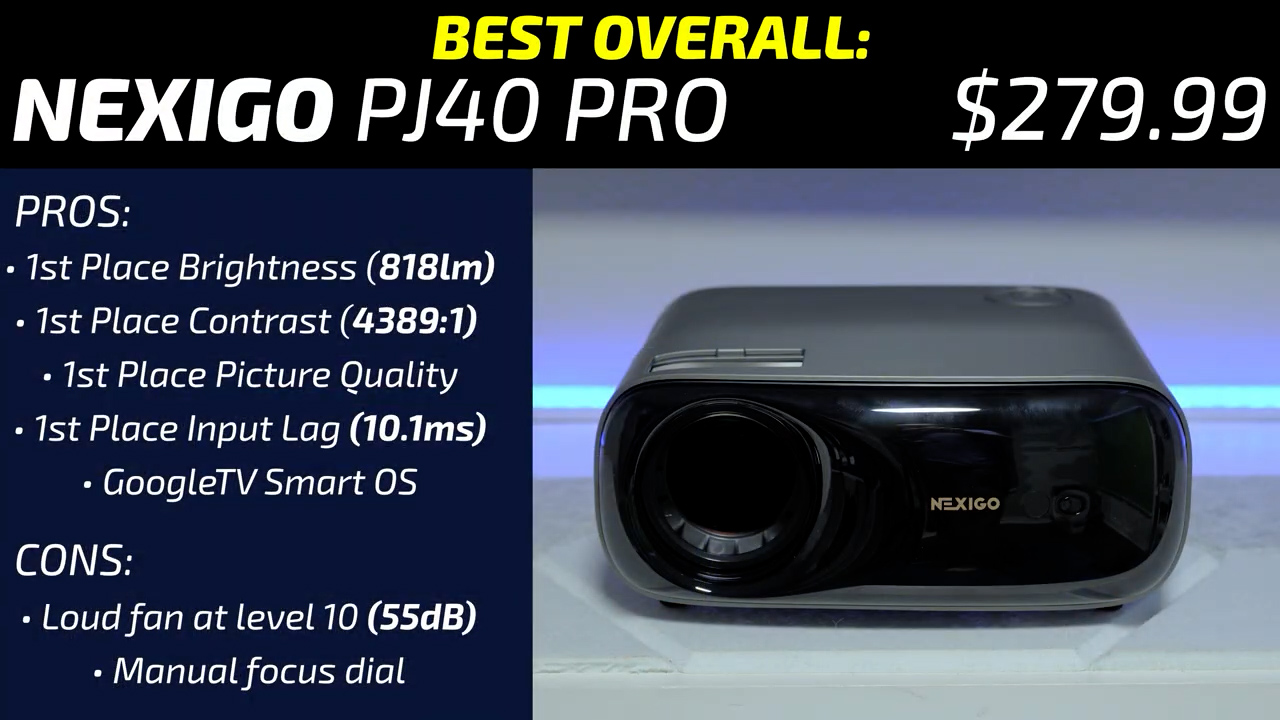
Starting out with brightness testing, it’s common for projectors in this price range to list their brightness in ANSI lumens. But unfortunately, those listings are mostly still lies. I tested each of the projectors using the ANSI/ISO brightness standard by taking nine individual brightness measurements and multiplying the average brightness by the screen size in square meters. The brightest projector was the Nexigo PJ40 Pro, coming in at 818 ANSI lumens, which is actually 18 lumens higher than advertised. Unfortunately, other than Nexigo, Aurzen was the only other brand to accurately report their brightness with most coming in at less than half of their advertised brightness.


Contrast Testing
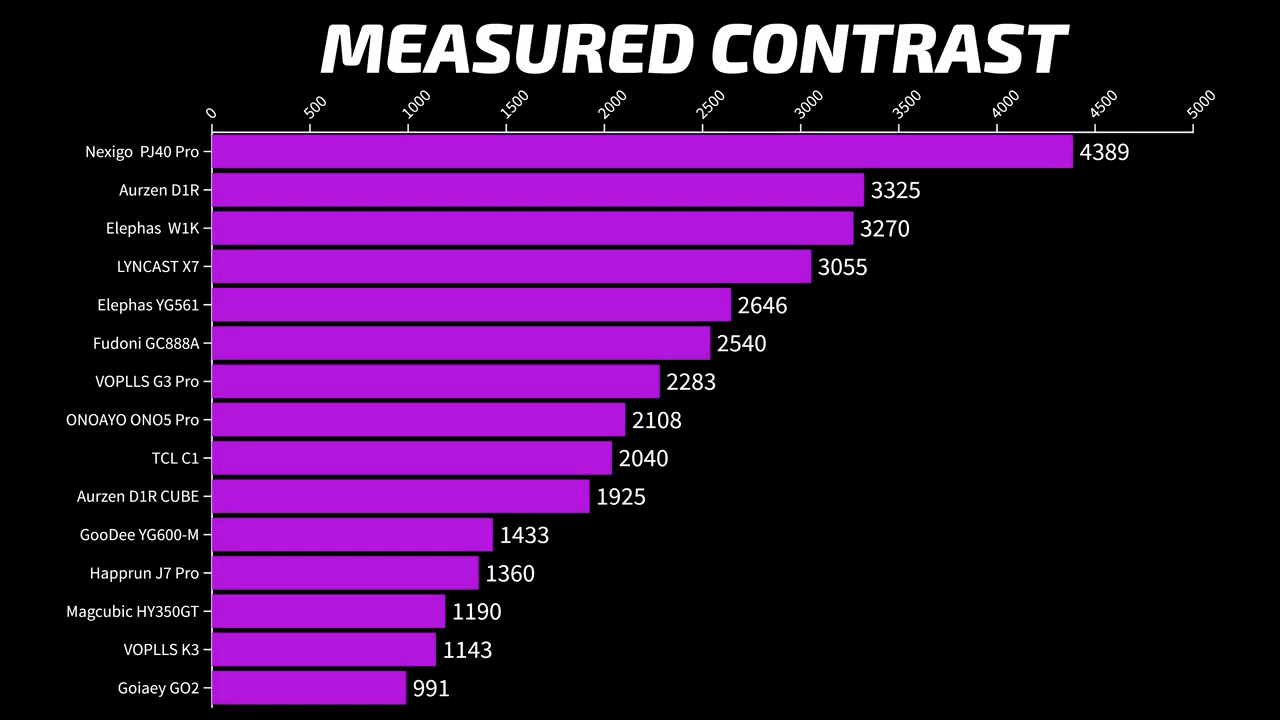
I also measured each projector’s native contrast, which is an area where these single LCD projectors generally excel. The Nexigo came out on top again with a nearly 4400:1 contrast ratio, with the Aurzen D1R in 2nd and the Elephas W1K in 3rd.
Uniformity Testing
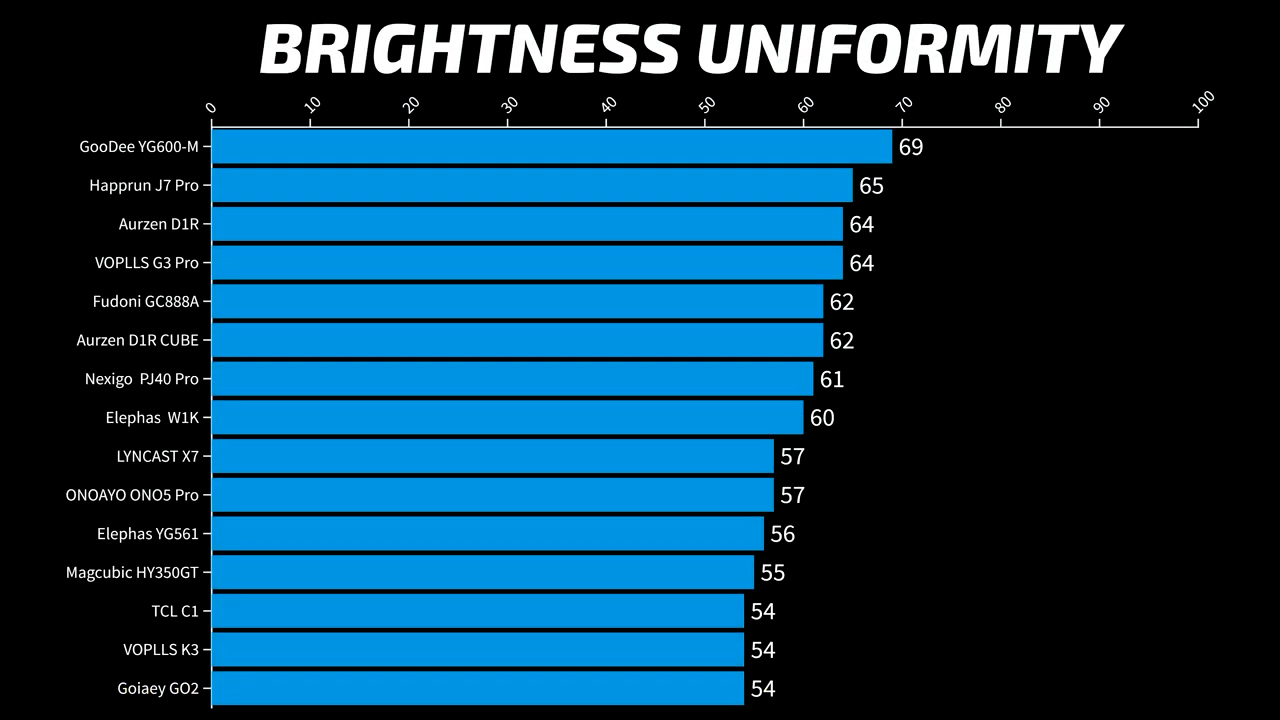
However, while single LCD projectors tend to have excellent contrast, they struggle with brightness uniformity and tend to be much dimmer in the corners than in the middle of the screen. This batch was no different and all came in between 69% and 54%, which is pretty bad compared to other projector technologies like DLP that are often more than 95% uniform.
Side-by-Side Testing
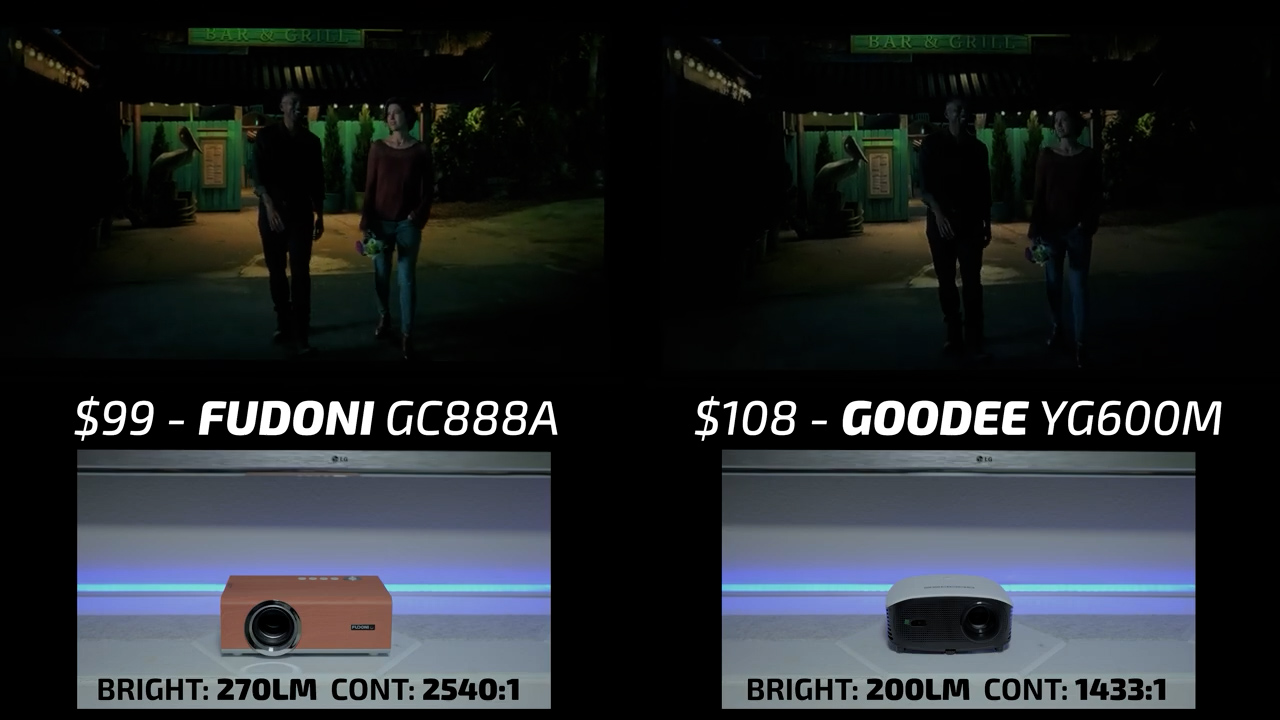
But if there’s one thing I know from more than five years of projector testing, measurements only get you so far, and side-by-side testing is the only way to find the best performing projector. So, I set up two 100” white screens in my completely light controlled garage. Starting with the least expensive projectors, we’ve got the winner from this year’s sub $100 projector video, the $99 Fudoni GC888A on the left and the $108 GooDee YG600-M on the right. You can see that the 70 extra lumens and much higher contrast on the Fudoni made a huge difference in overall image quality, and in bright scenes the Fudoni had better color accuracy and more prominent highlights, while also maintaining more shadow detail in dark scenes, making this an easy win for the Fudoni.

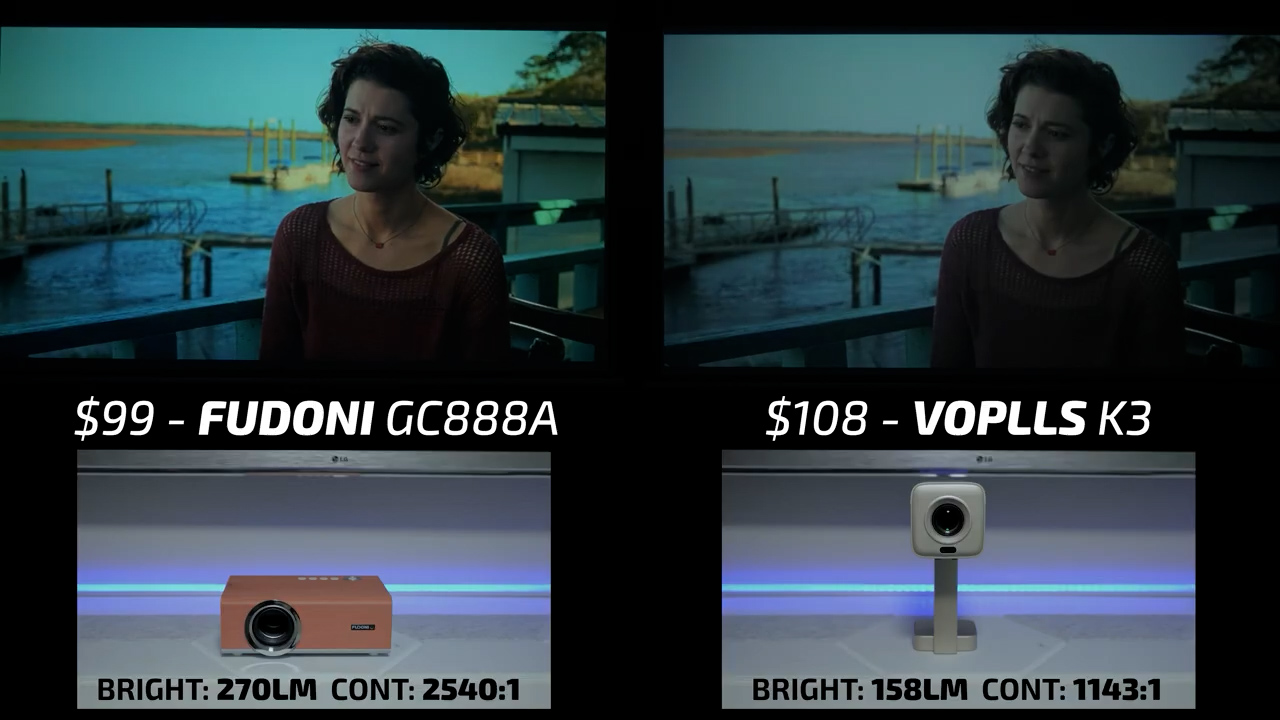
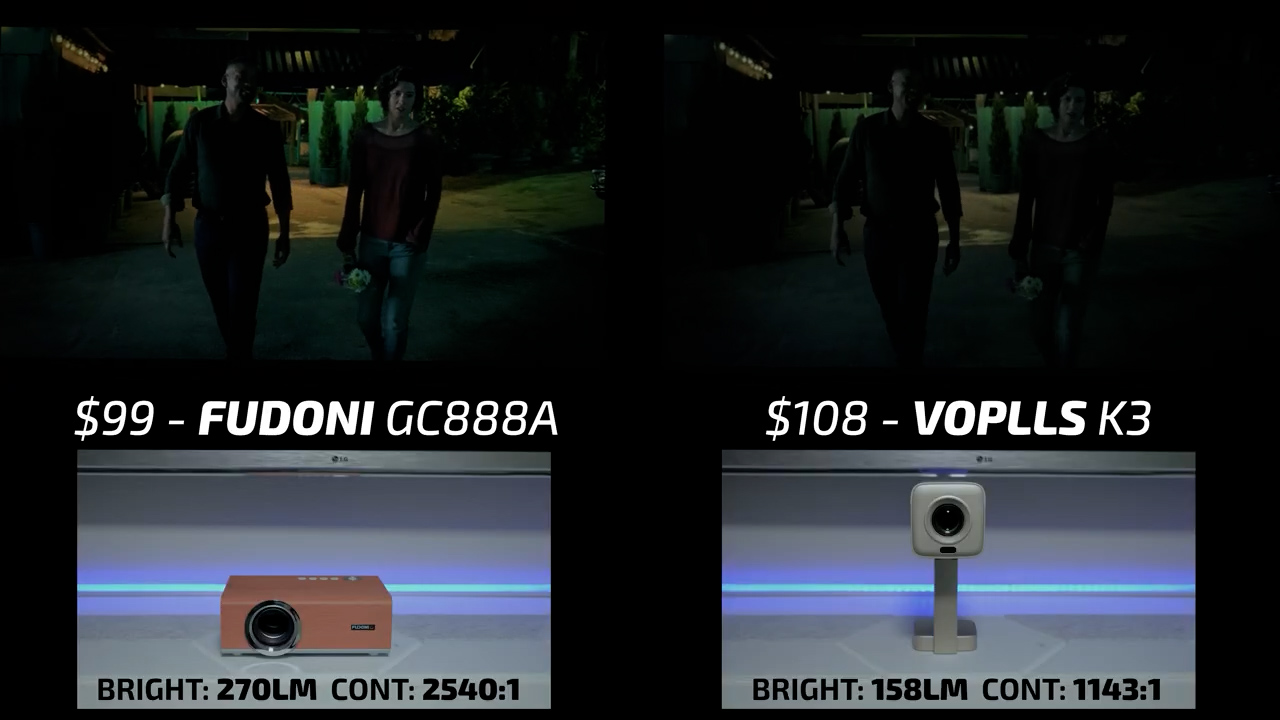
In round 2, the Fudoni is on the left and the $108 VOPPLs K3 is on the right. You can see that the VOPPLs never stood a chance, and despite specifically advertising 350 REAL ANSI lumens on the product page, it actually produced around 150 ANSI lumens, making the image much flatter and less interesting during bright scenes. It also had one of the worst contrast ratios resulting in almost unwatchable dark scenes, so the Fudoni easily won this round also.
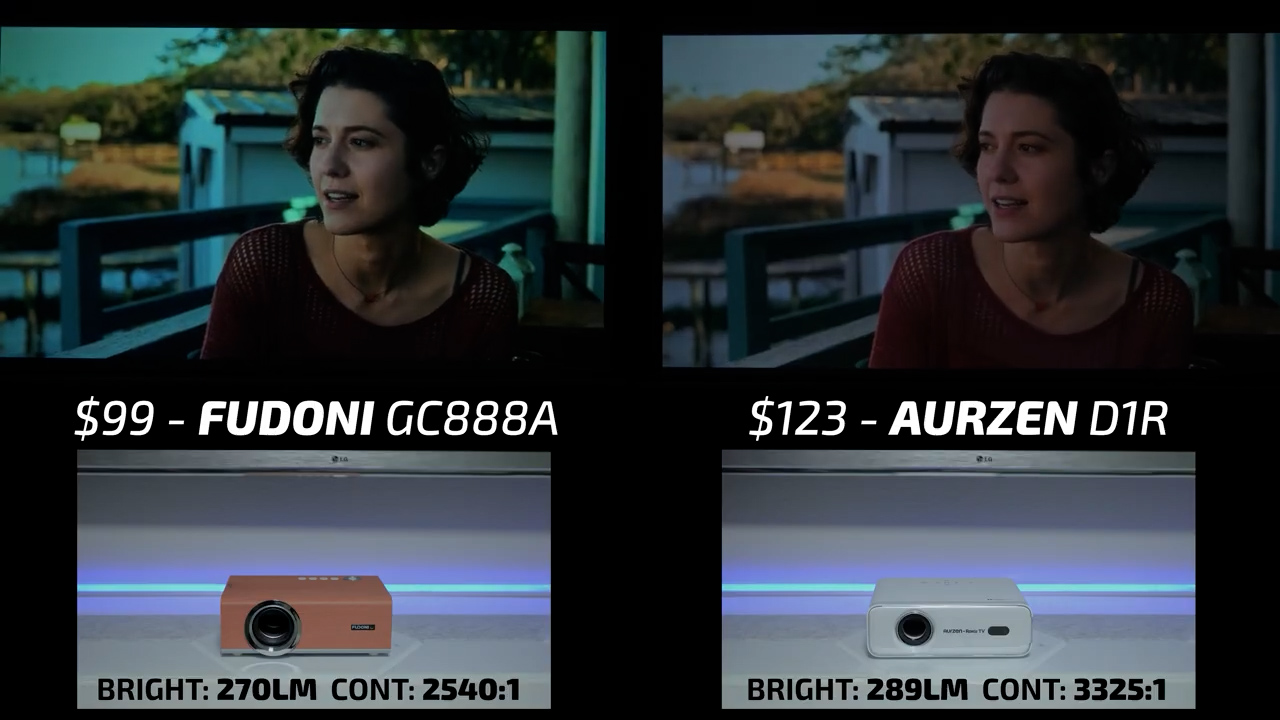
Round 3 then put the Fudoni on the left and the $123 Aurzen D1R on the right. While the Aurzen was pleasingly color-accurate, the overall picture quality felt flat and undersaturated compared to the Fudoni in bright scenes. In dark scenes, the gamma curve on the Fudoni was much more suited for a projector with under 300 lumens and despite the higher contrast ratio, the Aurzen lost a lot of shadow detail due to poor image processing making this another quick win for the Fudoni.

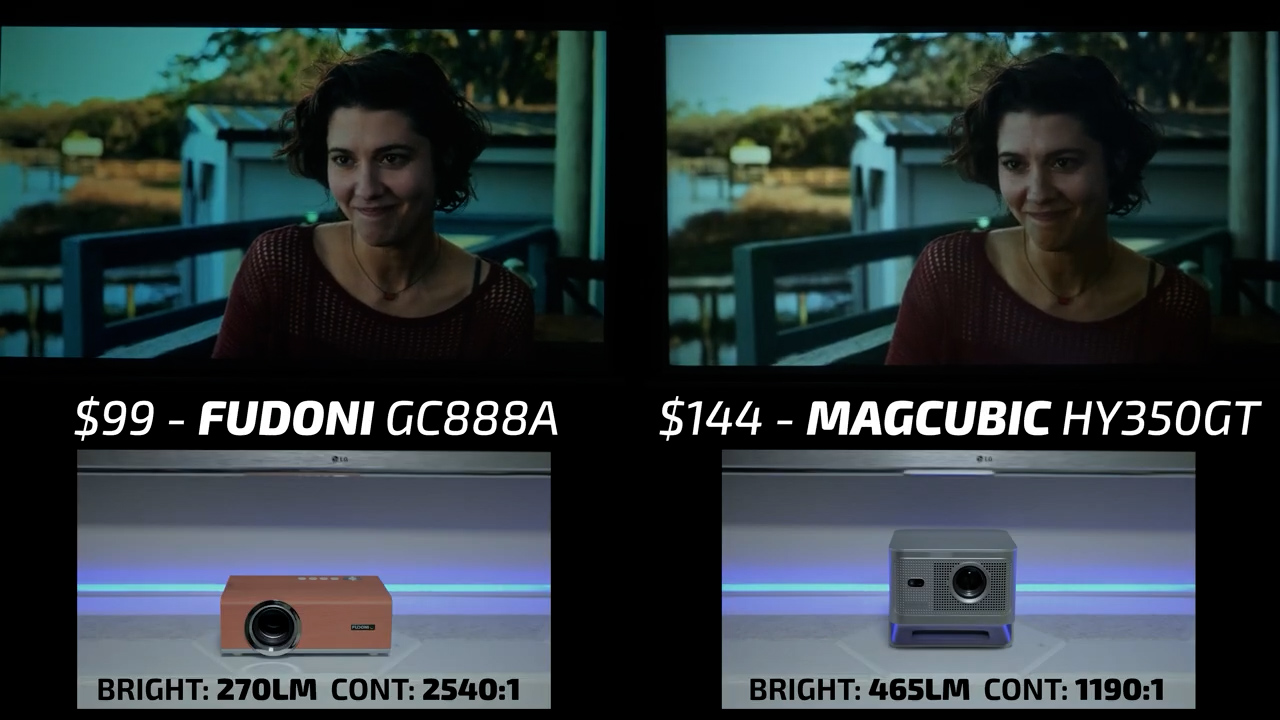
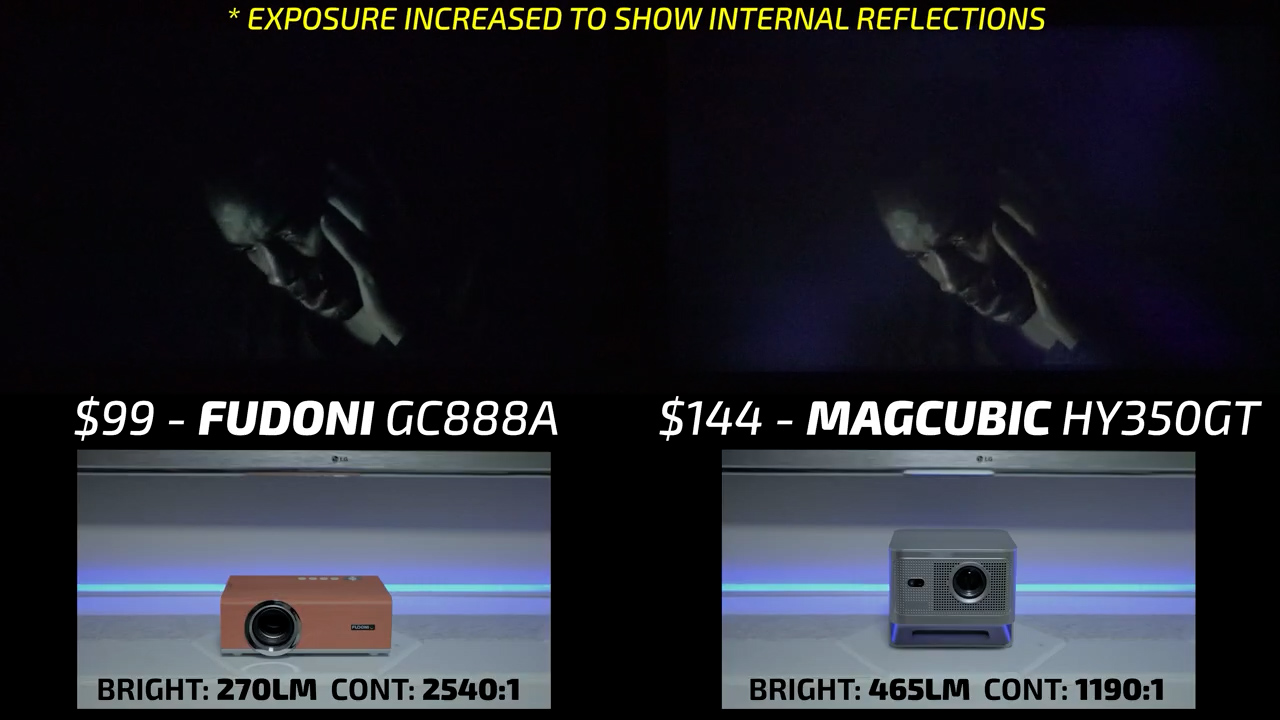
In round 4, the Fudoni is on the left and the $144 MagCubic HY350GT is on the right. In bright scenes, these two projectors were relatively similar, but I would give the slight edge to the Fudoni in terms of color accuracy and contrast, especially in Dani’s skin tone. However, in dark scenes, the HY350GT is one of the worst performing projectors I’ve ever tested and had all kinds of internal reflections casting blue streaks across the screen, so there is no question that the Fudoni won this round also.
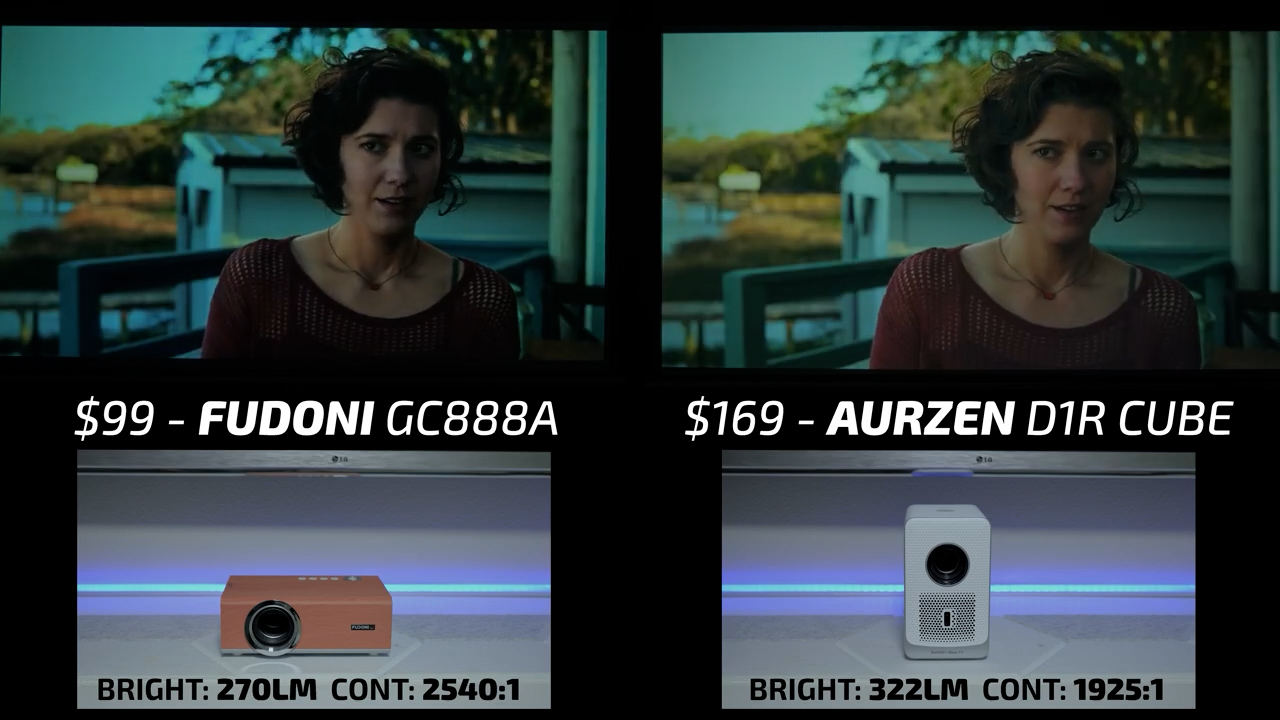
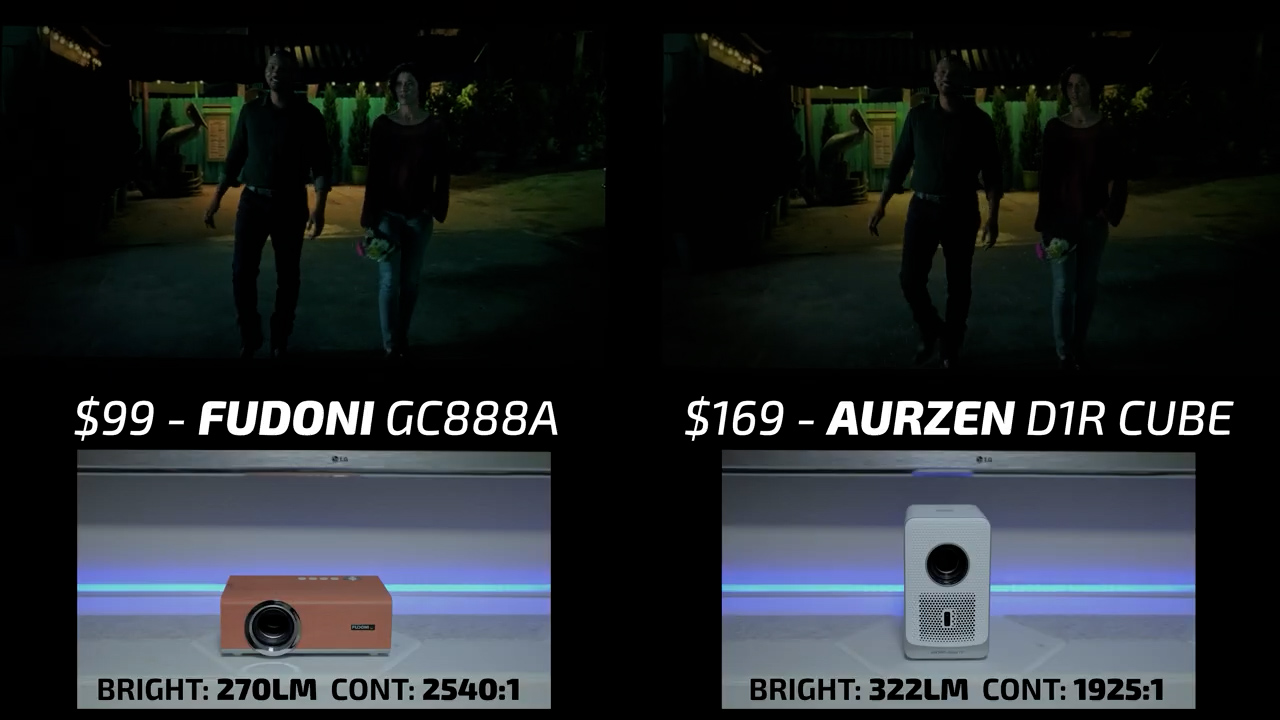
That makes round 5 the Fudoni on the left and the Aurzen D1R Cube on the right. Just like the Aurzen D1R from round 3 the D1R Cube looked flat compared to the Fudoni, but the color accuracy was decent, if not a little bit green shifted in bright scenes. Unfortunately, also like the other Aurzen, the D1R Cube failed to display highlights in dark scenes which made them difficult to follow and while I think the D1R Cube may have been more technically accurate, 322 lumens are not bright enough to properly display shadows and highlights without some extra image processing. The more aggressive processing on the Fudoni produced a much higher quality image.
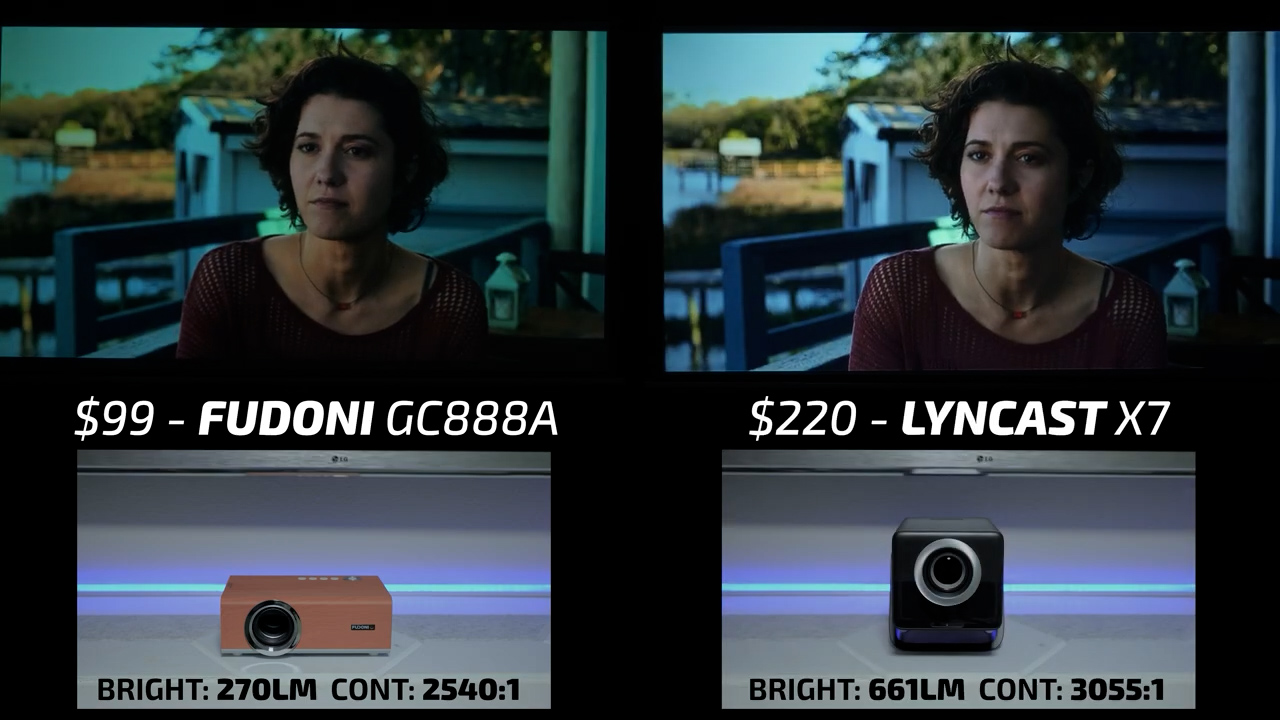
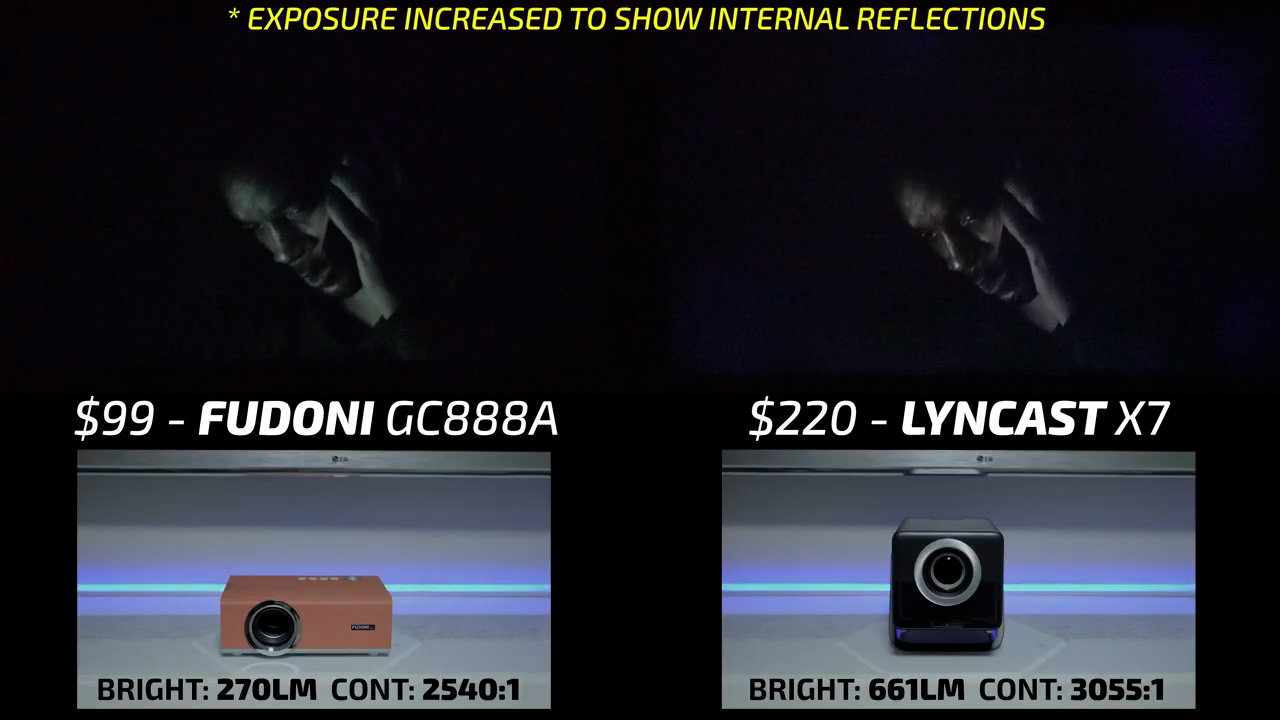
In round 6, the Fudoni is on the left and the $220 Lyncast X7 is on the right. On paper, this should have been a slam dunk for the Lyncast which has over twice the brightness and higher contrast than the Fudoni, but the picture settings on the Lyncast were not sufficient to fix the overly blue color temperature. While bright scenes were still enjoyable due to the extra brightness, they also appeared overly harsh, and I may have still given the win to the Lyncast in this round strictly due to the increased brightness, but like the MagCubic in round 4, the Lyncast also had some serious internal reflection issues in dark scenes that resulted in blue streaks across the entire screen forcing me to pick the Fudoni in this round too.
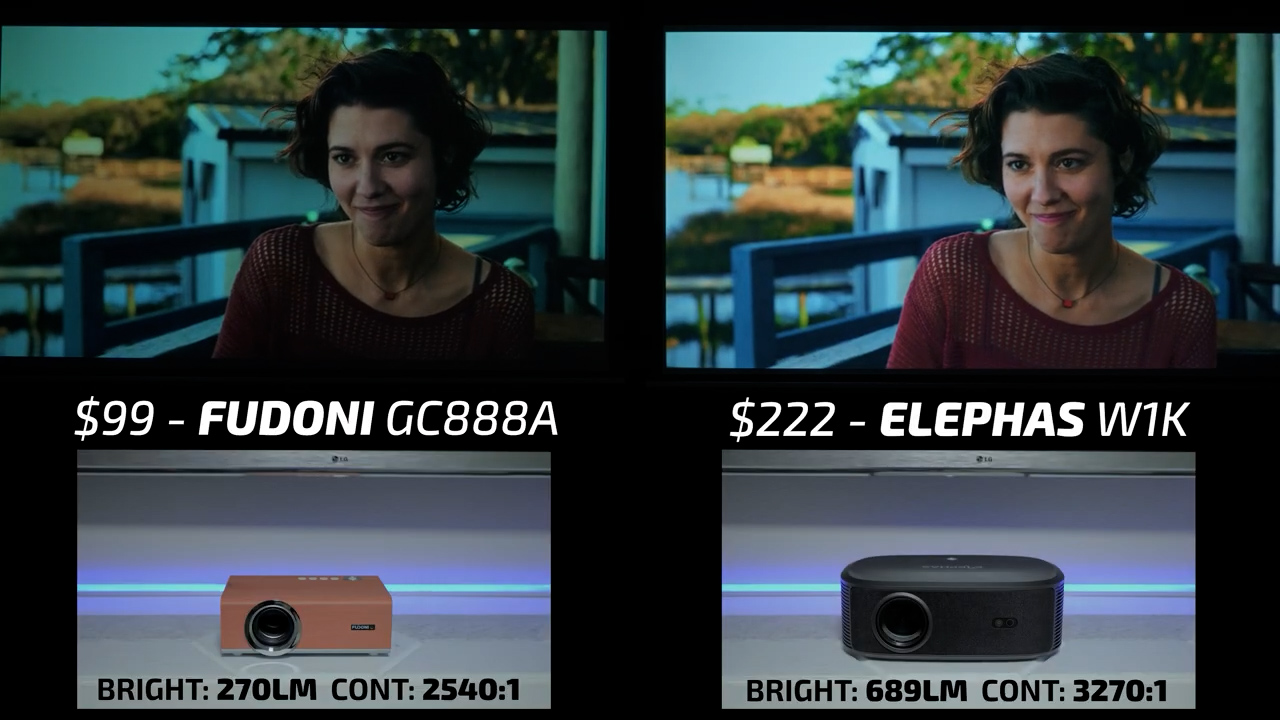
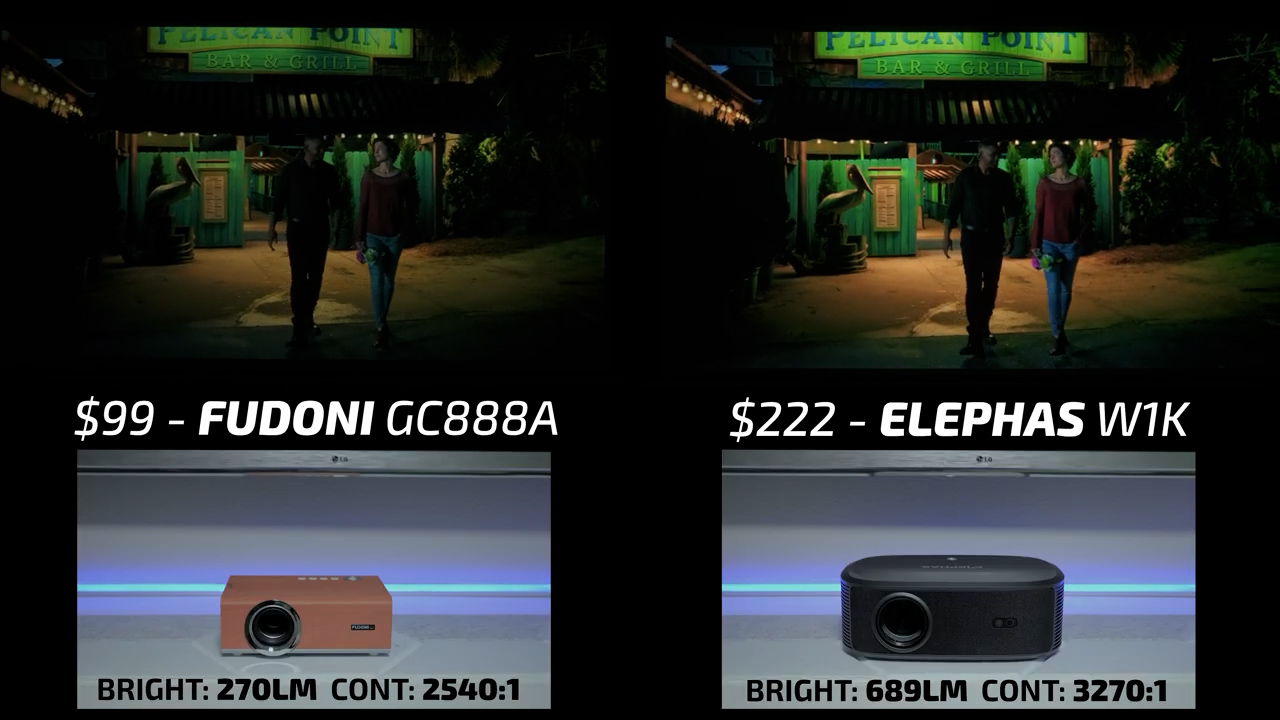
In round 7, the winner of this year’s $100 and under video, the Fudoni GC888A is still on the left, and the winner of last year’s $100-500 video, the $222 Elephas W1K is on the right. Finally, after six underwhelming rounds, there was a clear and significant improvement over the $99 Fudoni. In bright scenes, the Elephas was bright and vibrant if not slightly oversaturated, in moderately lit scenes the midtones were correctly processed to create a pleasing and easy to watch image, and in the darkest scenes the Elephas shifted slightly blue but was overall still a pleasure to watch with excellent black level and shadow detail making it a landslide winner in round 7.
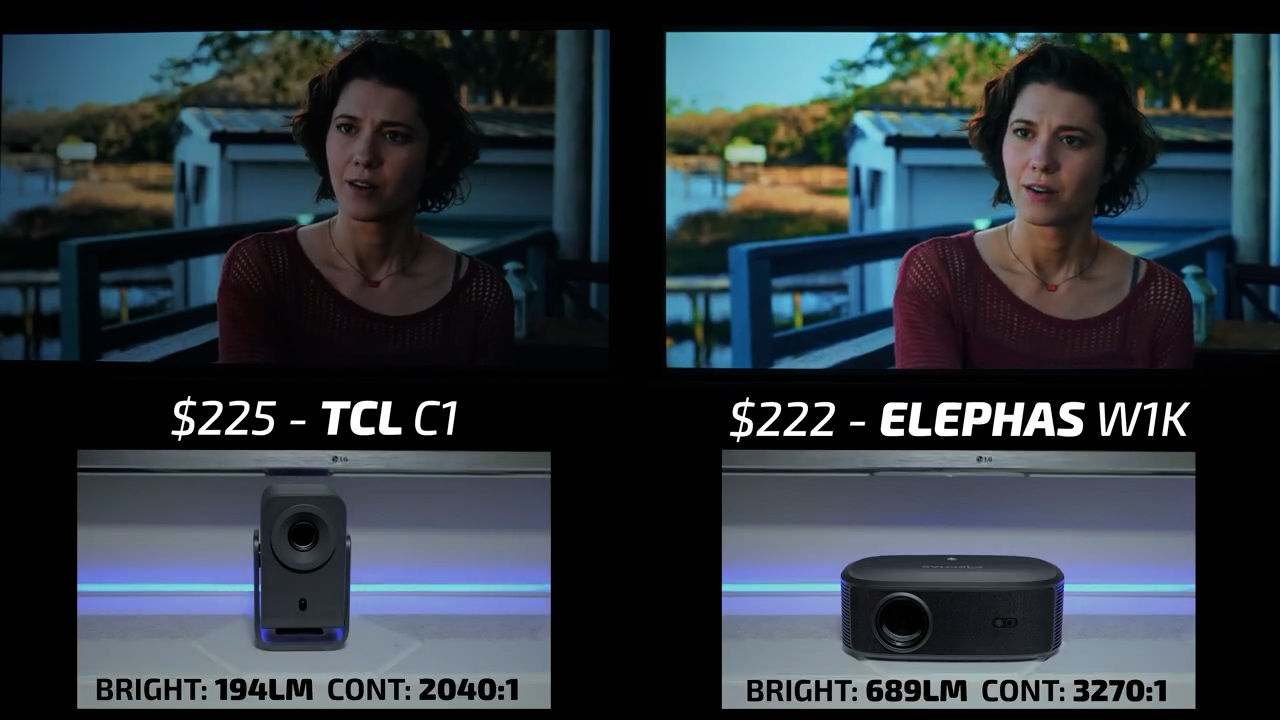
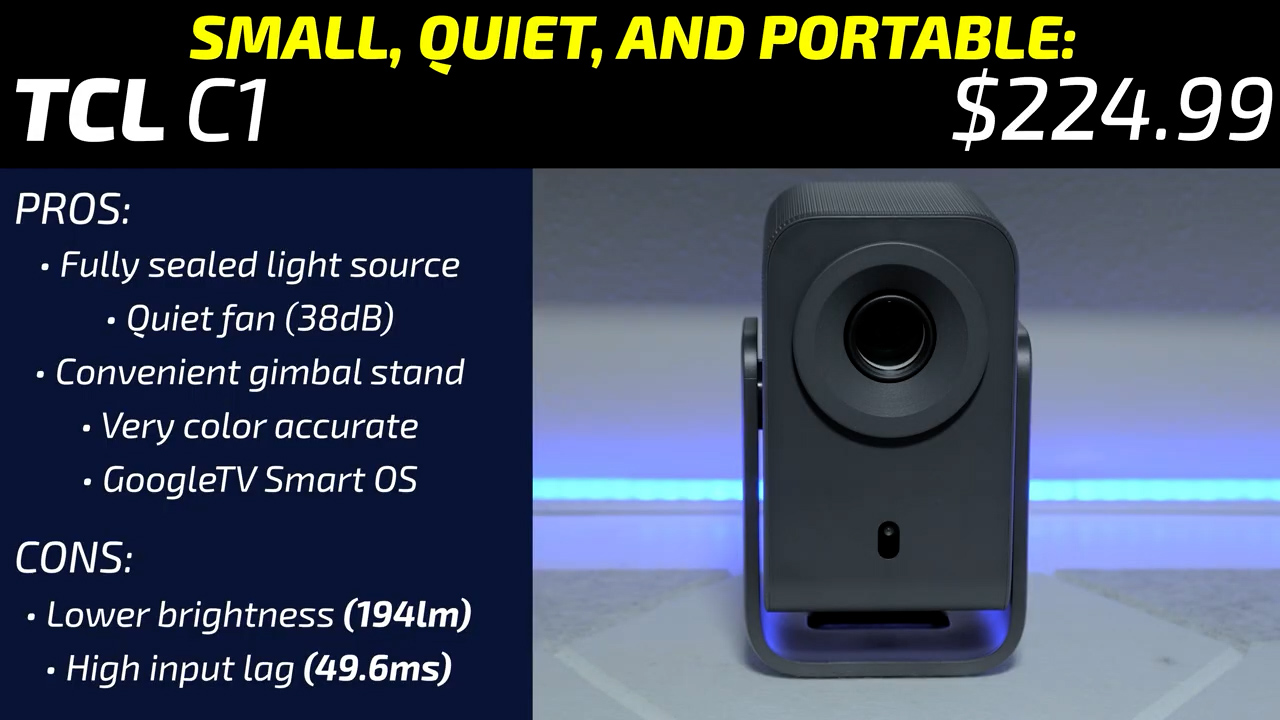
That makes round 8 the Elephas W1K on the right and the $225 TCL C1 on the left. In terms of image quality, these two projectors performed nearly identically in bright scenes except for the fact that the Elephas was over three times as bright. Dark scenes also went about how you would expect with both projectors showing excellent shadow detail, but the highlights on the Elephas were roughly three times brighter than the TCL making this another easy win for the Elephas.

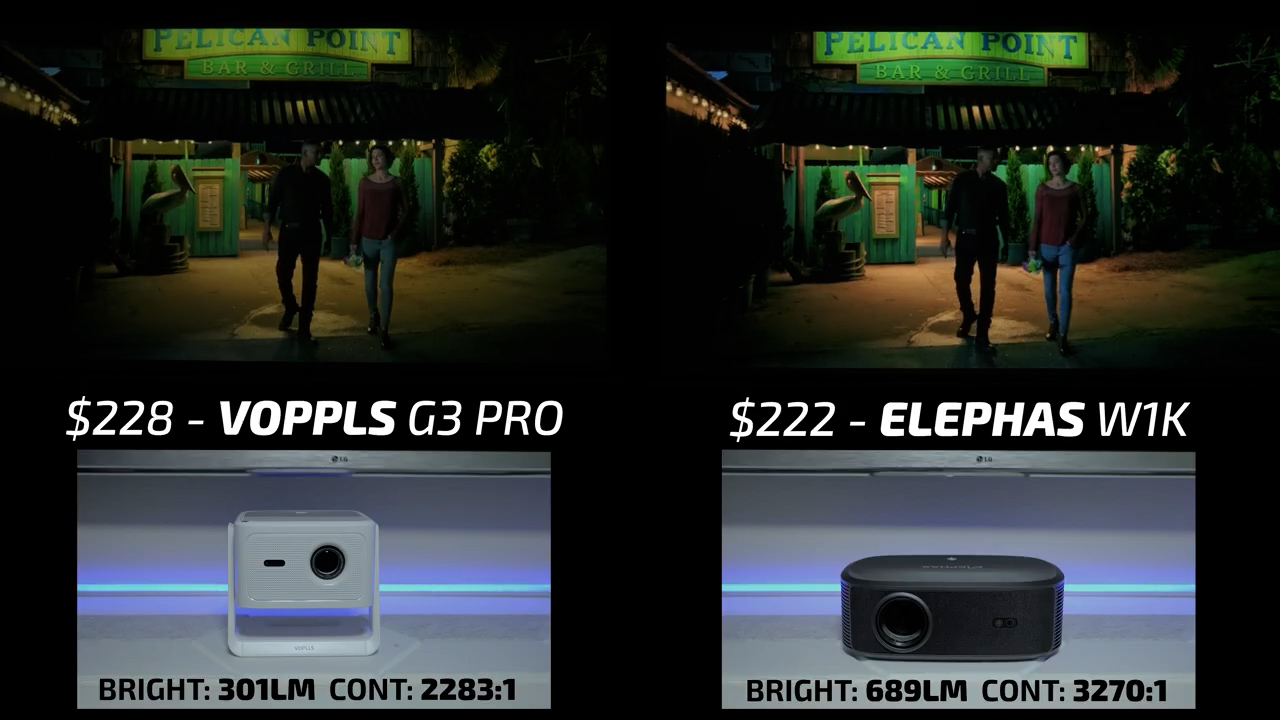
Round 9 then put the Elephas W1K on the right and the $228 VOPPLS G3 Pro on the left. One of the interesting things about the VOPPLS is that it doesn’t list the projector’s brightness anywhere on the product page. But in my testing, it came out to be just over 300 ANSI lumens, which is less than half of the Elephas. However, the VOPPLS color accuracy and tone mapping were some of the best I’ve ever seen at this price point, and despite having less than half the brightness it was able to deliver a very high-quality image in both bright and dark scenes. I significantly preferred the image on the VOPLLS for watching movies, but if you are more interested in using these projectors for sports, I think that the Elephas is still the better pick. But with that said, I’m going to give the win this round to the VOPLLS.

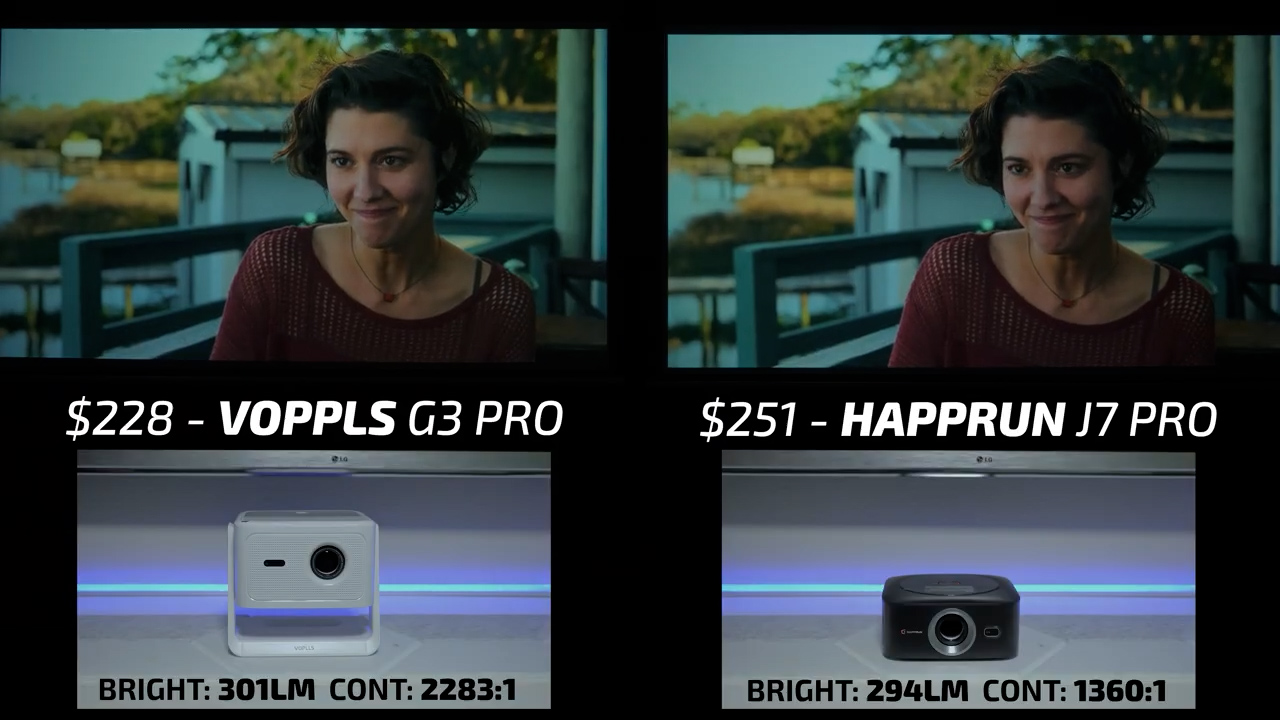
In round 10, the VOPPLS is on the left and the $251 Happrun J7 Pro is on the right. In bright content, the projectors were nearly identical with the VOPPLS having just a few extra lumens over the Happrun making it a very close matchup, but in darker scenes the black floor of the Happrun was substantially higher causing the image to look gray and washed out compared to the VOPPLS. So, the VOPPLS easily won this round.

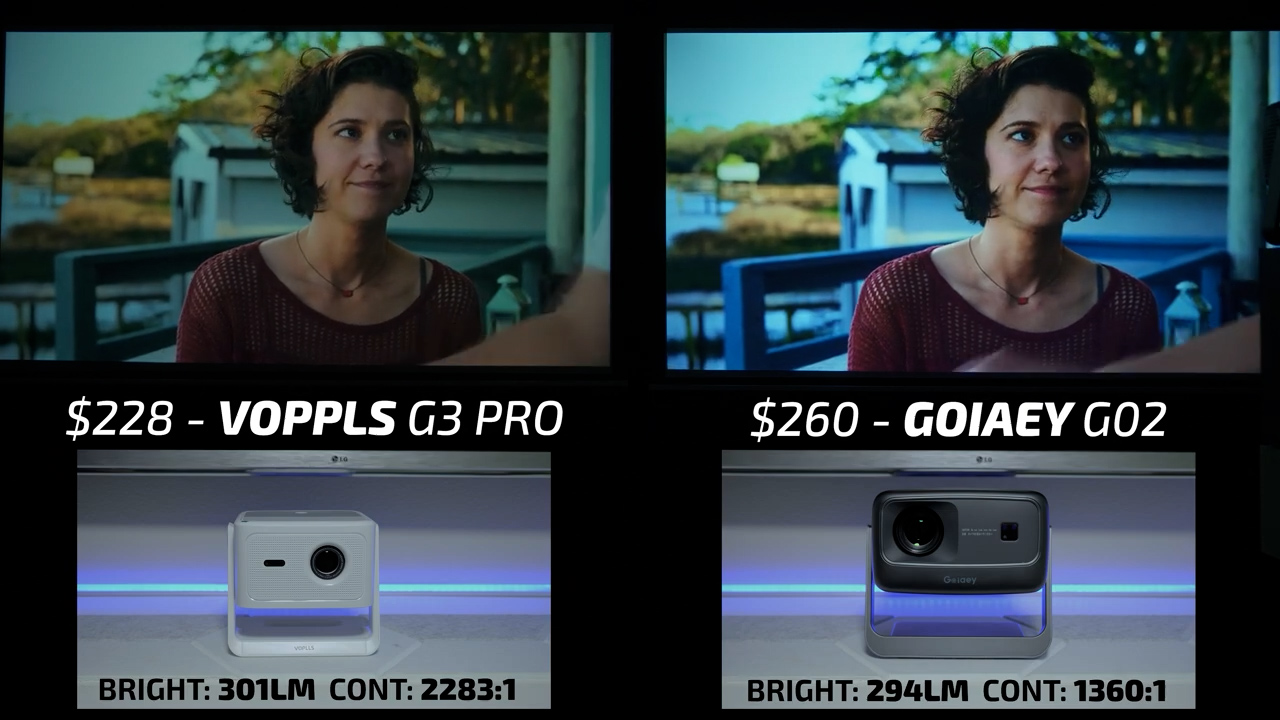
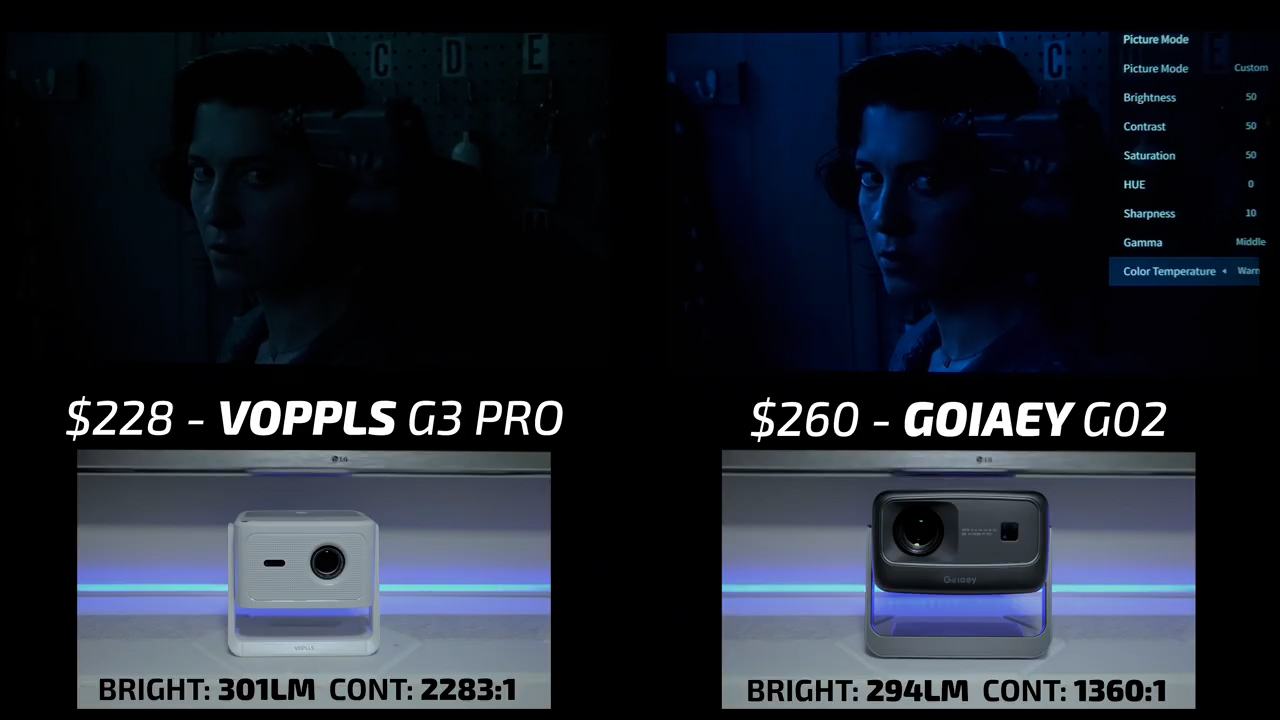
In round 11, the VOPPLS is on the left and the $260 Goiaey GO2 is on the right. Out of the box, the GO2 was extremely blue, not like daylight LEDs, but more like pure blue LEDs. Not a problem though, I always go into picture settings to try to give each projector the best shot. But to my surprise, none of the picture settings on the Goiaey do anything and no matter what picture mode you use or color temperature you choose, it’s always a purple mess. The Goiaey had no chance and the VOPPLS moved on again.
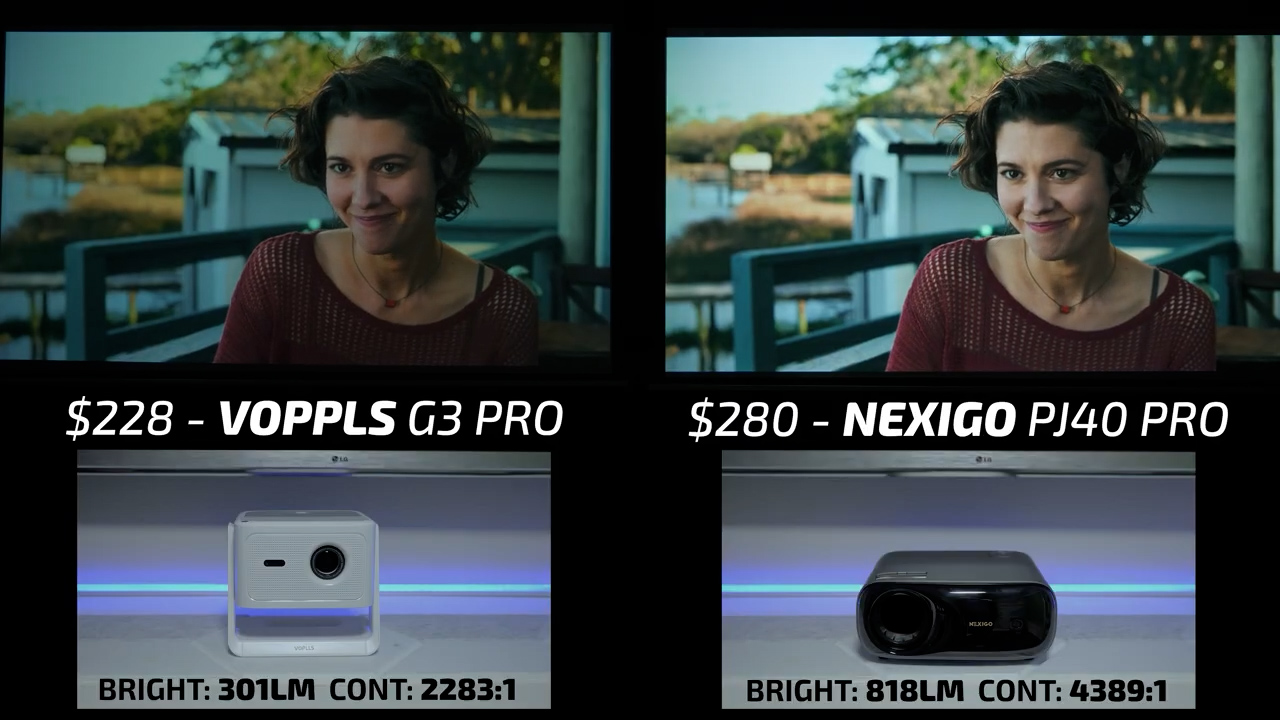
In round 12, the VOPPLS is on the left and the $280 Nexigo PJ40 Pro is on the right. The Nexigo absolutely knocked this out of the park in terms of brightness, color accuracy, contrast, and shadow detail. With 800 lumens and over 4000:1 contrast ratio, I would bet good money that in a blind side by side, even the most savvy projector experts would have a hard time distinguishing between the $280 Nexigo and projectors all the way up into the $2000 range. Regardless of content type, the Nexigo delivered a nearly perfect image every time making it the easy winner in this round.

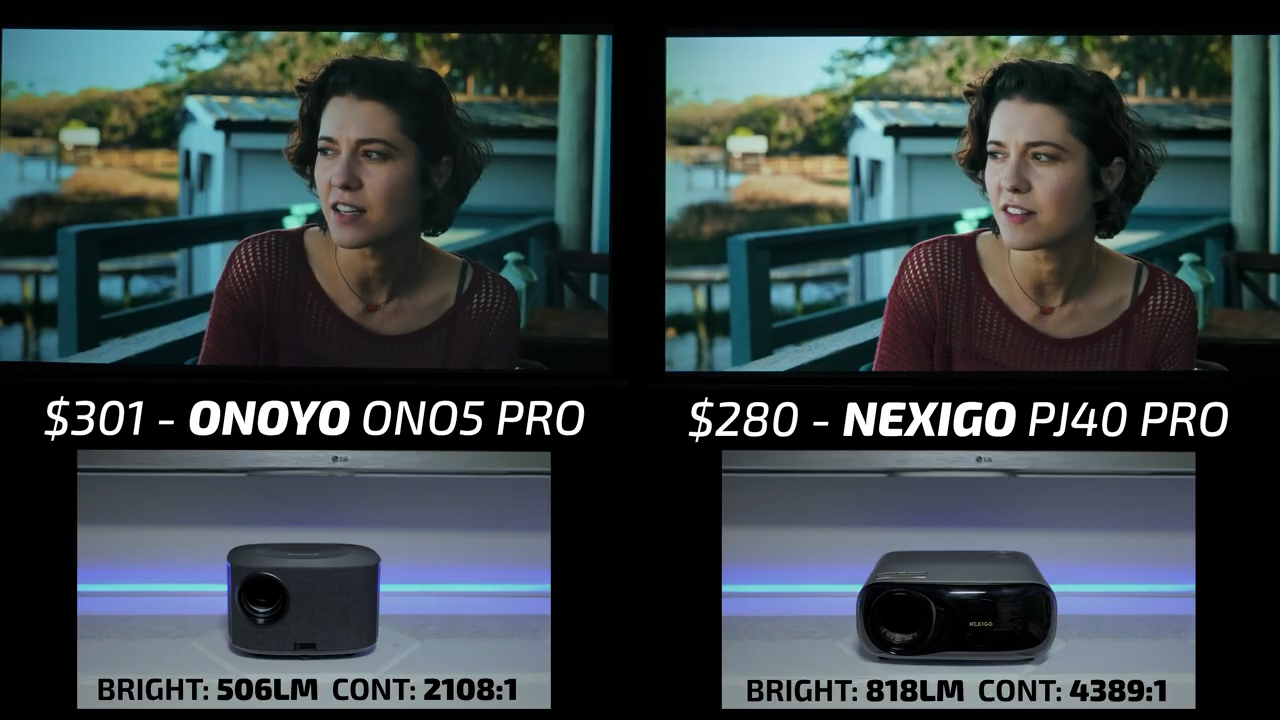
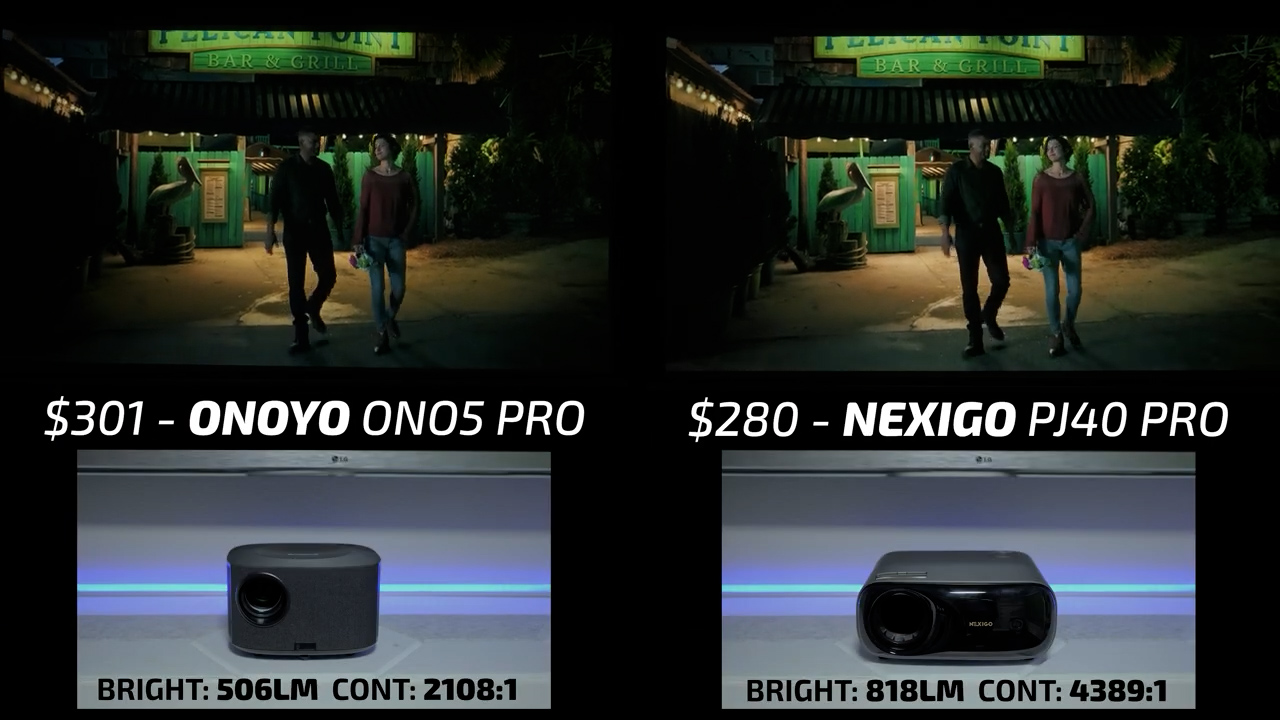
That makes round 13 the Nexigo PJ40 Pro on the right and the $301 ONOYO ONO5 Pro on the left. The ONO5 Pro is identical to the Happrun YG491 that I reviewed in 2024, which took 2nd place overall in the picture quality testing. Similar to 2024, I thought the ONO5 looked great with excellent, albeit slightly oversaturated color, good tone mapping, and decent contrast. But it was absolutely no match for the Nexigo, which as I said, is easily the best performing projector I’ve ever seen at this price point.
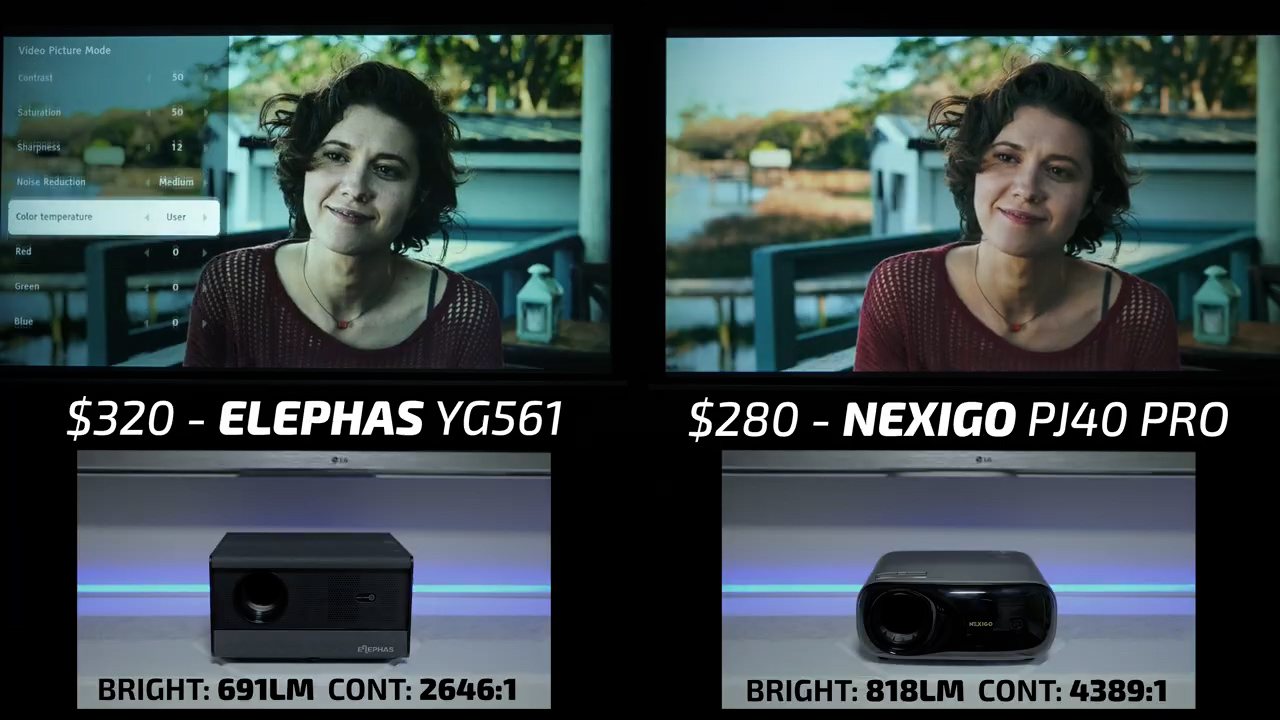
So, the final round is the Nexigo PJ40 Pro on the right and the $320 Elephas YG561 on the left. Straight out of the box, the picture settings on the Elephas were a hot mess, so I spent a little bit of time adjusting the white balance, brightness, and contrast to make this round somewhat of a fair fight. But no matter what I did, I couldn’t stop skin tones from looking sickly and it was almost like the Elephas was pushing all of the midtones into either highlights or shadows which I personally found very unappealing. Unfortunately, the Elephas YG561 lacked the proper advanced picture controls to be able to correct that issue, making the Nexigo PJ40 Pro the overall winner for picture quality in 2026 by a pretty large margin.

Side-by-Side Results
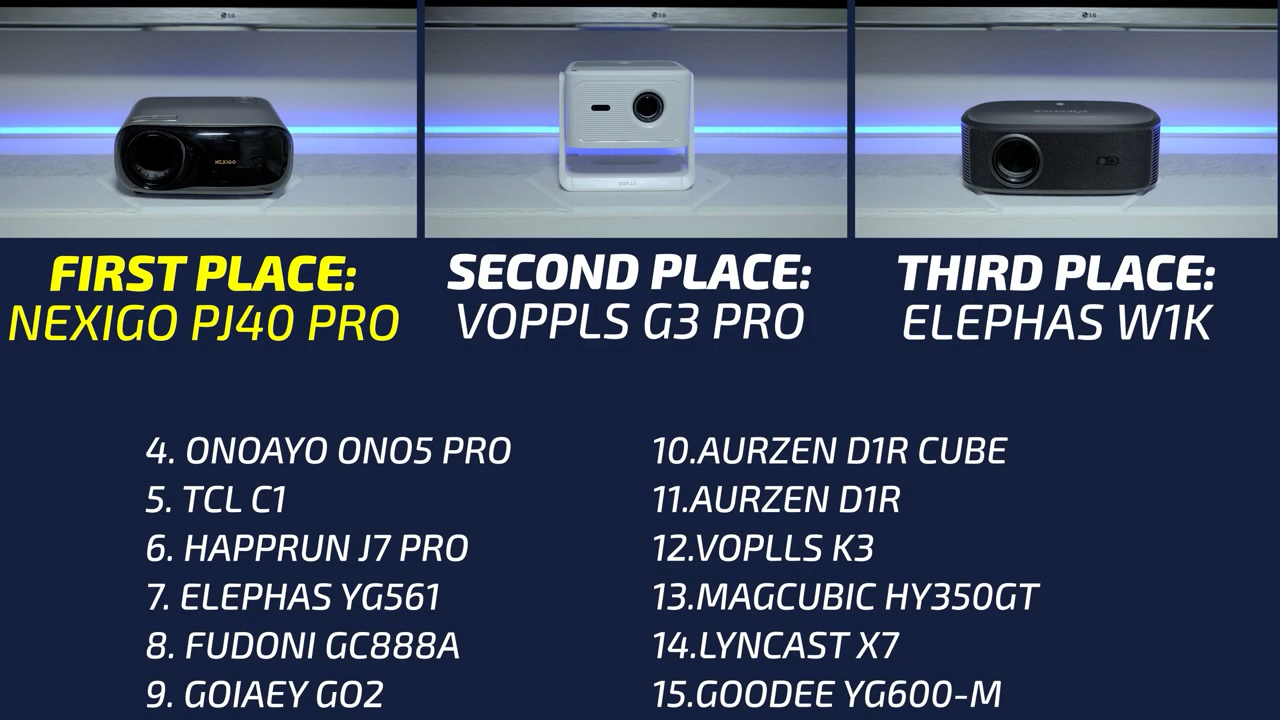
Here are the overall rankings for the rest of the projectors with the VOPPLS taking a surprising 2nd place, and last year’s winner, the Elephas W1K in 3rd place.
Input Lag Testing
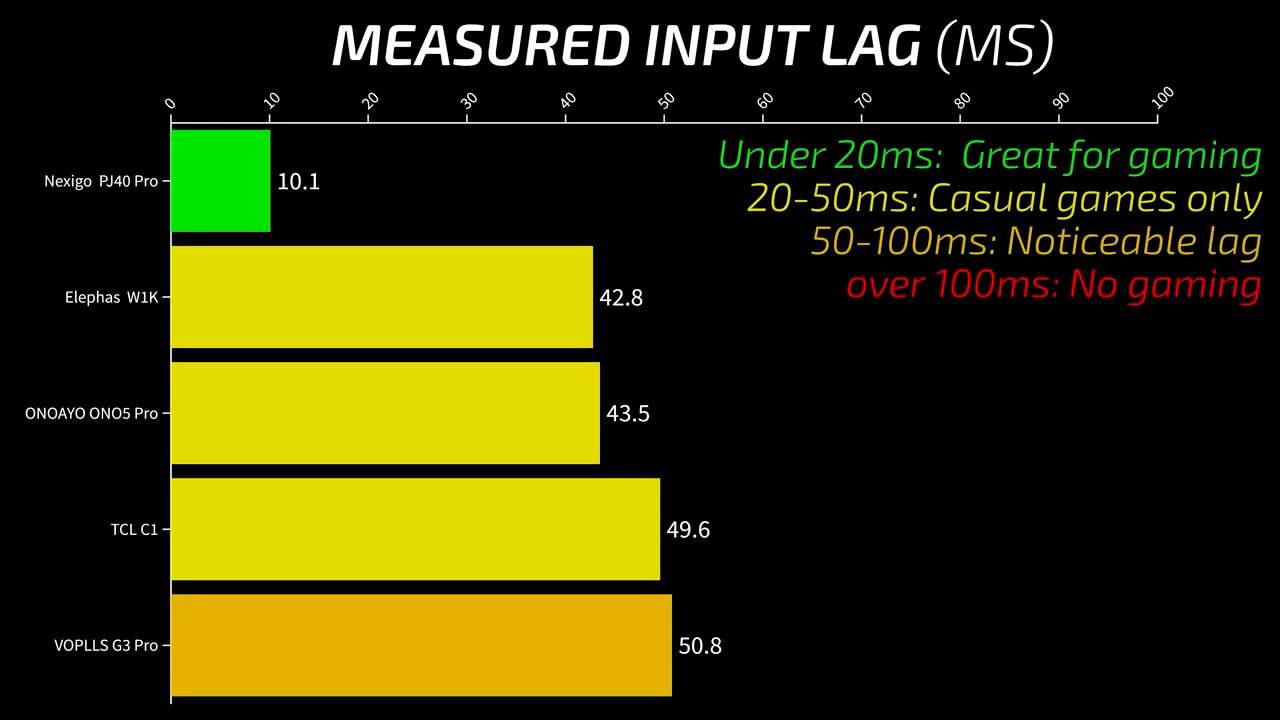
Next, it’s time to do some more in-depth testing on just the top five projectors, starting with input lag. Playing video games on a big screen is an awesome experience, but historically these single LCD projectors have had input lag values much too high for most video games. I used the industry standard Leo Bodnar lag tester to measure the input lag at 1080p60Hz for each projector and found that the Nexigo PJ40 Pro had a super impressive input lag time of just 10.1 ms when measured at the middle of the screen and just 3.3 ms when measured at the top, which is by far the lowest input lag I’ve ever measured on a single LCD and close to the lowest input lag I’ve measured, period. Compared to the other four projectors, the Nexigo PJ40 Pro is the clear choice and basically the only good option for someone who wants to use this projector for serious gaming.
Smart Operating Systems
Next, let’s talk about smart operating systems. In this video there are five different variants. For me, the highest tier is Google TV which has pretty much become the standard operating system for projectors and seems safe and secure. Roku TV is another widely used and legitimate operating system with standards for privacy and security. After that you’ve got Movin OS, which feels much less premium, but does offer things like free live TV through various apps and an app store with a wide variety of legitimate apps. Under that you’ve got NetRange OS, which mostly works, but feels a little sketchy and not something I’d personally want connected to my home network. Last, the Lyncast is just running the mobile version of Android 14, which is by far the least secure and again, not something I’d feel comfortable putting my personal information into and having on my home network.

For everyone following along at home that means that the Nexigo PJ40 Pro has the highest brightness, the highest contrast, best picture quality, lowest input lag, and the best operating system. So, now it’s time to talk about what’s wrong with it.
Fan Noise
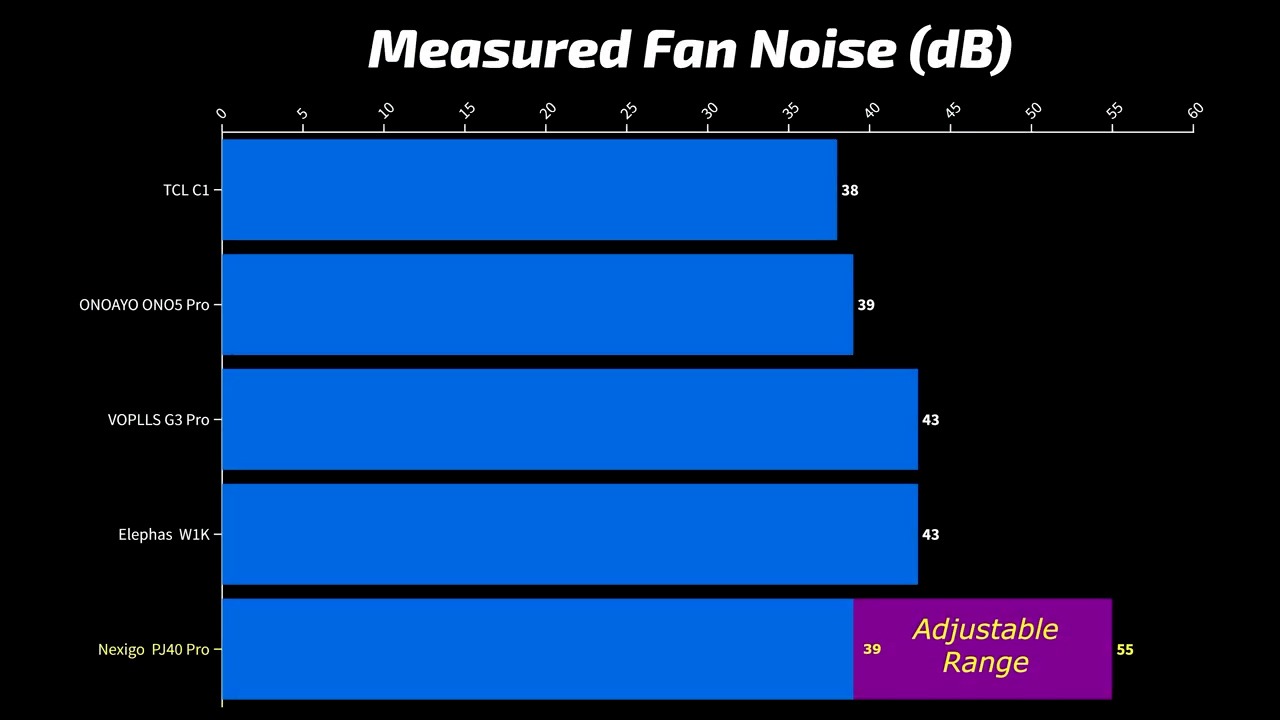
Its biggest issue by far is fan noise. Like every version of the PJ40, the Pro has adjustable brightness, and the fan level will vary with that brightness slider. At maximum brightness, the PJ40’s fans absolutely scream at about 55 db, but reducing the brightness decreases fan noise with every click and at level 1 the PJ40’s fan goes down to 39 db while still outputting 375 lumens. I think the sweet spot is level 4 which has a fan noise of 44 db and a brightness of 475 lumens.
But even then, that makes the PJ40 Pro the loudest of all the projectors, with the Elephas W1K coming in with a lower pitched 43 decibels. The VOPPLS is also 43 decibels, but at a much higher pitch. The ONOYO ONO5 Pro has a very unoffensive fan that comes in around 39 db. And the TCL C1 has the least offensive fan noise at around 38 db.
However, I’ve got more to say about that. I mentioned that the ONOYO ONO5 Pro is basically the same projector as the Happrun YG491 from 2024, and more than any other projector I’ve reviewed, people reported having overheating issues with that model to the point where Happrun just gave people their money back. So, the low fan noise is pleasing but also concerning.
Fully Sealed Light Engine
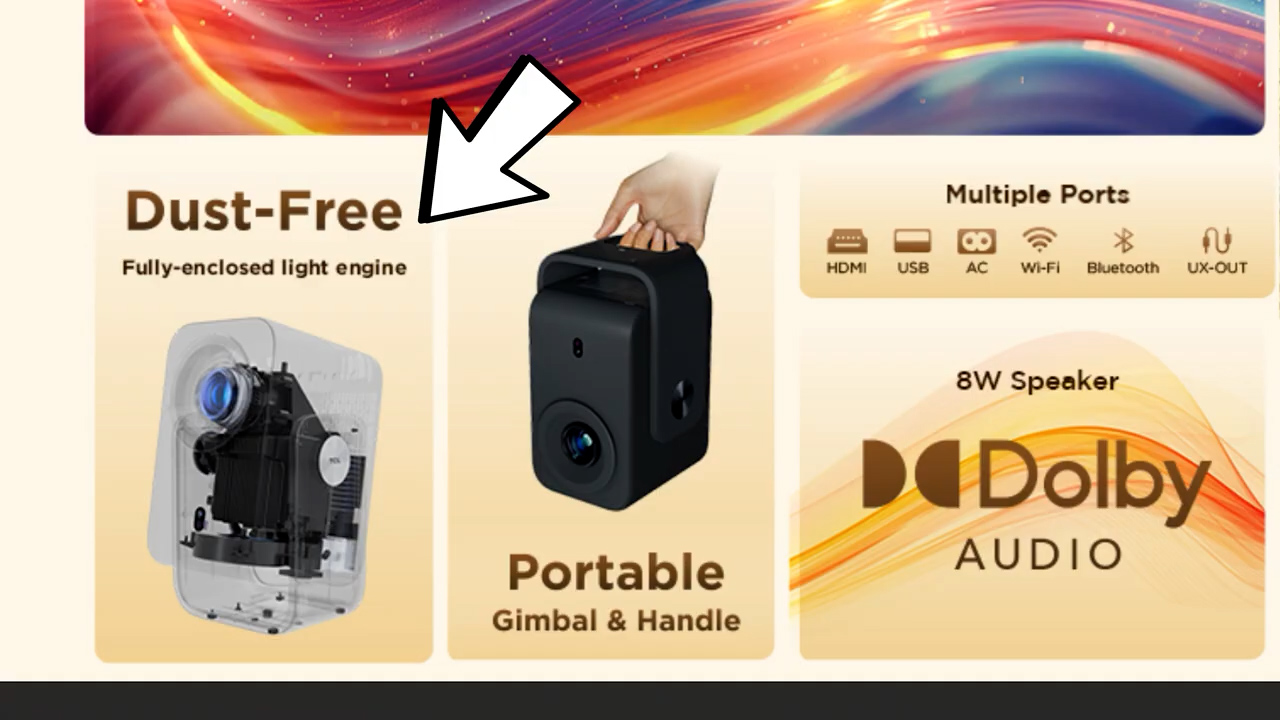
For the TCL, its low fan noise and lower brightness in comparison to its price is due to the fact that it is the only projector in this video that uses a fully sealed light engine, which should theoretically also prevent dust from getting onto the LCD screen where it will cause spots on the projected image. So, while other projectors have air filters, access ports to stick cotton swabs into the projector, and dust removal modes to dislodge any blobs on the screen, the TCL’s fully sealed light engine should just avoid them in the first place.
Throw Ratios
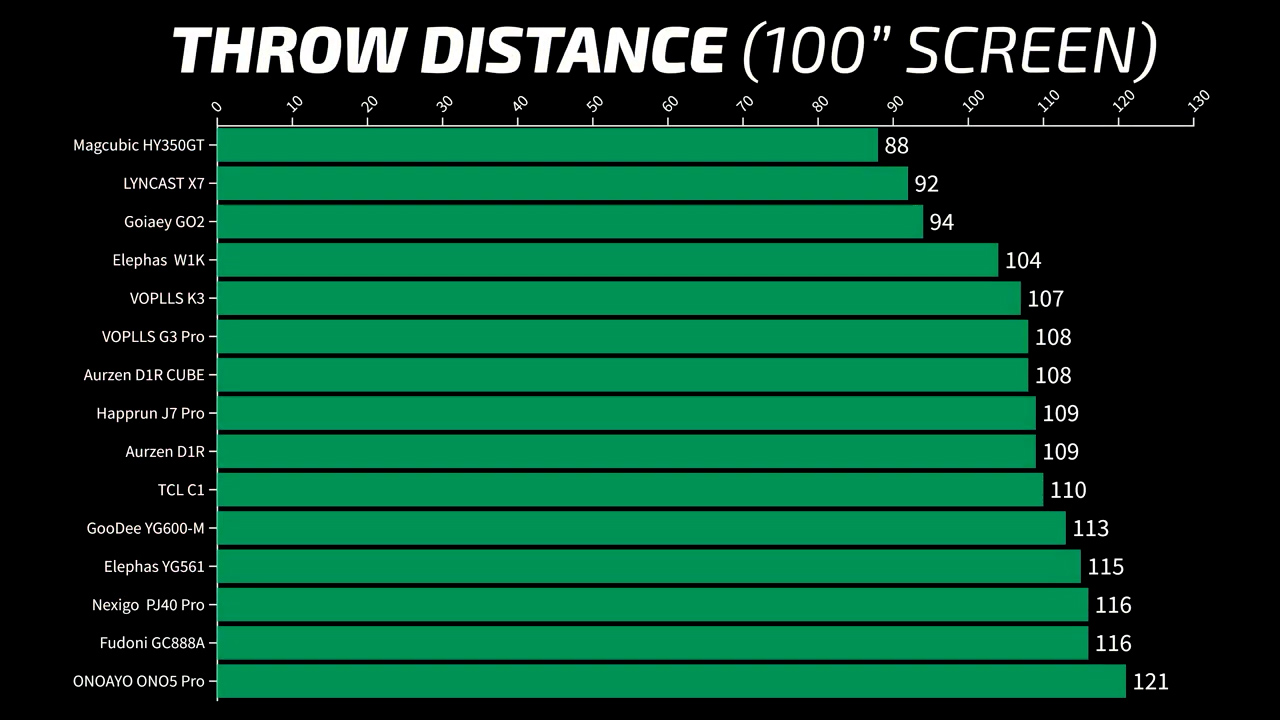
The last consideration before buying a single LCD projector is the throw, which describes the distance and positioning of the projector relative to the screen. You can see that the top five projectors all had very similar throw distances between 104 and 121” away from the screen to project a 100” screen. Here are the throw ratios, so if you know how wide of a screen you want to project, just multiply that number by the throw ratio and that will give you the distance you’ll need to place your projector away from the screen.
You should also consider that unlike DLP projectors that typically have 100% lens offset, meaning the bottom of the screen lines up with the bottom of the lens, all the projectors in this video have 0% offset, meaning the middle of the lens lines up with the middle of the screen, so these are best placed at bar height, slightly behind the viewing position.
If you can’t get the positioning exactly right, all of these projectors also include 4-point digital keystone, though you should always try to avoid using keystone if possible.
Conclusions
Now it’s conclusion time. As I mentioned at the beginning of the video, there’s not much to discuss here. The Nexigo PJ40 Pro is the clear winner in 2026 and other than a loud fan when used at its highest brightness level, the PJ40 Pro is an absolute budget masterpiece with top tier brightness, contrast, image processing, input lag, and a genuine Google TV smart OS and it’s my recommendation for anyone trying to build a home theater experience on a tight budget.
The Elephas W1K is also going to get an honorable mention for excellent brightness, contrast, and picture quality with substantially lower fan noise, but for those interested in the highest quality image I think the PJ40 Pro is still the better choice.

If you’re looking for a smaller, quieter, more portable option, I also like the TCL C1, but I would avoid it for video games and screens larger than 90 inches since it lacks the brightness to make a high-quality image on larger screen sizes. But I do really like the fully sealed light engine, and I look forward to hearing long term testing feedback from users about whether dust still found its way into the projector.
As always there are no sponsored reviews on this channel, but I do have links below to all of the projectors in this video, and as always, I appreciate when you use those links since as an Amazon affiliate I do earn a small commission on the sale at no cost to you.
I’d also like to thank all of my awesome patrons over at Patreon for their continued support of my channel, and if you’re interested in supporting my channel please check out the links below. If you enjoyed this video, please consider subscribing to my YouTube channel and as always, thanks for watching The Hook Up.