Best Ultra Short Throw Projectors 2026
September 26, 2026Today on The Hook Up, I’ve got nine brand new ultra-short throw projectors from XGIMI, AWOL, LG, Epson, Hisense and NexiGo. I’m going to test their brightness, contrast, and color accuracy, then I’ll put them head-to-head to test overall picture quality. After that, we’ll get into the more nerdy stuff like refresh rates, input lag, DLP Rainbow Effect and a lot more. As always, there are no sponsored reviews on this channel and all the data in this video is the result of my own measurements rather than relying on manufacturer claims and spec sheets.
XGIMI Mira Testing
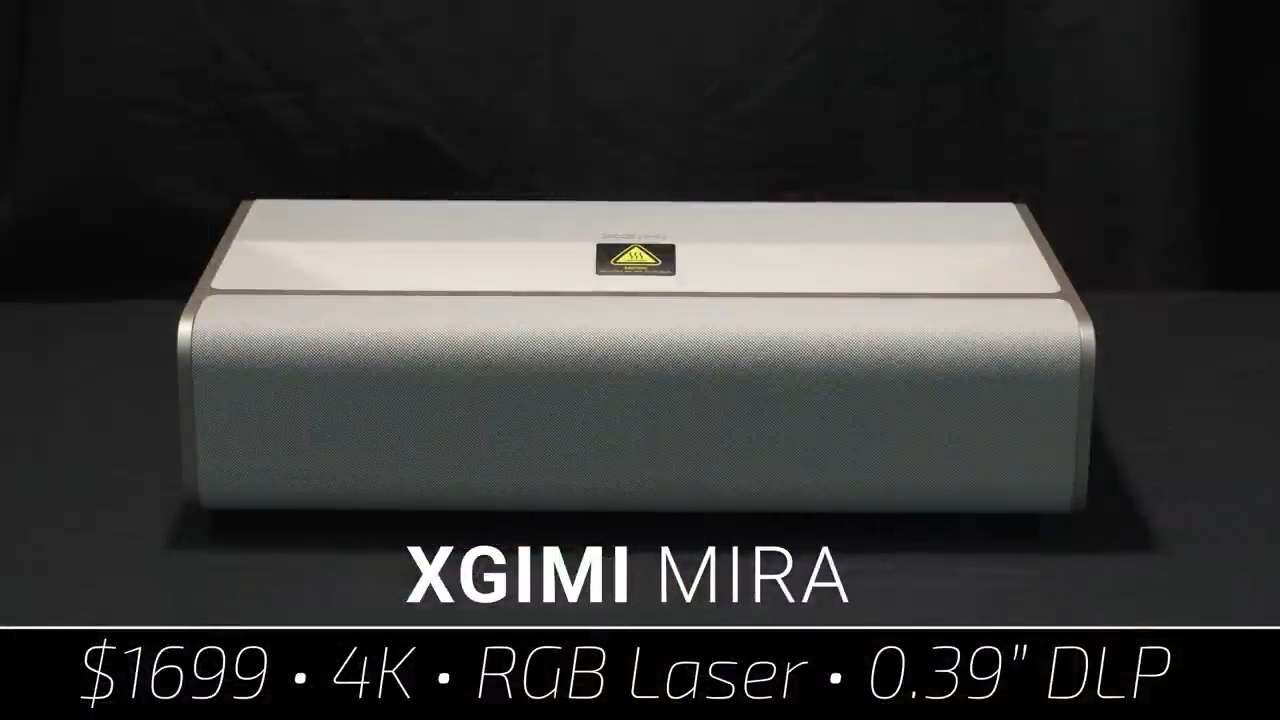
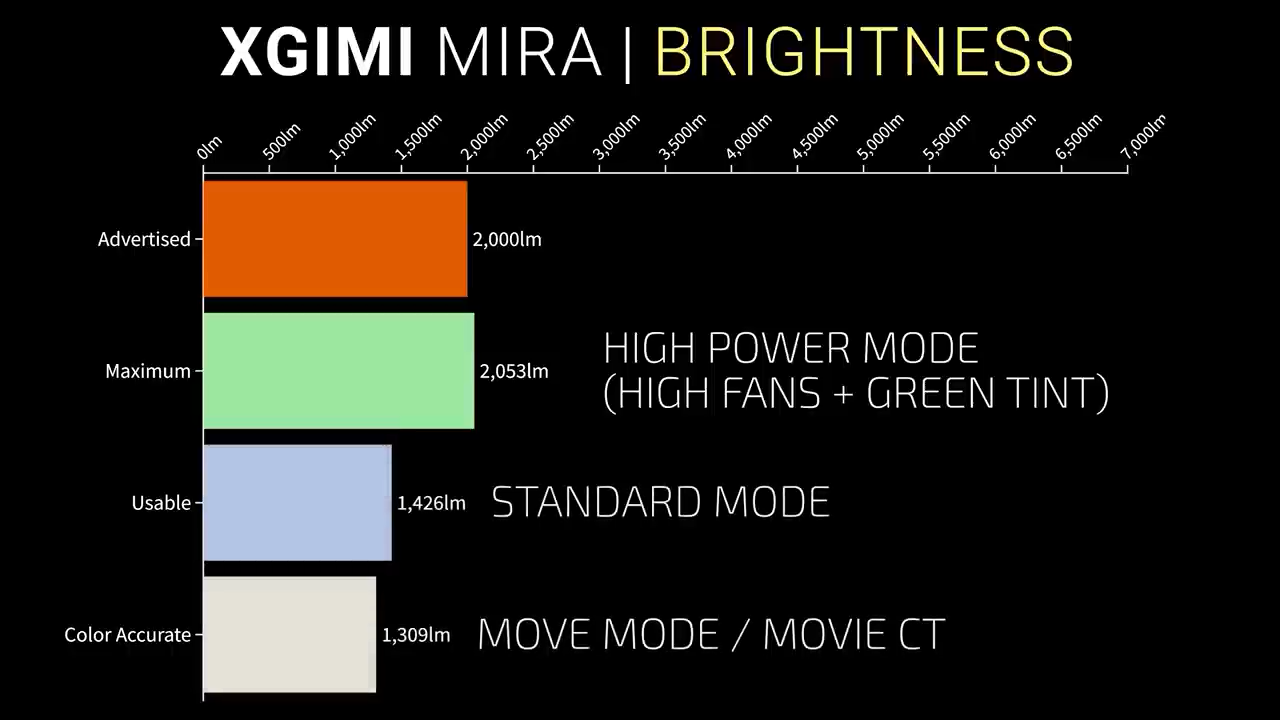
Starting with the least expensive projector in the video, the XGIMI Mira is a $1699 4K, triple laser, ultra-short throw based on the newest Texas Instruments 0.39” DLP package. XGIMI advertises the Mira at 2000 ISO lumens, and I was able to measure 2053 ISO lumens in High Power mode, which comes with extremely high fan noise and a green shifted image. The Mira has just over 1300 ISO lumens in Movie mode with movie color temperature, which is what I’ll be using for all my testing.
The Mira’s native contrast without any laser dimming is a respectable 1895:1 and turning on XGIMI’s Dynamic Black Level Enhancement results in a near infinite dynamic contrast ratio, which is fairly common these days, so we’ll just need to wait and see how it performs in actual content.
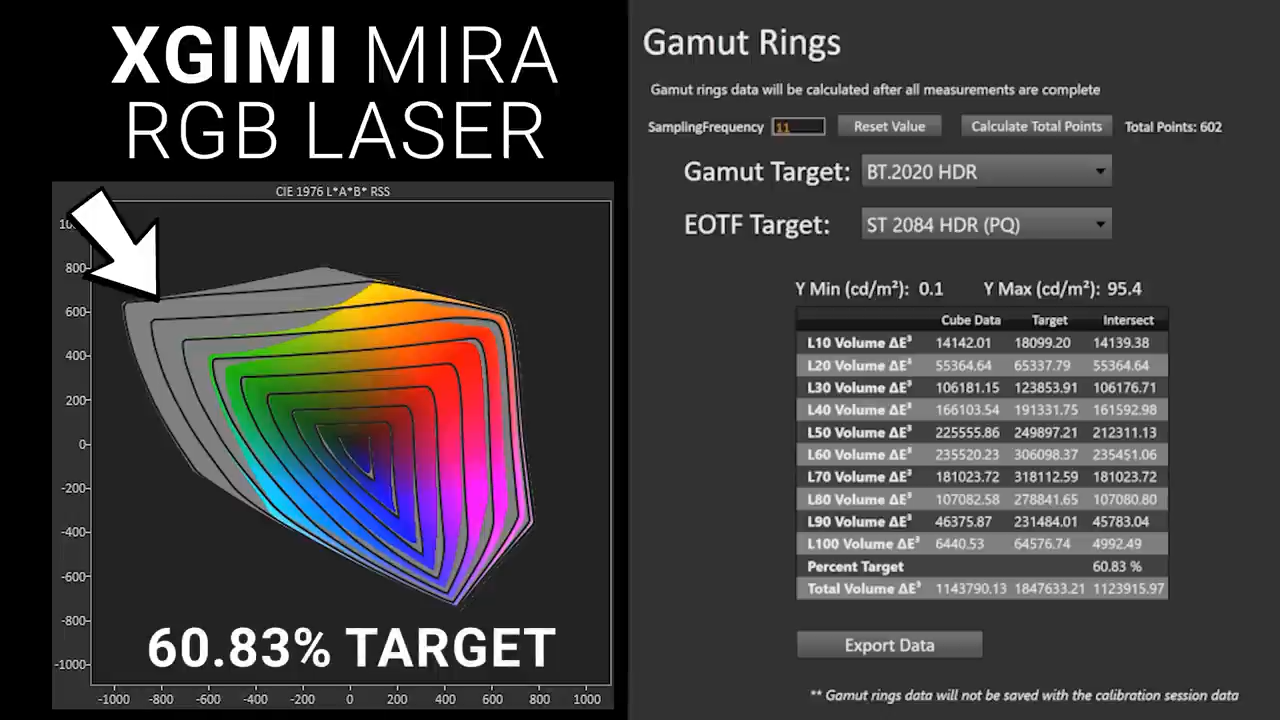
The Mira’s RGB laser light source covers 99.2% of the DCI-P3 HDR color space, and 84.5% of the larger BT.2020 color space, but the more rigorous gamut rings analysis reveals a large deficiency in the ability to cover the most saturated green colors in BT.2020, hitting just 60.83% of target colors.
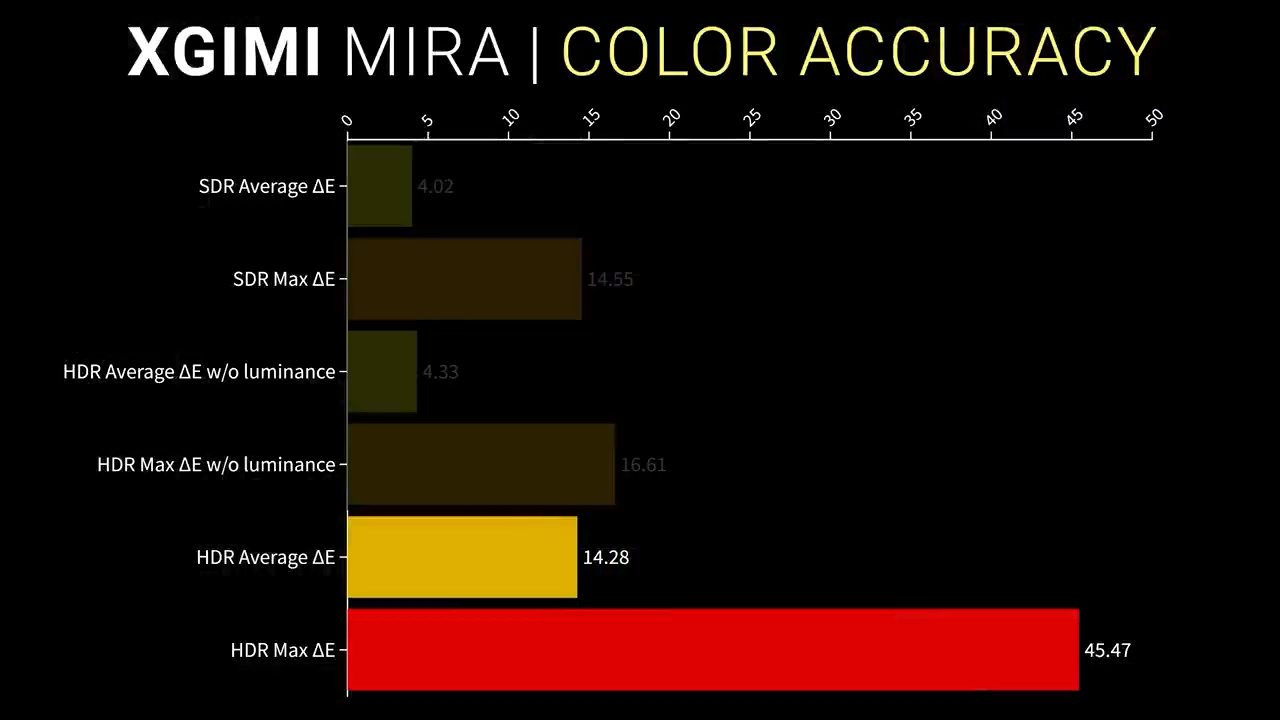
When looking at out-of-the-box color accuracy measured with Calman Ultimate, the Mira had a greater than average SDR color error of 4.02. It had a similar average HDR color error of 4.33 without luminance, but it made large sacrifices in luminance to remain accurate, and it had a massive 14.28 average HDR color error including luminance.
XGIMI AURA 3 Max Testing
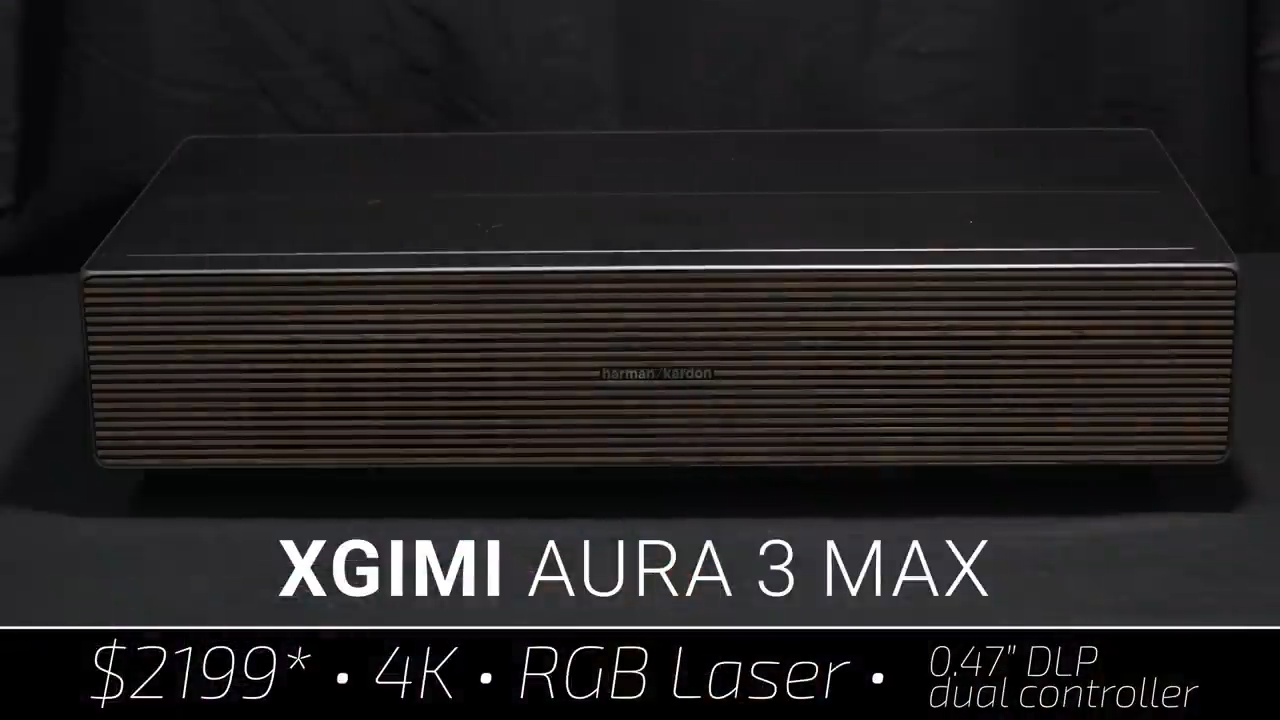
Through the magic of Kickstarter, the second least expensive projector in this video is XGIMI’s new flagship, the AURA 3 Max. As of this writing, you can put down a $50 deposit to lock in a Kickstarter price of $2199. After the early bird deposit period, the Kickstarter price will go up to $2399, and after the Kickstarter campaign, the Aura 3 Max will have an MSRP of $4999. So, it does feel a little strange to put it against the Mira in the very first round.
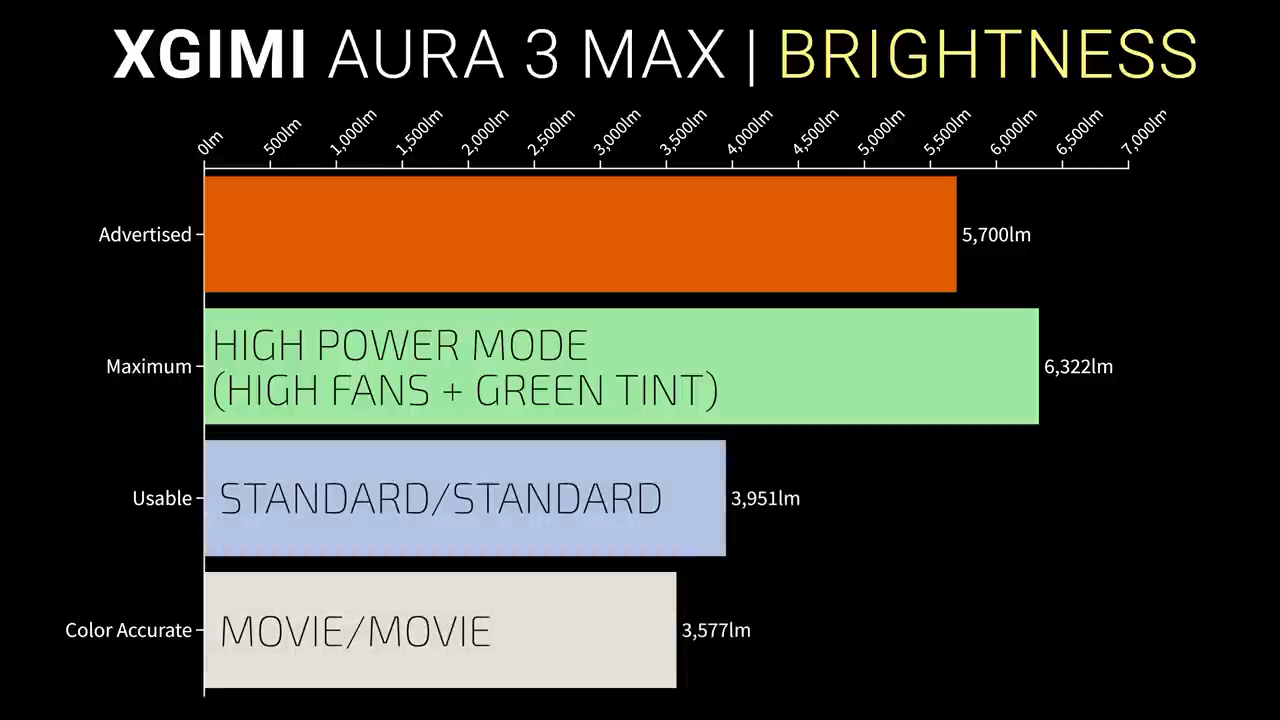
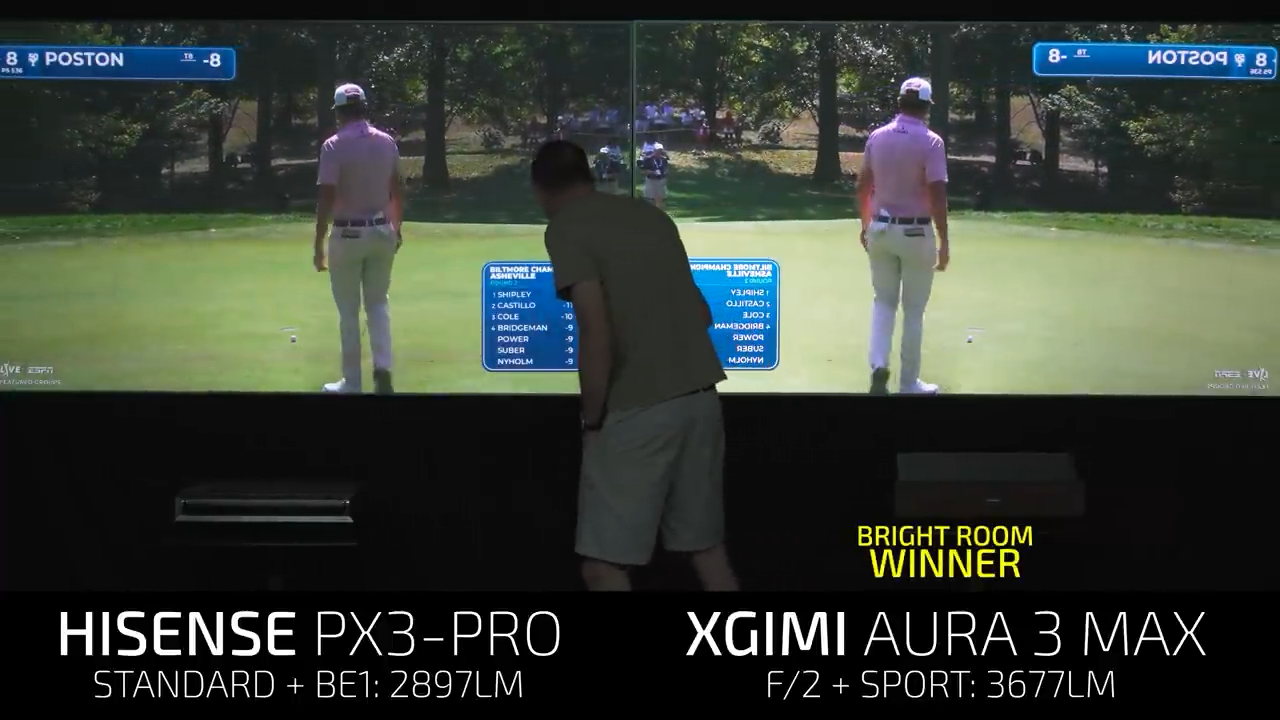
But it is what it is, and whatever price you end up paying for it, the Aura 3 Max is advertised to have 5700 lumens, but like the Mira, that’s only in High Power mode with jet engine fans and a heavily green shifted image. You can realistically get 3580 lumens out of the Aura 3 Max using movie color temperature and setting the iris to f/2, but my favorite setting is the dynamic iris which puts out around 2500 lumens.
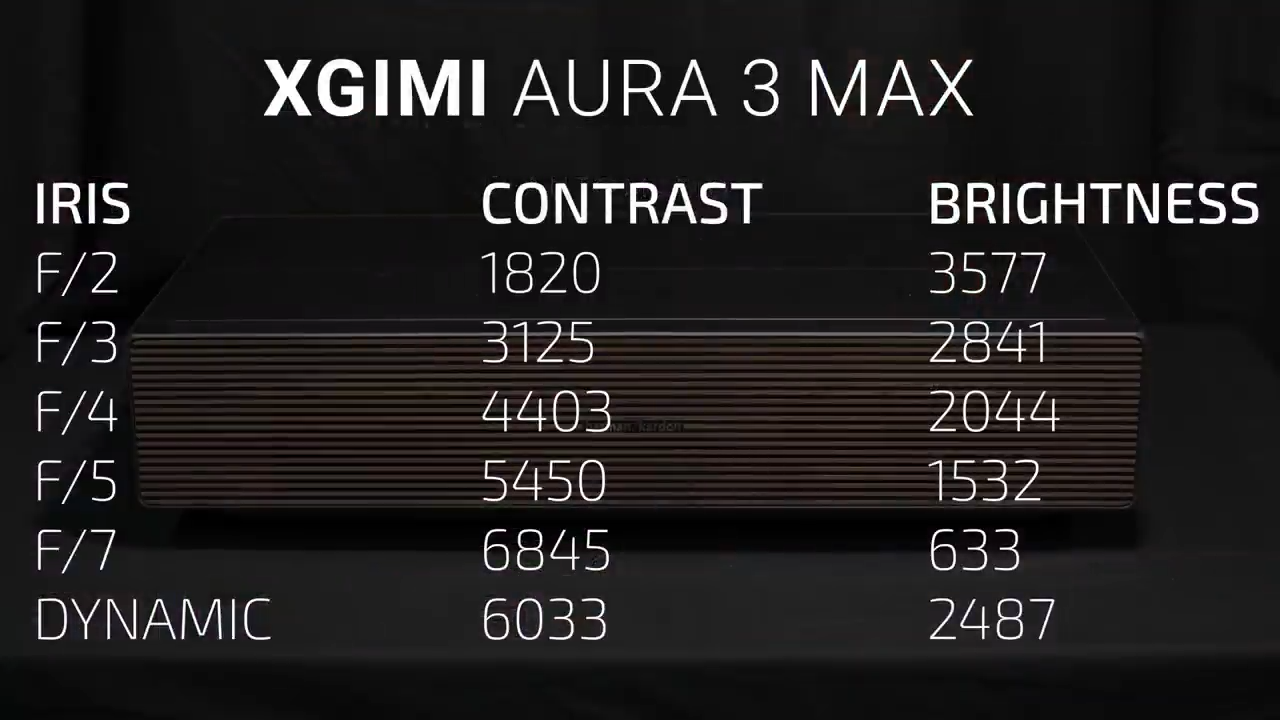
Looking at the Aura 3’s native contrast performance, the Brightest Iris mode, f/2, has a native contrast of 1820:1, which nearly matches the Mira. Closing down the iris results in a considerable increase in contrast at the expense of brightness and at f/5, the Aura is still brighter than the Mira but with 5450:1 native contrast. Dynamic mode, which I’ll be using for testing, keeps the iris between about F3.2 and F4.5, resulting in a dynamic contrast of 6033:1 using just the iris. Turning on DBLE laser dimming again makes the dynamic contrast too high to measure in test patterns.
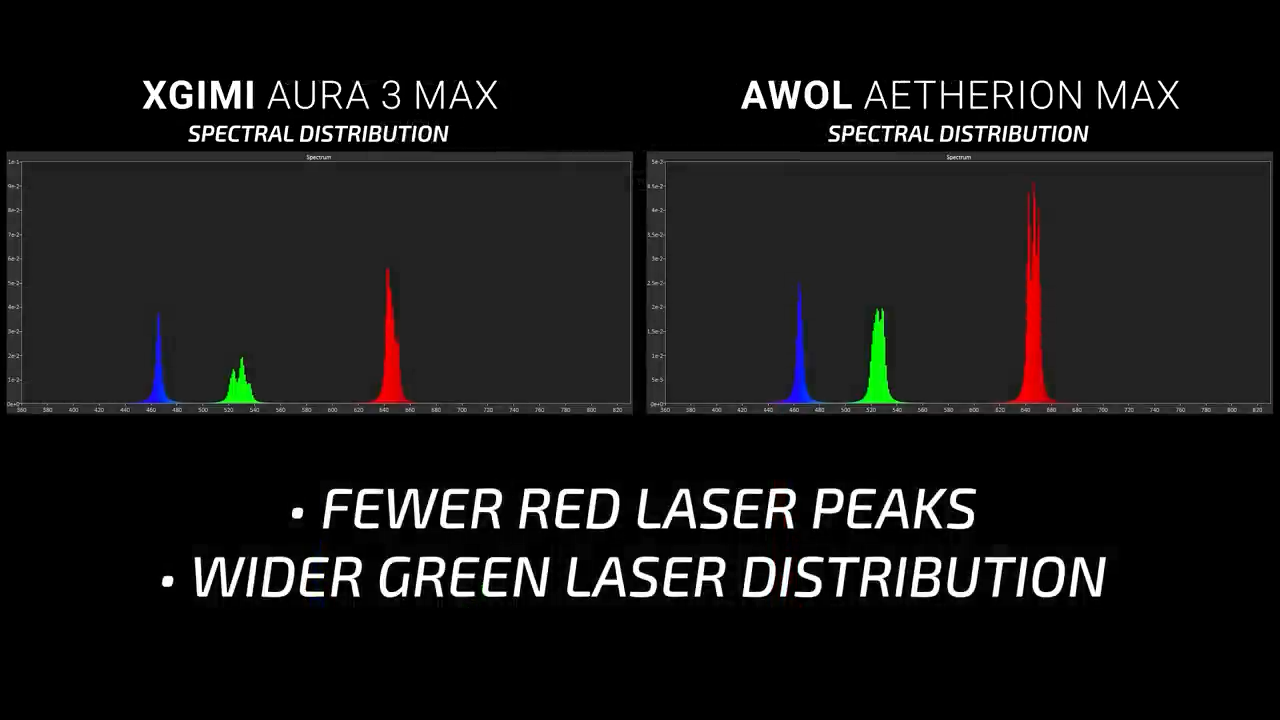
I apologize if this is too early in the video to get into the really nerdy stuff, but the most exciting part about the Aura 3 to me is this spectral distribution. XGIMI has either switched laser diodes completely or is using extra filtering to make more cohesive primaries. For me, the change results in much less metamerism, meaning I see the same colors as everyone else despite a slight deficiency in my red color vision. It also means the Aura 3 Max has slightly less laser speckle than other RGB laser projectors, which I previously didn’t think was possible. And they managed to do it without sacrificing color performance.
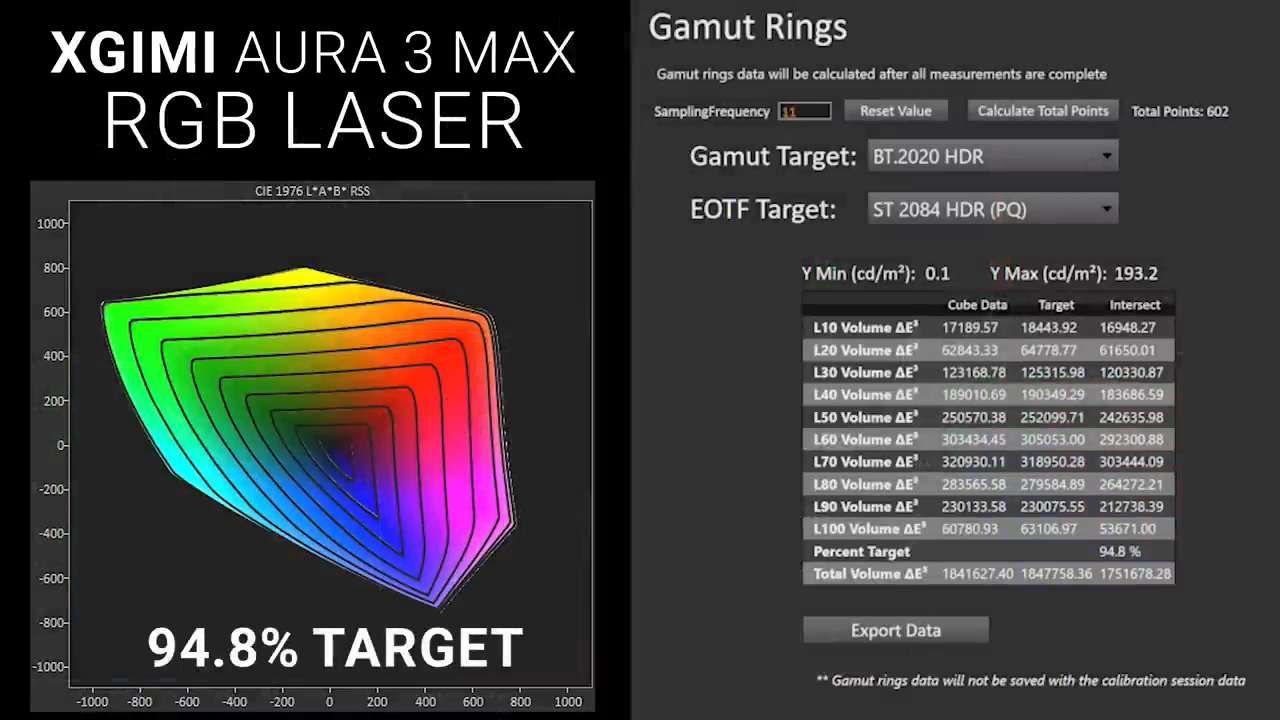
The Aura 3 covers 99.3% of the DCI-P3 HDR color space and 98% of BT.2020. Looking at the gamut ring, the only missing colors are in the darkest blues. The Aura 3 hit 94.8% of its BT.2020 target colors compared to just 60.83% on the Mira, and that’s actually the highest gamut ring coverage that I’ve ever measured.
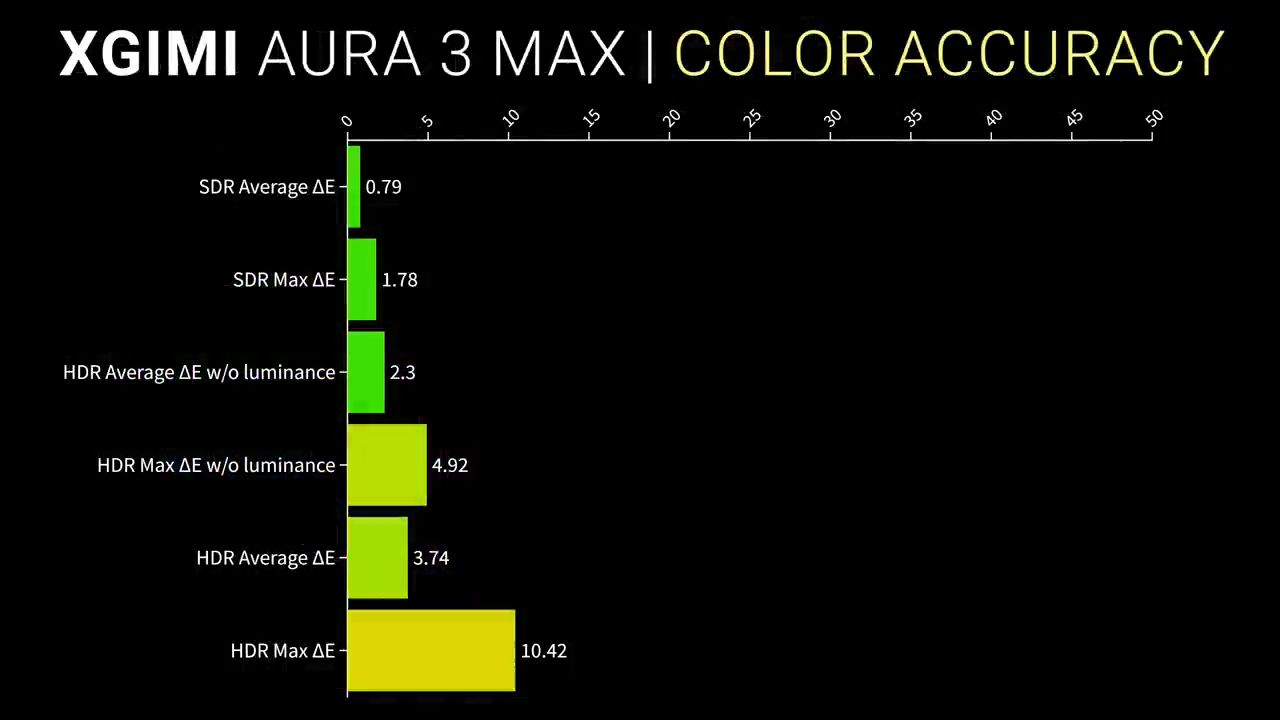
As you could expect, that translates directly into color accuracy, where the Aura 3 had an average SDR color error of 0.79, with a max error of 1.78, which is still well below where the human eye could detect a difference in colors without an immediate side-by-side reference. In HDR without luminance error, the Aura 3 was also very accurate with an average color error of 2.3. But the most impressive part was that even with luminance, the Aura 3’s average HDR color error was just 3.74, and the maximum HDR error was just 10.42, considerably lower than even the Mira’s average color error.
Side-by-Side Round 1
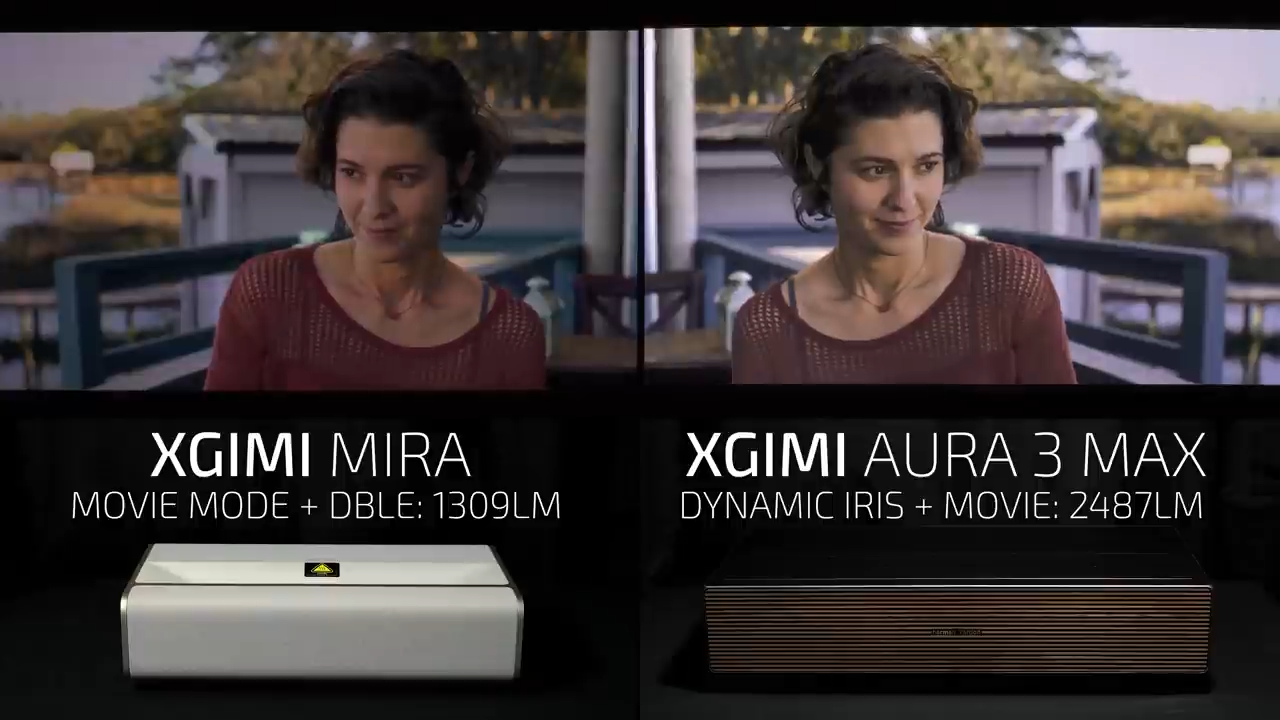
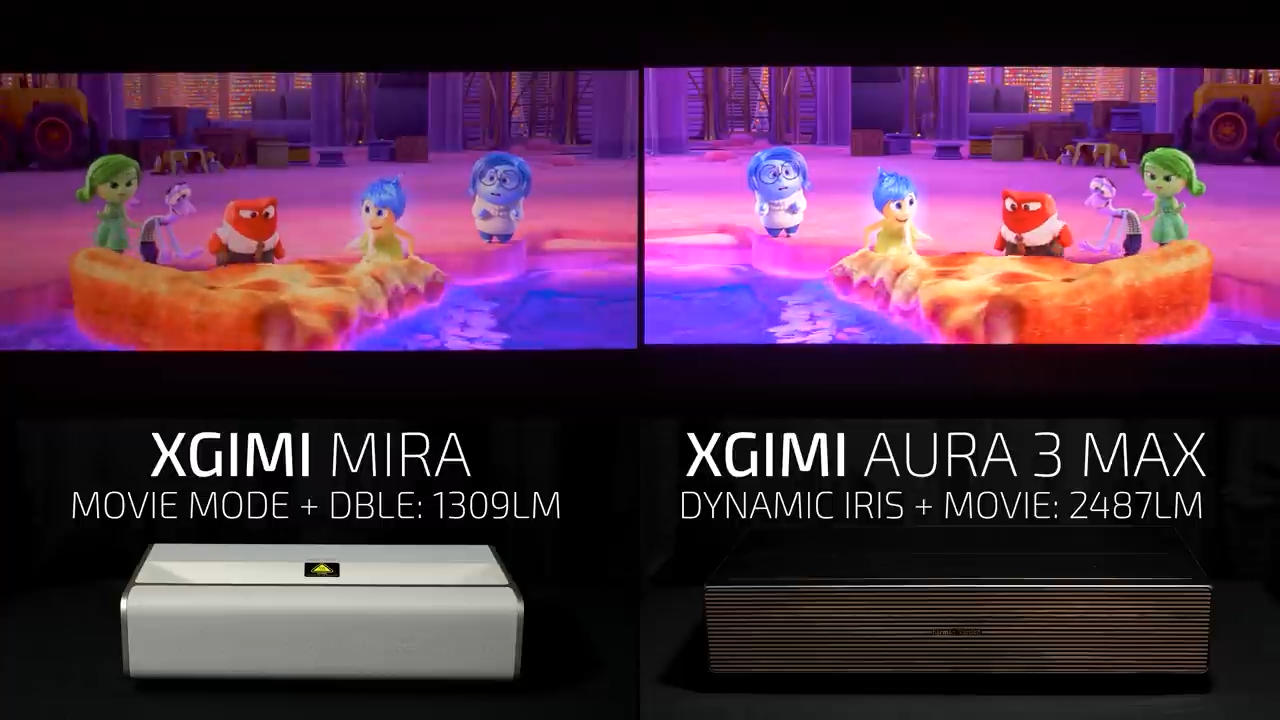
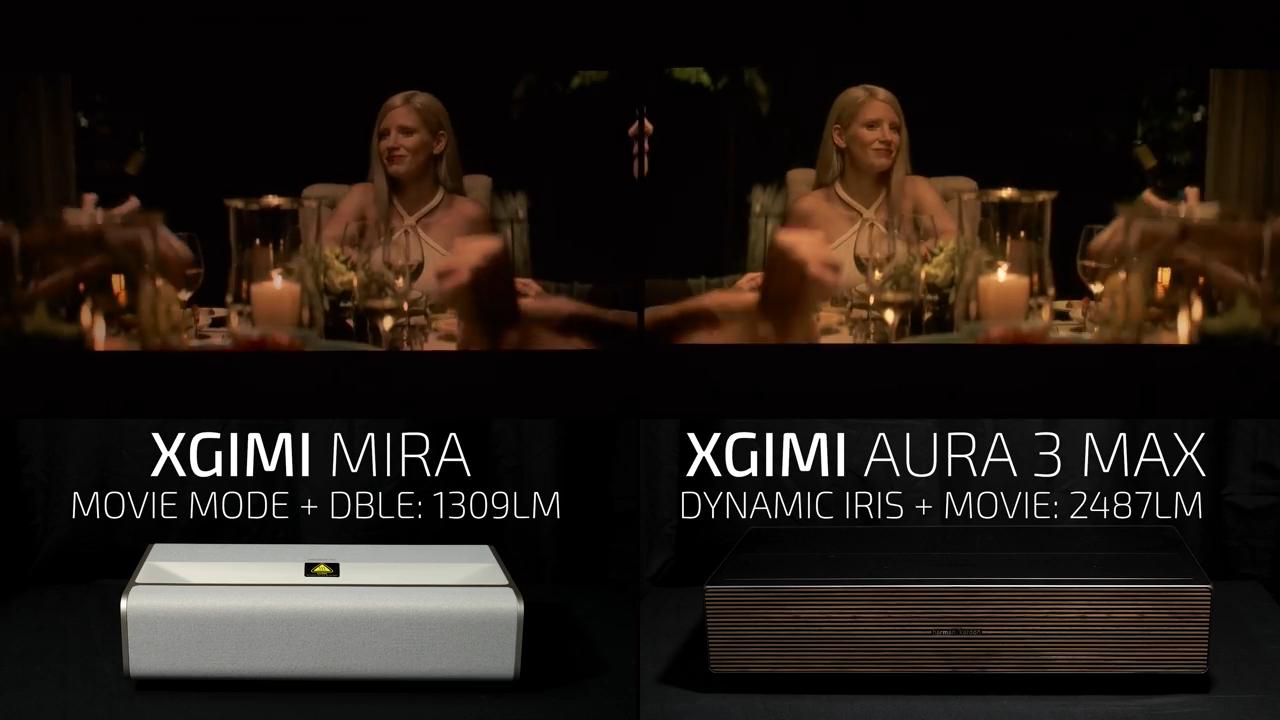
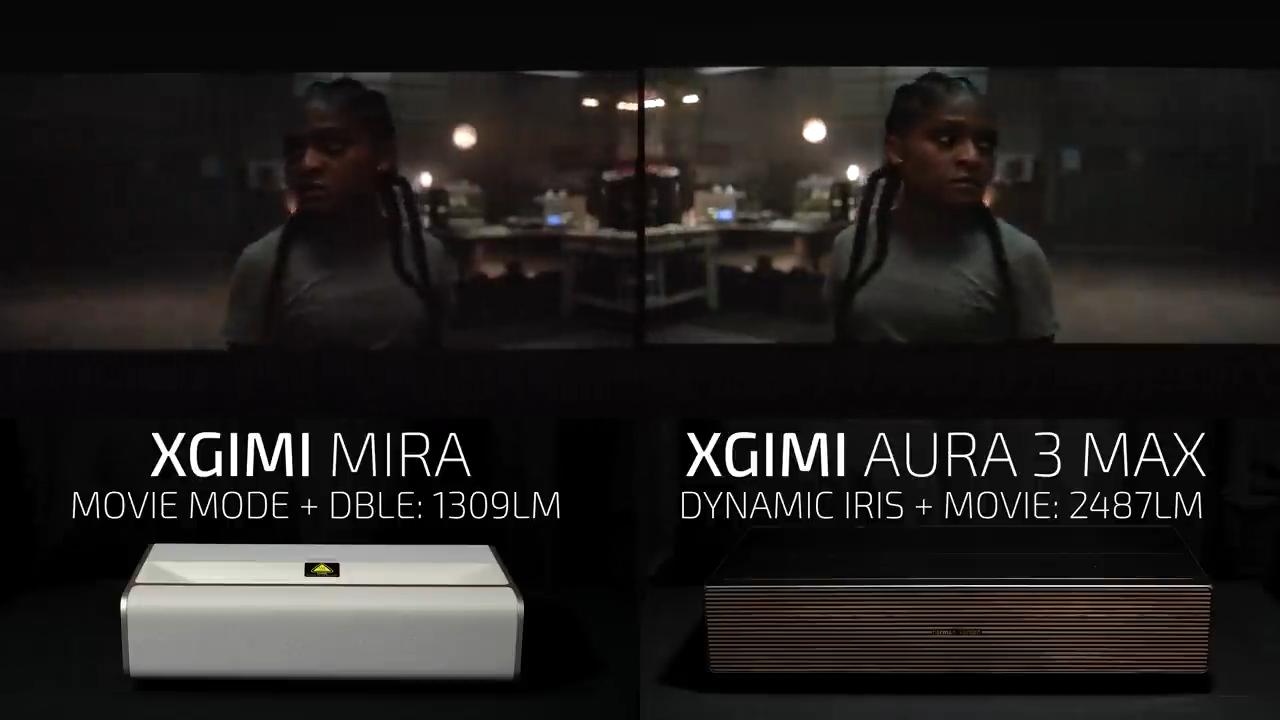
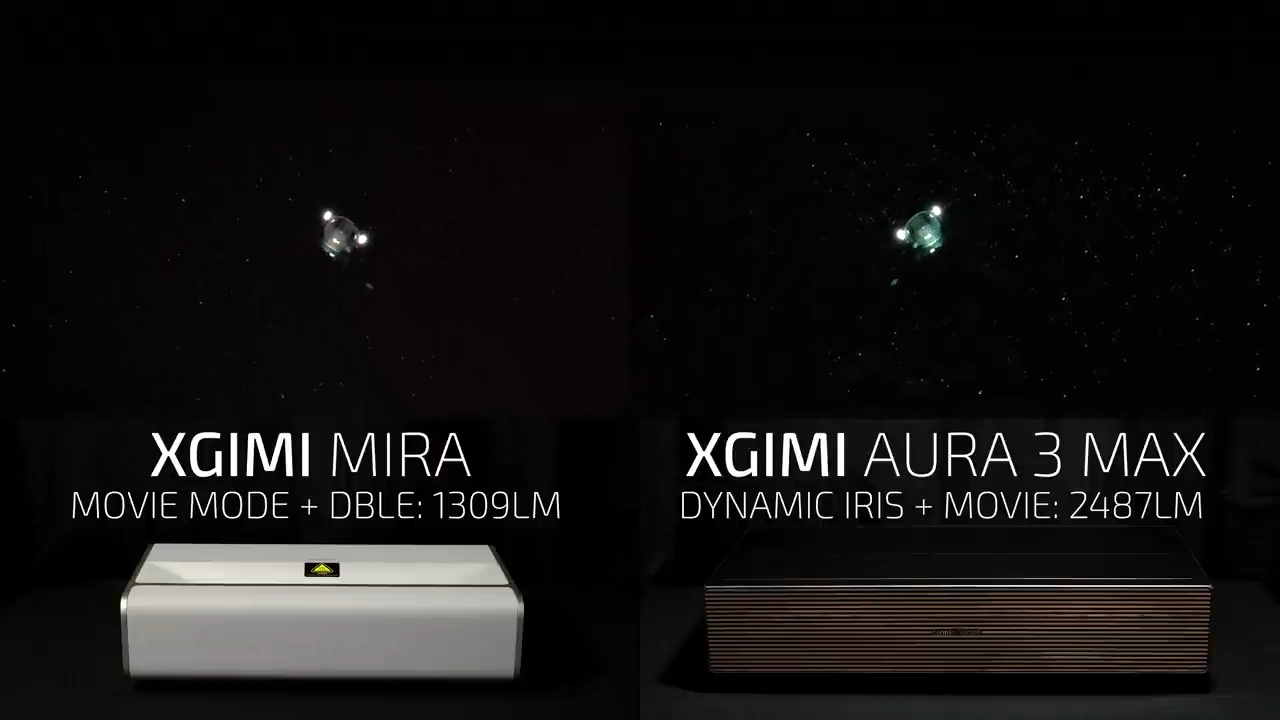
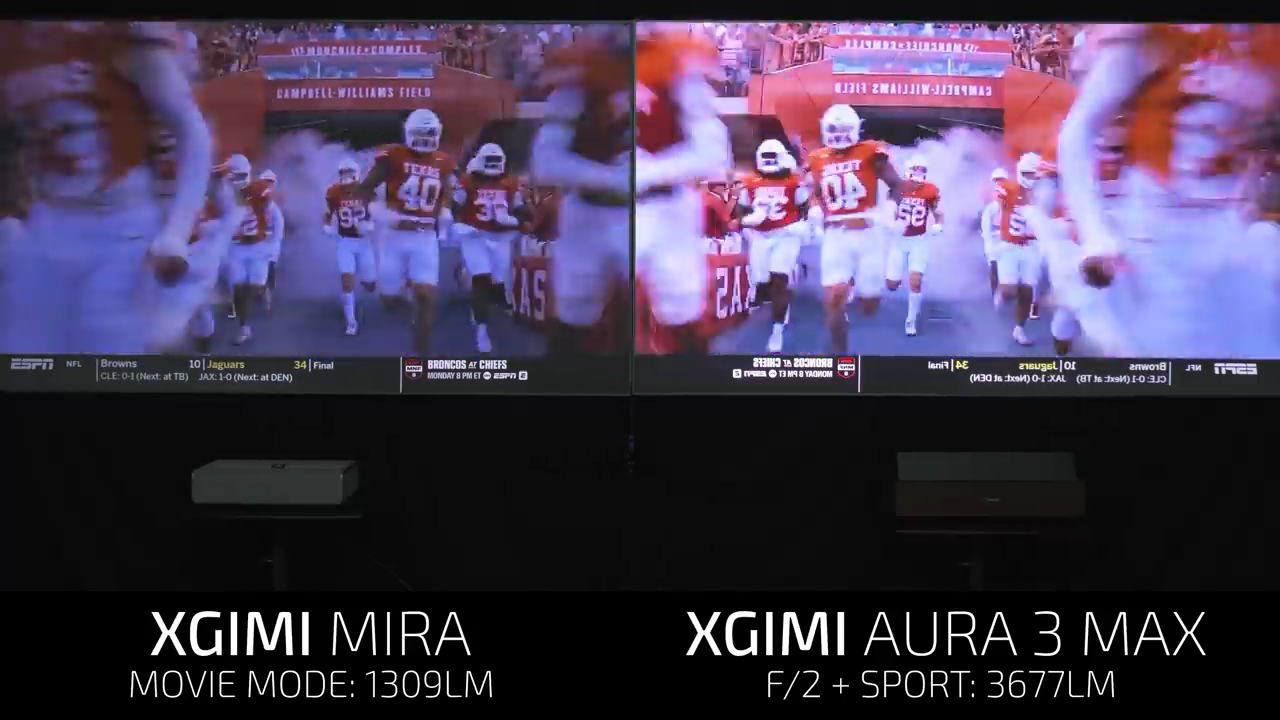
Moving on from test patterns, I put up two 100” Fresnel screens in my completely light controlled garage and for Round 1 the XGIMI Mira is on the left and the Aura 3 Max is on the right. I know people have said in the past that mirroring one of the projectors is distracting, but it’s necessary since these are Fresnel screens and the camera isn’t in the center of either screen, so the part of the screen closest to the middle is going to be brighter on camera than the outside edge.
I also had to make a filming compromise because the Aura 3’s new dual controller 120Hz refresh rate isn’t locked at exactly 60Hz like every other DLP projector. So I had to film at 61Hz to avoid extremely distracting flashing on the Aura 3, which results in slight banding on the rest of the projectors, but keep in mind that none of the projectors actually had banding in person.
As you can probably see, the Mira just didn’t stand a chance here. Even with the Aura 3 on Dynamic mode, the highlights were much brighter, the shadows were usually much blacker, and the colors were more saturated, accurate and vibrant. Putting the Aura 3 on iris f/5 to more closely match the brightness of the Mira there was just no contest, and unsurprisingly, XGIMI’s flagship UST is in a completely different league than their entry level UST for dark room viewing.
Turning on 200 watts of overhead LED lighting and putting each projector into their brightest usable modes, the Aura 3 is roughly three times brighter than the Mira resulting in brighter more saturated colors and better perceived contrast, making the Aura 3 max the winner in Round 1 for daytime viewing as well.
Hisense PX3-Pro Testing
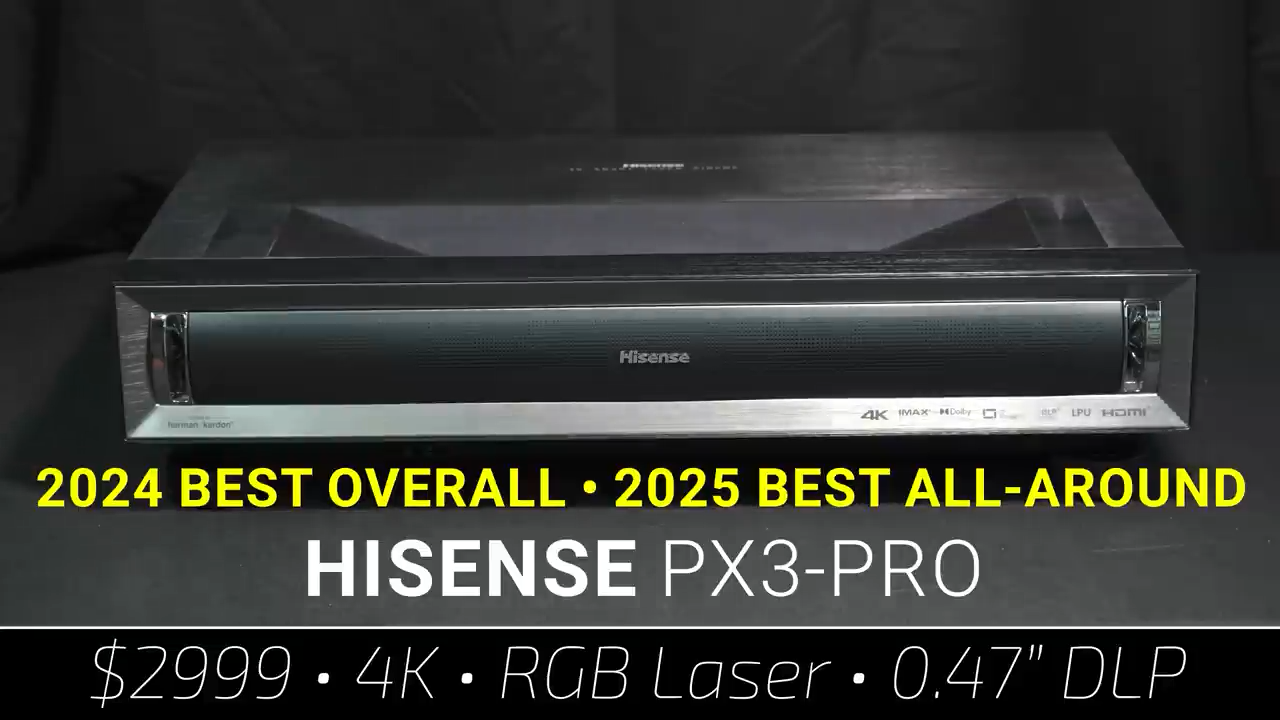
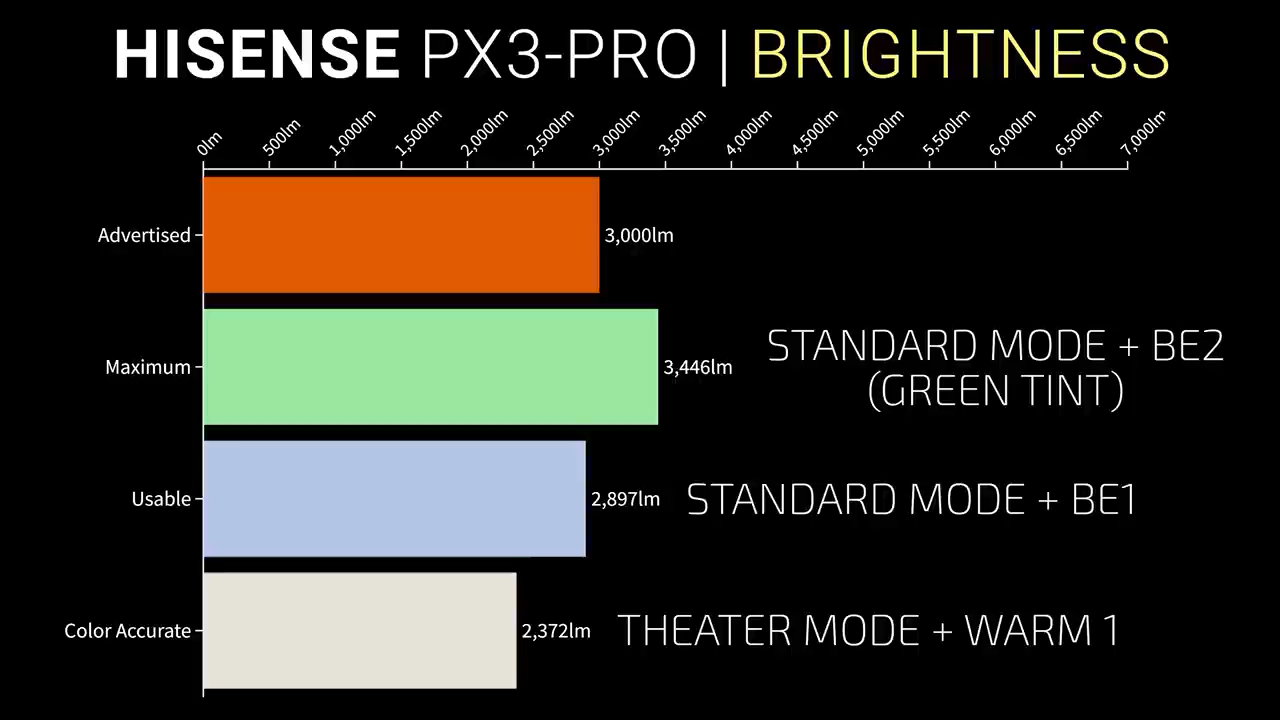
So in Round 2, the XGIMI Aura 3 Max will go up against the $2999 Hisense PX3-Pro which I’ve chosen as the best “all-around” UST projector for the last two years. Hisense advertises the PX3-Pro as having 3000 lumens, and on Standard mode with the brightness enhancer on high, the PX3-Pro hits 3446 lumens but in Theater mode, which is what I’ll be using for my testing, it has 2372 lumens.
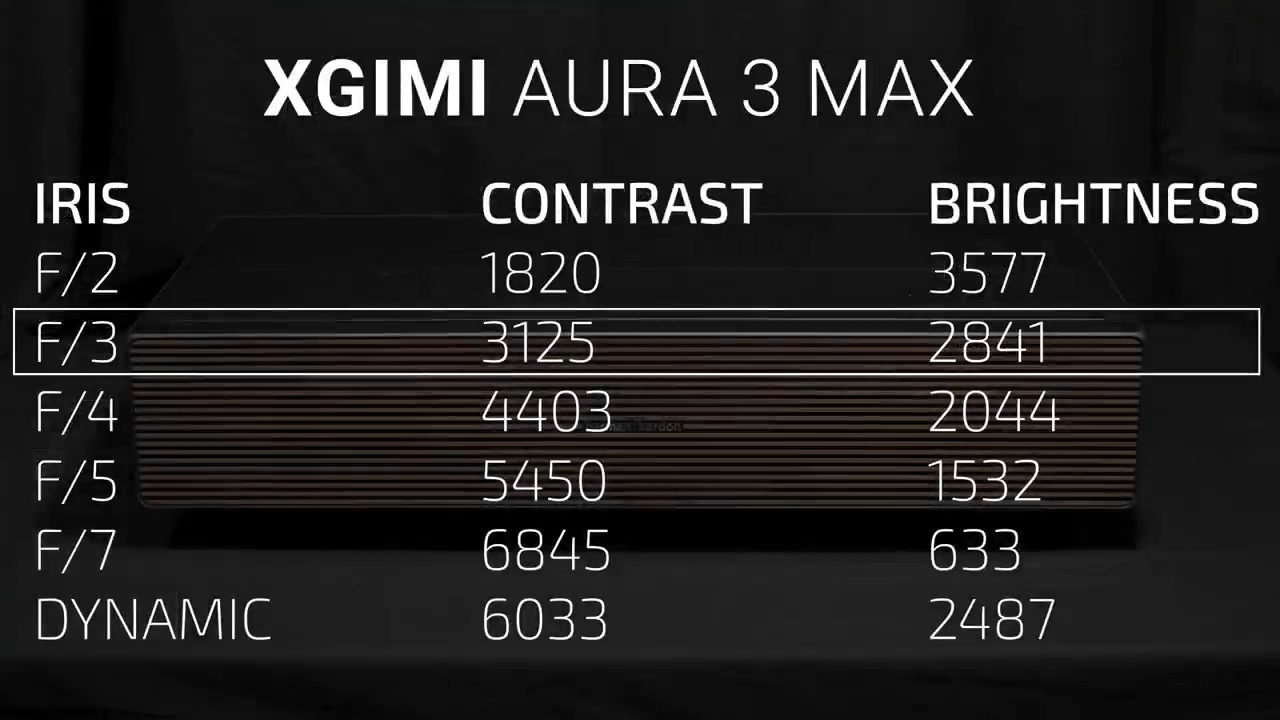
Looking at native contrast, the PX3-Pro doesn’t have an adjustable iris and the native contrast on Movie mode is 2809:1, which is about the same as the Aura 3 set to f/3. Turning on Hisense’s dynamic laser dimming resulted in a dynamic contrast of 10310:1.
The spectral distribution of the PX3-Pro is fairly standard for a triple laser projector with three large spikes in the red primary. Looking at color performance, the PX3-Pro covered 97.8% of DCI-P3 HDR, and 94.8% of BT.2020, but the gamut ring shows significant deficiencies in both high luminance green and high luminance red hitting just 68.1% of the BT.2020 target.
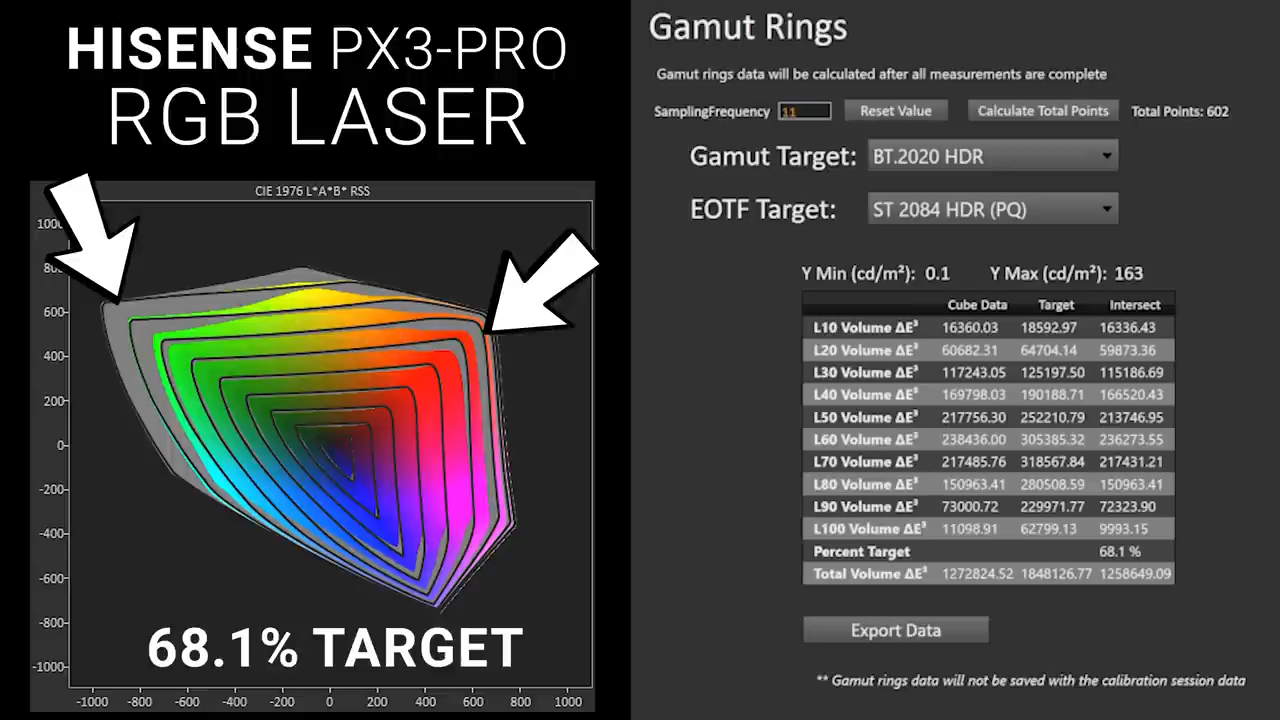
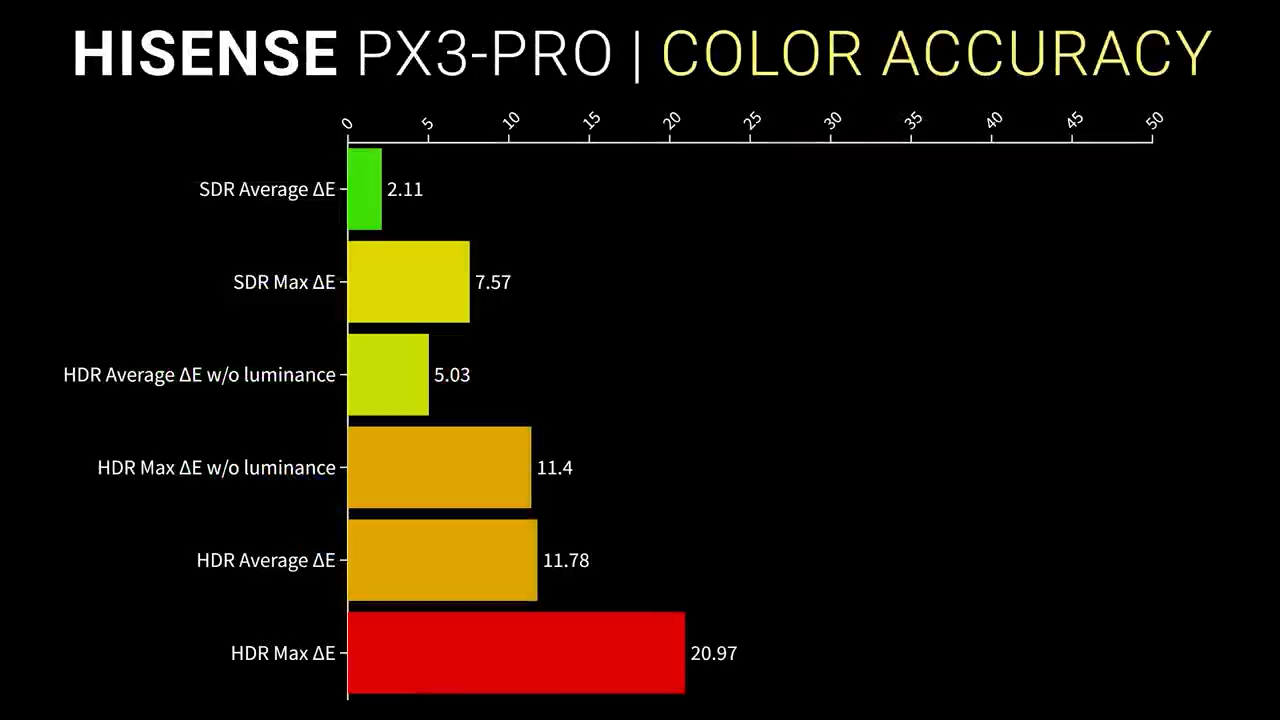
That again translates into color accuracy where the PX3-Pro was relatively accurate in SDR content and did alright in HDR without luminance, but adding in luminance raised the average color error to 11.78 with a max of 20.97. So we can expect HDR greens and oranges to be a bit muted on the PX3-Pro compared to the XGIMI Aura 3 Max.
Side-by-Side Round 2
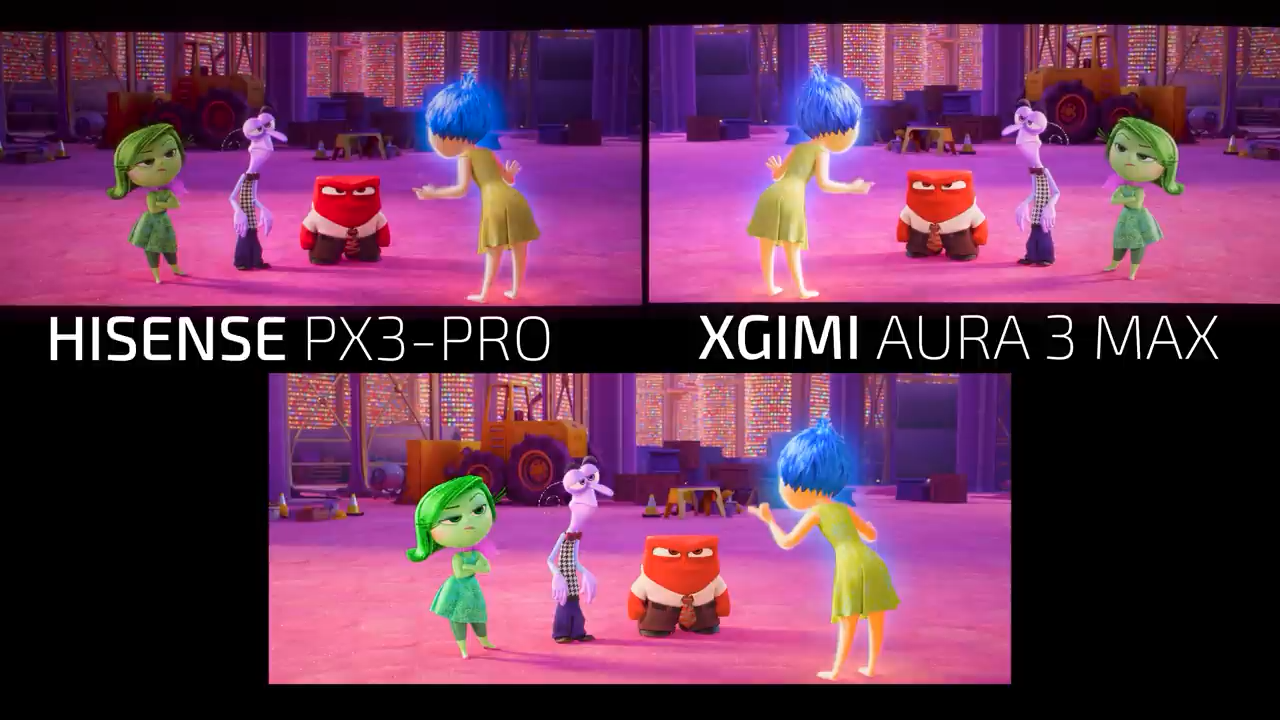
Starting with bright SDR content, the biggest difference is sheer brightness where the Aura 3 dominates with roughly 1000 more lumens than the PX3-Pro. In bright HDR content, the extra brightness of the Aura 3 not only helps the colors pop, but you can also see the HDR color error in action. If we stop on one frame and pull up the source footage, you can see that Anger is supposed to be a much lighter red than the PX3 shows but based on its gamut ring, it’s not actually able to show that color. So it maps it to a lower luminance version of the same hue and saturation.
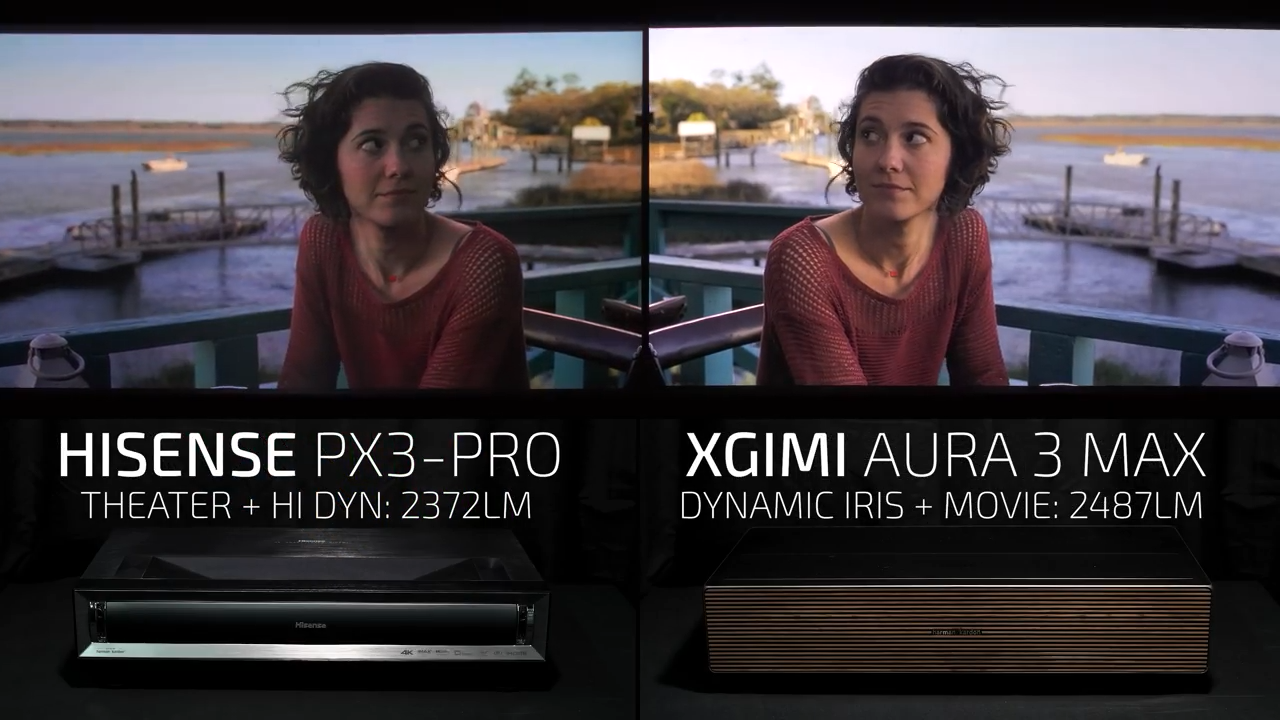
But I think the most dramatic example of luminance error happens with fire. You can see how much orange is missing from the Balrog’s flame whip, and you might be tempted to say that the Aura 3 is just blowing out highlights for a brighter effect, but you can see that if I reduce the exposure, all the detail is still there but the dynamic range is just insanely high compared to the PX3-Pro.
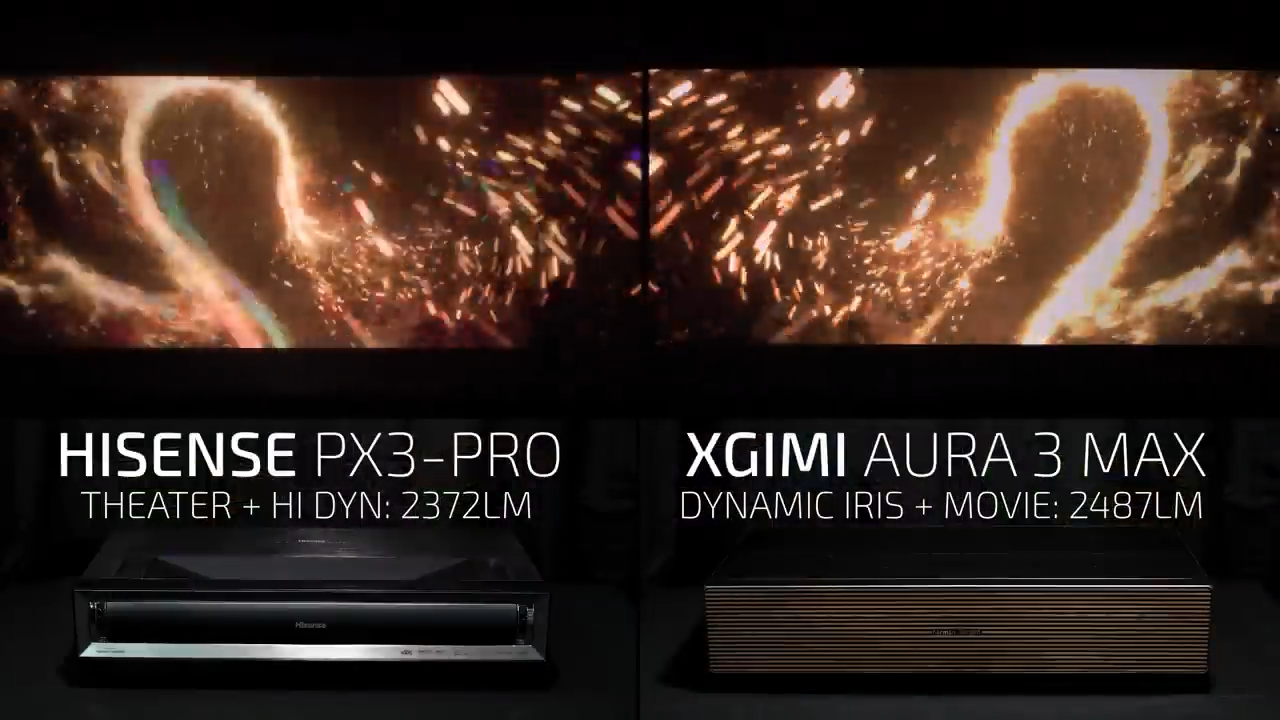
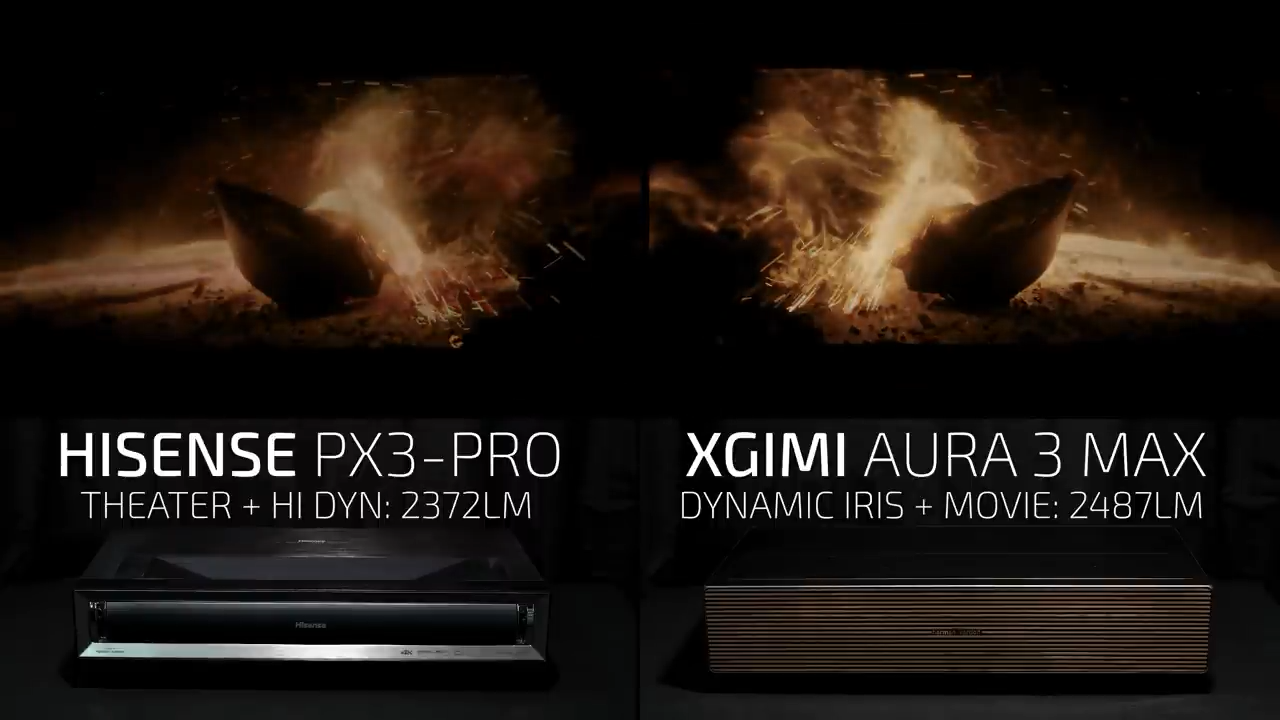
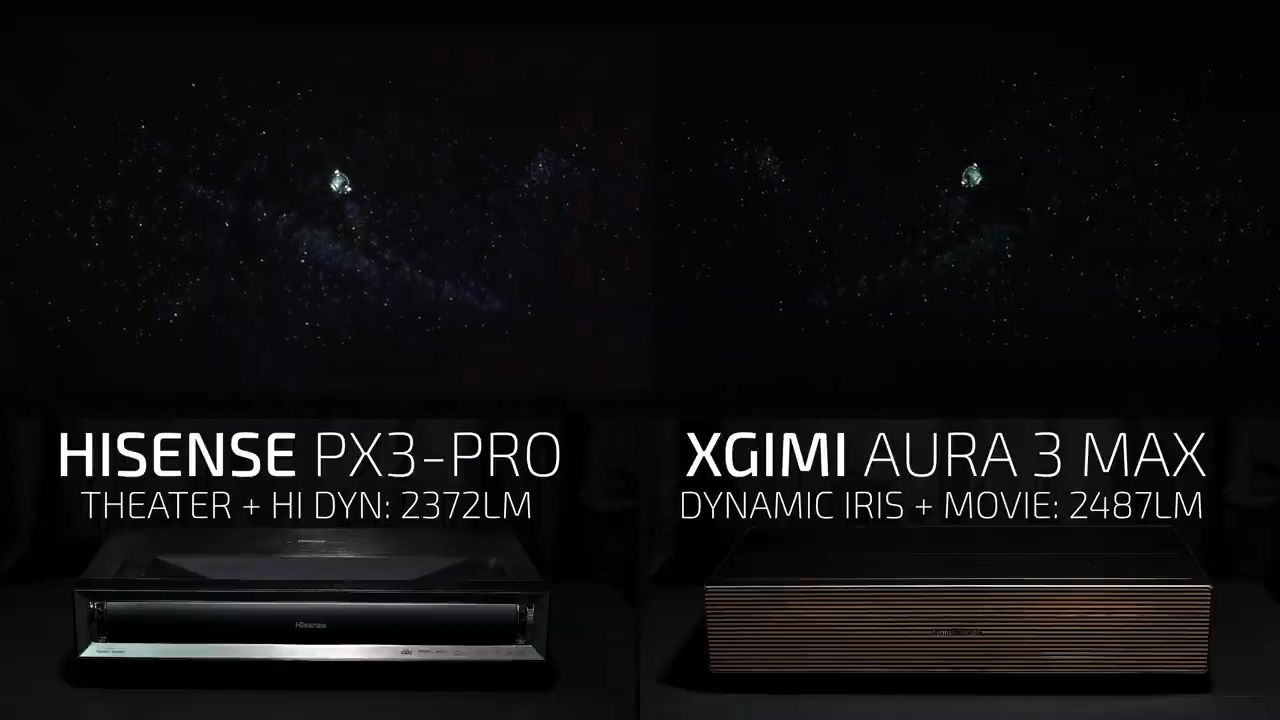
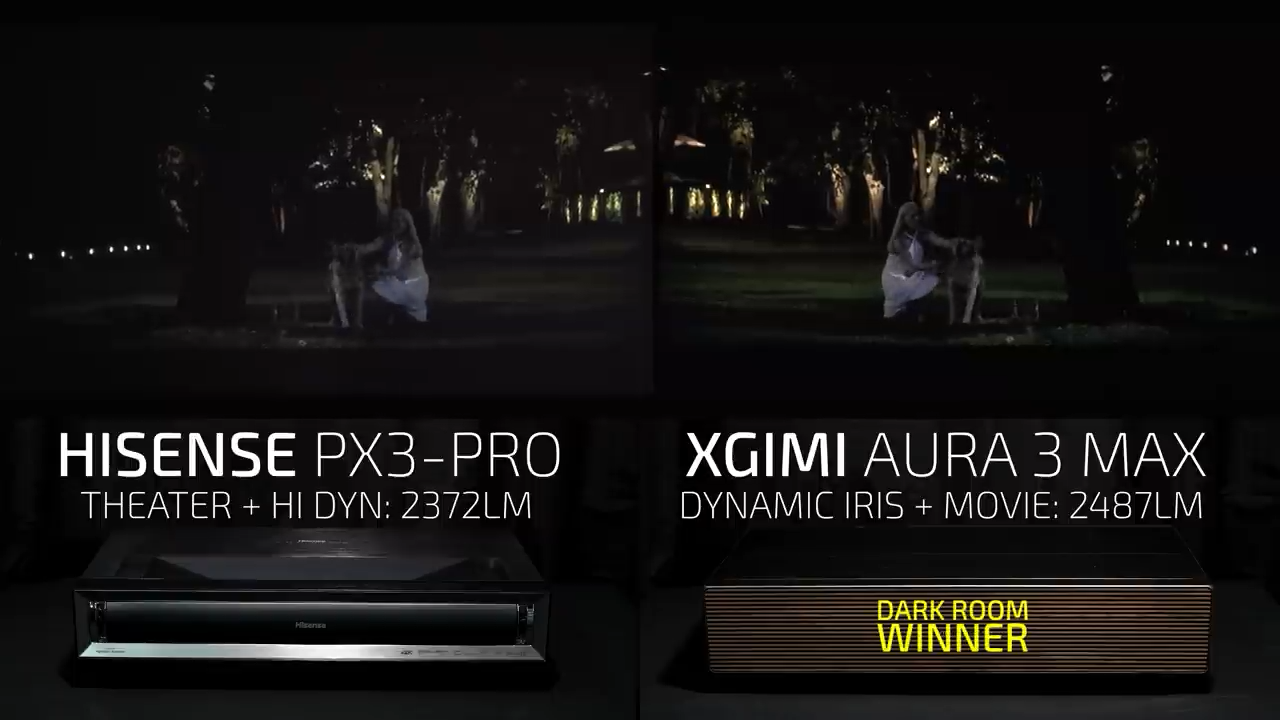
However, the biggest difference comes in the darkest scenes where the dynamic iris and DBLE on the XGIMI make the PX3-Pro look like a gray muddy mess in comparison, which is really saying something since it has been an absolute standout performer for the last two years. But there’s no question that the Aura 3 is the superior dark room projector in Round 2.
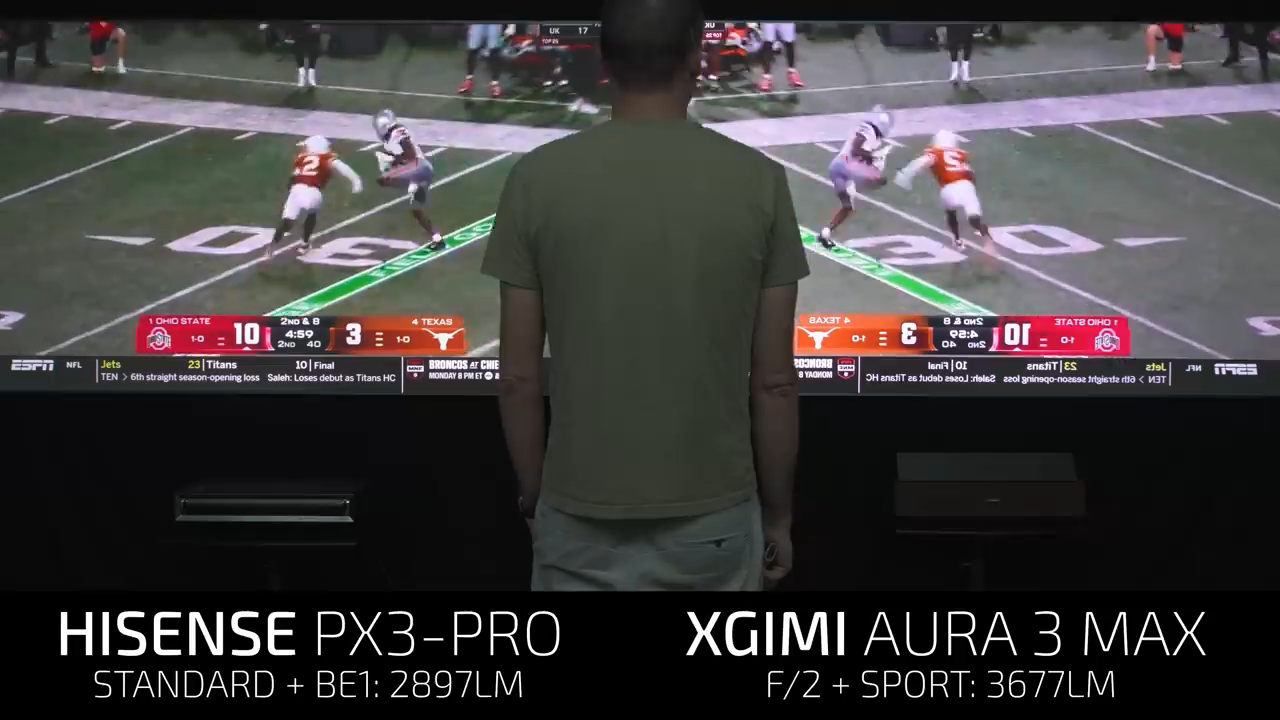
Flipping on the lights, changing image modes, and setting the brightness enhancer to low on the PX3-Pro, the brightness difference isn’t too significant, but the color error keeps rearing its ugly head. The PX3-Pro substitutes in lower luminance saturated colors when it can’t hit its target, resulting in a darker, less accurate image, and the Aura 3 Max is going to get the win for bright room performance in Round 2 also.
NexiGo Aurora Pro MKII Testing
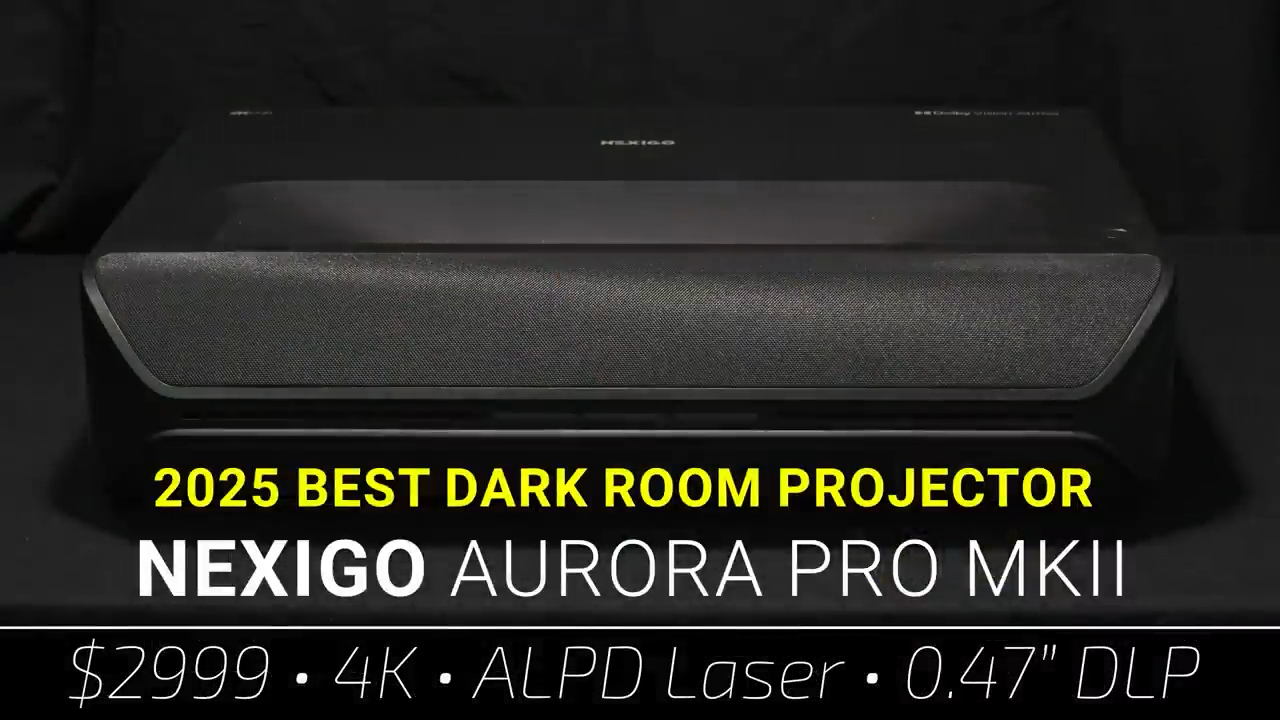
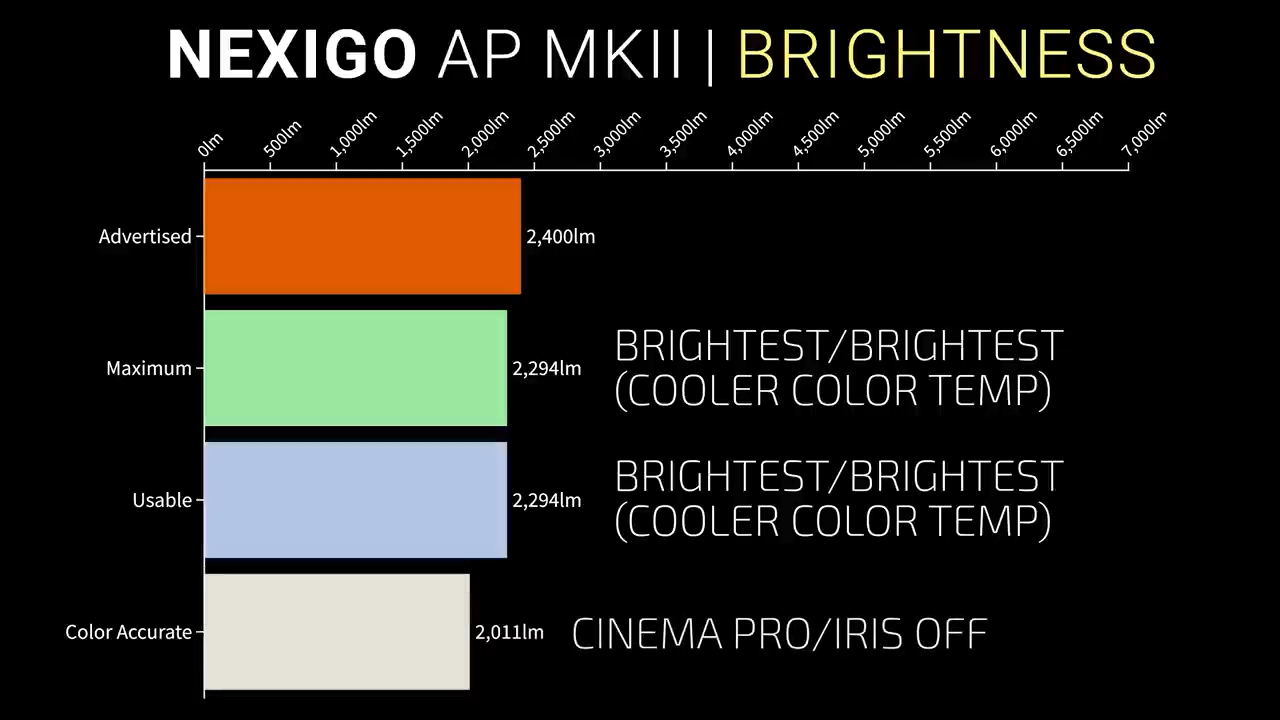
Round 3 brings in the dark room winner from last year and the projector that I’ve personally been using, the $2999 NexiGo Aurora Pro MKII. NexiGo doesn’t really use brightness in any of their advertising, but the MKII is rated at 2400 lumens and on the Brightest Picture mode setting, which is perfectly usable other than a cooler color temperature, I measured 2294 lumens and on Cinema Pro, the MKII puts just over 2000 lumens on the screen.
The contrast on the NexiGo is also a little difficult to measure properly because it’s not really meant to work without dynamic iris and laser dimming, but the native contrast is around 3200:1. Turning on the dynamic iris and scene adapt engine, again, results in dynamic contrast numbers that are too large to be useful when using test patterns.
The Aurora Pro MKII uses a hybrid ALPD light engine, which means it has direct red, green, and blue laser diodes in addition to a blue laser and phosphor wheel. The phosphor wheel creates all these more diffuse wavelengths, which have a ton of benefits, like reducing laser speckle, preventing metamerism, and making the image more film-like. However, these benefits come with a tradeoff in color gamut.
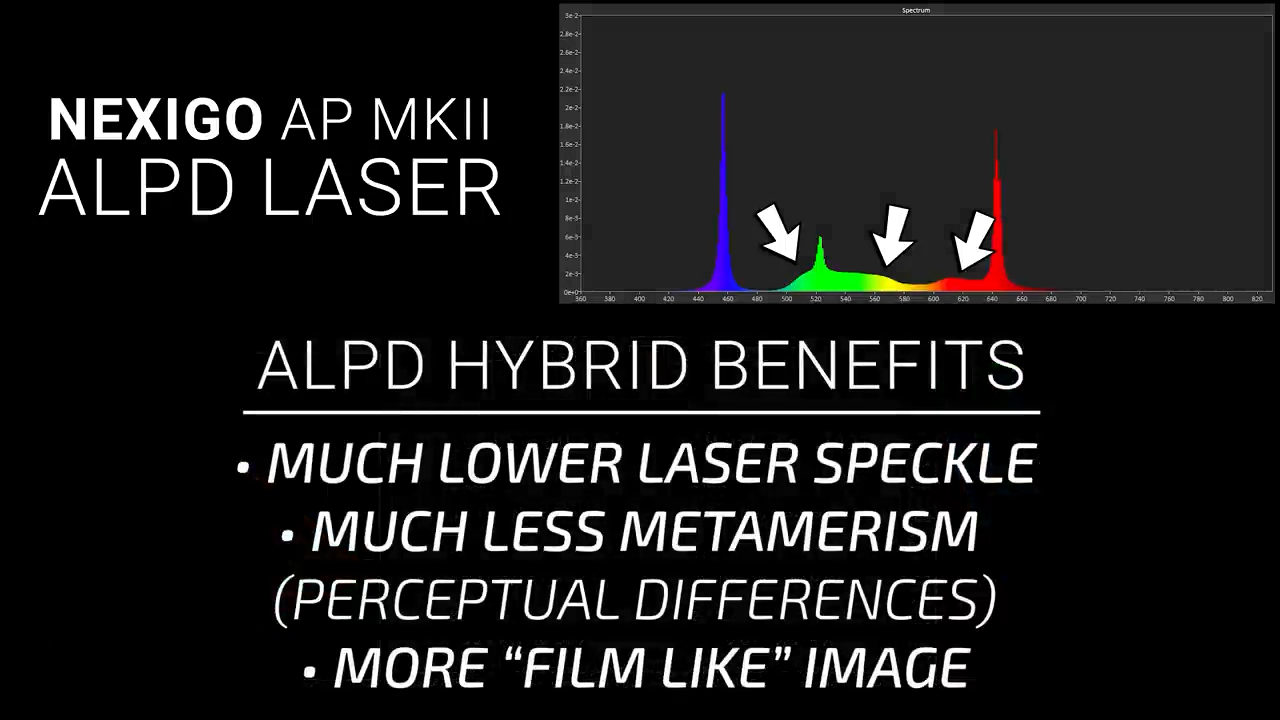
While the MKII covers 98.2% of the DCI-P3 HDR color space, it only covers 82.7% of BT.2020 and the BT.2020 gamut ring shows a ton of missing colors near the edges where both high luminance and high saturation are required. The MKII has the lowest gamut ring coverage yet, hitting just 55.95% of the target.
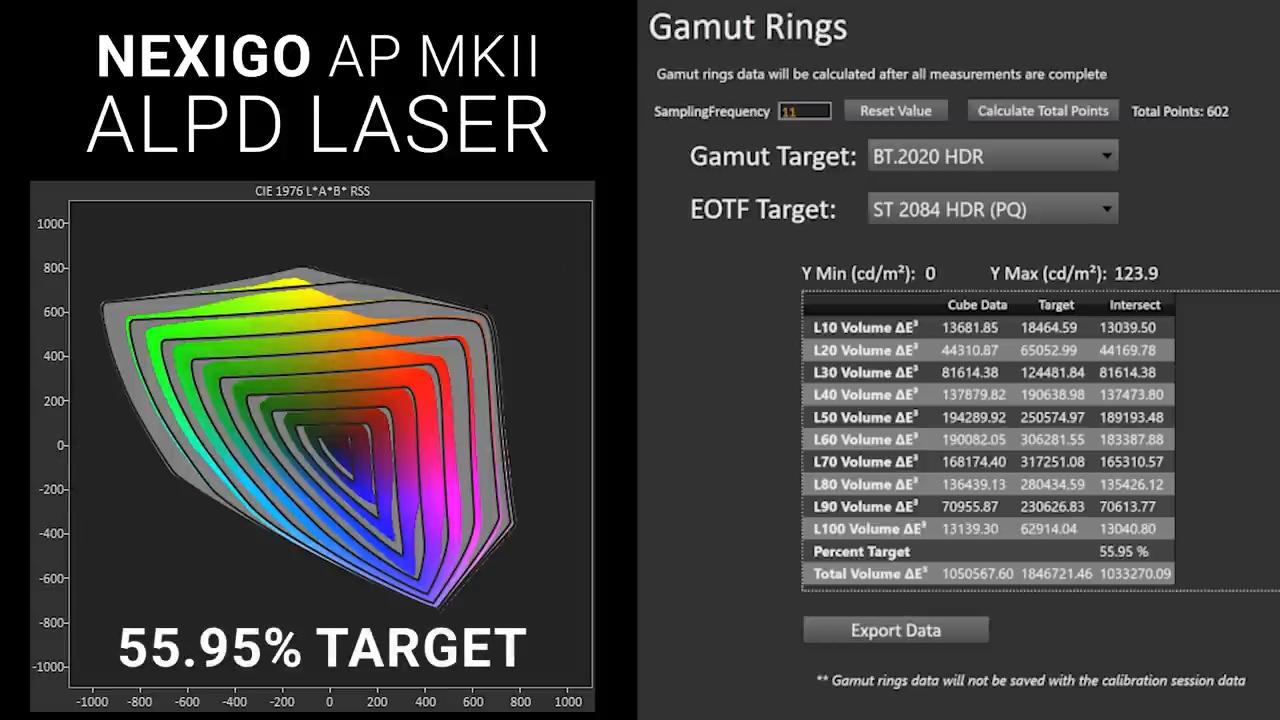
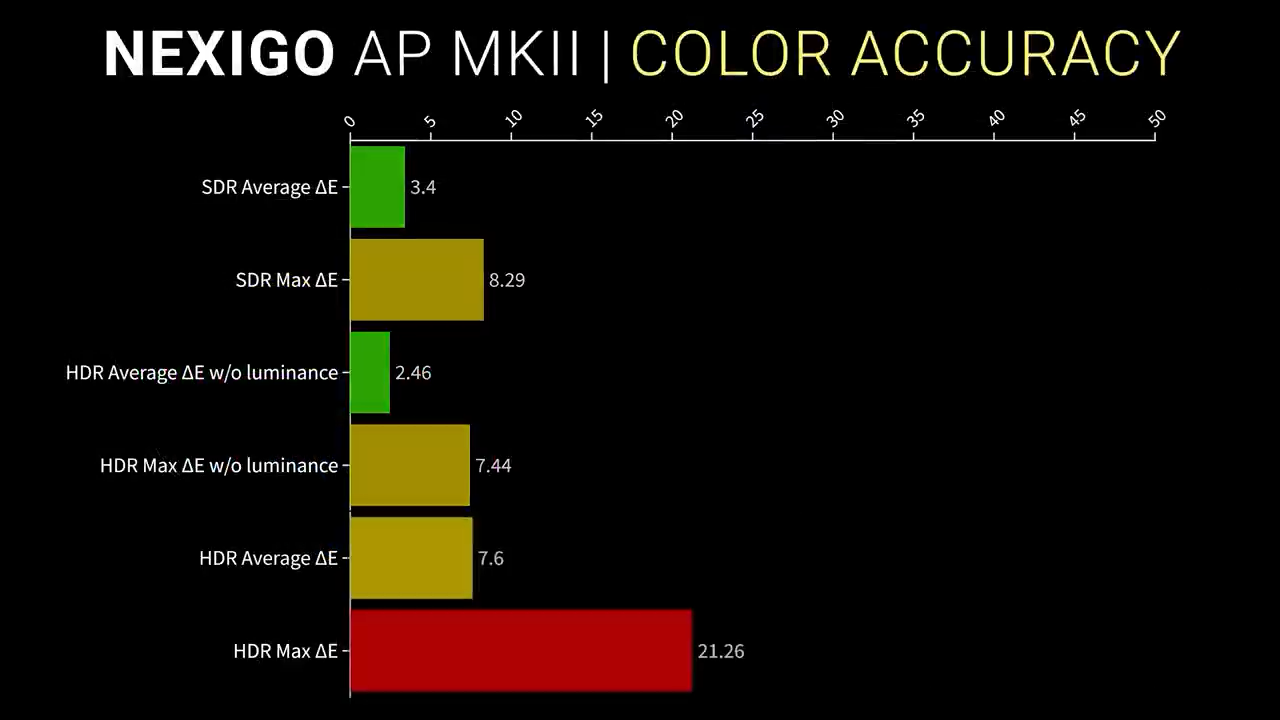
As for color accuracy, SDR and HDR accuracy without luminance error were good, but not exceptional, and DCI-P3 HDR accuracy was surprisingly okay given the poor gamut ring performance, but still nowhere near the XGIMI Aura 3 Max in terms of HDR color accuracy.
Side-by-Side Round 3
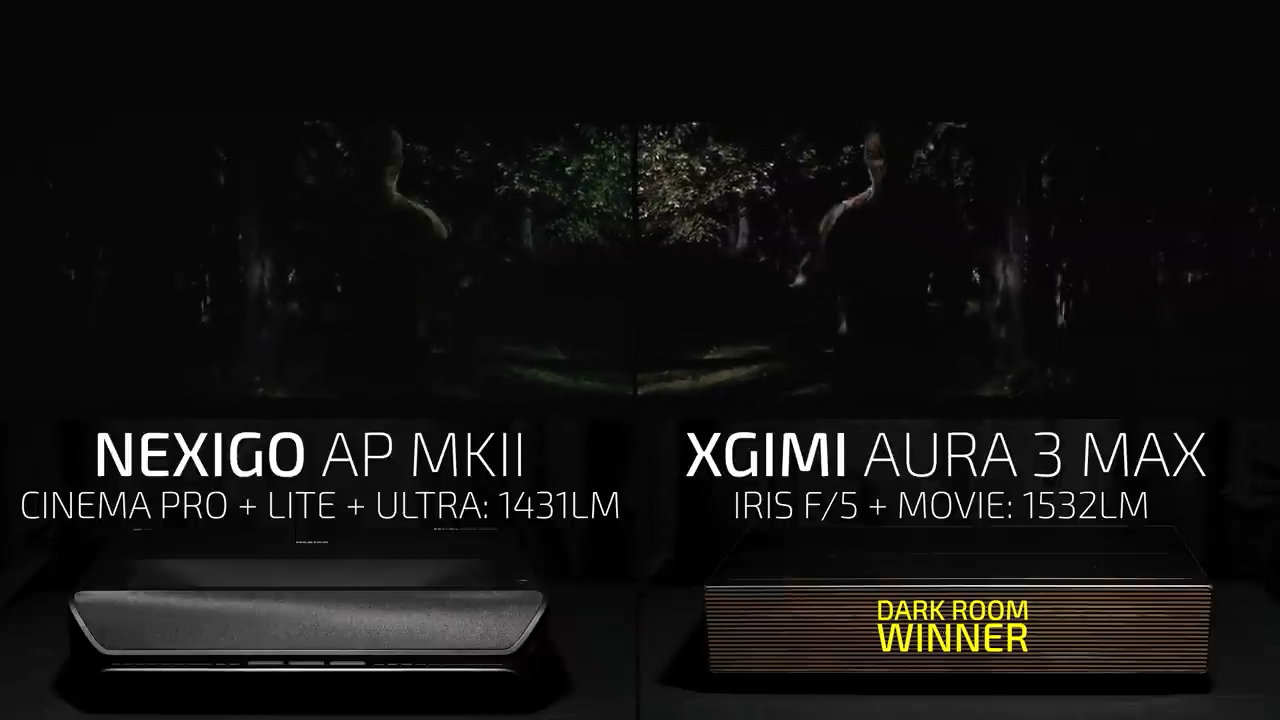
The MKII is specifically a dark room projector, so we’ll start with dark content in SDR with the MKII on Iris Lite and the Aura 3 on Dynamic Iris. You can see that the NexiGo’s dynamic iris kicks in first and the Aura 3 eventually catches up.
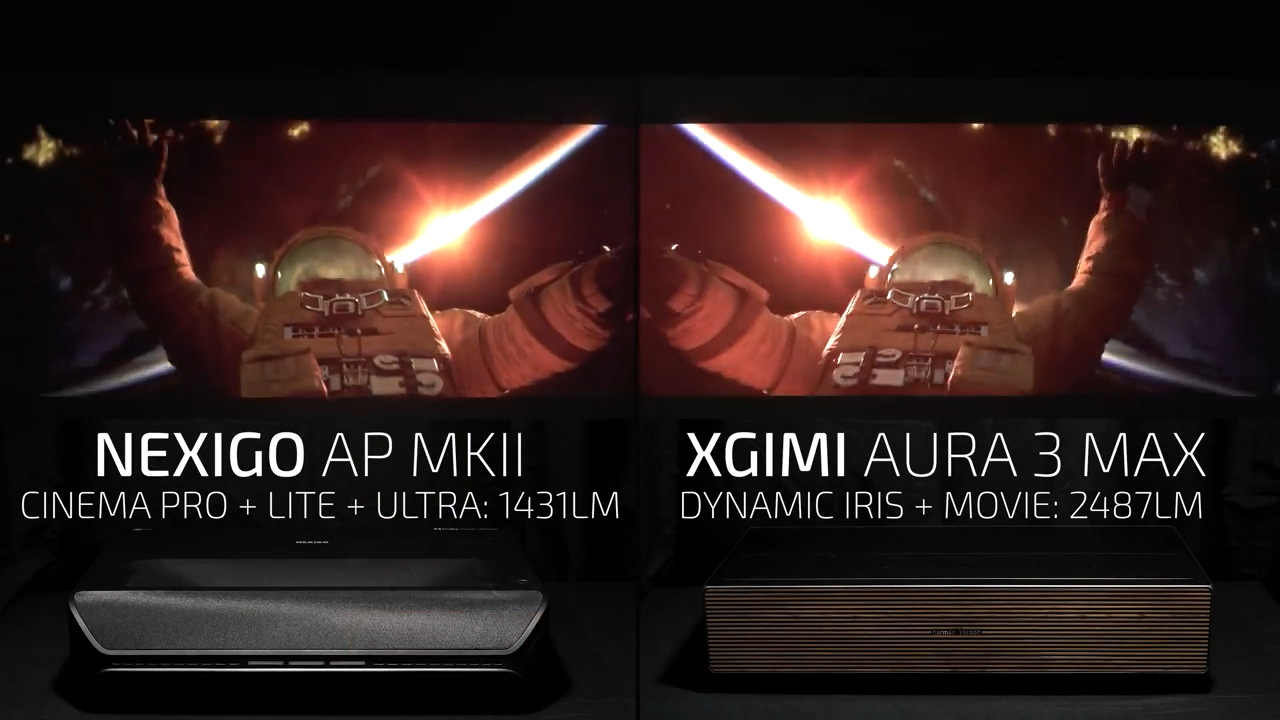
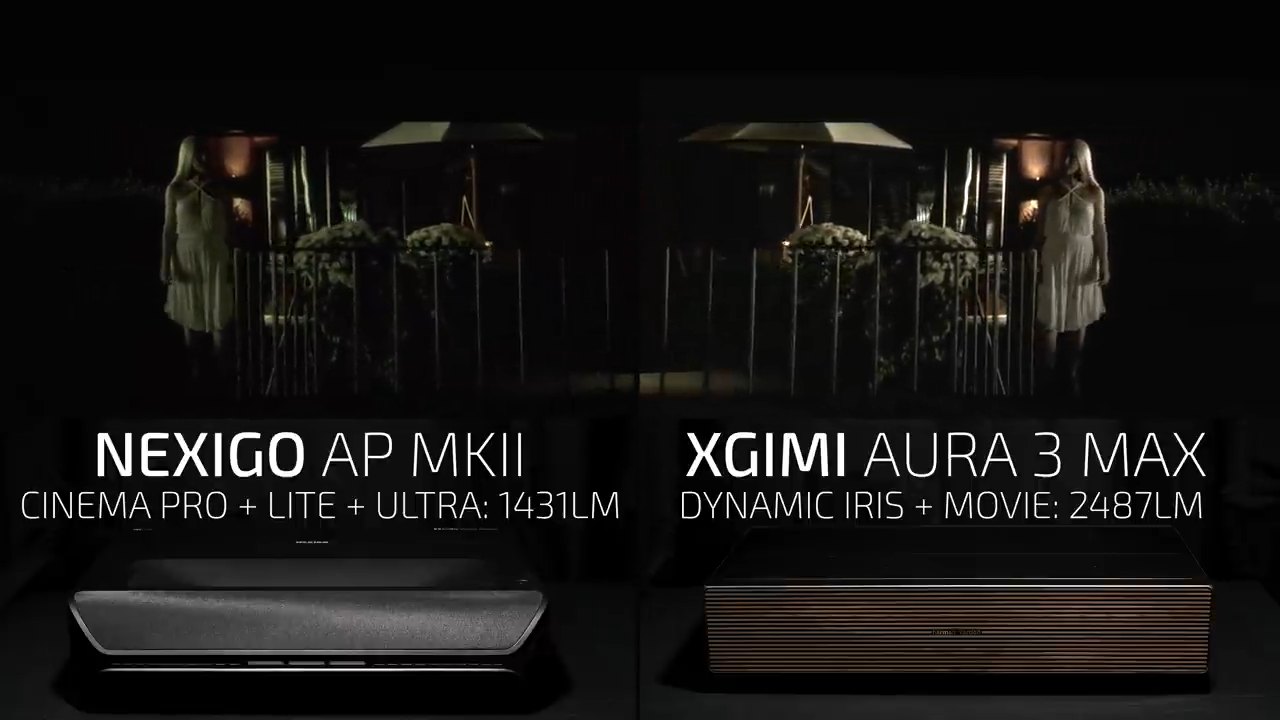
In HDR, the XGIMI 3 does a really great job competing with the NexiGo, aside from a few times that you can see the iris open for brighter highlights. Looking at only those two clips, you might be tempted to say the NexiGo is the better dark room projector, but, if we look at bright content the Aura 3 is so much brighter, both in SDR and in HDR. If we make it a little more of a fair fight by putting the Aura 3’s iris on f/5, you can see that it’s still considerably brighter than the NexiGo in bright scenes, and in dark scenes it’s got brighter highlights and darker shadows within the same scene. So with the caveat that you use f/5 or f/7 instead of dynamic, there’s no question that the Aura 3 is the superior dark room projector this year.
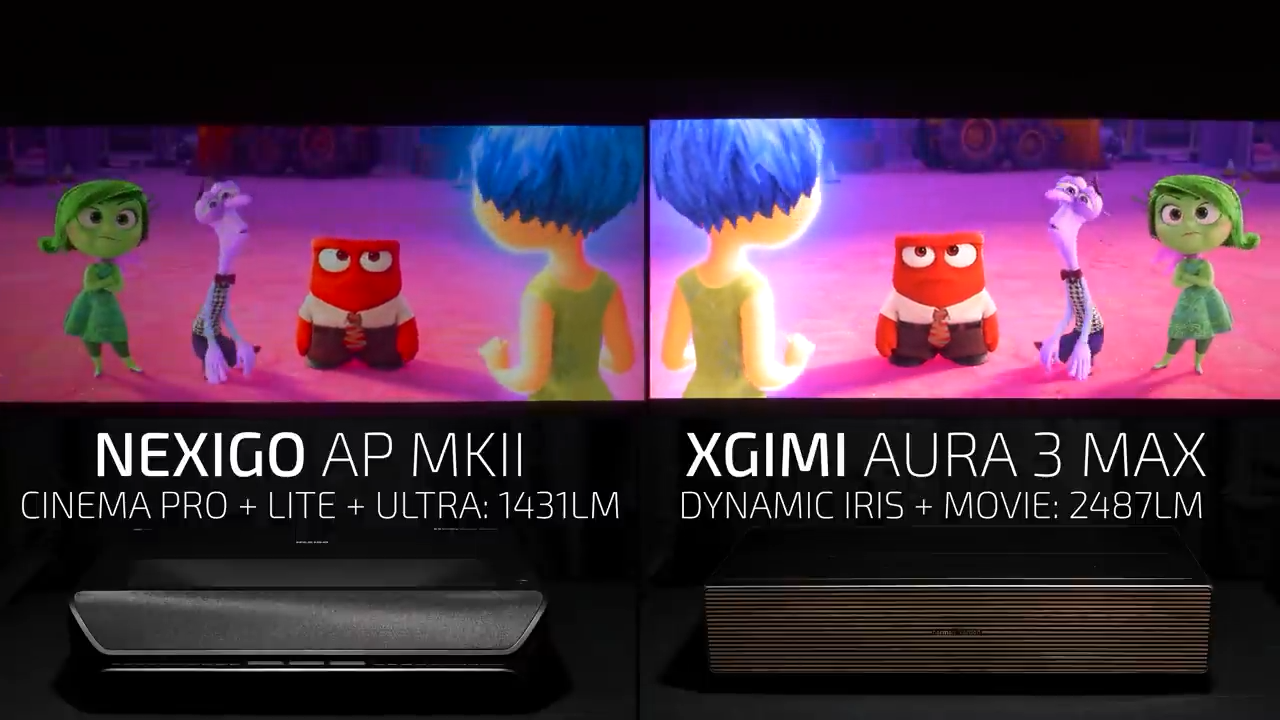
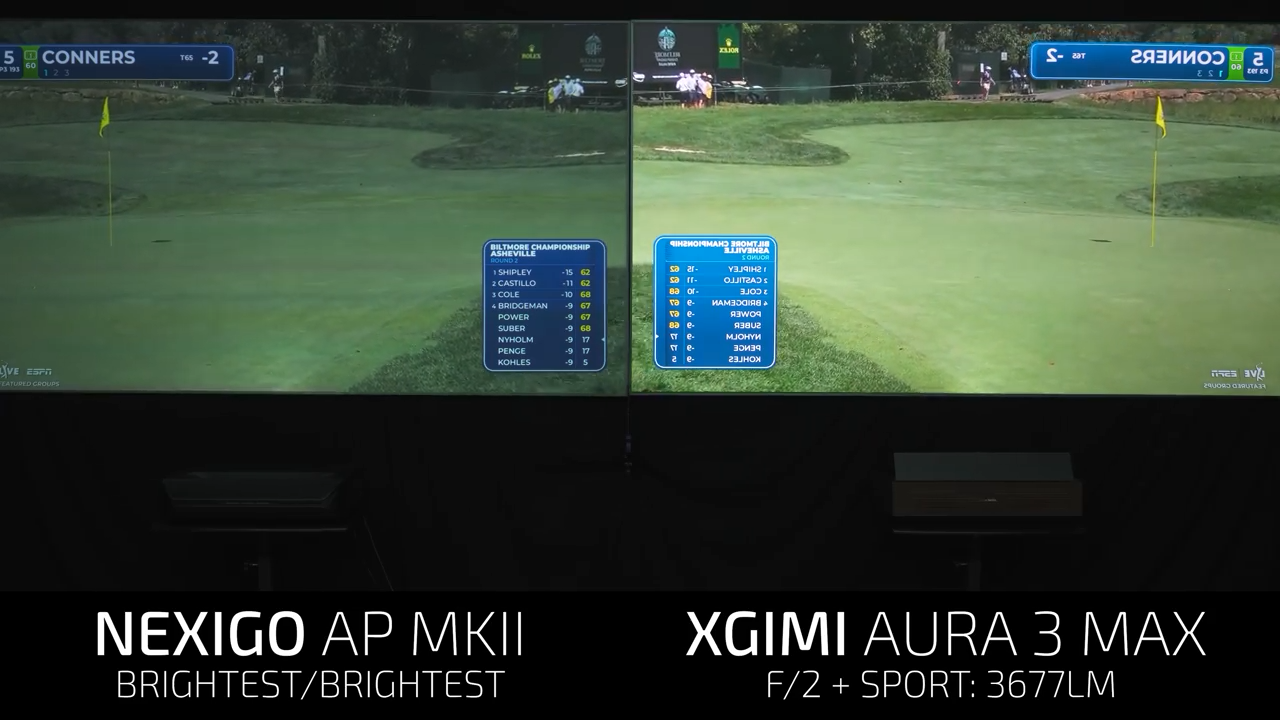
Turning off the iris on the NexiGo and putting it in the Brightest Picture mode, it’s still nowhere near as bright or vibrant as the XGIMI Aura 3, and even though the NexiGo MKII’s focus is extremely improved compared to the first-generation Aurora Pro, it’s also not nearly as sharp as the Aura 3, so the XGIMI moves on again.
AWOL Aetherion Pro Testing
In Round 4 it goes up against the $3499 AWOL Aetherion Pro, advertised at 2600 lumens, and I measured 3264 lumens on brightness enhancer high. With the iris off in Movie mode, the Aetherion Pro puts out just under 1900 lumens.
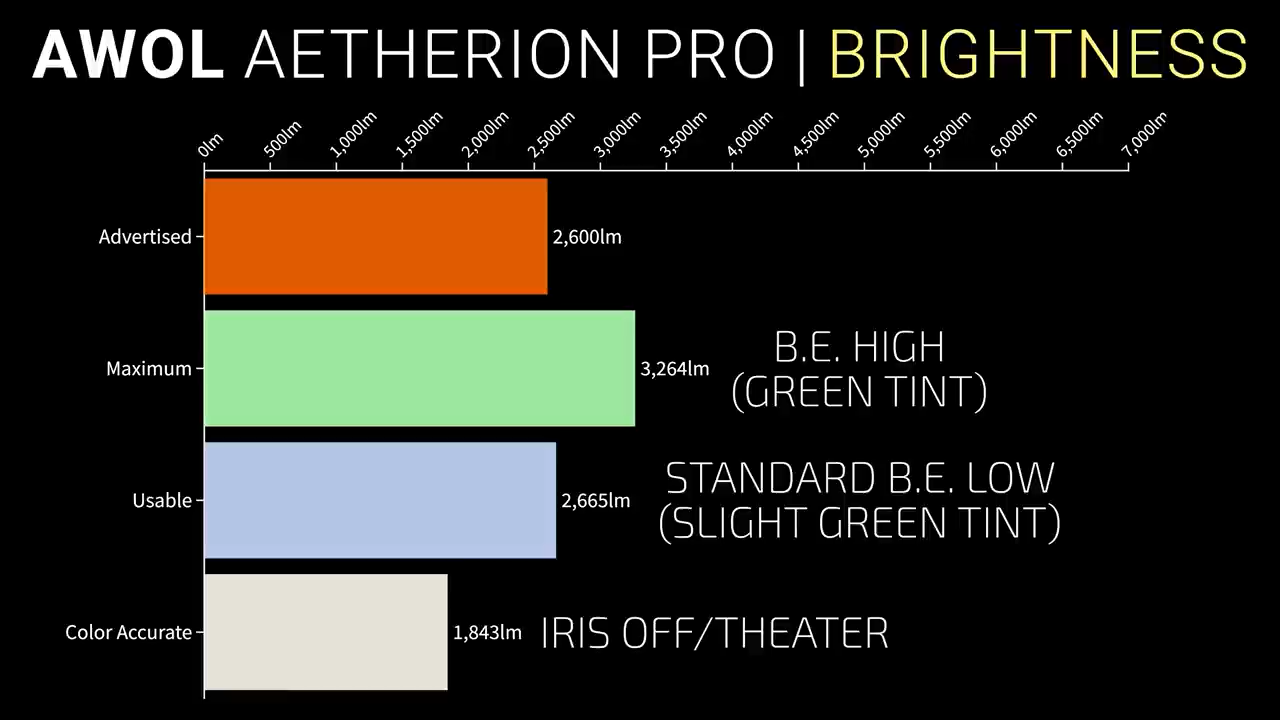
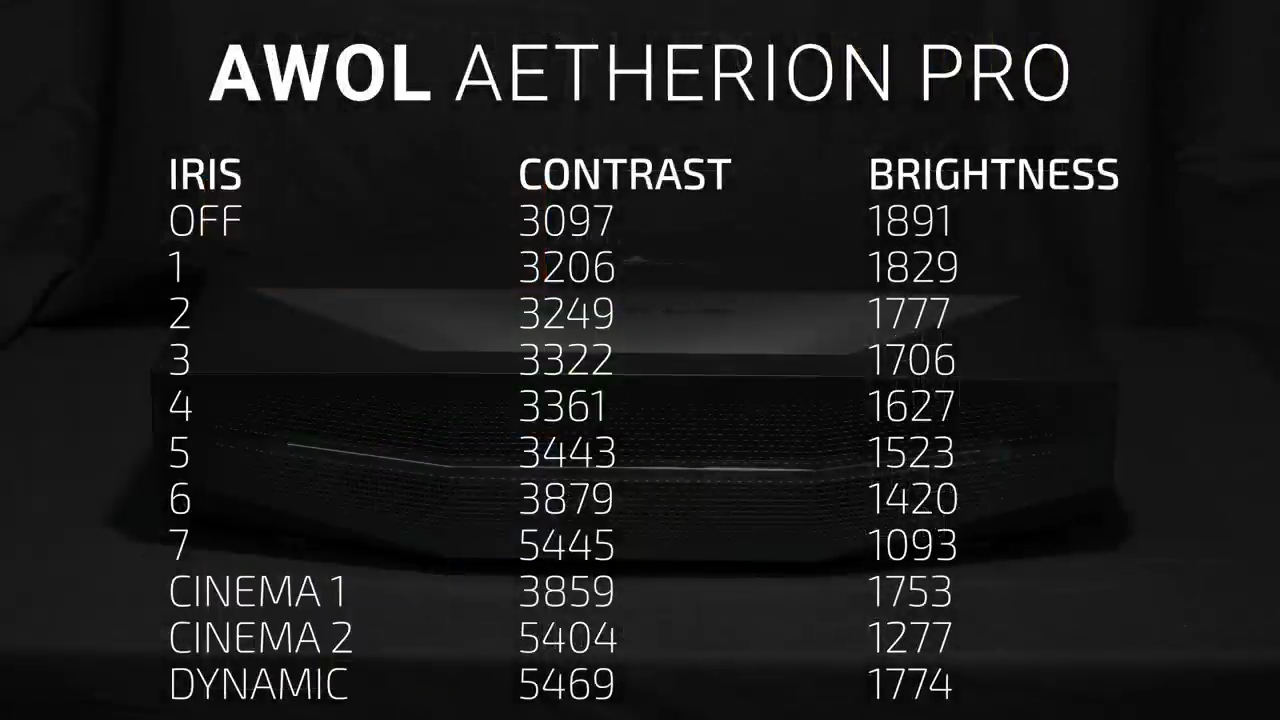
The Aetherion Pro also has an iris, and with the iris wide open it has a native contrast of 1828:1. Closing the iris all the way down results in a maximum native contrast of 5445:1 with around 1100 lumens, which is really good. I also have beta firmware enabling dynamic iris which you can seem to operate between about iris 2.5 and iris 6.5 resulting in a dynamic contrast of 5469:1 using just the iris. Turning on AWOL’s EBL laser dimming results in a dynamic contrast ratio of 23,798:1.
The Aetherion Pro is a pure triple laser projector, and has a fairly standard spectral distribution, with slightly less peaks in the red spectrum than the Aetherion Max, but still not as coherent as the XGIMI.
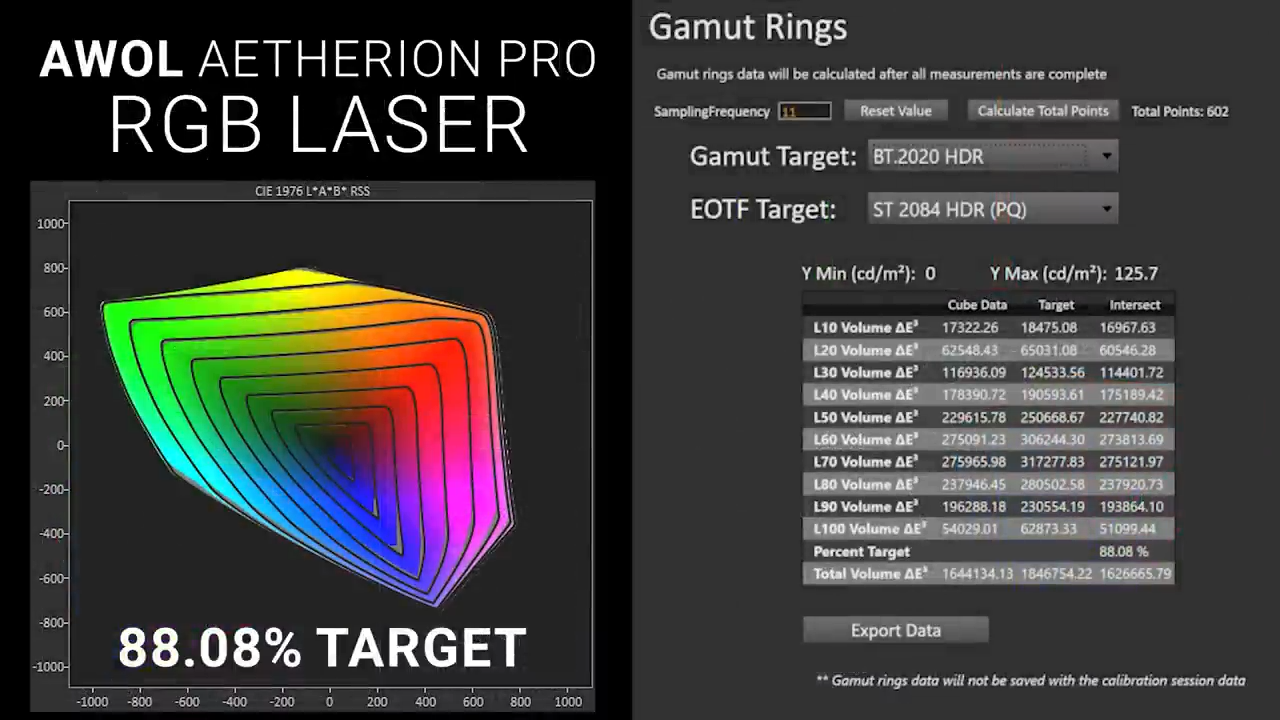
The Aetherion Pro covers 99.2% of the DCI-P3 HDR color space and 92.2% of BT.2020, hitting 88% of its gamut ring target, with only a few missing colors in the extremely high luminance greens and teals, and the most saturated blue colors.
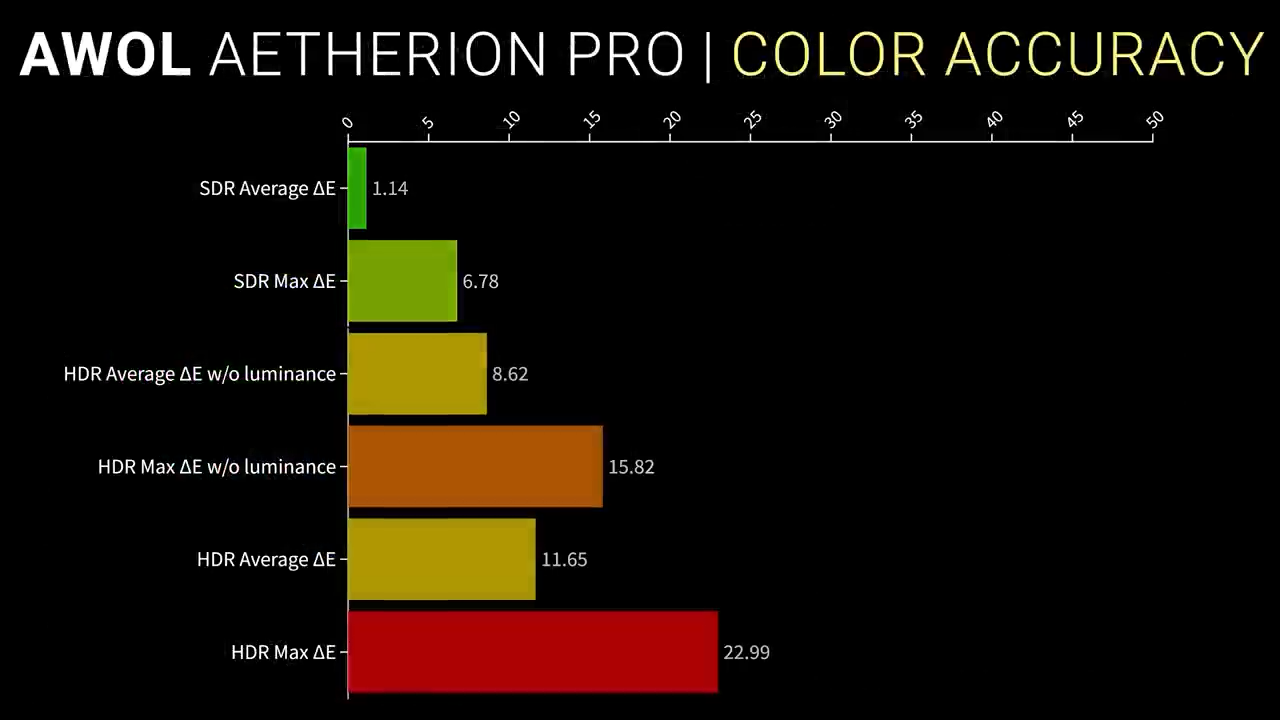
The Aetherion Pro had an average SDR color error of 1.14 which is very good, but HDR accuracy was not nearly as good with an average error of 8.62 without luminance, and 11.65 with luminance error factored in.
Side-by-Side Round 4
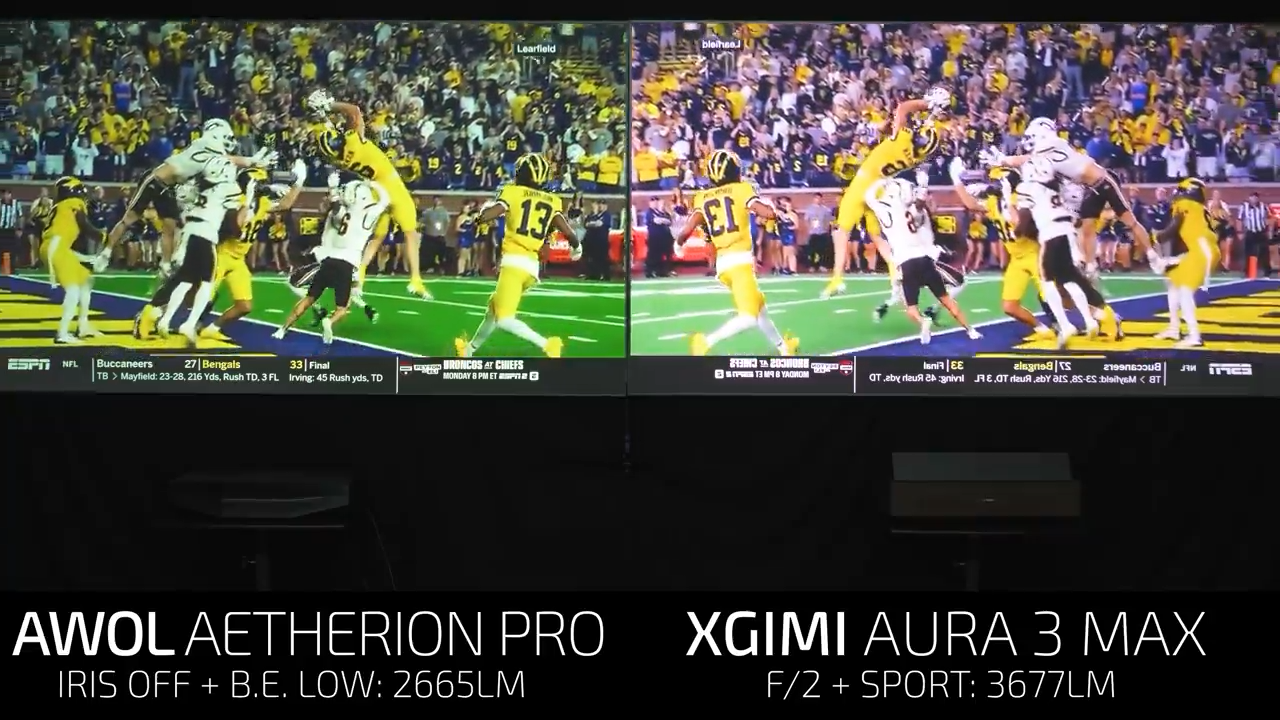
In bright SDR scenes, the Aura 3 was considerably brighter, but both were very color accurate, while in HDR the Aetherion Pro was noticeably less color accurate in addition to not being as bright.
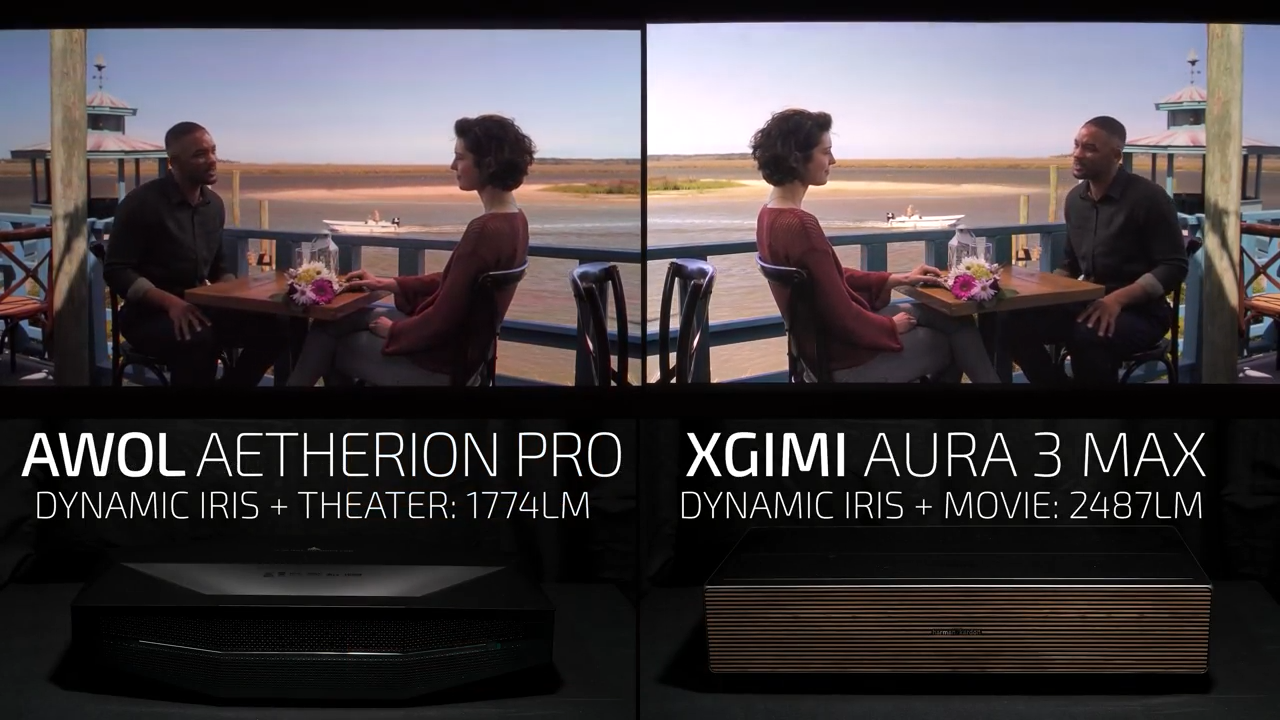
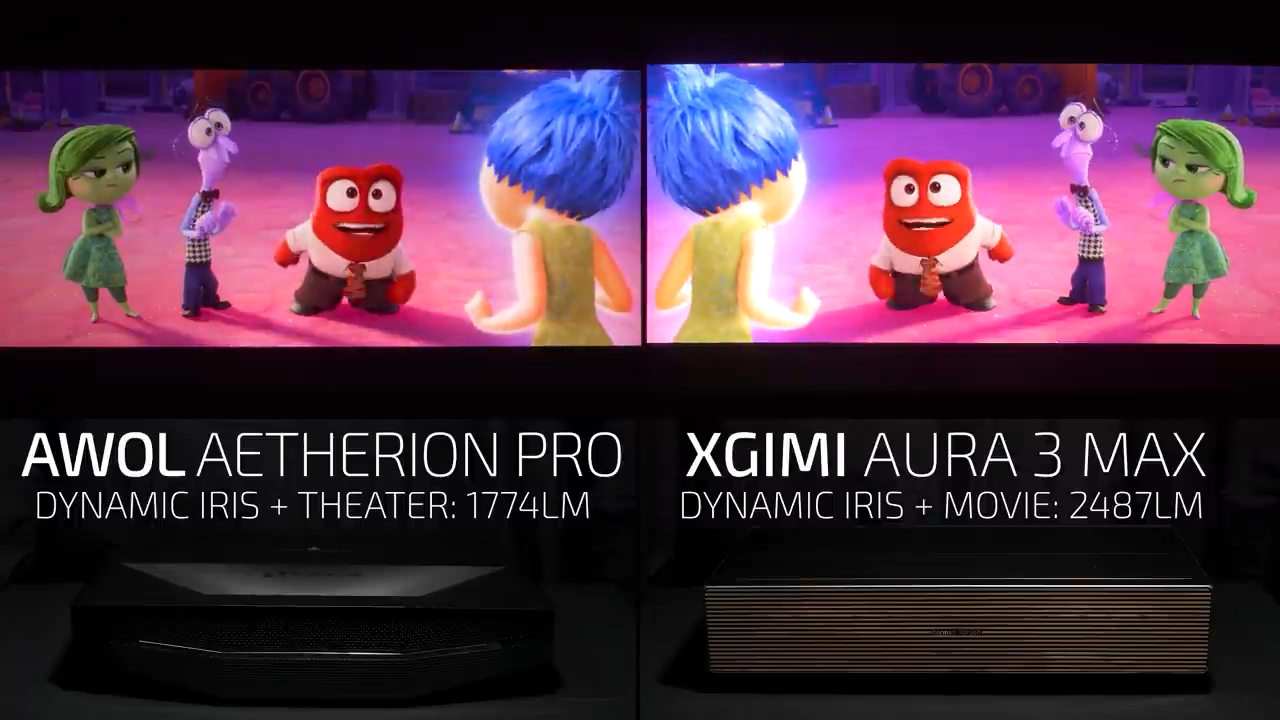
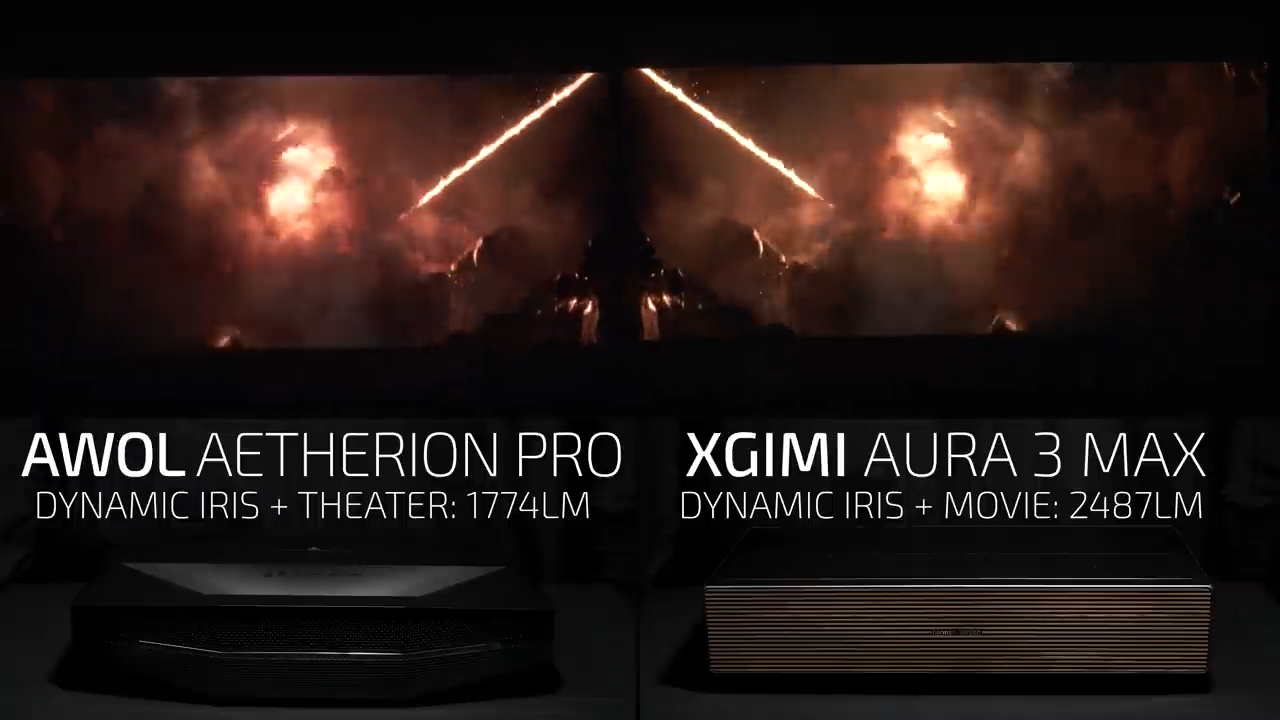
However, using the beta dynamic iris for the Aetherion Pro, the black level performance is extremely good and in general EBL laser dimming from AWOL is slightly faster than DBLE from XGIMI, which not only means it’s quicker to decide to dim, but also that it recovers faster. Based strictly on dark content, I would give the slight edge to the Aetherion Pro after the new dynamic iris update.
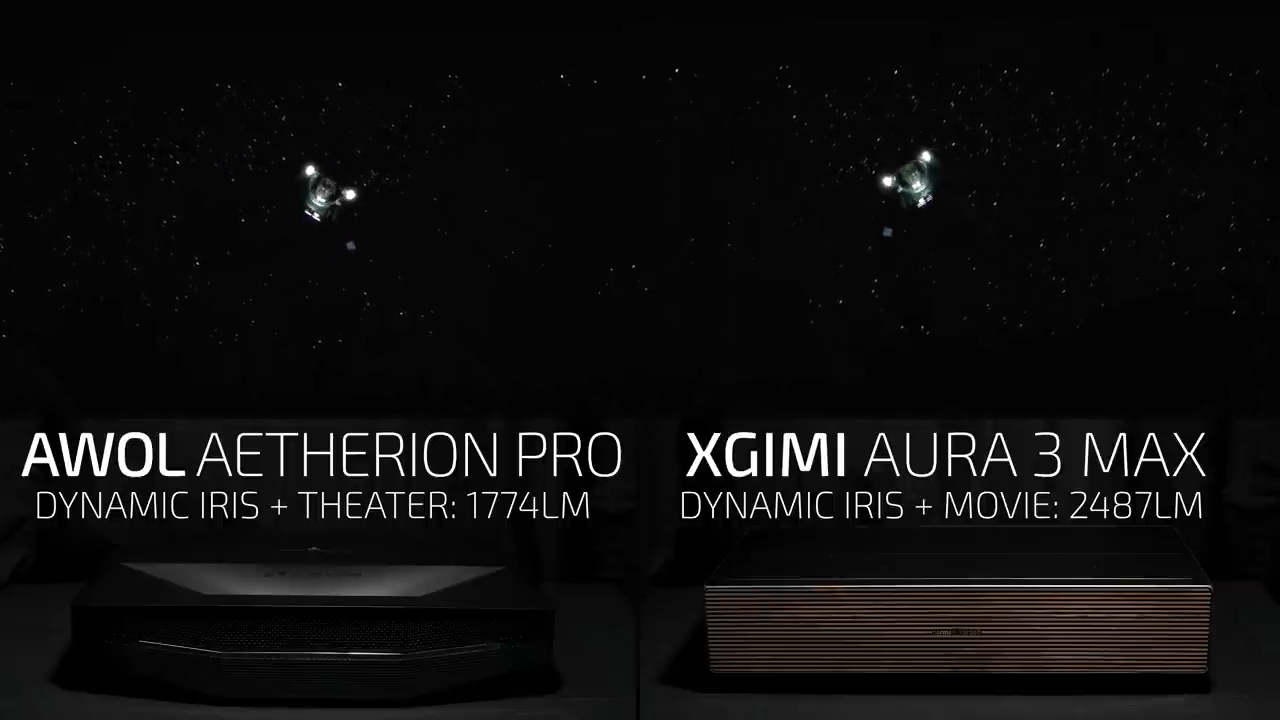
However, the Aura 3’s considerable brightness advantage in moderately lit scenes combined with much better HDR color accuracy makes all the difference when displaying bright colorful objects where it seems like the Aetherion Pro needs to pick between being either bright, or saturated, but not both, and the Aura 3 is going to just barely edge out this round over the Aetherion Pro.
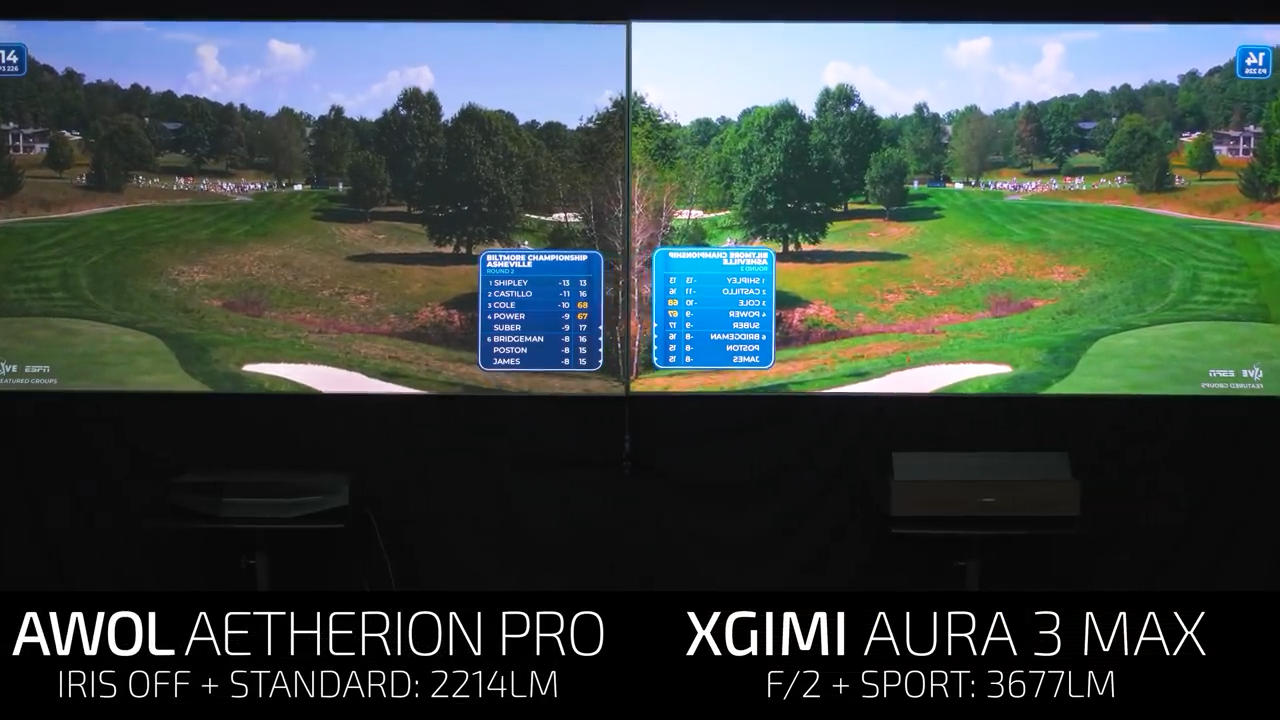
For lights on viewing, the Aetherion Pro didn’t really stand a chance when I tested it without the brightness enhancer on, and turning it on low helped to close the gap a little bit, but at the expense of color accuracy, so the XGIMI Aura 3 Max moves on in both categories again.
Epson LifeStudio Grand Plus Testing
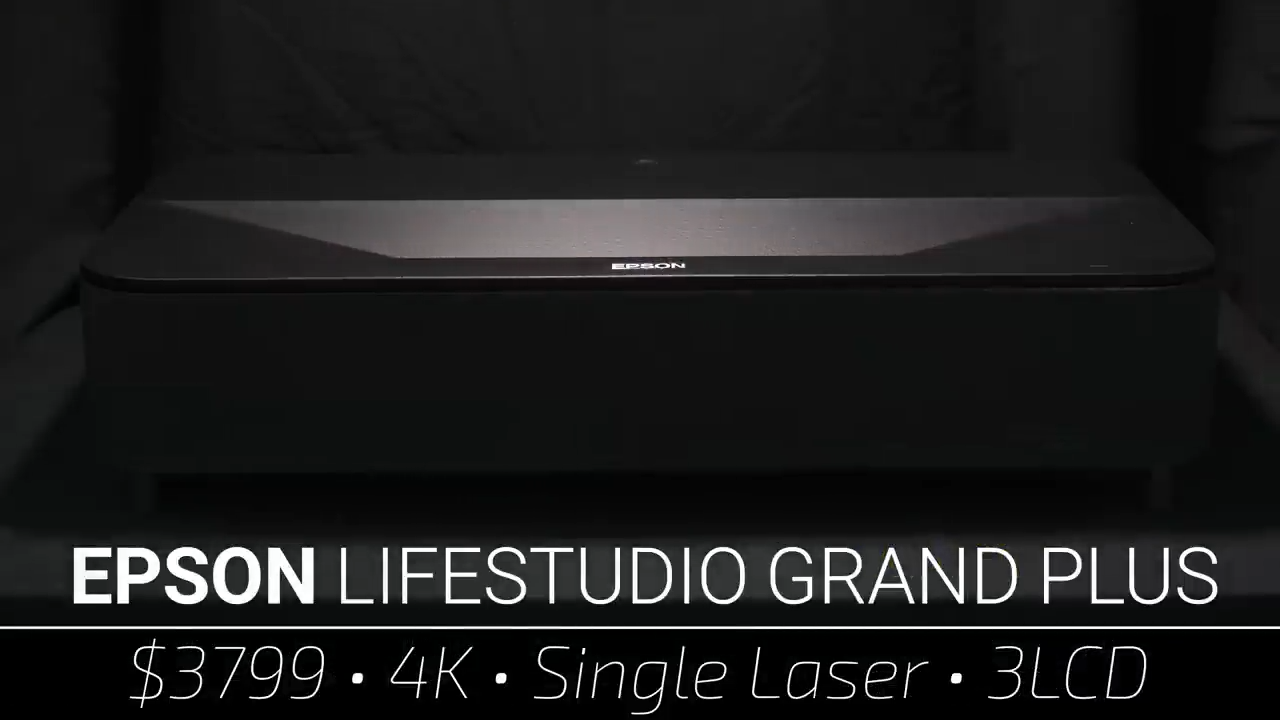
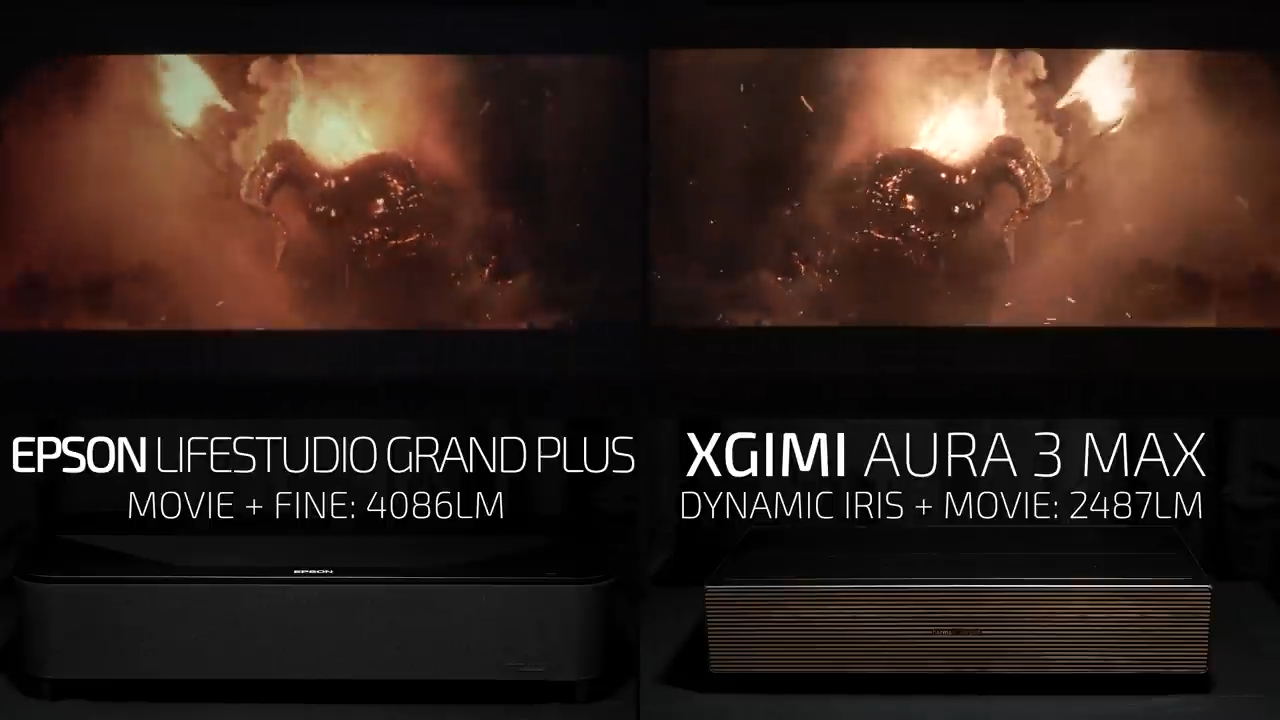
In Round 5 it will face off against the $3799 Epson LifeStudio Grand Plus, which Epson advertises at 4000 lumens, but unlike most of the other projectors in this video, those 4000 lumens are available in Movie mode where I measured 4086 lumens. On Dynamic mode, which I think is the picture mode most Epson users end up using, it had 6635 lumens, 65% higher than advertised.
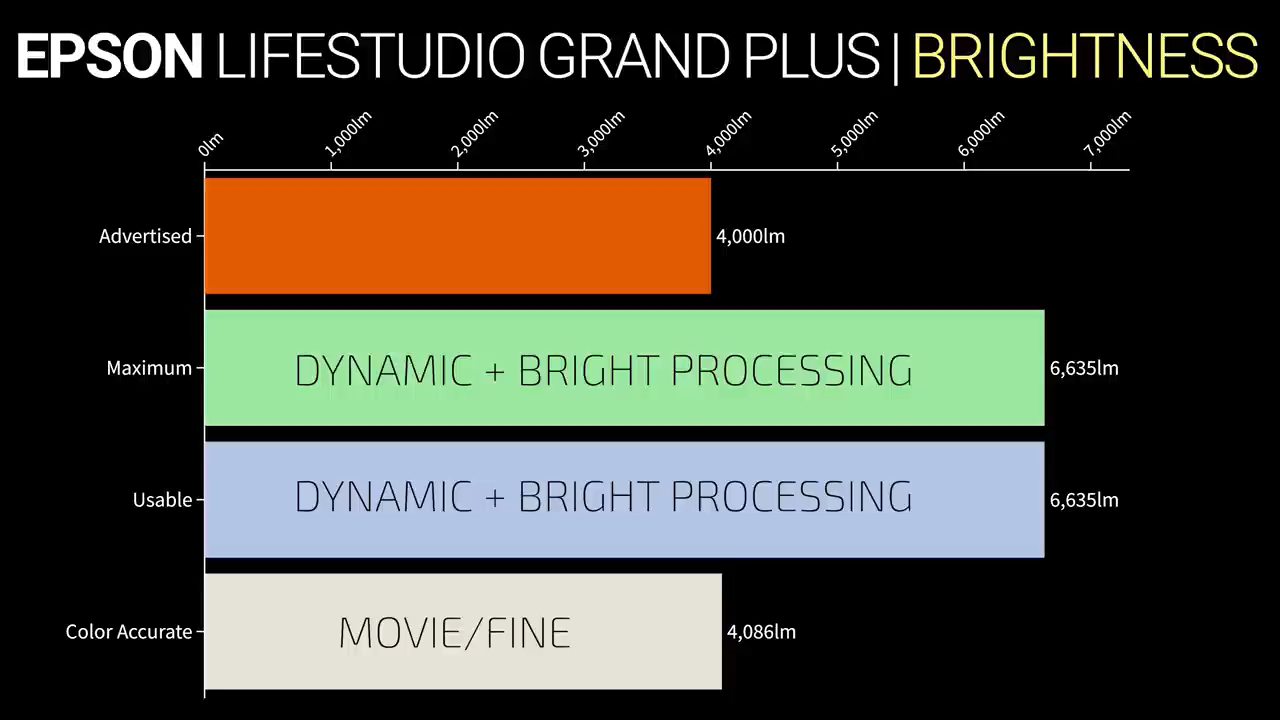
However, the contrast ratio isn’t nearly as impressive and I measured 1452:1 native contrast on Movie mode. If you put the picture mode on Dynamic and change the image processing from fine to bright you can enable full fade to black, giving the Epson a dynamic contrast ratio close to the 5 million to one that they advertise.
The Epson is a single laser phosphor projector which means that the blue primary is produced by a direct laser while the red and green primaries are created by a phosphor, which typically results in almost no laser speckle and very little metamerism but at the cost of gamut coverage.
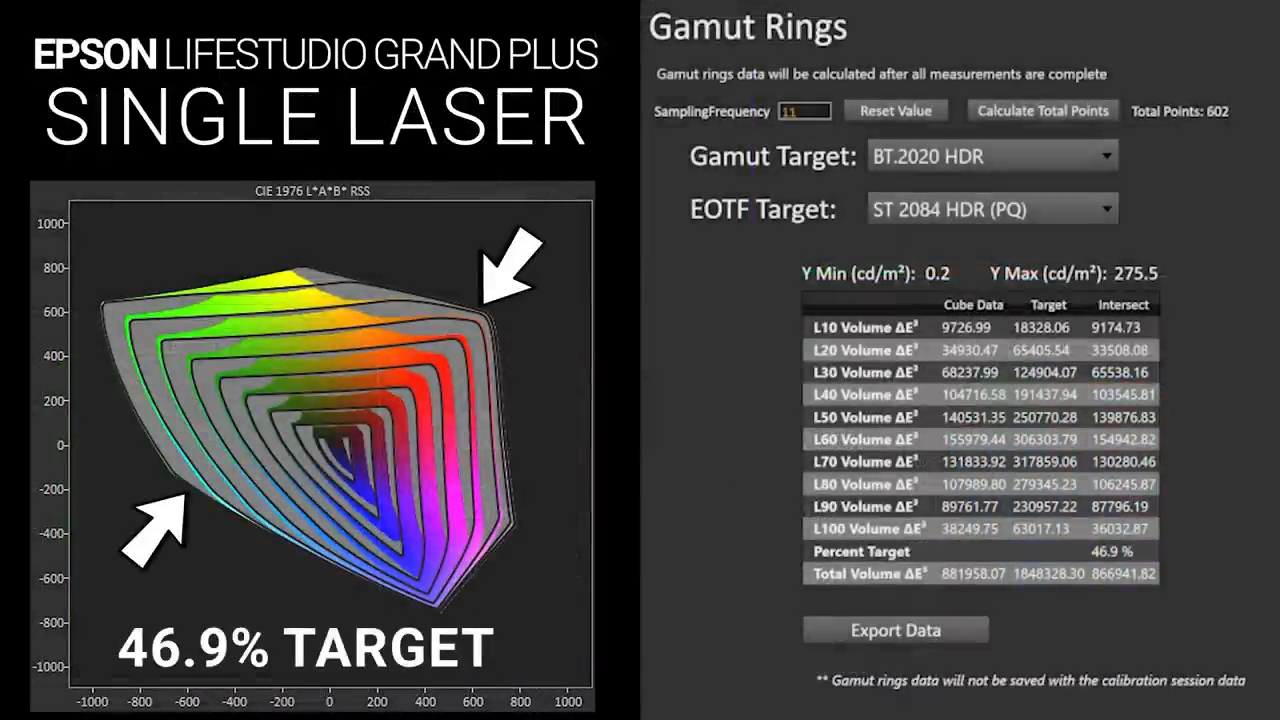
The Epson covered just 81.8% of the DCI-P3 HDR color space and 62.2% of BT.2020, and the gamut ring analysis shows massive deficiencies in the green and red parts of the gamut that are created by the phosphor, while the direct blue laser performs similar to a triple laser projector.
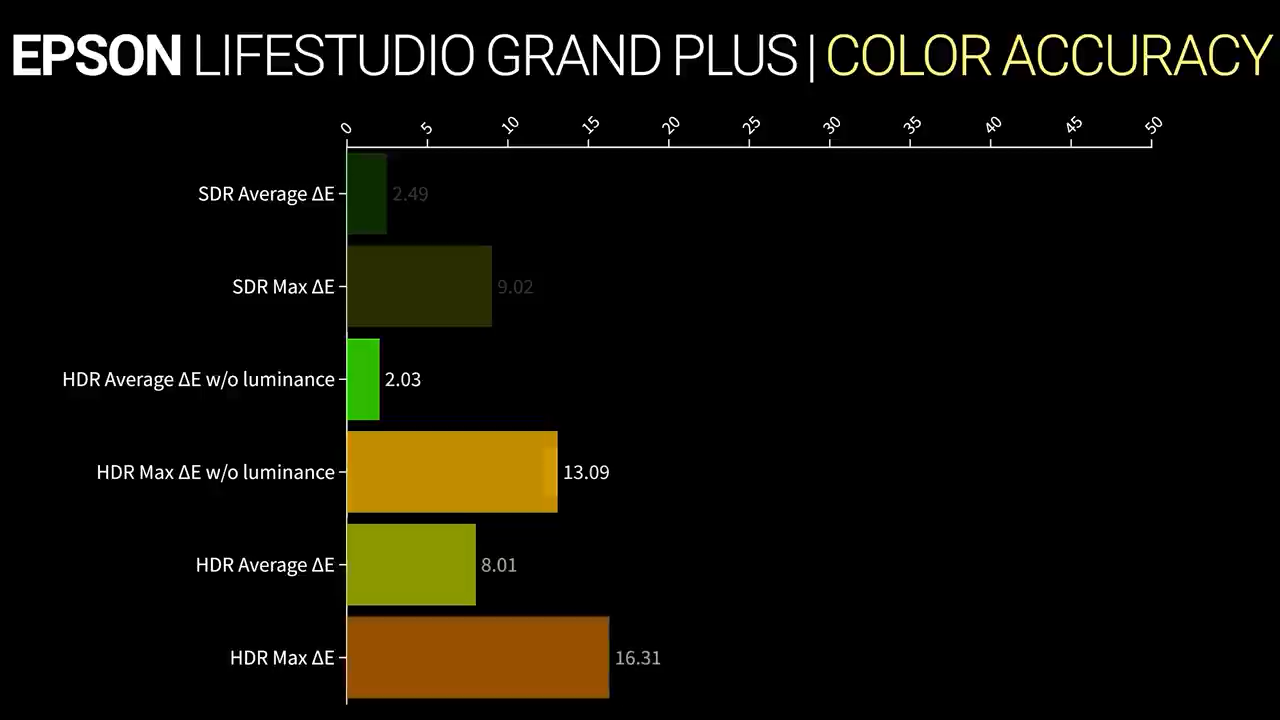
In SDR the Epson had an average color error of 2.49, which is good, but just average compared to the rest of the projectors in this video. For HDR, it actually improved to 2.03 average color error without luminance and 8.01 including luminance.
Side-by-Side Round 5
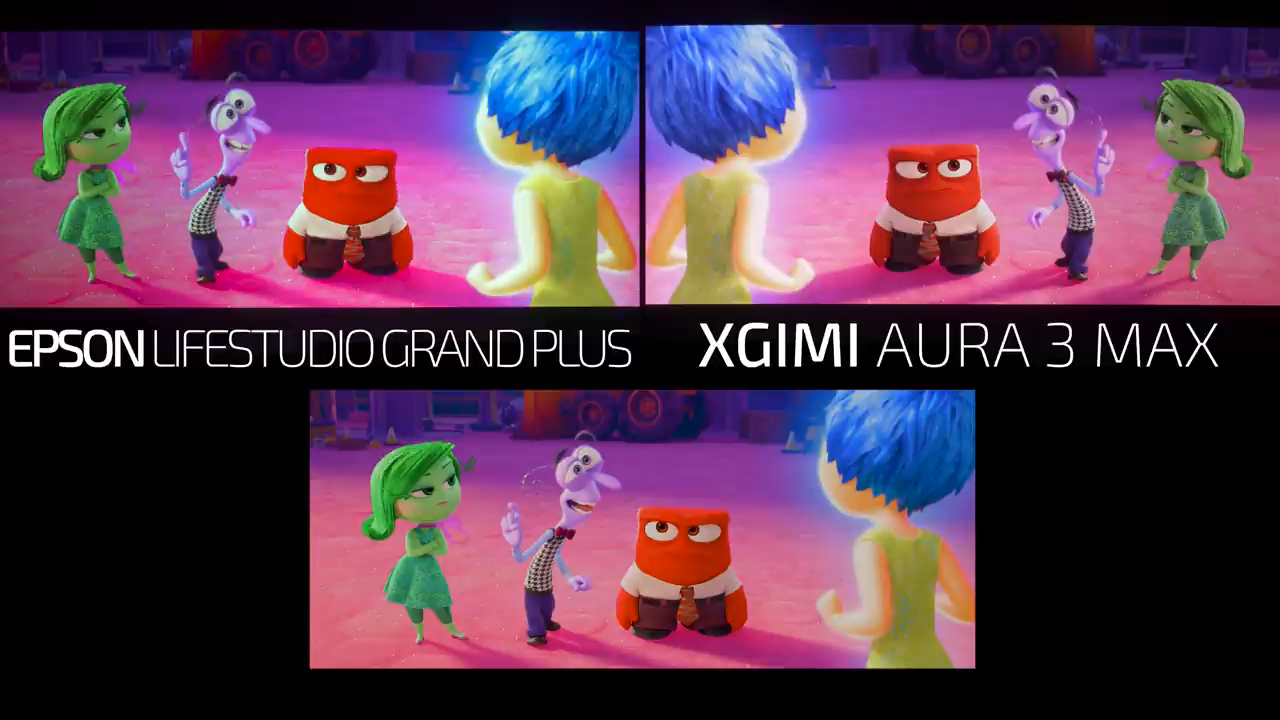
Looking first at Bright content, the Epson looked phenomenal, and even with the processing mode set to Fine instead of Bright, it was noticeably brighter than the Aura 3. The colors were also surprisingly vibrant given the lower color space coverage of the Epson but pulling up the source footage you can see that the color is more accurate on the Aura 3. Interestingly, you can see that compared to the source the Epson appears to have lost some detail, especially in Anger’s face, while the Aura 3’s processing seems to have sharpened the image and there looks like there’s more detail on the projected image than on the source.
However, if you want to enjoy the high brightness, it comes at a cost and moderately lit scenes on the Epson were an absolute mess even with High-Speed Dynamic dimming enabled. By comparison, the Aura 3 Max looked absolutely incredible. Don’t misunderstand me, no projector has OLED level blacks, but the difference here looks like a non-dimming LCD TV verses an OLED and even with all the extra brightness on the Epson, the Balrog’s fire whip still looked far more vibrant and realistic on the XGIMI.
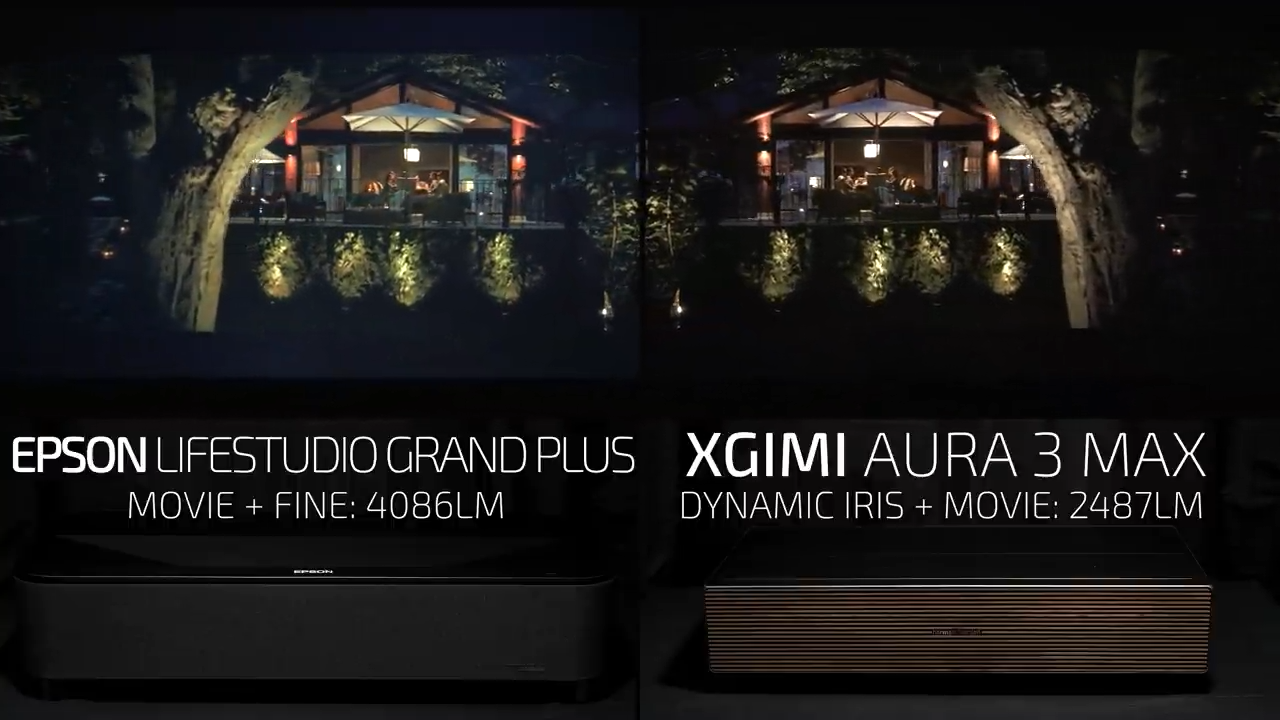
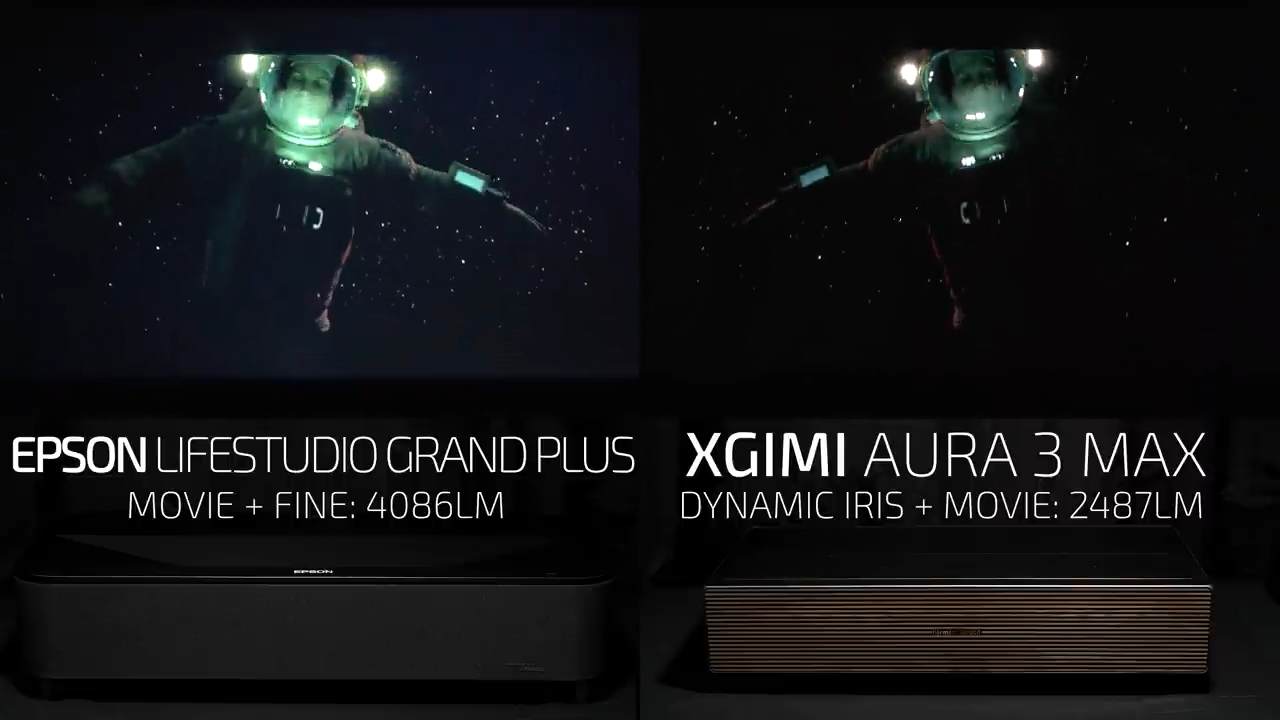
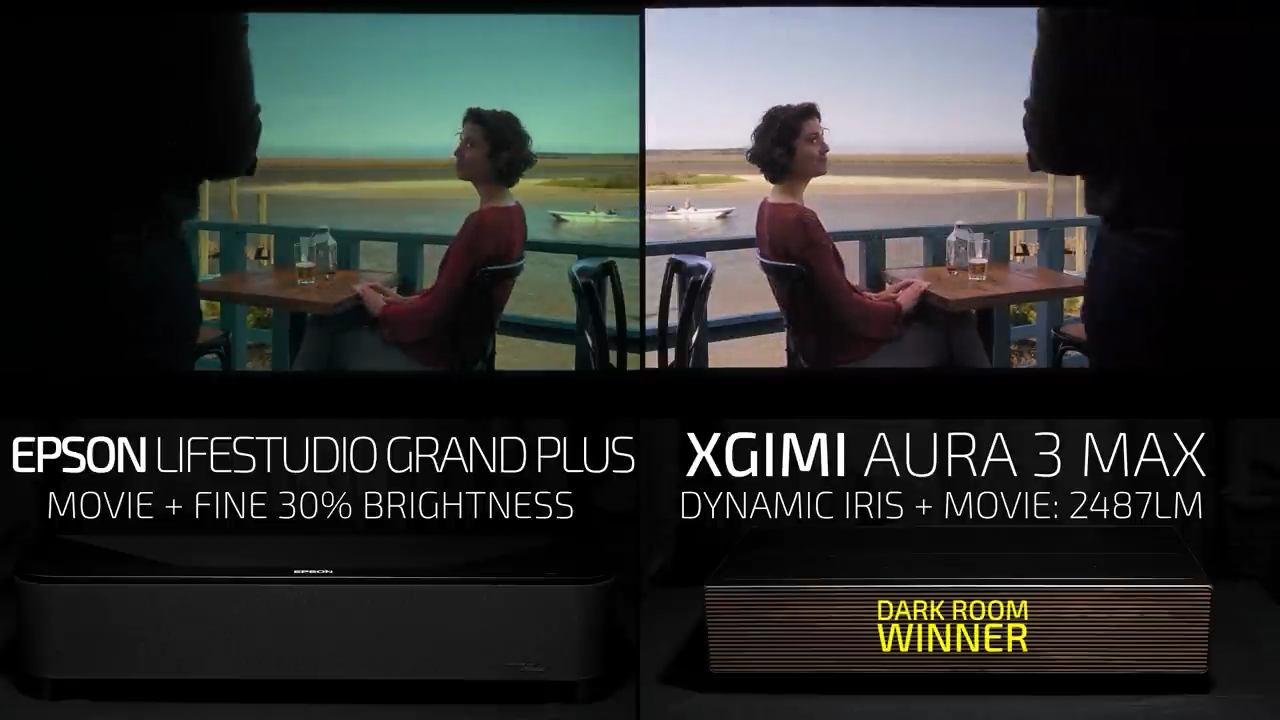
The Epson does have a dedicated button on the remote to lower the brightness output and bringing it down to 30 does considerably improve the performance in dark content, but it’s still not on the same level as the XGIMI. Then you’re missing out on the best part of the Epson which is its excellent performance in bright scenes, and there’s basically no question here that the XGIMI Aura 3 Max is the superior dark room projector.
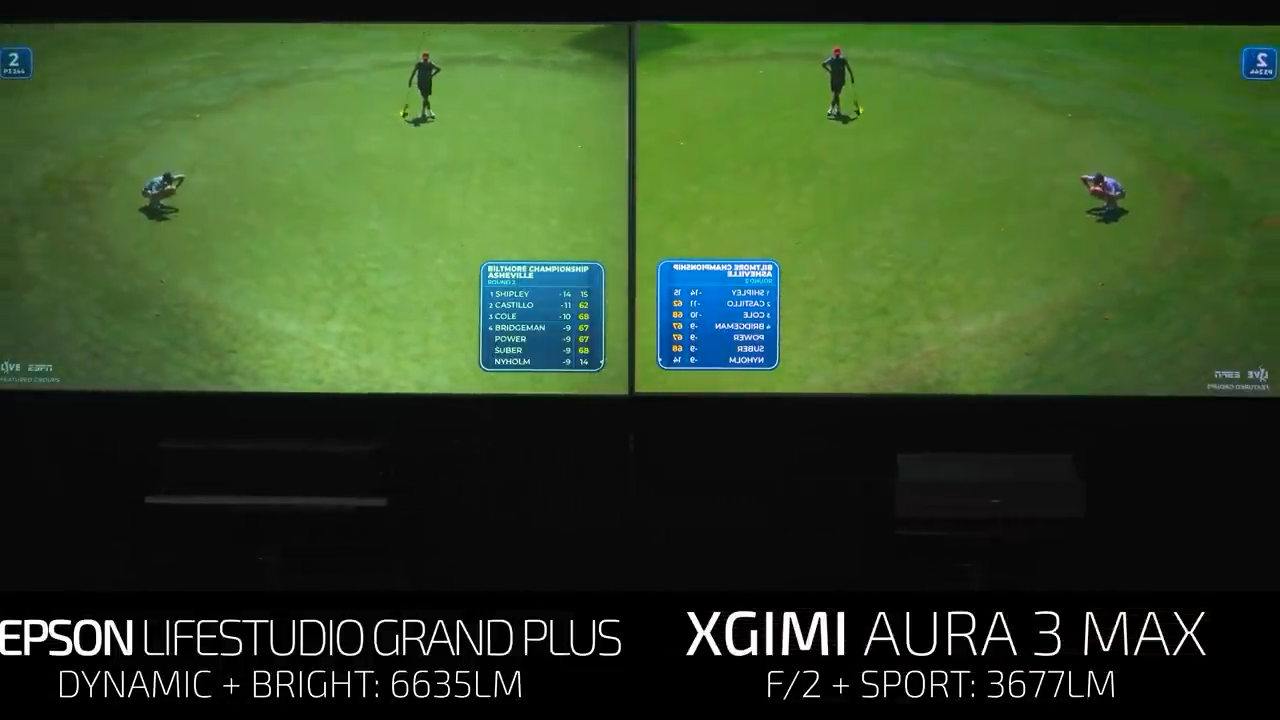
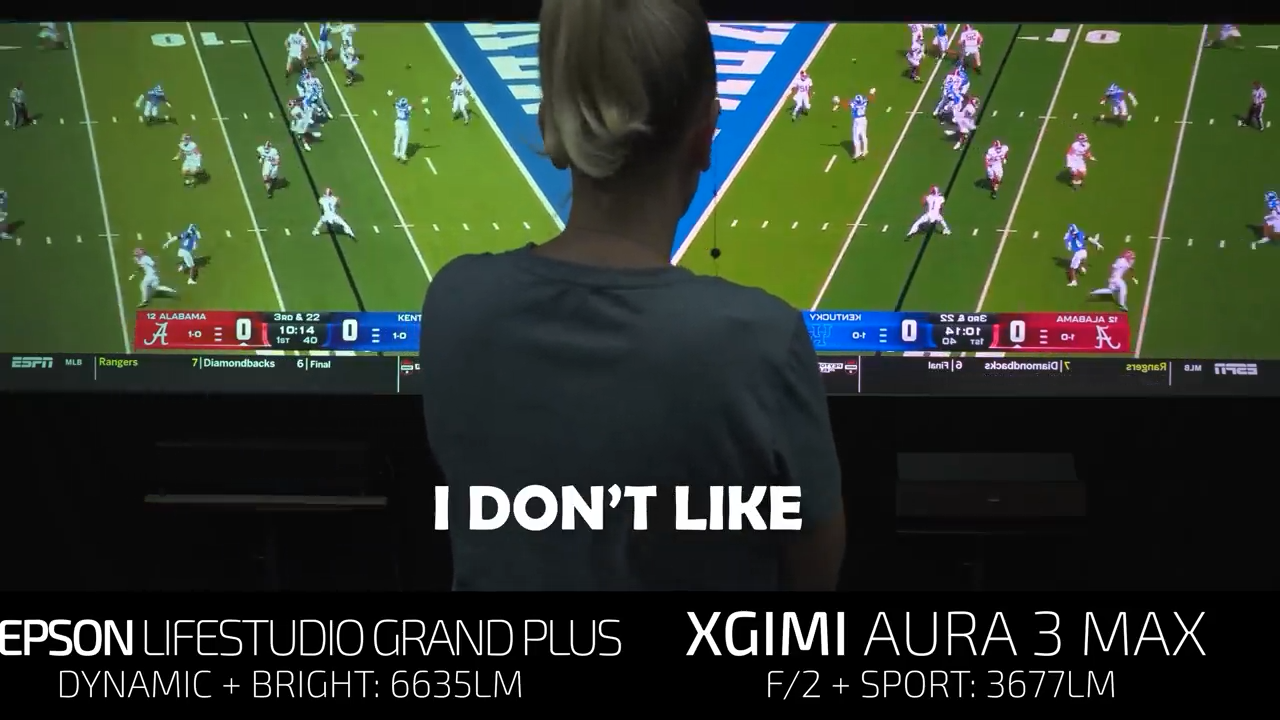
But I’ve picked Epson projectors as the best bright room projectors for the last two years, so I put the LifeStudio Grand Plus in Dynamic mode and turned on the lights, and my initial impressions were that the Aura 3 looked a lot better, but just to be sure, I brought in my wife who uses our projector every Saturday during college football season to watch four games at a time in quad view for 12 hours straight, and we deliberated for about 10 minutes before, in the biggest upset so far, my wife and I both agreed that the Aura 3 Max’s colors and extra sharpness made up for the difference in brightness, giving it another win for both dark room and bright room viewing.
Hisense PX4-Pro Testing
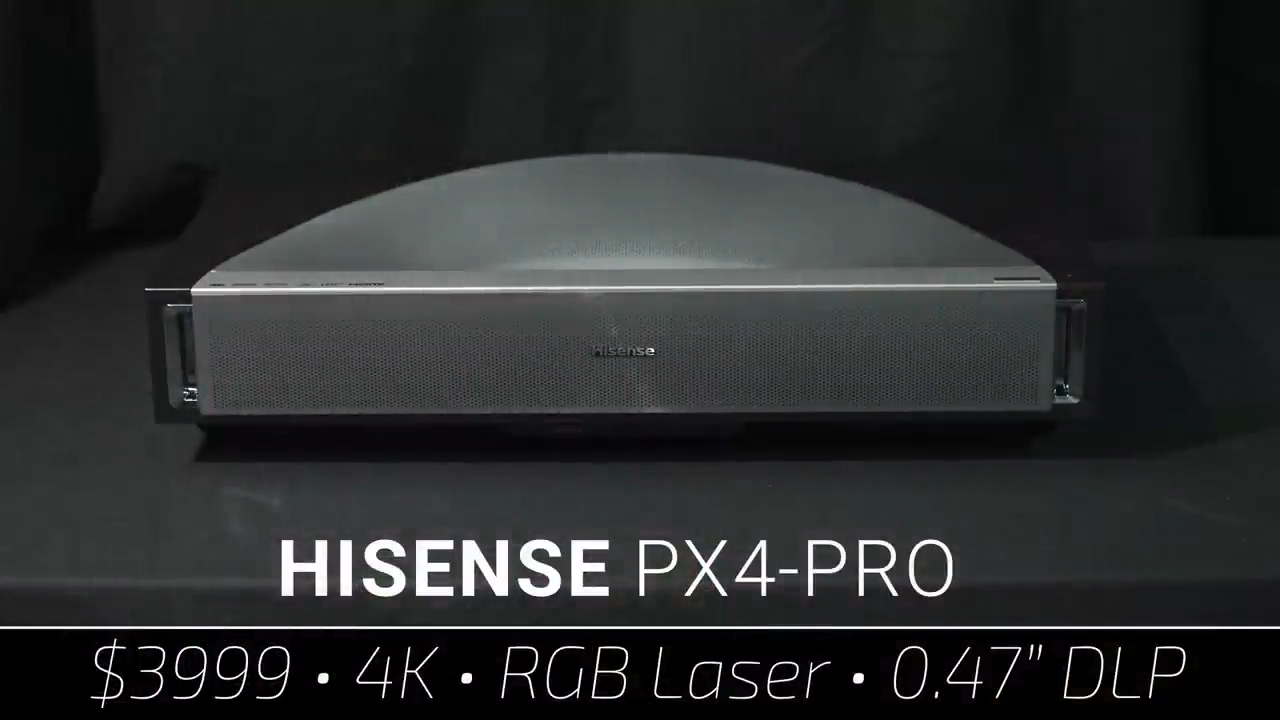
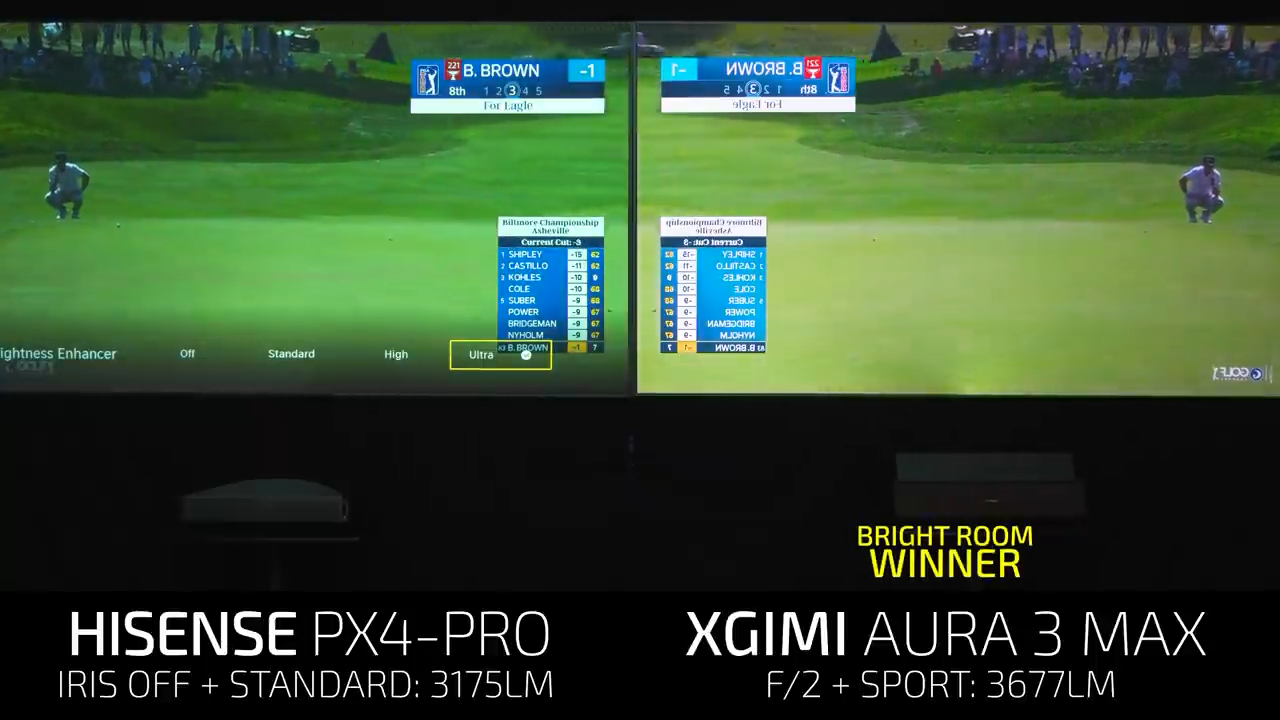
That brings us to Round 6 where it will face the new Hisense PX4-Pro, and like the AWOL projectors, I also have the beta firmware for the PX4-Pro that includes dynamic iris. The PX4-Pro is advertised at 3500 lumens and on brightness enhancer high it hits 4857 lumens but with a heavily green shifted image, and on Theater mode the PX4-Pro still retains a very respectable 2905 lumens.
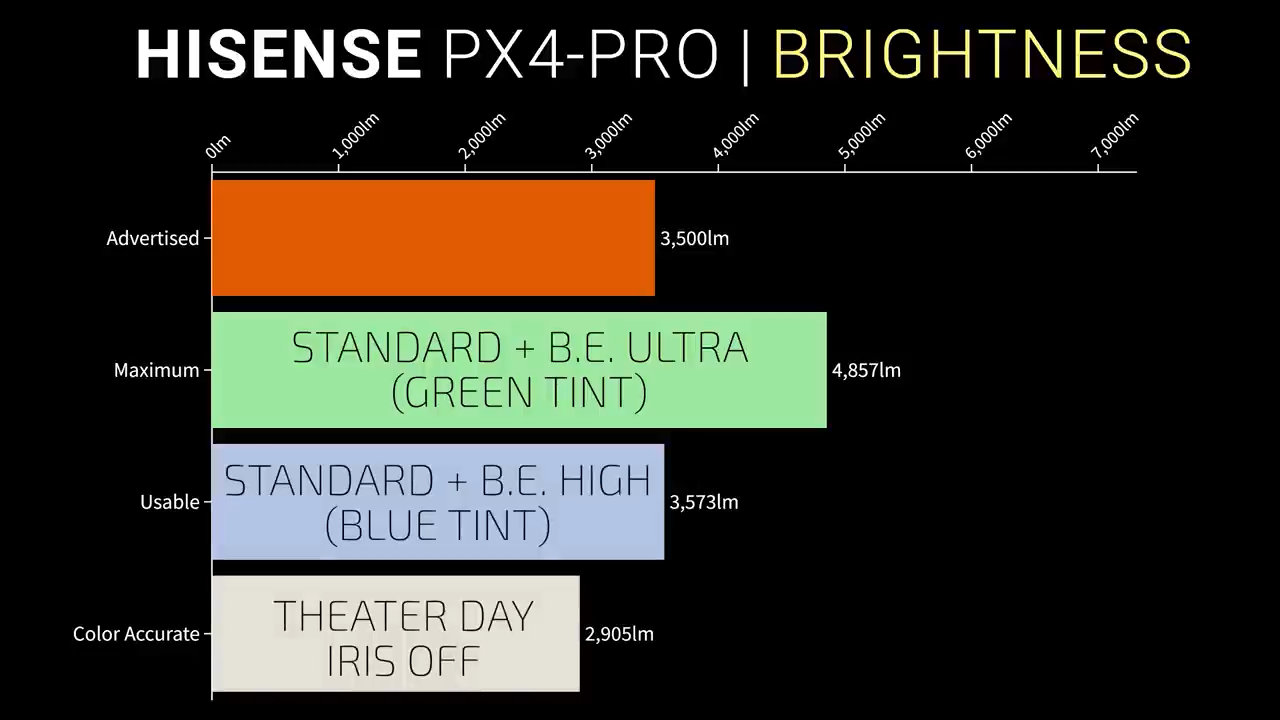
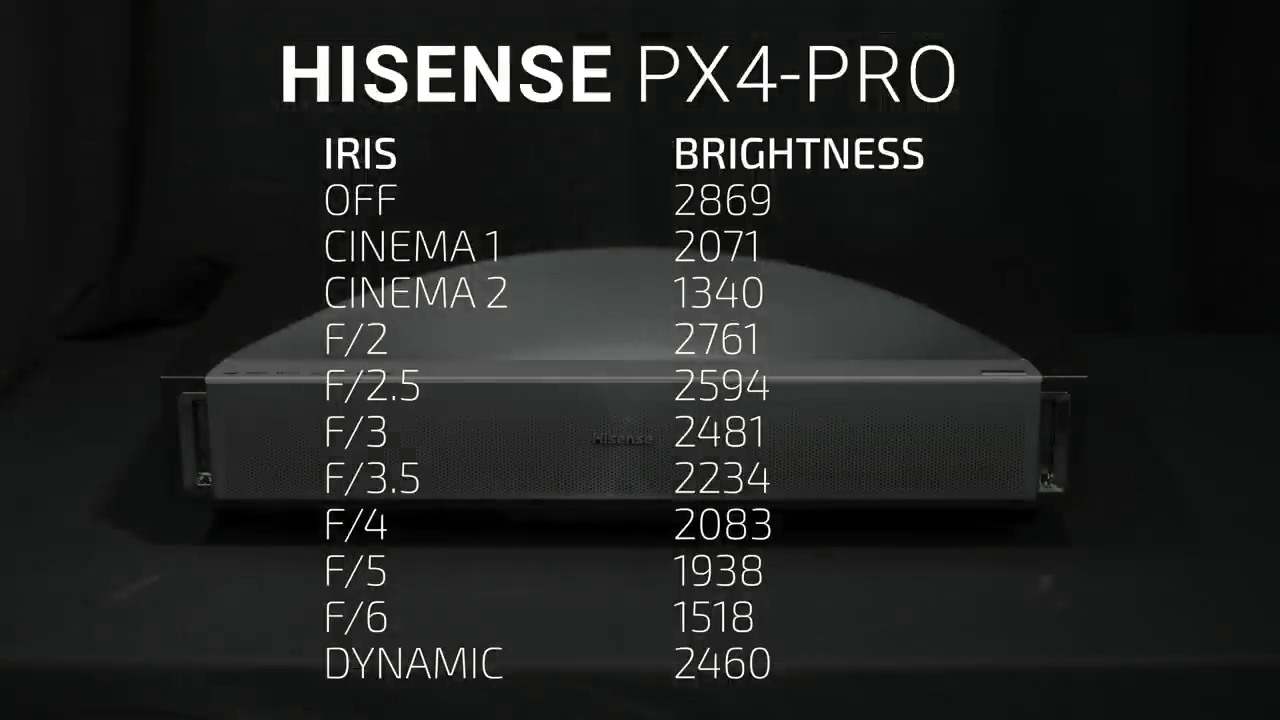
Looking at contrast, the PX4-Pro is a little tricky because engaging the iris in any position automatically turns on laser dimming. But I measured the native contrast with the iris off at 3121:1 and here’s what happens to the brightness as you close the iris. But as I said, there’s no way to know the native contrast with the iris since it automatically enables laser dimming.
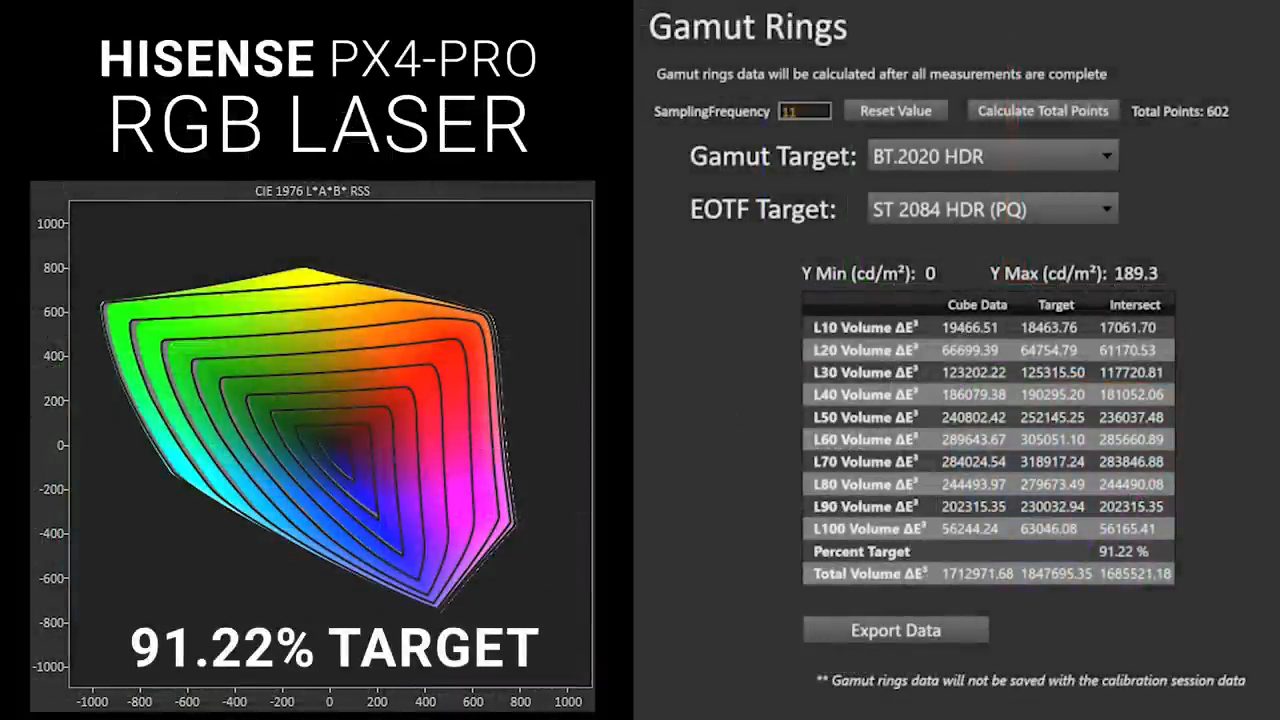
The PX4-Pro has a pretty standard pure RGB laser spectral distribution which allows it to cover 99.9% of the DCI-P3 HDR color space and 95.5% of BT.2020, and while its gamut ring analysis shows some issues with high luminance greens, it still had the 2nd highest gamut ring result hitting 91.22% of the BT.2020 target colors.
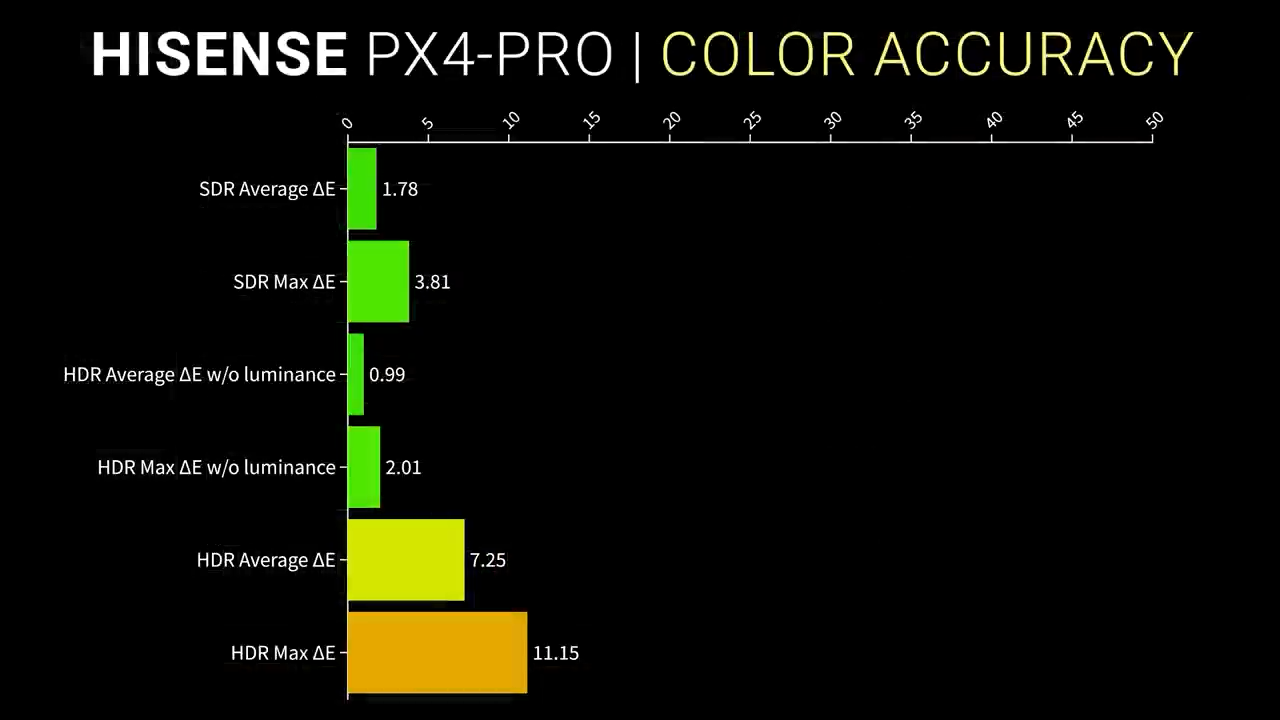
SDR color accuracy was excellent, coming in with an average color error of 1.78 and a max of 3.81, and HDR color accuracy without luminance was the best yet at just 0.99 average and 2.01 max error. So the PX4-Pro has excellent tone mapping, but adding in luminance error raises the average dE to 7.25 with an average of 11.15, which is still enough for 2nd place but almost twice the error of the Aura 3.
Side-by-Side Round 6
With both projectors in Dynamic Iris mode, the PX4-Pro definitely favors keeping its iris more closed down, while the Aura 3 favors brighter highlights at the expense of a lower native contrast ratio. You can absolutely see certain transitions where the PX4-Pro keeps the iris closed, resulting in a much lower black floor but the Aura 3 does eventually adjust.
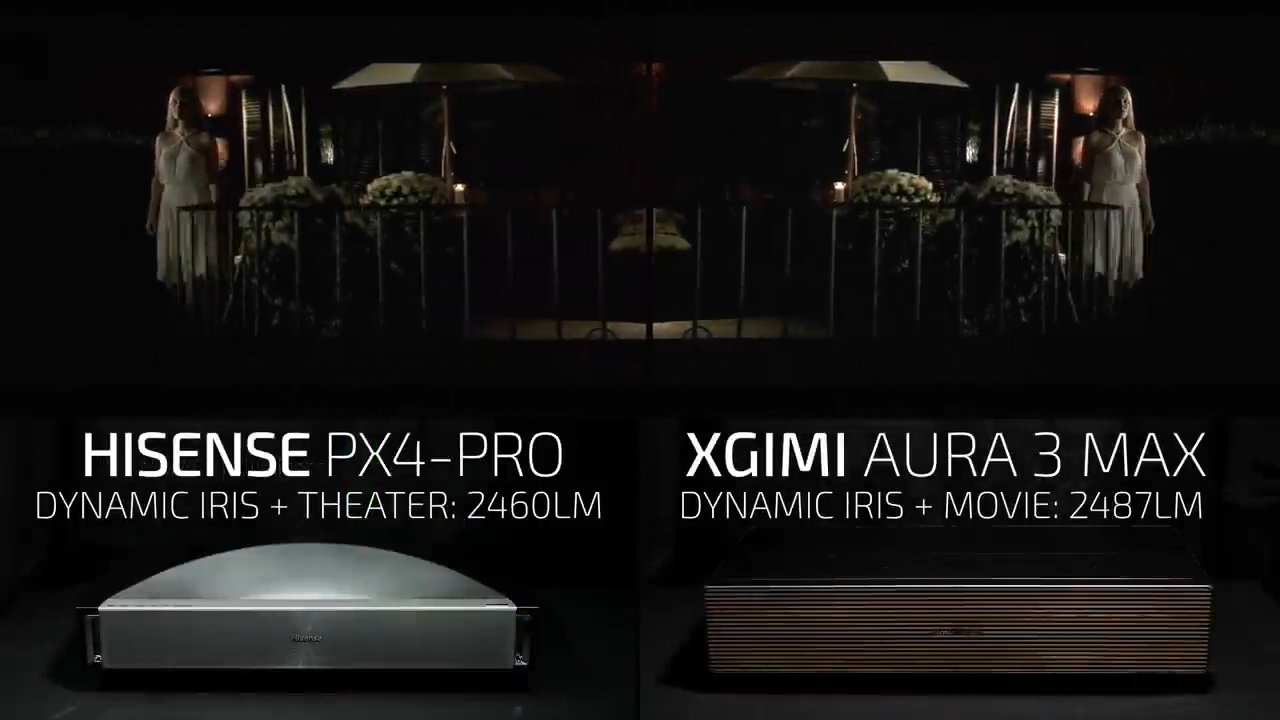
But the thing that stuck out to me the most in moderately lit scenes was the intra-scene contrast of the Aura 3 compared to the PX4-Pro. While it seemed like the black levels on the PX4-Pro were ever so slightly lower, the highlights were disproportionately higher on the Aura 3 in those same frames.
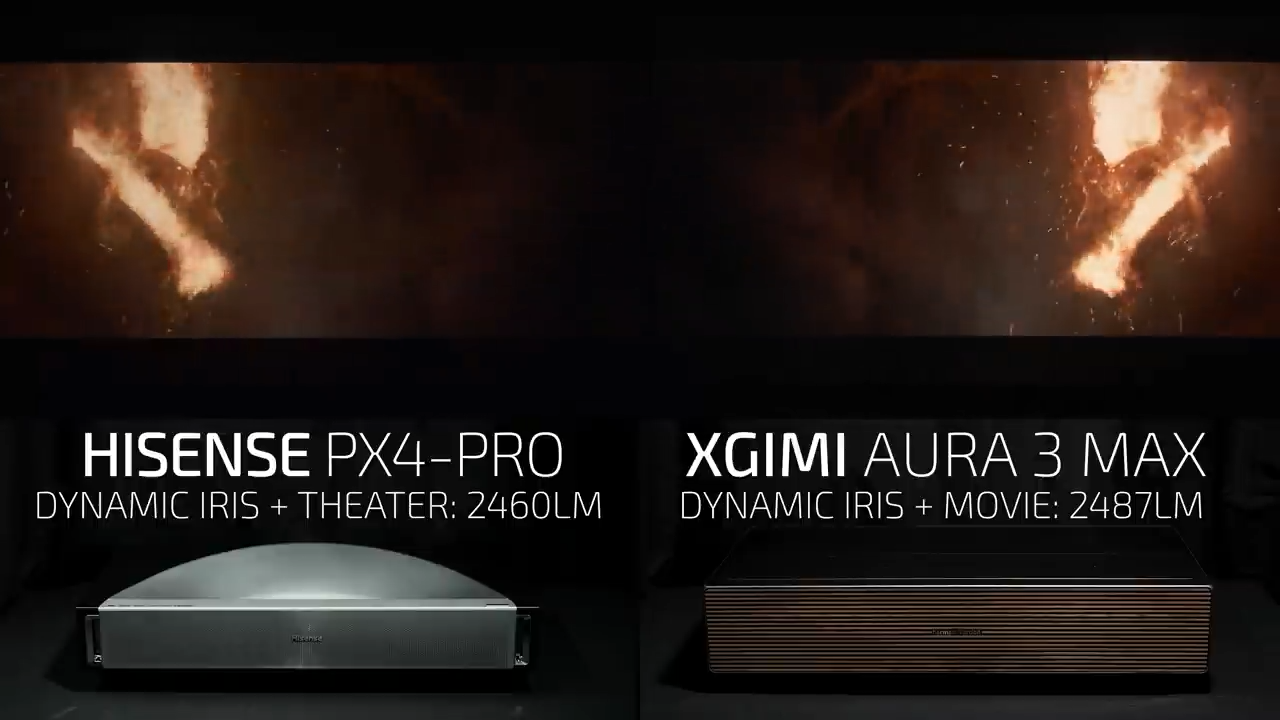
This is probably going to come down to a matter of preference, but that same behavior consistently applied across all of my test scenes. Sometimes it was great, like in 1917, when the PX4-Pro stayed clamped instead of raising the black floor for the window highlight, but other times, like in Rings of Power, it chose to stay clamped even when nearly the full screen was engulfed in flames and took a lot away from the viewing experience.
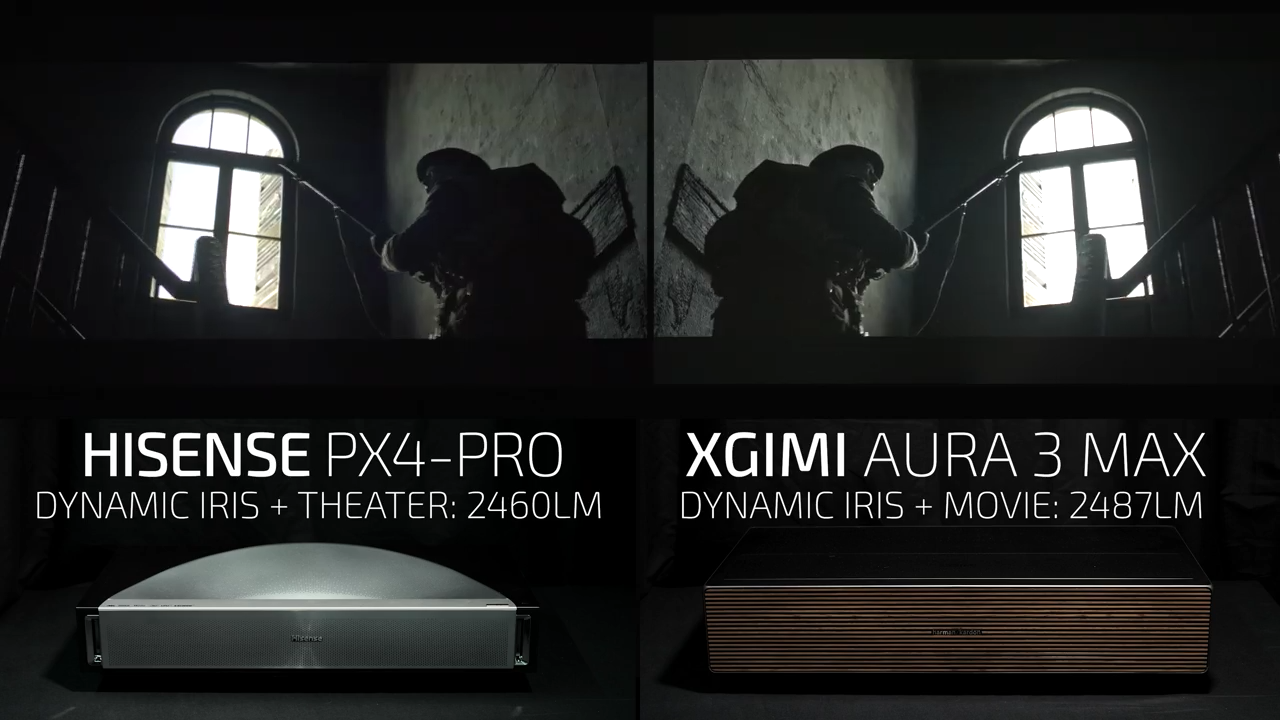
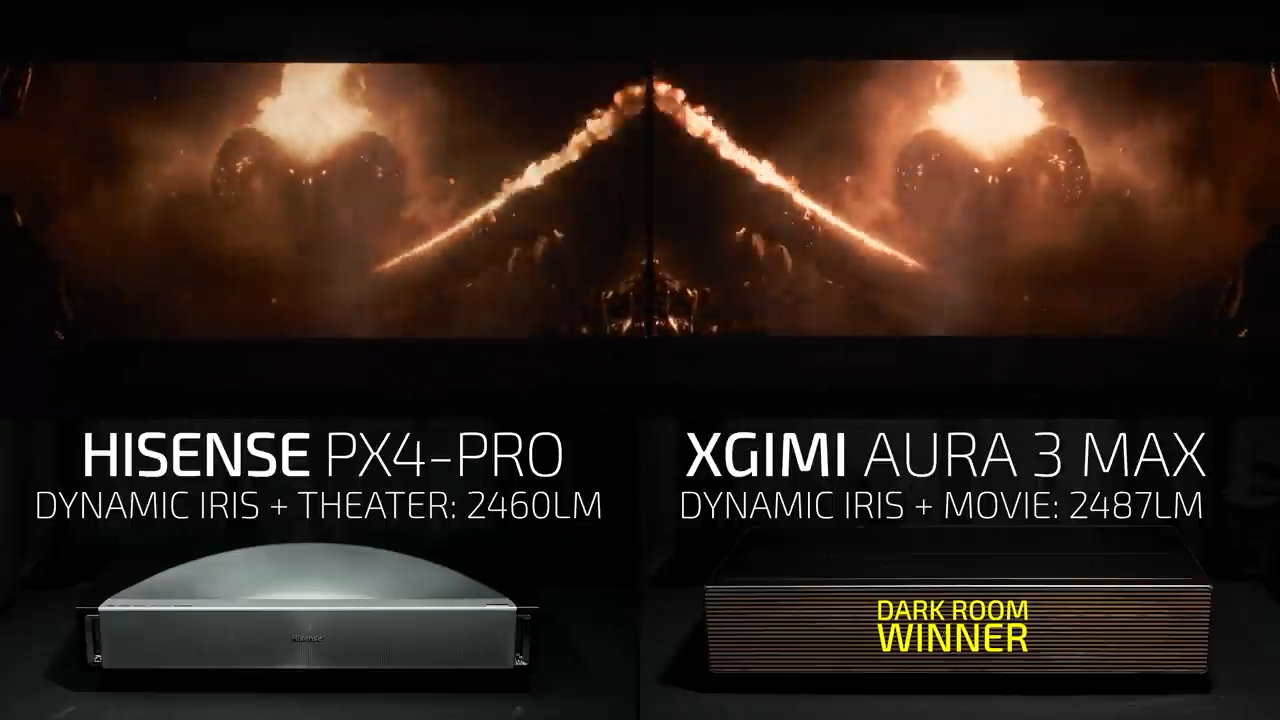
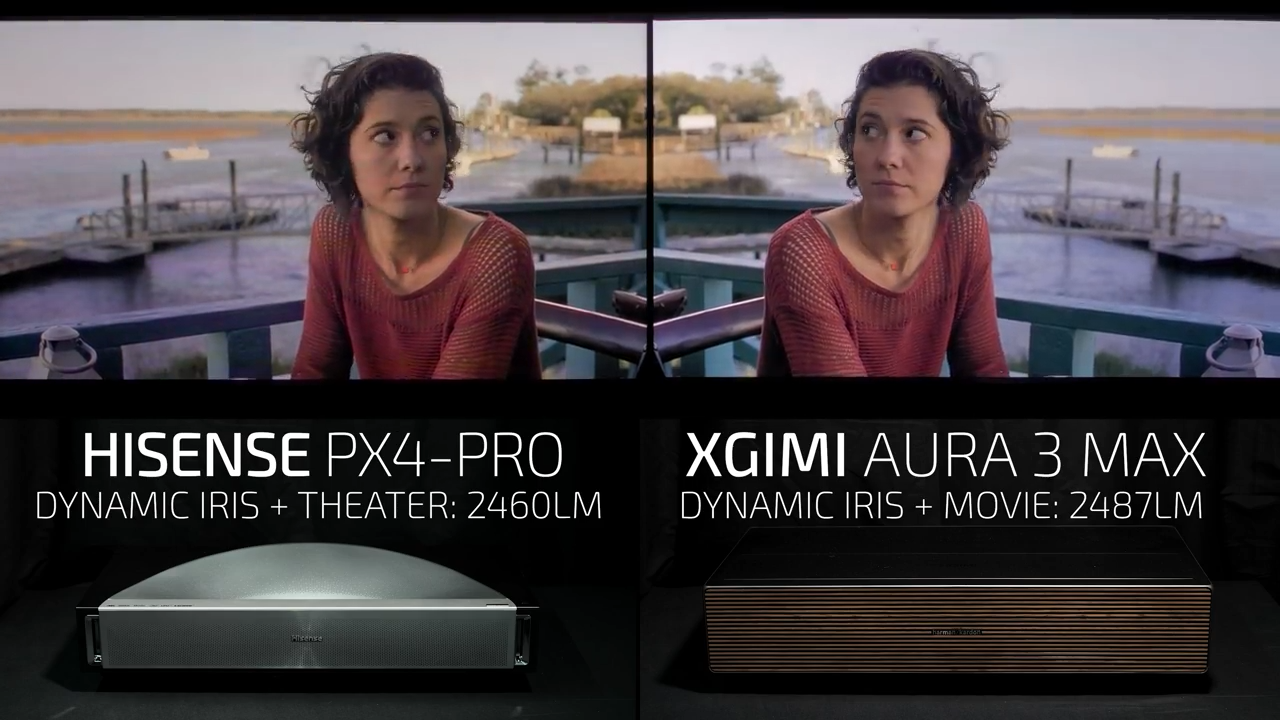
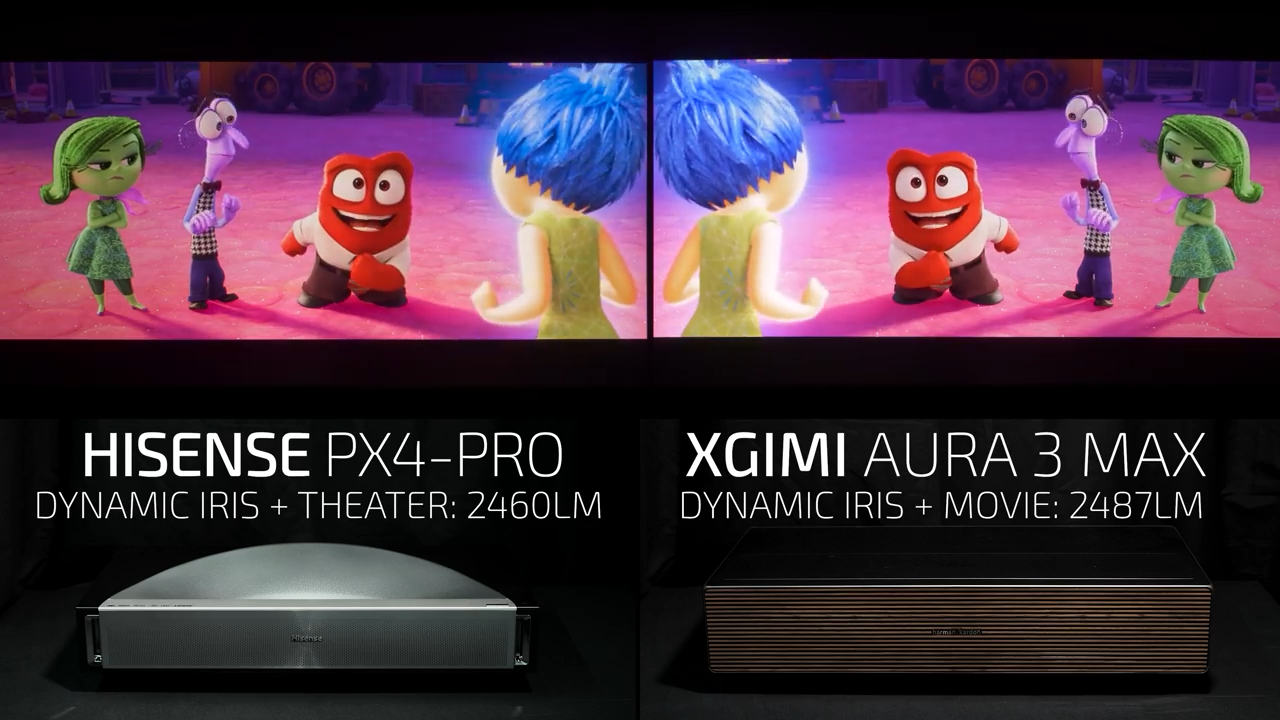
In bright SDR content, the PX4-Pro and Aura 3 were both extremely color accurate, but the Aura 3 was just a little brighter, and in bright HDR content, again they were both absurdly good with excellent color accuracy and vibrance.
I hate to have it come down to this again, but the only scene where I wasn’t constantly wavering back and forth between the two projectors was the Balrog scene. It wasn’t even close between the two projectors, with the Aura 3 producing bright, saturated fire. I think this is going to be another very narrow win for the XGIMI Aura 3 for dark room viewing, but the PX4-Pro was also just excellent, and I would have zero issue recommending it as a dark room projector.
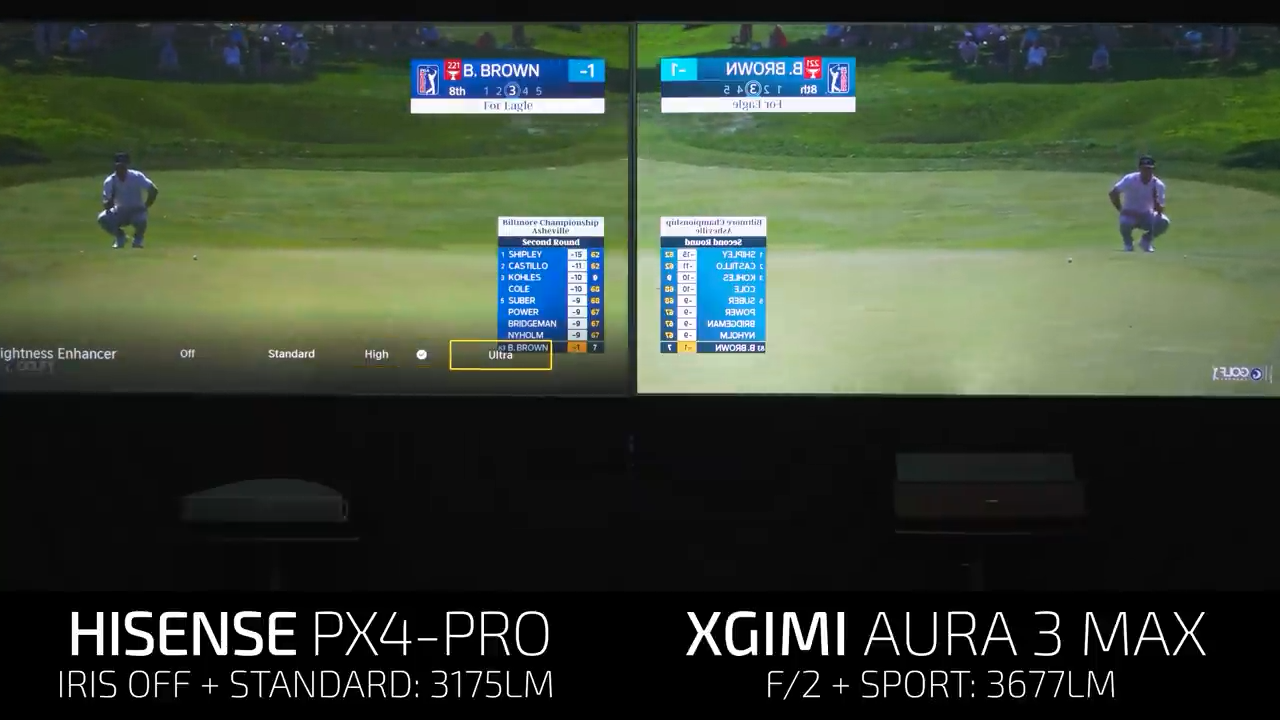
However, flipping the lights on, the Aura 3 consistently looked brighter and more accurate to me. I tested out all three levels of the brightness enhancer, and it wasn’t until brightness enhancer ultra that the PX4-Pro had a brightness advantage, but that came with very poor color accuracy. So the Aura 3 easily took the bright room win in this round.
AWOL Aetherion Max Testing
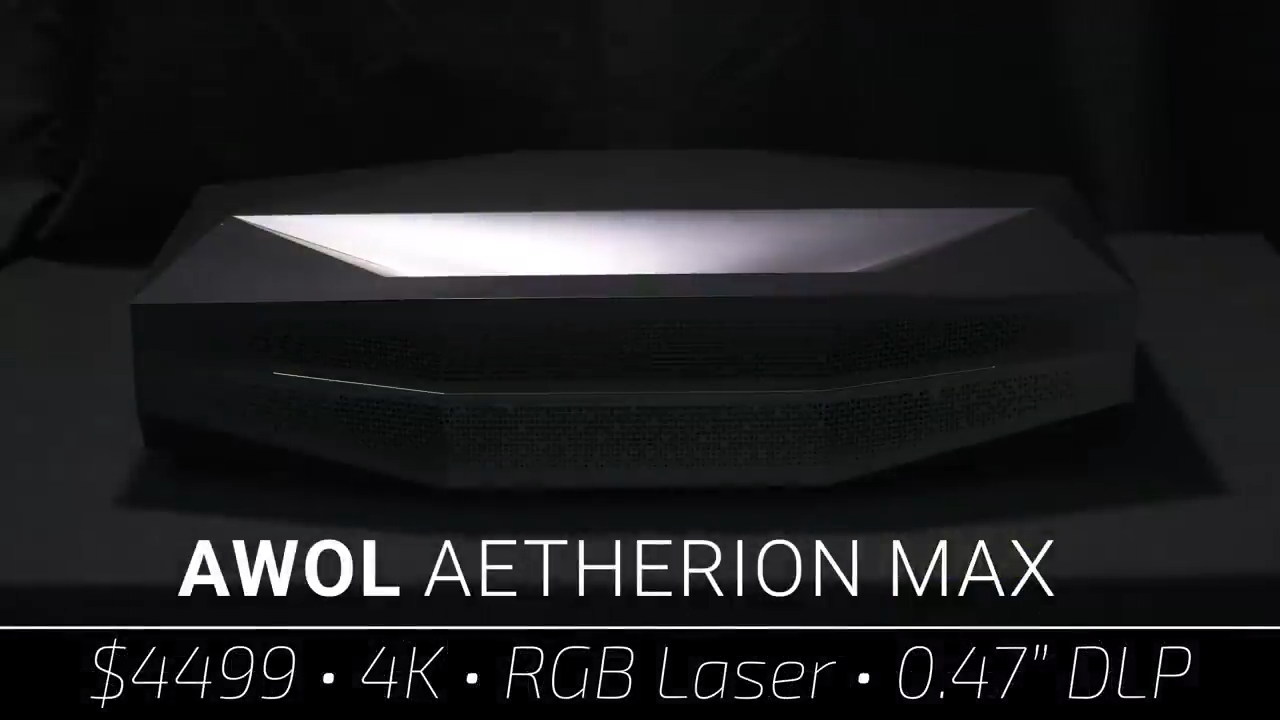
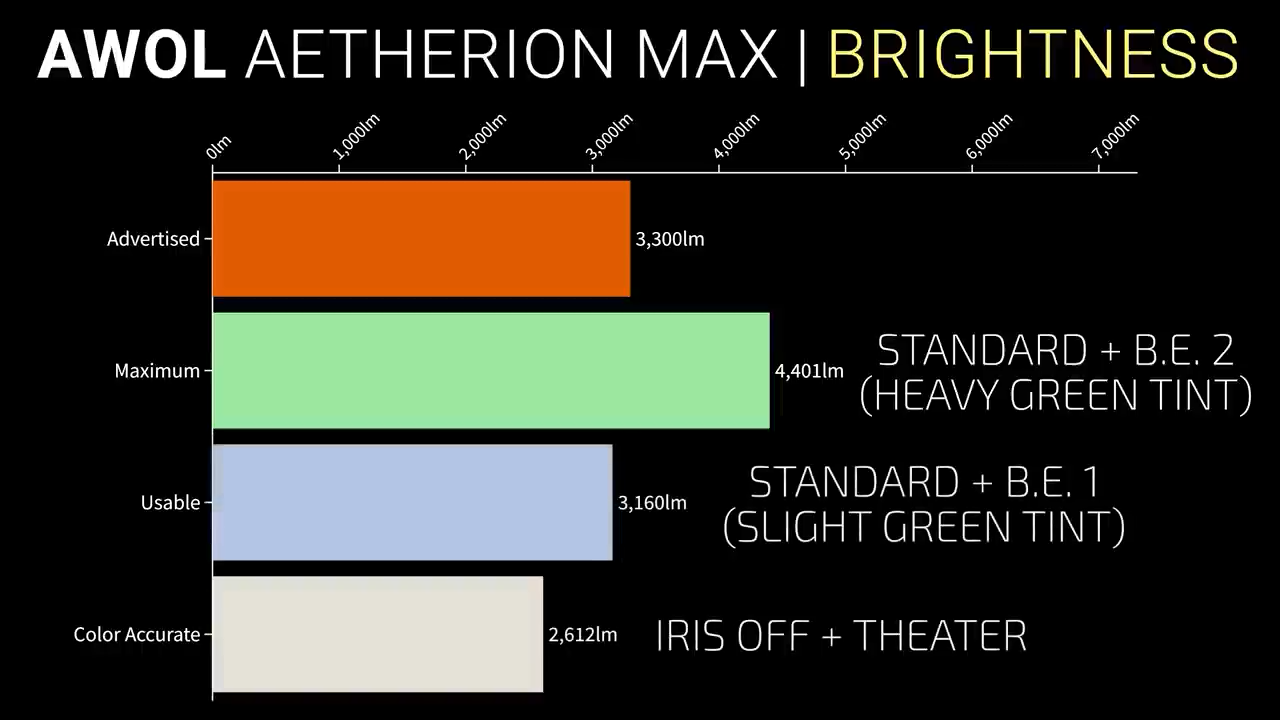
So Round 7 has the $4499 AWOL Aetherion Max which is advertised at 3300 lumens and using brightness enhancer high it came out at 4401 lumens, while on Theater mode it had 2612 d65 accurate lumens without the iris engaged.
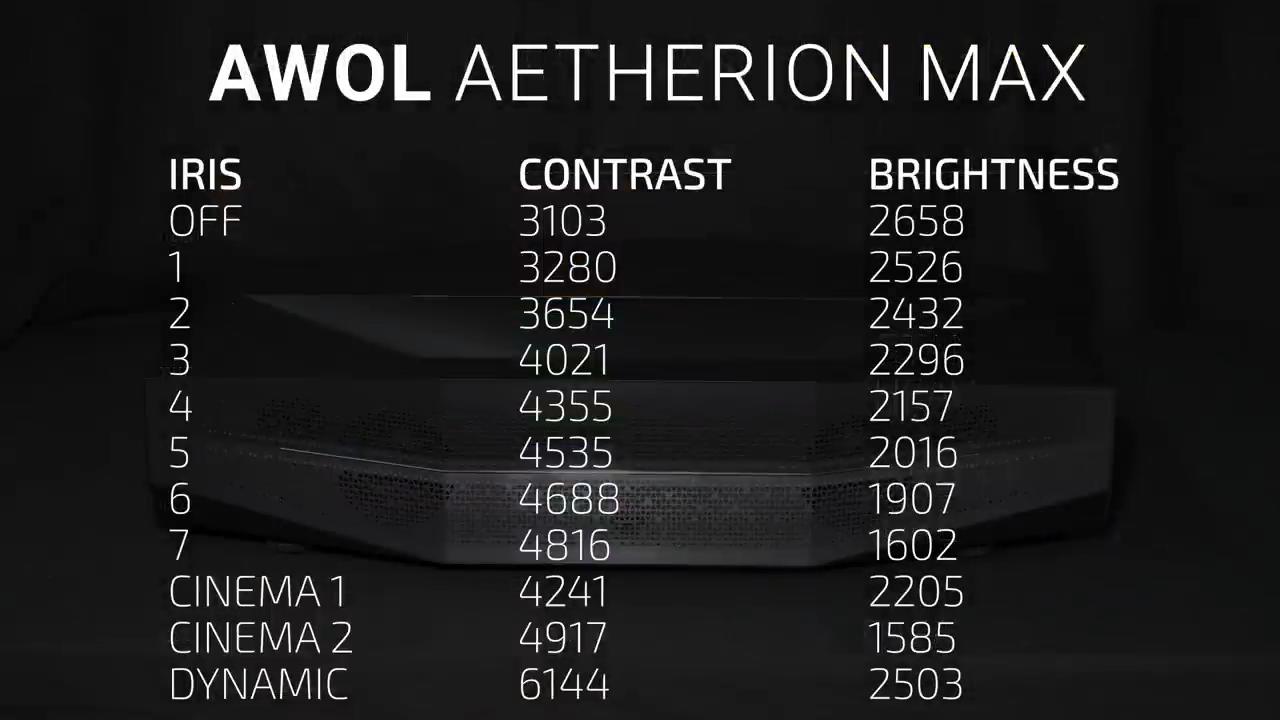
Like the Aetherion Pro, I also have the Dynamic Iris beta firmware for the Max, and here’s how the brightness and contrast change with each iris setting. I’m not sure if it’s intended behavior but you’ll notice that the dynamic iris on the Max favors a brighter image and can open all the way to about iris 1.2 and close to around 5.2 compared to the Pro that when from 2.5 to 6.5. But both have approximately four iris steps in their dynamic algorithm and on the max, that results in a dynamic contrast of 6144 using just the iris and 24096 using dynamic iris and EBL laser dimming.
The Aetherion Max’s spectral distribution shows some extreme peaks in the red primary that weren’t present on the Pro that may lead to greater laser speckle and metamerism, but it did help the Max have a slightly higher color gamut coverage with 99.3% of P3 and 93.6% of BT.2020. Interestingly, the gamut ring performance on the Max wasn’t as good as the Pro with more missing colors, missing the highest luminance oranges and yellows resulting in 2% less coverage of the target than the Pro.
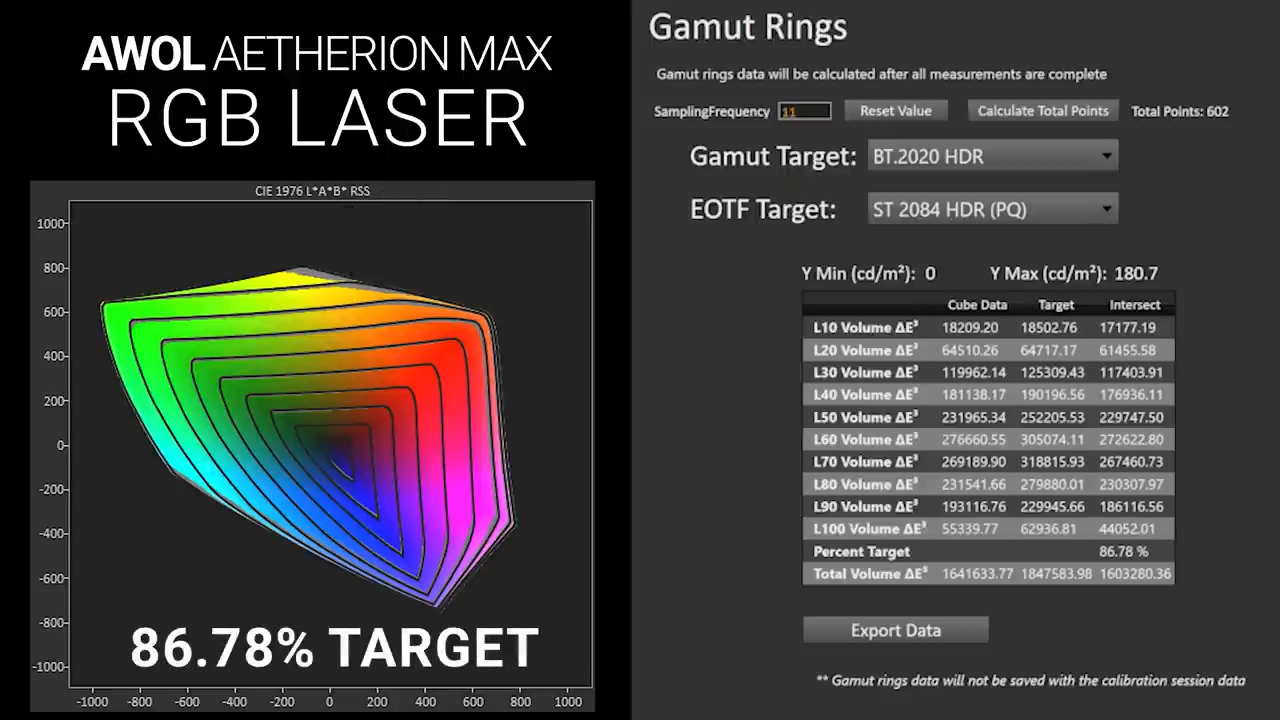
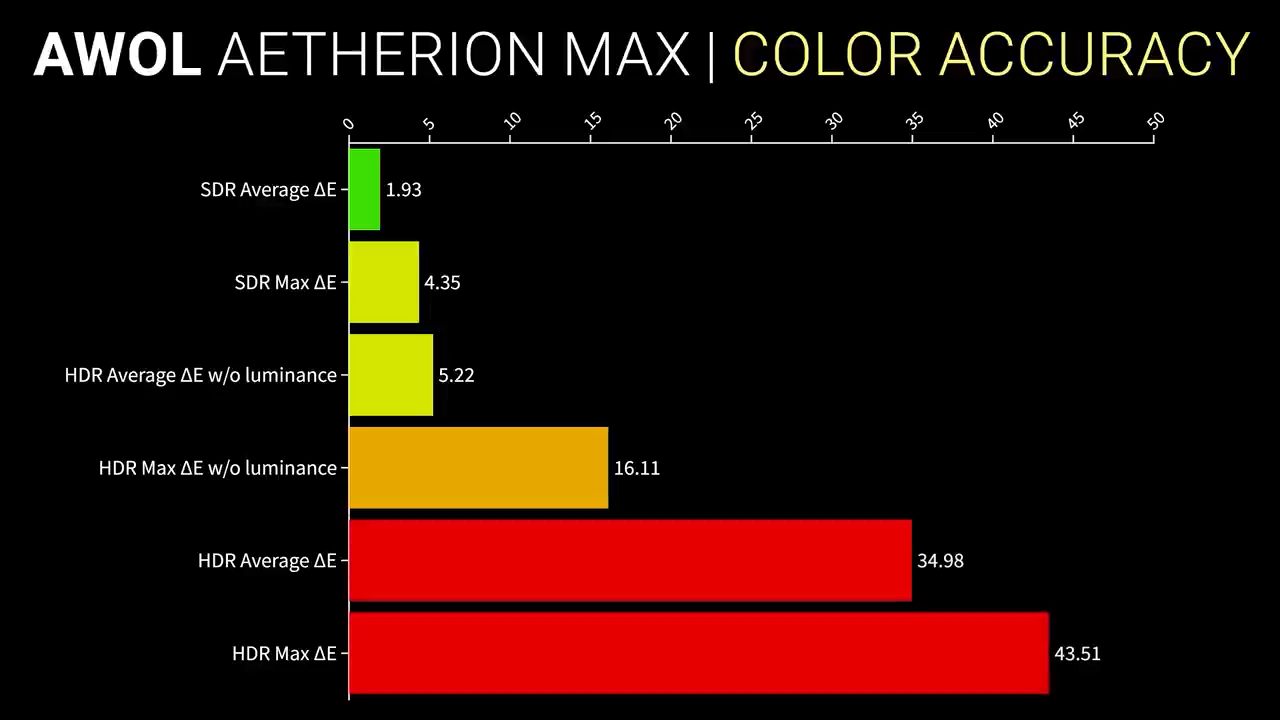
The Max also had a slightly higher SDR color error of 1.93, but that’s still under the 2.0 acceptable threshold, and HDR color error without luminance was better than the Aetherion Pro at 5.22 but including luminance the HDR color error was by far the highest in the video at an average of 34.98.
Side-by-Side Round 7
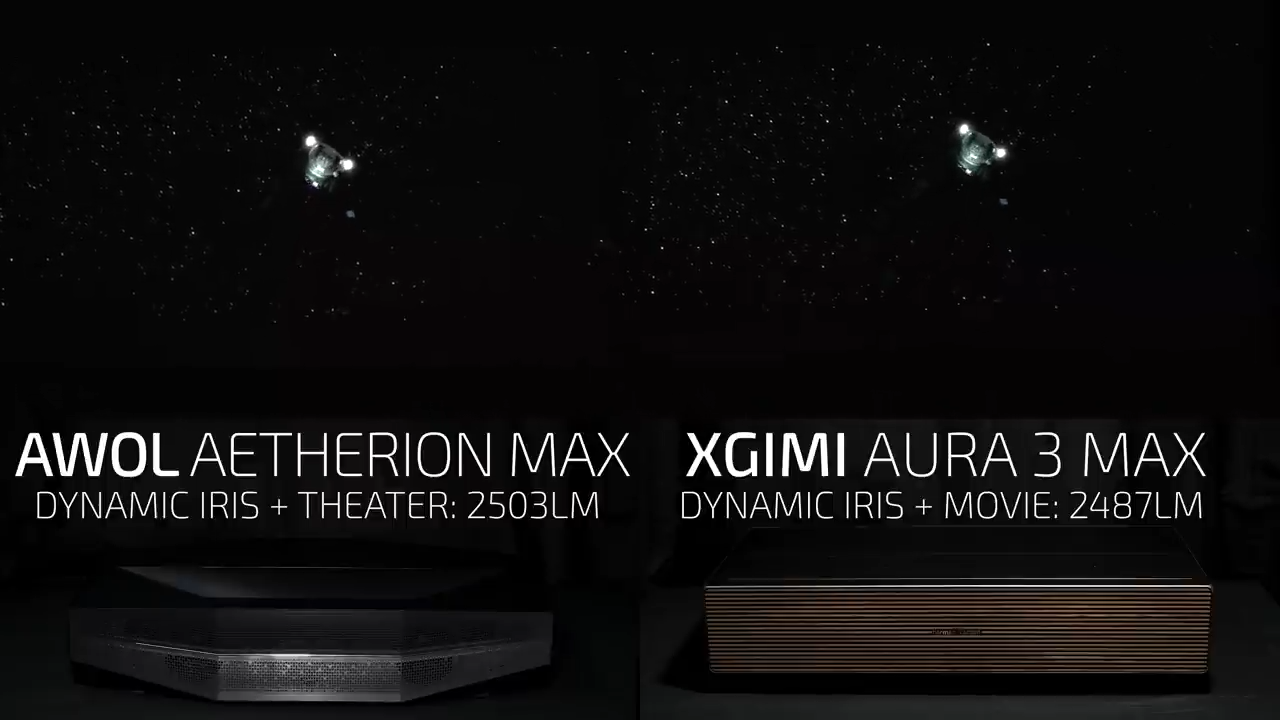
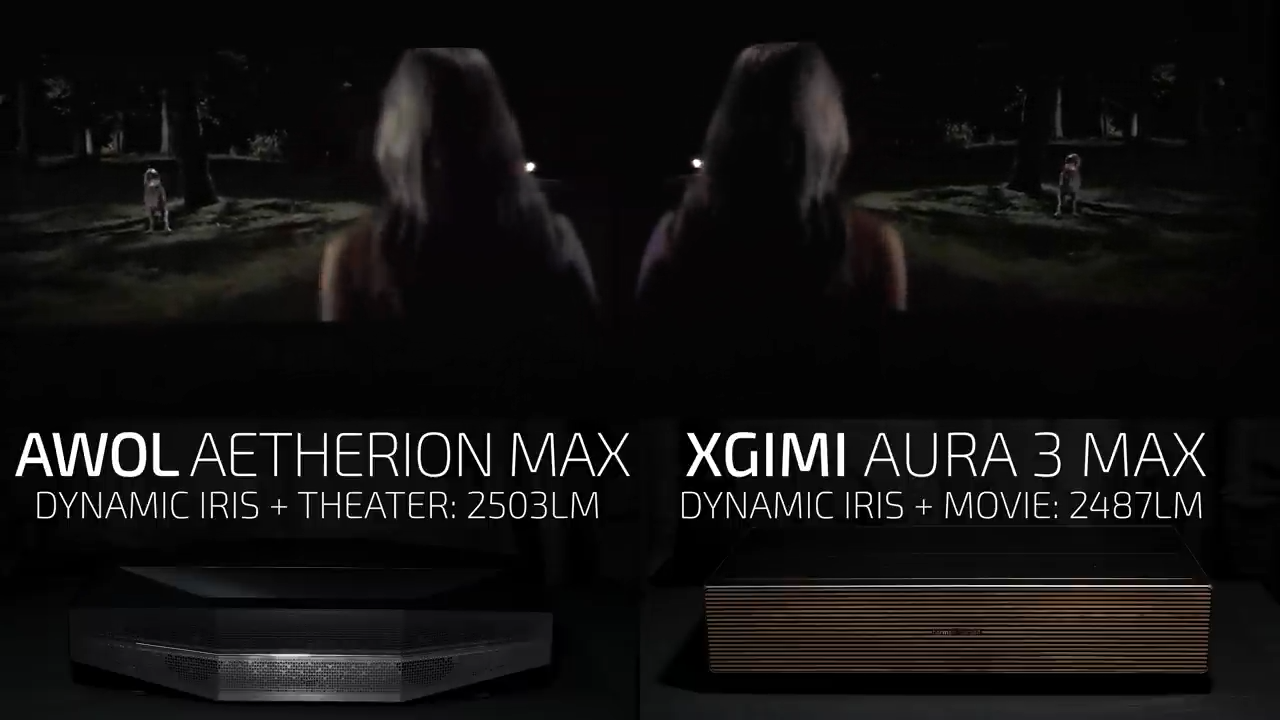
I have to admit, the meters say one thing, but I’m really not seeing that kind of HDR color error, and I do think that bright HDR content looked better on the Aura 3 just due to the extra brightness with both of the projectors on Dynamic Iris mode, but in terms of accuracy it’s hard to understand how this is a dE of 34.98 and this is 3.74.
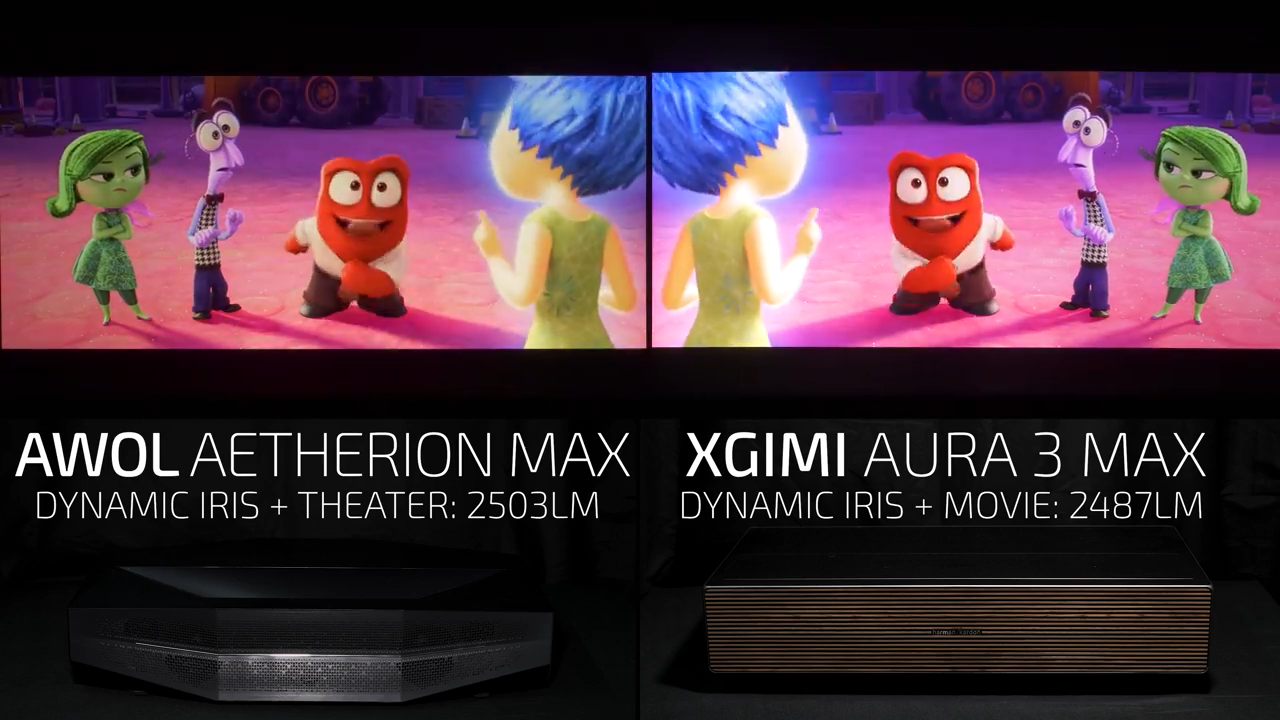
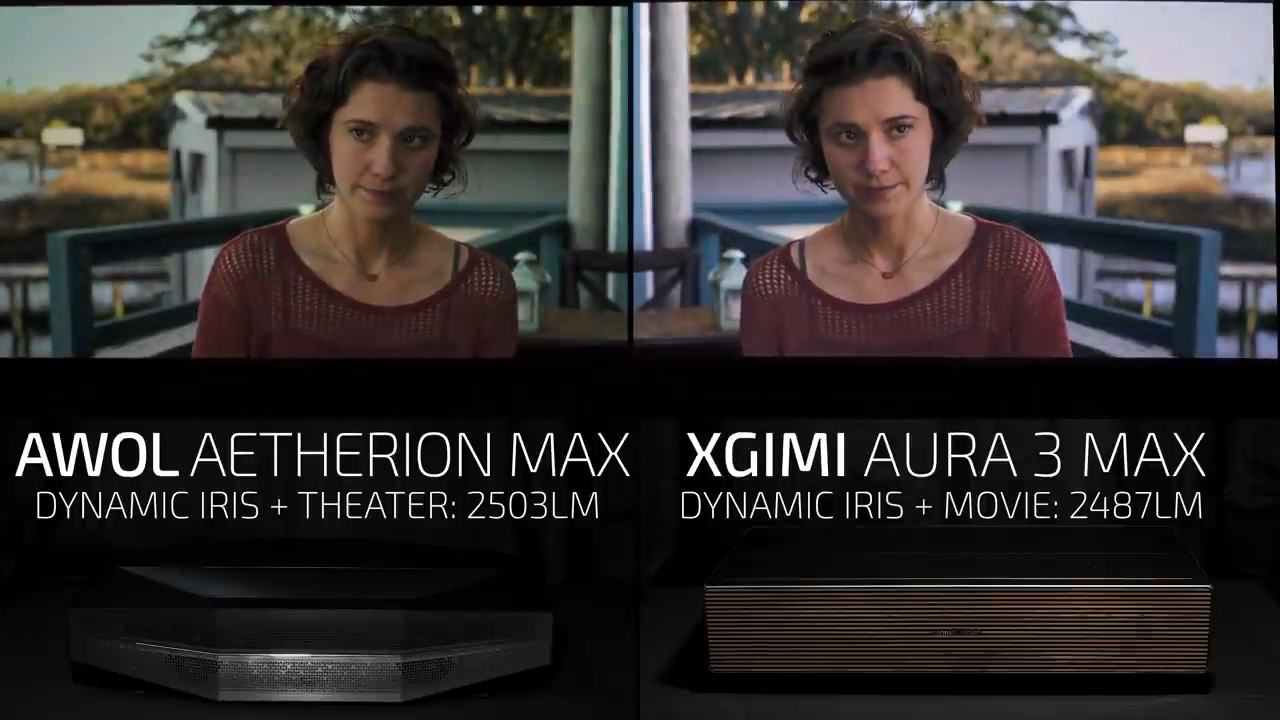
In Rings of Power, it was definitely the first projector to hang with the Aura 3. I liked the extra brightness and reflections that the Aetherion brought, though I think the skin tone was a little bit off. And when the Balrog showed up, both projectors did a great job with the fire, with the Aura 3 showing a little more of that super high luminance orange. The Aura 3 felt like it had slightly higher intra-scene contrast, but both were excellent.
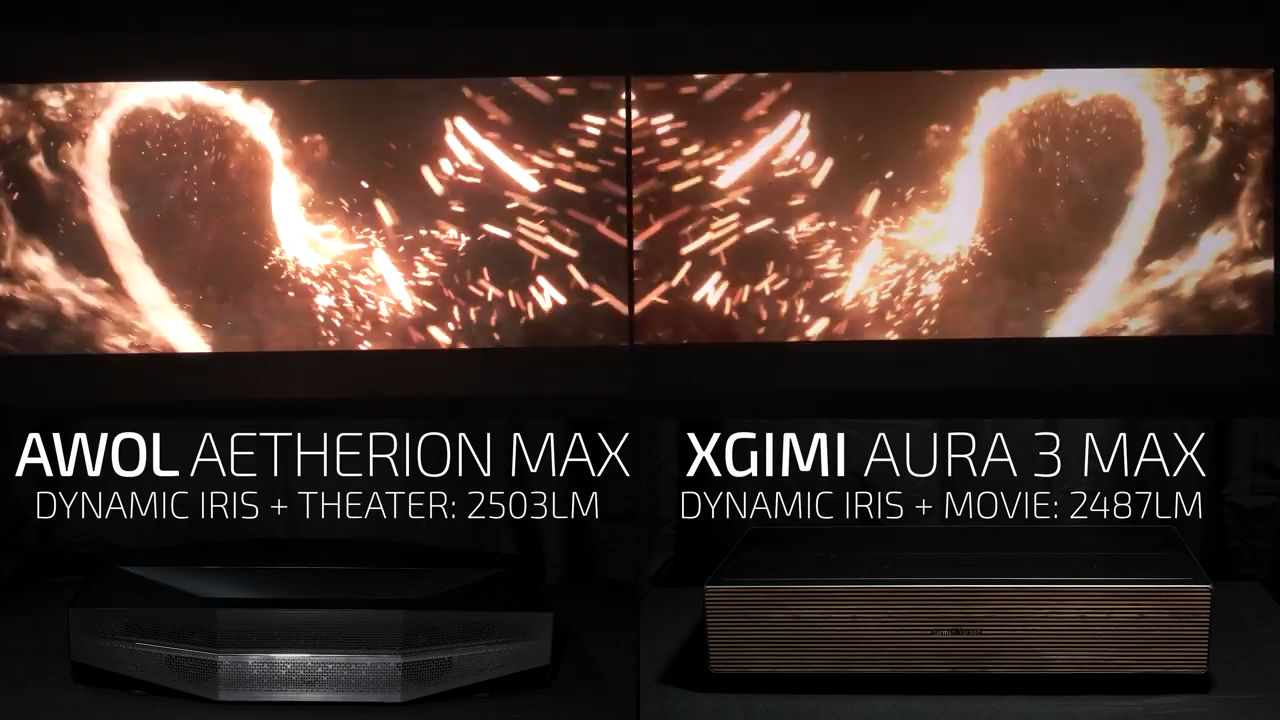
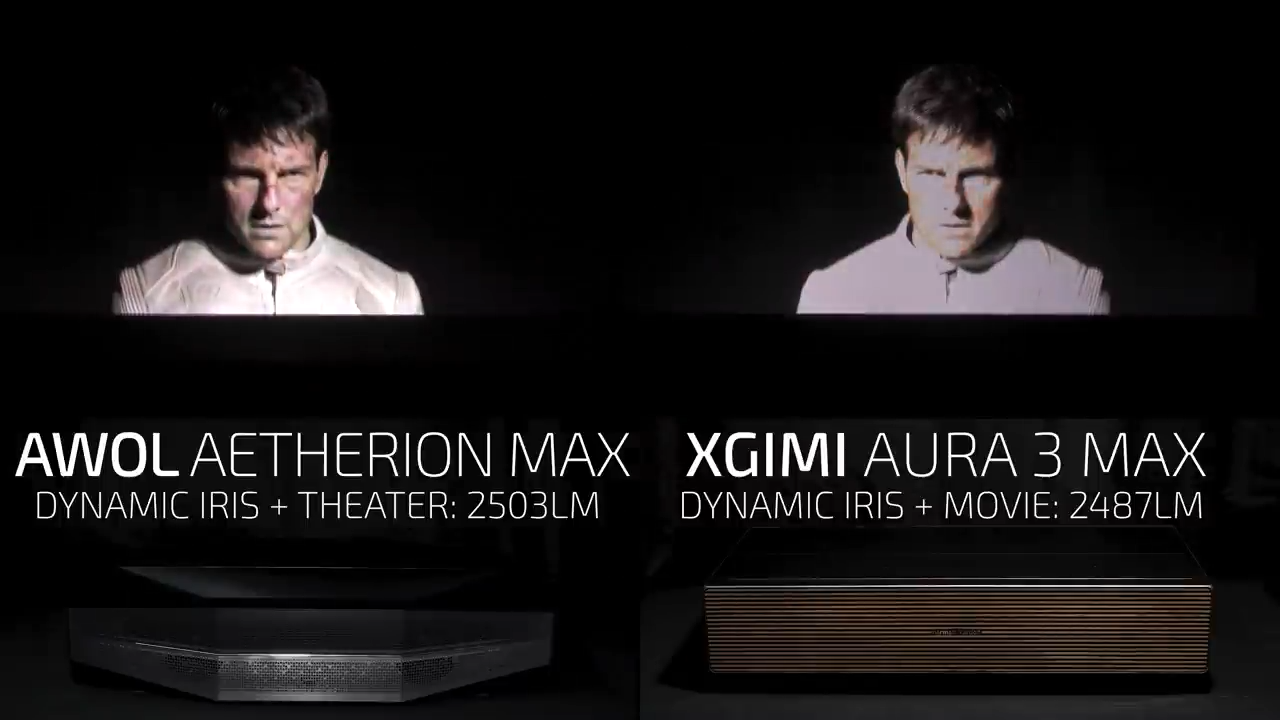
In SDR, the Aura was definitely more color accurate and slightly brighter when both projectors were on Dynamic mode. In the darkest scenes, the big difference again was that the EBL on the Aetherion is faster to react, but the dynamic system on the XGIMI digs deeper and produces deeper blacks and higher contrast when it eventually kicks in. Overall, I preferred the Aura 3, but I want to point out where AWOL’s EBL absolutely dominates XGIMI’s DBLE: coming out of dimming. In Oblivion where the camera is on Morgan Freeman, dimming and iris are fully engaged, and in the quick cut back to Tom Cruise, this is the first frame out of dimming. You can see that EBL has recovered the gamma but still has dim lasers while the XGIMI has dimmed lasers but also hasn’t corrected the gamma curve. Two frames out of dimming, EBL is fully recovered and DBLE is still a mess, and it takes a full 12 frames or half a second to fully recover. In person, my eyes generally interpret this as my own iris movement, but looking back at the footage you can tell EBL is more refined than DBLE during those specific transitions. But as I said, that wasn’t enough for me to overlook the greater intra-scene contrast and deeper blacks of the Aura 3, so it’s still going to take the win for dark room performance.
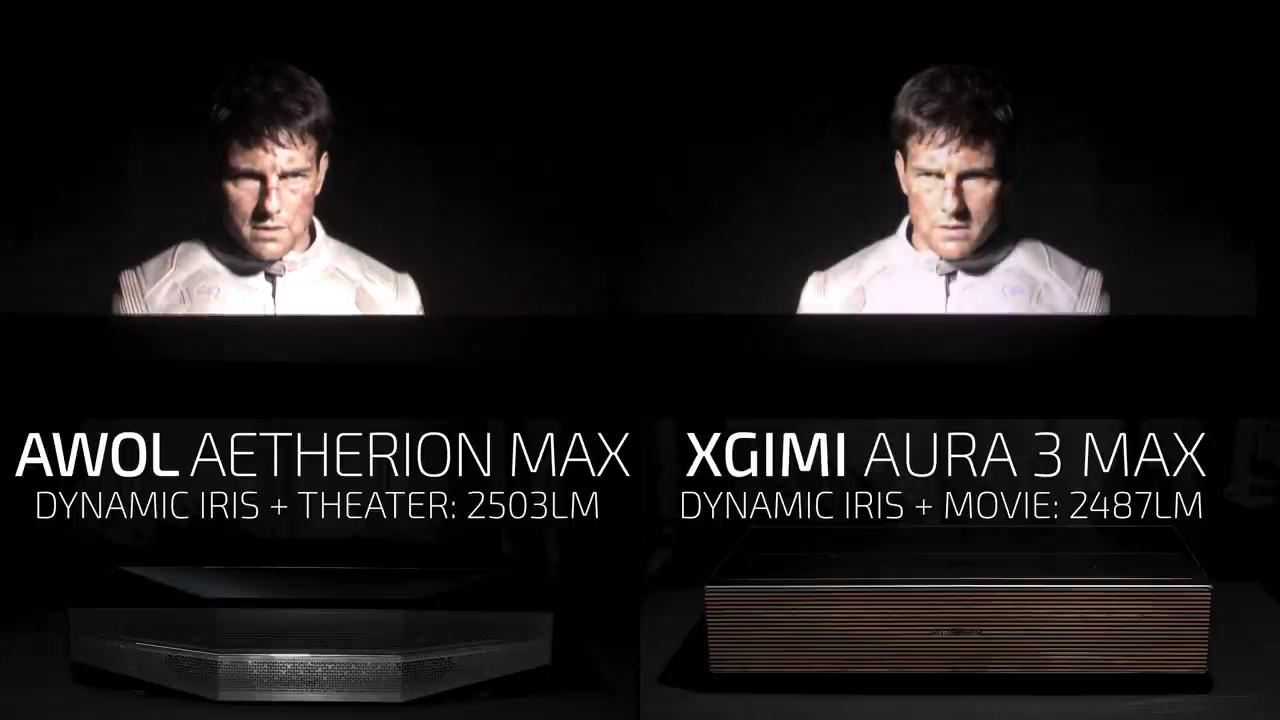
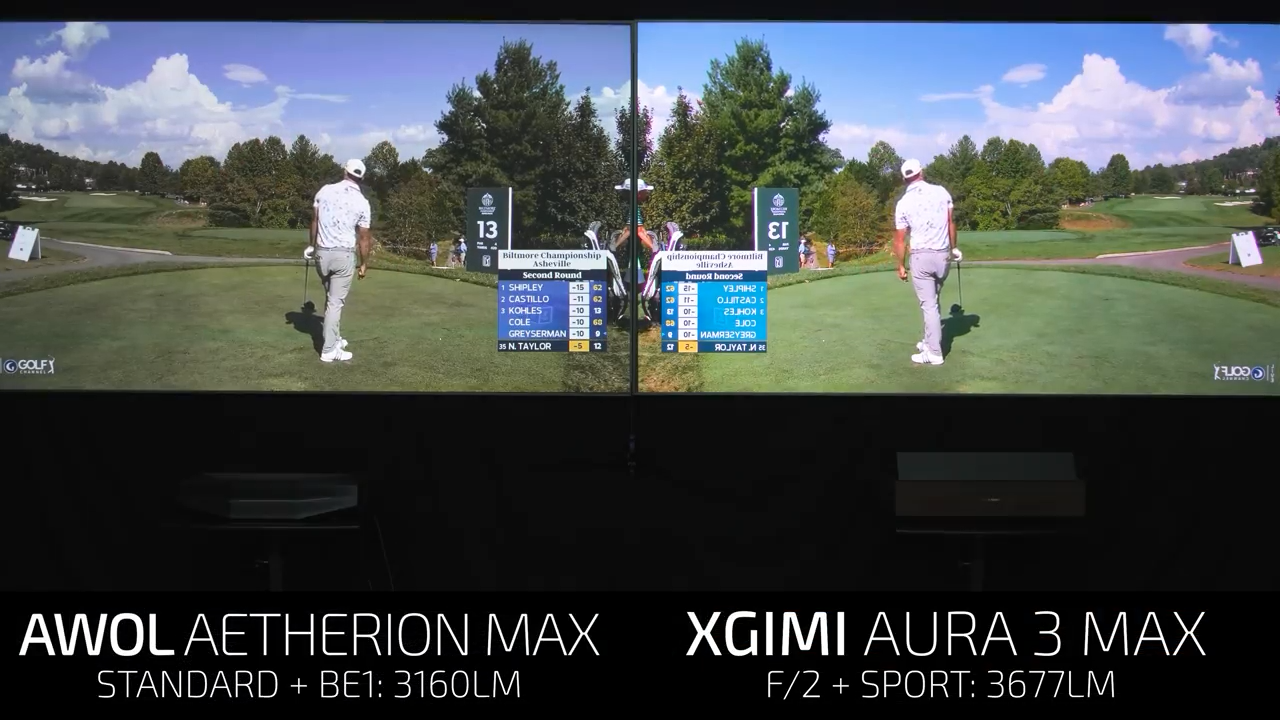
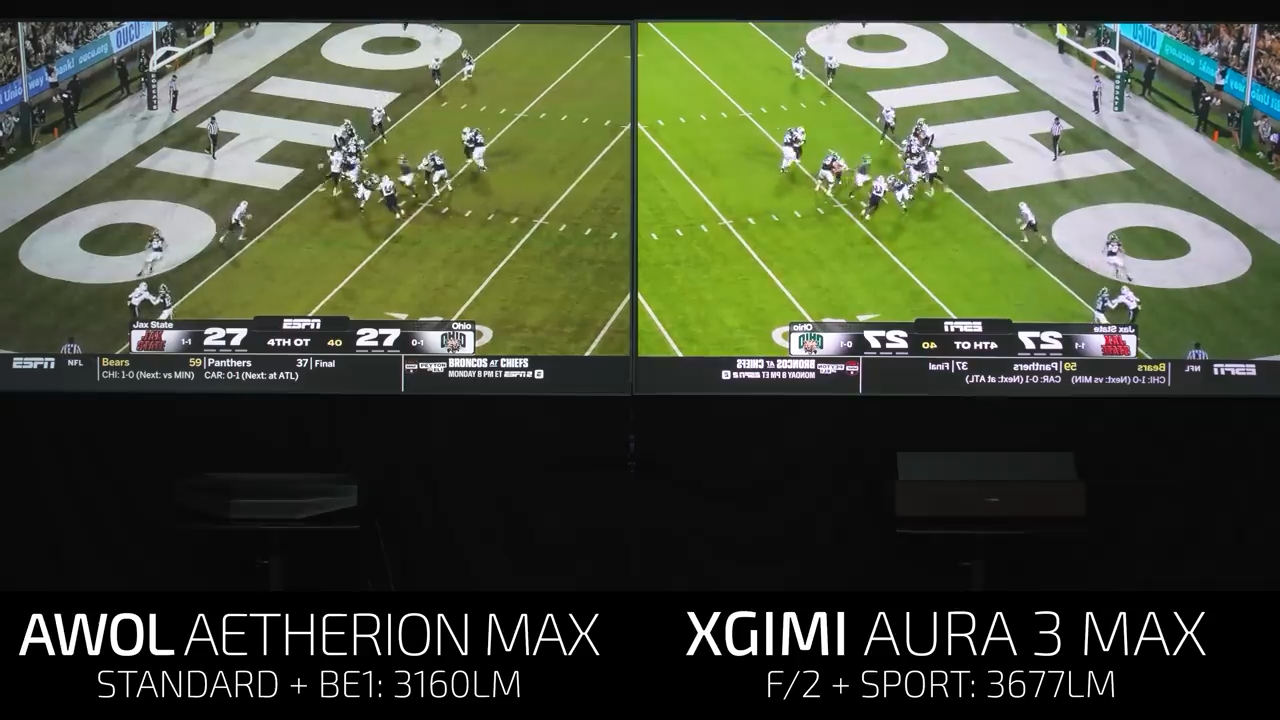
With the lights on, the Aura 3 just looks incredible, and this wasn’t particularly close for me. When combined with a Fresnel ALR screen, the Aura 3 looks bright, vibrant, and accurate and doesn’t have any of the annoying glare that you’d be dealing with on a TV in this amount of ambient light, and the Aura 3 is going to move on in both categories again into the final round.
LG CineBeam AI Testing
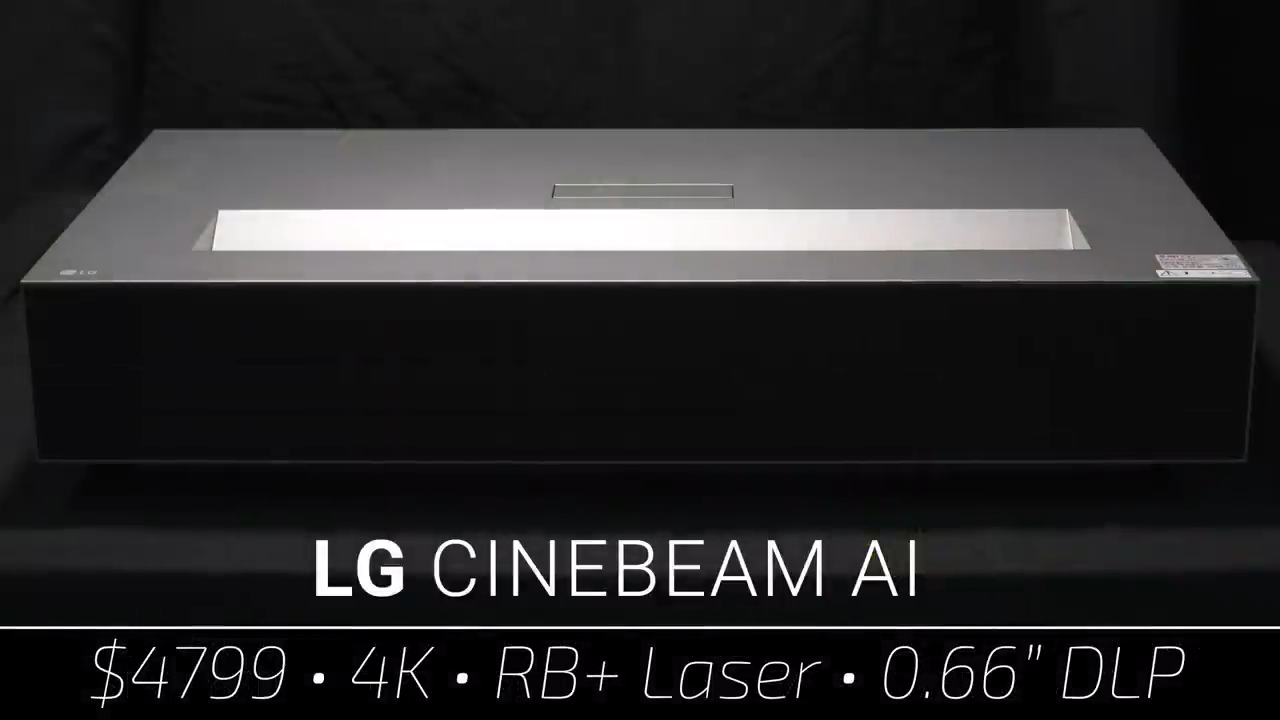
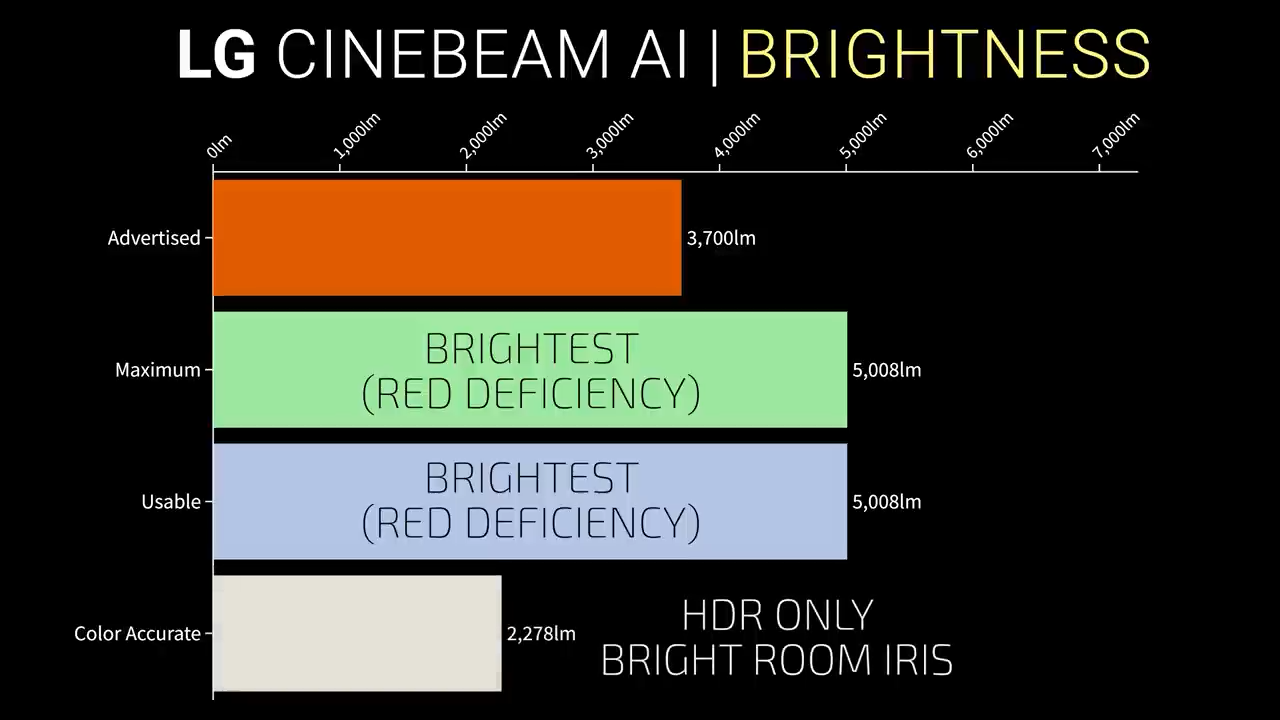
In Round 8 it’s going to go up against the brand new $4799 LG CineBeam AI, the successor to their popular HU915QB. The CineBeam AI is advertised at 3700 lumens, and with the mode set to Brightest while displaying SDR content it actually measured just over 5000 lumens, but if you’re looking for accurate lumens, the CineBeam’s options make it nearly impossible to control the laser brightness.
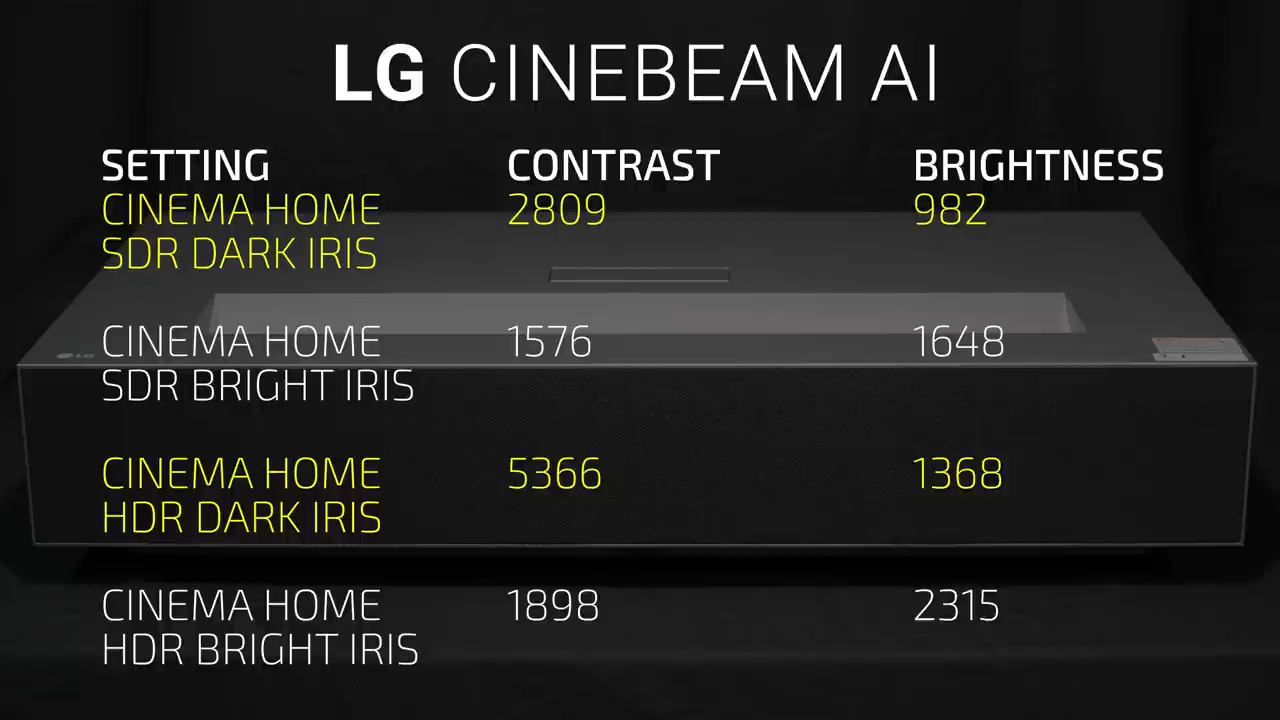
If you choose cinema home and set it to bright room iris, you’ll get 1647 lumens in SDR and 2314 lumens in HDR without changing any settings. If you use the dark room iris for extra contrast, you’ll only get 981 lumens with a 2809:1 contrast ratio in SDR but 1368 lumens with over 5000:1 contrast in HDR, again with the exact same settings, which I found EXTREMELY inconvenient.
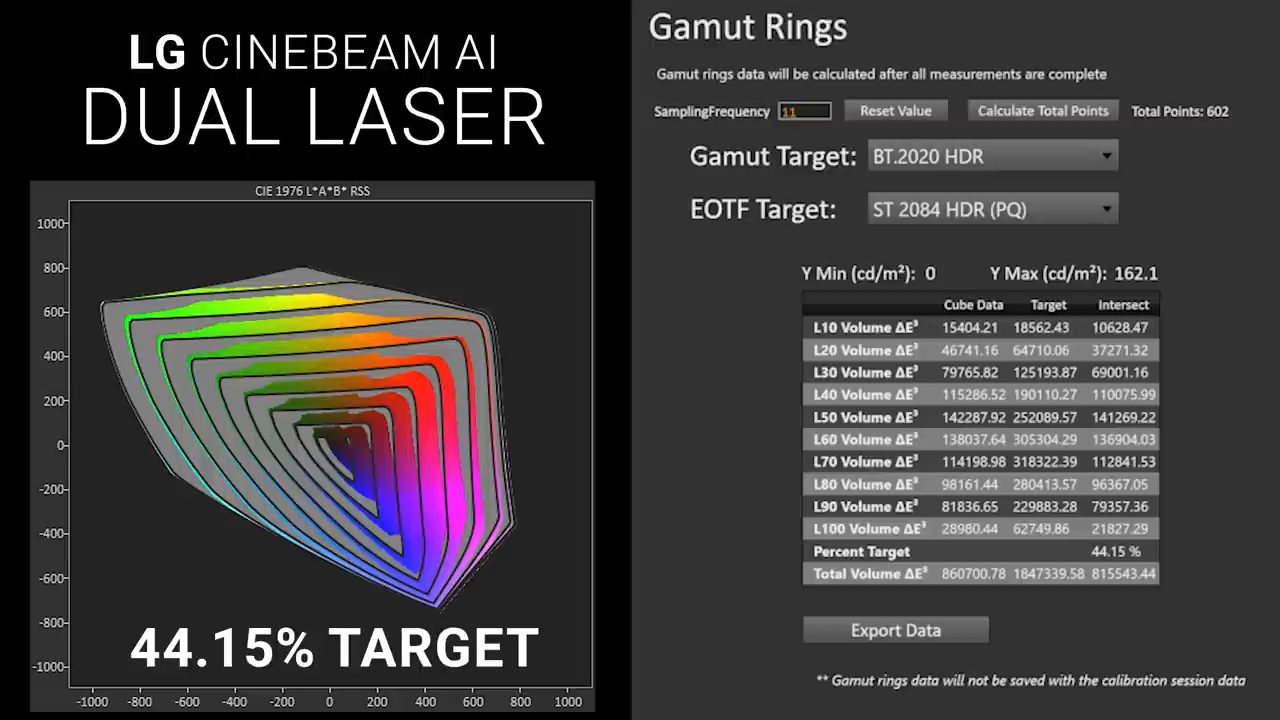
The LG uses a dual laser light source which means it has direct red and blue lasers but uses a phosphor for green, and this typically results in less laser speckle than a pure RGB laser projector but more than a single laser or ALPD hybrid like the Epson or NexiGo.
Unfortunately, the slightly lower laser speckle comes with a huge color gamut tradeoff, and the LG covers just 84.6% of DCI-P3 HDR and 64.5% of BT.2020. The gamut ring reveals so many missing colors in the teal, oranges and yellows as a result of the weak green primary, and the LG had the lowest gamut ring score covering just 44.15% of the target colors.
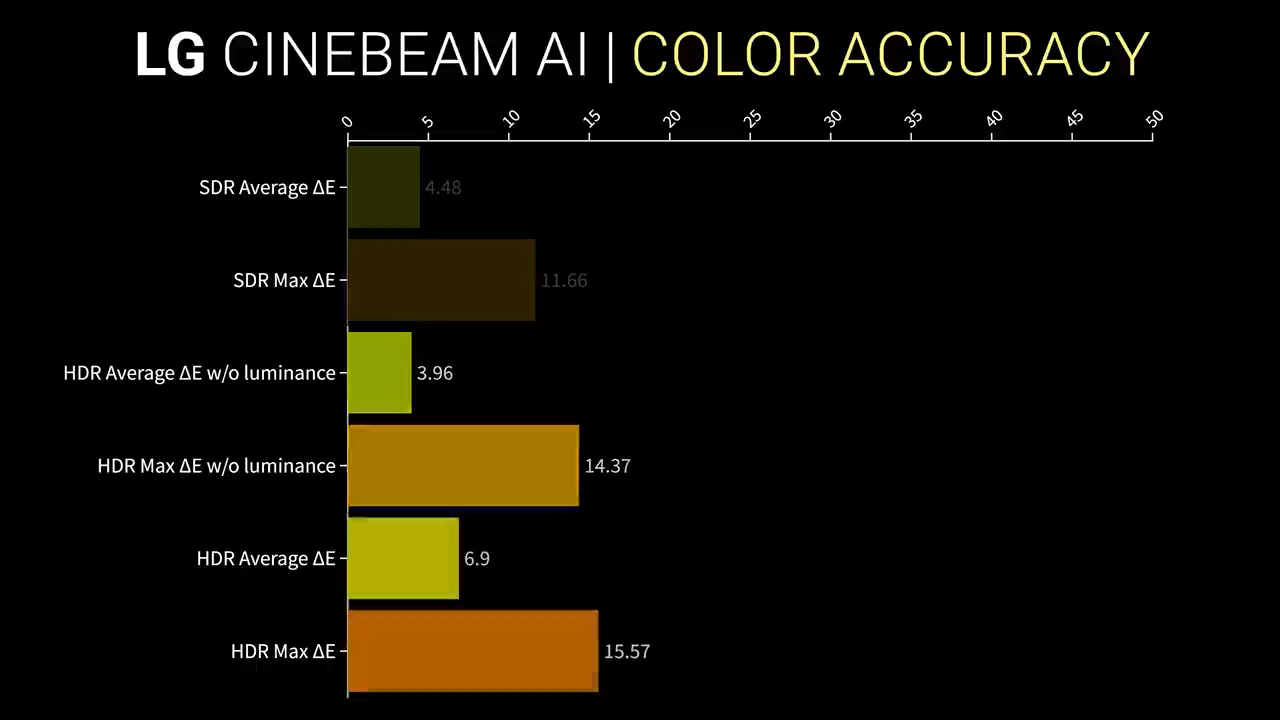
However, what it could cover, it covered well and while the SDR color error was a bit higher than I expected at 4.48, the DCI-P3 HDR accuracy was pretty good with an average error of 3.96 without luminance and only 6.9 including luminance, which again is largely attributed to staying within the DCI-P3 color space in this test.
Side-by-Side Round 8
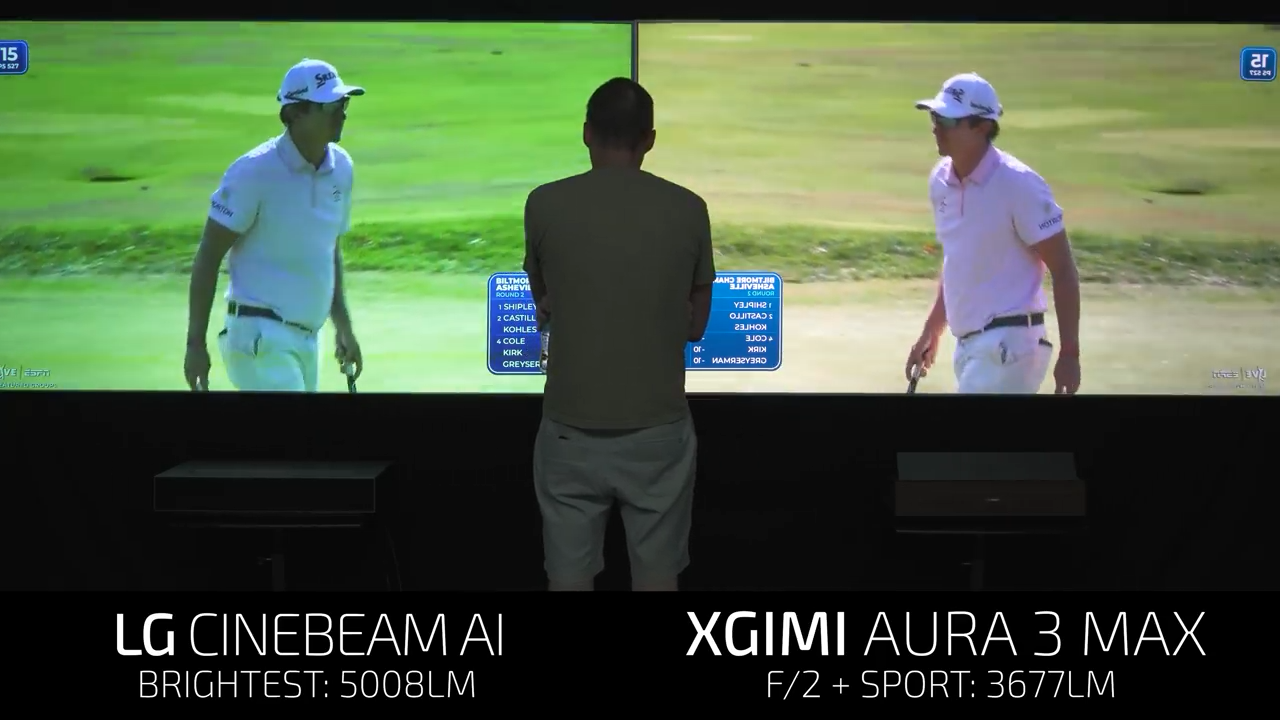
As I mentioned, this was a little difficult to judge because the LG has two iris settings, one for a dark room, and one for a bright room with wildly different performance between HDR and SDR content. But in practice, the dark room brightness is more similar to f/7 iris on the Aura 3, and even with the LG set to bright room iris it was more similar to f/5 rather than dynamic. So in some scenes, the LG appeared to be performing better in terms of black levels and contrast, but in actuality it was just less than half the overall brightness and setting the XGIMI to f/5 resulted in it still being brighter overall but also having consistently and significantly better black levels in both HDR content and SDR content. Unlike the previous couple of rounds where the Aetherion Max, PX4-Pro, and Aetherion Pro all had small advantages in some parts of some scenes, there was not a single instance in the 45 minutes of test clips that I watched where the LG’s image out classed the Aura, so the XGIMI Aura 3 Max will take the top spot for dark room performance.
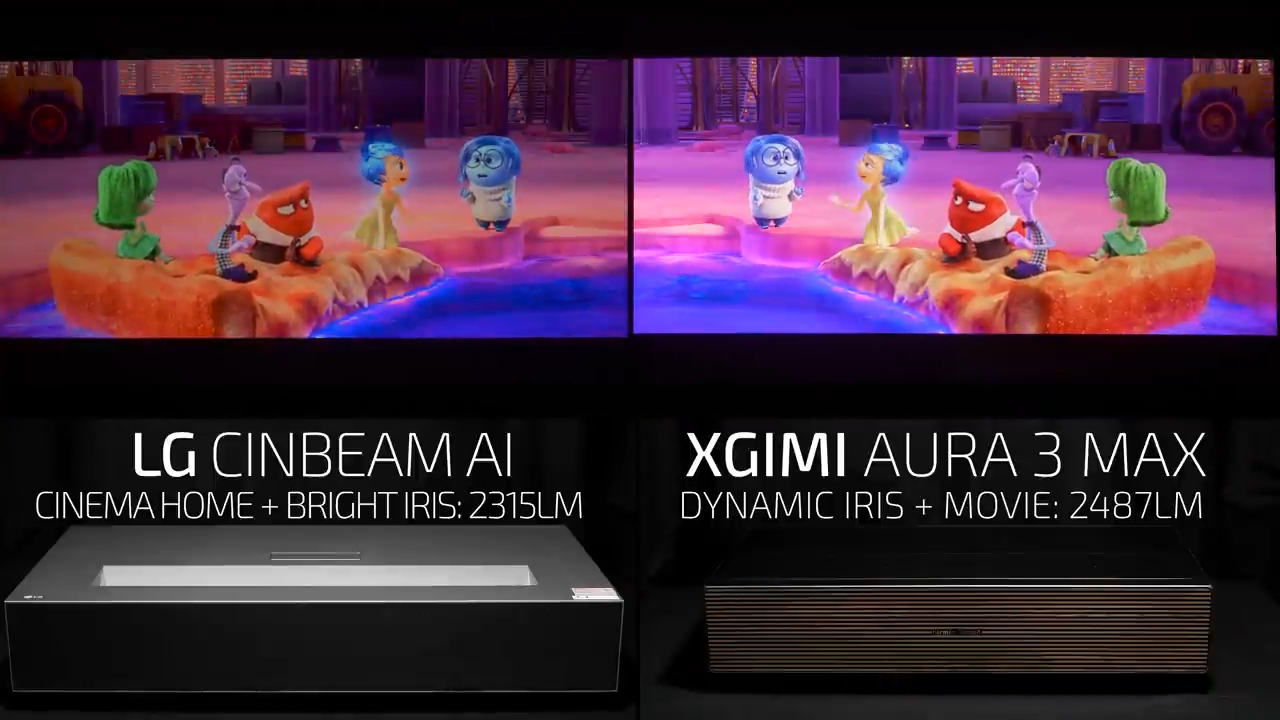
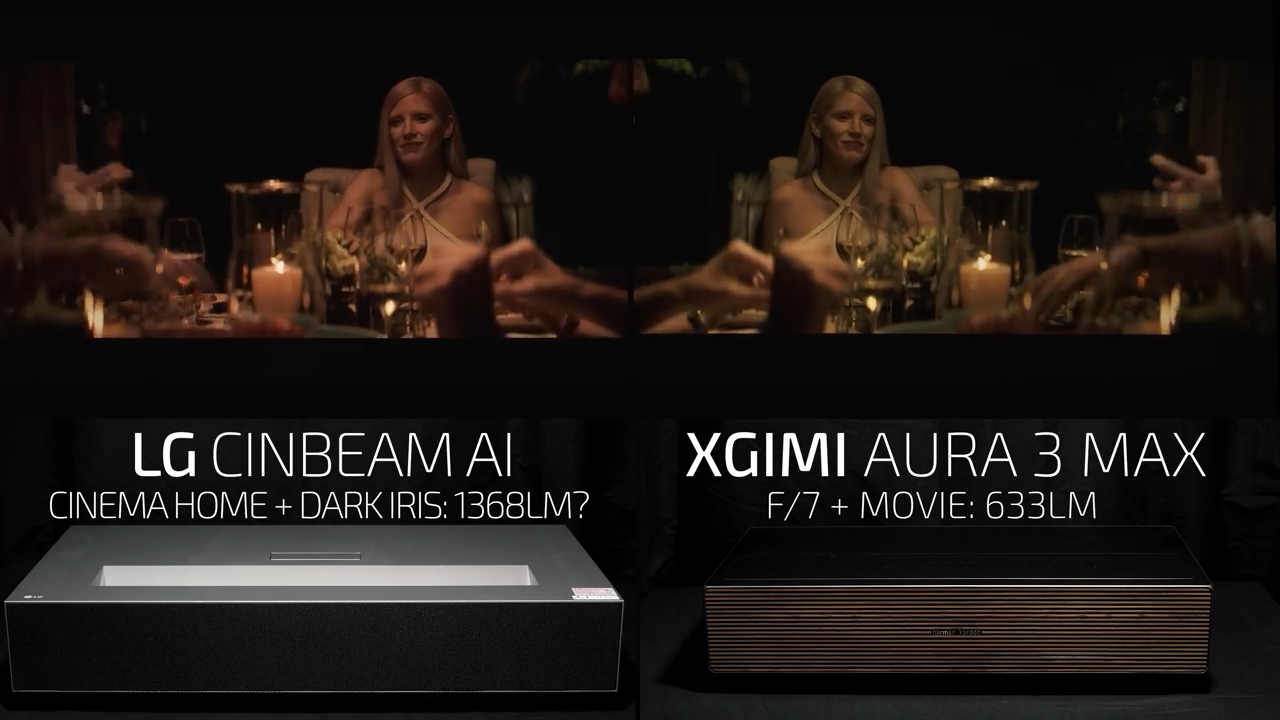
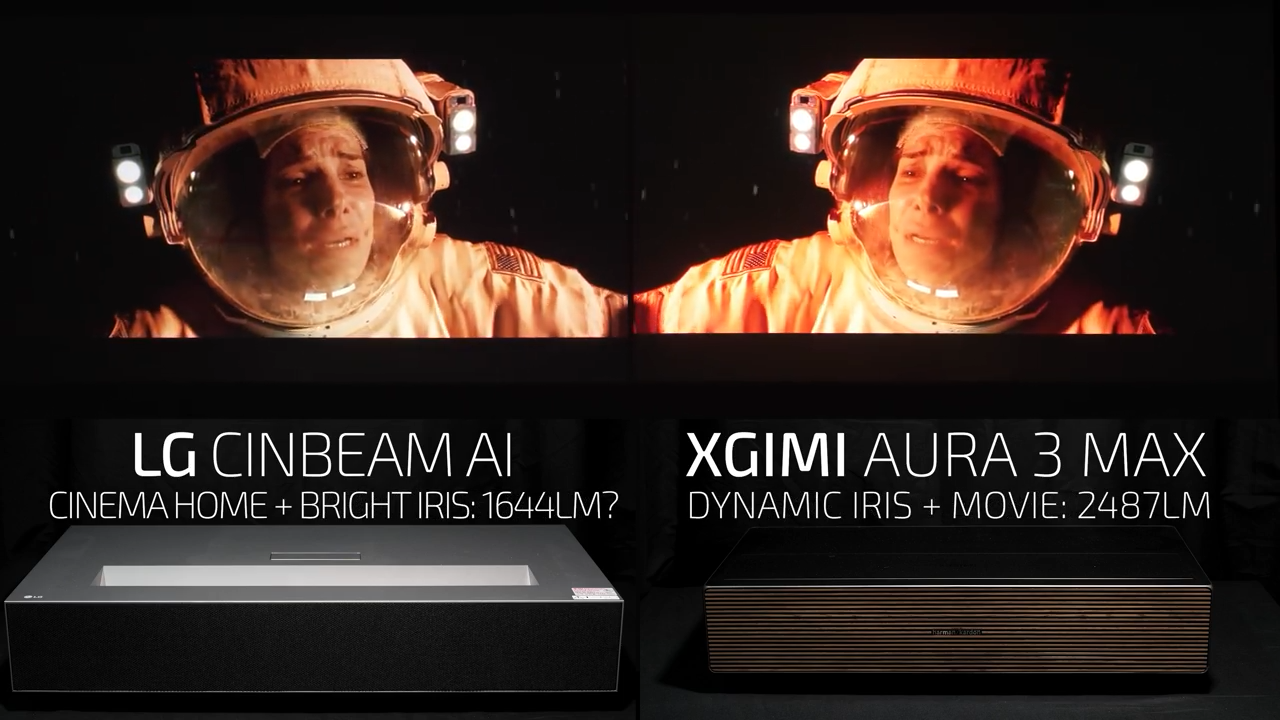
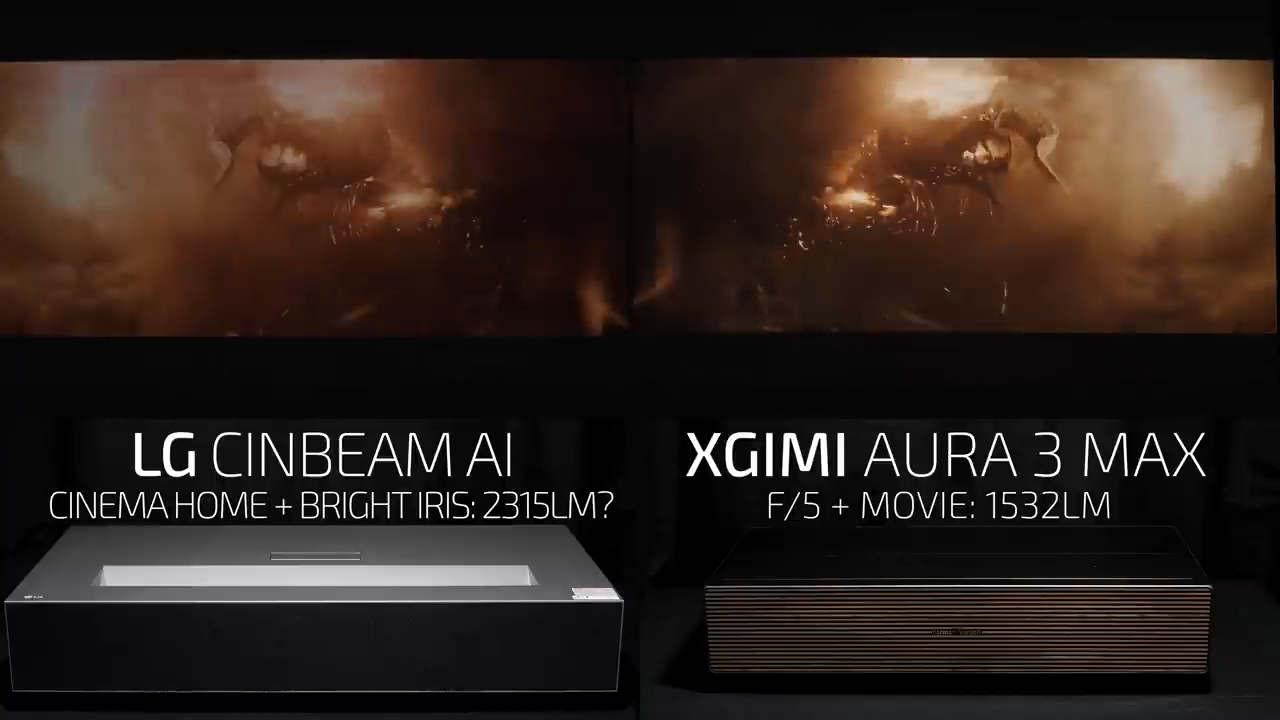
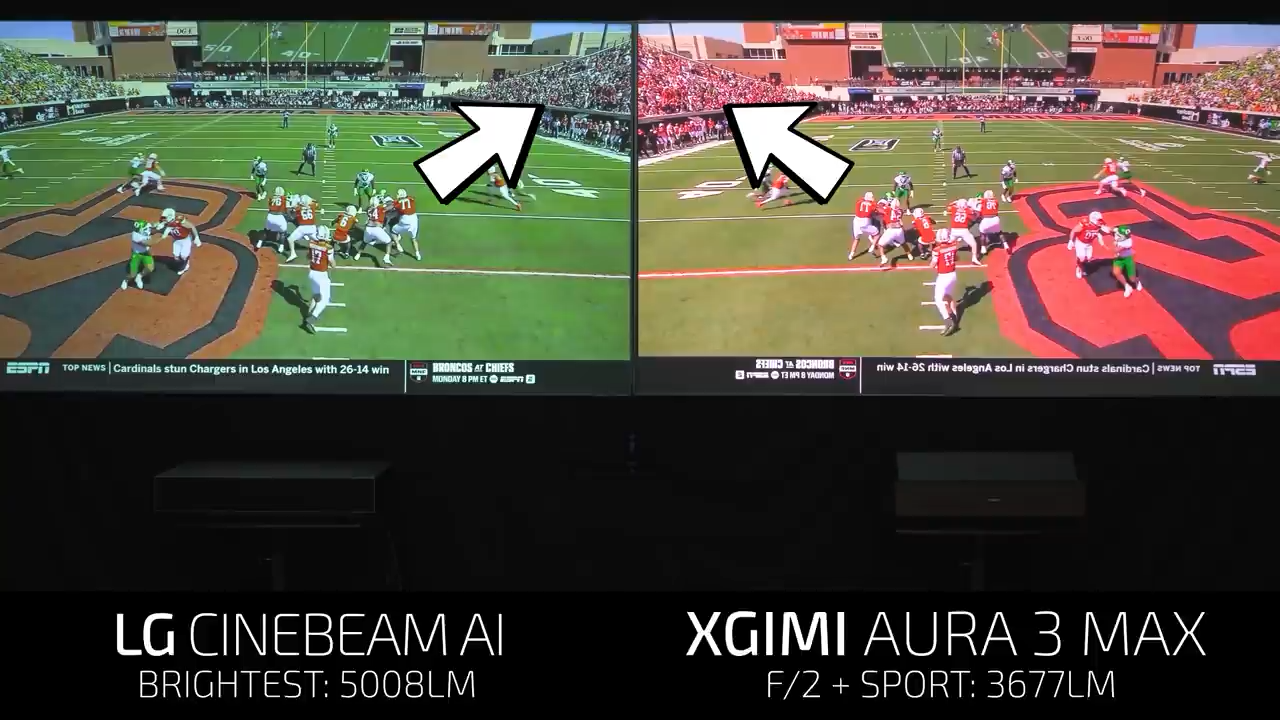
Turning on the lights and putting LG in its brightest picture mode, its 5000 lumens occasionally looked really good, but while other projectors in their brightest mode have an overall green tint, the LG seemed like it was actually substituting green in for red. If you look at the crowd in the Oklahoma State game, the LG transformed all of the Oklahoma fans into Oregon fans, and as long as there was no red on the screen, it looked pretty good, but all the reds got turned brown at best and sometimes green, meaning the XGIMI Aura 3 Max also takes the top spot for bright room performance.
Final Rankings – Dark and Bright Viewing
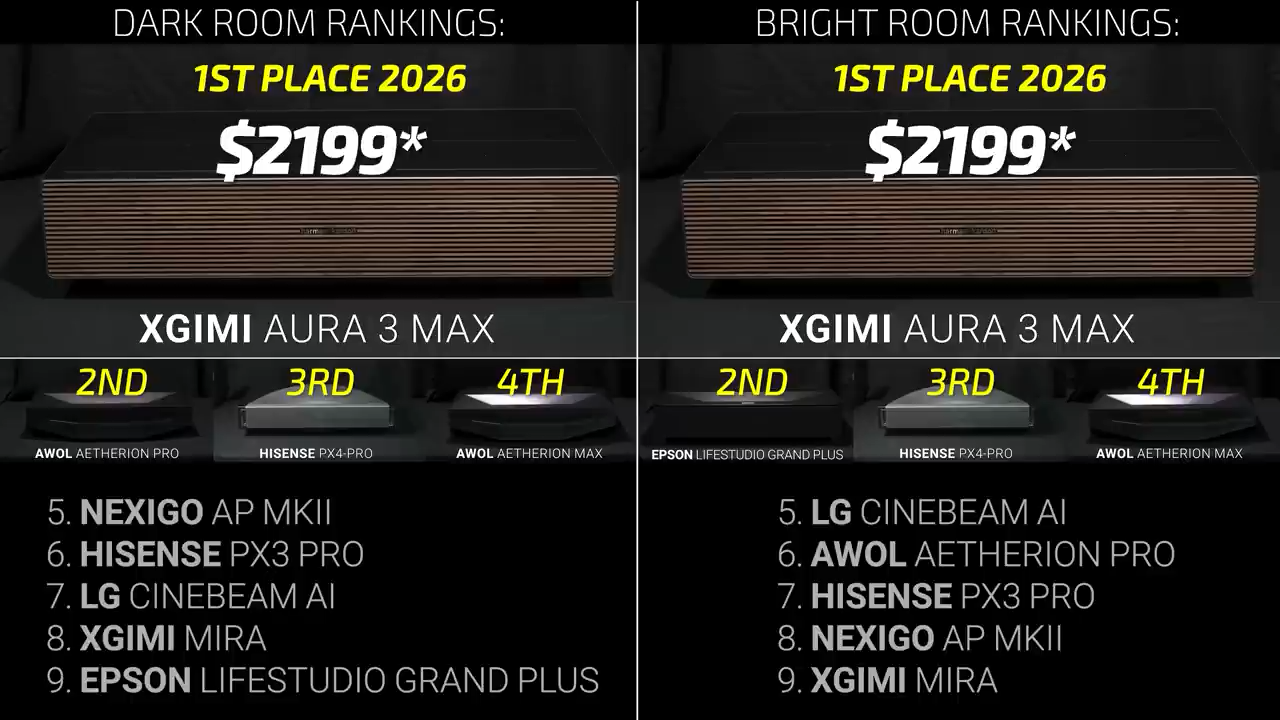
For the first time ever, the same projector won for both bright room and dark room performance, and again, through the magic and ridiculousness of Kickstarter, it also happens to be the 2nd least expensive projector in the video. But it’s worth noting that these results would be a lot less surprising at its MSRP of $4999, which would make it the most expensive projector in the video, and comparing it to other projectors at their MSRP, I thought the Aetherion Pro was a standout for Dark Room performance and the Epson LifeStudio Grand Plus carries on Epson’s tradition of excellent bright room performance.
Input Lag Testing
But there’s still more to test, starting with gaming input lag and refresh rate. I bought a new lag tester this year that supports 4K@120Hz to be able to test the Epson LifeStudio Grand Plus and XGIMI Aura 3 Max that both support full resolution 4K120Hz and to also answer the debate of whether it’s worth it to feed projectors like the NexiGo MKII and Aetherion Pro 4K120Hz even if they still display them at 4K60Hz.
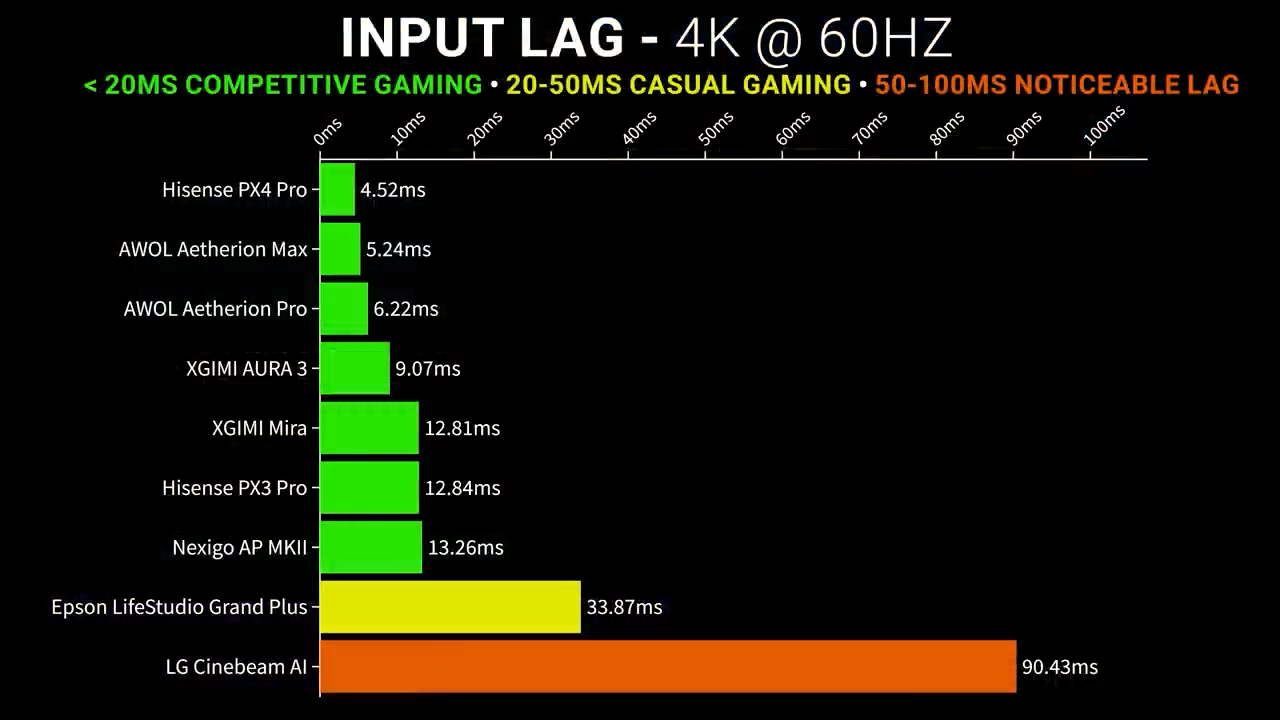
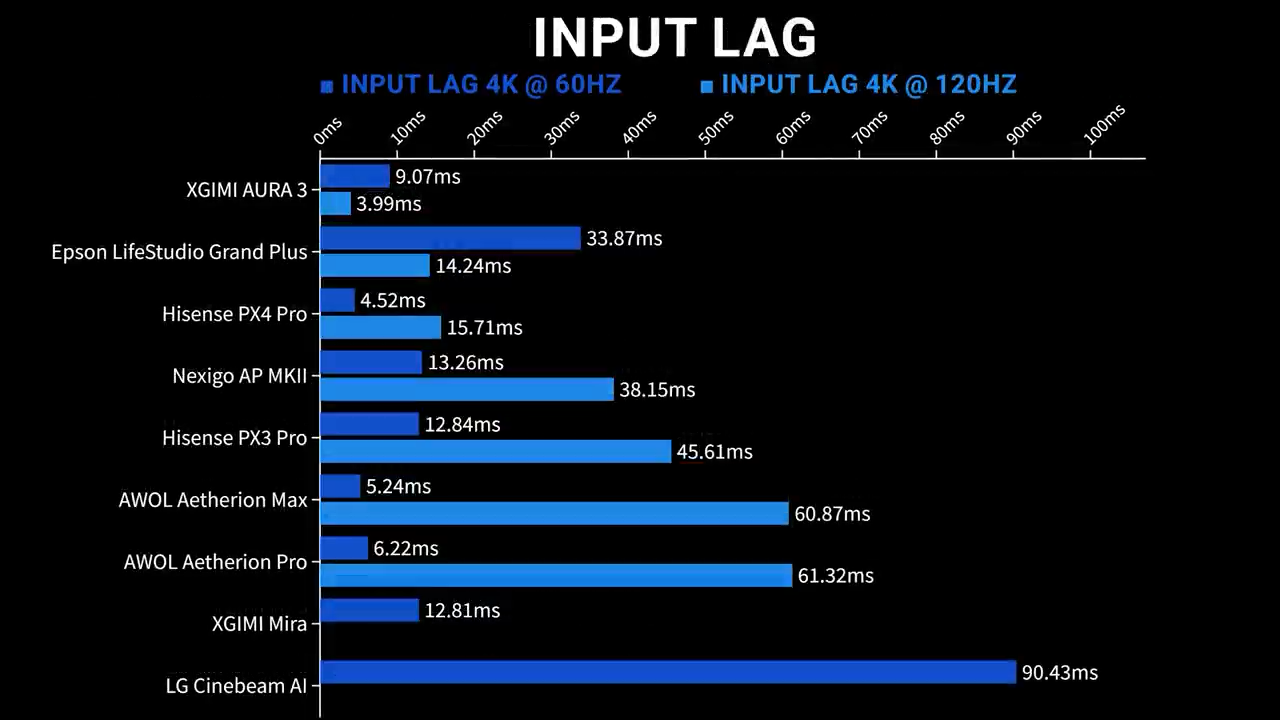
Starting with 4K60Hz, which is by far the most common resolution that people use for gaming, my new lag tester works by flashing the screen ten times and taking the average of those measurements. With all the projectors in their Gaming modes, only the Epson and LG failed to get under the 20ms mark that is generally needed for serious gaming, and at 90.43ms the LG is very close to the 100ms mark that’s not acceptable for any kind of gaming. Just to be sure, I double checked that input lag with my old tester and came up with more or less the same result.
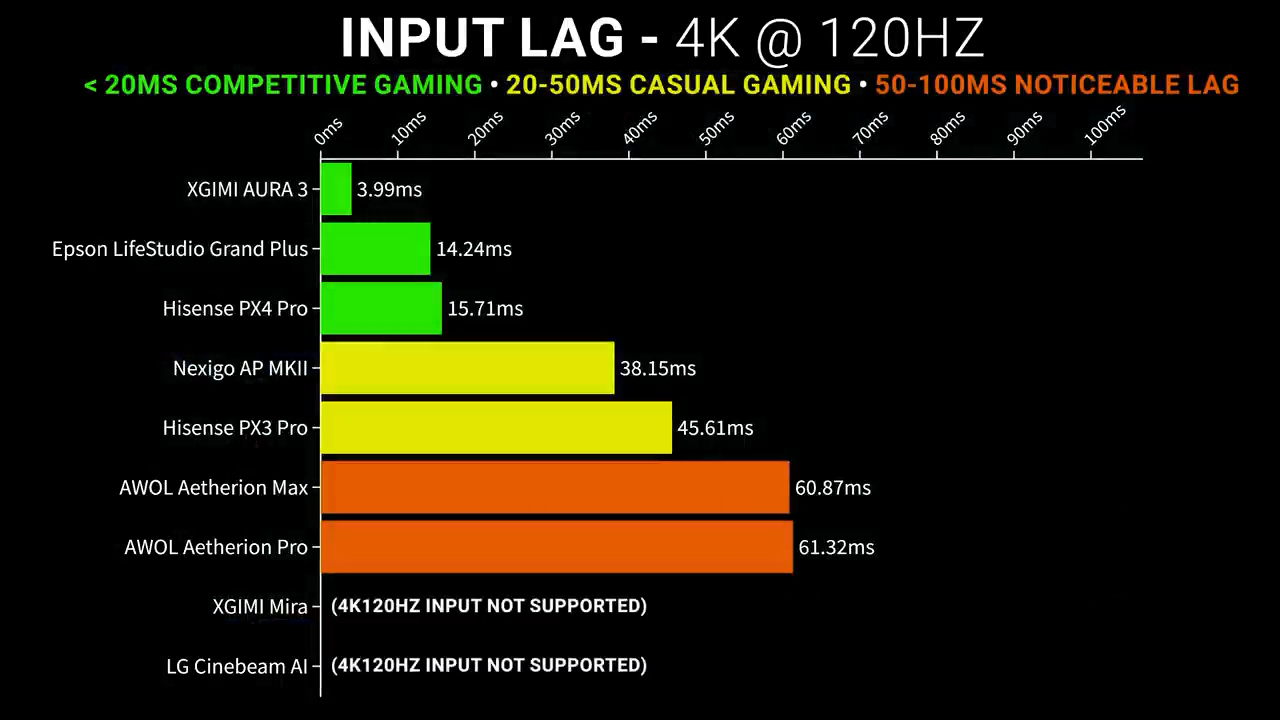
Moving on to 4K120Hz, all the projectors except the XGIMI Mira and LG CineBeam AI will accept 4K120Hz, but only the Epson LifeStudio Grand Plus and XGIMI Aura 3 are actually capable of displaying 4K at 120Hz and the rest will just downscale to 60Hz internally. Looking at their input lag, the Aura 3 ends up with an average measured input lag of 3.9ms, and the Epson basically cuts its 60Hz input lag in half to 14.24ms, but all of the other projectors considerably increase their input lag when fed 4K120Hz, so I can pretty definitively say it’s better to just use 4K60Hz instead of relying on the projector to downscale.
I also did some preliminary testing with Test UFO and while 4K120Hz definitely offered benefits over 60Hz on both the Epson and Aura 3, the difference was considerably more apparent on the Aura 3 and some of the advantages of the higher refresh rate on the Epson were offset by the fact that LCD pixel response is pretty slow, so there was still a considerable amount of motion blur on the Epson.
24p Testing
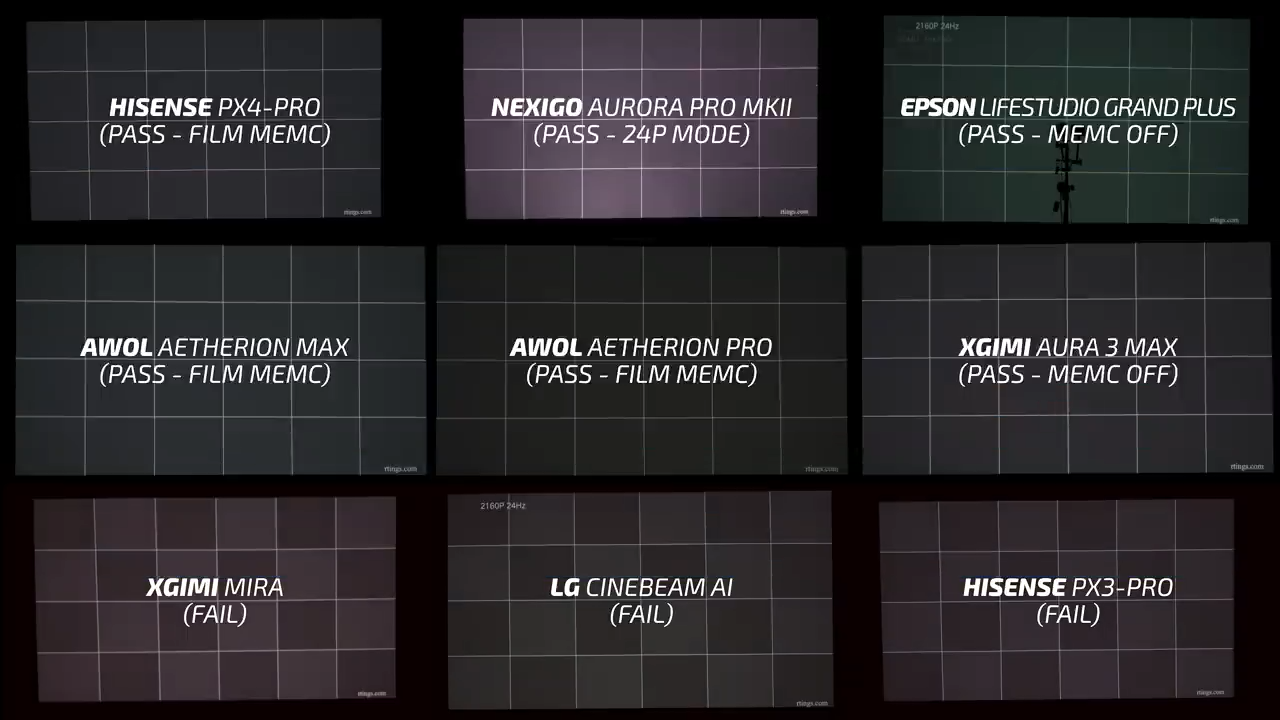
Speaking of motion blur, another common complaint is that older DLP projectors don’t support true 24p cadence. I tested all the projectors using the RTINGS 24p test pattern and the XGIMI Mira, LG CineBeam AI, and Hisense PX3-Pro failed to properly playback 24p content. It’s worth noting that the NexiGo, Aetherion, and Hisense PX4-Pro display 24p by lowering their DLP frequency from 240Hz to 192Hz to use 2:2 pulldown, while the XGIMI’s DLP package can run at 480Hz, which lets it display 24p content using 5:5 pulldown without reducing the DLP frequency, and that avoids the increase in DLP rainbow effect that can occur when watching 24p content.
DLP Rainbow Effect
If you don’t know what the rainbow effect is, you can count yourself lucky, but a lot of people can see rainbow artifacts in high contrast moving areas on DLP projectors. It’s caused by the fact that a DLP projector shows each color sequentially instead of all at once like an Epson 3 LCD.
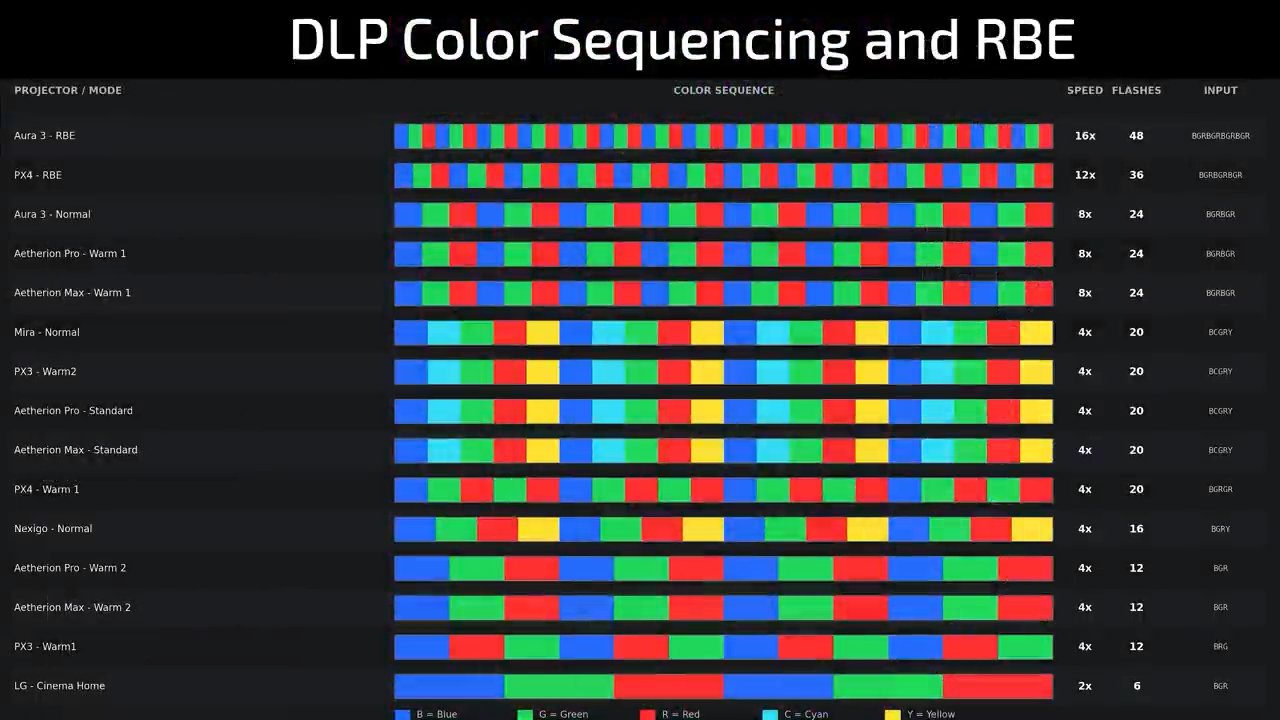
In general, the faster the colors cycle, which can be expressed in flashes per frame, will determine the amount of rainbow effect that a projector shows. So I used my Chronos high speed camera to record each screen at 40,000 frames per second. You can see that the lowest possible RBE should be from the XGIMI Aura 3 Max with its anti-RBE mode enabled which gives 48 flashes per frame, and the Hisense PX3-Pro with RBE mode enabled which has 36 flashes per frame. But unless you’re really really sensitive to rainbows, I wouldn’t recommend using either of them since the XGIMI’s introduces a lot of dithering artifacts and the Hisense RBE mode shifts the color temperature to around 9500 K and also disables laser dimming.
Instead, the most usable modes are the default 24 flashes per frame that you get on the XGIMI Aura 3 in any picture mode and the 24 flashes that the AWOL Aetherion projectors have on warm 1. My only complaint about the Aetherion is that warm 1 tends to be a little too yellow for me out of the box. I think 24 flashes should be more than enough to eliminate rainbows for 99% of people, and personally, the only projector that I consistently noticed rainbows on was the LG which only has 6 flashes per frame.
As I mentioned, the Epson LifeStudio Grand Plus uses a 3LCD imager, not DLP, so it will never show rainbows at all.
3D Performance
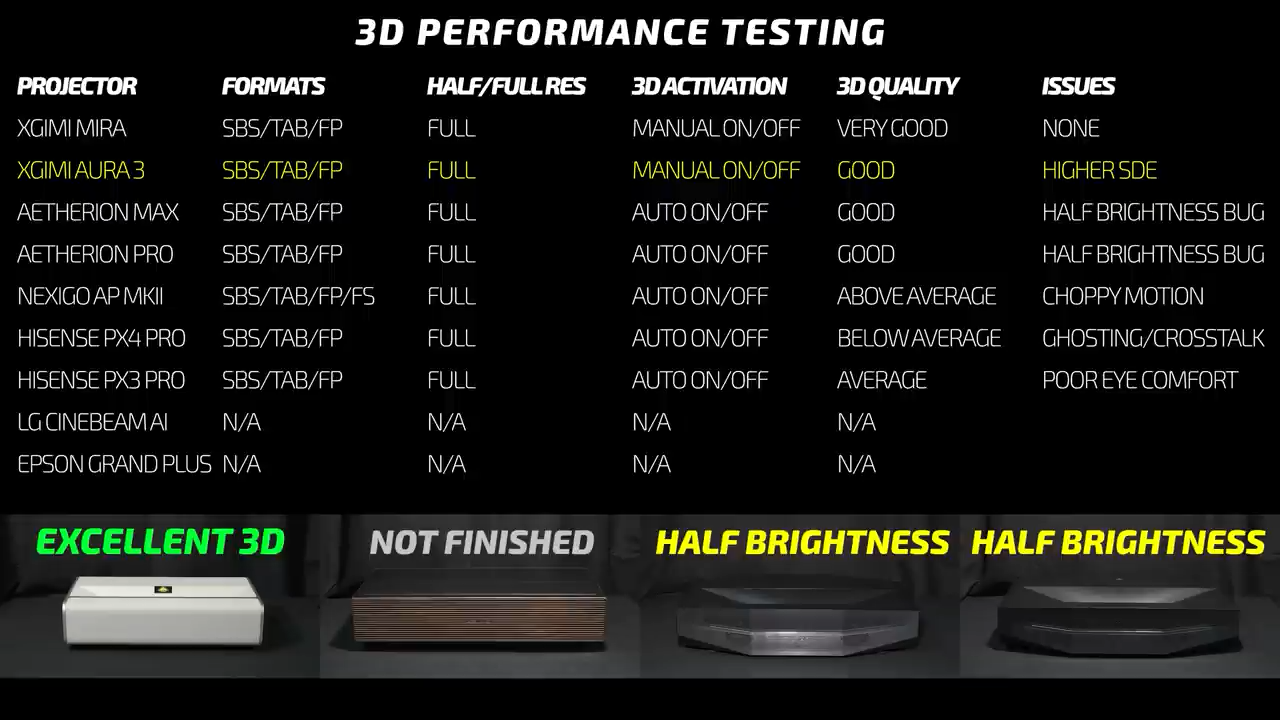
However, DLP has the advantage of being the last remaining bastion of 3D movie enthusiasts, and I tested each of the projectors using side by side, top and bottom, and frame packed Blu-ray 3D movies. Aside from the XGIMI Mira and NexiGo Aurora Pro MKII, I’d say the rest of the projector’s 3D modes are works in progress. Before the dynamic iris update, the Aetherion Max and Pro both had 3D crosstalk issues which caused ghosting and smearing, and they fixed it in the update but introduced a new bug that causes 3D to play at about half brightness unless you bring up the menu, but it returns to half brightness after exiting the menu.
The PX4-Pro still has the crosstalk issue that both Aetherion projectors originally had.
The Aura 3 Max doesn’t really have any 3D issues, but you can tell the 3D picture quality is not the same as the picture quality in non-3D content and I suspect they are using some kind of work around right now that isn’t fully utilizing the power of the dual controller 480Hz display.
And for some reason, the LG CineBeam AI doesn’t support 3D despite being a DLP projector.
But, as I said, the standout to me in terms of 3D, was actually the entry level XGIMI Mira that uses the new Texas Instruments 0.39” DLP chip that has the pixels laid out diagonally rather than straight up and down which led to less noticeable screen door effect, and the motion on the Mira also felt smoother than the rest of the projectors in 3D.
Focus and Sharpness
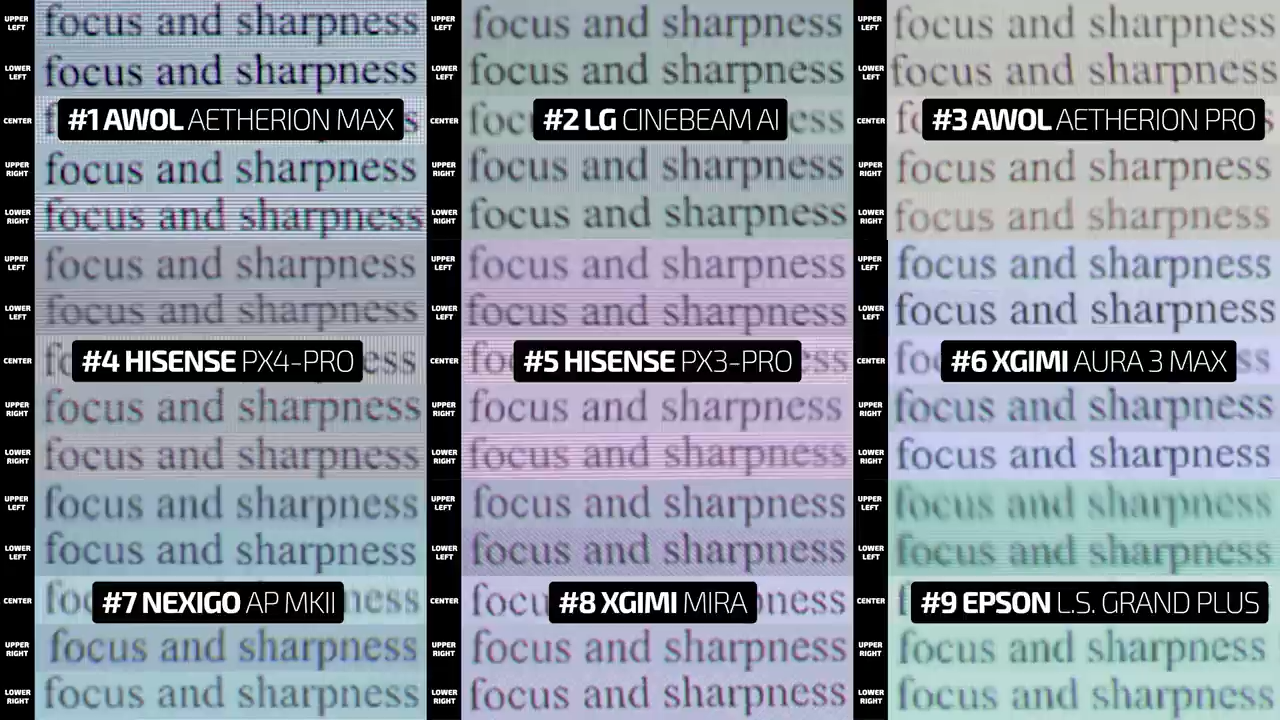
Moving on to focus and sharpness, I first projected this image, took individual still images of each corner and the middle of the screen, zoomed in on the smallest text line, and ranked each projector’s focus and clarity. One thing that stood out to me was that they were all very good, and while the Epson still ranked last among these nine projectors, there was a significant improvement in clarity between the older Epson LS800 and the new LifeStudio Grand Plus. You can also see the different pixel grid layout on the XGIMI Mira, which as I said helps reduce the screen door effect especially during panning motion, and while it comes with a higher-than-average screen door effect, the ability of the Aetherion projectors to maintain sharp focus in all four corners of the screen is truly impressive.
Throw Distance
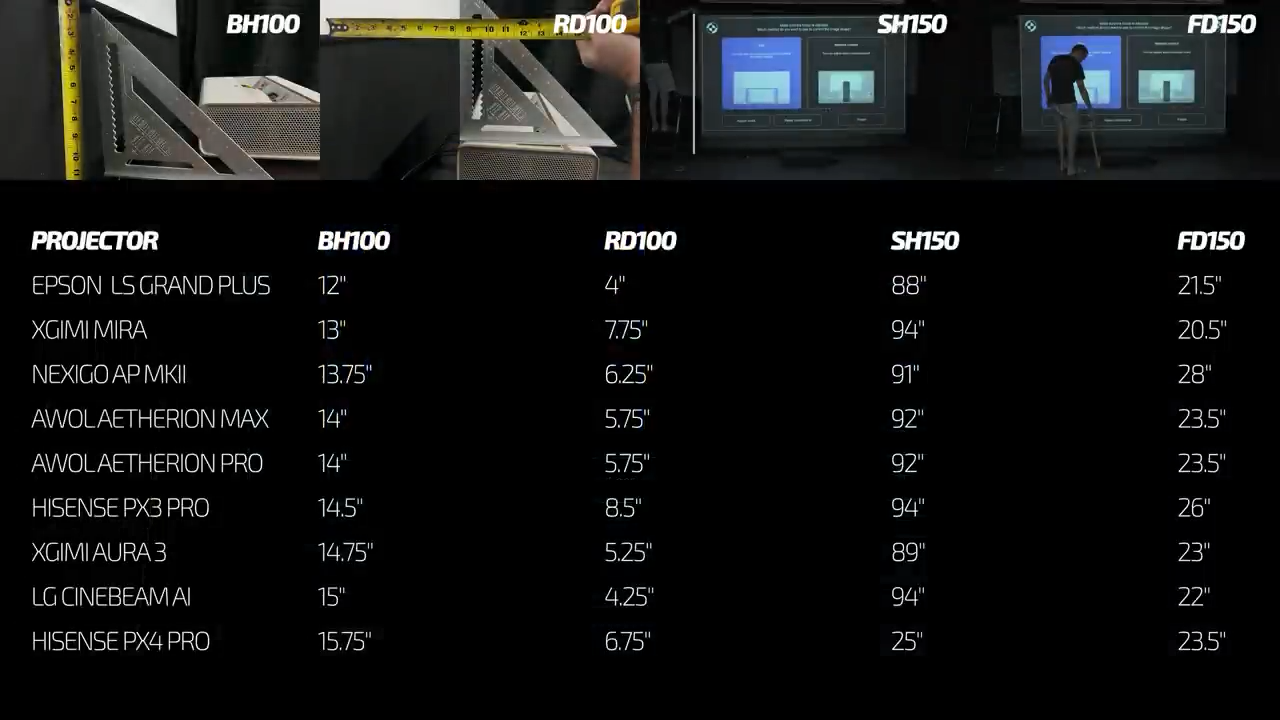
Next, looking at throw distance, this gets kind of confusing because manufacturers measure the throw ratio from the lens of the projector, but the lenses aren’t all in the same location on the projector and the projectors themselves have very different dimensions. So the first thing I did was measure the distance from the shelf that the projector was sitting on to the bottom of the image when projecting a 100” screen, listed as BH100, and the distance from the back of the projector to the front of the screen, listed as RD100.
Then I got out my 150” Spectra Phoenix floor rising screen and set each projector on the ground Then I measured the distance from the top of the projected image to the ground, listed as SH150, and from the front of the floor rising screen casing to the front of the projector, listed as FD150.
Fan Noise and Speakers
Last, let’s talk sound starting with fan noise. Most of these projectors are extremely quiet and are below the normal noise floor of my room. So I unplugged my refrigerator and turned off the air conditioning, and here they are from quietest to loudest with the microphone boosted 15db.
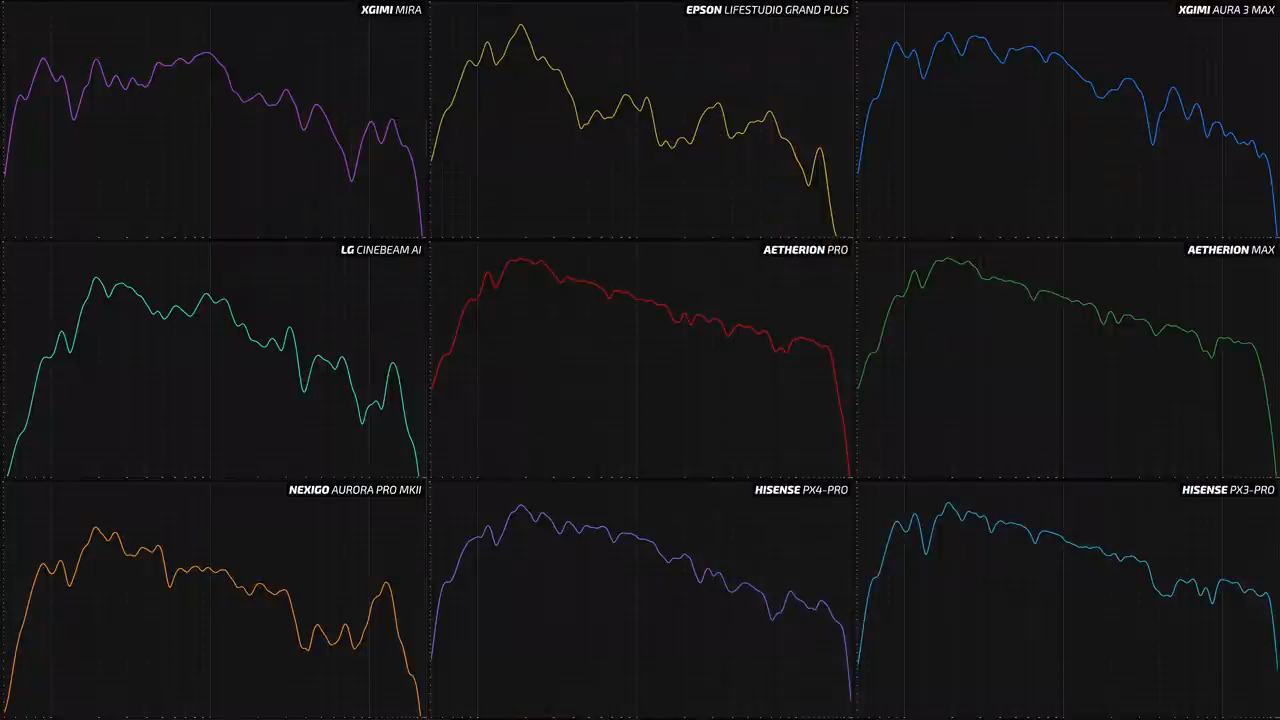
I’m not going to go too far into speaker quality because I really don’t think you should base any of your projector buying decision on the quality of the built-in speakers, but here are the frequency response curves for each projector. Subjectively I’d say the XGIMI Mira and Epson LifeStudio Grand Plus had the best speakers, the XGIMI Aura 3 Max and LG CineBeam AI were slightly above average, and all the others were basically the same average quality, usable in a pinch, but not something I’d personally consider as a long-term option.
Conclusions and Recommendations
So conclusion time.
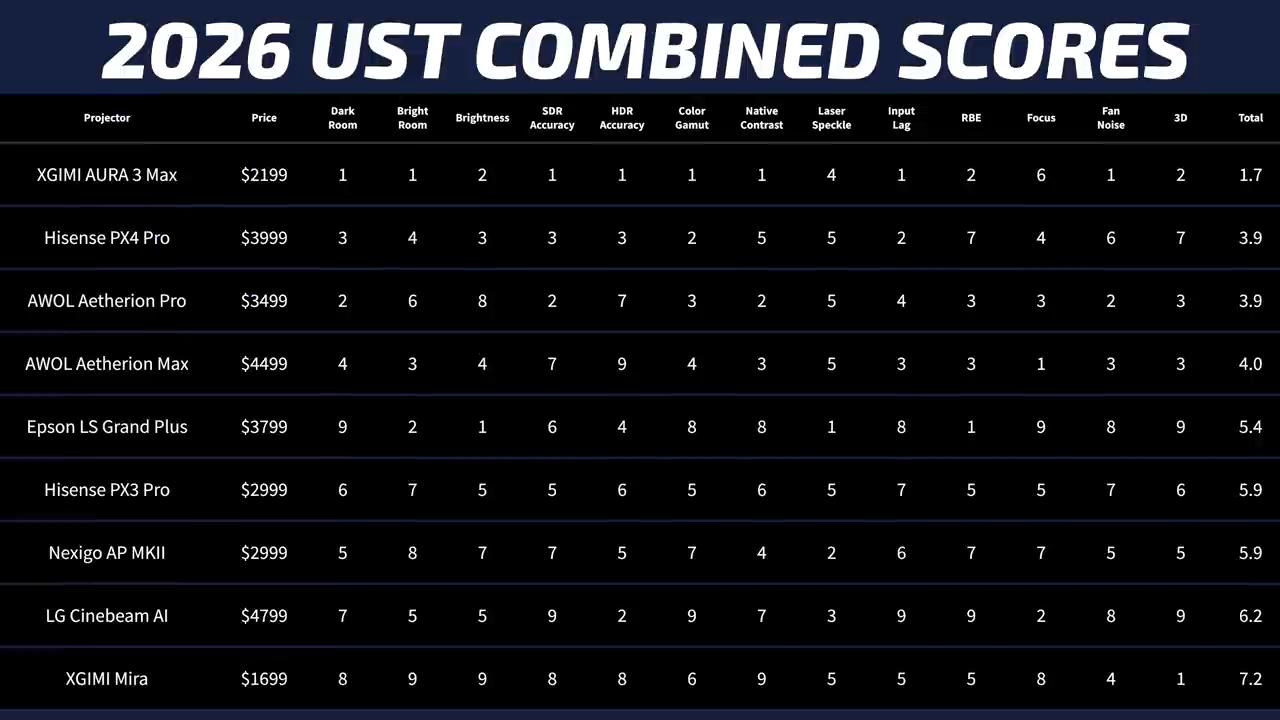
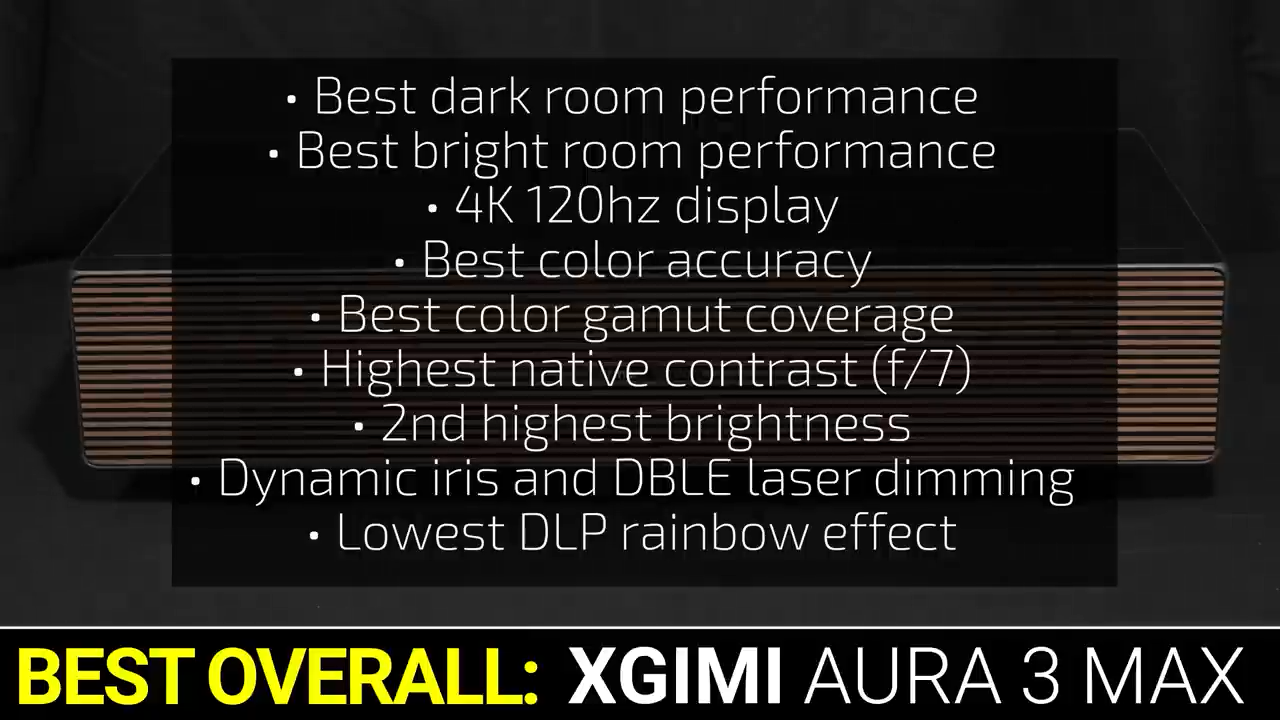
Looking at all the individual scores combined and double weighting the dark room and bright room ranking, it should be no surprise that the XGIMI Aura 3 Max came out on top. To be completely frank, it’s incredible. Even if we ignore the 4K120Hz display, it still has the best color accuracy, best color gamut coverage, highest native contrast, and 2nd highest brightness along with excellent laser dimming and dynamic iris. The unfortunate truth for every other projector manufacturer right now is that unless you need your UST right now, there’s no reason to even consider anything other than the XGIMI Aura 3 Max given the deposit Kickstarter price of $2199. Even at the regular Kickstarter price of $2399, there’s nothing that even comes close to its performance, and even when the Aurora Pro MKIII, L9Q Pro, and AWOL LuxVision eventually come out, they’re not going to come close to that price.
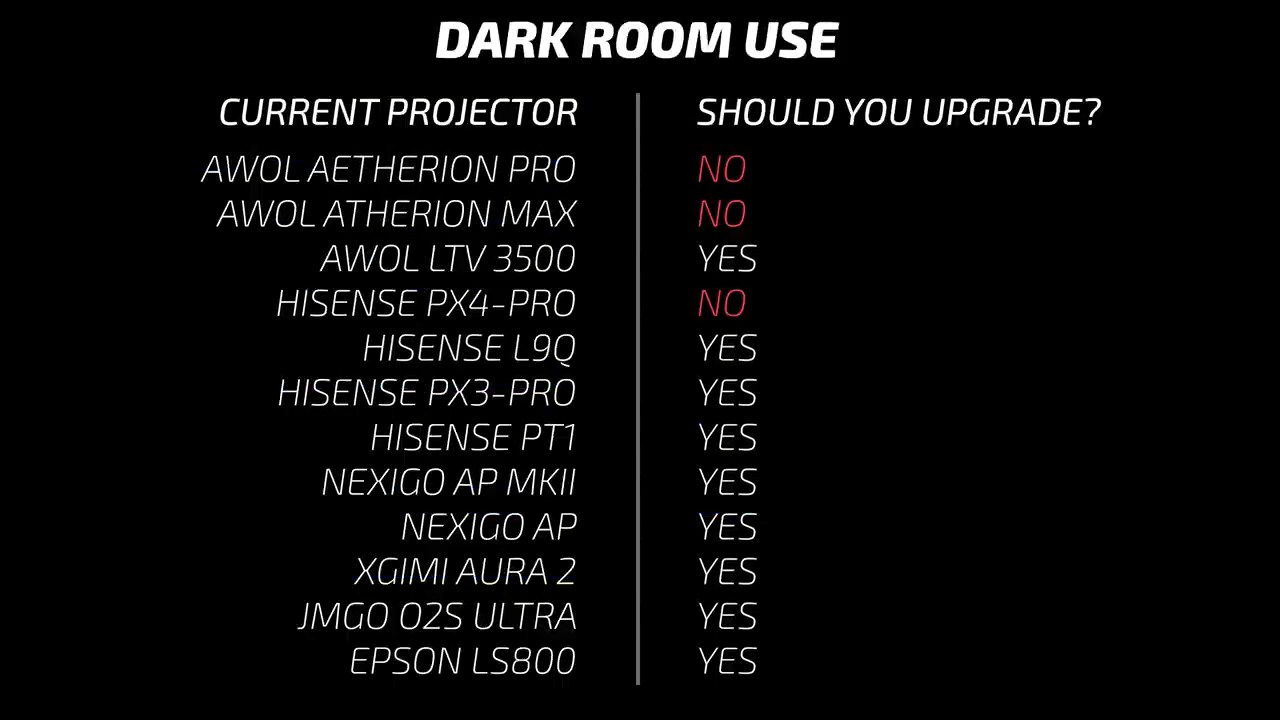
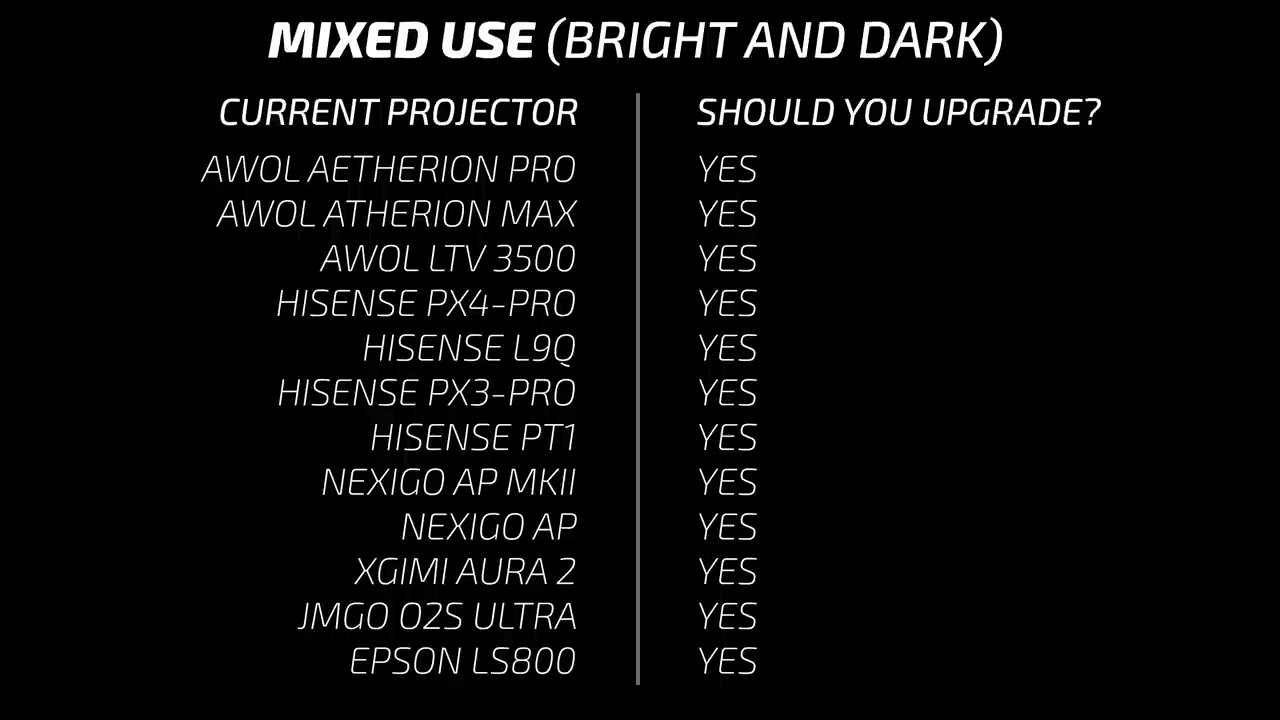
Normally now I’d talk about the other options, but like I said, you really shouldn’t even consider anything else at this point, so instead the question becomes whether you should upgrade from your current ultra-short throw, starting with dark room performance.
If you have any of these projectors, you will see a very significant improvement in a light-controlled room when switching to the Aura 3 Max, and if you have the Aetherion Pro or Max I think you should hold off and wait for the dynamic iris update which massively increases performance.
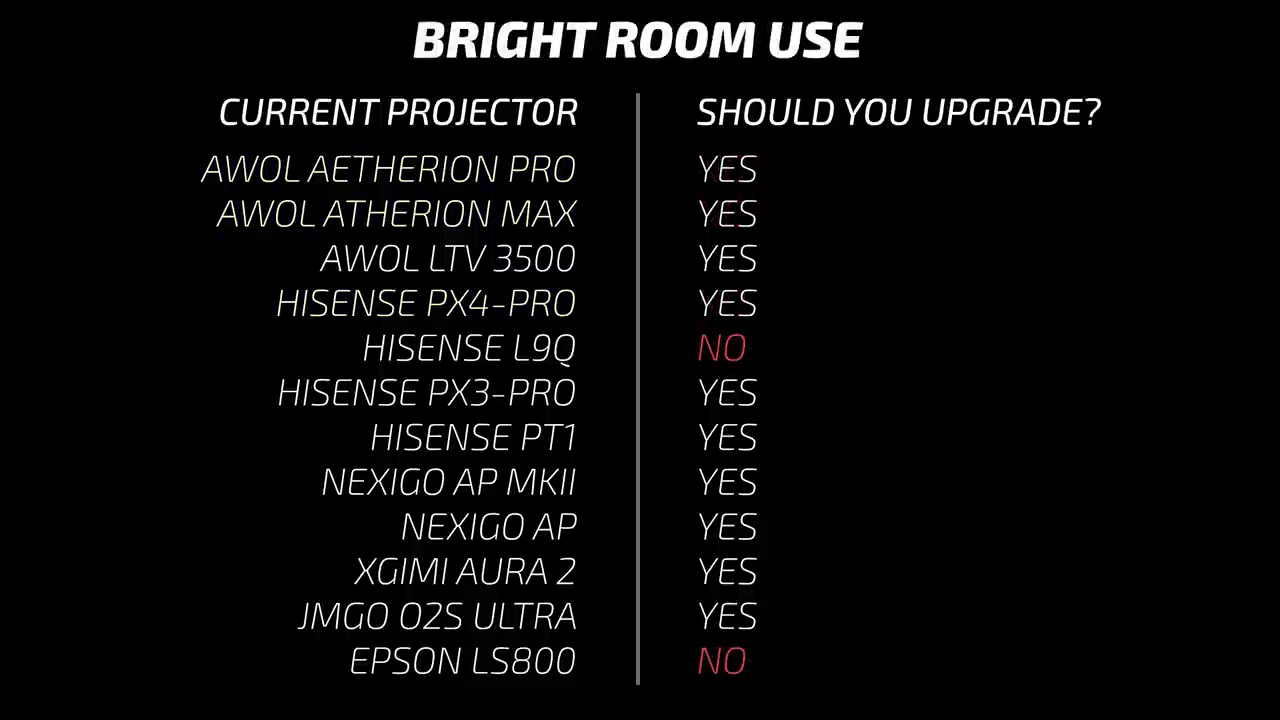
Strictly for bright room performance, the Aura 3 Max is a major improvement over the Epson USTs and Hisense L9Q, but if you’re planning on using the projector in both bright and dark conditions like football during the day and movies at night, the Aura 3 Max is just completely unmatched, and the Kickstarter price honestly just doesn’t make any sense.
As always, there are no sponsored reviews on this channel, but I’ve got a link to the Kickstarter reservation deposit in the description. If you appreciate the time, effort, and money that it takes to make a video like this, I’d love it if you used that link since I will earn a small commission on your Kickstarter pledge at no cost to you when you end up making it, and once the Kickstarter actually starts on October 20th, I’ll swap the link for my Kickbooster link.
If you need your projector right now and you want something like the Aetherion Pro or Epson LifeStudio Grand Plus I’ve got Amazon links to those as well as all of the other projectors, and I appreciate when you use those links because as an Amazon affiliate, I also earn a small commission at no cost to you.
I’d also like to thank all my patrons over at Patreon for their continued support, and if you’re interested in supporting the channel please check out the links below. If you enjoyed this video, please consider subscribing to my YouTube channel and as always, thanks for watching The Hook Up.