Robotic Lawn Mowers 2026 Update
June 12, 2026The difference in the performance of the 13 robotic mowers in this video compared to the six I tested last year is night and day. To figure out if robotic mowers are ready to go from novelty tech toys to more widespread adoption, I tested their battery life, cut quality, navigation, object avoidance, edging, and a lot more.
Battery Life, Mowing Capacity, and Cut Quality
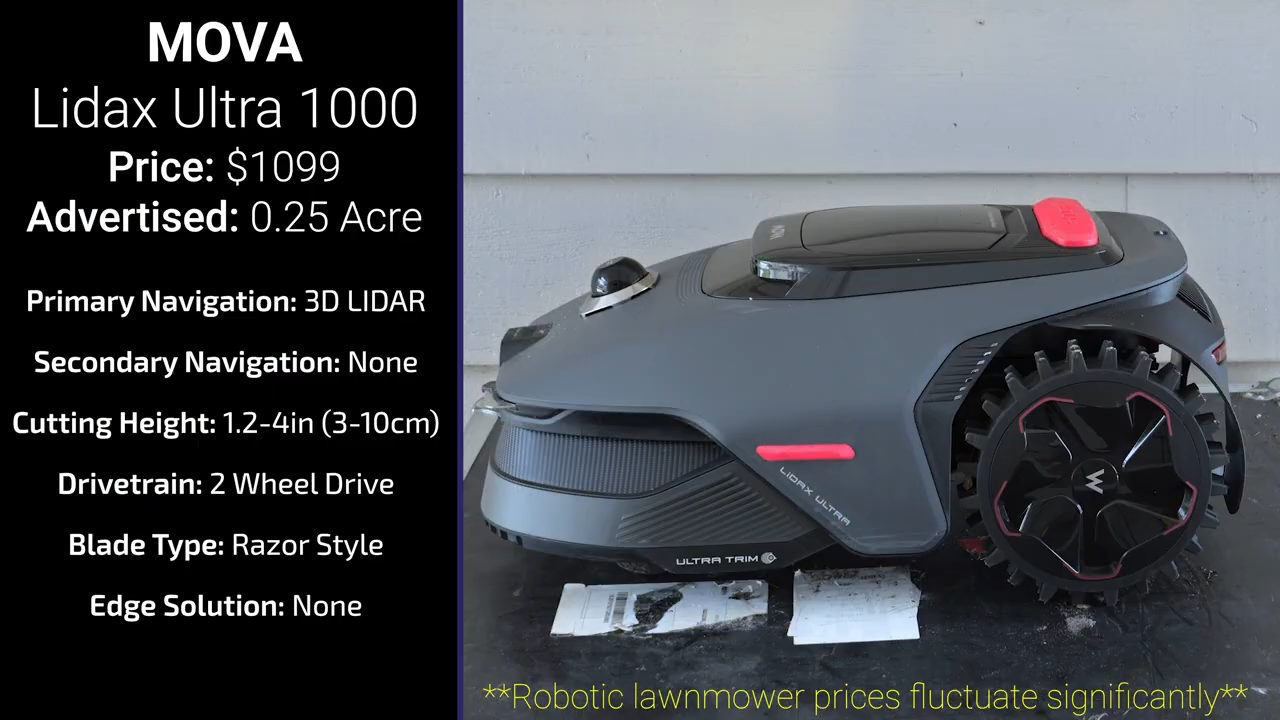
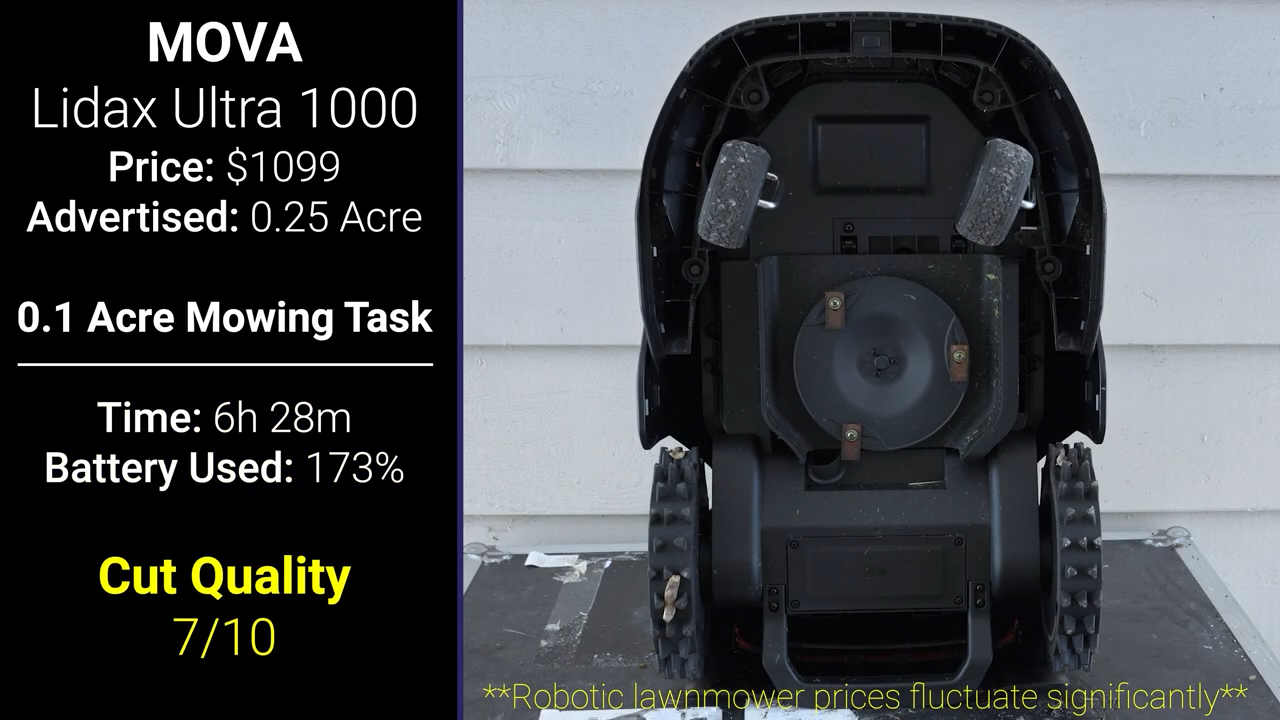
First up, looking at battery life, mowing capacity, and cut quality, I sent each mower out in my wide open 0.1 acre back yard. The least expensive mower in this video is the $1099 MOVA LiDAX Ultra 1000. The LiDAX 1000 is advertised as having a quarter acre of mowing capacity. The LiDAX 1000 mowed for 2 hours, using 85% of its battery to complete 54% of the lawn before going back to recharge. It charged back up to 100% in 1 hour and 5 minutes before going back out to mow again, getting to 99.2% progress before going back to recharge all the way to 100% again before completing the last 1%, meaning the overall mowing time was 6 hours and 28 minutes and the A1000 used 173% of its battery. I rated the cut quality of its single three-blade cutting disk a 7 out of 10 and the slower movement speed helped it miss fewer blades than some of the other smaller robots.
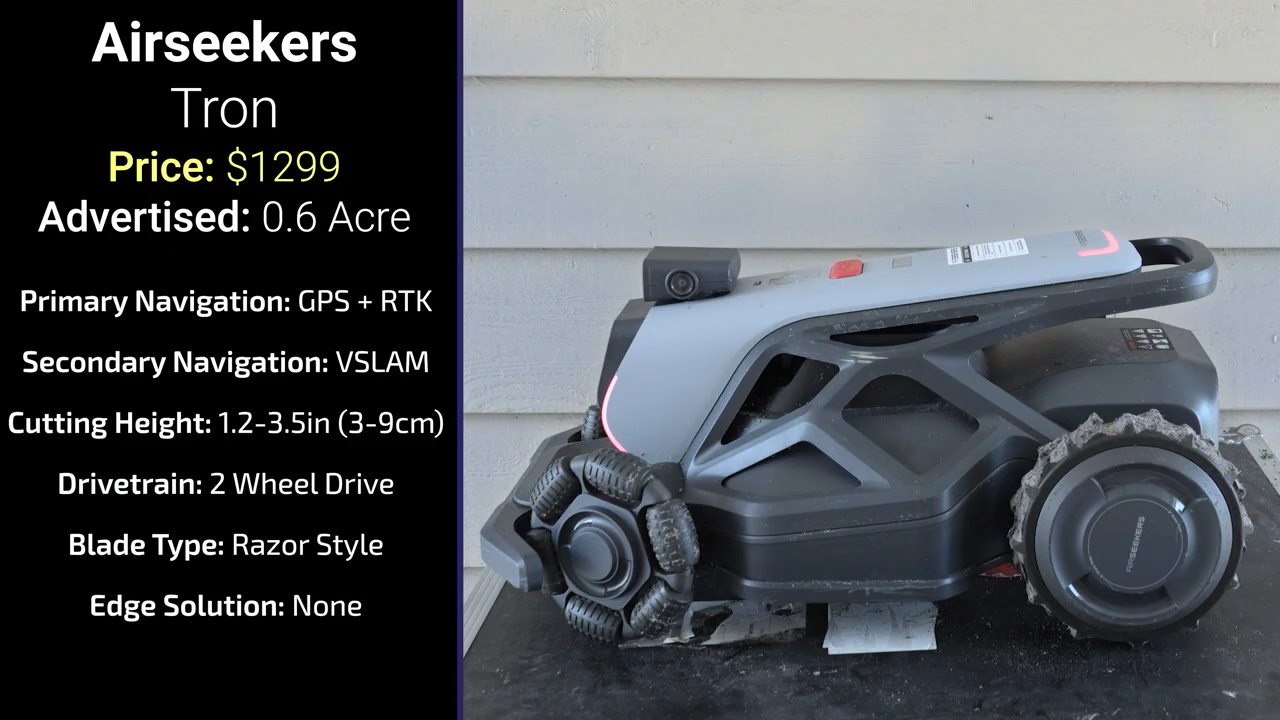
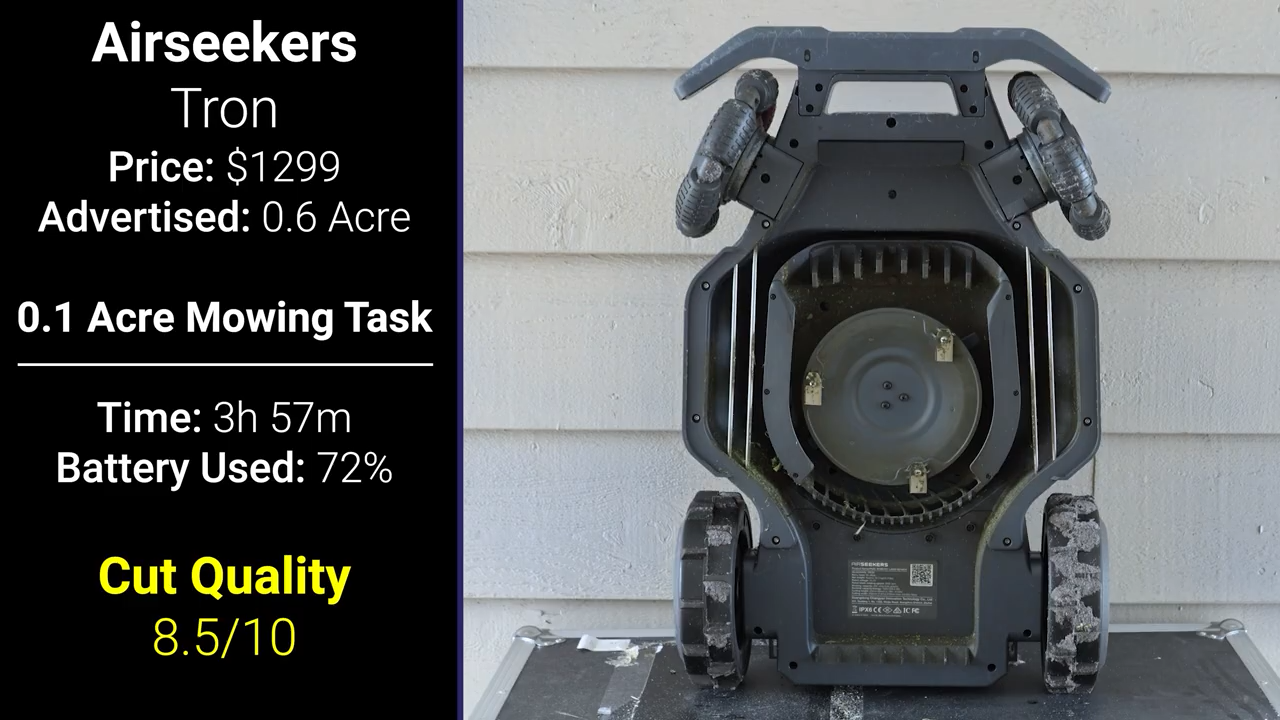
Next for $1299 is the Airseekers Tron, rated for 0.6 acres of mowing capacity. Unlike the MOVA, the Tron was able to complete the entire 0.1 acre mowing task without recharging but moved relatively slowly finishing in 3 hours and 57 minutes. But the Tron had very good cut quality using its razor blade style cutting disk and extra lift generating plastic propeller, and I rated it an 8.5 out of 10 with nice clean cuts and no missed blades of grass on the areas that I inspected.
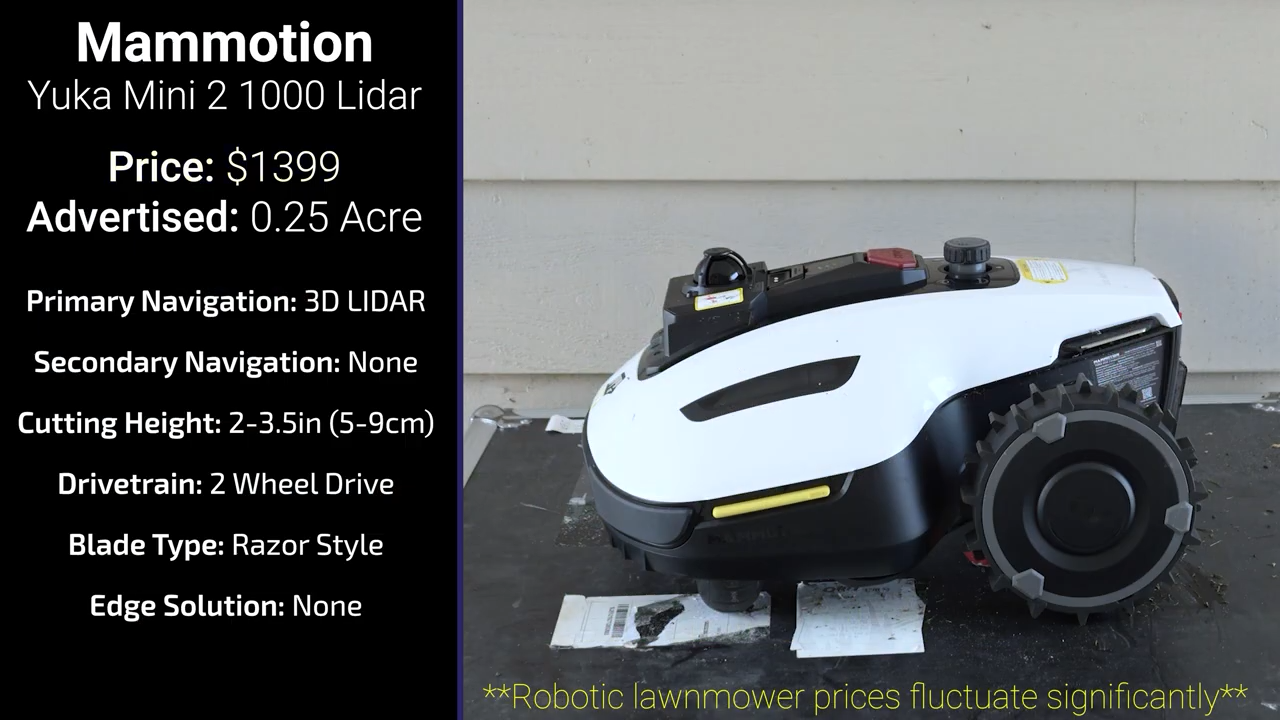
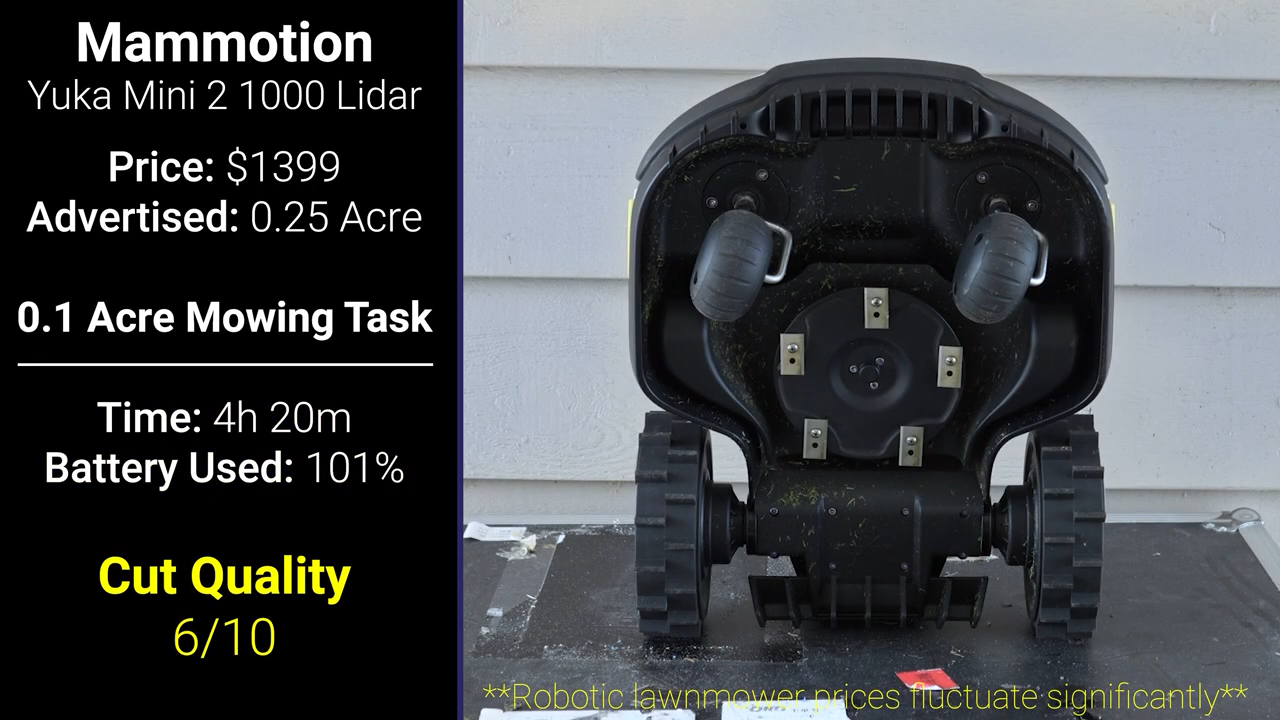
Then for $1399 is the Mammotion Yuka Mini 2 1000 LiDAR which has an advertised mowing capacity of a quarter acre. The Yuka Mini 2 mowed for 3 hours and 20 minutes and completed 91% of the mowing task before heading back to charge at 10% battery. It charged for about 40 minutes, getting back up to 40% battery before going back out to finish the last 9% of the lawn. Overall, the Yuka 2 Mini completed the mowing task in 4 hours and 20 minutes and used 101% of its battery capacity. I rated the cutting quality of its single five-blade disk at a 6 out of 10 because when it did cut grass blades, they were clean, but it left a lot of uncut grass. Also, grass blades that were over a certain height also triggered the obstacle avoidance.
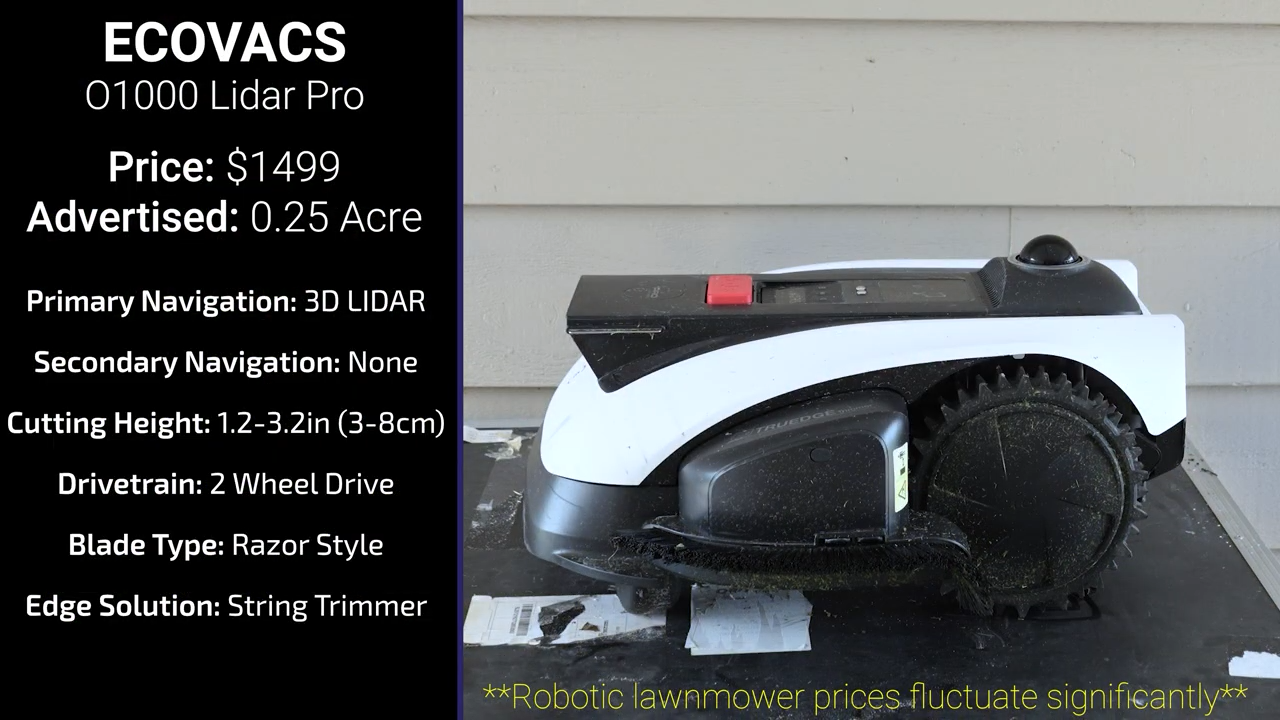
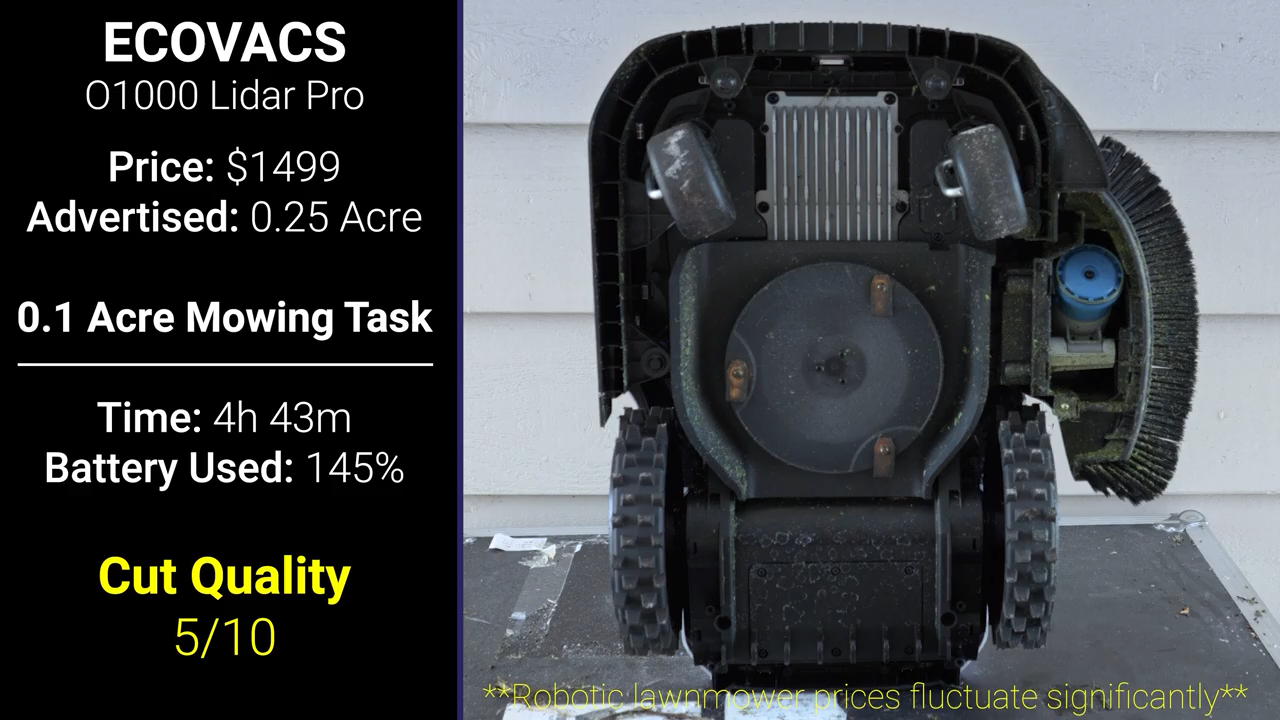
After that for $1499 is the Ecovacs O1000 LIDAR Pro, which kept the same size and shape as last year’s O1000 model, but switched from GPS to Lidar and got the same string trimming attachment as the more expensive new A3000 Pro. The O1000 Pro has an advertised mowing capacity of a quarter acre. It mowed for 1 hour and 50 minutes and used 85% of its battery to mow 59% of the lawn before returning to charge. It charged for an hour and 20 minutes up to 81% before going out to finish the lawn. Overall, the O1000 Lidar completed the mowing task in 4 hours and 43 minutes and used 145% of its battery capacity. I rated the cut quality of the O1000’s single three-blade disk a 5 out of 10 with a lot of missed blades. I think that the “quick” movement speed in the app is much too fast for the O1000 to get quality cuts, especially on thicker St. Augustine grass.
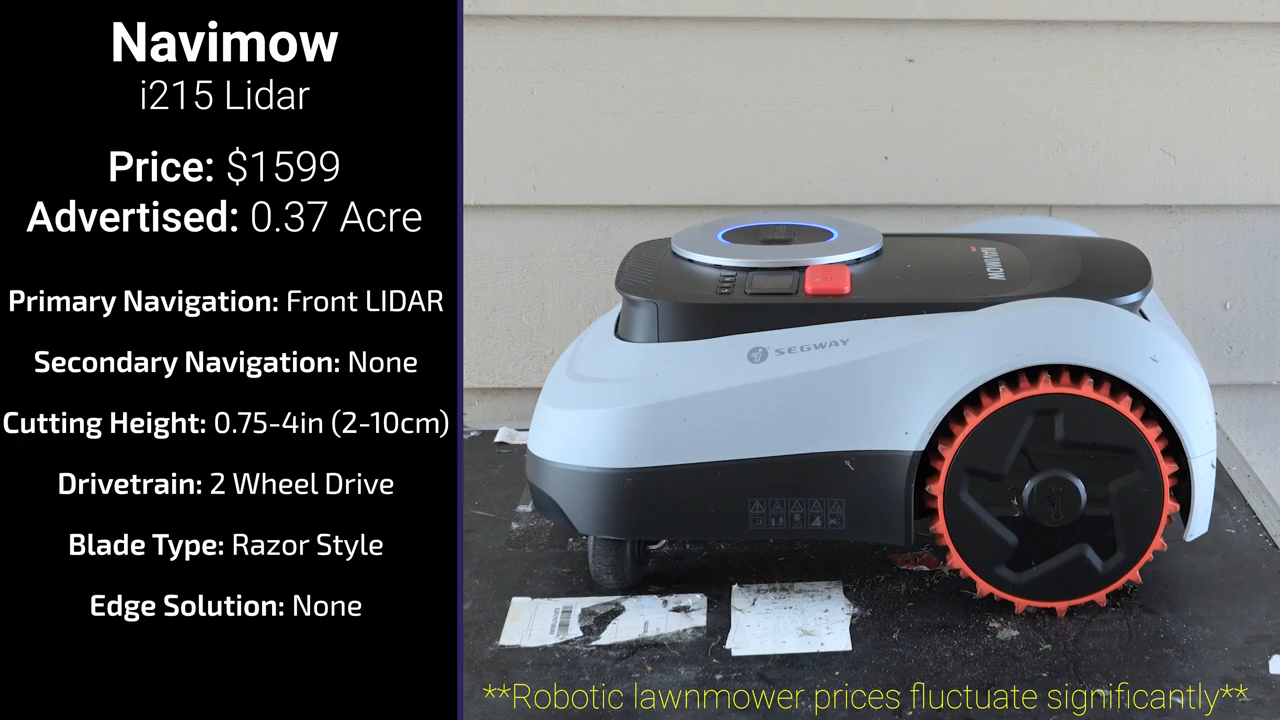
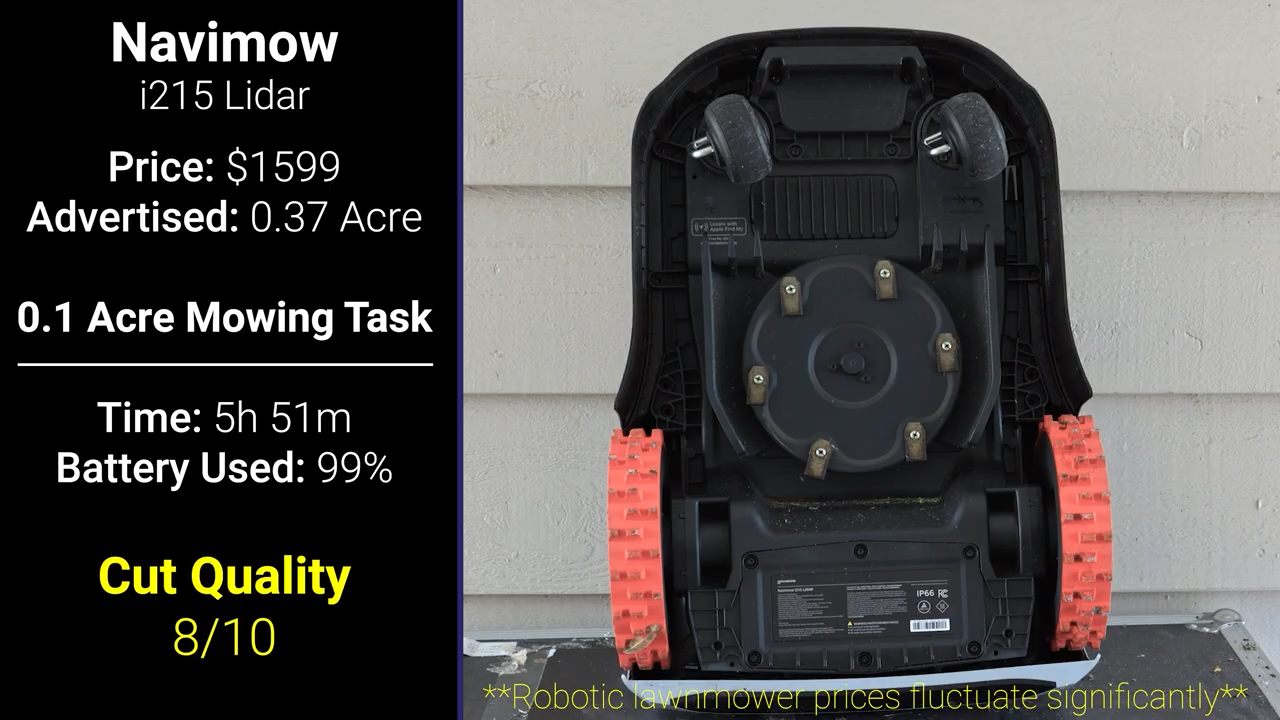
For $1599 the Navimow i215 LiDAR has an advertised mowing capacity of 0.37 acres. The i215 mowed for 3 hours and 25 minutes and completed 92% of the lawn before heading back to charge. It charged for a full 2 hours, getting back up to 100% before going back out to finish the job. Overall, it took 5 hours and 51 minutes and only used 99% of its overall battery capacity, but the i215 lacks any kind of smart recharge that would have allowed it to do a short charge to finish faster. For cut quality, I rated the Navimow i215’s single six-blade disk at 8 out of 10. In the areas that I inspected, it did an excellent job with clean cuts and very few missed blades.
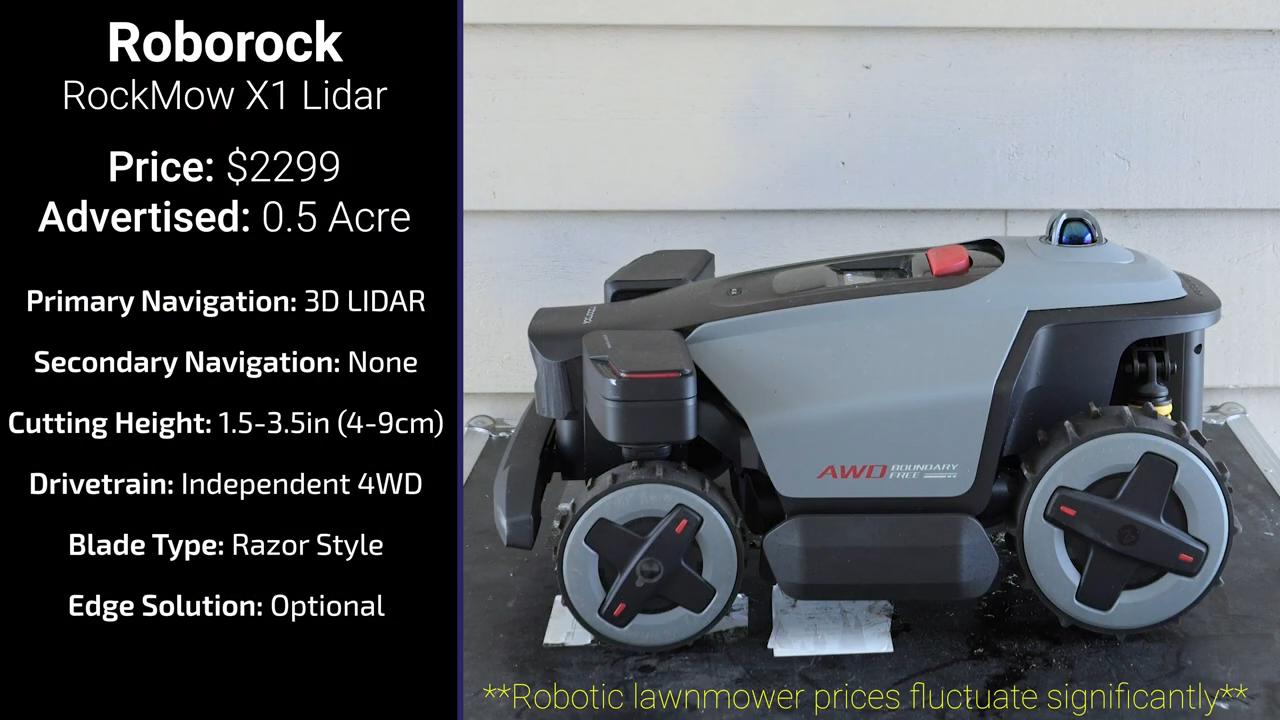
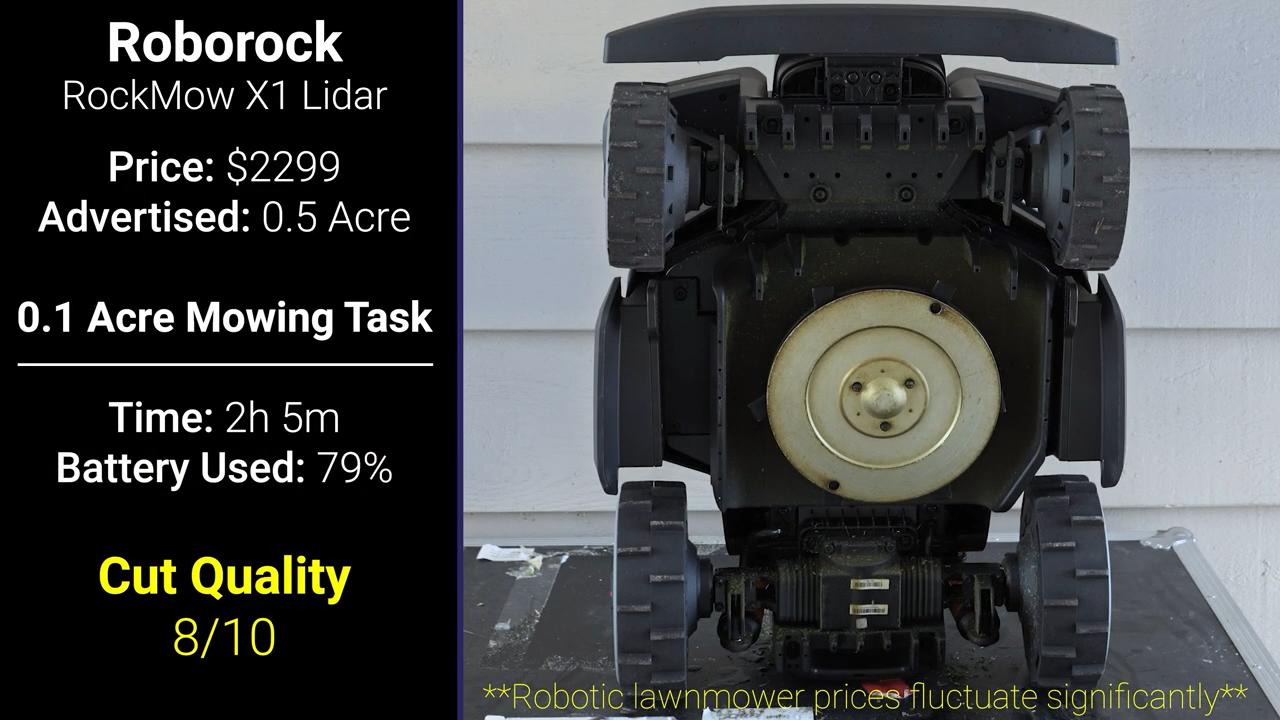
Jumping up significantly to an expected price around $2299 is the Roborock RockMow X1 LiDAR that has, unfortunately, had its global release delayed until August. But the X1, which is actually still called the X120H Lidar V5 in my Roborock app, has an advertised mowing capacity of a half an acre. The X1 completed the mowing task in 2 hours and 5 minutes and used 79% of its battery. I rated the cut quality of its single six-blade cutting wheel an 8 out of 10 with very clean cuts, but some missed grass blades.
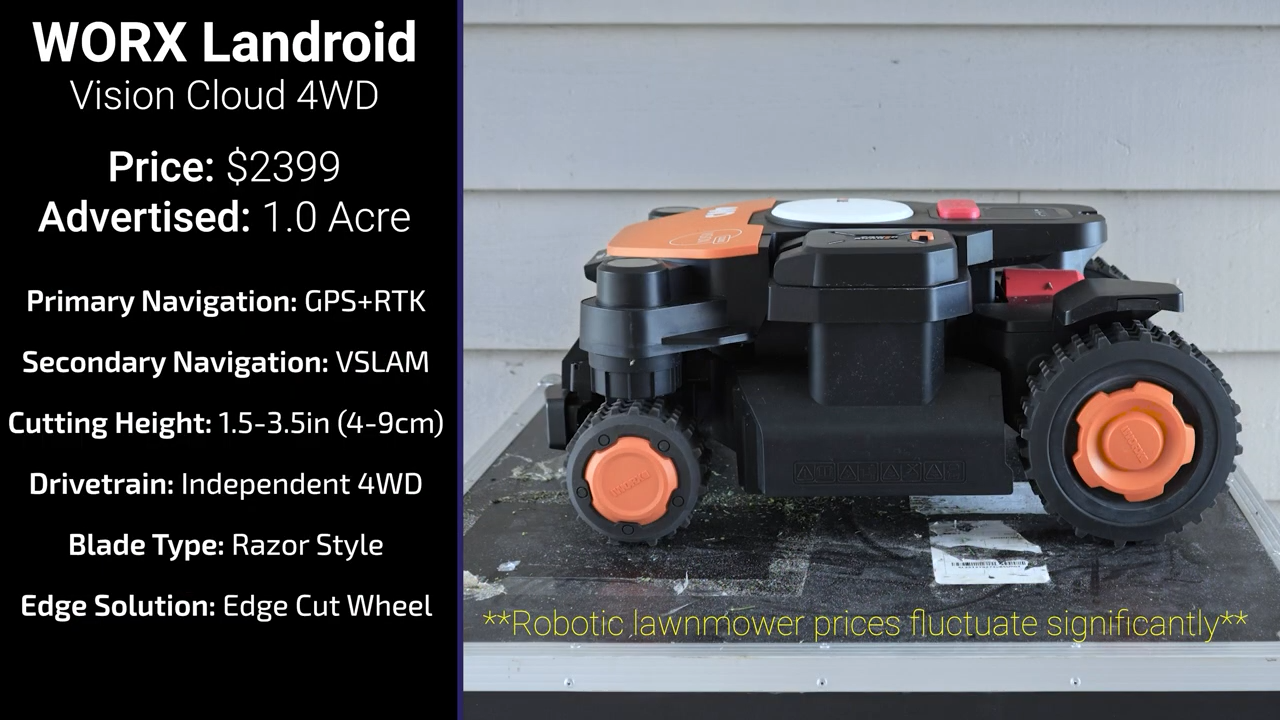
Then for $2399 is the WORX Landroid Vision Cloud AWD that has a fairly large advertised mowing capacity of 1 acre but failed to complete my 0.1 acre back yard without needing a recharge and mowed for 1 hour and 14 minutes, using 90% of its battery before going back to charge. It charged for 45 minutes before going back out to complete the task, which took another 45 minutes but drained the battery down to 13%, which means overall the Landroid used 177% of its battery capacity to mow 0.1 acres despite being rated for an acre of coverage.

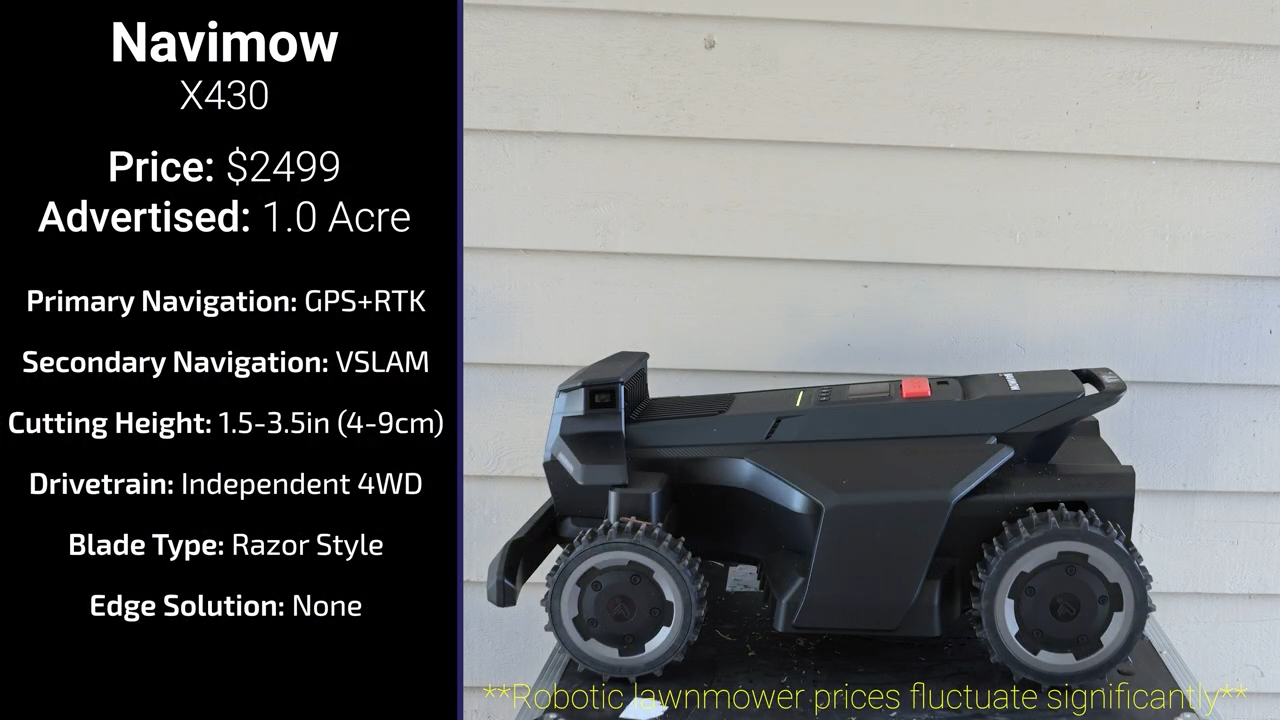
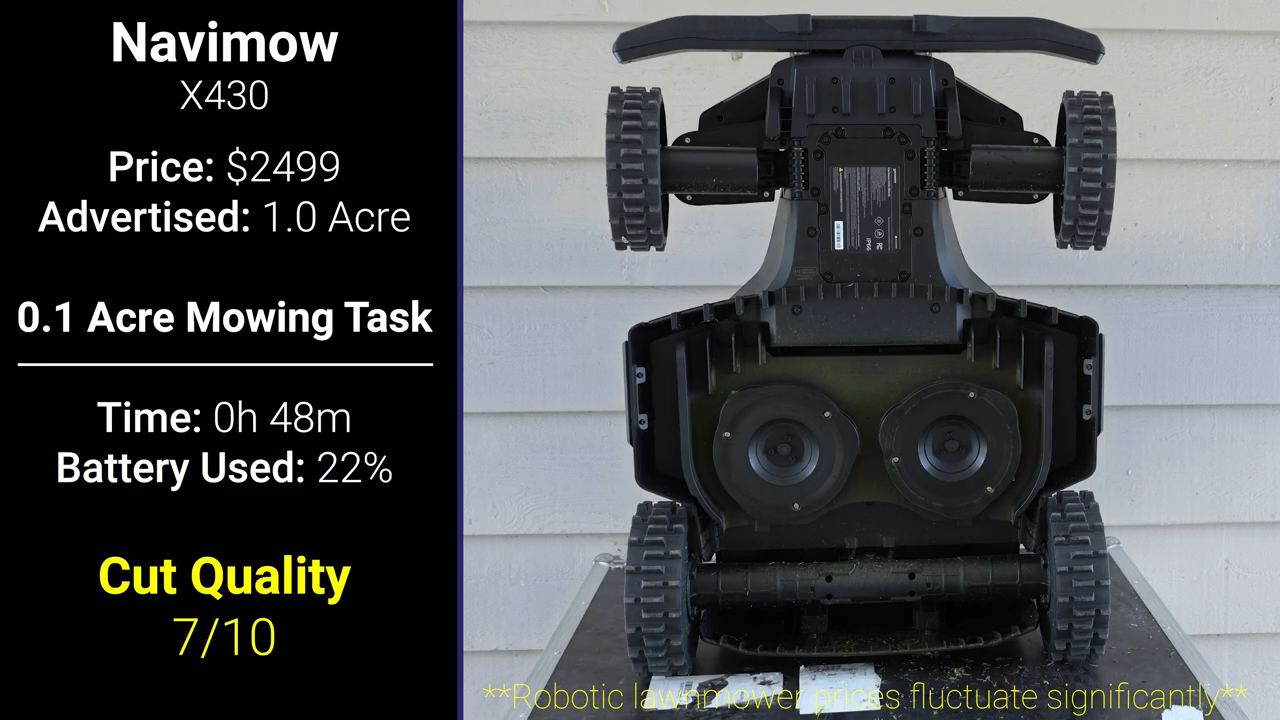
In contrast the $2499 Navimow X430 also has a rated mowing capacity of 1 acre, but the X430 finished mowing my 0.1 acre yard in 48 minutes and used just 22% of its battery, making it the best so far by a significant amount. However, I did rate the X430’s cut quality at 7 out of 10 using its two three-blade cutting disks. I found that while grass blades that did get cut were clean, the X430 also left about 10% of the grass blades it passed over untouched. I think the X430 would benefit from a lower movement speed, but I didn’t see any obvious place to do that in the app.
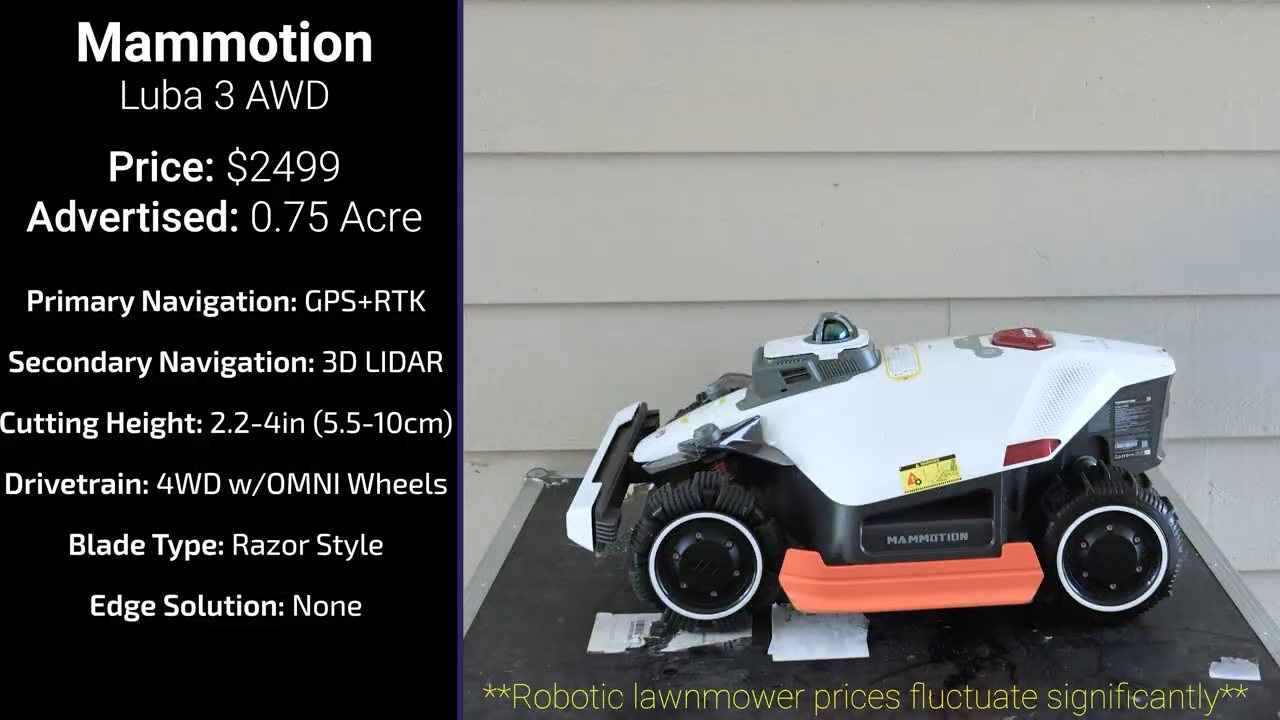
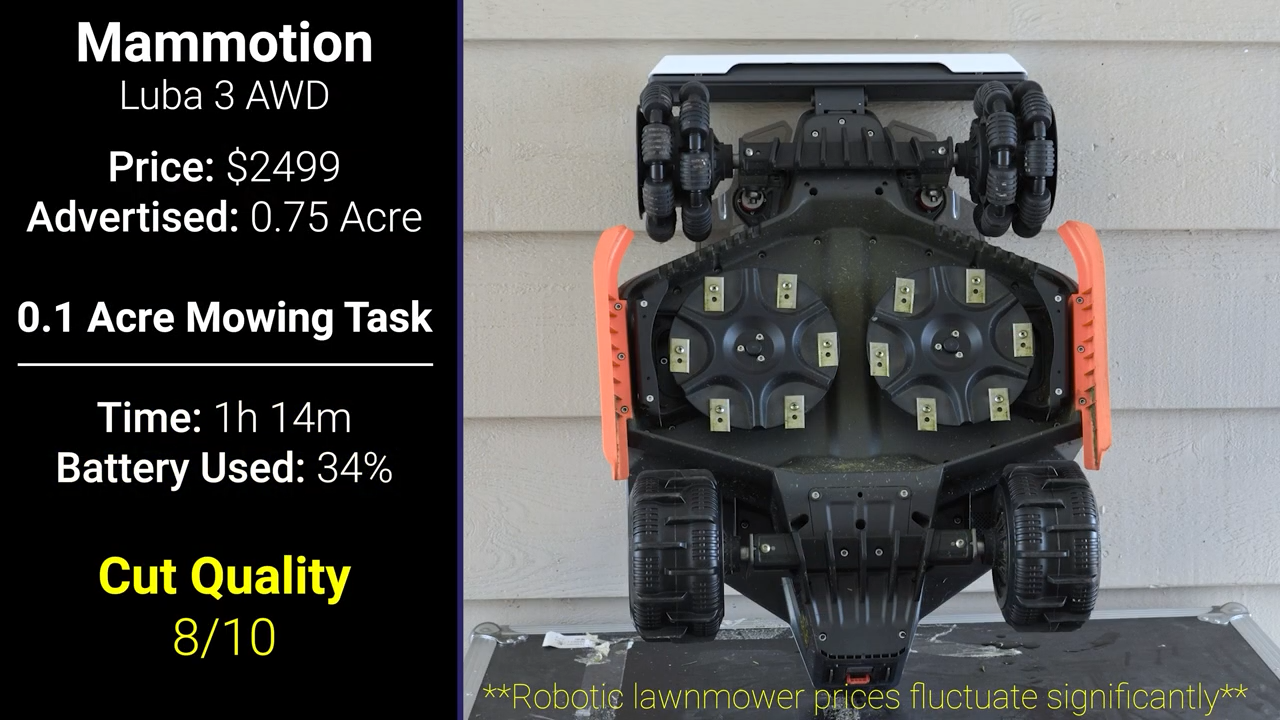
Next, also for $2499 is the Mammotion Luba 3 that has an advertised mowing capacity of 0.75 acres. The Luba 3 completed the 0.1 acre back yard mowing task in 1 hour and 14 minutes and used 34% of its battery. I rated the cut quality of its two six-blade disks at an 8 out of 10, which I think is close to the best you can expect from the razor style blades since they can’t generate lift to pull the blades up before cutting them.
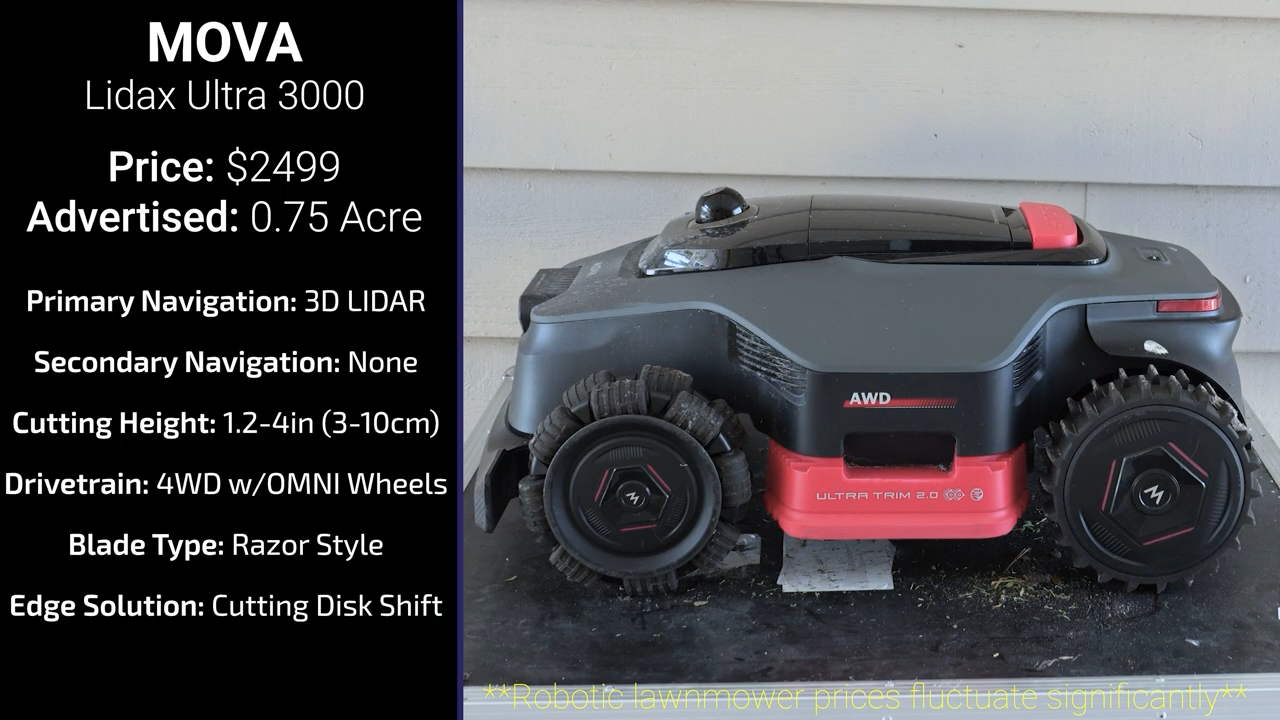
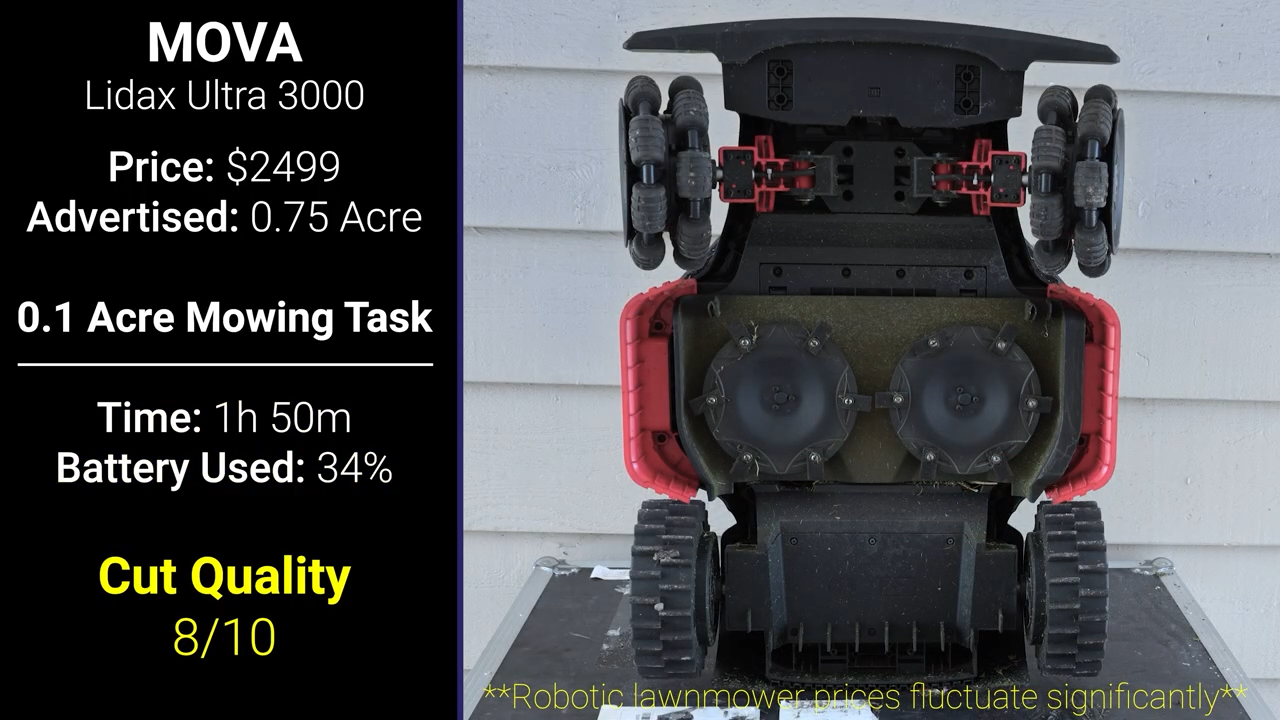
$2499 is a popular price and the MOVA LiDAX Ultra 3000 AWD also has an advertised mowing capacity of 0.75 acres. The Ultra 3000 completed the mowing task in 1 hour and 50 minutes, using 34% of its battery. Like the Mammotion Luba, the cut quality of the MOVA’s two six-blade disks was excellent and I rated it an 8 out of 10. It not only provided clean cuts with no tearing but also had very few missed blades.
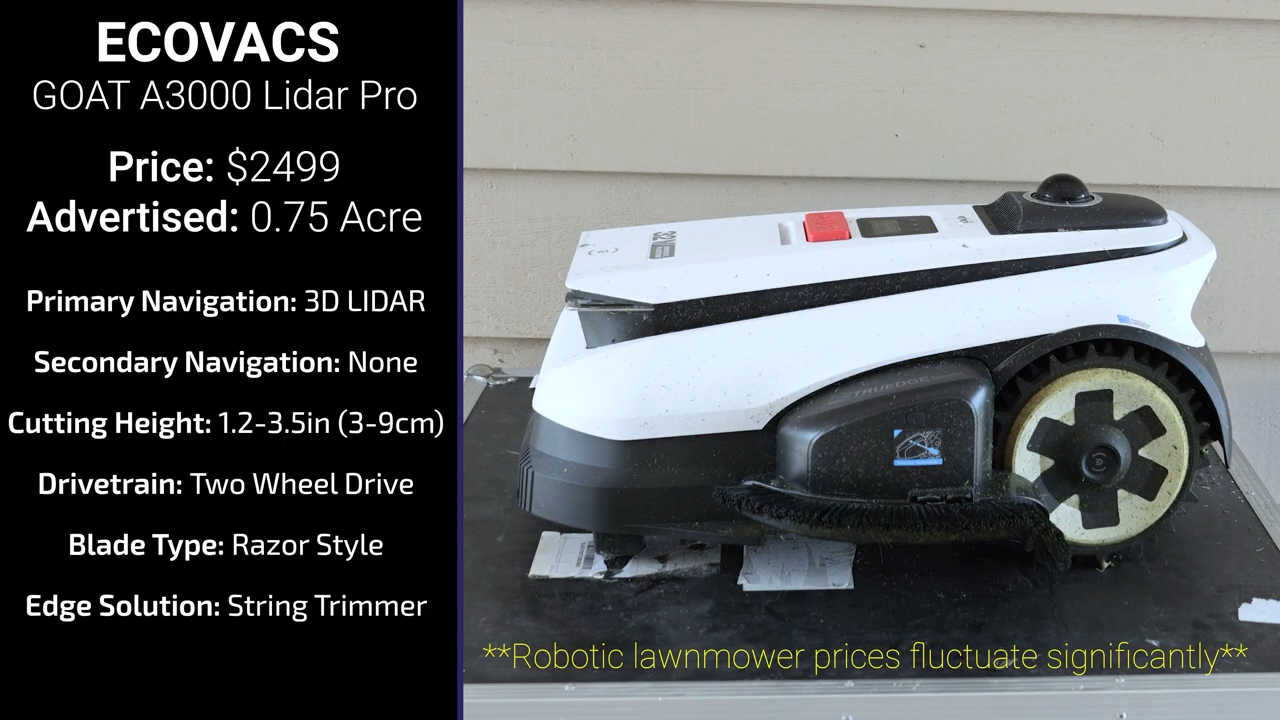
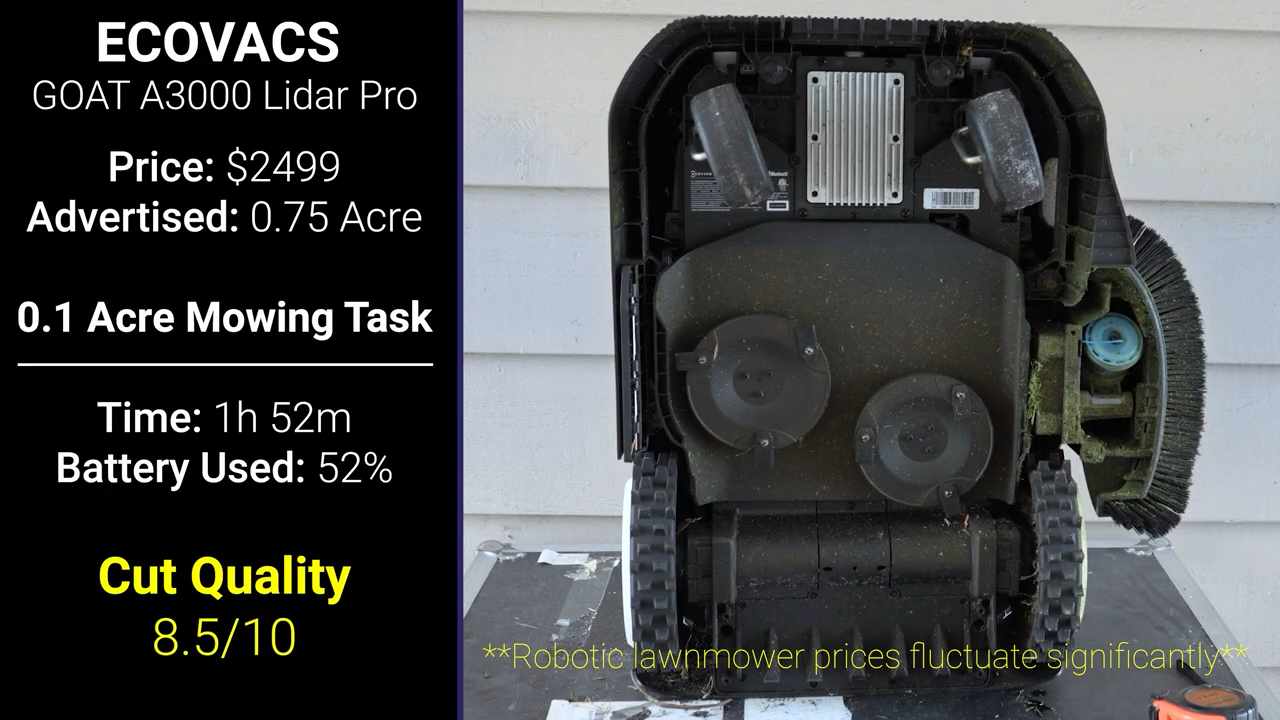
One last $2499 robot, the Ecovacs GOAT A3000 Lidar Pro is the upgraded version of the A3000, which was the only mower I ultimately recommended from last year’s video. The A3000 Pro also has an advertised mowing capacity of 0.75 acres and completed the mowing task in 1 hour and 52 minutes, similar to the MOVA, but used 52% of its battery compared to 34% on the MOVA. But I rated the cut quality of its two offset three-blade disks slightly higher at 8.5 out of 10. It provided clean even cuts even in the worst areas with a mix of grass types and had zero missed blades in the areas that I inspected.
Jumping up to $2999 is the Lymow One Plus, rated for 1.1 acres of mowing capacity, the highest yet. Using Lymow’s default settings, it completed the mowing task in 55 minutes and used 35% of its battery. The Lymow One Plus’s lawn mower style mulching blades resulted in an amazing cut quality that I rated at a 9.5 out of 10. That is when it was actually cutting the grass, which was unfortunately not that often.
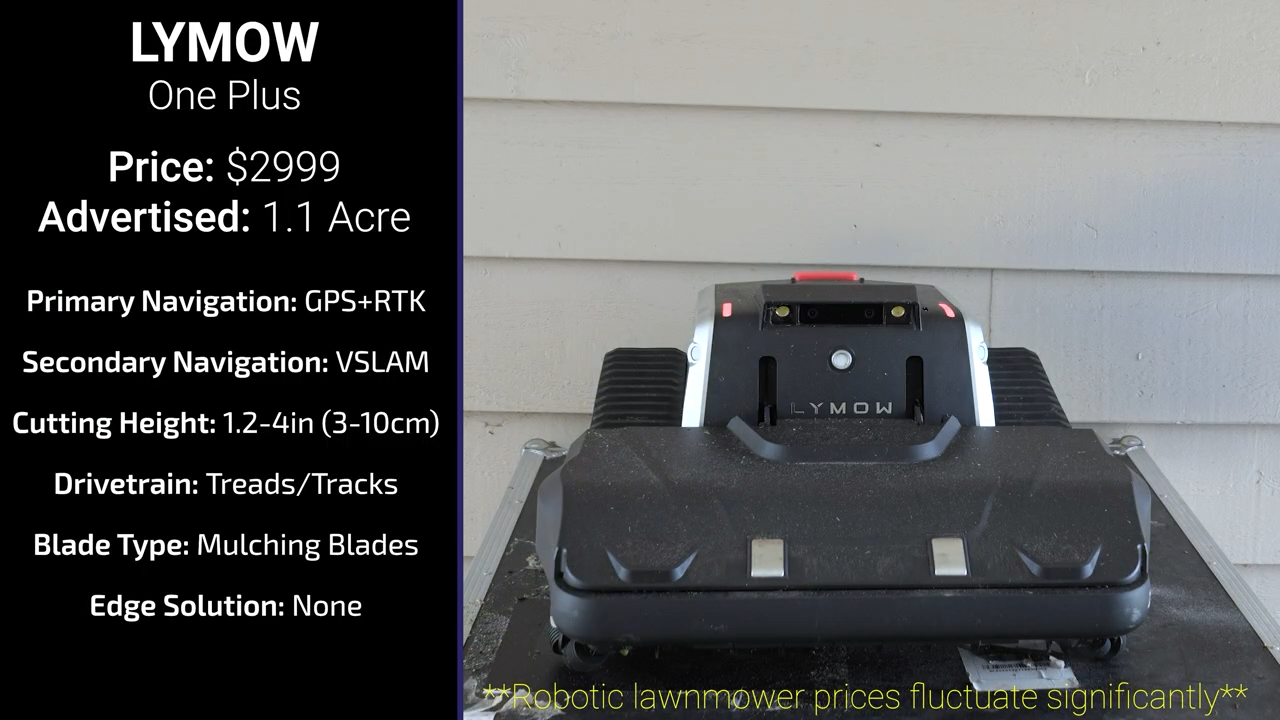
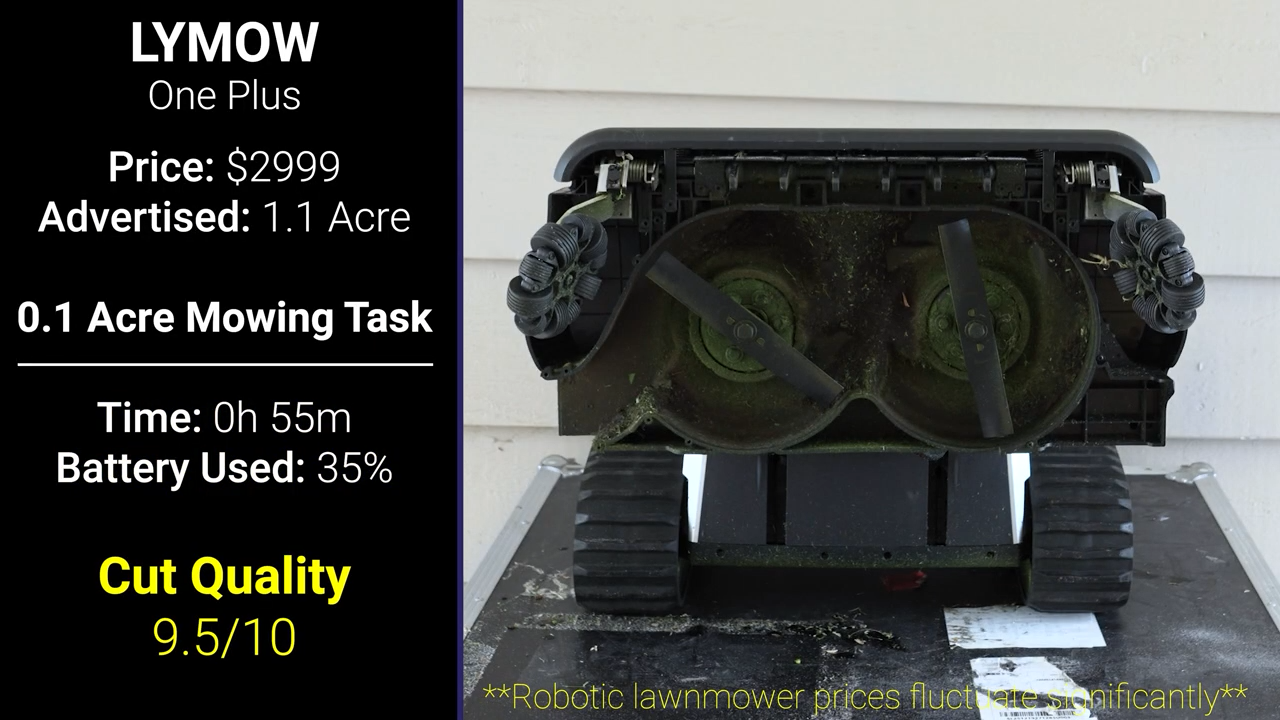
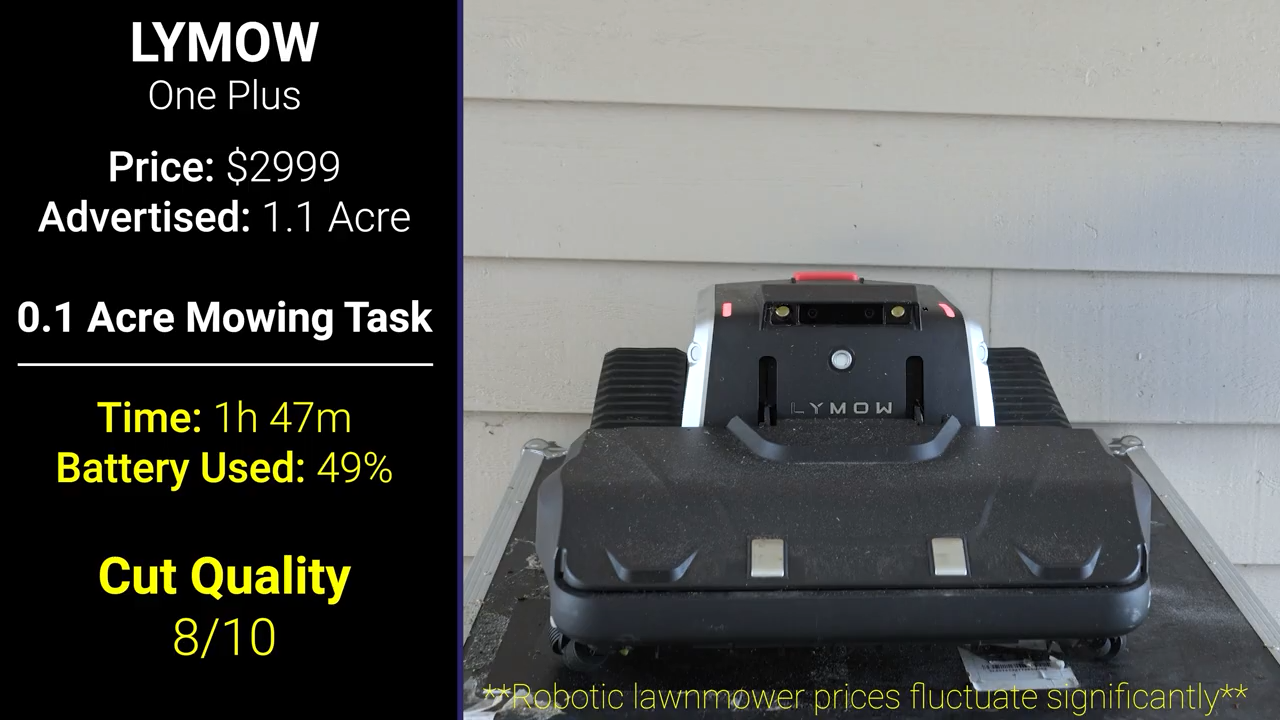
From the factory, the Lymow comes with a little outlet flap that barely lets any grass clippings out and the entire deck quickly gets clogged with grass clippings, causing the motors to stop cutting. Luckily, unlike another video that I saw on YouTube where the guy took a Dremel to his new $3000 mower, the entire exit port assembly was removable on my Lymow using just a few screws. Unfortunately, this still didn’t completely eliminate the motor overload problem. By far the worst part about the Lymow One Plus is that I don’t think the Lymow actually knows when its motors have stopped working. So, it just keeps moving when the blades stop and it can move 20 or 30 feet before the blades start up again, randomly leaving huge uncut portions of lawn. As those areas get longer and longer, the likelihood of them causing the motors to stop again also increases, meaning the same patches will remain un-mowed. The only way I’ve been able to mitigate it is by selecting the slowest movement speed, the slowest blade speed, and largest path overlap which significantly reduces battery life and mowing capacity. To mow my 0.1 acre back yard with those settings took an hour and 47 minutes and uses 49% battery. The lower blade speed also reduces cut quality and mulching ability.
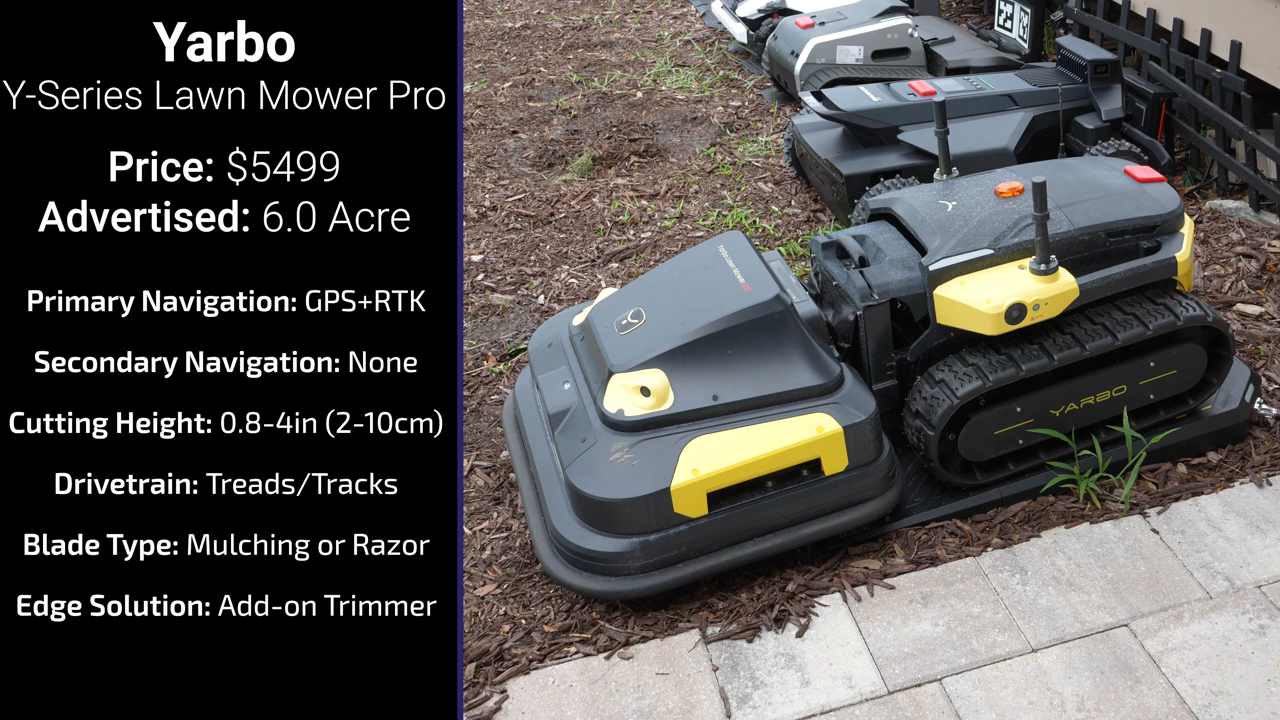
Last, the most expensive mower in this video is more like a robotic tractor than just a mower. The Yarbo Y-Series Lawn Mower Pro will run you $5499 for the Core unit and Lawn Mower Pro module, and then you can add on other modules like a Leaf Blower or Snow Blower for about $1000 each. The Yarbo has by far the highest rated mowing capacity, advertised at up to 6 acres, but to complete my 0.1 acre mowing task took 1 hour and 20 minutes and used 34% of its battery. I think to get anywhere close to 6 acres of capacity from the Yarbo it needs a much more open space since it spent at least a third of the time turning itself around using its multi-point smart turn that minimizes the damage to the grass caused by the tank treads and the fact that the Yarbo weighs well over 200lbs. Like the Lymow, the Yarbo Lawn Mower Pro also has more traditional looking mower blades that generate lift and the Yarbo didn’t have any issues with motors overheating like the Lymow but unfortunately cut quality of the dual straight blades was significantly lower. I rated it a 6 out of 10 for cut quality and blades of grass looked like they were being smashed and ripped rather than cut, but I do see now that Yarbo recommends only using the straight blades on cool season grasses like Kentucky Blue, Rye, and Fescue, rather than the mix of Bermuda and St. Augustine that I have in my yard.

Results and Graphs
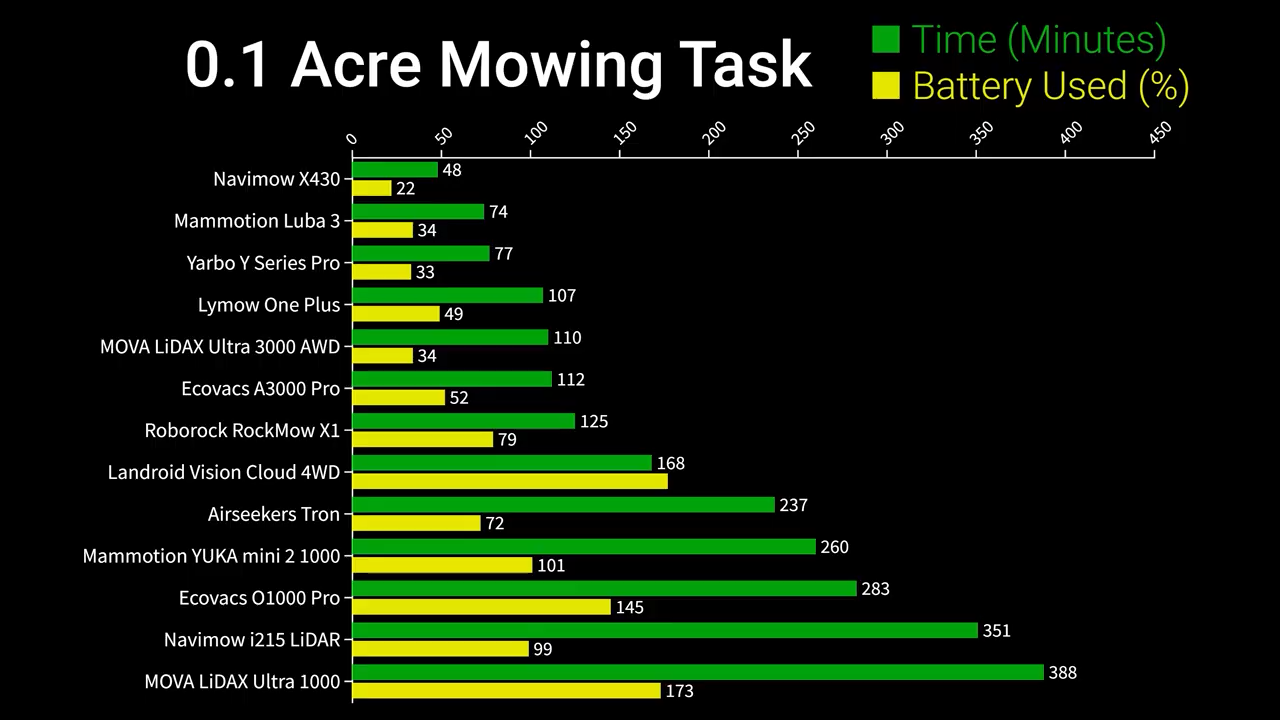
That makes these the final rankings for mowing speed, with the Navimow X430 in a commanding lead, the Mammotion Luba 3 in 2nd, and the Yarbo Y-Series in 3rd, all completing the 0.1 acre mowing task in under an hour and a half.
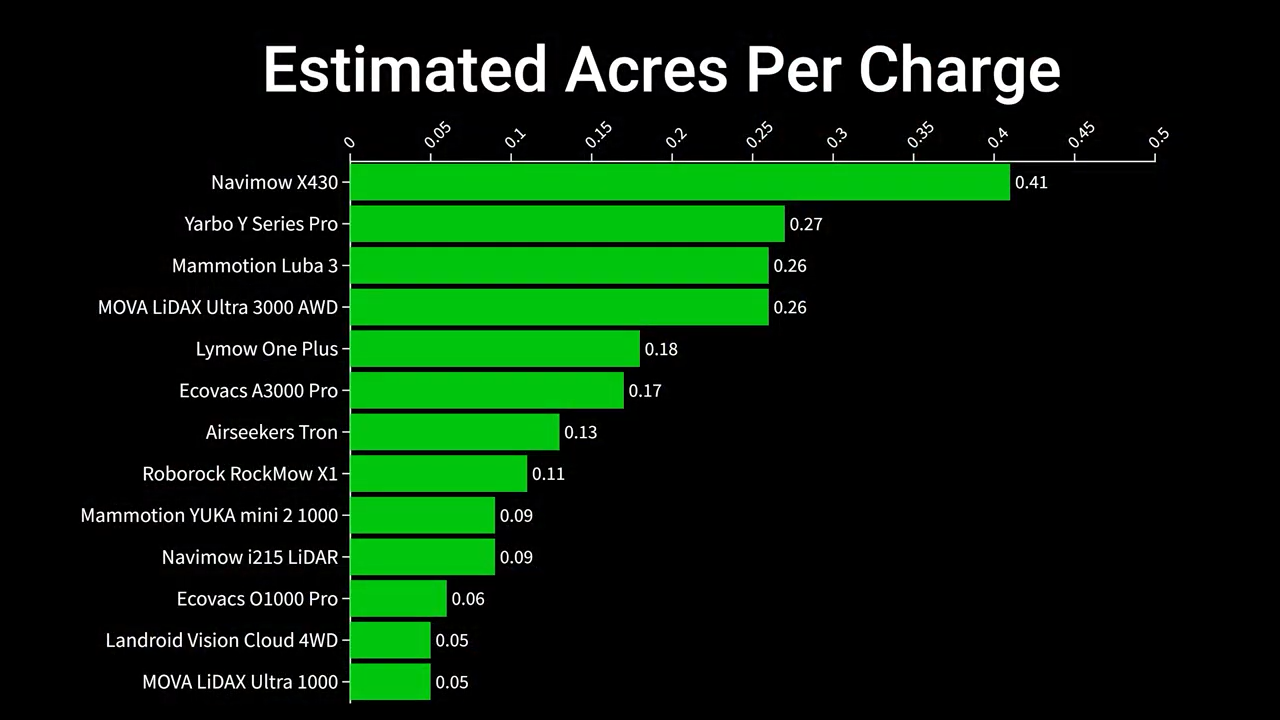
Since there’s clearly not any agreed upon way to advertise actual mowing capacity and battery life, here is the estimated yard size that each mower could complete without charging, with the Navimow X430 in first again by a long shot at about 0.4 acres, the Yarbo in 2nd at 0.27 acres, and the Luba 3 and Mova LIDAX Ultra 3000 tied for 3rd at 0.26 acres, but keep in mind these values will vary based on grass density, complex yard shapes, and hills.
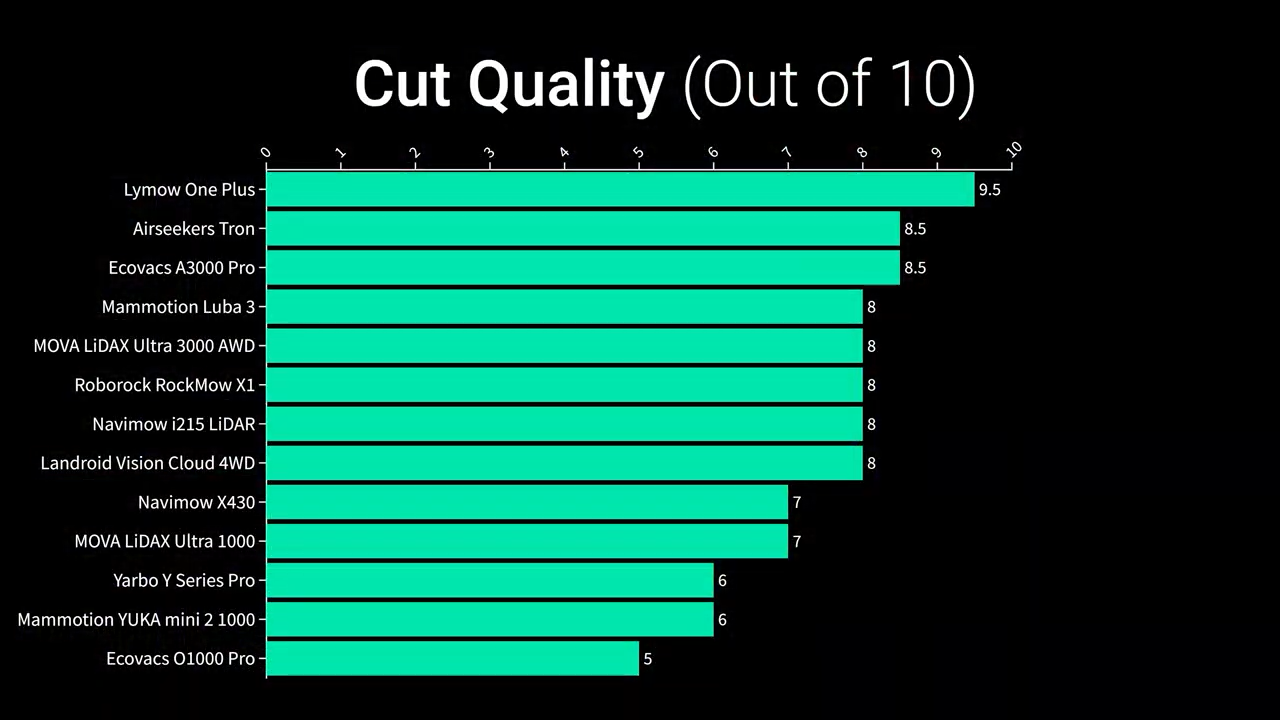
Last, looking at cut quality, the Lymow One Plus was in an absolute league of its own with the blades on their highest cutting speed. But that resulted in continuous overheating and to get the mower to work consistently it required modification to the mowing deck, the slowest mowing speed, and the slowest blade speed which reduced cut quality. Even then there were still occasional issues with uncut strips. The Airseekers Tron also had excellent cut quality when it was working due to the extra plastic propeller mounted above the blade disk, but my first propeller lasted less than a month before breaking. The Tron only ships with two propellers in the box and changing the propeller is kind of a pain, so the most consistent, least problematic, best cut quality came from the Ecovacs A3000 Pro’s offset cutting disks. They rarely missed any grass blades and provided sharp clean cuts without any modification or extra parts to replace.
Navigation Types and Testing
However, even though cut quality and mowing capacity are important, to me they aren’t the most important thing when it comes to a robotic mower. Above all else, the thing just needs to do its job, not get stuck, and not cause other problems, and that’s where navigation comes into play.
There are really three kinds of navigation when it comes to device positioning and mapping your yard: GPS with RTK, LiDAR, and VSLAM Camera positioning. Most of these mowers have some combination of those technologies, but they don’t all function equally.
First, let’s talk about GPS. The Lymow, Yarbo, Navimow X430, Luba 3, Landroid, and Airseekers all have GPS positioning with RTK. The 30 second explanation of that technology is that the robots triangulate their position by locking onto at least three satellites in medium Earth orbit, but the location data isn’t all that accurate and can vary by as much as 3-5 meters, which obviously won’t work for precision mapping of your yard. But since the variation is consistent for all devices using those same satellites, a local RTK station can be used as an anchor point to help the mower orient itself in your yard, increasing positioning accuracy to around 1-3 centimeters.
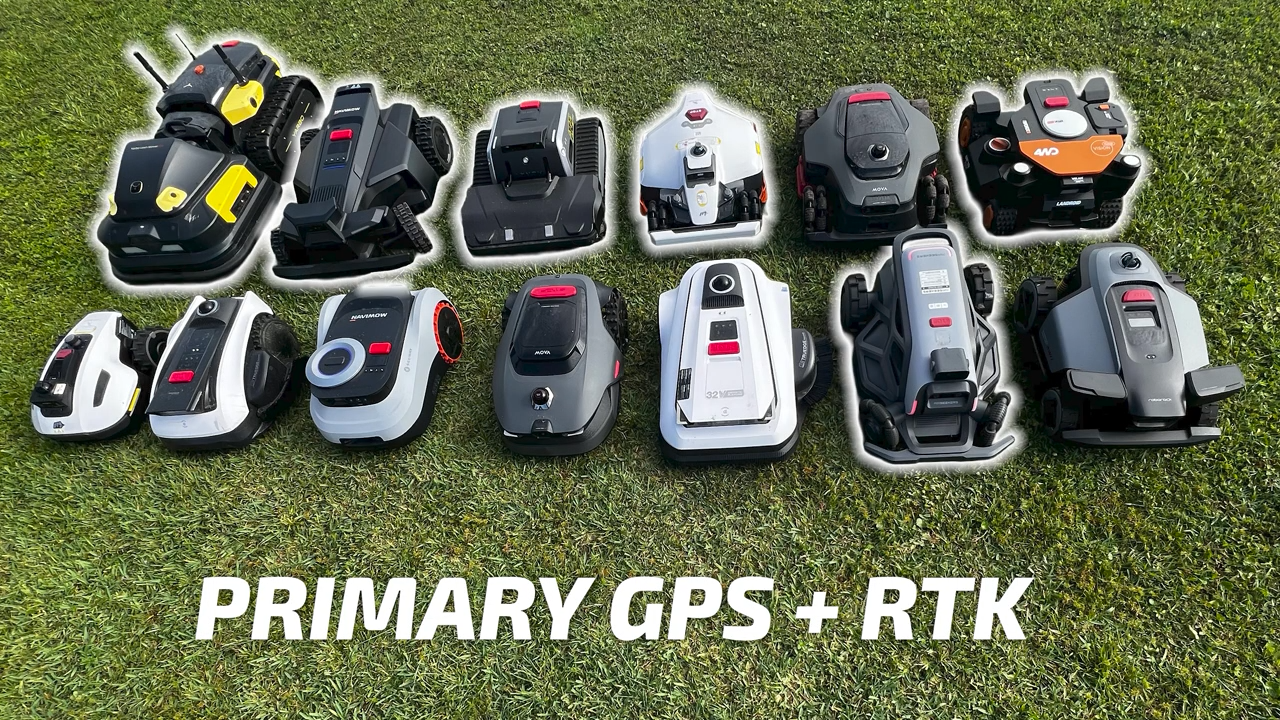
Previously RTK required you to put your own local base station somewhere in your yard, but NetRTK has become more popular and relies on RTK providers that have networks of remote RTK stations mounted all over the country and provide the offset data as a service. While I appreciate the extra ease of setup, I’m personally not a fan of NetRTK because it’s a service, and even though it’s free right now it probably won’t be free forever. More importantly, I think GPS is just an inferior positioning system in general, and my lake house has almost no tree cover, is a single story house, and is located on a wide open lake, and the GPS-based robots still consistently had navigation issues, despite also having other navigation systems they are supposed to be able to fall back to.
The Yarbo was by far the most dependent on a strong GPS signal. At my house I mapped the front and back yard and both side yards, and the Yarbo was the only robot that just refused to map the side yard due to poor GPS signal. Even more ridiculously, I couldn’t even set up a channel for the Yarbo to travel 25 feet through my breezeway to get from its charging station in the back yard into my front yard. The only channel I could get set up goes through the alleyway on the side of my garage, where the Yarbo frequently got stuck on old stumps and sticks. Even with its base station positioned completely in the open in my back yard, on overcast days the Yarbo would occasionally say it didn’t have a strong enough GPS signal to start a mowing task.
The Lymow, Airseekers, Navimow X430, and Landroid all fall back to vision-based systems when GPS signals are weak, but in practice the backup VSLAM navigation is just not that good. As a test of these backup systems, I sent each mower to mow my side yard, and as I mentioned before, the Yarbo just completely refused to map the area, the Lymow did alright for a while and then started mowing about 5-6” outside of its boundary, running into the concrete pad for the house’s old propane tank and then smashing its steel mulching blades into the concrete border of the crawl space access.
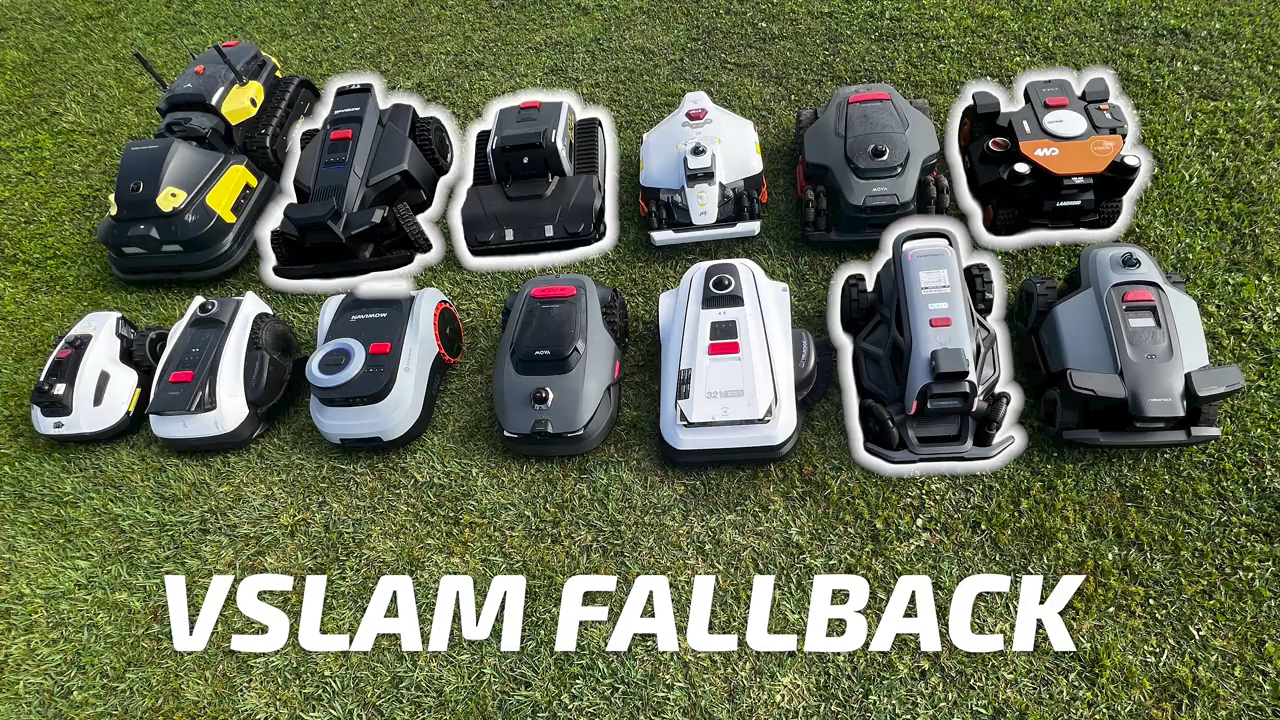
The Tron never even made it to the side yard and after losing its GPS lock it steered itself right into the foundation of my house and then proceeded to back up and run into the house over and over.
The Landroid worked and completed the mowing task by falling back into vision mode, but when the switch over happened it freaked out and dug a hole in the ground with its front wheels that are usually extremely gentle. Throughout the entire mowing task, it looked like someone walking around in a room with the lights off trying to avoid running into things by keeping their hands out in front of them.
The Navimow X430, which doesn’t really advertise a backup navigation system, somehow didn’t have any issues mowing the side yard and stayed completely in bounds. I think the X430 may use some sort of short-range infrared laser detection in addition to its cameras, and you can see it flashing and lighting up my security camera footage at night.
The Mammotion Luba 3 primarily uses GPS as its main positioning system but also has 360-degree LiDAR and camera-based VSLAM, but like the Landroid, you can see when it loses its GPS signal and switches to secondary navigation. It backs up out of the mowing zone and almost falls into the crawl space access. If I’m honest, I don’t know why Mammotion would use GPS as the primary positioning method when LiDAR is significantly more accurate and precise.
Unsurprisingly, the robots that use 3D LiDAR as their positioning method had no problems navigating my side yard and that includes the Mova LiDAX Ultra 1000, Mammotion Yuka Mini 2 1000 LiDAR, Ecovacs O1000 Pro, Roborock RockMow X1, the Ecovacs A3000 Pro, and Mova LIDAX Ultra 3000 AWD.
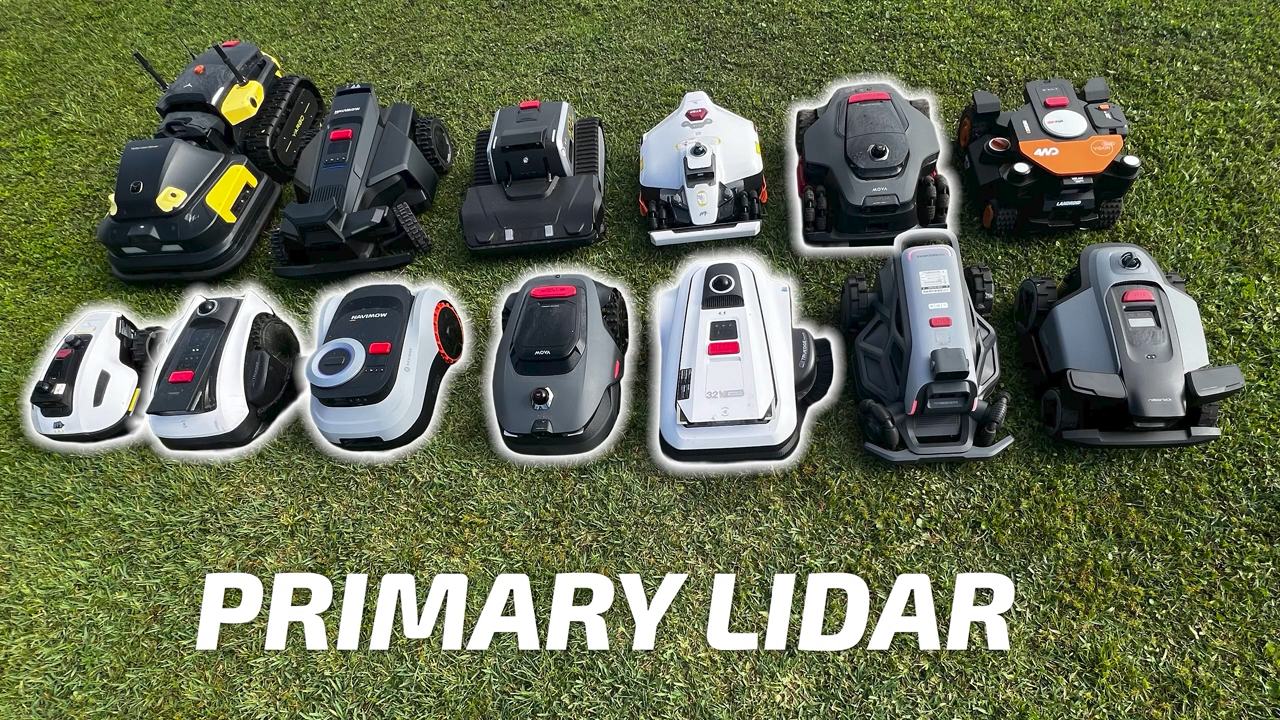
One interesting thing is that the Navimow i215 LiDAR obviously advertises itself as being a LiDAR navigation robot, but unlike the other robots that have the rainbow-colored dome on the top, the Navimow i215 uses single plane 2D LiDAR which is more similar to a robotic vacuum. After mapping my side yard, I noticed that it looked a little funny on the map, and sure enough when I sent the i215 out to mow it ended up in my neighbor’s yard. My hypothesis is that there was some reflection off the PVC fencing that caused the Navimow to miscalculate its position. I ended up needing to delete that zone and remap, which did completely fix the error, but I wonder if 2D LiDAR is just ultimately inferior to 3D for outdoor applications.
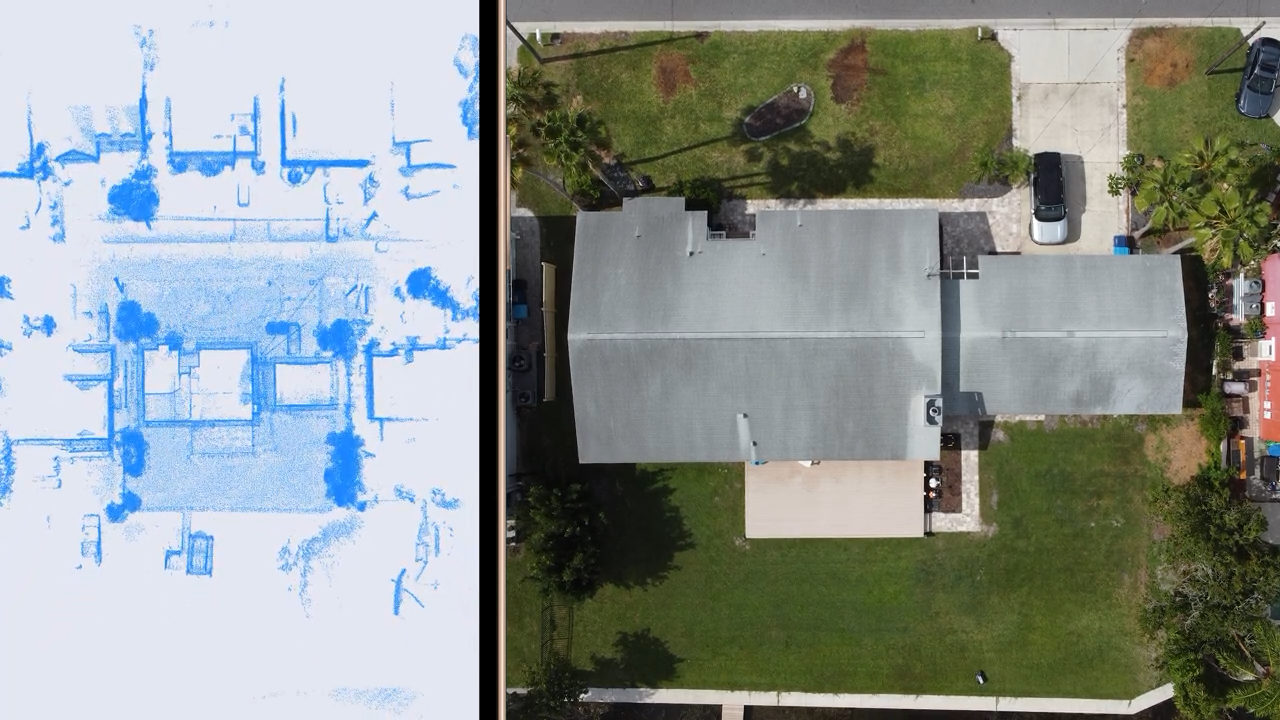
When it comes to navigation I’m really just at a loss why companies are still trying to use GPS, calculating position using satellites that are over 12,000 miles away in space instead of just using objects in the yard, and both MOVA and Ecovacs let you see the 3D map that gets created by the robot’s LiDAR system. It’s insanely detailed and sees surprisingly far away, so it would almost certainly be able to handle even extremely large open fields and you’re more likely to run into Wi-Fi or battery issues before maxing out LiDAR’s positioning capabilities.
Object Avoidance Testing
Next, while good positioning is an important foundation for keeping your robot out of trouble, sometimes there are things inside your mowing area that aren’t supposed to be there, and the robot’s ability to avoid those things can make the difference between completing a task and needing human intervention.
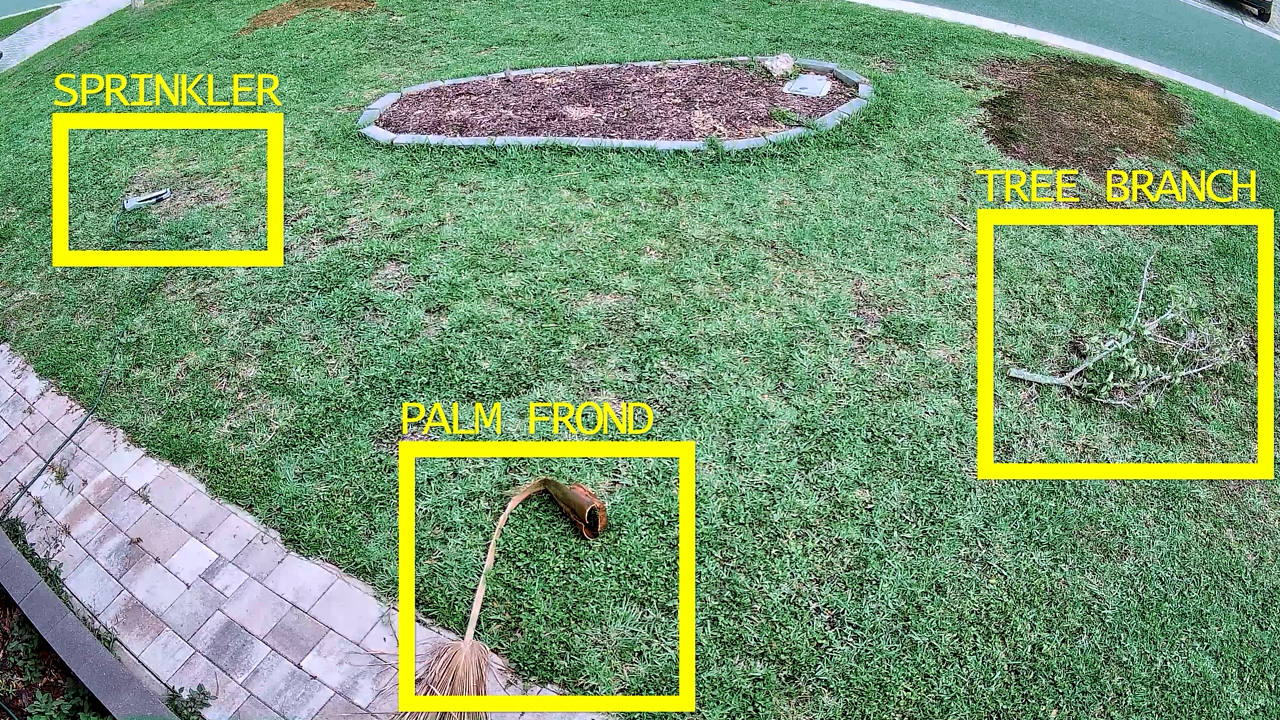
So, I set up an object avoidance course for the robots with a large tree branch, a palm frond, and a hose with a sprinkler attached to see what real life objects they could avoid. I made the mistake of sending the Yarbo out first, not considering that it is able to cause the most catastrophic damage, and it immediately ran directly over the palm front before making a B-line for the sprinkler, driving over it, and smashing it into a million pieces. But after a little clean up I restarted it, and it was at least able to avoid turning the fallen branch into a mulch pile.
The Airseekers Tron immediately went for the stick and lifted itself off the ground, triggering an error, and requiring intervention.
The Lymow ran over the edge of the palm frond and got it lodged into the side of its mulching blade, also requiring human intervention.
The Mova LiDAX Ultra 1000, Ecovacs O1000 Pro, and A3000 Pro ran into or over absolutely everything, but never got stuck. In the event that they do run over things, their razor blade style cutting disks do a lot less damage than the Lymow and Yarbo.
The MOVA LiDAX Ultra 3000 didn’t avoid the palm frond or branch but successfully avoided the sprinkler.
The Mammotion Luba 3 and Roborock RockMow X1 did an excellent job with object avoidance and avoided the branches and sprinkler, but did drive over the hose, and I’m not sure if that’s the right behavior or not since it’s not likely that they would damage it since their cutting depth isn’t that low and they don’t generate any lift. But the Navimow X430, and Mammotion Yuka Mini 2 were even able to avoid the garden hose, which is extremely impressive.
Then taking obstacle avoidance slightly too far, the Landroid Vision Cloud and Navimow i215 LiDAR avoided all the obstacles but also detected the mulch areas as problematic and avoided them which is not ideal behavior.
Traction and Drivetrain Testing
Next, some obstacles are unavoidable and some terrain is just challenging. So, the ability to navigate rough terrain and recover from slips is another important feature, and these robots’ drivetrains can be divided up into 4 different types.
First, are the 2-wheel drive robots that usually have either one or two caster wheels in the front, and that includes the more budget friendly Mova LiDAX Ultra 1000, Mammotion YUKA Mini 2 1000 LiDAR, Ecovacs O1000 Pro, and Navimow i215 LiDAR, as well as the more expensive Ecovacs A3000 Pro and the Airseekers Tron, which looks a lot like a 4-wheel drive mower, but the front omni-wheels have no power and are more of a liability than an asset. To test the robots’ traction, clearance, and strength, I had them mow my front side yard where I recently had a tree taken down and stump grounded to see which robots could not only climb the steep grade but also avoid digging themselves into the soft mulch.
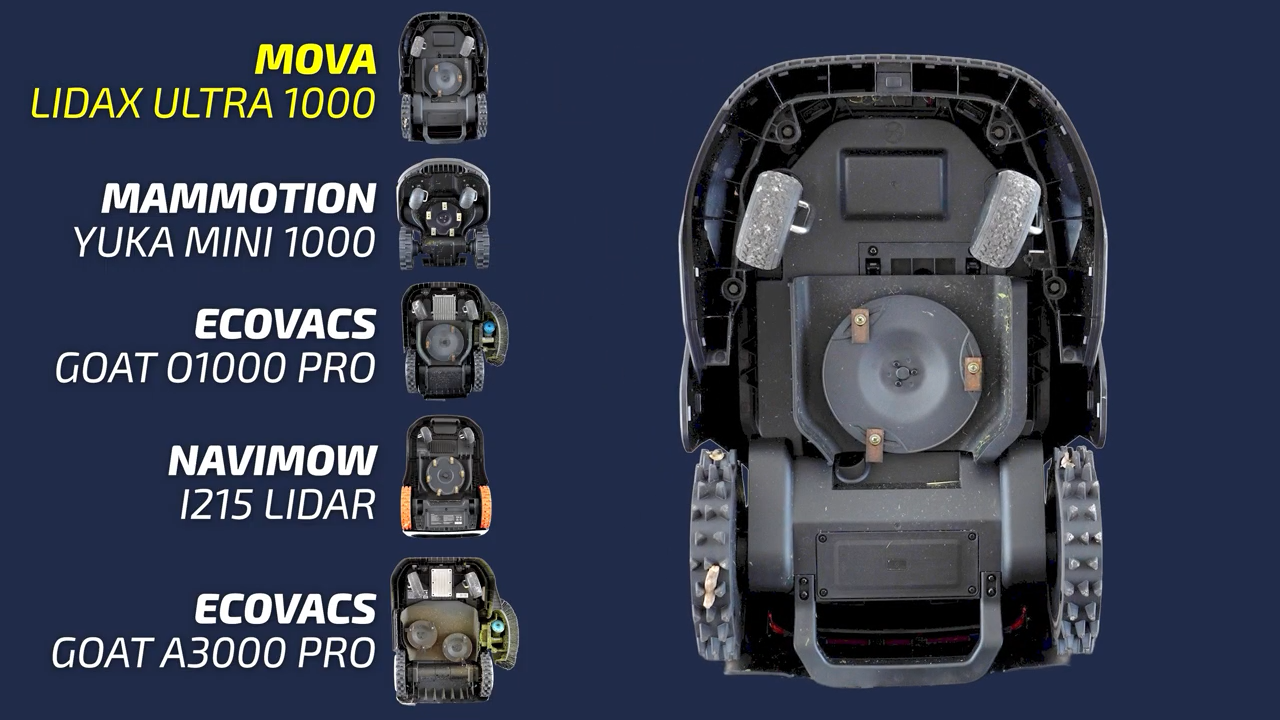
Unfortunately, none of the 2-wheel drive robots managed to complete the mowing task and all of them got stuck in various places on the mound. But the Ecovacs A3000 Pro didn’t fail in the sense that it got stuck and stopped, it instead slipped out into the road, drove around for a while, and then went back to its dock. On the one hand, I appreciate that it didn’t just die in the road, but on the other, if this had been in my backyard, it likely would have driven itself into the lake.
The second drivetrain type is a 4WD system that Mammotion has been using for years in the Luba series where the rear wheels are the main drive wheels, but the front wheels are powered omni-wheels that can assist in climbing and give the robot better clearance. The Luba 3 and Mova LiDAX A3000 both have this same drivetrain, in fact there is a lot of similarity in the design of the Luba 3 and Mova LiDAX A3000, and both of them were able to easily navigate the mulch pile and hills.
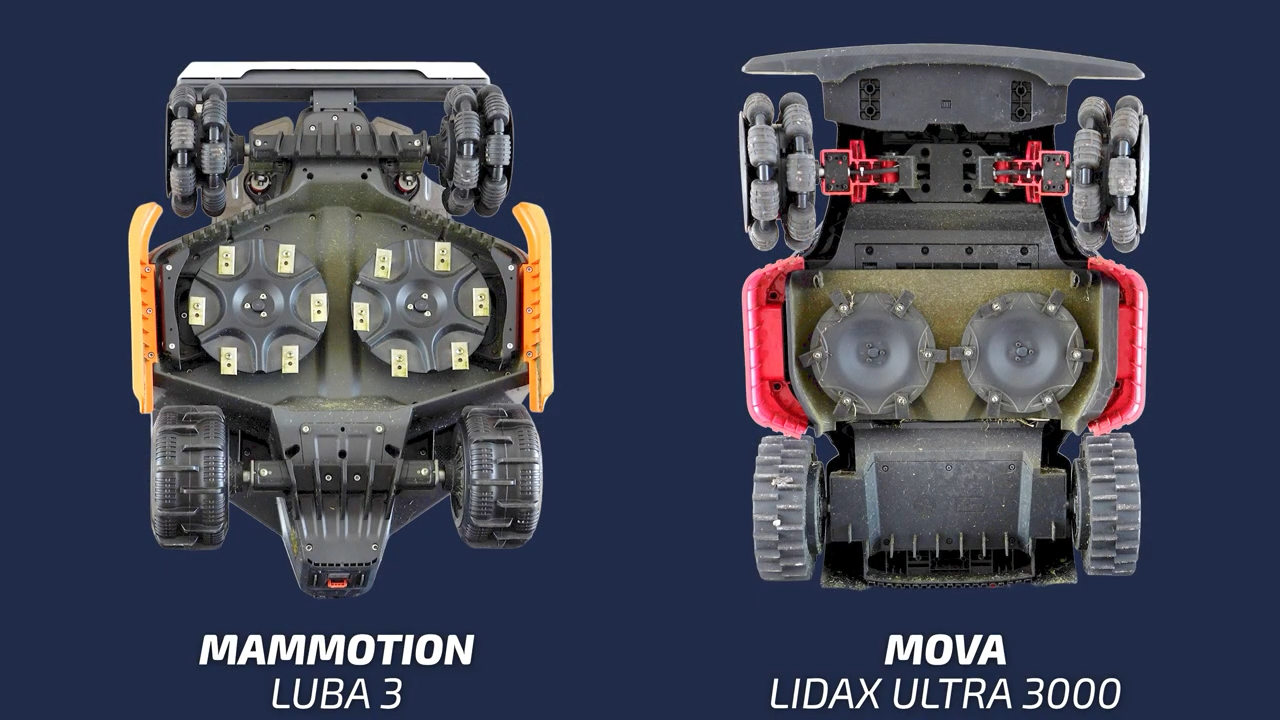
The third drivetrain is a newer 4WD system where the front wheels not only act as additional drive wheels, but they are also the steering system. So, while the old 4WD system would turn by rotating one rear wheel forward and the other backward, which drags the front omni-wheels over the turf, the new system actively turns the front wheels, and they can be turned completely perpendicular to the robot to rotate in a circle. The Landroid Vision Cloud 4WD, Roborock RockMow X1, and Navimow X430 all have this newer drivetrain. Interestingly, even though the Navimow product page shows it doing the perpendicular wheel circle turn, I haven’t ever seen it use that method and it seems to just turn like a car with both front wheels synchronized. Like the other 4WD robots, none of these newer generation drivetrain robots had any issues with the mulch hill.
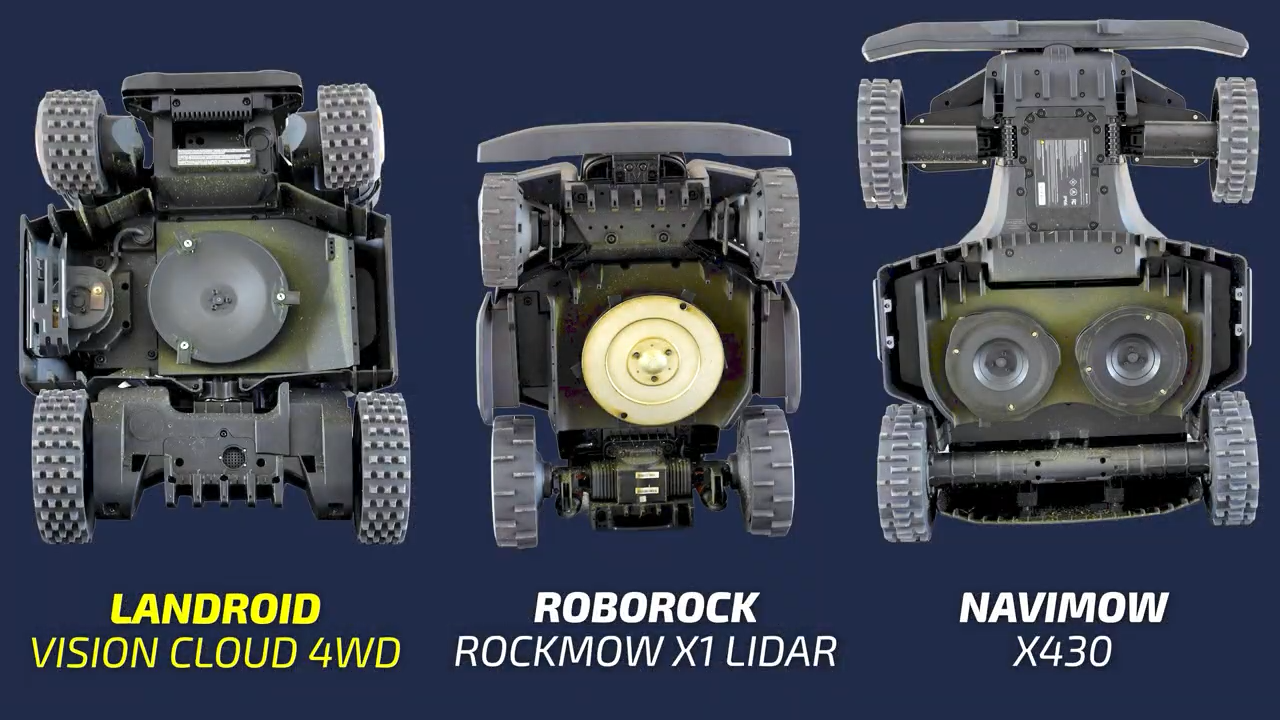
Last, the fourth drivetrain type is tread based. The Lymow and Yarbo both have heavy duty treads that allow them to move their much heavier bodies around without getting stuck, but the important distinction is that their cutting decks are cantilevered off the front of the track system. So, while they can mostly cut with the same precision of the other robots, they look a lot clumsier doing it. As I mentioned before, to avoid tearing up your lawn with their treads, they need to do multi-point turns at the end of each mowing path, which takes a lot longer than the other drivetrain types.

Lawn Damage Potential
In addition to being able to navigate rough terrain, the other big difference between the drivetrain types is their potential to tear up your grass. In my opinion, the newest 4WD system is far and away the most gentle option, especially when using the perpendicular turn-in-place method like the Roborock RockMow X1 and Landroid Cloud Vision 4WD, and I’d love to see an update from Navimow that adds an option to the X430 to use that turning method exclusively.
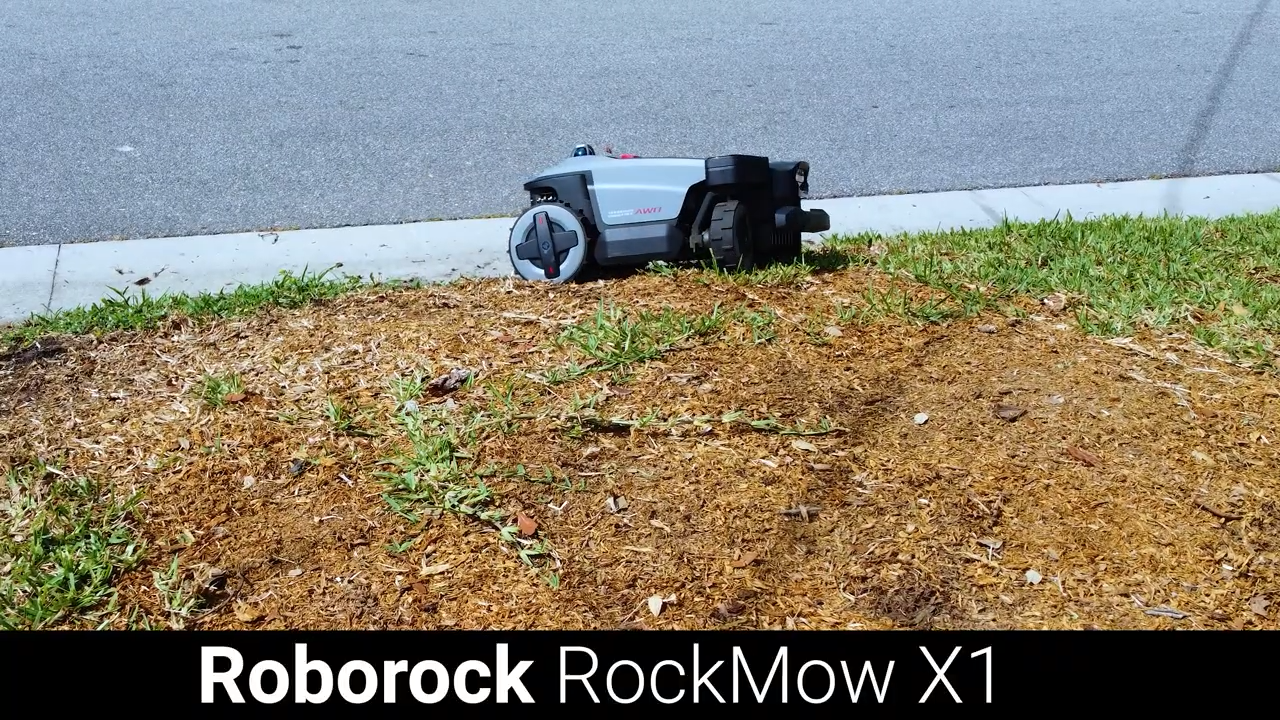
The 2WD robots are also fairly gentle until they start getting stuck, and then they can really dig those back wheels into the ground and dig ruts. The track systems are also fairly gentle other than their sheer weight, and they don’t cause problems as long as they’re using multi point turns, but turning in place will absolutely destroy the grass under them.
The 4WD system on the Luba 3 and MOVA LiDAX Ultra 3000 has by far the most potential to damage the lawn. The LiDAX specifically does a full tank turn every time it exits the dock, and there will almost certainly be a bare patch in front of the MOVA’s dock if you need to put it on your lawn and not on a paved space.
Edging
Last, before I make some final conclusions, I want to evaluate some of the extra features that some of these robots have, starting with edging. Right upfront, I want to say that none of these mowers can actually edge, meaning that nice square border on your lawn you get by flipping the string trimmer upright. Instead, what they mean by edging is “trimming closer to the border of your lawn”, and that is determined by two things: (1) the distance between the edge of the lawn and the edge of the robot when doing a perimeter pass, and (2) the distance between the outside of the cutting blade and the edge of the robot.
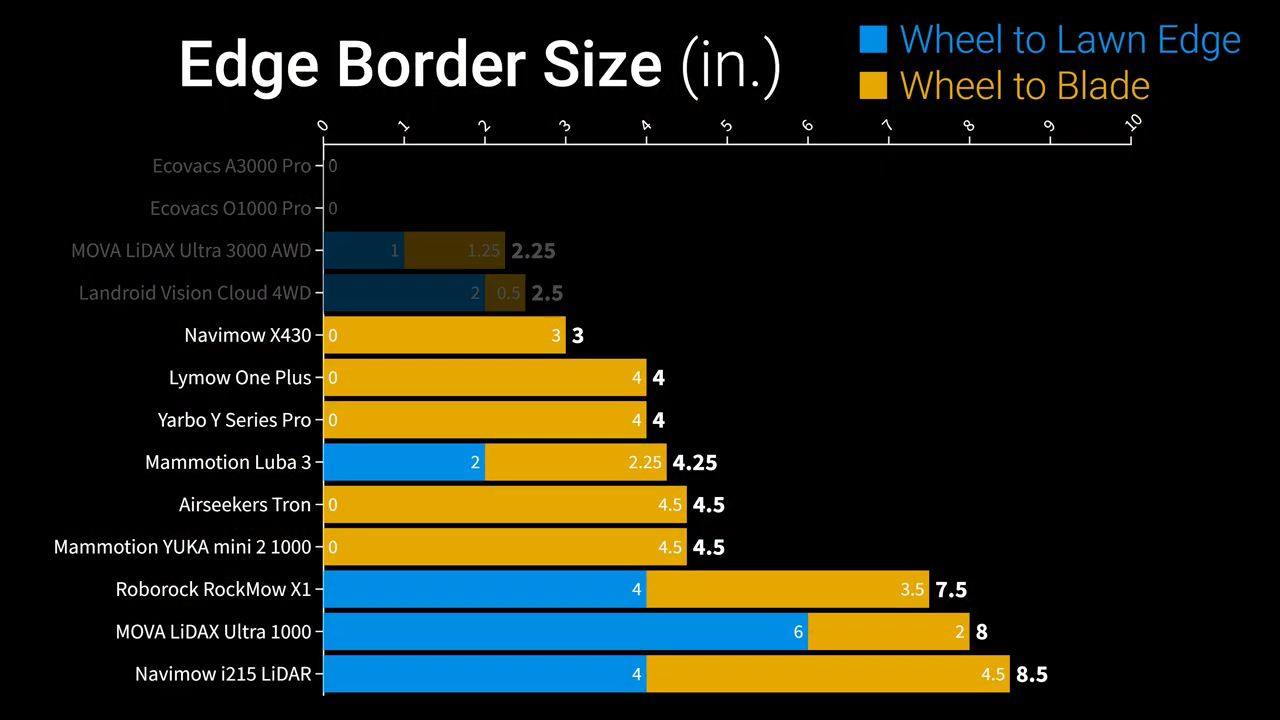
For the robots without specialized edging systems, the Navimow X430 has the closest cut with blades about 3” from the edge of the mower, and precise navigation that gets the wheels right up to the edge of the zone. But the Landroid Vision Cloud has a specialized edge cutter with only a half an inch of clearance from the side of the robot, but in most cases the navigation left about 2 inches between the robot and the perimeter for a total of 2.5” of uncut space. The Mova LIDAX Ultra 3000 gets about 1” from the perimeter while navigating and has a cutting deck that slides over to get just 1.25” from the edge resulting in 2.25” of uncut grass.
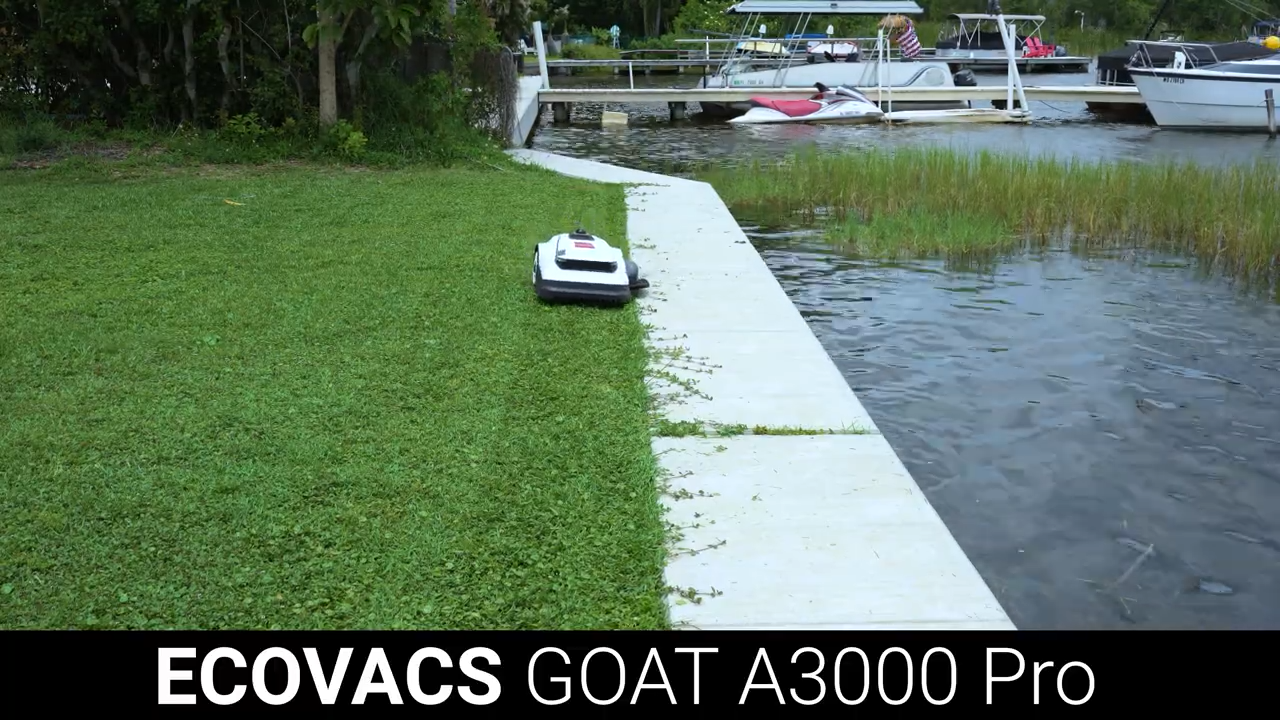
But the Ecovacs GOAT O1000 and A3000 have actual string trimmers and can use their adaptive boundary function which uses the GOAT’s camera system to make sure it gets as close to edges as possible. I actually think this needs a firmware update because in my testing it actually got too close to the edge and didn’t leave any room for the string to come out of the trimmer and instead just rubbed the trimmer spool right up against the curb and broke off the trimmer line inside. But when it was working, it was by far the most effective edging solution and got up next to curbs, under my deck, and even trimmed around my Aiper irrigation system. I’d love to see the next generation of this be able to rotate the trimmer 90 degrees to actually do proper edging since these robots are already pretty good at driving in straight lines, but I’m not sure the string trimming is ready for prime time yet.
Mulching
The next special feature is mulching, which is when the blades of the mower generate lift and then create a vortex inside of the cutting deck to break up grass trimmings and other debris like leaves into smaller pieces that then fall down and fertilize your yard. The Lymow, Yarbo Lawn Mower Pro, and Airseekers are all supposed to generate lift when they mow, but in my testing using dried oak tree leaves, the results were pretty underwhelming.
The smallest amount of mulching was done by the Airseekers Tron that uses a plastic propeller that mostly just broke the leaves up into one or two pieces each, and as I mentioned, the first plastic propeller lasted less than a month before a blade broke off, so it doesn’t seem like a great option long term.
The Yarbo which uses more traditional steel straight blades also did a surprisingly small amount of mulching I think maybe due to the large overall volume of the Lawn Mower Pro attachment.
The Lymow had the best mulching using its compact deck and traditional mower style blades, but it’s hard to tell how well it mulched from this footage because after the modification to the cutting deck it mostly just spits clippings out the side instead of vortexing them.
For reference, this is what it looks like when a normal, non-lift-generating robotic mower runs over a leaf pile.
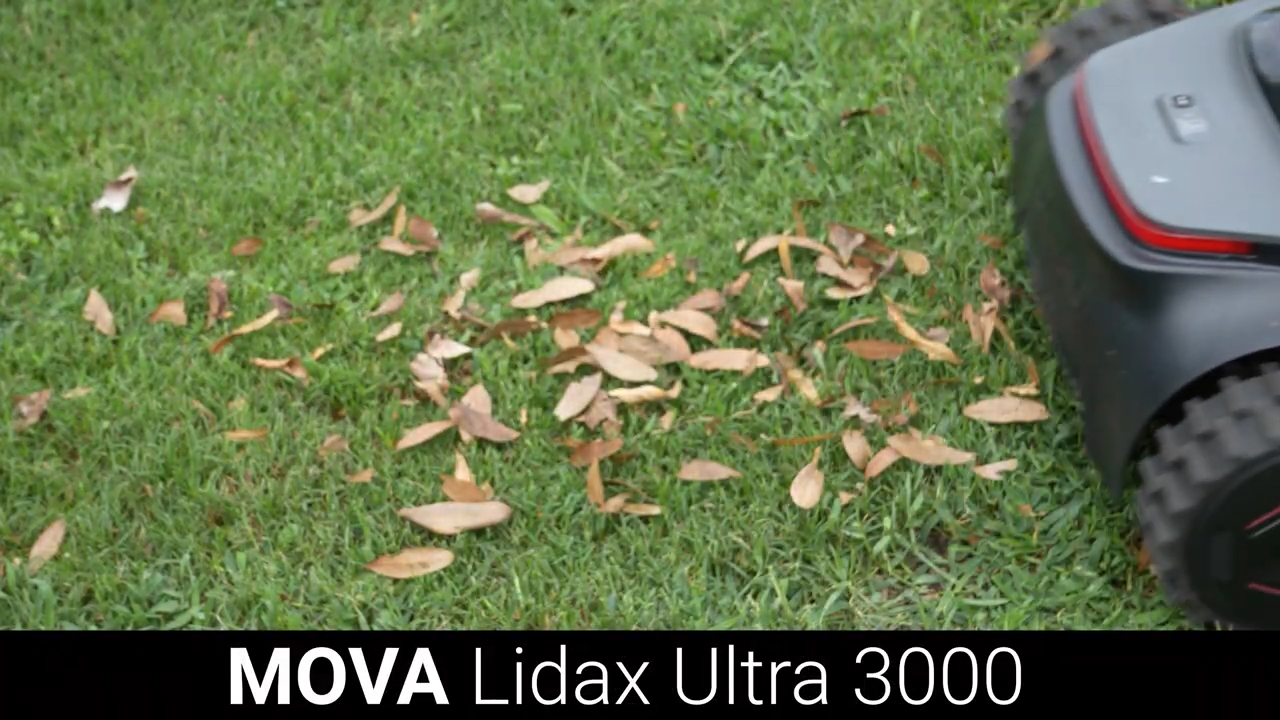
But mulching has one major downside, which is that while the razor blade style mowers are basically silent, adding in mulching causes significantly more noise, not only from the blades themselves, but also from the actual mulching action and while I would have no problem sending out one of the non-mulching robots at 7 AM, the Yarbo, Lymow and Airseekers all make enough noise that I would be worried about disturbing my neighbors during quiet hours. Taking everything into account I’m not sure mulching is worth the extra cost, maintenance, and noise.
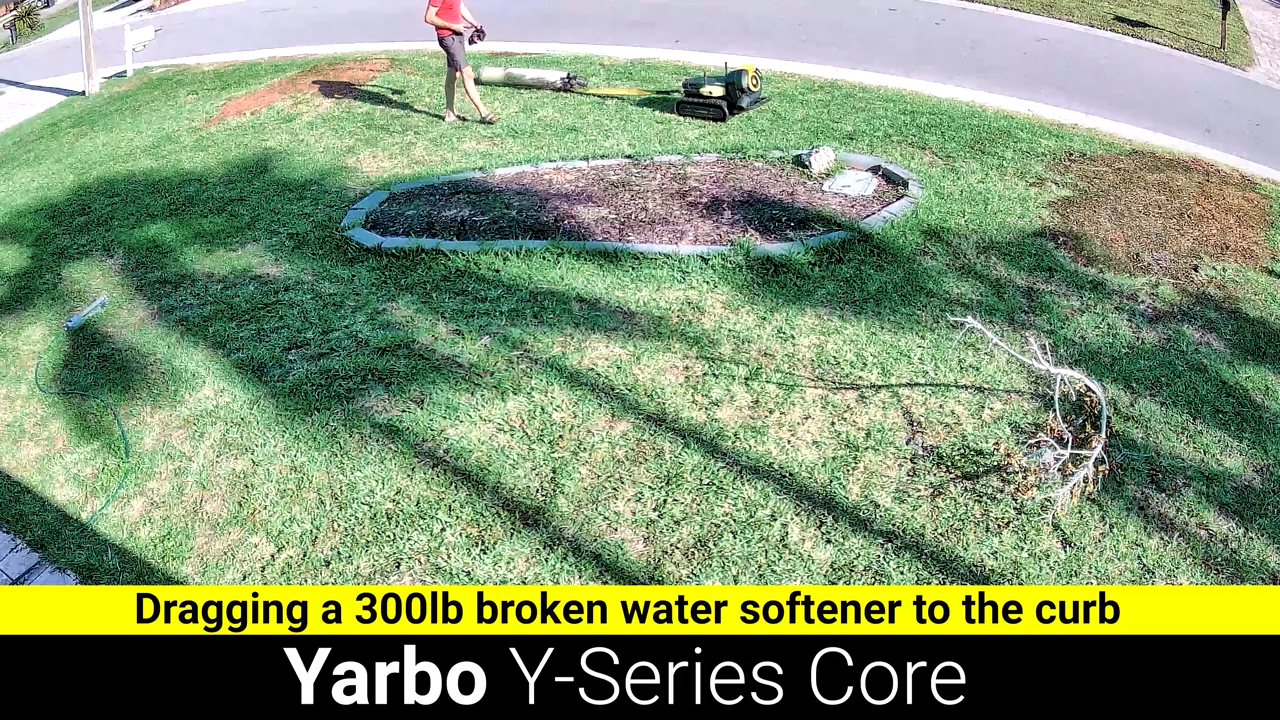
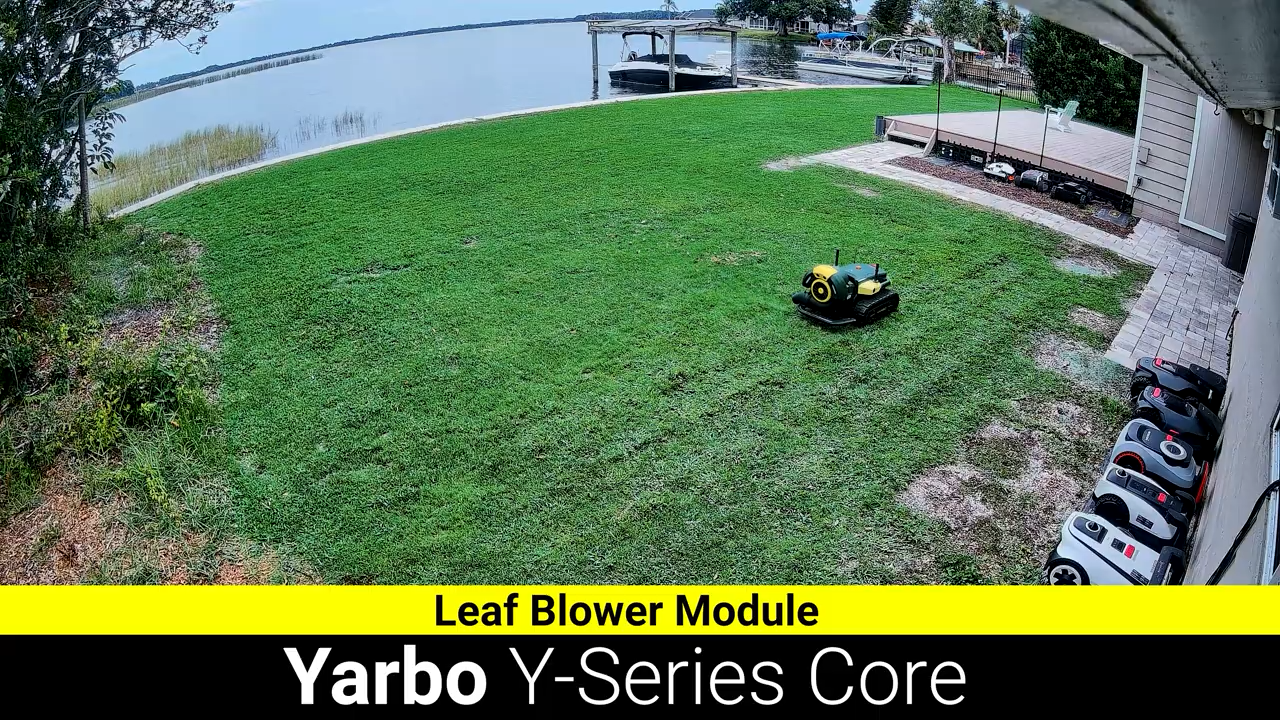
Last, I want to take a second to acknowledge the Yarbo is more of a robotic tractor than a mower like the rest of the robots in this video. I do also have the leaf blower attachment for testing, and for me, it was the best part about the Yarbo, and it was genuinely useful and functional and took a job that requires time and patience and automated it. But how useful it is for you is going to depend on whether you have a straight path where you can blow all your leaves and debris out of your lawn, because if the Yarbo has to blow leaves out of and around corners it starts to plan all kinds of crazy paths and becomes significantly less efficient and productive.
Final Conclusions
So finally, after testing these 13 mowers for the last four months, I’ve got some pretty simple conclusions.
The ultimate robotic lawn mower would have a large battery, 3D LiDAR navigation, 4-wheel drive with independent front wheel steering, effective camera-based object avoidance, a low maintenance edge cutting solution, and depending on your use case, maybe mulching blades.
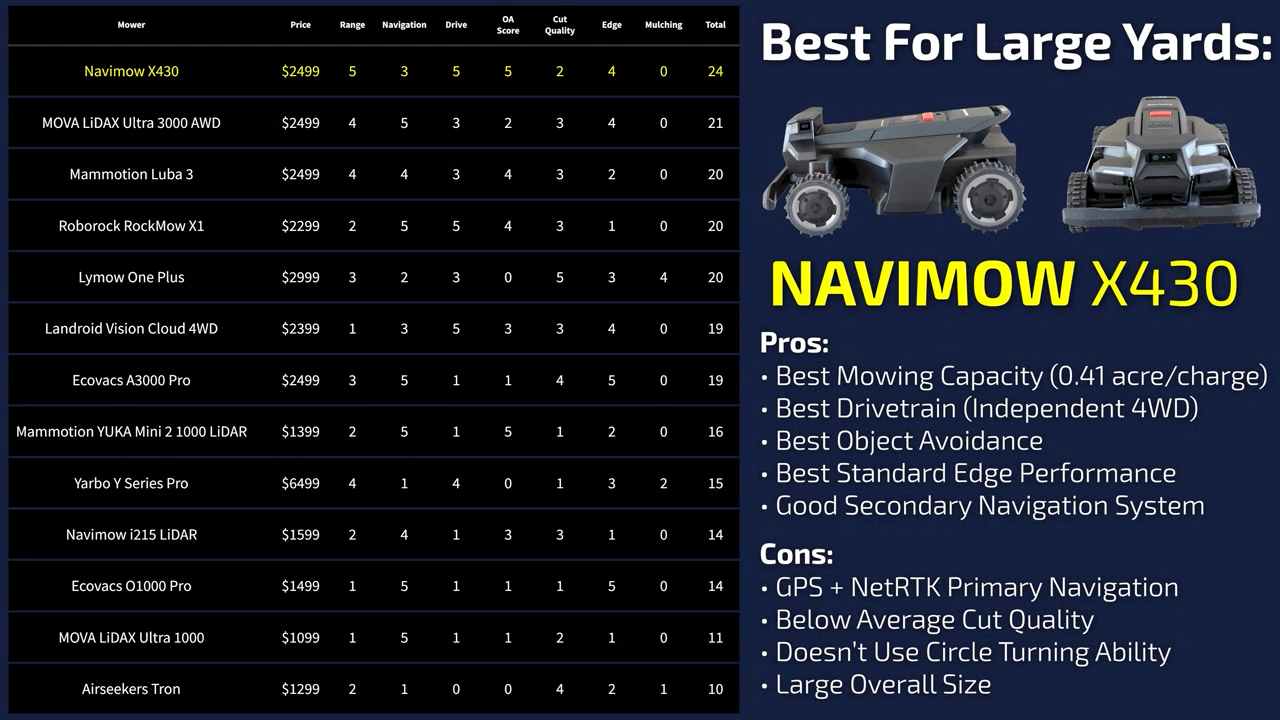
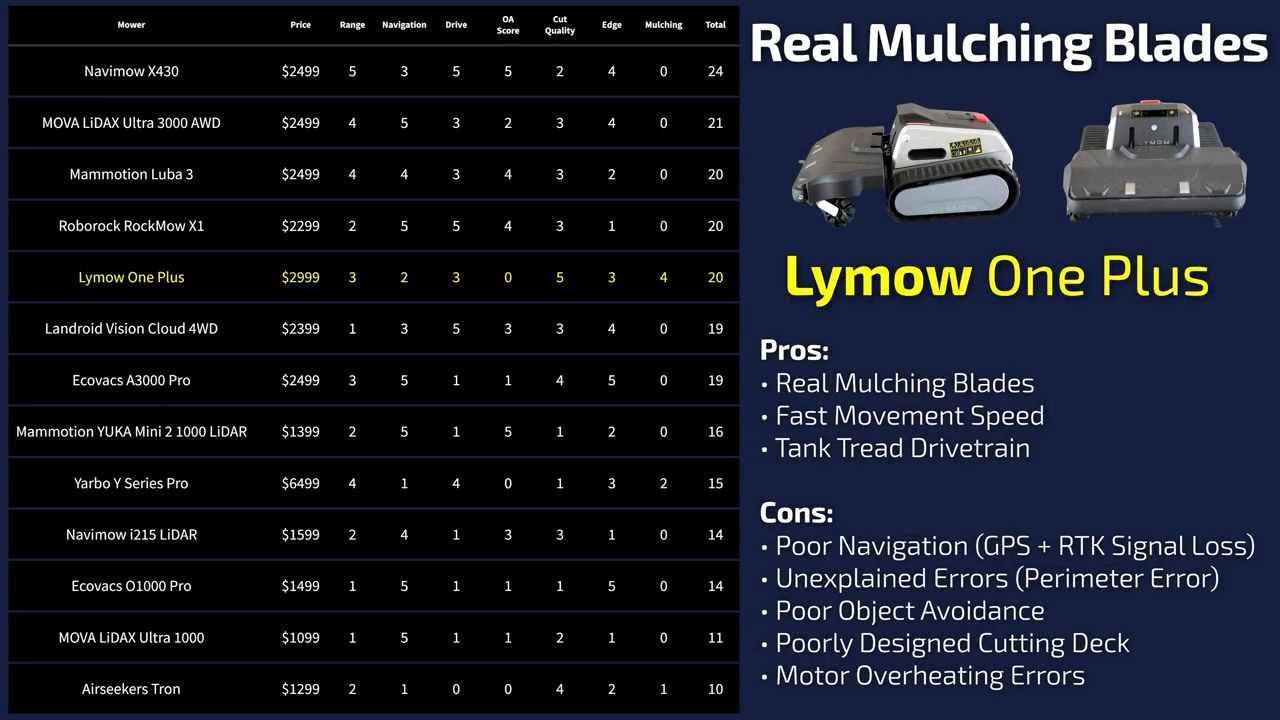
You may have noticed that ultimate robot doesn’t exist yet, but tallying up the individual scores, the Navimow X430 ends up in first place. It had the highest real mowing capacity and was able to mow my entire property in an hour and 45 minutes using just 55% of its battery, it also had excellent obstacle avoidance, the best drivetrain type, and decent edge performance. The only thing holding back the Navimow X430 from being the perfect solution is the fact that it still uses GPS as its primary navigation type, but I do appreciate that as of now the NetRTK service is free, and they do include a local RTK antenna in the box if you don’t want to use NetRTK. Also, as I mentioned, it is the only GPS-based mower that never complained about GPS signal and didn’t veer off course, so I think it has a more advanced secondary navigation system than Navimow is disclosing.
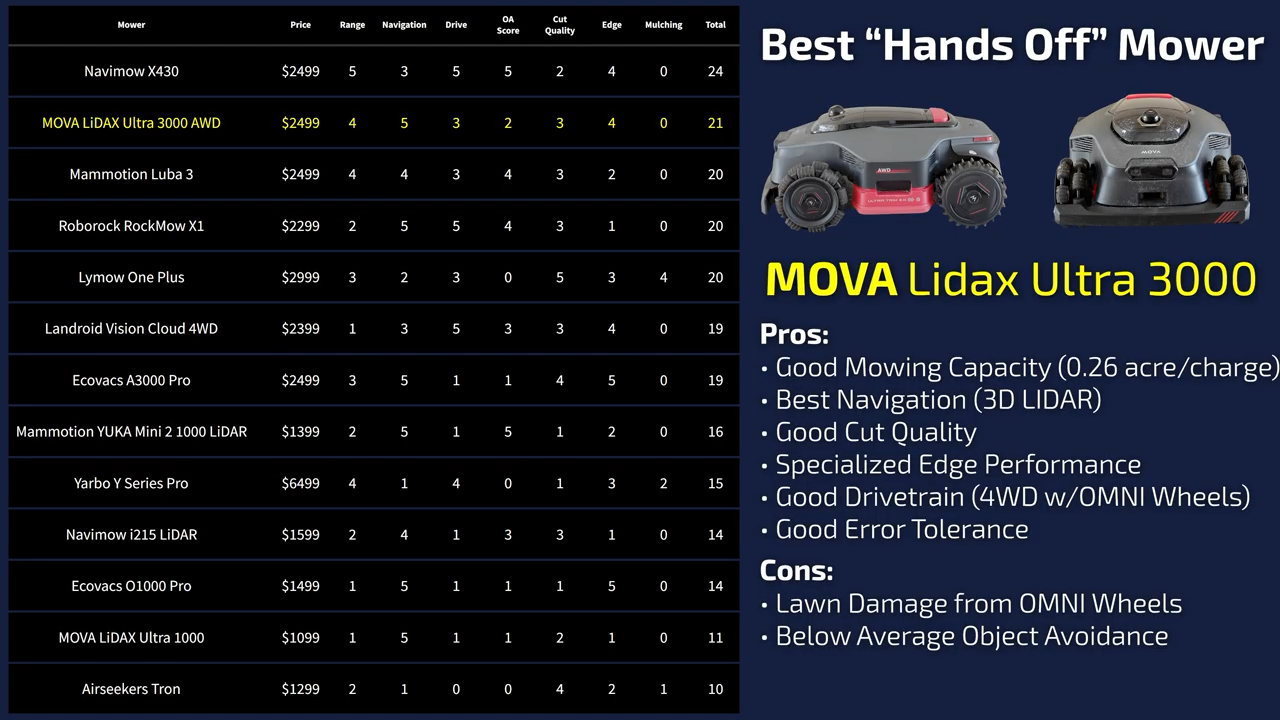
The Mova LiDAX Ultra 3000 is also very close to perfect with very good range, 3D LiDAR navigation, good cut quality, and decent edge performance, but has the older 4-wheel drive drivetrain with front omni-wheels that can be rough on your yard if the mower ever tries to spin in place. The MOVA LiDAX 3000 also had a lower than average object avoidance score, but in my experience with it the last four months, it’s basically a honey badger and even if it runs over something, it’s almost certainly not going to get stuck and it will just power through and finish the job no matter what, which is an advantage that can’t be overstated.
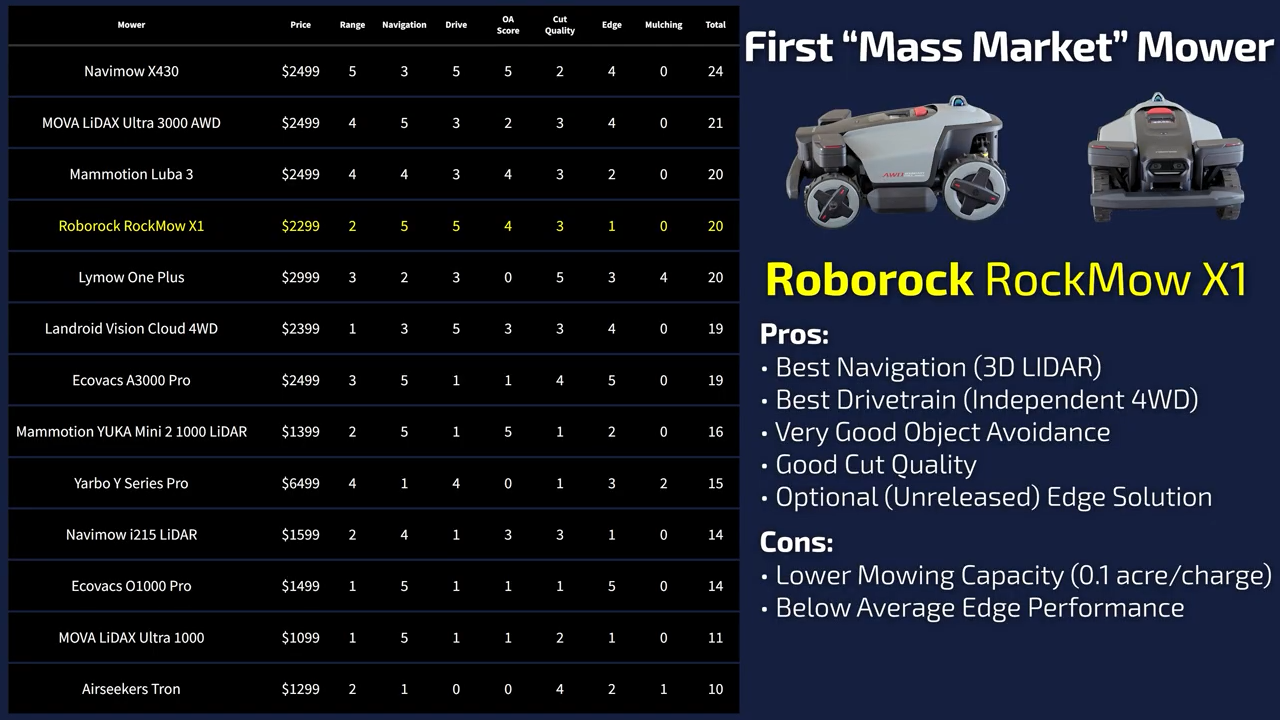
The Roborock RockMow X1 LiDAR has all the right parts: 3D LiDAR navigation, independent front steering, good object avoidance, and good cut quality, and I wonder if the Global Release delay until August is related to the development of their optional edge cutting module because everything else about the RockMow seems polished and ready to go. The only downsides of it currently are lower than average mowing capacity and larger edge borders from not having the optional edging module, but I still think the RockMow may be the most “one size fits all” mower ever made and could be the first step to more widespread robotic mower adoption. As much as it sucks for me, a guy who ultimately only earns money if you buy a product with my affiliate link, if you’ve got a medium to small size suburban lawn, the RockMow X1 LiDAR may be worth waiting for until August.
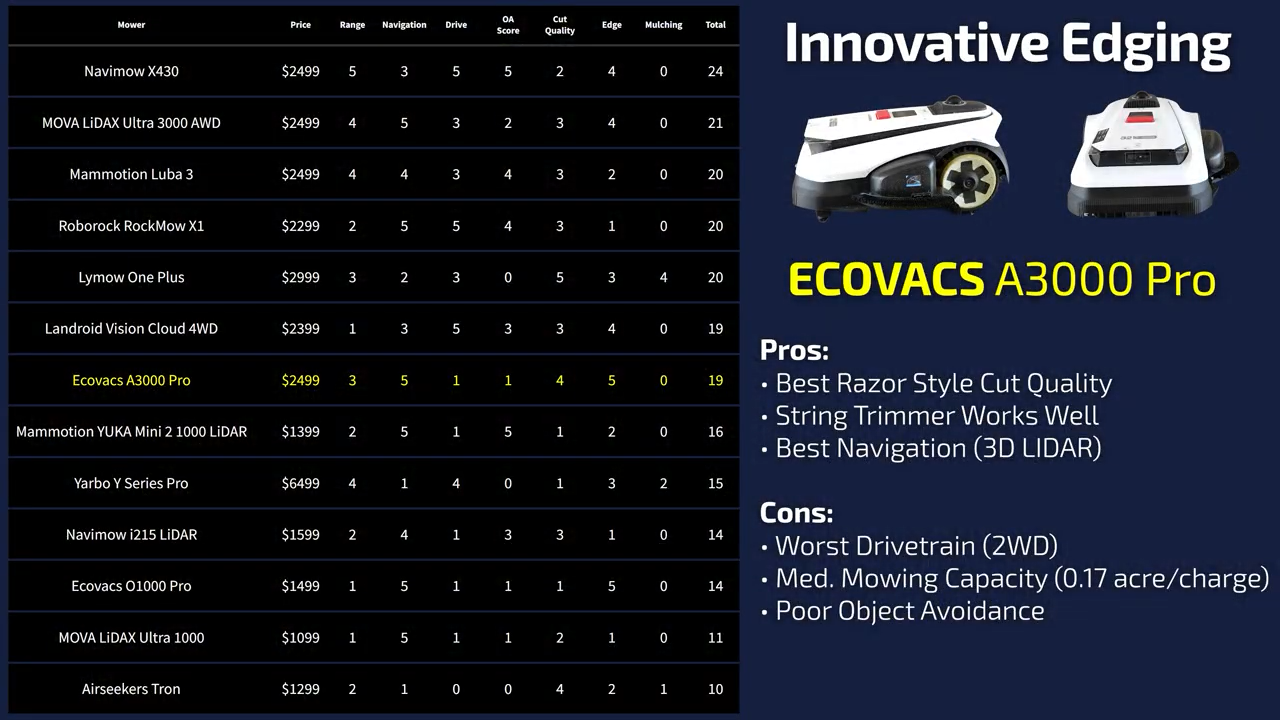
The Ecovacs GOAT A3000 Pro performed very similarly to the GOAT A3000 that I’ve been using for a full year now, and the A3000 was clearly the best performer last year. The new A3000 Pro had the best cut quality of the razor blade-style mowers and the new string trimming edger worked pretty well in my testing. However, I don’t think anything could make me go back to a 2-wheel drive mower and as I mentioned before, the most important feature for me is a mower that just finishes the job without getting stuck. Over the last year I would say my A3000 got stuck on a stick, curb, or hill and about one out of every ten times it mowed, which became more and more annoying as the year went on. For that same reason I can’t in good conscience recommend any of the more budget friendly 2WD mowers unless you’re okay with dealing with a stuck robot every couple weeks, in which case I don’t think there was a massive difference between their performance and you should probably just get whichever one is on sale since their prices can fluctuate by as much as $500.
When I started making this video, the Lymow One Plus was the mower that I was most excited for, and I was pretty sure it was going to be my pick despite the GPS navigation, but in all honesty the thing is a mess. While the Lymow’s blades and cutting deck are the most powerful of any mower in the video, pairing that with poor navigation and obstacle avoidance seems like a terrible plan. Combining that with all of the issues with cutting deck clogs, motors overheating, noisy treads, and all of the reports online about build quality issues, I wouldn’t recommend the Lymow One Plus to anyone in its current state, despite its promising design.
Similarly, the Yarbo Y-Series is so awesome, in theory, and if I had a five acre property with no trees and I wanted a fun toy to play around with, I’d be taking a serious look at Yarbo, but for most residential uses the Yarbo is just too big and too reliant on GPS to work effectively. The fact that you can switch out modules is a cool concept, but it’s labor intensive and the Lawn Mower Pro module on its own weighs more than most of the other robots in the video, so even though I thought the blower attachment worked really well, I don’t think you’re going to want to switch it out multiple times a week to mow and blow with the same core unit. At $5500 each, I don’t think you’re going to have a fleet of Yarbo’s either.

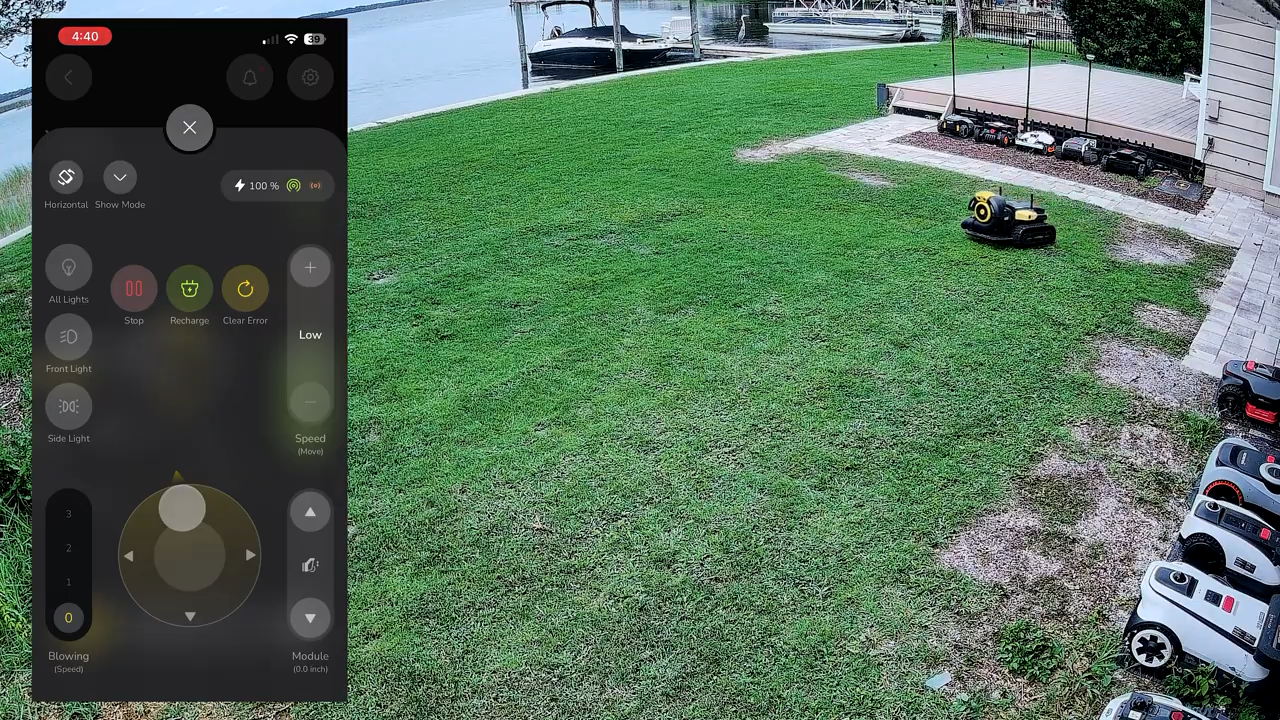
There was however, one thing about the Yarbo that every mower needs to adopt, and that is that no matter where you are you can always remote control the Yarbo, so if it gets itself stuck or loses GPS, you can just pilot it back to safety remotely from the app. It is a little sketchy that you can’t see the camera feed while driving, but since my entire property is visible on security cameras I could always drive the Yarbo out of trouble without having to go anywhere, and while all of the apps have remote control options, the Yarbo and Airseekers apps are the only ones that allow you to remote control without a Bluetooth connection.
As always, there are no sponsored reviews on this channel, but I do have links below for all of the mowers in this video, and as always, I appreciate it when you use those links since as an Amazon Affiliate I do earn a small commission on the sale at no cost to you.
I’d also like to thank all my awesome patrons over at Patreon for their continued support of my channel, and if you’re interested in supporting my channel, please check out the links below. If you enjoyed this video, please consider subscribing to my YouTube channel and as always, thanks for watching The Hook Up.