Best Projectors under $100 – 2025 Edition
November 20, 2025It’s November 2025 and to wrap up projector review season I’m performing my yearly service of using my own money to buy every projector on Amazon under $100 to figure out if any of them are actually decent. Even after five years of making this video, most of the cheapest projector Amazon listings are still filled with misleading pictures and outright lies and still selling thousands of projectors every month.
For this video I’ve got 25 projectors ranging from $25 to $99. I’ll test their actual brightness and contrast, then I’ll put them side by side to figure out which ones have the best overall image quality, and after that I’ll pull out the top five to do some more in depth testing for focus, input lag, throw distance, fan noise, speaker quality, and smart OS features before making my final recommendations. As always there are no sponsored reviews on this channel.
Brightness Testing
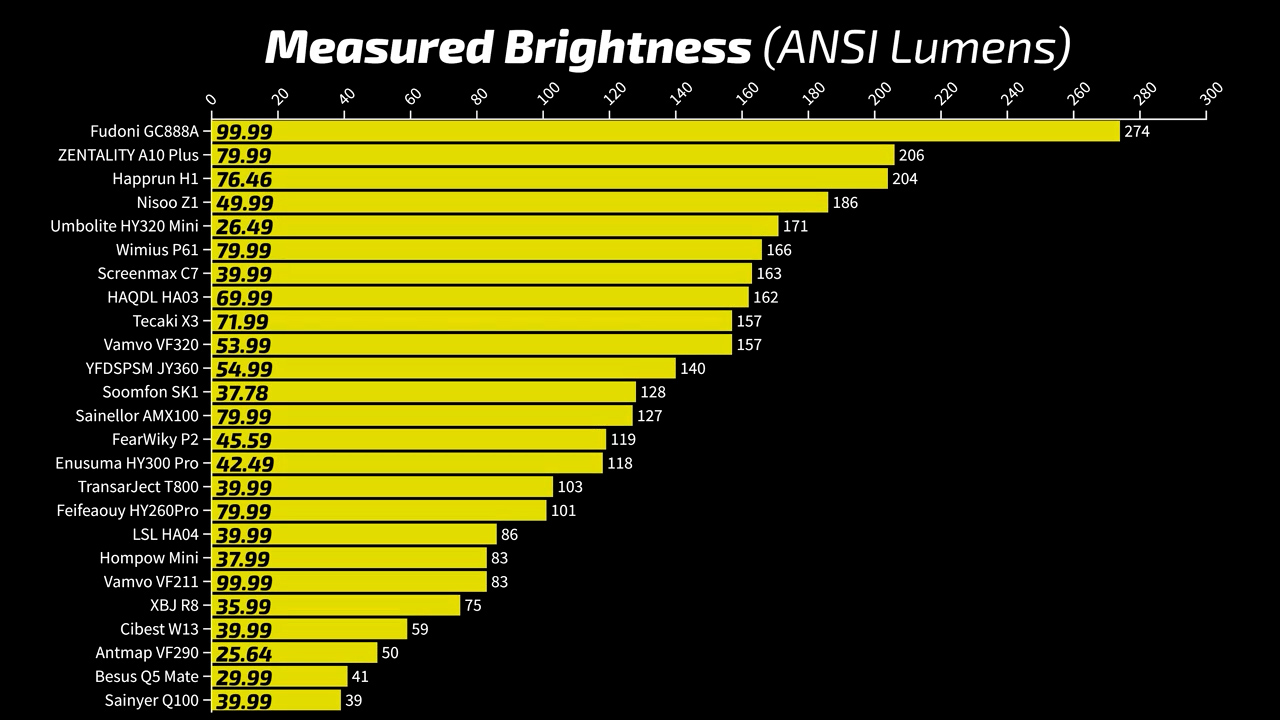
Starting with brightness testing, I used the industry standard ANSI method for measuring each of these projectors where you take nine individual brightness readings, average them, and then multiply by the screen size in square meters to determine the ANSI lumens. In this group, the brightest projector was the $99 FUDONI GC888A at 274 ANSI lumens, but if you consider price, the $26 Umbolite HY320 Mini comes out way ahead with 171 tested ANSI lumens, which is 6.45 lumens per dollar compared to 2.74 lumens per dollar on the Fudoni.
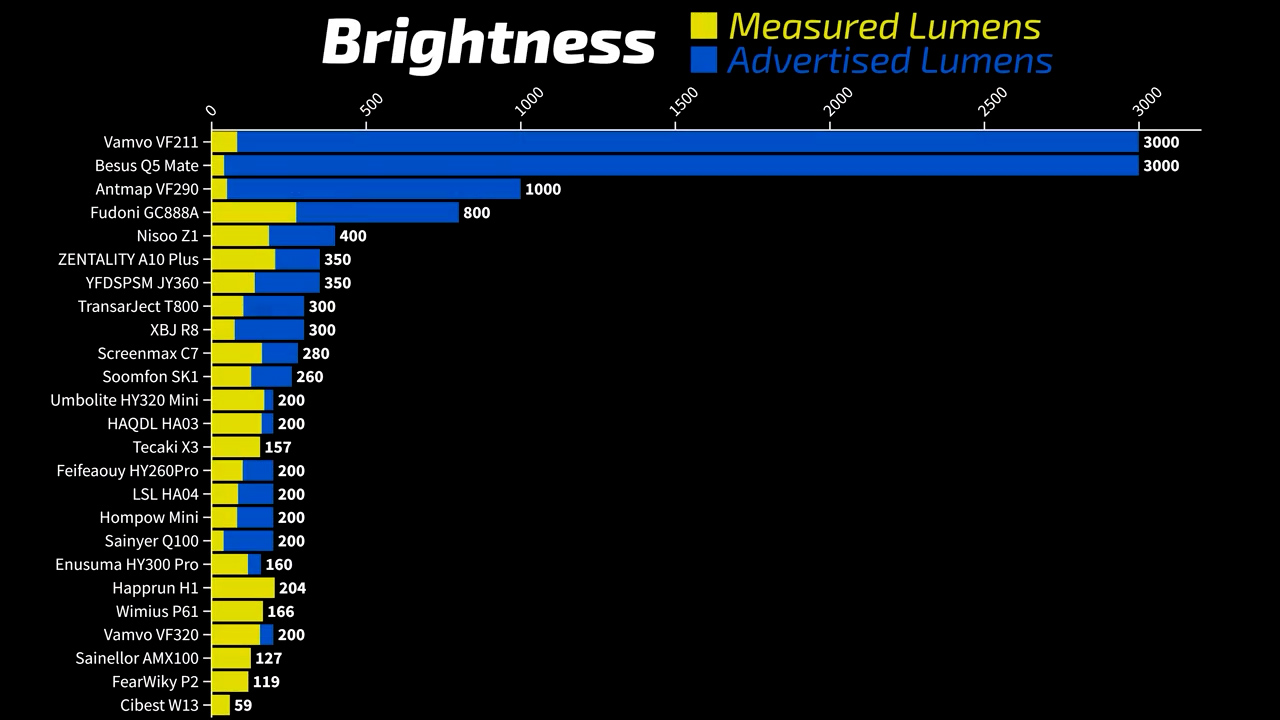
Just to do a little bit of public shaming, here are the advertised lumens from their Amazon listings compared to their actual lumens, where none of the projectors were able to match their advertised brightness and only 7 of the 25 projectors had 50% or more of advertised, which makes me kind of appreciate the six projectors that didn’t even bother to list brightness on their Amazon page.
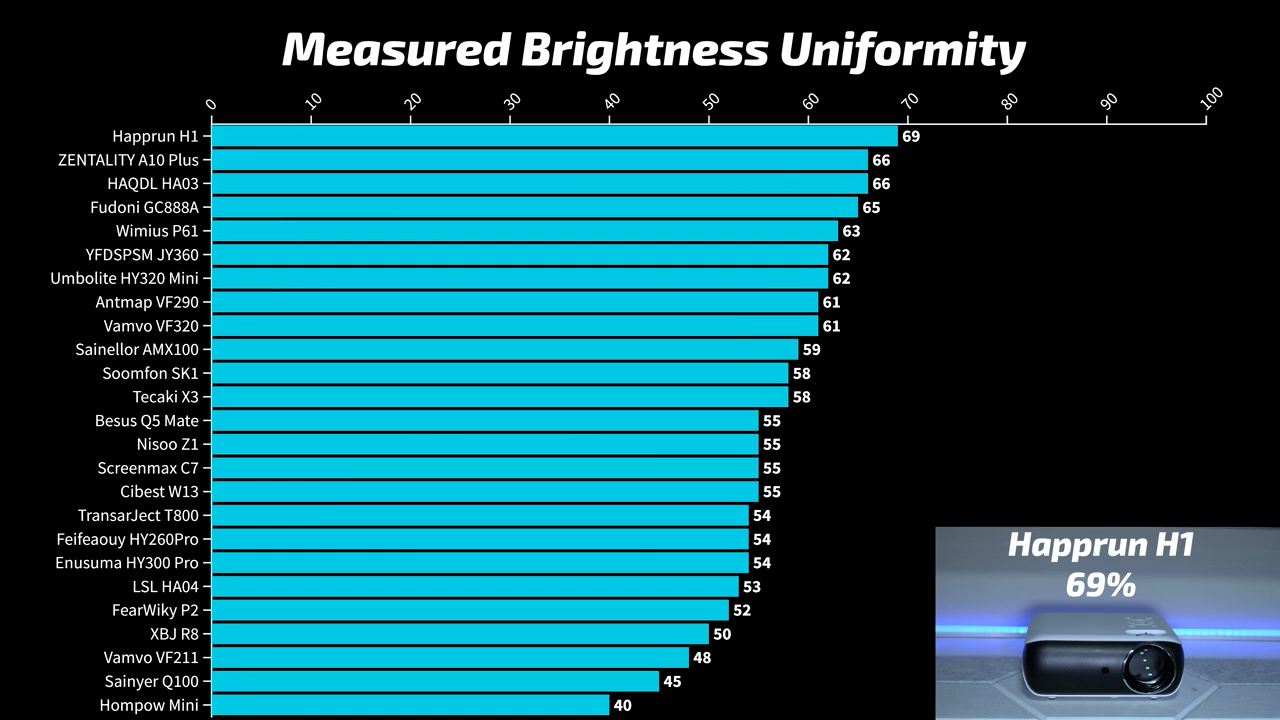
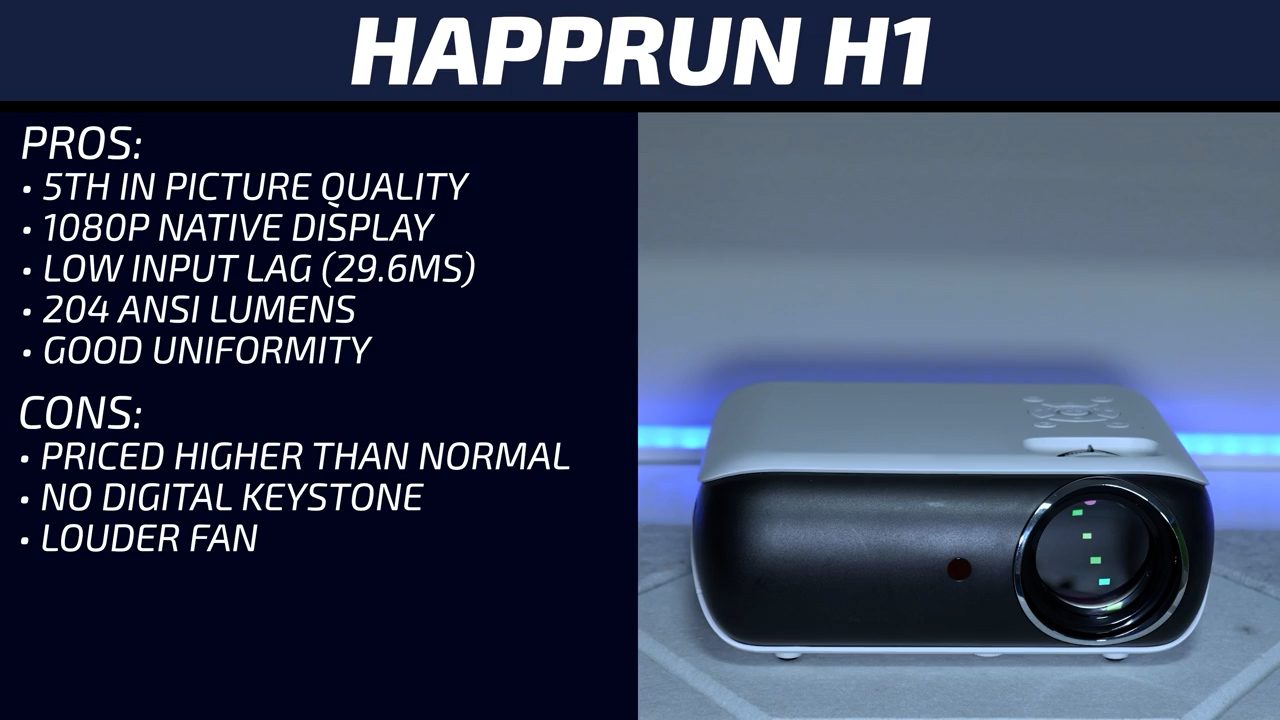
I also measured their brightness uniformity, which is where you divide the brightest of the nine ANSI measurements by the dimmest one. The $76 Happrun H1 came out on top with 61% but the Fudoni and Umbolite that I mentioned before also performed well with 65% and 62% uniformity.
Contrast Testing
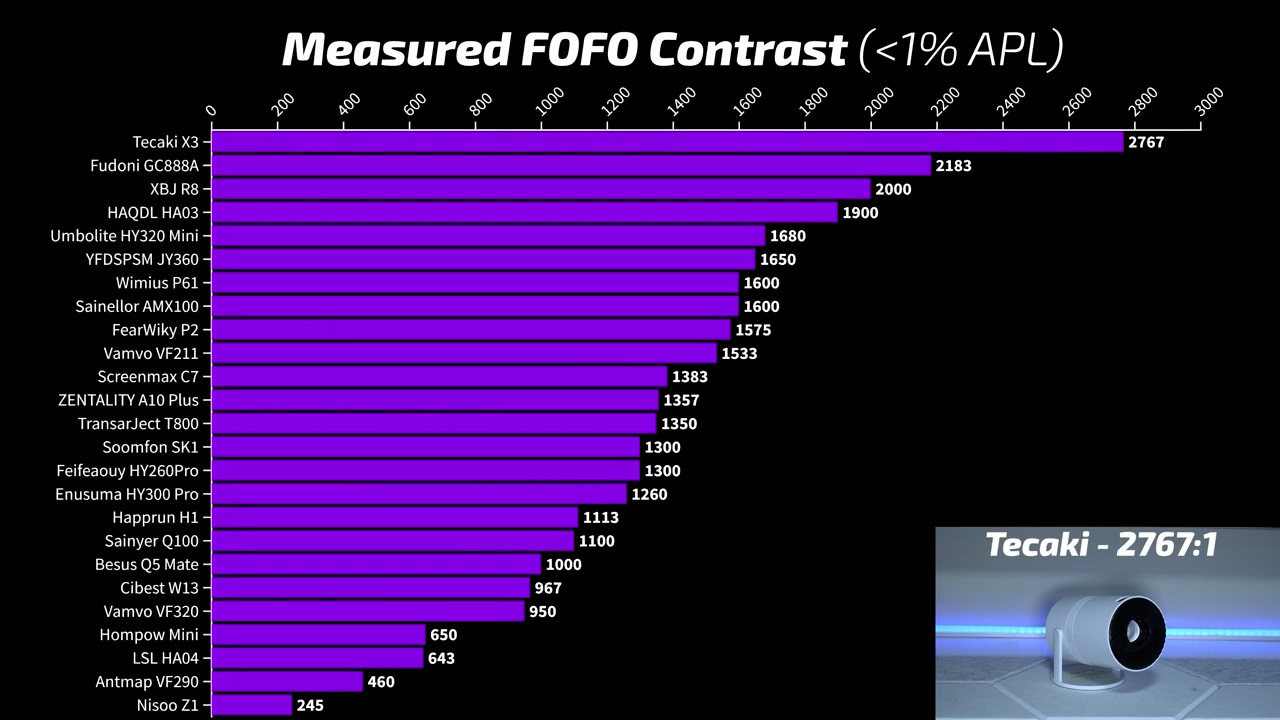
I also measured their contrast by comparing the center point brightness of a full white screen with the center point brightness of a full black screen with a 50% moving gray box. The highest contrast came from the $54 Tecaki at 2767:1, but the Fudoni showed up in 2nd place at 2183:1, and the $26 Umbolite was still hanging in there in 5th place.
Side-by-Side Testing
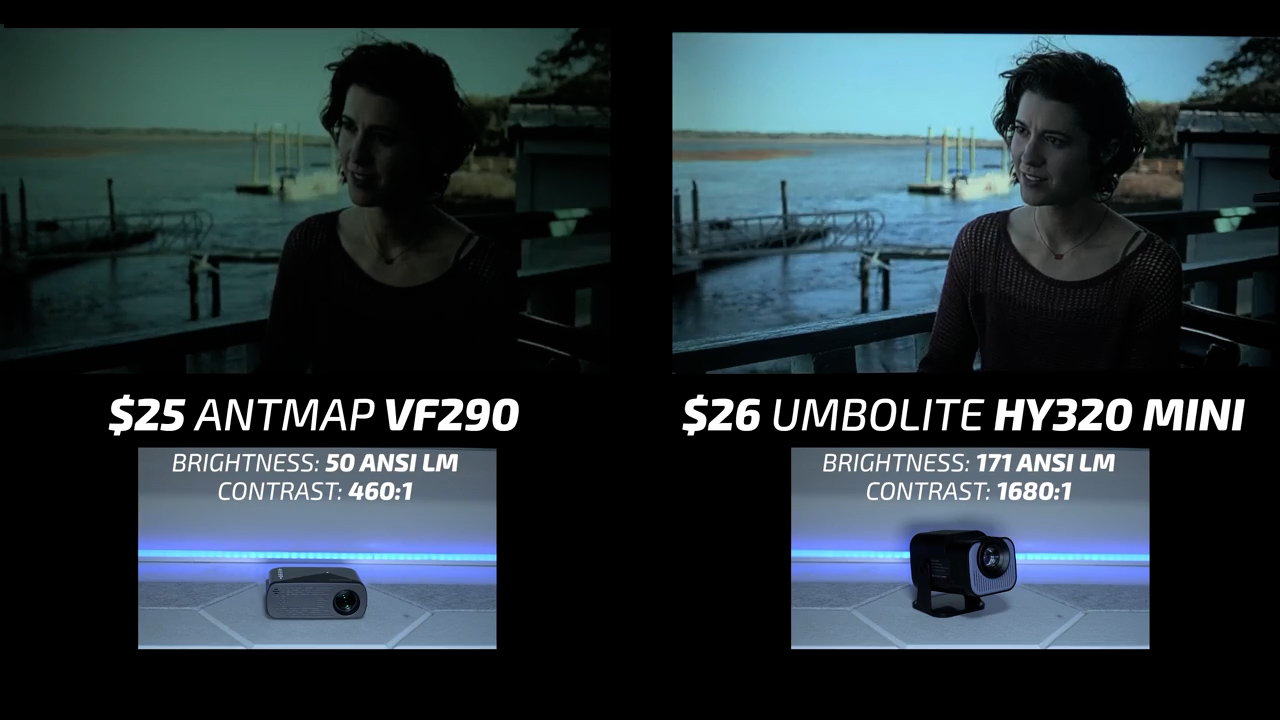
Moving onto the side-by-side testing, I set up two 100” white screens in my light-controlled garage and put the projectors head-to-head from least expensive to most. This made round 1 the $25 Antmap on the left and the $26 Umbolite HY320 Mini on the right. The Antmap’s 50 lumens were completely insufficient for it to compete with the Umbolite’s 171 lumens, not to mention the Antmap’s motion was bad, the aspect ratio was wrong, and shadows were completely crushed, so the Umbolite moves on.
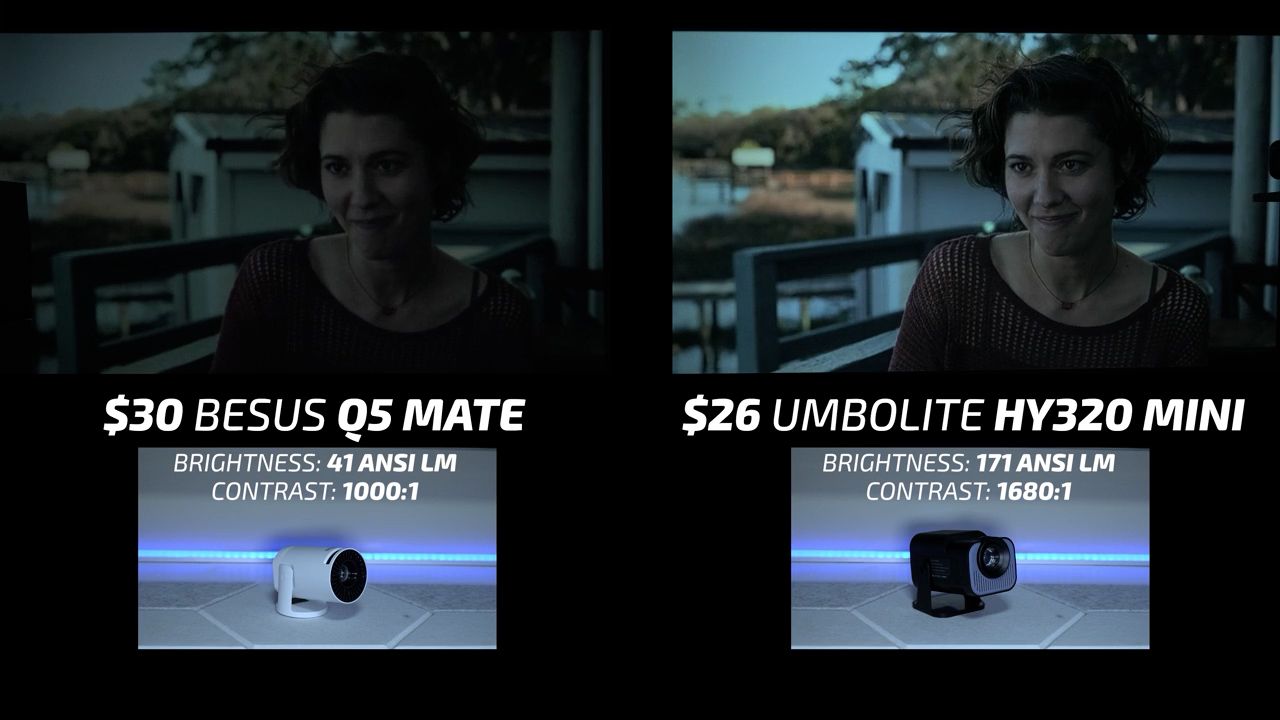
Round 2 brings in the Besus Q5 Mate on the left and the Umbolite HY320 Mini on the right. At 41 lumens the Besus is even dimmer than the Antmap from last round but still looks slightly better since it isn’t crushing shadows as badly, but it still didn’t stand a chance compared to the Umbolite.
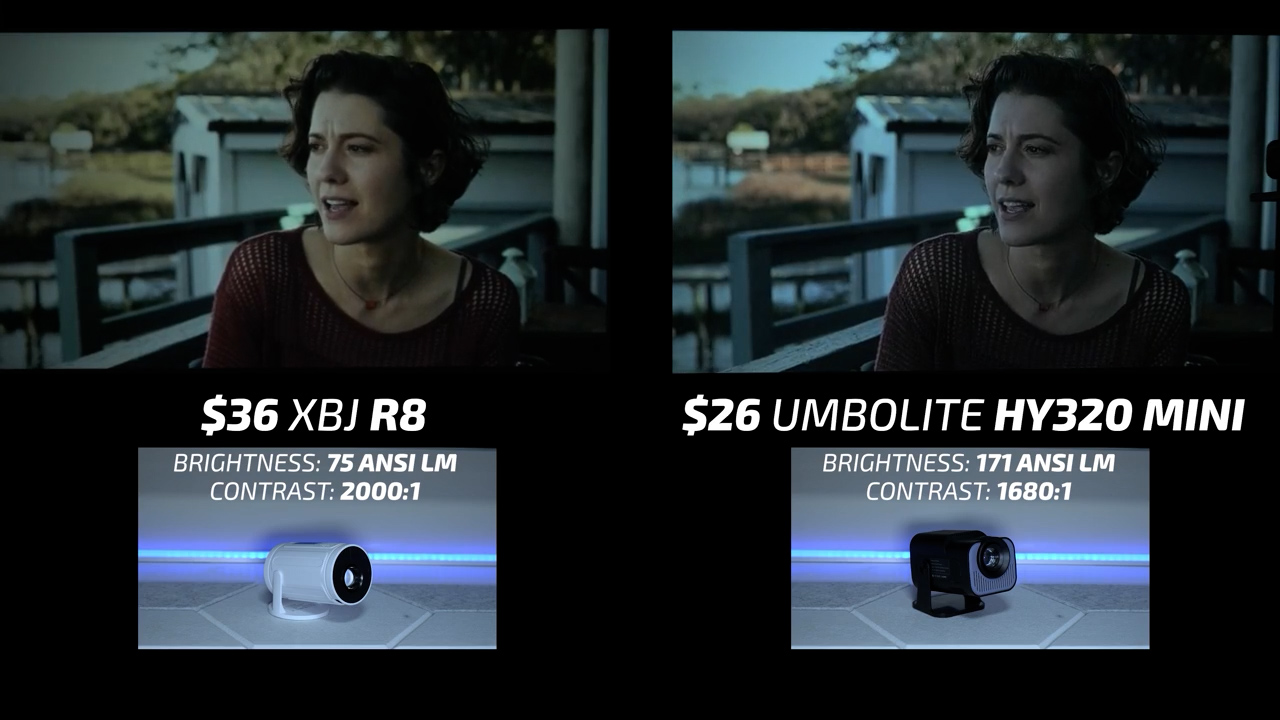
In round 3 the XBJ R8 is on the left and the Umbolite HY320 Mini is on the right. The XBJ was brighter than the previous two challengers, but it was also too yellow, and overall, just extremely blurry compared to the Umbolite, which was still over twice as bright, making this another easy win for the Umbolite.
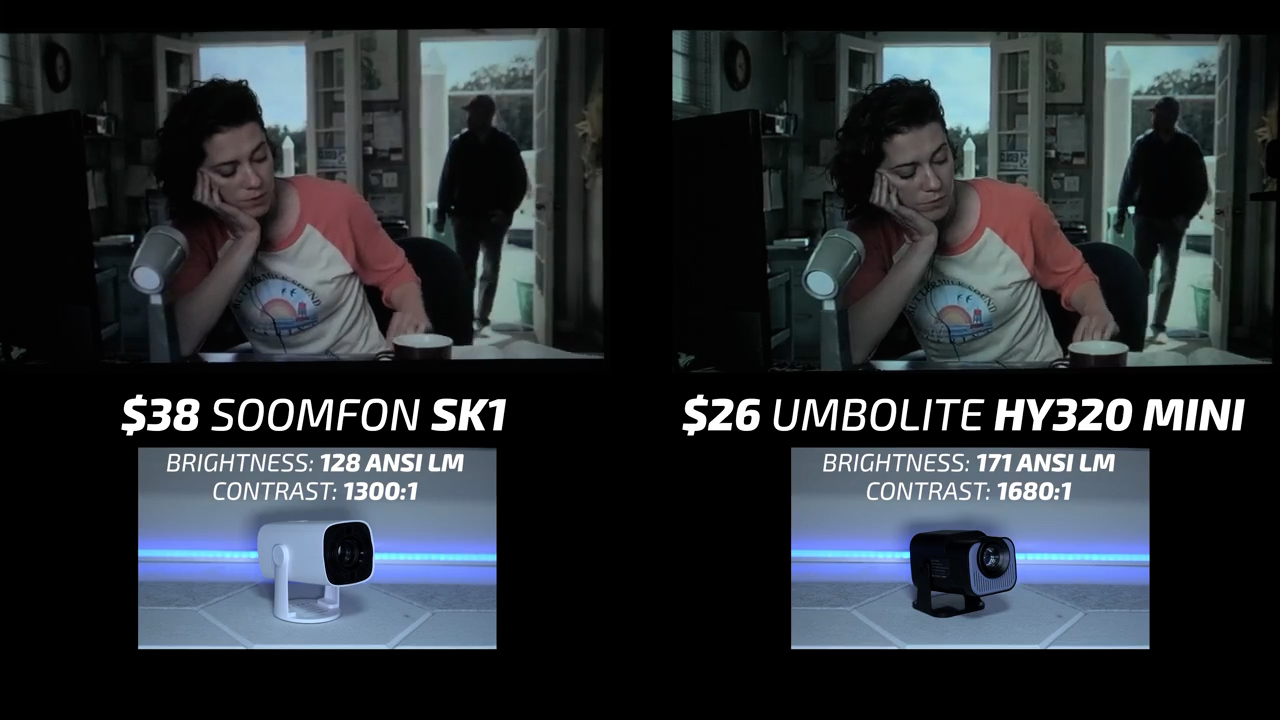
In round 4 the Soomfon SK1 is on the left and the Umbolite HY320 mini is on the right. Finally, the Umbolite has some real competition. The Soomfon looks pretty decent, but compared to the Umbolite it isn’t as sharp, has noticeable light pollution in darker areas, and also crushes shadow detail all while having a higher black floor, so the Umbolite moves on again.
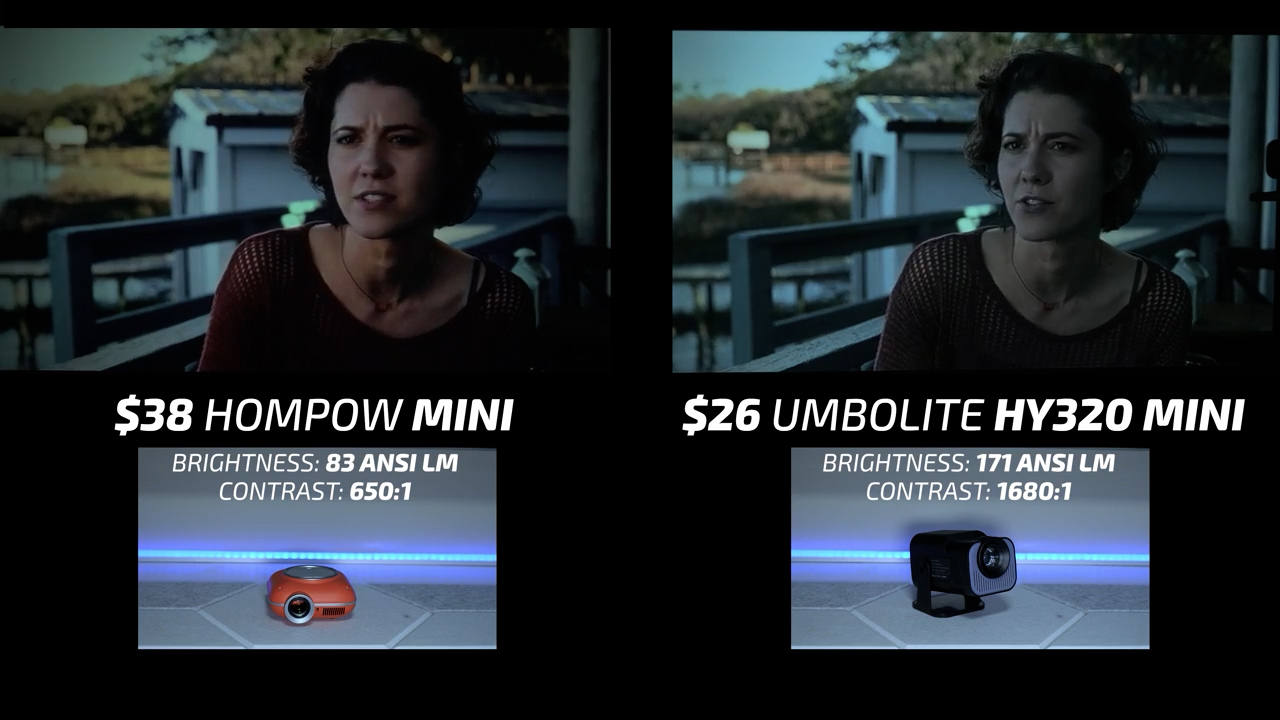
That makes round 5 the Hompow Mini on the left and the Umbolite HY320 Mini on the right. I was overall surprised by the quality of the Hompow, given that it looks and feels like a toy, but while the picture quality was mostly fine, it wasn’t anywhere near as good as the Umbolite which easily won again.
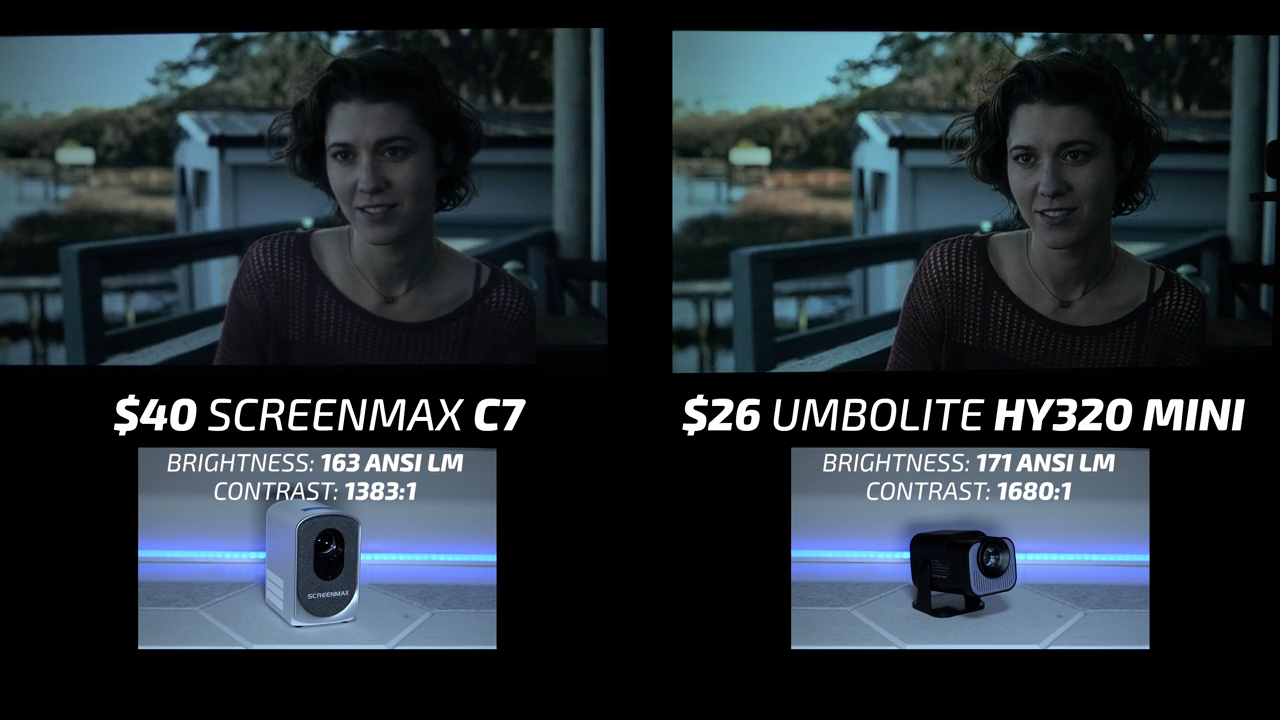
In round 6 the Screenmax C7 is on the left and the Umbolite HY320 Mini is on the right. Unlike the Hompow from the previous round, the Screenmax feels sturdy and well built, but even though the Screenmax’s overall brightness was almost identical to the Umbolite, the picture looked washed out and undersaturated in brighter scenes, and muddy and gray in darker scenes, meaning the Umbolite moves on.
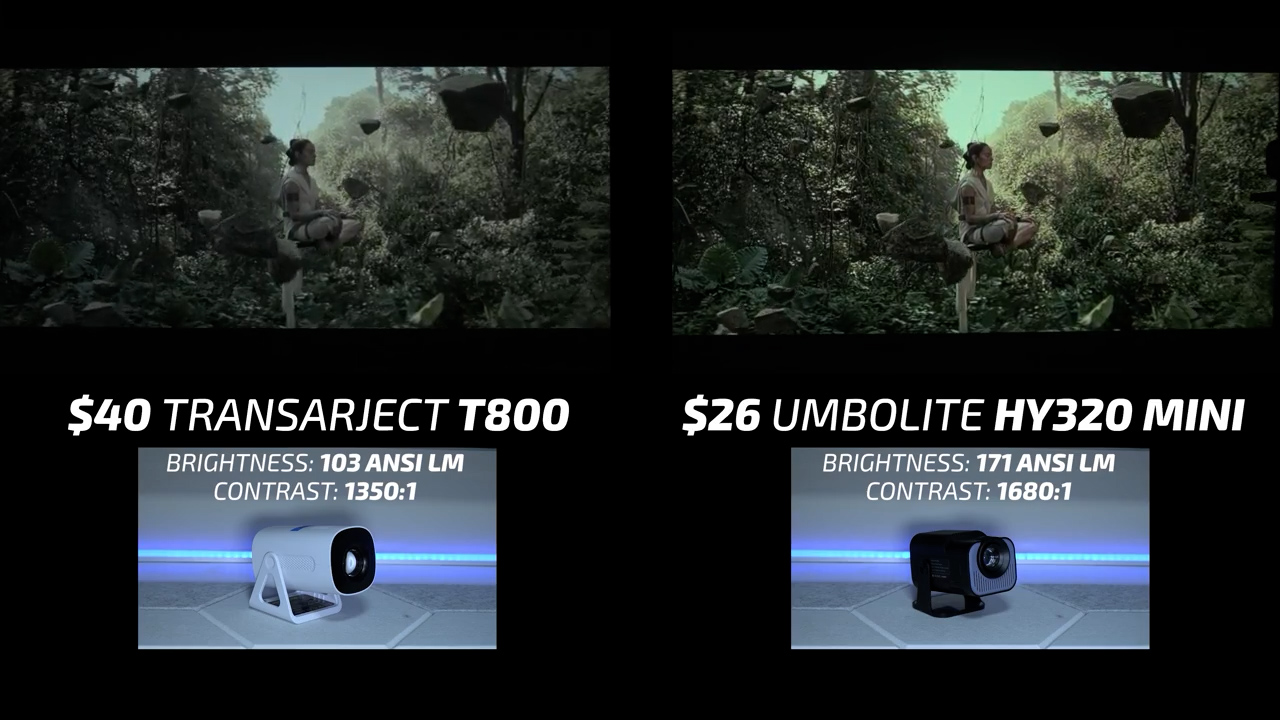
In round 7 the TransarJect T800 is on the left and the Umbolite HY320 Mini is on the right. Unlike previous rounds where I thought the Umbolite was slightly undersaturated, the TransarJect had so little color that it made the Umbolite look oversaturated in comparison. In moderately lit scenes, the lower contrast on the TransarJect made it look both undersaturated and washed out, so the Umbolite won this round too.
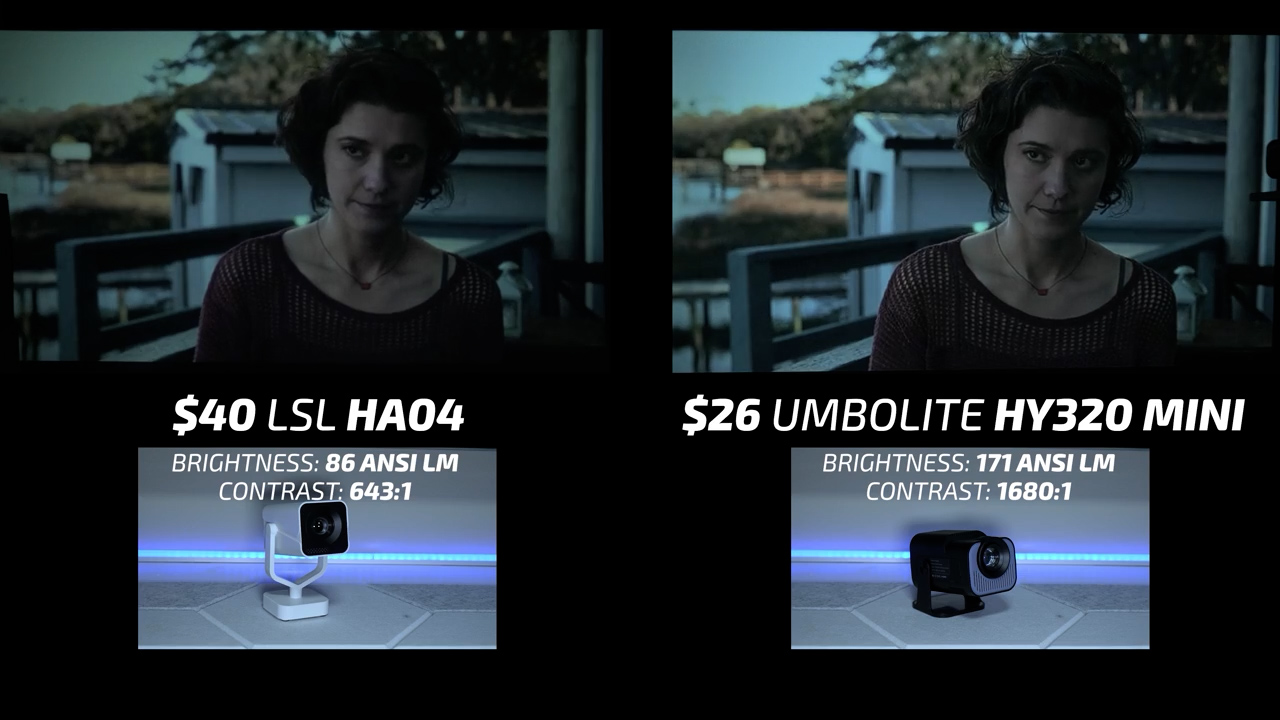
Next in round 8 the LSL HA04 is on the left and the Umbolite HY320 Mini is still on the right. In addition to an incorrectly squished aspect ratio, the LSL HA04 was also noticeably blurry compared to the Umbolite and had less than half the overall brightness. Ultimately it didn’t stand a chance, and the Umbolite moved on again.
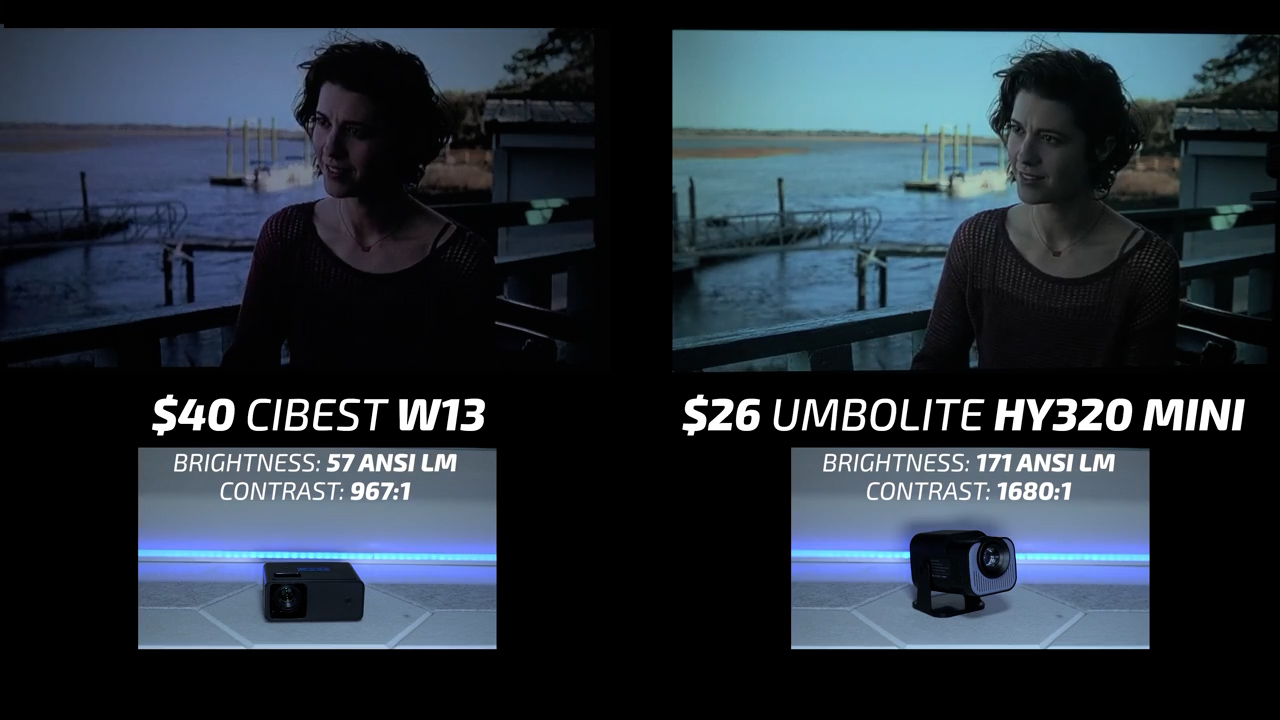
In round 9 the Cibest W13 is on the left and the Umbolite HY320 Mini is on the right. The Cibest is an absolute garbage tier projector that combines terrible brightness and contrast with even worse image processing and settings to make a basically unwatchable image, making this another quick win for the Umbolite.
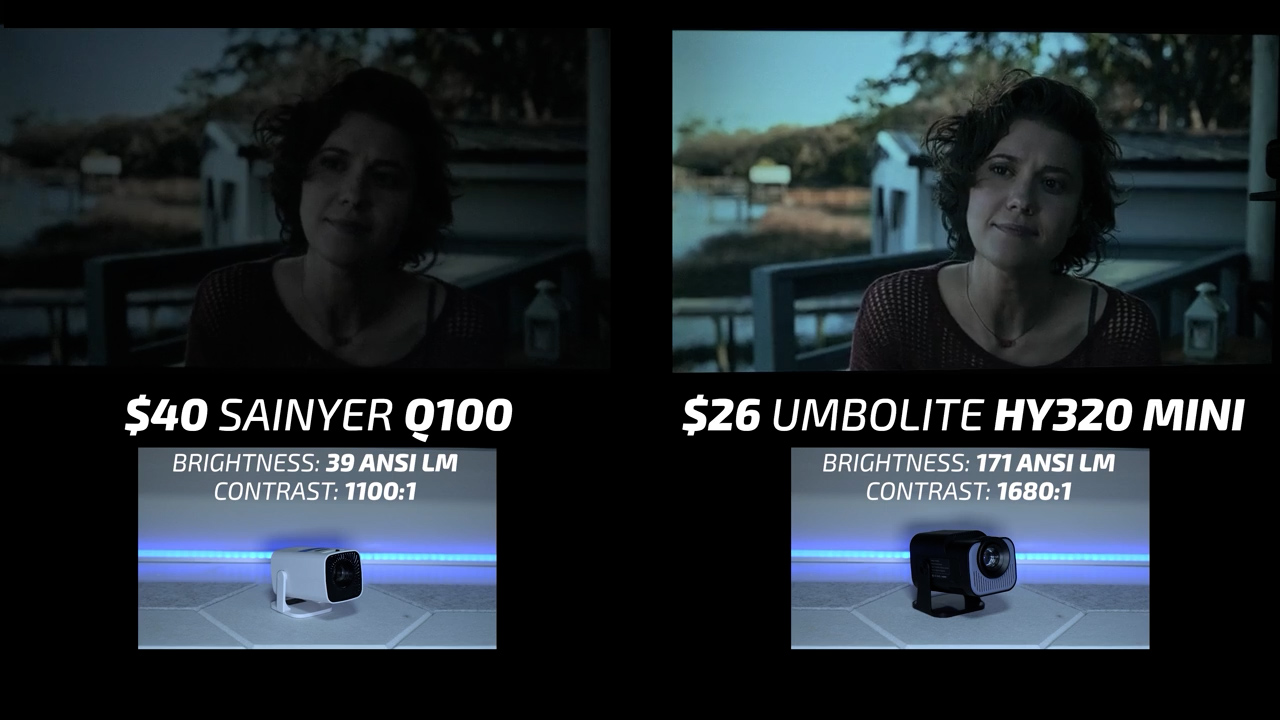
In round 10 the Sainyer Q100 is on the left and the Umbolite HY320 is still on the right. The Sainyer saw the terrible performance of the Cibest and was not going to be outdone, coming in at just 39 lumens for $39. This projector is an absolute joke and is probably the worst performance we’ve seen since the Antmap in round 1, so the Umbolite moves on again.
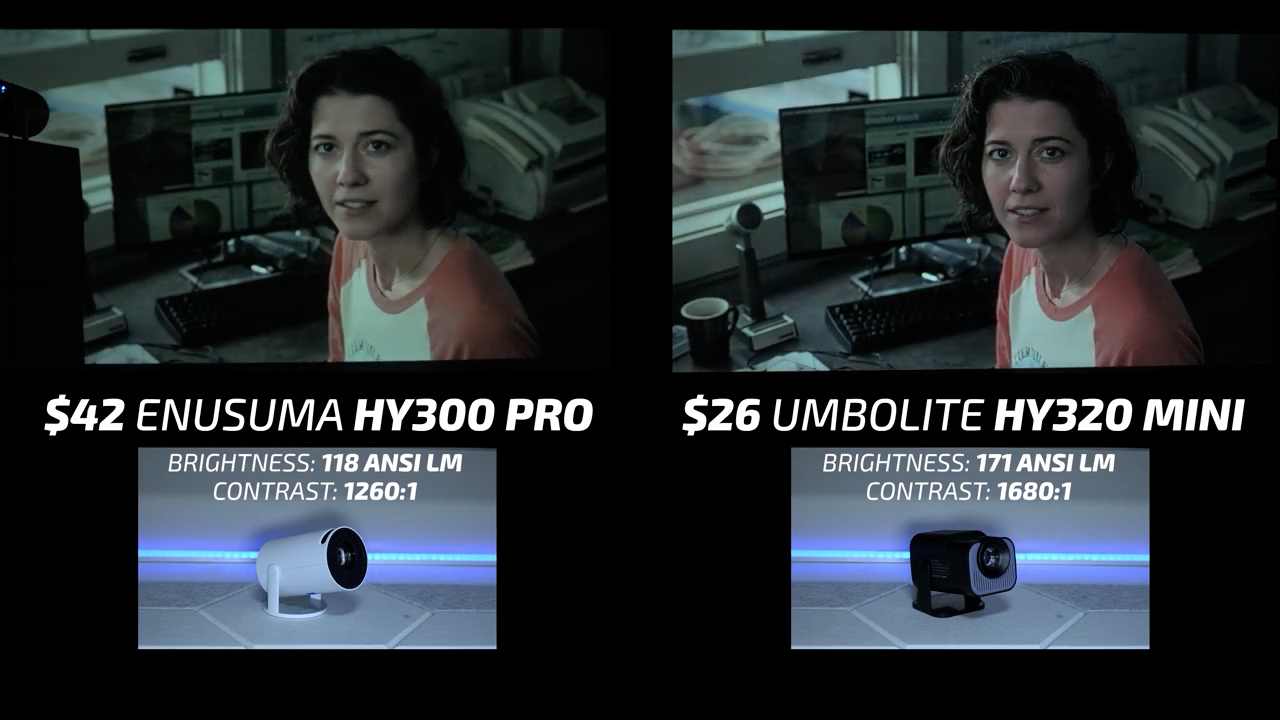
That means that round 11 is the Enusuma HY300 Pro on the left and the Umbolite HY320 Mini on the right. The short throw of both of these projectors makes them difficult to film at the same time since they both get in the way, but this was a decently close round with the HY300 Pro having enough brightness to compete and very similar color and saturation to the HY320, but the focus on the HY320 Mini was noticeably better. Even though the image was slightly over sharpened, the processing on the Umbolite made for a much clearer and more detailed image, so it easily moved on again.
In round 12 another short throw projector, the FearWiky P2 is on the left and the Umbolite HY320 Mini is still on the right. Overall, the P2 was just fine. It had decent brightness, good color, and even okay focus, though it wasn’t nearly as sharp as the HY320 Mini, and in bright scenes they were not too far off. But in the darkest scenes I thought the HY320 Mini was significantly better, earning it another win.

Round 13 has the Nisoo Z1 on the left and the Umbolite HY320 Mini on the right. The Nisoo is the first projector so far to have more brightness than the HY320 Mini, and overall, I thought the picture quality was pretty good, if not a little too blue, but there were two main reasons that I didn’t pick it to win this round. First, it had an absolutely atrocious out of the box contrast ratio of 245:1, which I was able to slightly improve by lowering the brightness in picture settings. Second, it was trying to sabotage the HY320 Mini by casting all kinds of stray light over the left side of the Umbolite’s screen, which was much more distracting in person than came through on video, so the Umbolite moves on again.

Round 14 is the Tecaki X3 on the left and the Umbolite HY320 Mini on the right. Like last round, I thought that both projectors looked pretty good in bright scenes. I was expecting this to be the HY320’s last round because the Tecaki had the highest measured contrast of all of the projectors, but in actual content shadow detail was totally crushed. While neither of these projectors are excellent in dark scenes the HY320 mini is definitely better.
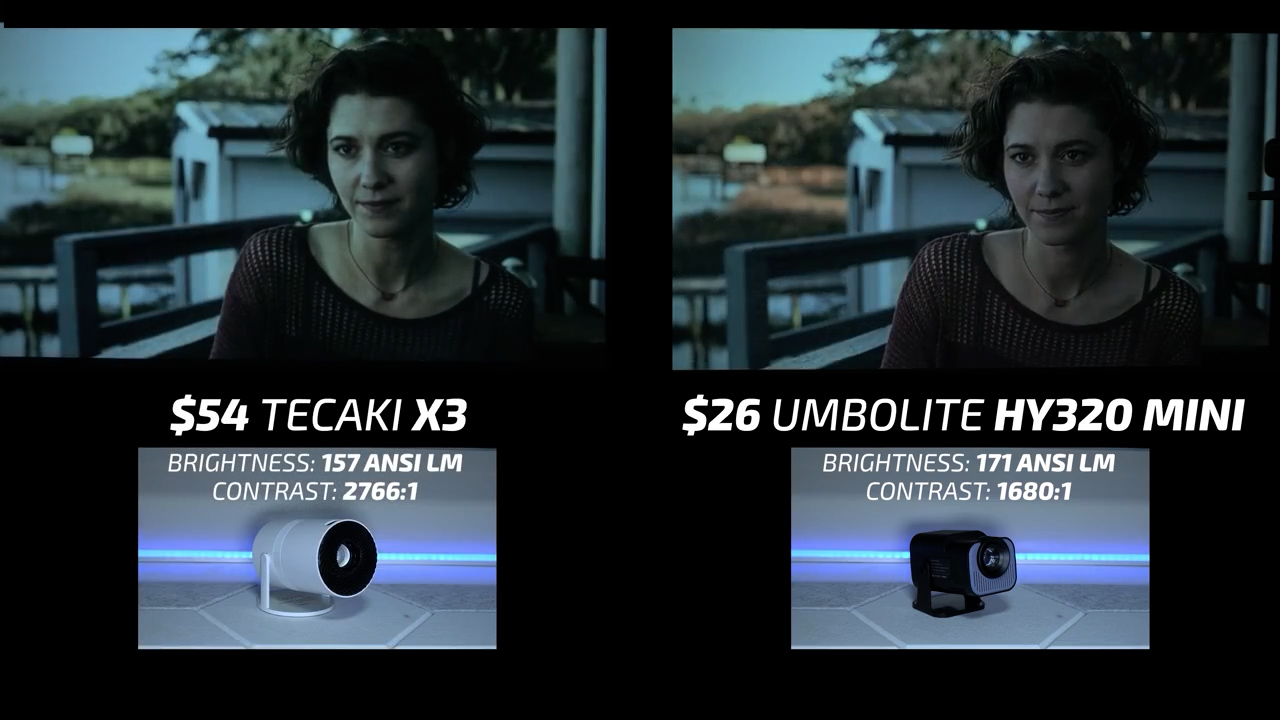
Round 15 has the JY360 on the left and the Umbolite HY320 Mini on the right. The JY360’s picture quality is as bad as its brand name, with over saturated green shifted colors, and extremely crushed shadow detail, so the Umbolite easily moves on again.

Round 16 has the HAQDL HA03 on the left and the Umbolite HY320 Mini on the right. I thought both projectors looked pretty good with the HAQDL shifted towards a cooler white balance, but maintaining similar contrast and focus to the Umbolite. On paper the HAQDL’s contrast was higher, but in actual content it really could have used a higher gamma setting because shadow details were slightly crushed compared to the Umbolite, and this round was close, but in the end the Umbolite took this round too.
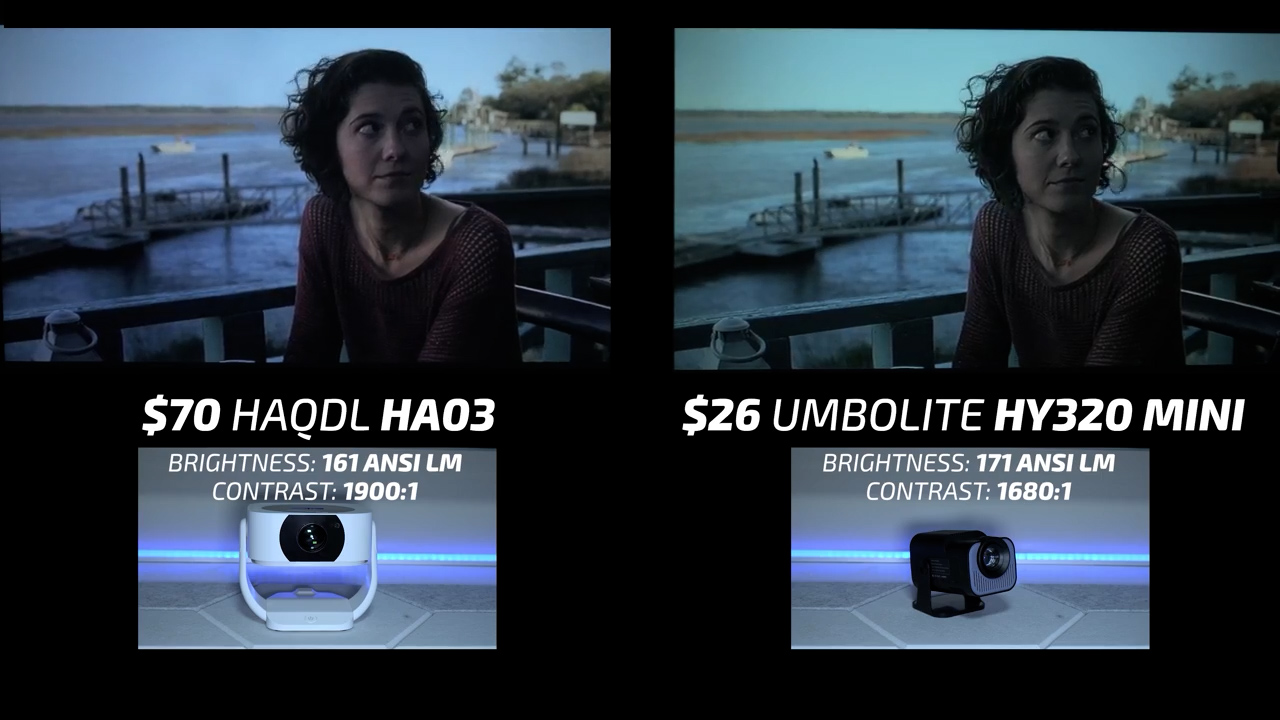
In round 17, the 3rd place finisher from last year, the Vamvo VF320, is on the left and the Umbolite HY320 is on the right. If you’re wondering why the 3rd place finisher is in this year’s video, it’s because the 1st and 2nd place projectors are now over $100, and don’t qualify for this video. But putting the Vamvo side-by-side with the Umbolite that swept the previous 16 rounds just puts into perspective how unimpressive most of the other projectors in the video are, and basically everything about the Vamvo, including brightness, sharpness, gamma, and contrast were all better on the Vamvo and it easily won this round.
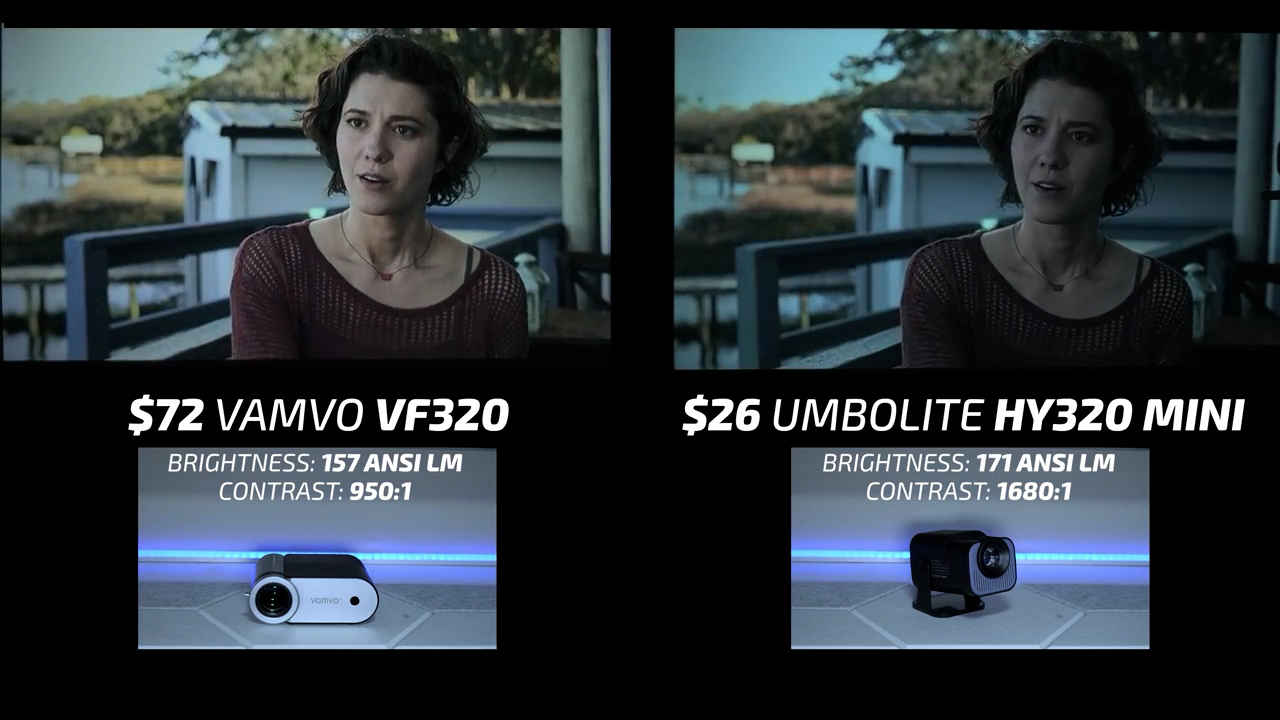
In round 18, the Vamvo VF320 on the left is up against the 4th place finisher from last year the Happrun H1 which has been one of my overall recommendations for the last three years. The Happrun is just a solid performer with a slightly cooler color temperature, but good brightness and overall clarity. But like last year it was no match for the Vamvo VF320, which has a more appropriate gamma curve for these lower brightness inexpensive projectors. While the Happrun is a solid performer, the Vamvo easily won this round.
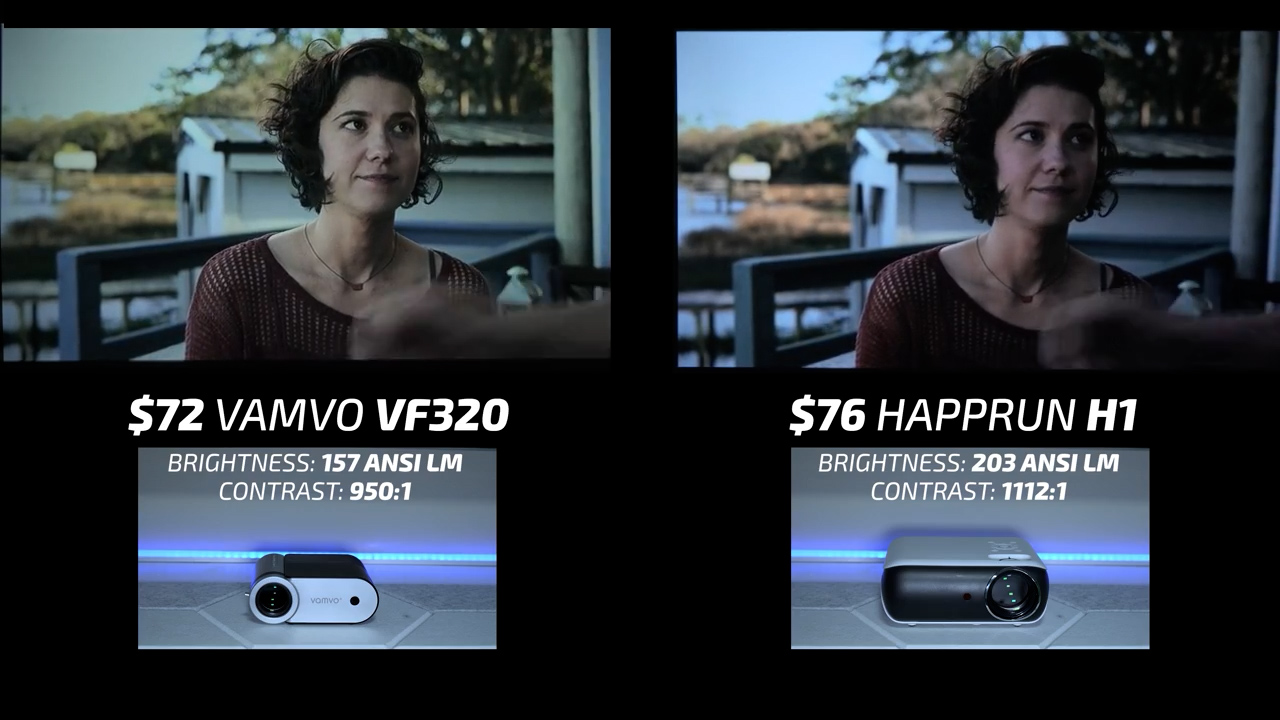
Round 19 then has the Vamvo VF320 on the left and the Zentality A10 Plus on the right. The A10 Plus probably would have done fine in a previous round, and might have stood up to the HY320 Mini, but compared to the Vamvo’s lower gamma setting, there is just so much missing detail in shadowy areas. On much higher end projectors, a high gamma with darker midtones and shadows is seen as the correct way to set up a home theater projector, but under 200 lumens and in the environment where most people will be watching a sub $100 projector, the Vamvo’s image processing just makes much more sense, so the Vamvo moves on.

Round 20 is the Vamvo VF320 on the left and the Wimius P61 on the right, and this was a joke and the Wimius looked truly terrible in just about every scene, so the Vamvo moved on.
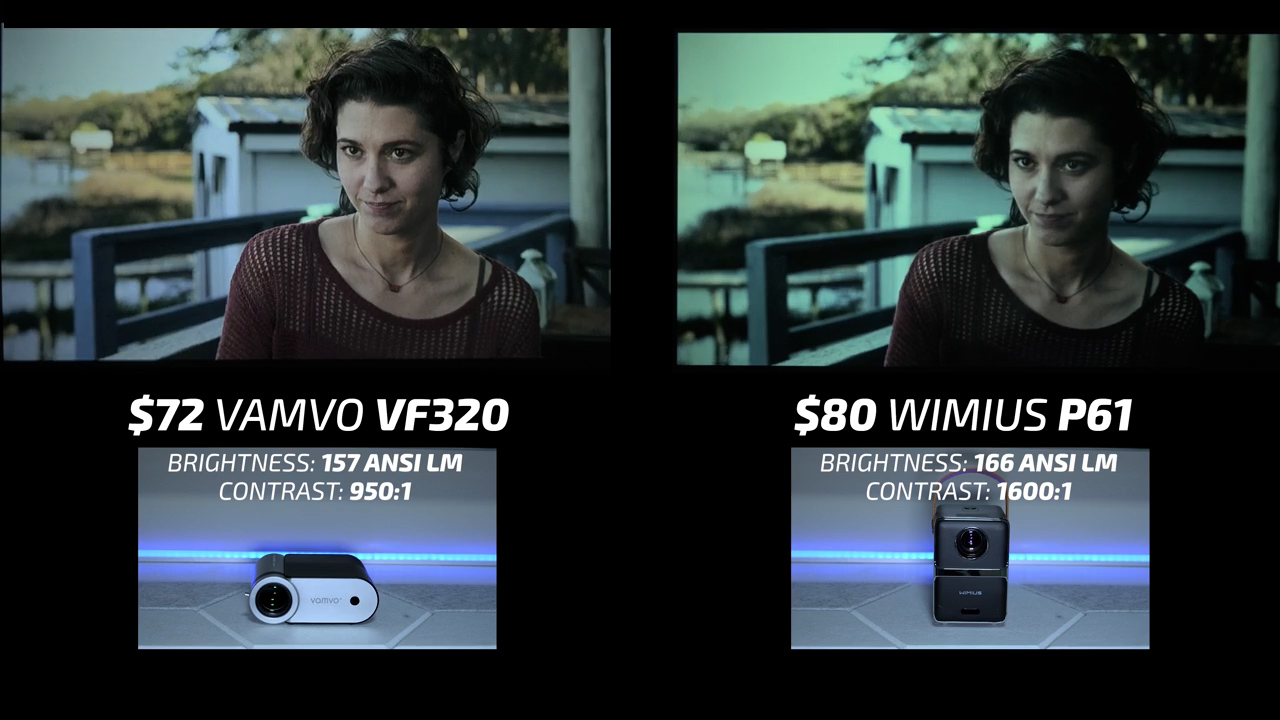
Round 21 then has the Vamvo VF320 on the left and the Sainellor AMX100 on the right. While it certainly wasn’t as bad as the Wimius, the AMX100 was extremely flat and washed out compared to the Vamvo in bright scenes and dark scenes had dim highlights and low shadow detail, so the Vamvo moved on again.
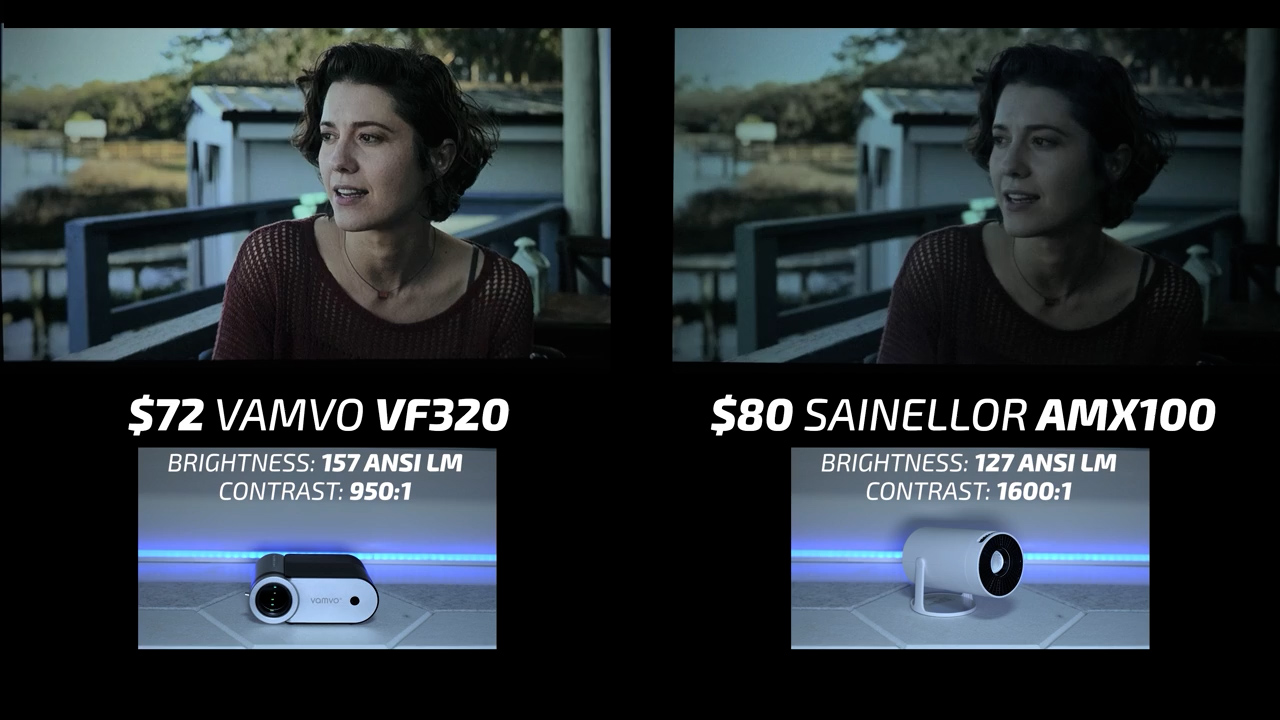
Round 22 is the Vamvo VF320 on the left and the Feifeaouy HY260 Pro on the right. In the time that it took me to pronounce that name, you’ve probably already figured out that it didn’t stand a chance against the Vamvo, which easily won this round.
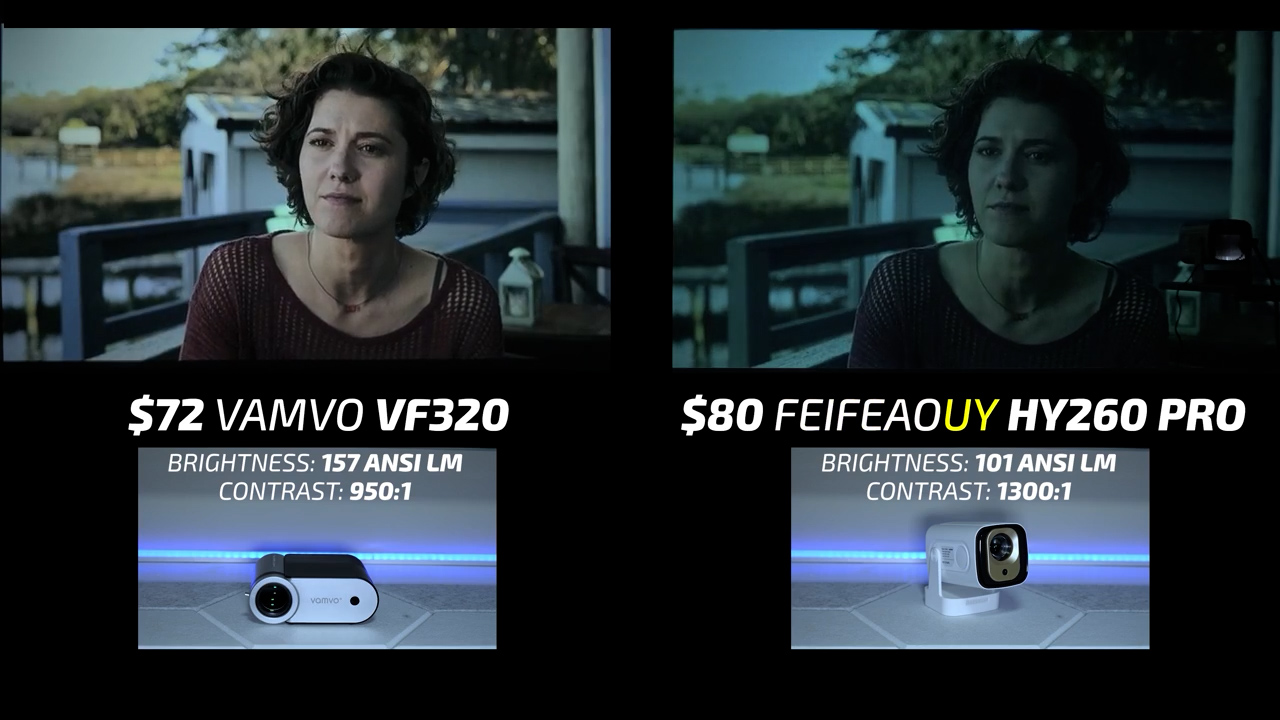
Round 23 then put the Vamvo VF320 on the left and the Vamvo VF211 on the right. Despite the $29 increase in price, the more expensive VF211 had half the brightness, less contrast, and was missing the excellent image processing of the VF320 and is easily the worst value of any of the projectors in this video.
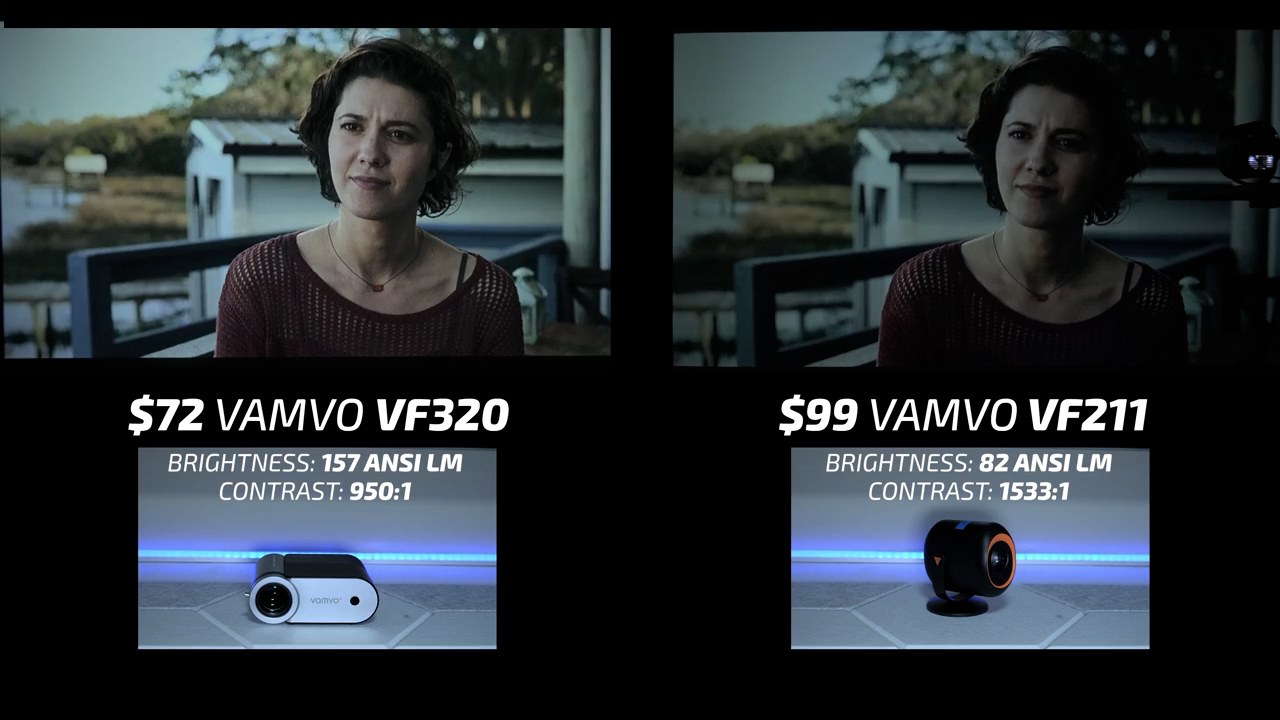
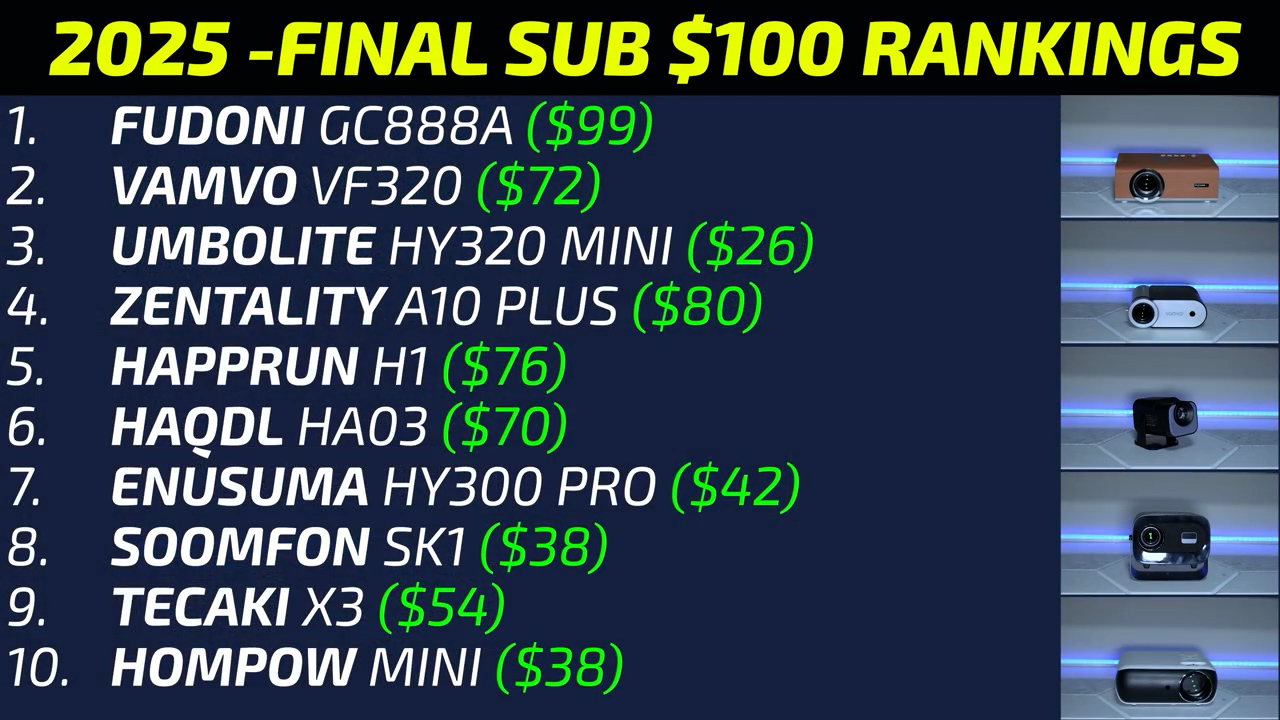
Then the final round, round 24 is the Vamvo VF320 on the left and the Fudoni GC888A on the right. Throughout all these side-by-sides everything has been graded on a sliding scale relative to other sub $100 projectors, but the Fudoni actually looks pretty decent even relative to projectors that cost two to three times as much. It’s not going to have the 700+ lumens of the Elephas W1K, but for under $100, this is really solid performance in both bright and dark scenes. In the last round the Fudoni GC888A is going to steal the first-place spot away from the Vamvo VF320 in the picture quality rankings.


Side-by-Side Rankings
Here are the top ten, and the plan was to do some additional testing on just the top five.
Input Lag Testing
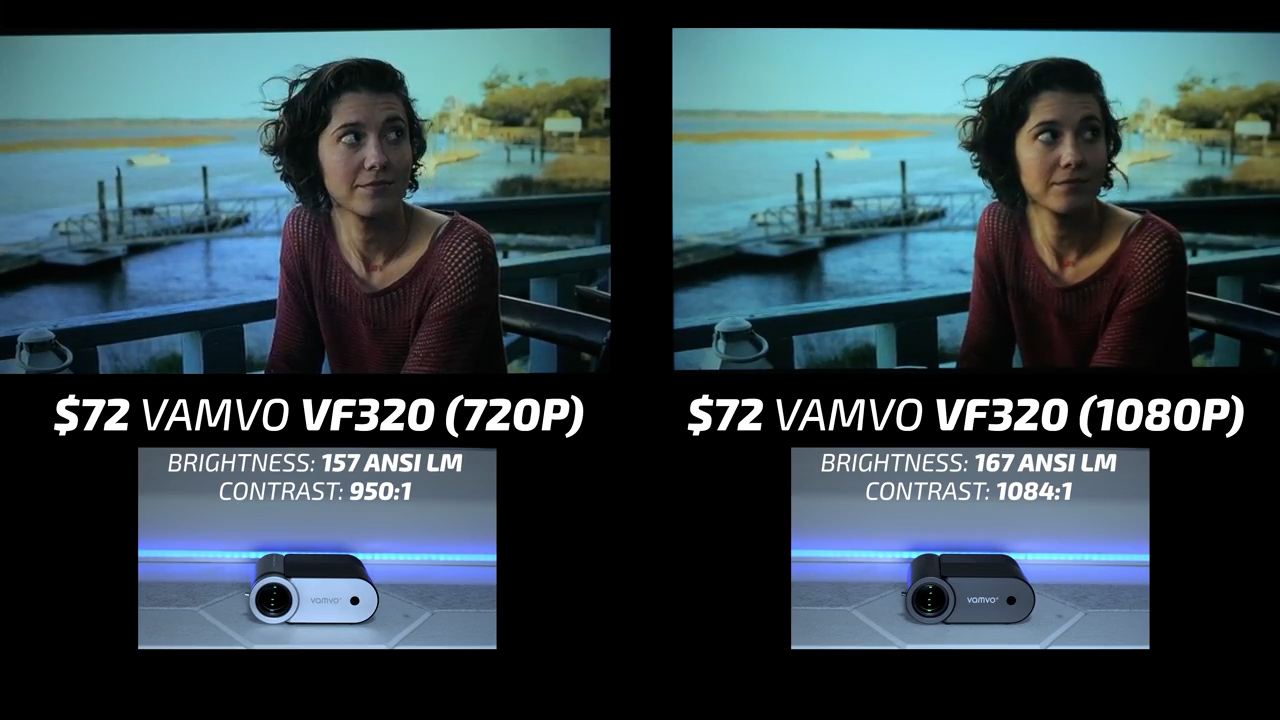
Unfortunately, while writing this script, I realized that the Vamvo VF320 from last year’s video that finished in 2nd place is no longer available and has been replaced with an “upgraded” version that looks almost identical but has a 1080p native display. So, I bought that too, but it performed terribly compared to the old 720p native version and not only lacked the sharp focus of the previous version, but it also didn’t have any of the same image processing and gamma improvements that helped the old VF320 finish 2nd.
To add insult to injury, the new VF320 also lost the main feature that made me recommend it in 2024, which was its low input lag. When playing video games, the input lag represents the time in between when you press a button on the controller and when you see that action on the screen. In general input lag numbers under 20 ms are excellent for gaming, between 20-50 ms is good for casual gaming, 50-100 ms can start to feel strange, and input lag over 100 ms shouldn’t be used for gaming. I tested all these projectors at 1080p60Hz using the industry standard Leo Bodnar lag tester and found that the old Vamvo VF320 still had the best input lag at 26.6 ms, the Happrun H1 hovered around 30 ms, and the Fudoni GC888A was just under that 50 ms mark for acceptable casual gaming.
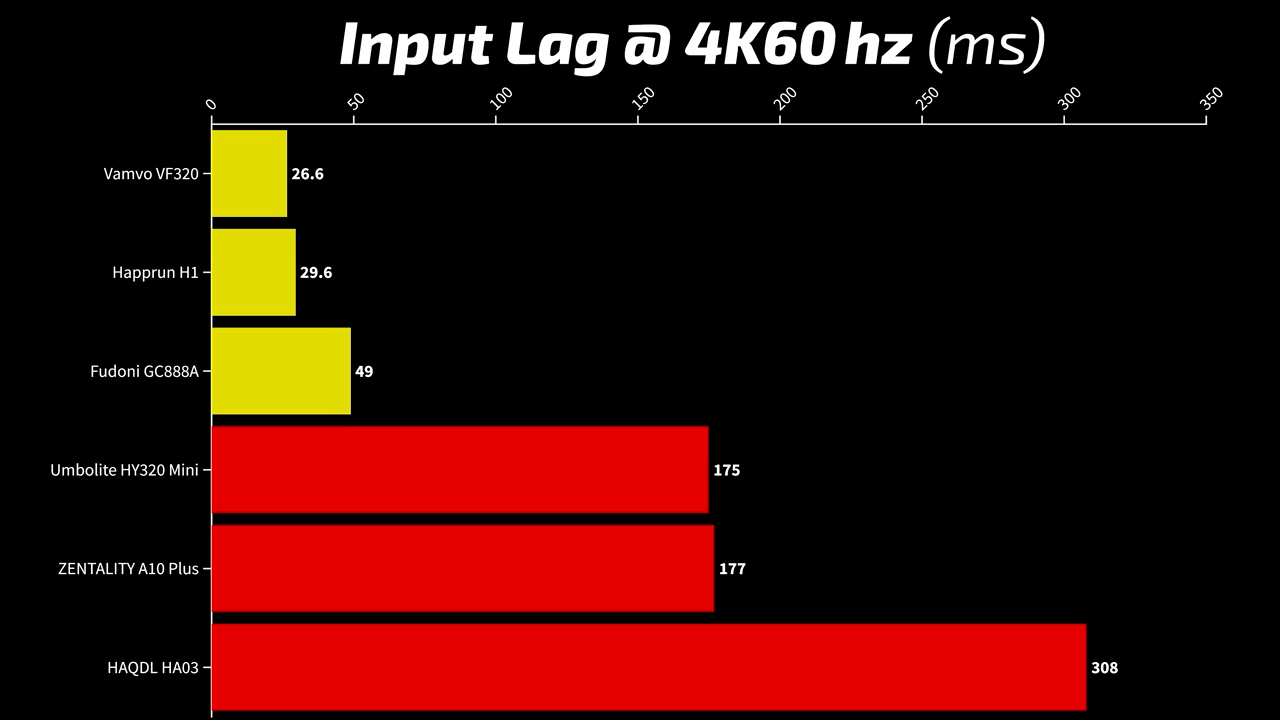
As I mentioned, the new Vamvo VF320, which I wouldn’t recommend anyway based on its image quality, now has between 70 and 80 ms of input lag, and all the projectors with Android built in were well over 100 ms, meaning they can’t really be used for gaming.
Focus and Clarity
Next looking at their focus and clarity, there are two main things that affect the overall clarity of the image, the first being their native resolution. Of the remaining top five projectors, they all claim to be 1080p native, but counting the pixels used in each letter on my focus pattern tells me that only the Happrun H1 and Fudoni GC888A are actually 1080p native, while the HAQDL, Zentality, and Umbolite are all using 720p resolution LCD panels.
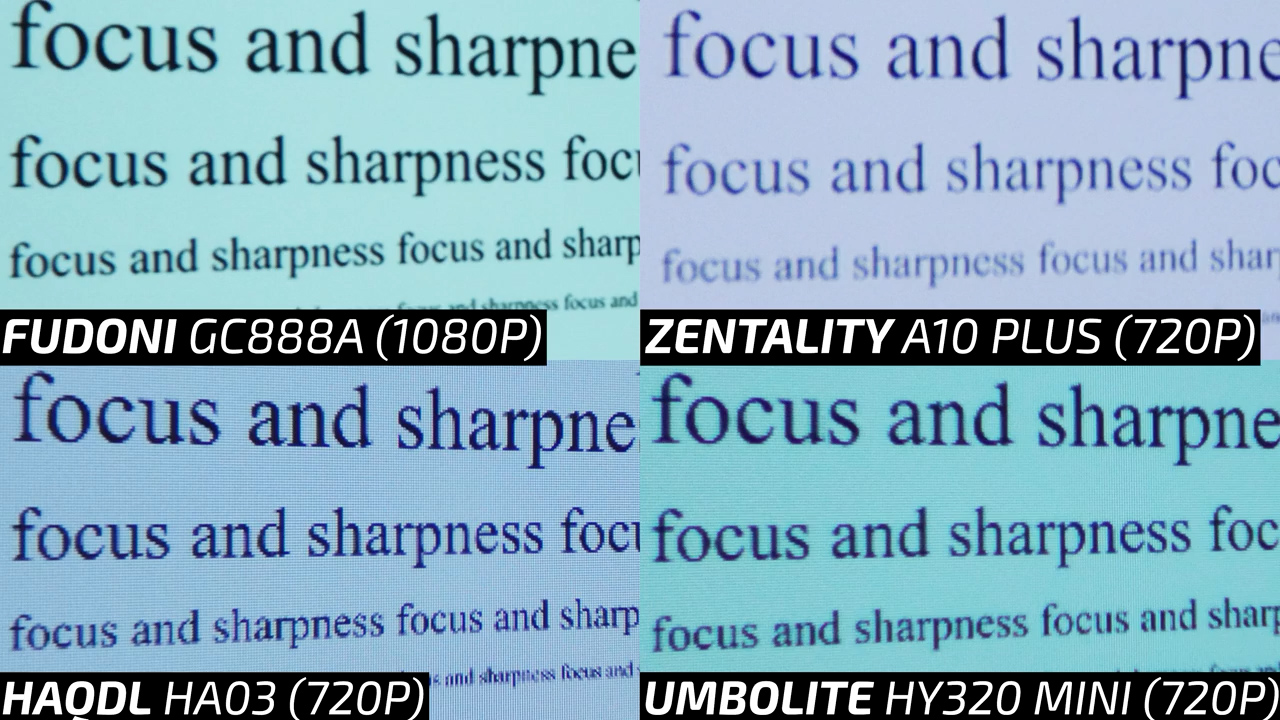
The second thing that affects image clarity is the quality of the lens. I thought that the HAQDL had the sharpest lens, and the A10 Plus was by far the worst. Combining native resolution and lens quality, the Fudoni ranked first in overall focus, followed by the HAQDL, then the Happrun, and HY320 Mini, and the Zentality was in a distant last place.

It’s also worth noting in this section that the Fudoni, HAQDL, and Zentality have motorized focus that’s controllable on the remote, so it’s easier to get the image dialed in perfectly while standing close to the screen while the Happrun and HY320 Mini both have manual focus dials.
Throw Ratio and Distance
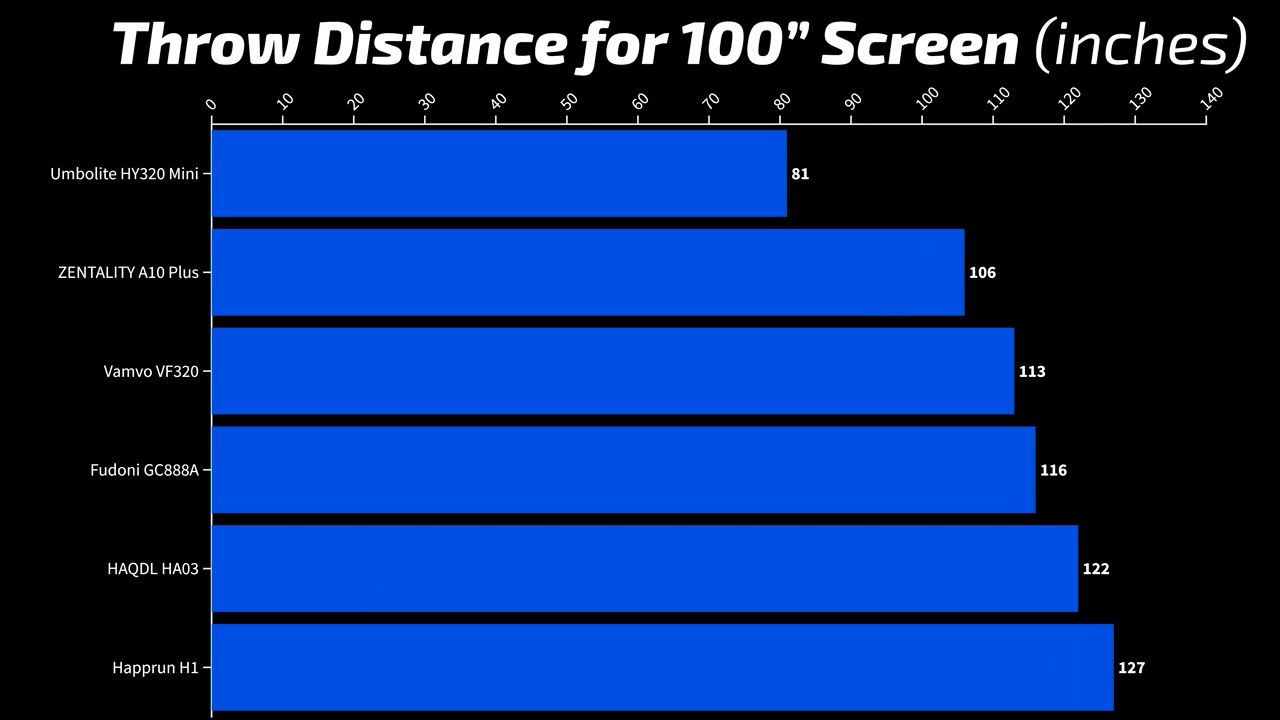
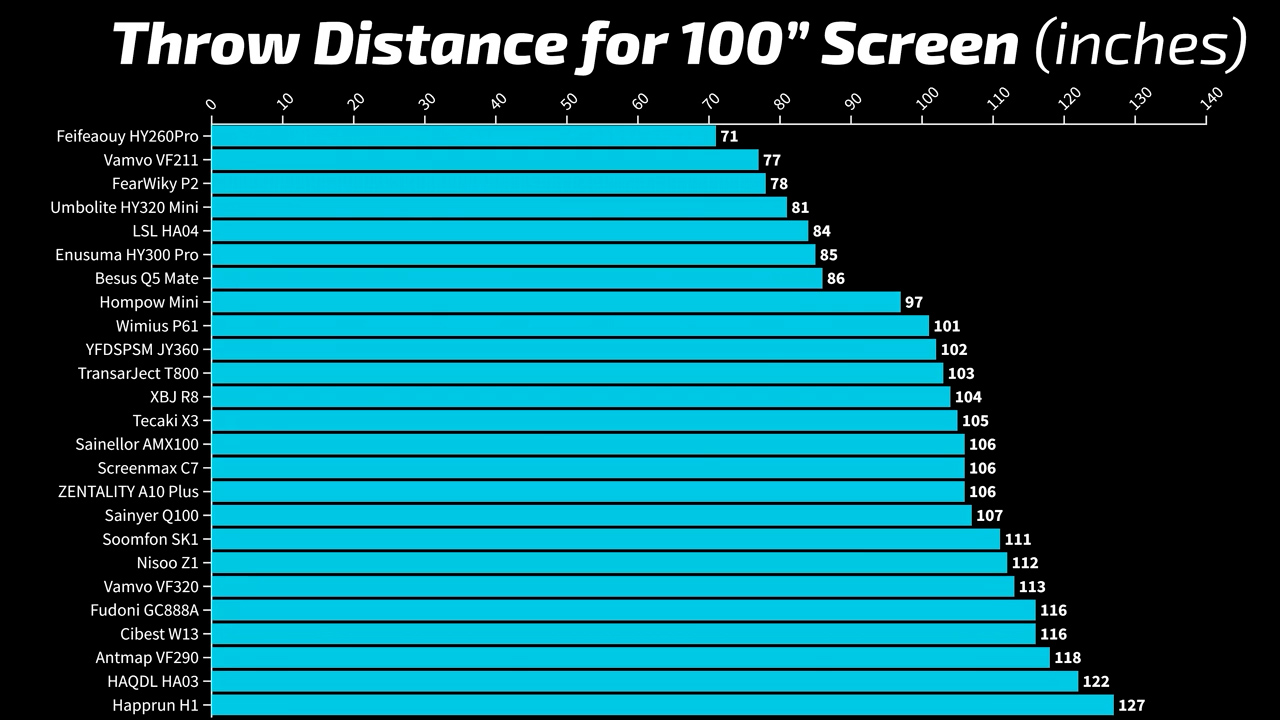
The next big difference in these five projectors is their throw distance. To project a 100” screen the Happrun H1 needs the largest distance from the projector to the screen at 127”, which is a 1.46:1 throw ratio, while the HY320 Mini needs just 81” which is a throw ratio of 0.93:1, and just because I measured them, here are the throw distances for the rest of the projectors in the video as well.
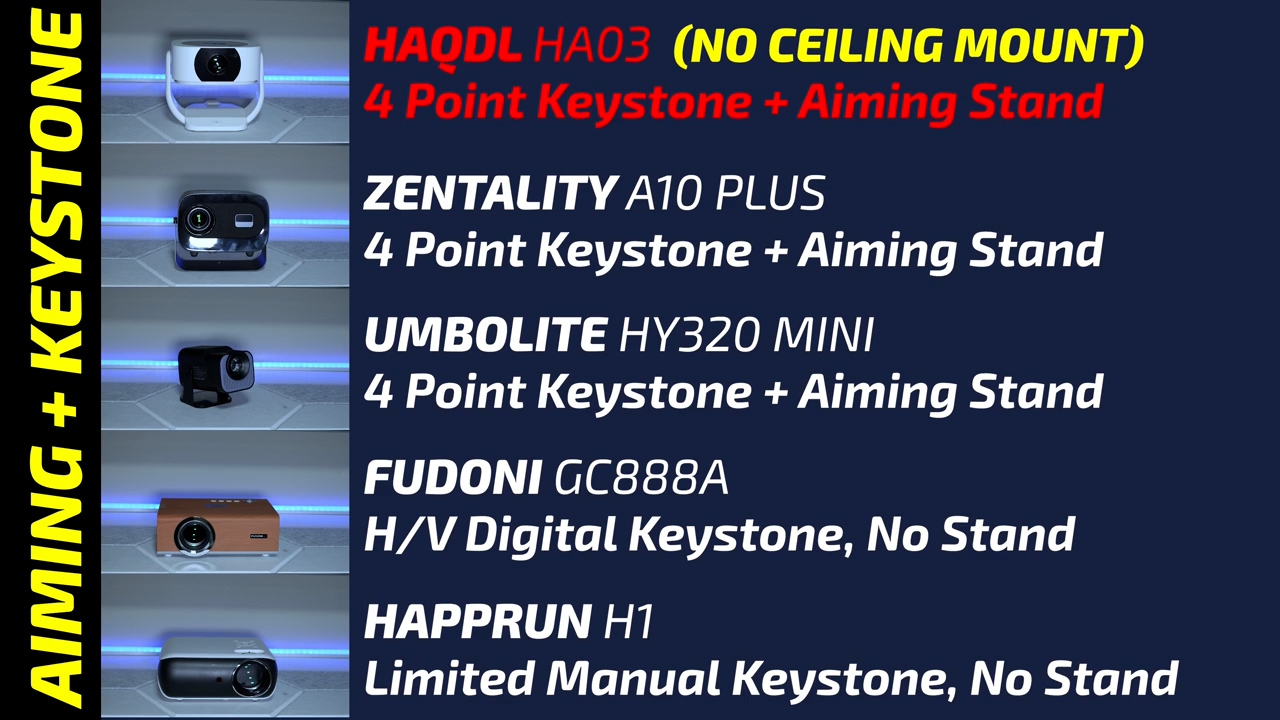
If you can’t put your projector in the exact correct position to fit onto your screen it’s also useful to have a digital keystone function. Of these top five projectors, the only one that doesn’t include digital keystone is the Happrun H1. The HAQDL, Zentality, and Umbolite all have 4-point corner keystone while the Fudoni has a slightly more difficult to use angular keystone function. Of these five projectors the HAQDL, Zentality, and Umbolite all have built in aiming stands, while the Fudoni and Happrun just have an adjustable front foot to tilt the projector up. If you want to ceiling mount, all the top five projectors except the HAQDL have a ¼ – 20 tripod mount on the bottom.
Smart Operating Systems
Next, looking at their smart operating systems, the Umbolite HY320 Mini runs Android 11, and the HAQDL and Zentality have Android 13, but neither are the kind of Android meant for use in a TV or projector. As a result, they have pretty poor compatibility with most apps and clunky interfaces that require you to use the remote as a mouse to get even basic functionality. That said, I was able to get YouTube working on all three, Netflix worked on the HAQDL but not the others, and Disney+ technically worked on the Zentality, but didn’t play any sound. In all cases you’re better off just getting a cheap streamer like the FireTV stick to use with these projectors.
Speaker Quality
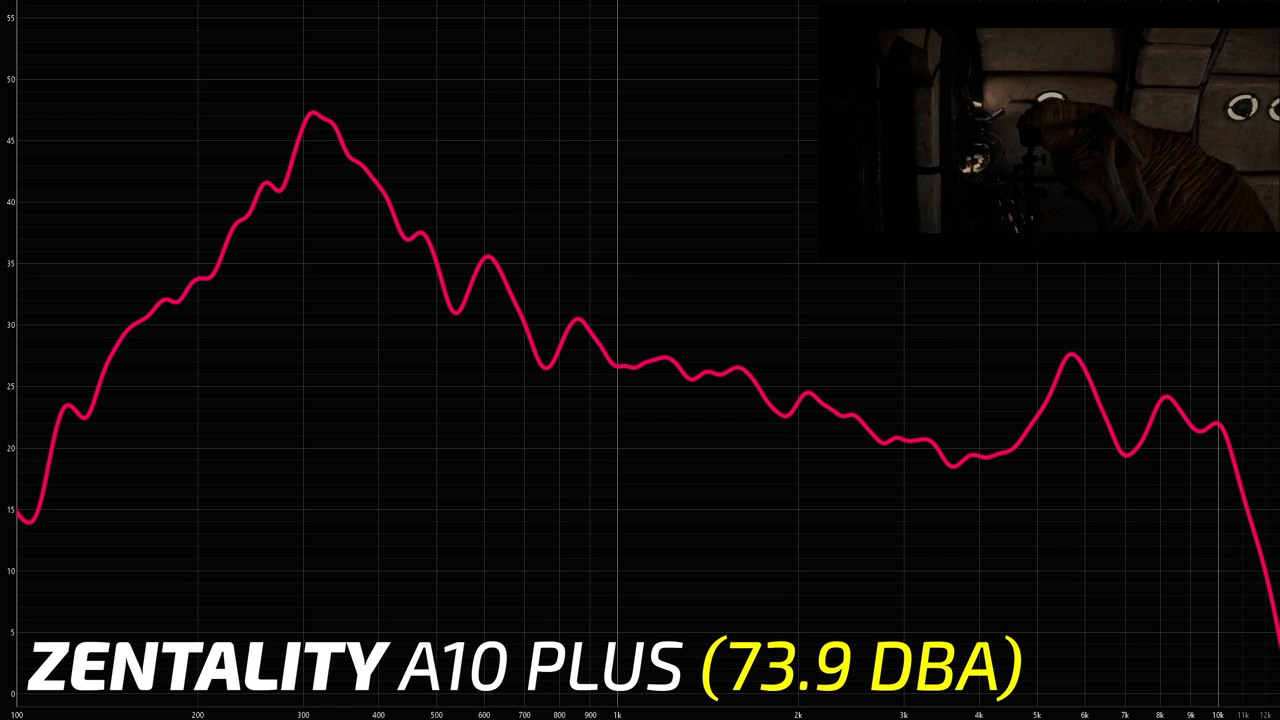
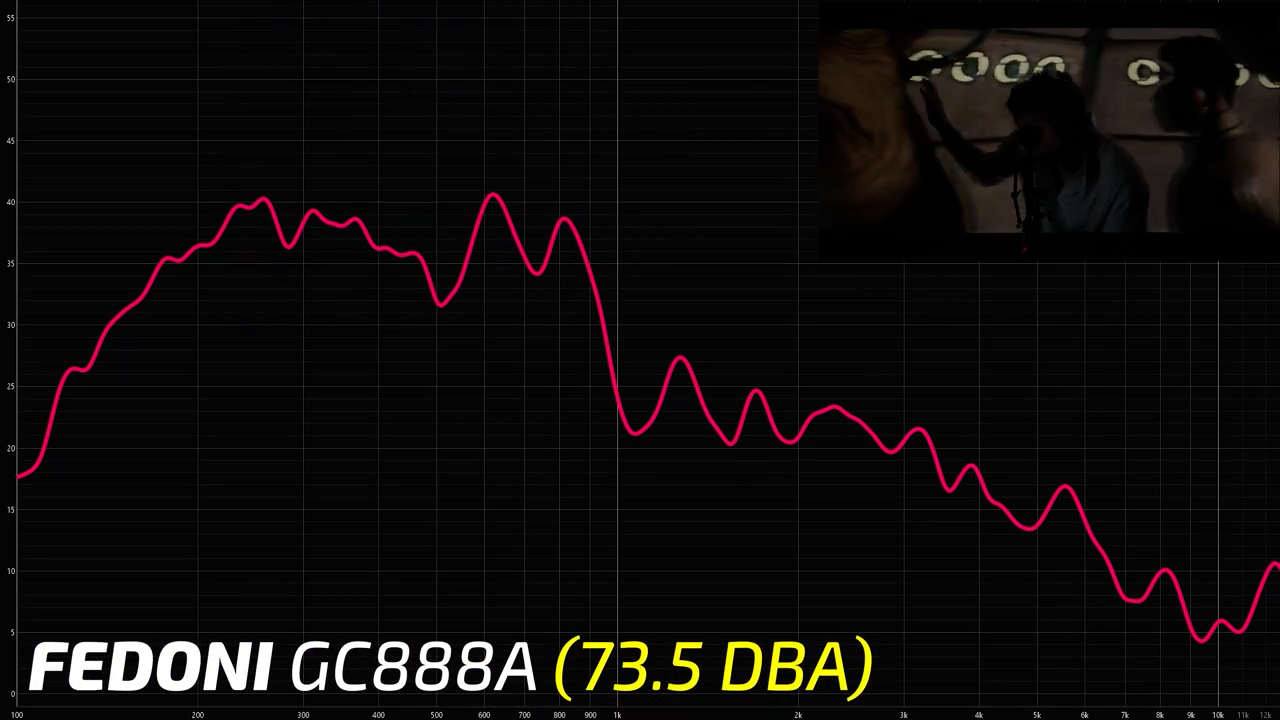
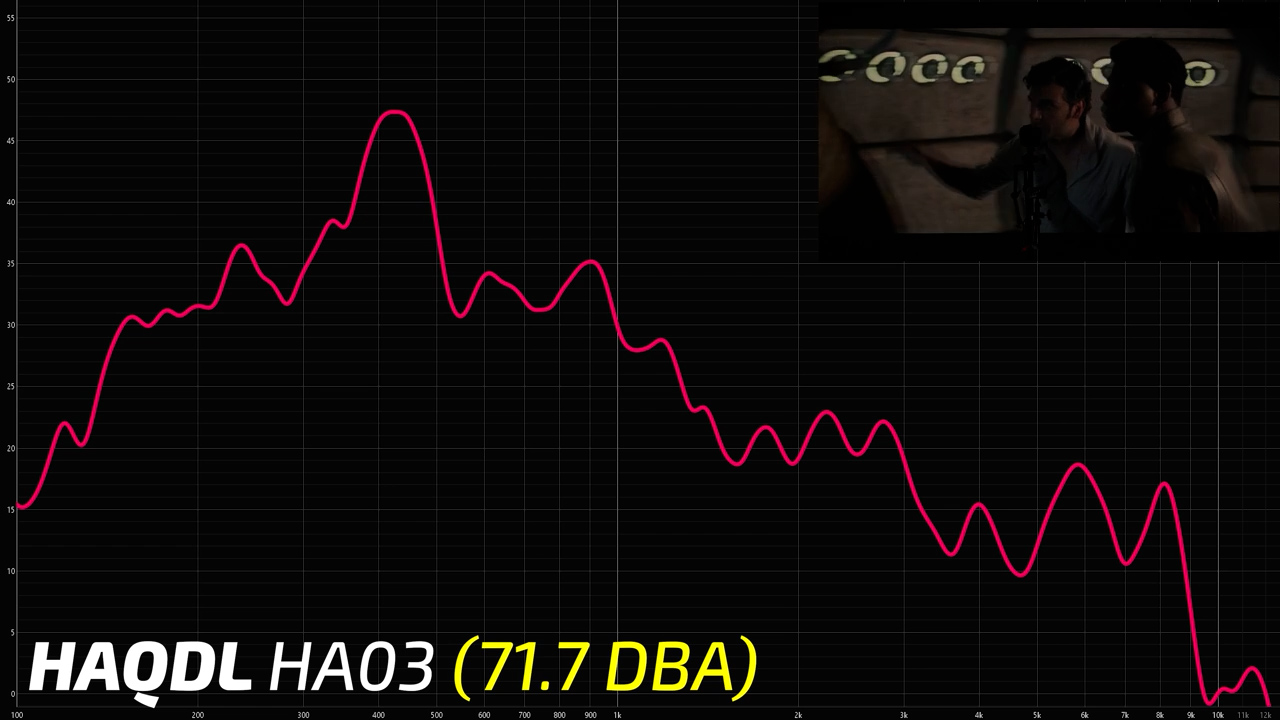
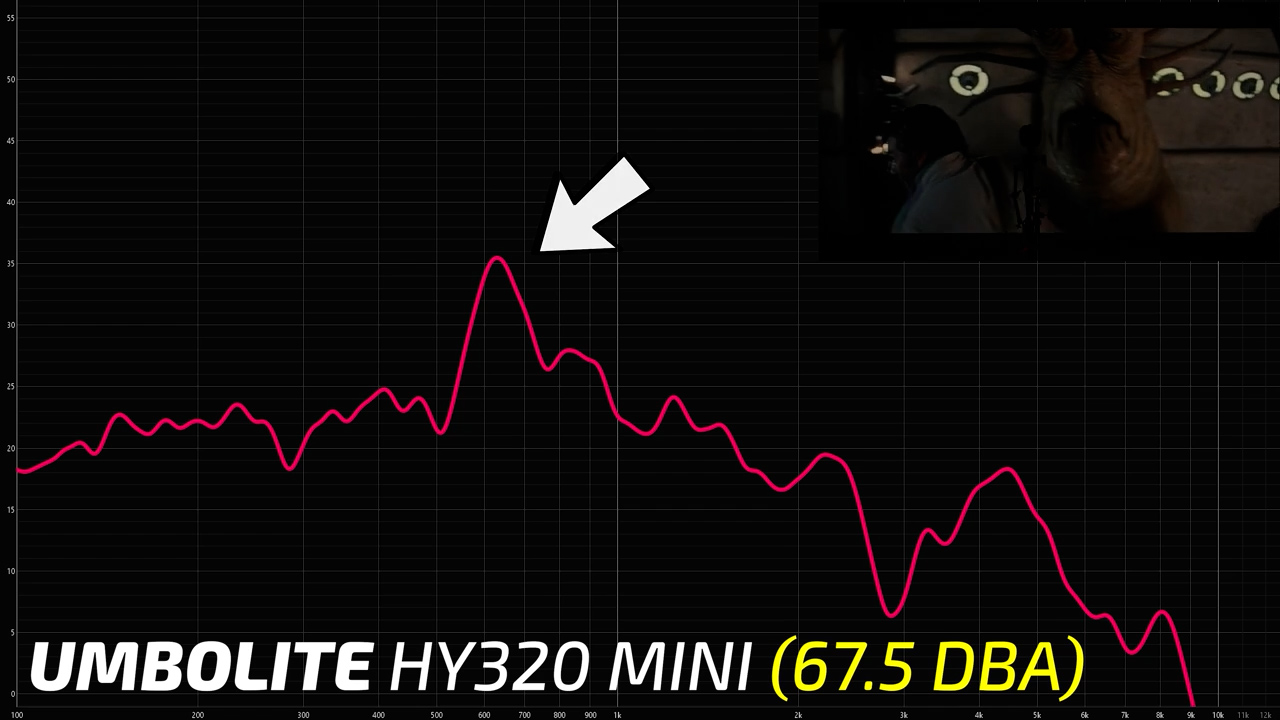
While we’re on the subject of sound, none of the speakers on these projectors are particularly good, but the Zentality was both the loudest and most balanced. The Fudoni was almost as loud, but was focused more in the midrange. The HAQDL was slightly quieter with a huge spike around 400 Hz, which is in the high midrange, above where most vocals take place. The Happrun was just under 70 decibels average but had a fairly flat frequency response. The Umbolite HY320 Mini was the quietest at 67.5 decibels with a large spike around 600 Hz.

Fan Noise
Last, fan noise is always a concern with these cheap projectors so here they are from quietest to loudest.
Conclusions
So, conclusion time. Should you buy any of these projectors? Unfortunately, it’s complicated.
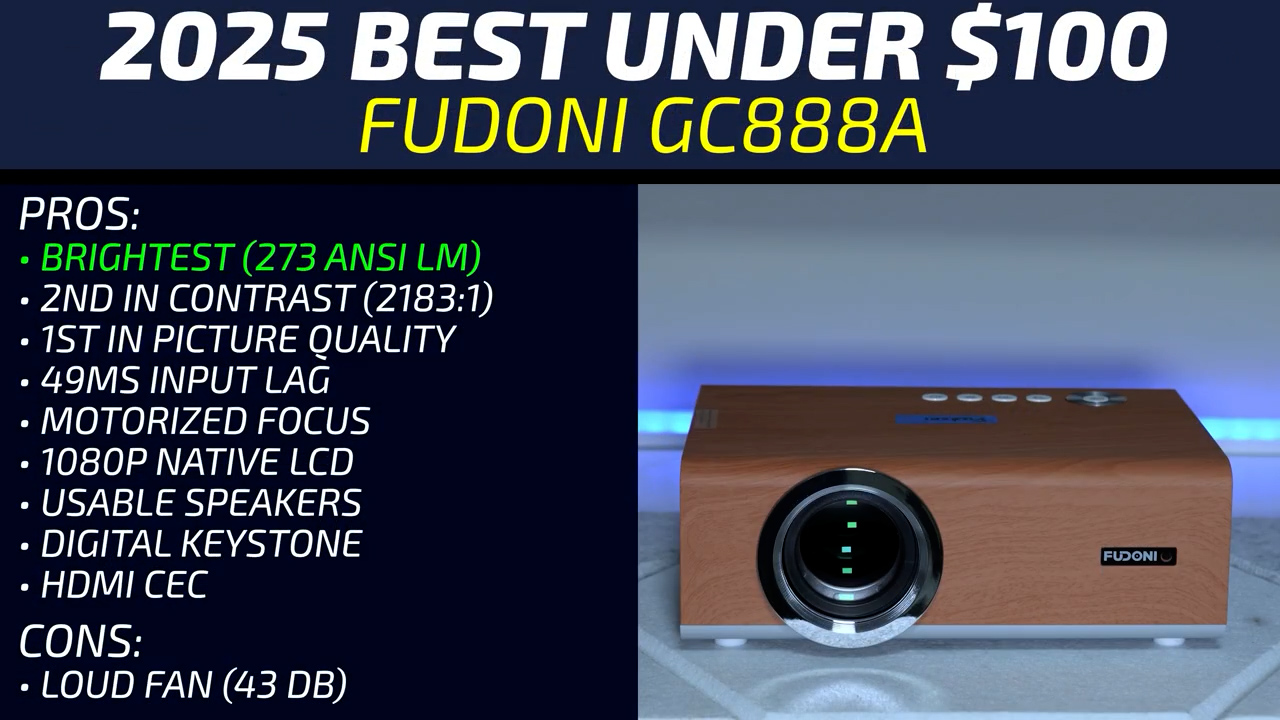
If your budget is $100, the Fudoni is the clear winner. It’s the brightest, has the best picture quality, acceptable input lag for casual gaming, it has motorized focus, a 1080p native display, decent speakers, digital keystone, and HDMI CEC support for controlling your streaming stick with the Fudoni remote. Overall, the Fudoni was the only projector that didn’t disappoint me in some way.
However, I was fully ready to give my recommendation to the Umbolite HY320 Mini that finished 3rd in overall picture quality, has a nice small form factor, a mildly usable smart operating system, and puts out almost 200 lumens for just $26.49, which is almost unbelievably cheap. But as of writing this script it’s already unavailable just 10 days after I bought it. Now, the good news is that Umbolite is just a reseller and the HY320 Mini is actually made by Magcubic so it should have other sellers, so I’ll try to keep the link in the description updated with one that’s actually available, but I don’t think you should pay more than around $40 for it.

Similarly, the Happrun H1 did well enough to earn my recommendation again in 2025, but I don’t think it’s worth the $76 that it’s currently selling for, and I think it’s more fairly priced in the $50-60 range. But as you can see from my price tracker, it’s only been under $70 one time since July 2025.
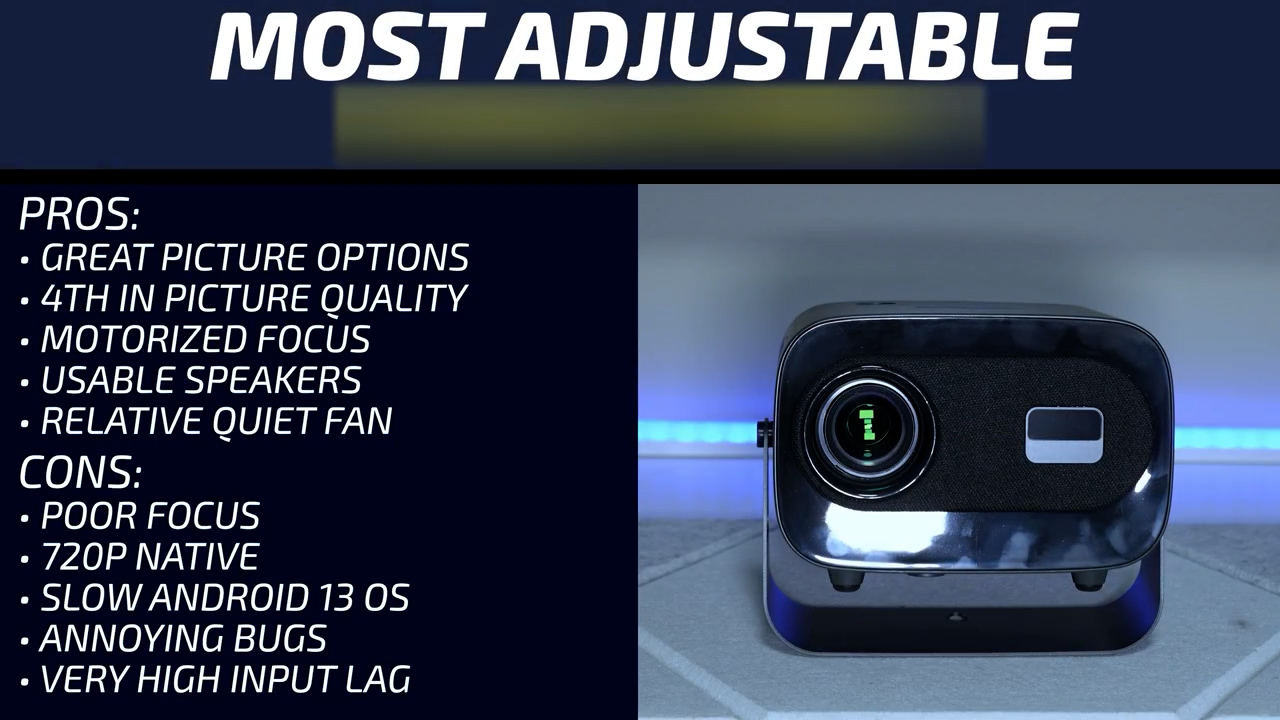
The HAQDL and Zentality both have Android 13, but the Zentality has all of Android 13’s picture options available that let you adjust things like gamma and white balance, and it also has better speakers and a fairly quiet fan. But it’s got relatively poor focus, a 720p native display, and some annoying bugs like the fact that it doesn’t play any sound through its speakers unless you go into the FireTV settings and set sound to PCM output instead of Auto, but I still think it’s a decent value at $70-80 if you want to try and make the built-in Android operating system work.
As always there are no sponsored reviews on this channel, but I do have links below for all the projectors in this video and as always, I appreciate when you use those links since as an Amazon Affiliate I do earn a small commission on the sale at no cost to you.
I’d also like to thank all of my awesome patrons over at Patreon for their continued support of my channel, and if you’re interested in supporting my unsponsored reviews, please check out the links below. If you enjoyed this video, please consider subscribing to my YouTube channel and as always, thanks for watching The Hook Up.